Comrades Dispatch · 04 Nov 2026 (PDF)
In this edition
- Siri Cattle Conservation and Dairy Development in Sikkim Agriculture & Rural
- UN CBD COP-17: Adoption of the Yerevan Pathway Environment & Ecology
- MINURSO’s 35-Year Mission Ends Schemes & Initiatives
- Transgender Persons Act 2019 Impact on Women’s Rights Social Issues
- Khelo India Sports Goods Manufacturing Scheme Social Issues
- Satellite Tracking Limitations in Cheetah Conservation Space
- 1st International Maize Conference 2026 Visits & Conferences
- SC on Balancing Informational Privacy and Press Freedom Miscellaneous
Agriculture & Rural
Siri Cattle Conservation and Dairy Development in Sikkim
Source Recently, the establishment of a Centre of Excellence for Siri cattle in Sikkim was announced to conserve and develop the indigenous breed, alongside the launch of the North District Cooperative Milk Producers’ Union under White Revolution 2.0 to strengthen dairy cooperatives and farmers’ livelihoods.- Siri Cattle:
- An indigenous, dual-purpose cattle breed found in the eastern Himalayan region, particularly Sikkim and Darjeeling (West Bengal), and historically associated with Bhutan, where it is known as Nublang.
- Adapted to mountainous terrain, it is distinguished by a cervico-thoracic hump covered with long hair and is used for milk production and agricultural work.
- Its declining population, partly due to crossbreeding, highlights the need for genetic conservation.
- Siri Cattle Conservation Initiatives:
- Breed Conservation: The Siri Cattle Conservation Programme aims to preserve indigenous genetic resources, promote breed improvement and scientific breeding.
- Infrastructure and Funding: A Siri Bull Mother Farm at Chuchachen, Pakyong district, will support genetic improvement and quality germplasm production, backed by a ₹27.64 crore conservation project.
- IVF Technology: A work plan has been proposed to introduce In Vitro Fertilisation (IVF) for faster genetic improvement and multiplication of superior animals.
- White Revolution 2.0: The North District Cooperative Milk Producers’ Union Ltd was launched at Mangan to expand the dairy cooperative network and increase farmers’ participation.
- Sikkim Milk Brand: National Dairy Development Board (NDDB) has been advised to prepare a plan for dairy plant modernisation, cooperative expansion and development of an integrated Sikkim Milk brand.
- Pig Breeding Protocols: Standard protocols for semen production and artificial insemination using liquid semen in pigs were released to improve genetic quality, productivity and biosecurity.
Environment & Ecology
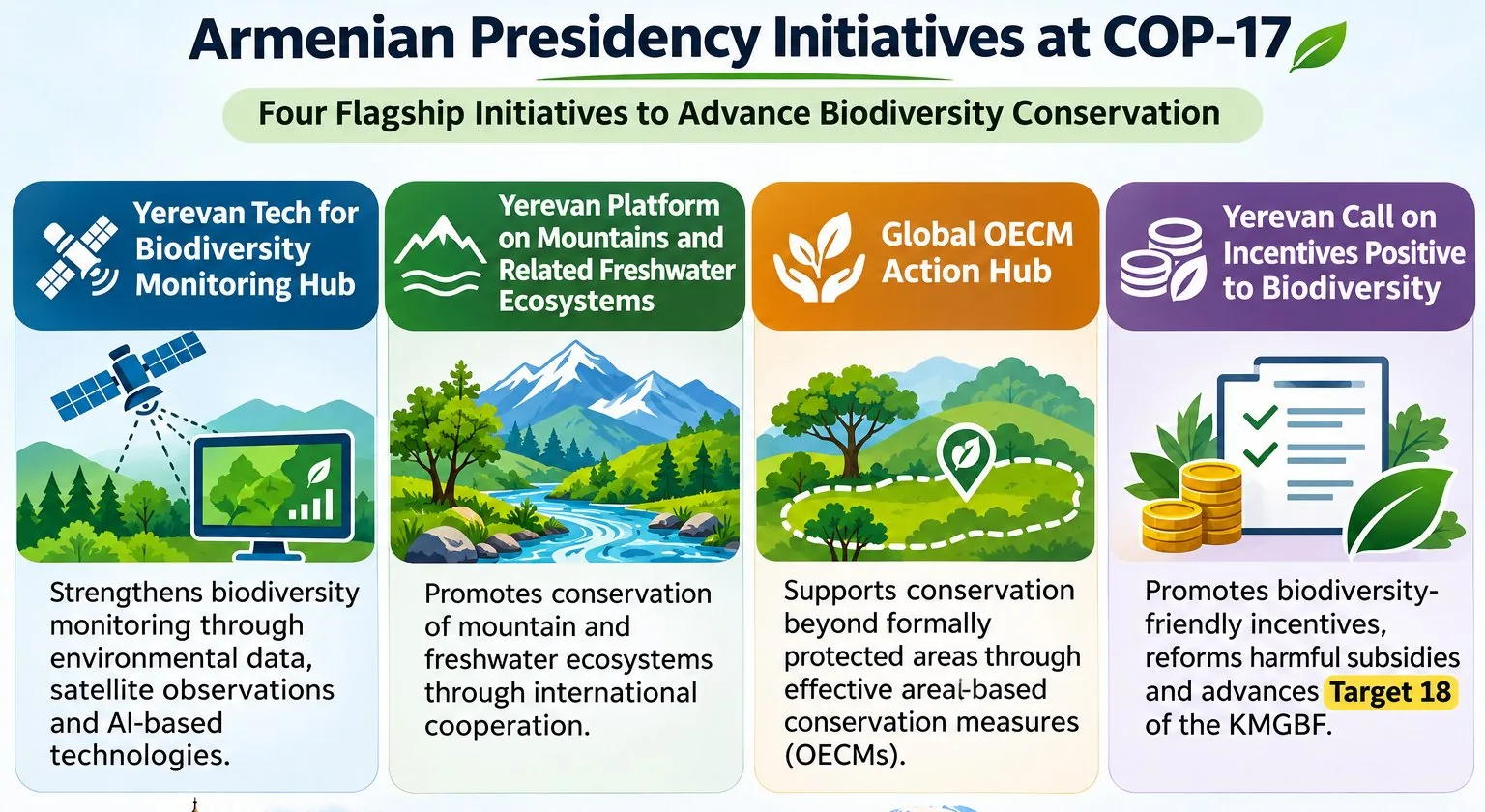
UN CBD COP-17: Adoption of the Yerevan Pathway
Source Why in News?- The 17th Conference of the Parties (COP-17) to the UN Convention on Biological Diversity (CBD) concluded in Yerevan, Armenia adopting the Yerevan Pathway. India emphasized the urgent need for adequate, predictable finance and technology transfer from developed nations to implement the Kunming-Montreal Global Biodiversity Framework (KMGBF) effectively.
- Adoption of the “Yerevan Pathway”:
- Following the first global review of the KMGBF which showed insufficient progress, nations adopted the “Yerevan Pathway” to accelerate action and implementation ahead of the 2030 deadline.
- The pathway calls on member nations to align their national budgets and economic decisions with biodiversity goals, reform harmful subsidies, and strengthen monitoring mechanisms.
- Sevan Guidelines for Indigenous Peoples:
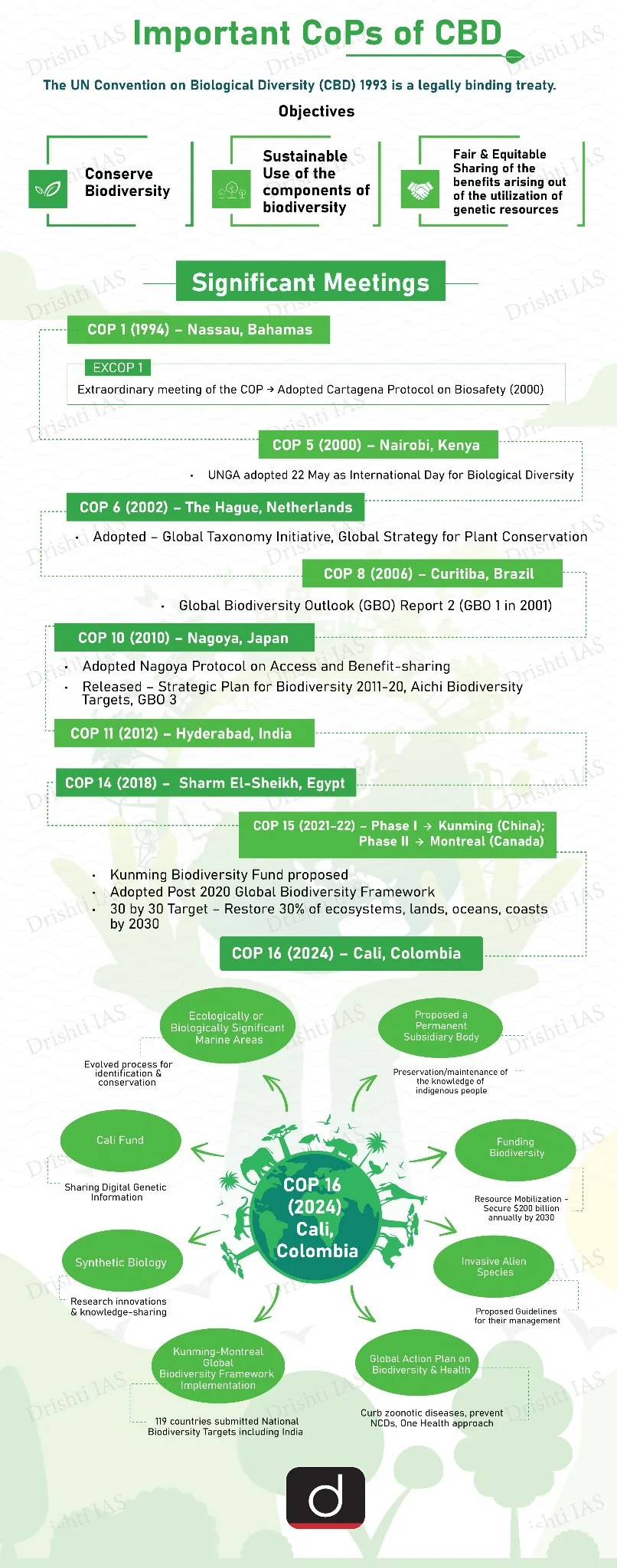
- Nations adopted the Sevan Guidelines to establish the operational rules for a new permanent subsidiary body under Article 8(j) of the Convention.
- These voluntary Sevan Guidelines empower Indigenous Peoples and Local Communities (IPLCs) by ensuring their rights, roles, and traditional ecological knowledge are structurally integrated into global biodiversity policy and decision-making.
- New Biodiversity Funding Pledges:
- Nearly USD 2 billion in new biodiversity funding was announced at the summit.
- This includes USD 560 million under the Global Environment Facility’s (GEF) (established at the 1992 Rio Earth Summit) latest replenishment and USD 500 million through the Species Recovery Alliance.
- The Asian Development Bank launched a biodiversity bond and investment incubator to promote nature-related investment.
- Diluted Stance on Harmful Subsidies:
- Reforming subsidies that harm nature was highly contentious. Attempts to include strong language that would “urge” countries to scale up the elimination of harmful subsidies were opposed by nations including Saudi Arabia, Russia, and India.
- The final text was softened to merely “encourage” countries to accelerate reform “in accordance with national circumstances”.
- Digital Sequence Information (DSI) and the Cali Fund:
- Negotiations continued on the benefit-sharing mechanism for genetic data (the Cali Fund), which was operationalized at the COP - 16 (2024).
- While technical disagreements prevented a definitive resolution, a pilot phase was agreed upon allowing the Steering Committee to issue certificates to companies that make voluntary contributions.
- Pending Decisions: COP-17 left unresolved several institutional and financing questions, including aspects of the Article 8(j) body’s governance, the future biodiversity-finance mechanism and the full implementation arrangements of the Cali Fund, essentially “kicking the can down the road” to COP18, which is scheduled to be held in Quito, Ecuador, in 2028.
- India’s National Statement at CBD COP-17
- Demand for Equity: India stressed that implementing the KMGBF must align with sovereign national priorities and be backed by predictable finance, capacity building, and technology transfer from developed to developing nations.
- Support for the Cali Fund: India backed the multilateral benefit-sharing mechanism for Digital Sequence Information (DSI) on genetic resources, utilizing the newly operationalized Cali Fund.
- Biosafety & Synthetic Biology: Advocated for a strictly science-based, risk-proportionate, and precautionary approach towards synthetic biology.
- Vast Conservation Network: Highlighted India’s expanding ecological footprint: 1,134 Protected Areas, 103 Ramsar Sites, 57 Biodiversity Heritage Sites, and 18 Biosphere Reserves (13 in the UNESCO MAB network).
- Decentralized Governance: Emphasized the alignment of domestic laws with the CBD through village-level Biodiversity Management Committees (BMCs) to ensure grassroots Access and Benefit Sharing (ABS).
- Flagship Ecological Schemes Showcased:
- MISHTI: For mangrove ecosystem restoration.
- Amrit Dharohar: For sustainable wetland conservation.
- International Big Cat Alliance (IBCA): Global cooperation to protect seven big cat species.
- Mission LiFE & “Ek Ped Maa Ke Naam”: Citizen-led environmental stewardship.
- About:
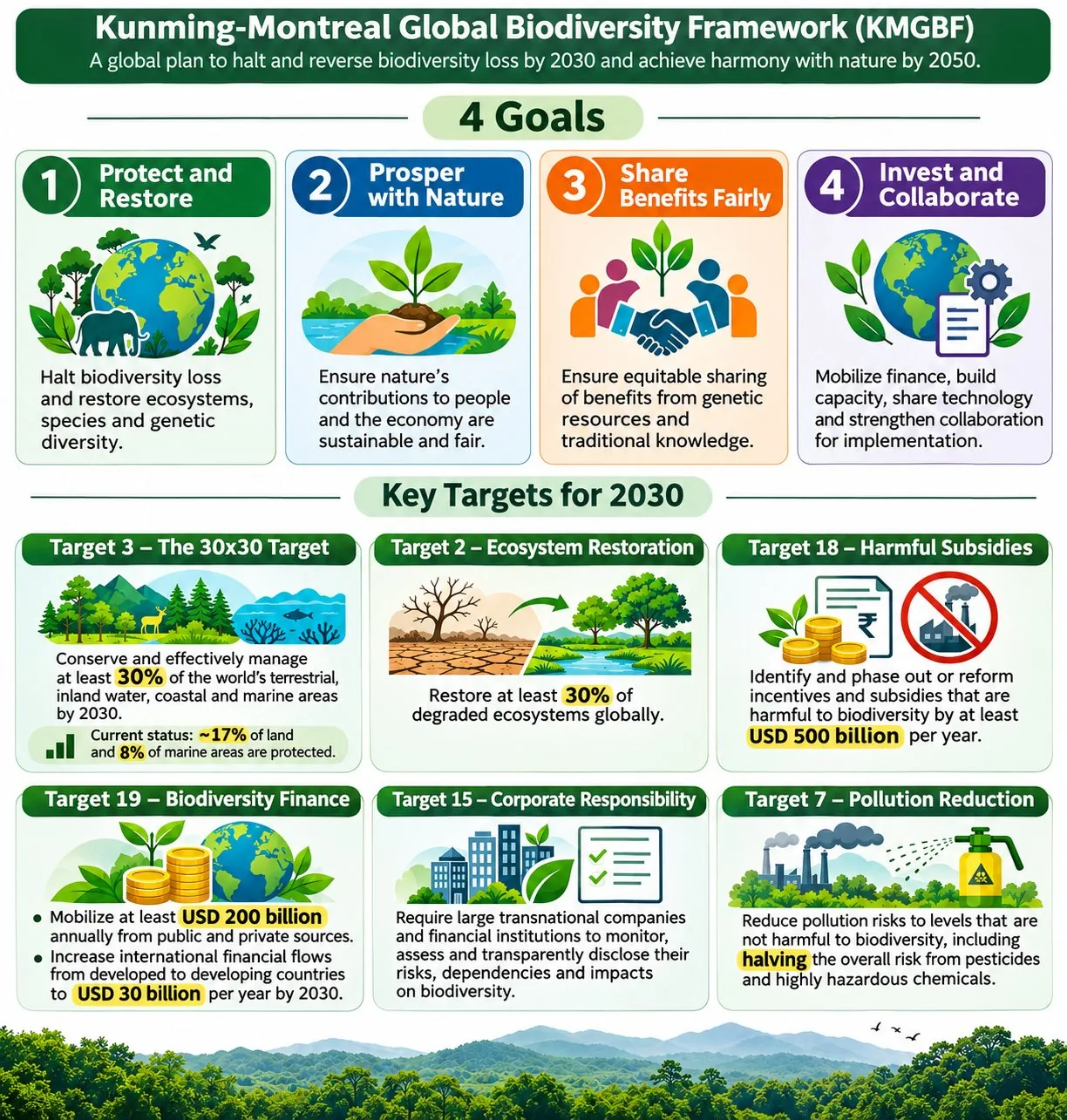
- The KMGBF is an international agreement adopted in 2022 at the 15th Conference of Parties (COP-15) to the UN CBD.
- It serves as the global roadmap to halt and reverse nature loss, replacing the earlier Aichi Biodiversity Targets (2011-2020).
- Vision and Mission:
- 2030 Mission: To take urgent action to halt and reverse biodiversity loss, aiming for a “nature-positive” world by 2030.
- 2050 Vision: To ensure a world where humanity is “living in harmony with nature.”
- Structure of the Framework The framework is built upon 4 overarching Goals for 2050 and 23 action-oriented Targets for 2030.
- Implementation and Funding Mechanism:
- Not Legally Binding: Like the Paris Agreement, the KMGBF relies on voluntary national commitments, though it sets a strong political and moral baseline.
- National Biodiversity Strategy and Action Plans (NBSAPs): Countries are required to update their domestic NBSAPs to align with the 23 global targets.
- Global Biodiversity Framework Fund (GBFF): A dedicated fund was established and is hosted by the Global Environment Facility (GEF) to directly finance the implementation of the KMGBF, with a special focus on developing nations, Small Island Developing States (SIDS), and Indigenous communities.
 India’s National Biodiversity Strategy and Action Plan (NBSAP)
- About:
- India’s NBSAP, first launched in 1999 and updated in 2008, 2014 and 2024 (2024–2030), adopts a Whole-of-Government and Whole-of-Society approach, aligned with the KMGBF.
- India’s framework is crucial as the country harbors nearly 8% of the world’s known plant and animal species (including 9.24% of global plant species), demanding a strong shield against habitat degradation.
- The 30% Restoration Target: A major priority is the effective restoration of at least 30% of degraded terrestrial, inland water, and marine and coastal ecosystems to enhance ecological integrity and connectivity.
- Focus on Threat Reduction: Eight of the 23 targets are dedicated to mitigating direct threats such as land and sea use change, pollution, climate change, and species overexploitation.
- Addressing Socio-Ecological Challenges: The updated NBSAP goes beyond conservation, aiming to tackle intersecting national crises like food insecurity, water scarcity, unsustainable livelihoods, human-wildlife conflicts, and disaster risks.
- Financial Mobilization: Substantial funding is critical; the projected annual average biodiversity expenditure required for the 2024-25 to 2029-2030 period is estimated at Rs 81,664 crore, a massive amount highlighting the need for comprehensive financial assessments and global support.
 Conclusion
- Achieving the KMGBF targets requires predictable finance, technology transfer and equitable cooperation. India must strengthen community-led conservation to secure a nature-positive future by 2030 and harmony with nature by 2050.
Schemes & Initiatives
MINURSO’s 35-Year Mission Ends
Source Recently, the United Nations Mission for the Referendum in Western Sahara (MINURSO) entered its liquidation phase after the UN Security Council (UNSC) failed to renew its mandate due to a US–Russia standoff, ending its 35-year peacekeeping presence.- MINURSO: Established in April 1991 under UNSC Resolution 690 (1991) to implement a UN-brokered settlement plan between Morocco and the Polisario Front.
- Original Mandate: Monitor the ceasefire and organise a referendum on self-determination, allowing a choice between independence and integration with Morocco. The referendum never occurred due to disagreements over voter eligibility.
- Ceasefire Breakdown (2020): Hostilities resumed in November 2020, but MINURSO continued monitoring the security situation and advocating cessation of hostilities.
- UN Security Council Standoff:
- Russia vetoed a US-backed draft resolution favouring Morocco’s autonomy proposal, which also sought to rename MINURSO as the UN Mission in Western Sahara (MINUSO).
- A competing Russian resolution to extend MINURSO’s mandate until October 2027 failed to secure the required votes, leaving the mission without a renewed mandate.
- Continuing Right to Self-Determination: The termination of MINURSO’s mandate does not change Western Sahara’s disputed legal status or extinguish the Sahrawi people’s right to self-determination. UN-led diplomatic efforts may continue independently of the mission.
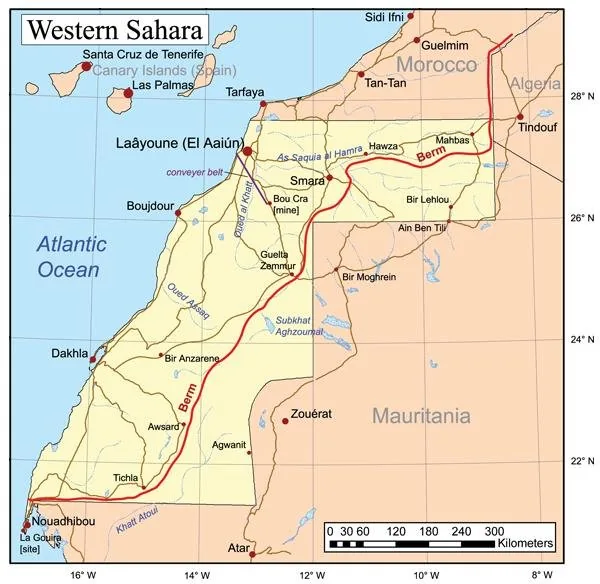
- About: A disputed territory in north-western Africa along the Atlantic Ocean, bordered by Morocco, Algeria and Mauritania.
- Colonial History: Formerly a Spanish colony, Western Sahara witnessed Morocco’s Green March in 1975 and Spain’s formal withdrawal in 1976. The territorial dispute subsequently centred on Morocco and the Polisario Front.
- Morocco’s Claim: Morocco claims sovereignty over Western Sahara and administers most of the territory. Its 2007 autonomy proposal offers self-government under Moroccan sovereignty.
- Polisario Front: A pro-independence movement seeking an independent Sahrawi state. Backed by Algeria, it operates from refugee camps near Tindouf, Algeria.
- International Status: Western Sahara remains on the UN list of Non-Self-Governing Territories, while the African Union recognises the Sahrawi Arab Democratic Republic (SADR).
Social Issues
Transgender Persons Act 2019 Impact on Women’s Rights
Source Why in News?- The Supreme Court of India issued a notice to the Union Government regarding a Public Interest Litigation (PIL) filed by Women’s Declaration International India. The petition challenges the Transgender Persons (Protection of Rights) Act, 2019, and its 2026 amendments, arguing that the legal recognition of gender identity should not automatically entitle transgender individuals to constitutional protections and affirmative action meant exclusively for biological women.
- About: The Transgender Persons (Protection of Rights) Act, 2019 was enacted to ensure the welfare, dignity, and mainstream integration of the transgender community. It was formulated based on the landmark NALSA v. Union of India (2014) Supreme Court judgment, which legally recognized transgender individuals as the “third gender.”
- Key Features:
- Anti-Discrimination: Strictly prohibits discrimination in education, healthcare, and employment.
- Right to Identity: Recognised the statutory right to self-perceived gender identity, aligning with the K.S. Puttaswamy v. Union of India (2017) judgment which recognised privacy, including personal and sexual identity, as an intrinsic part of the Right to Life and Personal Liberty under Article 21.
- Certification Process:
- Under the Transgender Persons (Protection of Rights) Act, 2019, Section 6 provides for an identity certificate issued by the District Magistrate recognising a person as transgender.
- Section 7 allows a revised certificate changing the recorded gender to male or female following gender-affirming medical procedures, supported by a medical certificate.
- Institutional Framework: Created the National Council for Transgender Persons (NCTP) to guide government policy.
- Transgender Persons (Protection of Rights) Amendment Act, 2026:
- Narrowed Definition: The amendment narrows the legal definition of transgender persons, focusing largely on traditional socio-cultural identities (such as hijras or kinnars) and specific intersex variations while excluding many non-binary and genderqueer identities.
- Removal of Self-Perceived Identity: The 2026 amendment officially omitted Section 4(2) of the 2019 Act, thereby removing the statutory right to a “self-perceived gender identity”.
- Mandatory Medical Scrutiny: The process of obtaining a Certificate of Identity was overhauled. The District Magistrate can now only issue a certificate after examining the recommendation of a state/UT-level Medical Board headed by a Chief Medical Officer.
- Judicial Precedents in Conflict:
- NALSA (2014) vs. Supriyo (2023): The petitioner seeks to interpret NALSA alongside Supriyo v. Union of India (2023), arguing that constitutional recognition of gender identity should be distinguished from eligibility for sex-specific protections and affirmative action.
- Article 15(3) and the Definition of “Women”:
- Biological women argue that under Article 15(3) of the Constitution which empowers the State to make special provisions for women - the term “women” must be interpreted to mean biological females.
- They argue this definition is necessary to recognize the unique historical subjugation and distinct physiological realities that biological women face, which form the foundational basis for female affirmative action.
- Dilution of Political Representation:
- Articles 243D and 243T of the Constitution mandate the reservation of seats for women in local self-government (Panchayats and Municipalities) to counter deep-rooted patriarchy.
- Biological women argue that allowing transwomen (assigned male at birth) to contest these specifically reserved seats dilutes the quota meant for biological women.
- This concern was practically highlighted in the case of Anjali Guru Sanjana Jaan v. State of Maharashtra (2021), where a transwoman was allowed to contest village panchayat elections from a seat reserved for women.
- Bodily Privacy in Sex-Segregated Spaces:
- Biological females argue that permitting individuals who are biologically male but hold a “female” identity certificate to enter female-only prisons or domestic violence shelters poses severe psychological and physical security concerns.
- They emphasize that female inmates, many of whom may be victims of male violence, require strictly sex-segregated spaces for trauma recovery, dignity, and absolute safety.
- Ambiguity in Criminal Justice Safeguards:
- Under the Bharatiya Nagarik Suraksha Sanhita (BNSS), 2023 female suspects and victims are granted specific procedural rights, such as the right to be searched strictly by female police officers and protections against being arrested after sunset.
- Women argue that if a biological male possesses a legal certificate identifying as female, law enforcement faces dangerous administrative ambiguity over which procedural safeguards apply, potentially compromising the safety of female detainees and officers alike.
- Fairness in Competitive Sports:
- Experts argue that integrating transgender women into female sporting categories compromises fair competition due to physiological advantages (like bone density and muscle mass) retained from male puberty.
- However in Anamika v. State of Kerala (2022), the Kerala High Court upheld transgender persons’ right to compete in their self-perceived gender category, highlighting the need for clear sporting eligibility rules to balance inclusion and fair competition.
- Defining “Sex” vs. “Gender”: The legislature must clarify that for laws pertaining to specific affirmative action (e.g., maternity benefits, female political quotas), “sex” refers to biological sex at birth. Conversely, “gender identity” should be the metric for anti-discrimination laws and social welfare.
- Horizontal Reservations:
- Karnataka became the first Indian state to provide a 1% horizontal reservation for transgender persons across all caste categories in civil services.
- Replicating this nationally ensures that the transgender community receives direct, uncompromised affirmative action without encroaching upon the quotas meant to uplift biological females.
- Parallel Infrastructure: Instead of forcing integration that compromises female bodily privacy, the government must fund and build “Third-Gender” or inclusive infrastructure, including dedicated transgender wards in prisons and gender-neutral public washrooms.
- Creation of “Open” Categories:
- Indian sporting bodies and the Sports Authority of India (SAI) should align with the policies of international federations like World Athletics and World Aquatics (FINA).
- These bodies protect the integrity of the female category by restricting it to biological females, while simultaneously creating an “Open Category” where transgender athletes can compete freely and fairly without facing discrimination.
- Dual-Recording Systems:
- Official documents (such as the Census, medical records, and the National Crime Records Bureau) should adopt a dual-recording system that notes both biological sex at birth and current legal gender identity.
- This ensures that sex-disaggregated data remains uncorrupted, while still respecting the individual’s gender identity.
- The path forward lies in the constitutional doctrine of Harmonious Construction. The State must fulfill its obligation to bring the transgender community out of the margins, but this inclusion must be achieved through the creation of new, dedicated resources, rights, and infrastructure. Clear statutory boundaries, coupled with parallel empowerment mechanisms, are essential for a truly equitable society.
Khelo India Sports Goods Manufacturing Scheme
Source Why in News?- The Union Cabinet approved the Khelo India Sports Goods Manufacturing Scheme, to strengthen domestic sports goods manufacturing, attract investment, promote innovation and boost exports, positioning India as a globally competitive manufacturing hub.
- The scheme complements initiatives such as Khelo India and Khelo Bharat Niti 2025 by linking sports development with industrial growth, skill development, employment generation and entrepreneurship.
- About: Announced in the Union Budget 2026–27, and approved by the Union Cabinet, the scheme has a total outlay of ₹1,856.67 crore for FY 2026–27 to FY 2033–34. It aims to attract private investment, expand domestic production, reduce import dependence and generate employment in the sports goods industry.
- Integrated Manufacturing Support: The scheme brings together support for investment, technology, innovation, skill development and market expansion to strengthen India’s sports goods manufacturing ecosystem.
- Global Competitiveness: The scheme aims to position India as a globally competitive hub for the design, development and manufacture of high-quality, affordable sports goods, enhancing its integration into global value chains.
- Growing Sports Manufacturing Opportunity: India’s sporting ecosystem is expanding beyond participation and infrastructure towards manufacturing, employment and exports supported by initiatives such as Khelo India and Khelo Bharat Niti 2025.
- Established Manufacturing Base: India has established sports goods manufacturing clusters such as Jalandhar in Punjab and Meerut in Uttar Pradesh, supported by skilled workers and a large network of entrepreneurial MSMEs.
- MSME-Led Production: Small and micro enterprises account for nearly 90% of sports goods production, making the sector an important source of local employment, entrepreneurship and industrial development.
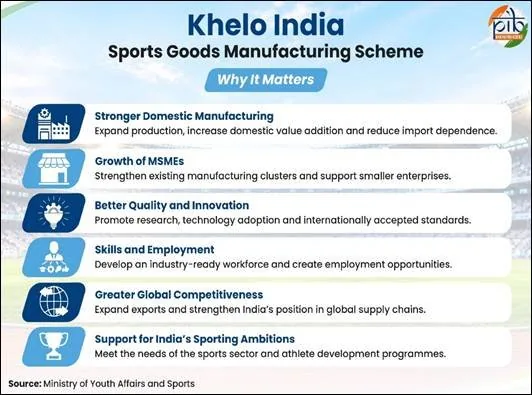 What are the Key Interventions under the Khelo India Sports Goods Manufacturing Scheme?
- Integrated Sports Goods Manufacturing Zones:
- Up to four integrated zones, each exceeding 300 acres, may be developed through convergence with the BHAVYA Scheme and NICDC Industrial Parks.
- These zones will bring together manufacturers, suppliers, testing facilities, design and prototyping centres, and ancillary enterprises to improve manufacturing efficiency.
- Investment and Production Expansion:
- Two components with a combined outlay of ₹1,130 crore, aim to attract investment and expand manufacturing capacity.
- Anchor Investment Support: Provides 20% capital expenditure support to anchor investors investing at least ₹100 crore to establish manufacturing facilities within SGMZs.
- Turnover Linked Support: Offers incentives of up to 15% to manufacturers investing ₹10 crore or more to encourage production and capacity expansion.
- Cluster and MSME Upgradation: Existing sports goods clusters will receive support for upgrading common facilities and shared infrastructure through cost-sharing with States, enabling MSMEs to improve manufacturing capabilities and competitiveness.
- International Certification Support: An allocation of ₹105 crore will support certification from International Sports Federations, covering 70% of first-time certification costs and 50% of renewal costs to facilitate global market access.
- Research and Start-up Innovation: Centres of Excellence in leading educational and research institutions will promote research in sports equipment, materials, protective gear and advanced manufacturing. Convergence with the Anusandhan National Research Foundation will support research co-funding, while DPIIT-registered sports start-ups will be eligible for grants of up to ₹20 lakh for developing and commercialising innovative products and technologies.
- Industry-Aligned Skill Development: Skill development programmes will be implemented in collaboration with the Ministry of Skill Development and Entrepreneurship and industry stakeholders to develop a workforce aligned with the evolving requirements of sports goods manufacturing.
- Global Promotion of Indian Sports Goods: An India Sports Expo and Brand India campaign, supported by branding, outreach and market development initiatives under the Export Promotion Mission, will enhance the global visibility of Indian sports goods and facilitate access to international markets.
- Established Manufacturing Clusters: Jalandhar and Meerut together have over 250 exporting units, 1,000 domestic-market units, 4,000 micro enterprises and nearly 20,000 household units. Other important centres include Ludhiana for bicycles and Delhi and Mumbai for sports accessories and apparel.
- MSME-Led Production: Nearly 90% of production is undertaken by small and micro enterprises, making the sector an important source of entrepreneurship, local livelihoods and employment.
- Strong Export Presence: India manufactures cricket bats, protective equipment, inflatable balls and gym and athletic training equipment. The UK, US and Australia together account for over half of India’s sports equipment exports, providing established access to major international markets.
- Global Market Strength: Indian manufacturers and brands are estimated to account for around 75–80% of the global cricket bat market, while India holds an estimated 30–35% share of the cricket helmet market.
- Cross-Industry Linkages: Sports goods manufacturing draws on capabilities in rubber, polymers, composites, wood and metals, creating opportunities to strengthen supplier networks, develop new products and diversify into related manufacturing industries.
- Untapped Market Potential: India’s domestic sports goods market is estimated at US$2.5 billion, including around US$0.5 billion in equipment. Against global sports equipment exports of approximately US$52 billion in 2024, India’s equipment exports remain relatively small at around US$275 million, indicating significant scope for expansion.
- Export and Employment Potential: India’s sports equipment exports could reach approximately US$8.1 billion by 2036, potentially generating around 54 lakh additional direct and indirect jobs.
- Major Sporting Events: The Los Angeles Olympics 2028, Commonwealth Games 2030 in Ahmedabad and Brisbane Olympics 2032, along with India’s planned bid for the 2036 Olympics, could create opportunities for increased demand, manufacturing participation and international market expansion.
- BHAVYA – Industrial Infrastructure: The Bharat Audyogik Vikas Yojna (BHAVYA) provides for 100 plug-and-play industrial parks with an allocation of ₹33,660 crore. These parks are designed to offer ready-built factory sheds, testing facilities, warehousing and essential infrastructure. The proposed Sports Goods Manufacturing Zones will leverage BHAVYA infrastructure to support integrated manufacturing ecosystems.
- National Industrial Corridor Development Corporation (NICDC): The industrial corridor programme covers 20 industrial smart cities across 13 States, with four completed as of September 2026. Infrastructure developed under NICDC will support dedicated sports goods manufacturing zones by bringing together manufacturers, suppliers, testing facilities and logistics services.
- Anusandhan National Research Foundation (ANRF): ANRF promotes collaboration among research institutions, universities and industry. Its convergence with the sports goods manufacturing scheme will encourage R&D in advanced materials, protective equipment, product design and manufacturing technologies, supported by specialised Centres of Excellence.
- Startup India: Startup India supports entrepreneurship through funding, investment facilitation and credit guarantees. As of 31 March 2026, India had over 2.23 lakh recognised startups, generating more than 23.36 lakh direct jobs. The sports goods scheme complements this ecosystem through dedicated support for innovation, product development, testing and commercialisation, including grants of up to ₹20 lakh for eligible sports technology startups.
- Export Promotion Mission: With an outlay of ₹25,060 crore for FY 2025–26 to FY 2030–31, the Mission supports export finance, quality compliance, logistics and international market access, particularly for MSMEs. Its components, Niryat Protsahan and Niryat Disha, will complement sports goods manufacturing initiatives through branding, trade promotion, international certification and connections with overseas buyers.
- Production Linked Incentive (PLI) Schemes:
- The PLI schemes support competitive manufacturing across 14 sectors by encouraging investment and increased production.
- As of June 2026, they had attracted ₹2.6 lakh crore in investment, generated ₹23.8 lakh crore in production and sales, supported exports exceeding ₹15.5 lakh crore and created 14.6 lakh jobs.
- Although sports goods are not a separately designated PLI sector, the broader approach demonstrates the role of production incentives in strengthening domestic manufacturing.
- Khelo India Scheme
- Launched in 2017: The scheme brought the Rajiv Gandhi Khel Abhiyan, Urban Sports Infrastructure Scheme and National Sports Talent Search Scheme under a common framework for sports development.
- Five Pillars: The scheme focuses on talent identification, capacity building, sports science and technology, competitions and leagues, and sports infrastructure.
- Progress as of July 2026: 349 sports infrastructure projects have been approved with an investment of ₹3,176 crore, alongside 1,067 Khelo India Centres, 267 supported academies and 2,745 Khelo India Athletes receiving support for coaching, equipment, medical care and monthly allowances.
- Khelo Bharat Niti 2025
- About: The policy recognises sport as a driver of economic growth, entrepreneurship, investment and sports start-ups. The manufacturing scheme reinforces this approach by connecting sports development with production, innovation, employment and exports.
- Sport for Nation-Building: The policy positions sport as an instrument of nation-building, economic growth and social inclusion, aligned with the vision of Viksit Bharat.
- Grassroots to Elite: It emphasises early talent identification, nurturing of athletes, competitive leagues and sports infrastructure across rural and urban areas.
- Sport for All: It promotes sports through the school curriculum under the National Education Policy 2020 and encourages participation by women, marginalised groups, tribal communities and persons with disabilities.
- The Khelo India Sports Goods Manufacturing Scheme presents an opportunity to build on India’s established manufacturing strengths and expand its presence in global markets. Its long-term impact will depend on effective implementation, stronger industry–academia linkages, skill development and export diversification. Sustained efforts in these areas can help India emerge as a competitive sports goods manufacturing hub, contributing to Make in India and Viksit Bharat@2047..
Space
Satellite Tracking Limitations in Cheetah Conservation
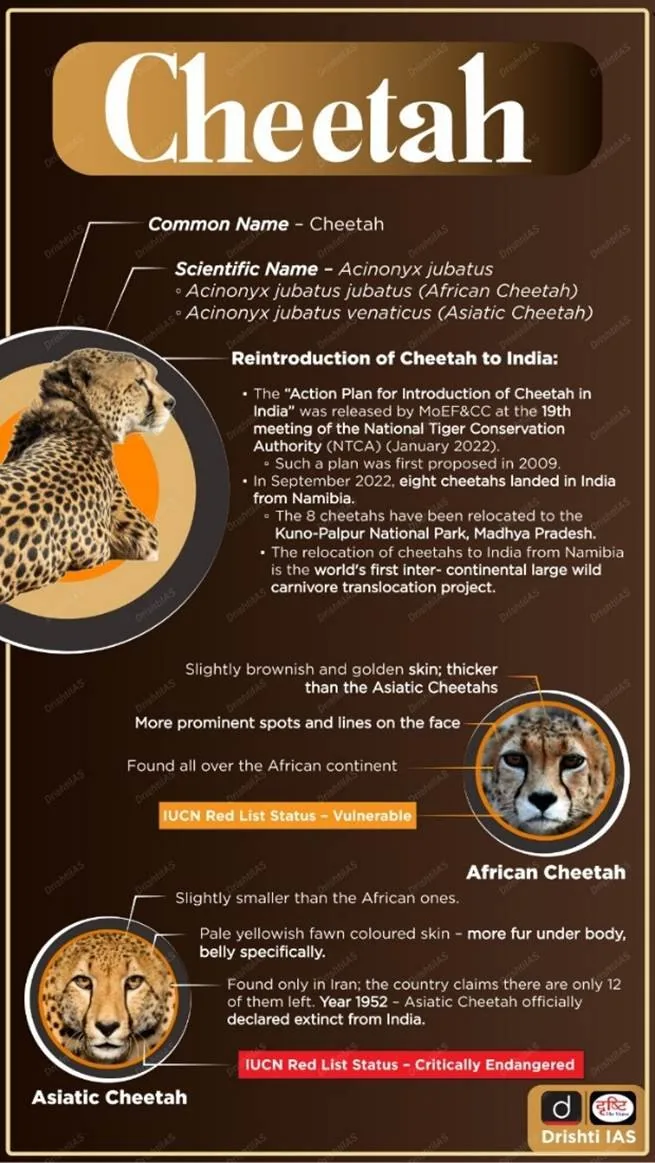
Source The death of KNG22, a 19-month-old cheetah associated with Project Cheetah at Kuno National Park, Madhya Pradesh, following injuries sustained outside the park, has highlighted the technological and geographical limitations of satellite-based wildlife monitoring.- Tracking Technology:
- Monitoring teams at Kuno use a combination of GPS-enabled satellite collars and Very High Frequency (VHF) radio telemetry to track approximately 15 cheetahs.
- Satellite Collars: Provide periodic geographical locations of animals across large and inaccessible landscapes.
- VHF Radio Telemetry: Enables field teams equipped with radio receivers to locate animals more precisely within the transmitter’s reception range.
- Location Update Frequency:
- Satellite collars are generally programmed to transmit location data at six-hour intervals to balance tracking requirements with battery life.
- Missed transmissions can extend gaps between updates to 12–18 hours, highlighting that satellite collars do not provide continuous real-time tracking.
- Technological Limitations: Dense forest canopies, rocky terrain, caves, deep valleys and poor satellite visibility can interfere with GPS location acquisition or data transmission. A missed signal does not necessarily indicate collar malfunction.
- Cheetah Movement: Cheetahs typically travel around 6–8 km daily, sometimes covering 12–15 km or more, making it difficult for field teams to locate them using previously transmitted coordinates, particularly when they move beyond VHF reception range.
Visits & Conferences
1st International Maize Conference 2026
Source The 1st International Maize Conference 2026, themed “Maize Revolution for Food, Feed, Fodder, Fuel and Sustainability in the Changing World” (M4FS), was held in Hyderabad, Telangana, bringing together scientists, policymakers and industry stakeholders to enhance maize productivity, research and sustainable value-chain development.- Production Target: India’s maize production has reached approximately 55 million tonnes, with a proposed target of 75 million tonnes over the next decade and a 1.5-fold increase in productivity through technological innovation, improved crop management and efficient resource utilisation.
- 5F Approach: Proposed expanding the traditional 4F framework (Food, Feed, Fodder and Fuel) to include Farmers, placing farm profitability and sustainable livelihoods at the centre of maize research and development.
- Systems-Science Approach: Emphasised integrating crop breeding, improved agronomic practices and resource-efficient cultivation to bridge yield gaps across seasons and agroecological zones without compromising oilseed and pulse cultivation.
- Maize Research and Innovation:
- The Indian Council of Agricultural Research (ICAR) highlighted the development of 329 maize hybrids over the past five years and called for strengthening the All India Coordinated Research Project on Maize (AICRP on Maize), focusing on:
- High-yielding, nutritionally improved varieties resistant to biotic and abiotic stresses.
- Advanced breeding techniques, germplasm conservation and mechanisation.
- Affordable, quality seeds, particularly public-sector hybrids, supported by robust seed systems.
- The Indian Council of Agricultural Research (ICAR) highlighted the development of 329 maize hybrids over the past five years and called for strengthening the All India Coordinated Research Project on Maize (AICRP on Maize), focusing on:
- Food and Feed Safety:
- Highlighted the importance of aflatoxin management to prevent contamination of maize used for human consumption and animal feed.
- Aflatoxins are toxic compounds produced by certain Aspergillus fungi, posing risks to human and animal health.
- Biofuel Potential: Emphasised maize’s growing importance as a feedstock for ethanol production, supporting India’s bioenergy and energy-security objectives.
- International Collaboration: Encouraged stronger partnerships among research institutions, agricultural universities, industry and international organisations, including expertise associated with CIMMYT (International Maize and Wheat Improvement Center).
- Maize Leading Producers (2025–26): United States, China, Brazil, Argentina, European Union and India.
Miscellaneous
SC on Balancing Informational Privacy and Press Freedom
Source The Supreme Court of India has sought a response from the Union Government on a petition by the Digital News Publishers Association (DNPA) challenging the Digital Personal Data Protection (DPDP) Act, 2023, over concerns that it severely curtails investigative journalism and transparency.- Classification as ‘Data Fiduciaries’:
- The DPDP Act, 2023 lacks specific exemptions for journalistic activities. Neither Section 7 (Certain Legitimate Uses) nor Section 17 (Exemptions) provides a statutory carve-out for the media raising concerns over restrictions on public-interest reporting.
- This leads reporters to be treated as “data fiduciaries” forced to seek prior consent from the very public functionaries they are investigating.
- Under the DPDP Act, 2023, a Data Fiduciary is an entity that decides why and how personal data is processed, either alone or with others.
- Threat to Confidential Sources: Section 36 of the Act empowers the Central Government to demand information from fiduciaries, which could compromise source confidentiality and deter whistleblowers.
- Arbitrary Censorship Risks: Section 37 of the DPDP Act, 2023 empowers the Centre to block online information following a Data Protection Board reference involving at least two monetary penalties, subject to a hearing and written reasons, raising concerns over press freedom, lack of journalistic exemptions and potential state pre-censorship.
- Dilution of the RTI Act, 2005:
- The DNPA petition also challenges Section 44(3) of the DPDP Act, which amends Section 8(1)(j) of the Right to Information (RTI) Act, 2005.
- Originally, Section 8(1)(j) exempted personal information from disclosure unless the authorities were satisfied that a “larger public interest” justified its release.
- The DPDP Act has removed this public-interest qualification. Now, all “personal information” is broadly exempted from RTI disclosure, even if exposing it serves a critical public interest.
- Restricting access to asset disclosures and tender records could shield public officials from corruption scrutiny and weaken investigative journalism.
- Right to Privacy vs. Freedom of Press: The Supreme Court emphasized the need to carefully balance citizens’ fundamental right to privacy (upheld under Article 21 in the K.S. Puttaswamy judgment, 2017) with the freedom of the press, which is constitutionally protected under Article 19(1)(a) (Freedom of Speech and Expression).
- Broader Constitutional Challenge: The DNPA petition is linked to the pending Venkatesh Nayak v. Union of India (2026), which questions the DPDP framework on grounds including the right to information, excessive government access to personal data and inadequate safeguards against surveillance.
- Regulatory Complexities: The Centre highlighted the difficulty of legally defining “journalists” for statutory protection in the modern digital age, given the rapid shift of young audiences toward independent social media content creators.