Comrades Dispatch · 03 Oct 2026 (PDF)
In this edition
- India’s Pharmaceutical Price Regulation Health & Medicine
- Sengol in New NCERT Textbook History
- Birth Anniversary of Mahatma Gandhi and Shri Lal Bahadur Shastri Important Days
- KAZIND 2026 Military Exercises
- Swachh Bharat Mission-Gramin Schemes & Initiatives
- PM E-DRIVE Scheme Schemes & Initiatives
- GOBARdhan Scheme Schemes & Initiatives
- Tigress Released in Buxa Tiger Reserve Wildlife
Health & Medicine
India’s Pharmaceutical Price Regulation
Source Why in News?- The Supreme Court of India criticized the massive markup between the wholesale price and the Maximum Retail Price (MRP) of essential life-saving medicines. Terming a 10-fold markup on a cancer drug as “broad daylight dacoity”, the Court questioned the Union Government on why a uniform retailer margin should not be applied to all essential medicines and medical devices.
-
Regulation of Pricing
- Essential Commodities Act, 1955 (ECA): Medicines are declared essential commodities, empowering the government to control their production, supply, and pricing.
- Drugs (Prices Control) Order, 2013 (DPCO): Issued under the ECA (1955), it provides the legal framework for drug price control in India.
- National Pharmaceutical Pricing Authority (NPPA):
- An independent body under the Department of Pharmaceuticals (Ministry of Chemicals and Fertilizers). It regulates prices, enforces the DPCO, and recovers overcharges from companies.
- Scheduled Drugs:
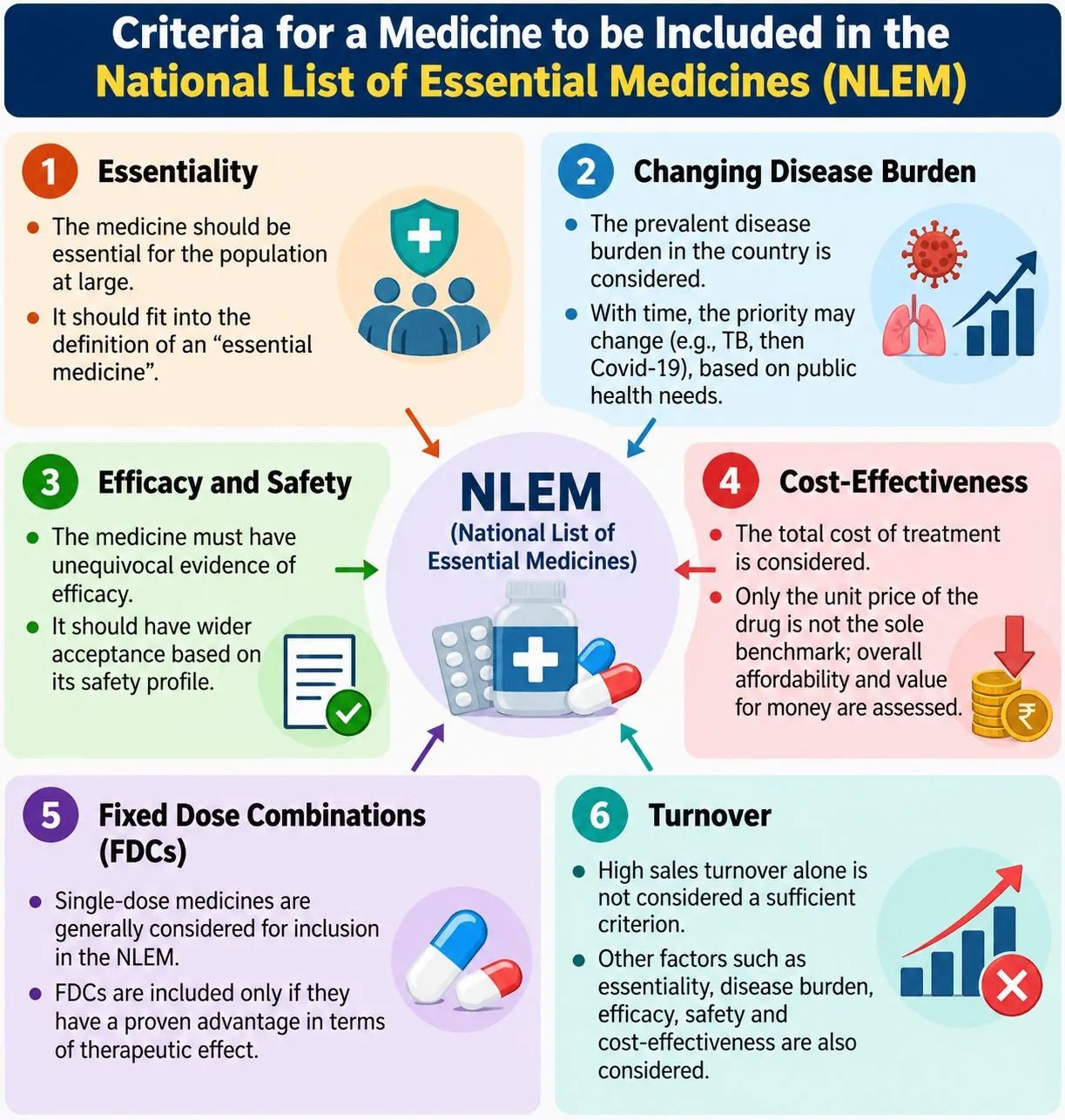
- Medicines listed in the National List of Essential Medicines (NLEM). Currently, the NLEM 2022 includes 388 medicines and about 1,000 formulations.
- The NPPA calculates the ceiling price based on the simple average of the Price to Retailer (PTR) of all brands holding at least a 1% market share.
- A fixed 16% notional retailer margin is added to this average to cap the final MRP. Annual revisions are strictly pegged to the Wholesale Price Index (WPI).
- Non-Scheduled Drugs:
- For medicines outside the NLEM, manufacturers can fix the launch price but cannot increase the MRP by more than 10% annually.
- Because the launch price is un-capped, companies build in massive Trade Margins (the gap between ex-factory cost/PTR and MRP) to incentivize distributors, chemists, and corporate hospitals to push their specific brands.
-
Regulation of Quality and Manufacturing
- Drugs and Cosmetics Act, 1940: Regulates the import, manufacture, distribution, and sale of drugs and cosmetics.
- Central Drugs Standard Control Organisation (CDSCO): The apex regulatory body under the Ministry of Health and Family Welfare. It is responsible for the approval of new drugs, conduct of clinical trials, and laying down standards for drugs.
- Exorbitant Trade Margins: Because launch prices of non-scheduled drugs (which form 80% of the market) are unregulated, pharmaceutical companies offer massive trade margins (often over 500-1000%) to incentivize corporate hospitals, distributors, and chemists to push their specific brands.
- Information Asymmetry & Captive Consumers:
- Patients lack pharmacological awareness to question doctors or ask for identical, cheaper generic equivalents.
- In corporate hospitals, patients are “captive buyers” forced to buy in-house pharmacy drugs billed at the maximum printed MRP.
- Medicines Driving Catastrophic Out-of-Pocket Expenditure (OOPE):
- The failure to effectively control drug prices is the primary driver of India’s healthcare financial burden.
- According to National Health Accounts (NHA) estimates for 2022-23, Out-of-Pocket Expenditure (OOPE) accounts for a staggering 43.4% of Total Health Expenditure (THE) in India.
- More alarmingly, NSSO (75th Round) data indicates that medicines alone account for roughly 70% of all out-of-pocket healthcare expenses.
- Quality Control & Spurious Drugs:
- The divided regulatory mechanism between CDSCO (Centre) and SDRAs (States) leads to uneven enforcement of quality standards.
- The World Health Organisation (WHO) has raised concerns over substandard Indian cough syrups contaminated with diethylene glycol and ethylene glycol, which have been linked to around 300 child deaths, highlighting gaps in pharmaceutical quality control.
- Narrow Scope of NLEM: The NLEM covers only about 20% of the total pharmaceutical market turnover, leaving the vast majority of critical and rare-disease drugs out of the strict ceiling price net.
- Violation of the Right to Health: Allowing manufacturers unrestricted power to set initial MRPs, regardless of actual manufacturing costs, is argued to be a violation of Article 21 of the Constitution (Right to Life).
- Trade Margin Rationalisation (TMR): The NPPA has successfully invoked its extraordinary powers to cap the trade margins of critical medical items. This led to drastic price drops for 42 anti-cancer medicines, coronary stents, orthopaedic knee implants, and oxygen concentrators.
- Pradhan Mantri Bhartiya Janaushadhi Pariyojana (PMBJP): A flagship scheme providing high-quality generic medicines at prices 50% to 80% cheaper than branded counterparts through dedicated Jan Aushadhi Kendras.
- National Health Mission (NHM): The Free Drugs Service Initiative under NHM, provides essential medicines free of cost at public health facilities from Primary Health Centres (PHCs) to district hospitals.
- Pharma Sahi Daam App: Launched by the NPPA to empower consumers to check the prices of medicines, find generic substitutes, and register complaints against overcharging.
- Mandatory Schedule M (Good Manufacturing Practices): The government has revised “Schedule M” rules, making World Health Organization (WHO) standard Good Manufacturing Practices (GMP) mandatory for all pharmaceutical MSMEs to ensure stringent quality control.
- Universal Trade Margin Capping: Instead of just capping the absolute prices of NLEM drugs, the government must impose a strict cap on the maximum permissible trade margin across the entire pharmaceutical supply chain to curb “hospital-driven” pricing.
- Achieving API Sovereignty: India must aggressively operationalize its Bulk Drug Parks, providing cheap electricity, effluent treatment subsidies, and tax holidays to enable Indian API manufacturers to compete with Chinese economies of scale.
- Diplomatic and Market Diversification: Indian pharma must diversify its export markets beyond the US and EU, while the government must use free trade agreements (FTAs) to safeguard against arbitrary international tariffs and export bans.
- Enforcing Generic Prescriptions: Strict penal enforcement of the National Medical Commission (NMC) guidelines, which legally mandate doctors to prescribe medicines by their generic pharmacological names rather than brand names.
- Centralised Quality Regulation: India must move towards a unified, centralized drug regulatory framework (merging State and Central licensing powers) to ensure zero-tolerance quality enforcement across all manufacturing units.
History
Sengol in New NCERT Textbook
Source Why in News?- The ‘Sengol’, which was installed in the new Parliament building in 2023, has been featured in the newly released NCERT class 9 textbook, titled Understanding Society and Beyond – Part 2. The textbook links it to the Chola tradition of righteous governance and the transfer of power in 1947.
-
Symbol of Righteousness:
- The word ‘Sengol’ is derived from the Tamil word ‘semmai’, which means righteousness. It fundamentally represents just and fair governance by a ruler, standing in direct contrast to ‘Kodungol’, which signifies authoritarianism or unjust rule.
- In ancient Tamil tradition, the Sengol was viewed primarily as a profound virtue or concept of equity rather than just a decorated rod. It served as a constant reminder to the king that he held the “aanai” (decree) to govern fairly and uphold his duties to the people.
-
Prominence in Classical Literature:
- Silappadikaram ( was written by the poet and prince Ilango Adigal): The first Tamil epic highlights its importance when Chera King Cheran Senguttuvan praises a Pandiyan king for sacrificing his own life to restore the “uprightness of the Sengol” after mistakenly executing an innocent man.
- Tirukkural (authored by Thiruvalluvar): Dedicates an entire chapter to ‘Sengonmai’ (The Right Sceptre), emphasising that a ruler’s equity, not his weapons, brings true victory.
- Sangam Era Texts: The practice of using a sceptre to denote righteous rule finds mention in 2,000-year-old texts like Purananooru, Kurunthogai, and Tholkappiyam.
-
Integral to Coronation Rites:
- Historically associated with the Chola dynasty and Nayaka kings, the Sengol was handed to a new monarch by high priests during coronation ceremonies.
- It was recognized as a sacred symbol marking the transfer of power and the bestowment of ethical responsibility.
- A Core Pillar of the Kingdom: Ancient Tamil treatises classify the Sengol as one of the 10 essential constituents of a kingdom, standing alongside other symbols of sovereignty like the venkottra kudai (white umbrella) and murasu (drum).
-
Sengol Connection to India’s Independence in 1947
- Freedom fighter C. Rajagopalachari (Rajaji) suggested to Jawaharlal Nehru that the Sengol be used as a ceremonial symbol to mark the transfer of power from British rule to independent India.
- Rajaji approached the Thiruvavaduthurai Adheenam, a 14th-century Saivaite Math in Tamil Nadu, which commissioned a gold-plated silver Sengol topped with a Nandi.
- On 14th August 1947, the Sengol was brought to Delhi, first presented to Lord Mountbatten, sanctified with holy water, and then ceremonially handed over to Jawaharlal Nehru.
- The ceremony symbolised the transfer of power from British rule to independent India, along with the ethical responsibility associated with authority.
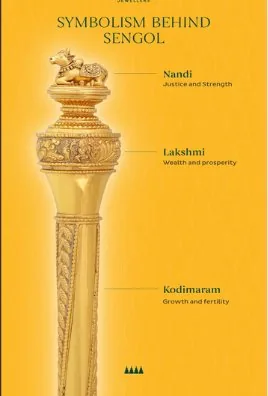
- The Sengol, installed in the new Parliament building in 2023, is topped with a Nandi, which symbolises steadfast justice, firmness, and the vigilant observance of truth (Nyaya).
- Institutional Mottos:
- The textbook links India’s national motto, Satyameva Jayate, to the Mundaka Upanishad, noting that it replaced the British-era motto “Heaven’s Light, Our Guide.”
- Similarly, the Supreme Court’s motto, Yato Dharmastato Jayah (“Where there is righteous duty, there is victory”), is linked to the Mahabharata.
- Ram Rajya: The text cites Mahatma Gandhi’s reference to Ram Rajya (drawing from the Ramayana and the 16th-century Ramcharitmanas) as an ideal governance structure based on probity, transparency, compassion, and public welfare.
- Governance as a ‘Sacred Responsibility’: It asserts that from the Vedic period through the eras of the Ramayana and Mahabharata, Indian traditions viewed governance as a sacred duty to the people, rather than merely a mechanism for exercising power.
- Divine Validation of Resistance:
- In the chapter titled ‘Resistance and Resilience,’ the text highlights traditional beliefs where Indian kings received swords from Goddesses (such as Kali, Durga, and Bhavani) to resist foreign invasions.
- Examples cited include Chhatrapati Shivaji Maharaj receiving a sword from Goddess Tulja Bhavani and Kumara Kampana using a goddess-given sword against Sultanate forces.
Important Days
Birth Anniversary of Mahatma Gandhi and Shri Lal Bahadur Shastri
Source Why in News?- On 2nd October 2026, India paid tributes to Mahatma Gandhi and former Prime Minister Lal Bahadur Shastri on their birth anniversaries.
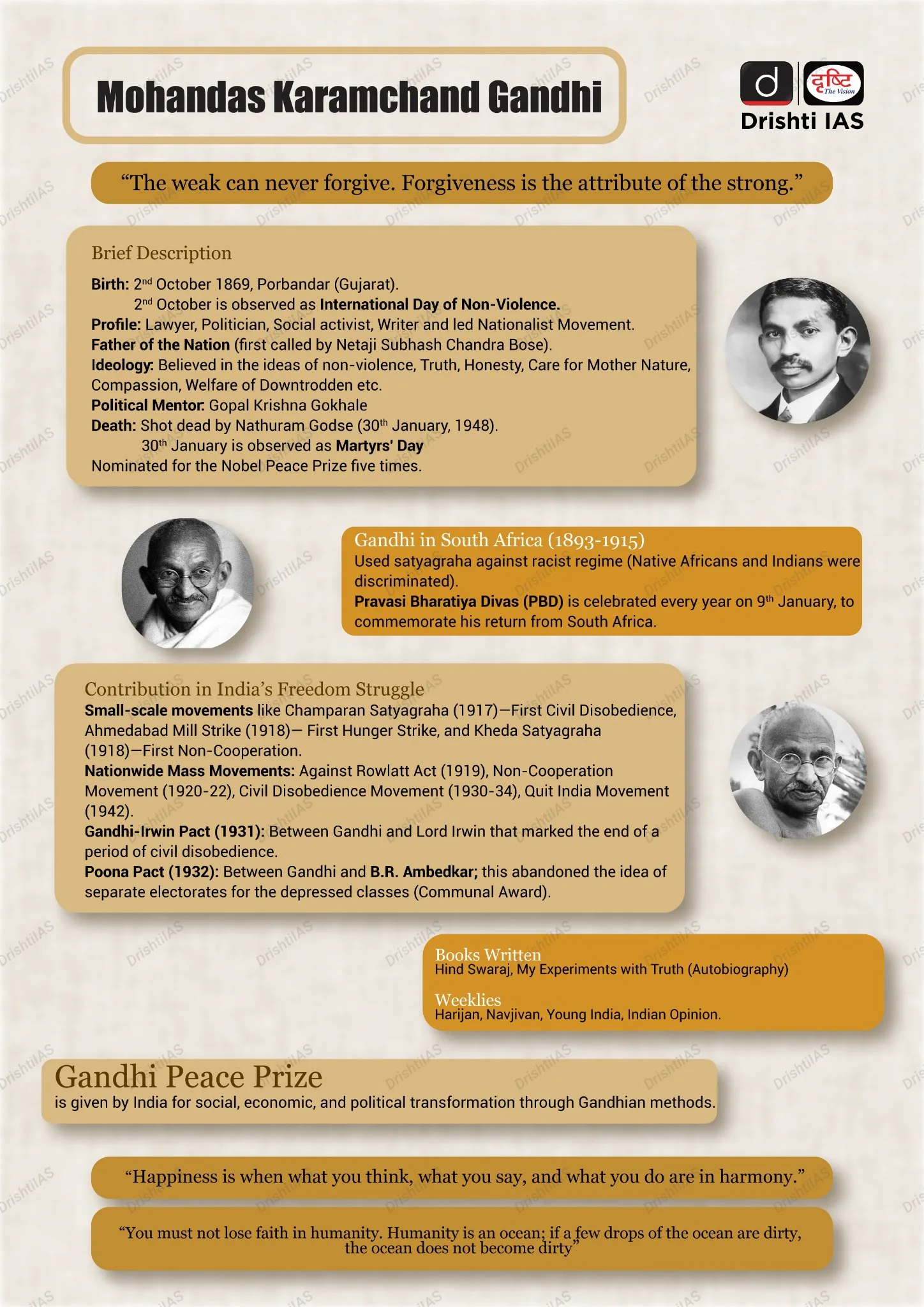
- Early Life & Formative Years: Born on 2nd October 1869 at Porbandar, he studied law in England (1888–91). His political and moral awakening was catalyzed in 1893 by racial humiliation at Pietermaritzburg, South Africa.
- South African Initiatives: He founded the Natal Indian Congress (1894), published the Indian Opinion newspaper, and established the Phoenix Settlement (1904) and Tolstoy Farm (1910), which served as foundational grounds for developing Satyagraha (non-violent resistance).
- Return to India: Gandhi returned to India on 9th January 1915, a date now commemorated as Pravasi Bharatiya Diwas, and subsequently established the Sabarmati Ashram (1917) to institutionalize his principles of truth and self-reliance.
- Core Ideology: His philosophy was rooted in Satyagraha (truth-force) and Ahimsa (non-violence). He believed that means must justify the ends.
- Major Political Movements:
- His pan-India leadership began with the Champaran Satyagraha (1917) and Kheda Satyagraha (1918), followed by the Rowlatt Satyagraha (1919).
- He subsequently led mass nationalist campaigns including the Non-Cooperation Movement (1920–22), the Civil Disobedience Movement via the Dandi March (1930), and the Quit India Movement (1942).
- Socio-Economic Reforms:
- Championing the Charkha and Khadi as symbols of the dignity of labor and economic self-reliance, he founded the All India Spinners’ Association (1925) and the Harijan Sevak Sangh (1932) to eradicate untouchability and foster communal harmony.
- Beyond political independence, Gandhi championed the eradication of untouchability (Harijan upliftment), Hindu-Muslim unity, and village self-reliance (Gram Swaraj) through the promotion of Khadi and cottage industries.
- Literary Contributions: He articulated his critique of modern civilization and political vision in Hind Swaraj and detailed his moral journey in An Autobiography: The Story of My Experiments with Truth.
- Global Recognition: Assassinated on 30th January 1948, his legacy of peace remains globally recognized, with the United Nations declaring 2nd October as the International Day of Non-Violence.
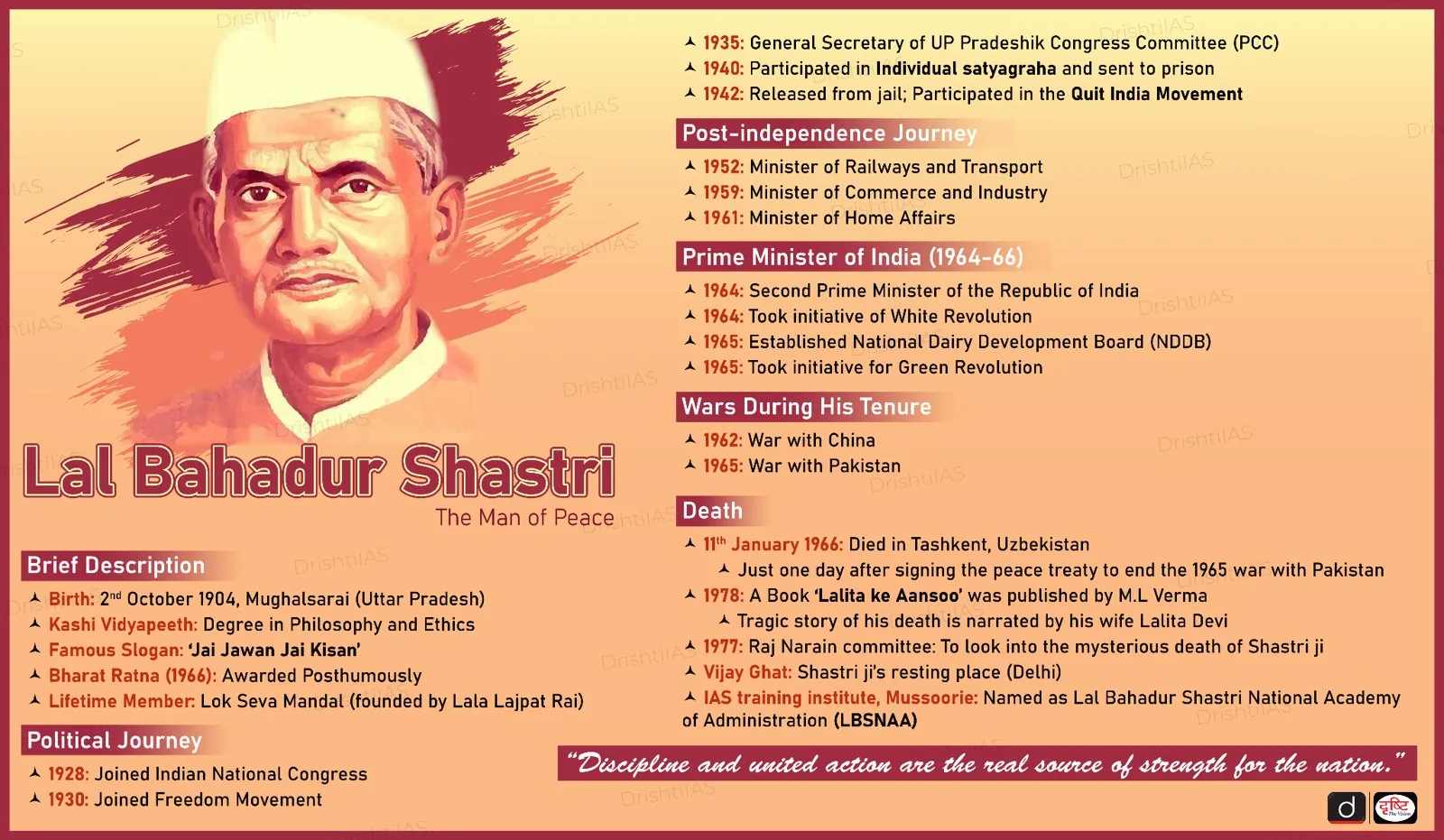
 What are the Key Facts About Lal Bahadur Shastri?
- Early Life:
- Lal Bahadur Shastri, born on 2nd October 1904 in Mughalsarai, Uttar Pradesh.
- He opposed the caste system, dropped the surname “Srivastava”, and earned the title “Shastri” from Kashi Vidyapeeth in 1926.
- Inspired by Mahatma Gandhi, he joined the Non-Cooperation Movement at 16 and later rejected dowry, accepting only a charkha and Khadi.
- He actively participated in the Civil Disobedience Movement and spent over seven years in British prisons.
- Political Career: Became Parliamentary Secretary (1946) and later Home Minister of Uttar Pradesh; held key Union portfolios including Railways, Transport & Communications, Commerce & Industry, and Home Affairs.
- Accountability:
- He resigned as Railway Minister in 1956, accepting moral responsibility for a train accident.
- He is known for integrity, humility and efficiency, and described as a “little dynamo of a man.”
- Tenure as Prime Ministership:
- Lal Bahadur Shastri succeeded Jawaharlal Nehru as Prime Minister and served from 1964–1966.
- He laid the groundwork for the Green Revolution in India to boost food grain production. He also promoted the White Revolution (Operation Flood) by supporting the Amul milk co-operative in Gujarat and establishing the National Dairy Development Board.
- He led India during the 1965 Indo-Pak War and gave the slogan “Jai Jawan, Jai Kisan”, highlighting the importance of national security and food security.
- He died in Tashkent on 11th January 1966, shortly after signing the Tashkent Declaration.
Military Exercises
KAZIND 2026
Source A 60-member Indian Armed Forces contingent is participating in the 9th edition of the India-Kazakhstan Joint Military Exercise, KAZIND 2026, being held in Oskemen, Kazakhstan, from 28th September to 11th October 2026.- Objective: Enhance interoperability and joint counter-terrorism capabilities in a sub-conventional environment under a UN mandate.
- Operational Focus:
- Semi-urban and mountainous terrain, including:
- Air mobility
- UAS and Counter-UAS operations
- Cordon-and-search operations
- Raids and search-and-destroy missions
- Special Heliborne Operations
- Semi-urban and mountainous terrain, including:
- India–Kazakhstan Relations:
- Diplomatic Relations: Established in 1992; India was among the early countries to recognise independent Kazakhstan.
- Strategic Partnership: Bilateral relations were elevated to a Strategic Partnership in 2009.
- Central Asian Engagement: Kazakhstan is an important partner in India’s Connect Central Asia approach and participates in the India–Central Asia Dialogue.
- Multilateral Cooperation: Both countries cooperate through the SCO, UN and CICA.
- UNSC: Kazakhstan has supported India’s candidature for permanent membership of an expanded UN Security Council.
- Defence Cooperation: Based on the 2015 Agreement on Defence and Military Technical Cooperation, covering military training, exercises, education and military-technical cooperation.
- Connectivity: Both countries cooperate on the Chabahar Port initiative, providing India with a potential connectivity route to Central Asia.
Schemes & Initiatives
Swachh Bharat Mission-Gramin
Source Why in News?- The Swachh Bharat Mission–Grameen (SBM-G) has evolved from a toilet construction programme into a broader community-led sanitation movement focused on behaviour change, waste management and sustainable sanitation systems.
- The Swachh Bharat Mission–Grameen (SBM-G) was launched on 2nd October 2014 with the objective of making rural India Open Defecation Free (ODF) by providing access to toilets and promoting behavioural change.
-
Phase I:
- SBM-G (2014–2019)
- Phase I focused on eliminating open defecation and achieving universal sanitation coverage in rural areas.
- Achievements:
- Over 100 million individual household toilets were constructed.
- More than 6 lakh villages were declared ODF by October 2019.
- The Mission contributed to achieving SDG Target 6.2 on sanitation and hygiene.
- It also improved health, safety and dignity, particularly for women, while reducing environmental contamination associated with open defecation.
-
Phase II:
- SBM-G (2020–21 to 2025–26)
- After achieving ODF status, Phase II shifted the focus from toilet construction to sustaining ODF outcomes and achieving comprehensive sanitation.
- Key Objectives
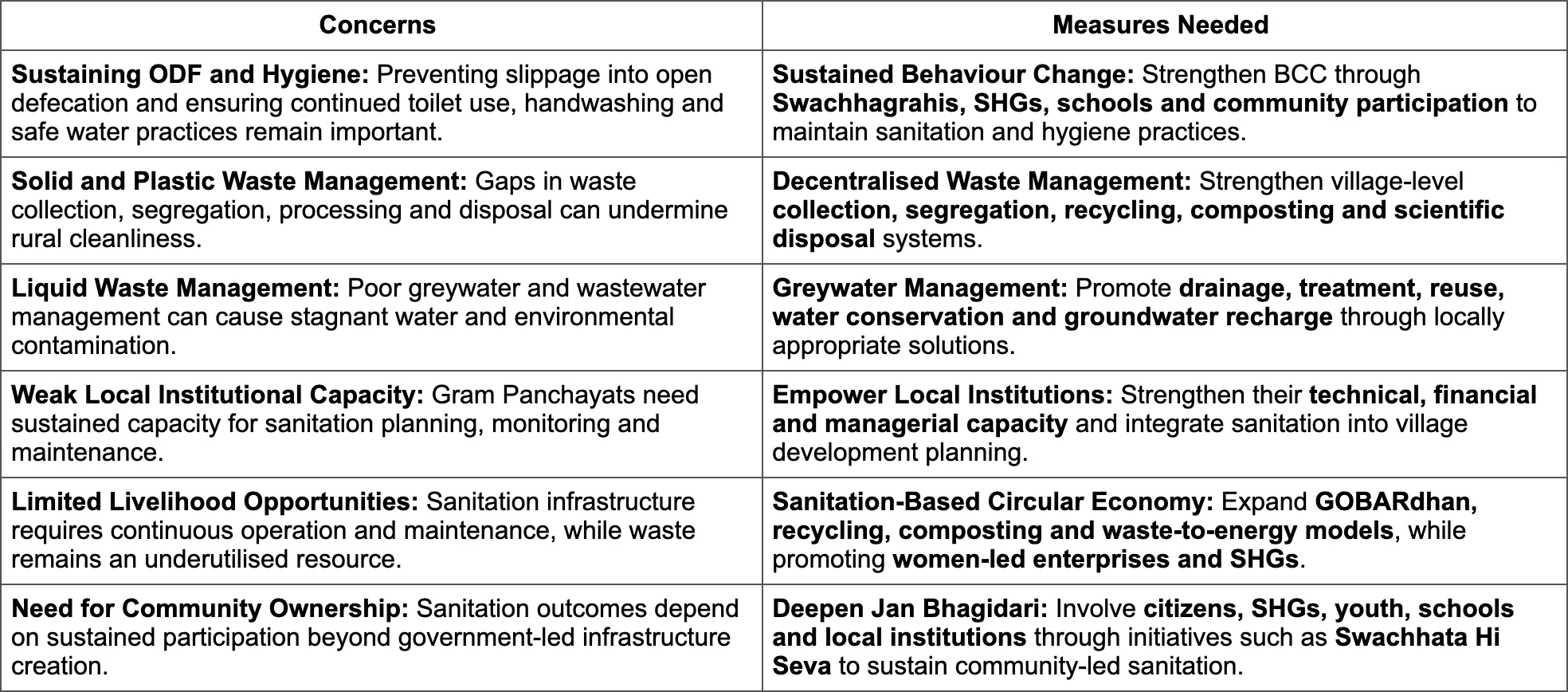
- Sustaining ODF Status: Prevent slippage into open defecation and ensure continued toilet usage and maintenance.
- Solid Waste Management: Establish systems for household waste collection, segregation, processing and disposal, including management of plastic waste.
- Liquid Waste Management: Promote effective management of greywater and other liquid waste through appropriate drainage and wastewater-management systems.
- Visual Cleanliness: Ensure minimal litter, stagnant wastewater and plastic waste dumps in public places.
-
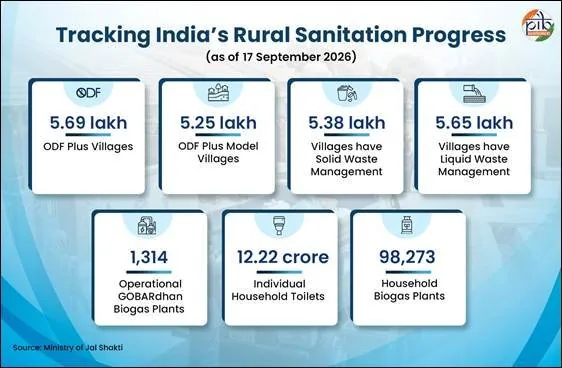
ODF Plus Categories: The progress of villages under SBM-G Phase II is assessed through three categories:

- GOBARdhan (Galvanizing Organic Bio-Agro Resources Dhan): A flagship umbrella initiative under SBM-G Phase II that converts cattle dung, agricultural crop residue, and organic waste into biogas, compressed bio-gas (CBG), and organic manure/bio-slurry.
- Behaviour Change Communication (BCC):
- SBM-G has shifted the focus from mere toilet construction to sustained sanitation behaviour.
- It promotes safe toilet usage, hygiene practices, handwashing, safe water storage, waste segregation, composting and responsible disposal practices to ensure long-term sanitation outcomes.
- Women as Sanitation Change Agents:
- Women have emerged as active participants in sanitation transformation through Swachhagrahis and Self-Help Groups (SHGs).
- They promote toilet usage, conduct awareness campaigns, support waste management and strengthen community-level sanitation practices.
- Role of Schools in Sanitation Awareness:
- Schools act as centres for developing sanitation habits among children by promoting hygiene education, waste management and environmental responsibility.
- Initiatives under SBM-G encourage students to carry sanitation practices from schools to their families and communities.
- Community Institutions and Local Governance:
- Gram Panchayats and Village Water and Sanitation Committees (VWSCs) provide institutional support for sustainable sanitation through village planning, waste management, IEC activities and community mobilisation.
- They connect individual sanitation practices with collective village-level outcomes.
- Jan Bhagidari and Citizen Participation: Cleanliness has evolved into a people-led movement through initiatives such as Swachhata Hi Seva (SHS), which encourages participation of citizens, SHGs, youth groups, schools and local institutions in maintaining public cleanliness.
- Sanitation and Livelihood Generation:
- SBM-G has created new livelihood opportunities in waste collection, recycling, composting, sanitation infrastructure and maintenance services.
- Women-led enterprises and community groups are increasingly participating in waste management activities.
- Waste-to-Wealth through Circular Economy: Initiatives like GOBARdhan promote the conversion of organic waste, cattle dung and agricultural residue into biogas, compressed bio-gas (CBG) and organic manure, supporting sustainable waste management and rural livelihoods.
- Sustainable Sanitation through Resource Recovery: Community-led models such as greywater treatment demonstrate how sanitation can contribute to water conservation, groundwater recharge, irrigation support and environmental sustainability.
 Conclusion
- India’s sanitation journey has progressed through three stages: Access → Usage → Sustainability. SBM-G has transformed sanitation from a government programme focused on infrastructure creation into a people-led movement based on behavioural change, community ownership and sustainable waste management.
PM E-DRIVE Scheme
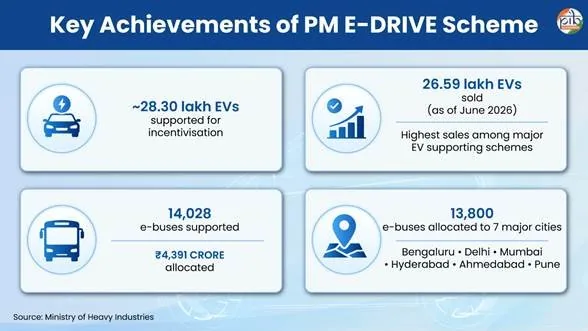
Source Why in News?- The Government has highlighted the progress of the ₹10,900-crore PM E-DRIVE Scheme, which aims to accelerate EV adoption, expand charging infrastructure and strengthen India’s domestic electric mobility ecosystem.
- As of July 2026, over 23.2 lakh EVs have been incentivised under the scheme, while ₹689 crore has been approved for deployment of 6,562 EV chargers.
- About:
- The PM E-DRIVE Scheme was notified on 29th September 2024 and implemented retrospectively from 1st April 2024, subsuming the Electric Mobility Promotion Scheme (EMPS) 2024. It will be implemented up to 31st March 2028, with specific terminal dates for certain vehicle categories.
- The scheme aims to promote faster adoption of EVs, establish public charging infrastructure and strengthen the EV manufacturing ecosystem in India.
- Covered Categories:
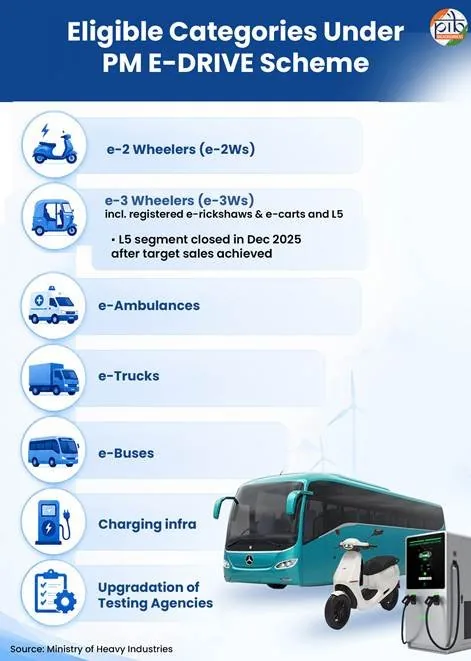
- The scheme provides demand incentives for e-2Ws and e-3Ws, along with support for e-trucks, e-ambulances and e-buses.
- It also allocates funds for EV public charging infrastructure and provides for the deployment of 14,000 e-buses.
- Promoting Domestic EV Manufacturing:
- PM E-DRIVE seeks to strengthen domestic manufacturing through localisation requirements under the Phased Manufacturing Programme (PMP). OEMs registered under the scheme have localised their EV models and obtained compliance certificates from designated testing agencies.
- This complements the Production Linked Incentive (PLI) Scheme for Advanced Chemistry Cell (ACC) Battery Storage.
- Battery Recycling: The Battery Waste Management Rules, 2022, notified by the Ministry of Environment, Forest and Climate Change, provide the regulatory framework for environmentally sound battery waste management and recycling.
- Significance
- Decarbonisation: Supports the shift from fossil-fuel-based transport to cleaner mobility.
- Energy Security: Reduces dependence on imported fossil fuels.
- Industrial Development: Encourages domestic EV and battery manufacturing.
- Urban Mobility: Promotes deployment of electric buses and public charging infrastructure.
- Employment: Creates opportunities across EV manufacturing, charging, maintenance and battery recycling.
- Circular Economy: Strengthens battery recycling and resource recovery.
GOBARdhan Scheme
Source The GOBARdhan scheme seeks to significantly expand India’s Compressed Biogas (CBG) production by converting agricultural and organic waste into a source of clean domestic energy. GOBARdhan (Galvanizing Organic Bio-Agro Resources Dhan)- Launch: 2018, under the Swachh Bharat Mission–Grameen (SBM-G) framework.
- Nodal Ministry: Ministry of Jal Shakti, through the Department of Drinking Water and Sanitation (DDWS) for its SBM-G component.
- Core Objective:
- Convert cattle dung and other biodegradable waste into useful resources such as:
- Biogas
- Compressed Bio-Gas (CBG)
- Bio-slurry/organic manure
- Convert cattle dung and other biodegradable waste into useful resources such as:
- Feedstock: Animal dung, crop residue, kitchen/food waste and other organic waste.
- GOBARdhan under SBM-G Phase II:
- GOBARdhan is an important component of Solid Waste Management under SBM-G Phase II, supporting villages in converting biodegradable waste into biogas and bio-slurry.
- Financial assistance of up to ₹50 lakh per district is available for community and cluster-level biogas plants under SBM-G Phase II for the programme period 2020–21 to 2026–27.
- It encourages Gram Panchayats and local institutions to participate in decentralised waste-to-energy solutions.
- Economic and Environmental Impact: It seeks to scale up Compressed Bio-Gas (CBG) production 10-fold, while converting agricultural and organic waste into domestic energy. It is expected to save over ₹40,000 crore in fuel imports, add more than ₹75,000 crore to GDP, and generate over 1.5 lakh jobs.
- Significance for Farmers: By converting agricultural and organic waste into energy and manure, the scheme seeks to create additional economic opportunities for farmers, supporting the transition from “Annadatas” to “Urjadatas.”
Wildlife
Tigress Released in Buxa Tiger Reserve
Source In a major milestone for species conservation, a tigress (T138) translocated from Valmiki Tiger Reserve (Bihar) was released into Buxa Tiger Reserve (West Bengal) to inaugurate India’s Wildlife Week 2026 and initiate a phased tiger recovery programme.- India’s Wildlife Week 2026 is observed nationwide from 2nd October to 8th October to promote biodiversity conservation and public awareness. India’s Wildlife Week 2026 central theme, “Connecting Habitats, Thriving Wildlife,” emphasizes the critical necessity of ecological corridors for species survival and safe dispersal.
- Institutional Architecture: The reintroduction is part of the Tiger Augmentation and Recovery Project, implemented collaboratively since 2018 by the Government of West Bengal, the National Tiger Conservation Authority (NTCA), and the Wildlife Institute of India (WII).
- Phased Translocation & Monitoring: Translocated under standard NTCA veterinary and management protocols, the tigress will be tracked using radio telemetry, camera traps, and field-based observation, with plans to introduce three additional tigers to establish a viable breeding population.
- Buxa Tiger Reserve (BTR):
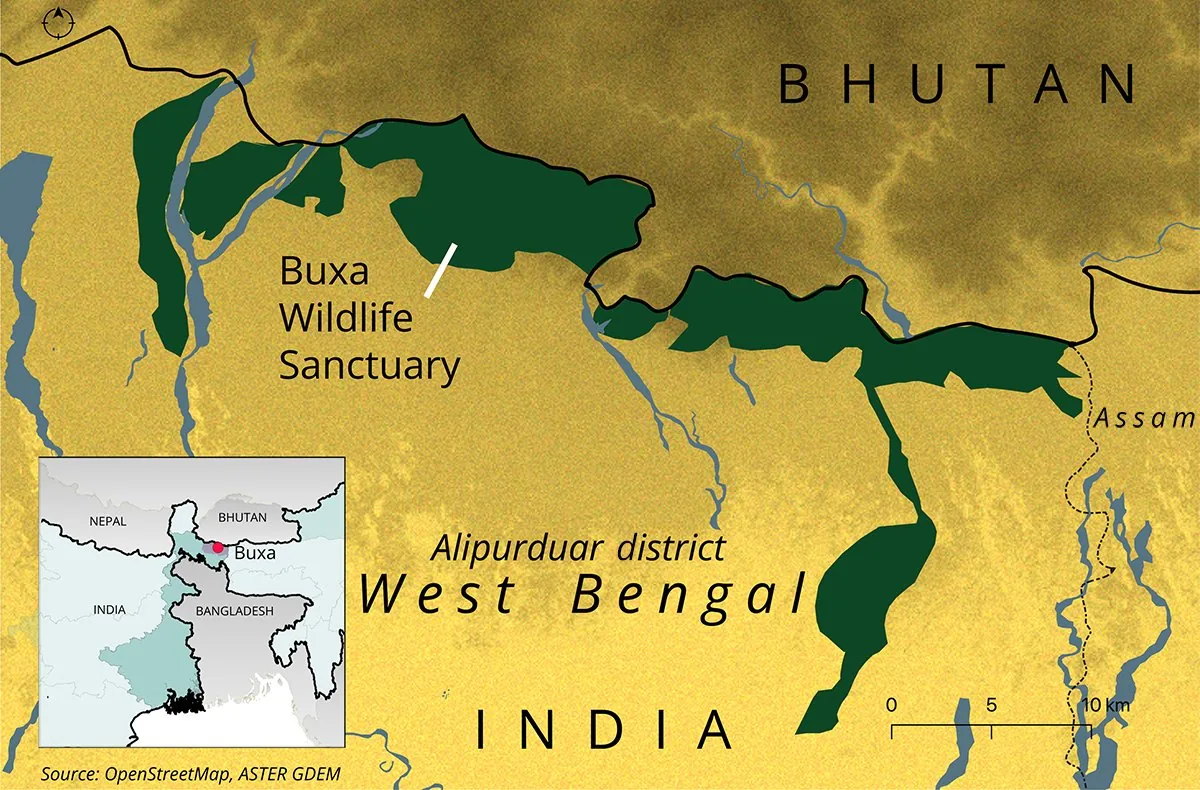
- Located in Alipurduar district, West Bengal, BTR covers Terai, Bhabar and sub-Himalayan ecosystems along the Bhutan and Assam borders.
- Buxa forms a critical transboundary landscape with a contiguous corridor. It connects the North East and Brahmaputra Valley tiger landscape with Manas Tiger Reserve (Assam), Phipsoo Wildlife Sanctuary (Bhutan) and Jaldapara National Park (West Bengal), facilitating natural genetic exchange and wildlife dispersal.
- The rivers Sankosh, Raidak, Jayanti, Churnia, Turturi, Phashkhawa, Dima, and Nonani flow through Buxa National Park.
- BTR is rich in Sal, Champ and Simul forests and supports tigers, elephants, gaurs, sambar, wild dogs and wild boars, along with endangered species such as the Bengal florican and Chinese pangolin.
- Addressing the historical absence of resident tigers caused by prey depletion, authorities restored over 380 hectares of grasslands and released more than 800 chital (Axis axis) to ensure adequate carrying capacity before releasing the apex predator.