Comrades Dispatch · 05 Oct 2026 (PDF)
In this edition
- Financial Stability in an Age of Flux Banking & Finance
- National Coastal Mission 2.0 Environment & Ecology
- Birth Anniversary of Shyamji Krishna Varma History
- Mumbai’s Jawahar Dweep Becomes India’s 1st Plastic-Free Oil Terminal Infrastructure & Energy
- India Attends SCO Meeting in Pakistan International Relations
- Framework Governing Foreign Nationals in India Polity & Governance
- Over-Regulation of HEIs Social Issues
- India’s Journey Towards Universal Literacy Social Issues
Banking & Finance
Financial Stability in an Age of Flux
Source Why in News?- The Reserve Bank of India (RBI) Governor outlined five key priorities to safeguard financial stability amidst growing global uncertainties. He delivered these remarks at the 5th Kautilya Economic Conclave held in New Delhi, under the theme “Resilience in an Age of Flux”.
- Strengthening Systemic Resilience: The objective is not just to prevent shocks, but to ensure that financial institutions can absorb them and continue providing critical services even under severe stress.
- Understanding New-Generation Systemic Risks:
- Modern risks are increasingly exogenous, cross-border, and interconnected.
- The next financial crisis is more likely to stem from geopolitical events, cyberattacks, or technological failures than from traditional banking channels.
- Improving Risk Assessment via Granular Data: The quality of risk assessment depends heavily on the quality of data. There is a need for less fragmented, highly granular data on non-bank financial intermediaries (NBFIs), interconnected exposures, and technology dependencies.
- Ensuring System-Wide Resilience:
- Resilience must extend beyond traditional banks to encompass NBFIs, payment systems, technology infrastructure, and critical third-party networks.
- As the Governor noted, “Financial instability anywhere can become a threat to financial stability everywhere.”
- Preserving Trust Amidst Innovation: While innovations like Artificial Intelligence (AI) and tokenisation can improve efficiency, their adoption must preserve fundamental trust-building properties such as sound institutions, settlement finality, and financial integrity.
Note: The Kautilya Economic Conclave (KEC) is a platform for discussing contemporary economic and policy issues. It was first organised in 2022 by the Institute of Economic Growth (IEG) in partnership with the Ministry of Finance. It brings together Indian and international experts to discuss economic growth, finance, technology, trade, investment and global economic developments.
- Global
- Elevated Sovereign Debt & Carry Trade Risks:
- Advanced economies are facing structurally high debt-to-GDP ratios (e.g., the US exceeding 120%), shorter debt maturities, and hardening bond yields.
- For emerging markets (e.g., India, Brazil, Indonesia), this poses a severe risk of capital outflows if global investors rapidly unwind “carry trades” (borrowing in low-interest currencies to invest elsewhere).
- The “AI Bubble”:
- Global financial markets are dangerously top-heavy, propped up by the AI investment cycle.
- A sudden slowdown in AI capital expenditure or earnings could trigger a sharp, contagious repricing of assets, disproportionately threatening economies heavily tied to AI-hardware supply chains (e.g., Taiwan’s semiconductor reliance, South Korea’s memory chip exports).
- Rising Leverage in Shadow Banking (NBFIs):
- NBFIs such as hedge funds, ETFs, and private equity firms have expanded their hidden leverage in equity and bond markets.
- Tighter financial conditions could rapidly transmit this stress to traditional banks (reminiscent of the UK’s 2022 Liability-Driven Investment (LDI) crisis, where shadow leverage nearly collapsed British pension funds).
- Private Credit Vulnerabilities:
- The loosely regulated global private credit market is showing deep signs of stress.
- High-profile defaults and a rising reliance on ‘Payment-In-Kind’ or PIK arrangements suggest deteriorating underwriting and loose lending standards in advanced economies.
- Exogenous Shocks & Cyber-Resilience: Deepening geopolitical fragmentation (e.g., the West Asia conflict disrupting the Red Sea / Suez Canal trade corridors, and ongoing US-China tech decoupling) and highly sophisticated, AI-driven cyberattacks threaten the core physical and digital infrastructure of the borderless financial system.
- Elevated Sovereign Debt & Carry Trade Risks:
- India
- Surge in Unsecured Retail Lending:
- While corporate balance sheets have cleaned up, retail debt is surging dangerously. The RBI has expressed deep concern over the unbridled proliferation of unsecured loans (e.g., algorithmic lending via instant loan apps and buy-now-pay-later schemes).
- Delinquency rates (fresh defaults) are disproportionately high among young borrowers under 25 years old. A sudden macroeconomic shock or widespread job loss could trigger a sharp spike in retail Non-Performing Assets (NPAs).
- Speculative Retail Froth & F&O Frenzy:
- Rapid retail participation in Futures & Options (F&O) and elevated valuations in some mid- and small-cap stocks have emerged as financial-stability concerns.
- A sharp market correction could lead to significant retail losses and weaker investor sentiment.
- Fintech Dependencies & Cyber Threats: India’s high fintech adoption rate of 87% has increased banks’ reliance on third-party digital platforms, creating risks from cyberattacks, data breaches, API vulnerabilities and technology failures.
- Shifting Deposit Mix & Margin Pressure:
- The declining share of low-cost Current Account and Savings Account (CASA) deposits is forcing banks to rely more on costlier term deposits, increasing their funding costs.
- To maintain Net Interest Margins (NIMs), banks may lend more to higher-yield but riskier segments, increasing credit risk.
- Vulnerability of Gold Loans:
- Gold loans have become the largest non-housing retail loan category, growing at a 42.4% CAGR since March 2024.
- With outstanding loans exceeding Rs 5.14 lakh crore in May 2026, a sharp fall in gold prices could reduce collateral value and increase credit and recovery risks for banks and NBFCs.
- Surge in Unsecured Retail Lending:
- Deploying Countercyclical Macroprudential Tools: The RBI must continue enforcing higher risk weights on unsecured retail credit and NBFC exposures to curtail irrational credit booms.
- Curbing Speculative Derivatives (F&O) Trading: Regulators like SEBI must implement stringent PAN-level position limits, monitor delta-adjusted positions, and restrict high-risk zero-day-to-expiry index options to protect retail household savings from severe capital erosion.
- Balancing the Credit-Deposit (C/D) Ratio:
- Banks must actively mobilize low-cost CASA deposits to correct structural asymmetries and reduce reliance on volatile wholesale funding.
- Strict compliance with the Liquidity Coverage Ratio (LCR) is essential to counter sudden liquidity shocks.
- Fortifying Cyber-Resilience & Fraud Prevention (MuleHunter.ai): To combat the rise of AI-driven cyber threats and digital financial fraud, the rapid deployment of tech-governance initiatives like the Reserve Bank Innovation Hub’s (RBIH) MuleHunter.ai is critical.
- Adopting World Bank Frameworks:
- To insulate against sovereign debt and cross-border liquidity risks, emerging markets must align with the World Bank Three-Pillar Approach:
- Accelerating structural reforms for domestic resource mobilization.
- Securing external financial support and expanding risk-sharing instruments.
- Utilizing global mechanisms like the G20 Common Framework for faster, predictable debt restructuring.
- To insulate against sovereign debt and cross-border liquidity risks, emerging markets must align with the World Bank Three-Pillar Approach:
- Building External Buffers & Rupee Internationalisation:
- Maintaining substantial foreign exchange reserves buffers the economy against abrupt capital outflows triggered by global carry-trade unwinds.
- Simultaneously, expanding local currency trade settlements insulates domestic balance sheets from external monetary volatility.
- From shock prevention to shock absorption, India’s financial stability framework must evolve with changing risks. With stronger macroprudential safeguards, cyber resilience and cross-border risk management, India can ensure that its financial system remains a silent strength behind sustained economic growth.
Environment & Ecology
National Coastal Mission 2.0
Source Why in News?- Recently, the Union Environment Minister launched the implementation Guidelines for National Coastal Mission 2.0 (NCM 2.0) in New Delhi.
- About:
- National Coastal Mission 2.0 (NCM 2.0) is a Central Sector Scheme with an approved outlay of ₹767 crore for 2025-26 to 2030-31, aligned with the Finance Commission award period.
- It has been formulated as the consolidated framework for climate-resilient coastal management, ecosystem restoration and sustainable livelihoods, subsuming the earlier NCM from 16th May 2025.
- Background: The Mission builds on India’s Blue Economy vision, earlier National Coastal Mission initiatives, the World Bank-assisted pilot project on Integrated Coastal Zone Management (ICZMP), and the Conservation and Management of Mangroves and Coral Reefs scheme.
- Vision: It seeks to conserve and protect coastal and marine ecosystems while promoting inclusive development, climate resilience and sustainable utilisation of coastal resources to unlock India’s Blue Economy potential.
- Objectives: Major objectives include climate adaptation and mitigation, conservation of mangroves, brackish-water wetlands and coral reefs, pollution control, sustainable livelihoods, capacity building, Integrated Coastal Zone Management Plans (ICZMPs) and Coastal Marine Spatial Plans (CMSPs).
- Five Components: The Mission covers Climate Resilient Blue Economic Growth; Coastal Vulnerability and Risk Reduction; Climate Change Adaptation with mitigation co-benefits; Capacity Building and Outreach; and Committed Liabilities and Project Management.
- Geographical Coverage: It covers nine coastal States—Gujarat, Maharashtra, Goa, Karnataka, Kerala, Tamil Nadu, Andhra Pradesh, Odisha and West Bengal—and four UTs—Dadra and Nagar Haveli and Daman & Diu, Andaman & Nicobar Islands, Puducherry and Lakshadweep.
- Expected Outcomes: NCM 2.0 envisages ICZMPs and CMSPs for 1,000 km of priority coastline, cumulative vulnerability assessment of India’s coastline, restoration of coral reefs, mangrove restoration in the Andaman & Nicobar Islands, improved coastal water quality, green shoreline infrastructure, eco-friendly tourism and conservation of coastal mammals.
- Significance: The Mission aims to reduce coastal vulnerability to erosion, flooding, and salinity ingress; strengthen institutional capacity and community livelihoods; and support sustainable Blue Economy-led development in line with Atmanirbhar Bharat, Blue Economy Vision 2047, and Viksit Bharat.
History
Birth Anniversary of Shyamji Krishna Varma
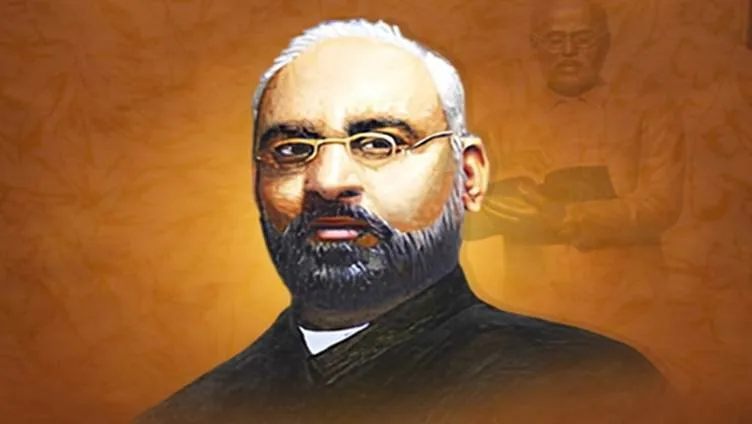
Source The Prime Minister paid homage to revolutionary and freedom fighter Shyamji Krishna Varma on his birth anniversary on 4th October 2026.- Early Life & Education: Born on 4th October 1857, in Mandvi, Kutch District (Gujarat). He was a scholar of Sanskrit and became the first non-Brahmin to be conferred the prestigious title of ‘Pandit’ by the Pandits of Kashi.
- Arya Samaj Connection: He was profoundly influenced by Swami Dayanand Saraswati and became the first President of the Bombay Arya Samaj in 1877.
- Professional Milestones: Served as the Diwan (Chief Minister) in the princely states of Ratlam, Ajmer, and Junagadh.
- Launch of ‘The Indian Sociologist’:
- In January 1905, he started an English monthly journal, “The Indian Sociologist”, in London, which became a powerful ideological vehicle for anti-colonial propaganda and nationalist ideas.
- Shyamji Krishna Varma was barred from practising law in London in 1905 for anti-colonial writings by the Inner Temple (one of the four historic Inns of Court in London, serving as a professional association and training body for barristers and judges), later reinstated posthumously in 2015.
- Formation of the Indian Home Rule Society:
- In February 1905, he inaugurated the Indian Home Rule Society in London.
- He was one of the earliest Indian political leaders to use the term “Swaraj” (Self-Rule) and demand complete independence from British despotism.
- Establishment of ‘India House’:
- To shelter Indian students facing racial discrimination in England, he founded ‘India House’ in London (1905).
- This hostel rapidly transformed into a vibrant hub for revolutionary activities, nurturing iconic freedom fighters like Vinayak Damodar Savarkar, Madam Bhikaji Cama, and Virendranath Chattopadhyaya.
- Final Years:
- In response to British criticism, he transitioned from England to Paris and subsequently settled in Geneva during World War I, where he remained until his death on 30th March 1930.
- A memorial called Kranti Teerth dedicated to him was built and inaugurated in 2010 near Mandvi.
Infrastructure & Energy
Mumbai’s Jawahar Dweep Becomes India’s 1st Plastic-Free Oil Terminal
Source Mumbai Port Authority declared the Jawahar Dweep Marine Oil Terminal plastic-free during Swachhata Abhiyan 2026, making it India’s first plastic-free oil terminal.- Objective: The initiative seeks to reduce single-use plastic and strengthen cleanliness and waste-management practices across Mumbai Port’s docks, residential colonies and coastal areas.
- Oil Spill Response: The Oil Spill Response (OSR) facilities were also dedicated to the nation during the programme.
- Terminal Profile: Jawahar Dweep Marine Oil Terminal handles crude oil and petroleum products; its fifth jetty, JD5, was completed in December 2020 and is 470 m long, with capacity to berth vessels carrying up to 1.5 lakh tonnes of cargo.
- Expansion Plans: Mumbai Port’s Masterplan 2047 proposes a sixth oil berth at Jawahar Dweep with about 22 MTPA capacity for large Suezmax-class vessels, along with terminal modernisation and related infrastructure upgrades.
- Significance: The development reflects Mumbai Port’s effort to combine cleaner port operations, environmental preparedness and capacity expansion with long-term maritime modernisation.
International Relations
India Attends SCO Meeting in Pakistan
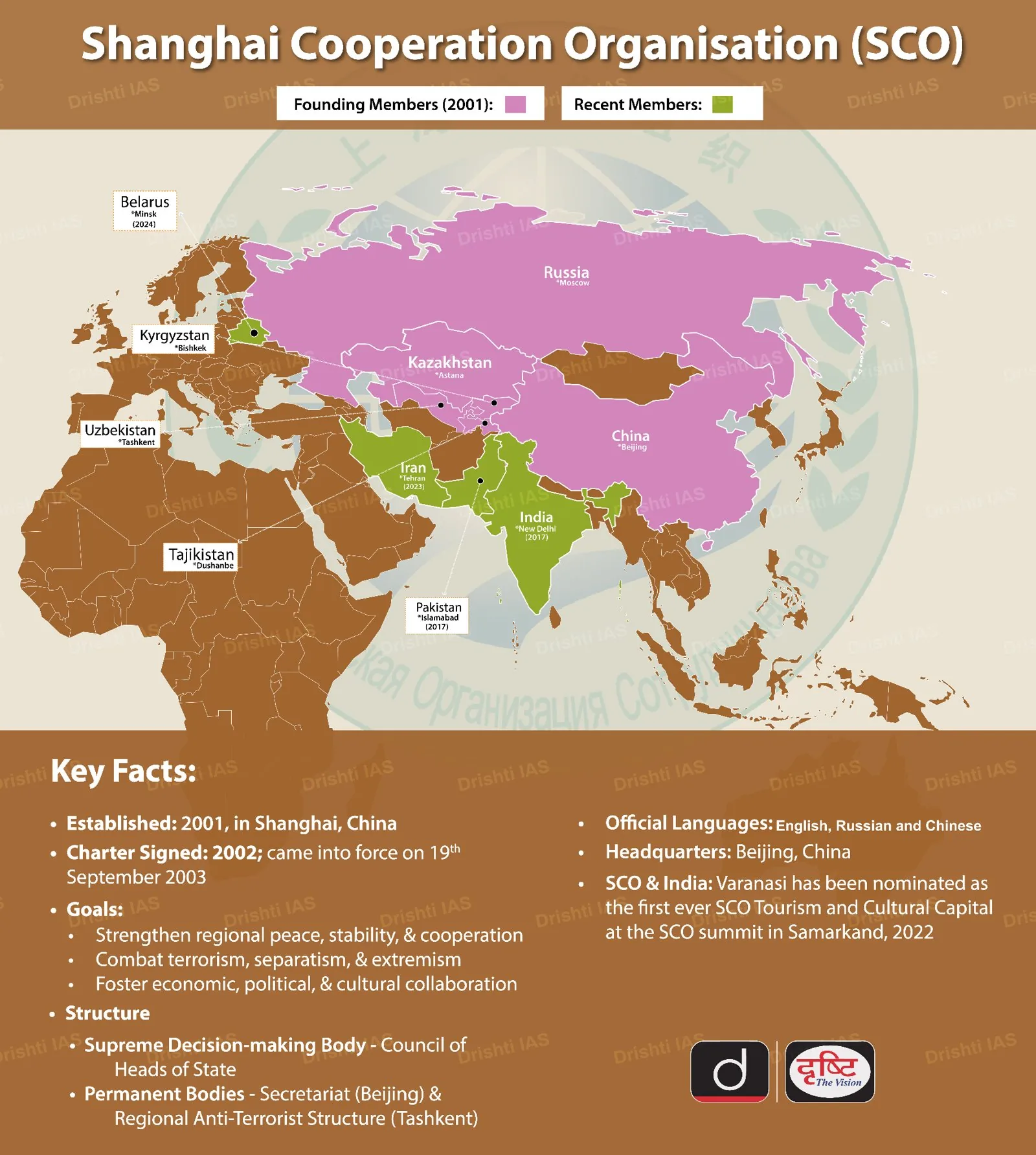
Source A senior Indian diplomat visited Pakistan to attend the Shanghai Cooperation Organisation (SCO) Council of National Coordinators meeting. This marks the first official visit by an Indian delegation to Pakistan since the recent military confrontations (Operation Sindoor).- Obligation as a Member State:
- After assuming the SCO presidency at the Bishkek Summit, Pakistan is hosting the organisation’s meetings during 2026–27. As a full member of the SCO, India’s participation is both a diplomatic and institutional commitment.
- Attending SCO meetings enables India to remain engaged in the organisation’s decision-making processes and maintain situational awareness.
- About: The SCO is a 10-member Eurasian grouping comprising India, China, Russia, Pakistan, Iran, Belarus, Kazakhstan, Kyrgyzstan, Tajikistan and Uzbekistan, with Pakistan currently holding the rotating Chairmanship.
- Pakistan’s SCO Chairmanship: Pakistan announced the theme “Turning Vision into Action: Connectivity, Innovation and Shared Prosperity” and will host the SCO Council of Heads of State Summit in August 2027.
- Takeaways for India:
- Diplomatic Balancing: India’s participation helps monitor Pakistan’s agenda and counter any misuse of the SCO platform on PoK and Kashmir.
- Future India-Pakistan Engagement: The meeting can help assess the possibility of future high-level diplomatic engagement, including a potential Prime Ministerial visit to Pakistan.
- Managing the China Challenge: Engagement through the SCO can help India maintain stability on its western front while focusing greater attention on the China border challenge.
Polity & Governance
Framework Governing Foreign Nationals in India
Source The Delhi High Court ruled that possessing a valid Indian visa does not grant a foreign national an absolute, inherent, or legally enforceable right to enter the country. The judgment was delivered after a Turkmenistan citizen, holding a valid business visa, was denied entry due to adverse intelligence inputs regarding her travel history.- Sovereign Function & Absolute Discretion:
- The Court held that issuing a visa, refusing entry, and providing immigration clearance are core sovereign functions based on national security, foreign policy, and administrative discretion.
- Relying on the Supreme Court’s landmark ruling in Hans Muller of Nurenburg v. Superintendent, Presidency Jail (1955), the Court reiterated that the Central Government holds absolute, unlimited power to regulate the entry of or expel foreigners.
- Visa vs. Entry: A visa is merely a conditional authorization. Earning a visa at an embassy does not guarantee admission; the final, binding decision rests entirely with immigration officers at the port of entry.
- No Enforceable Right:
- The Court clarified that since there is no legally enforceable right for a foreigner to enter India, a denial of entry cannot be challenged under Article 226 (Writ Jurisdiction).
- The judgment explicitly cited Louis De Raedt v. Union of India (1991) to affirm that a foreigner’s fundamental rights are confined to Article 21 (Protection of Life and Personal Liberty). The right to reside and settle in India under Article 19(1)(e) is exclusively reserved for Indian citizens.
- Rejection of Article 14 Claim:
- The Court also rejected claims that denying the petitioner entry while allowing her husband violated Article 14 (Right to Equality).
- The authorities proved that the two were not similarly situated, as “adverse intelligence inputs” were specific only to the petitioner.
- Governing the Entry and Stay of Foreigners:
- The Immigration and Foreigners Act, 2025:
- Section 3 requires a valid passport and visa, but explicitly permits the State to deny entry on grounds of national security, sovereignty, foreign relations, or public health.
- Section 7 authorizes the Central Government to broadly prohibit, regulate, or restrict the entry and presence of foreigners.
- Under the Immigration and Foreigners Rules, 2025, foreigners with visas valid for over 180 days must register before the 180-day stay limit if they wish to continue staying. Extensions will now be allowed only in emergent circumstances.
- Immigration Officer Authority: The law empowers border immigration officers to independently examine documents, demand additional information, and make the final determination regarding entry.
- The Immigration and Foreigners Act, 2025:
Social Issues
Over-Regulation of HEIs
Source Why in News?- The Viksit Bharat Shiksha Adhishthan (VBSA) Bill, 2025, currently under legislative review, seeks to execute a structural overhaul of India’s higher education system. While it aims to replace a fragmented regulatory regime with a unified framework, it has sparked a critical debate regarding the chronic issue of over-regulation in Higher Educational Institutions (HEIs).
- The “Paper Blizzard” vs. Actual Pedagogy:
- The current regulatory framework, involving bodies such as the University Grants Commission (UGC), the All India Council for Technical Education (AICTE), and the National Council for Teacher Education (NCTE), has created a system where external compliance and supervision often take precedence over internal academic integrity.
- HEIs increasingly focus on meeting regulatory requirements, while faculty spend substantial time preparing documentation and uploading evidence for annual self-assessment reports, leaving less time for research and intellectual inquiry.
- Arithmetic of Compliance: Overlapping and incongruent circulars trap universities in bureaucratic absurdities. For instance, the UGC Regulations (2018) mandate a 40-hour work week but require only five hours of daily physical presence, converting the profound substance of teaching into a rigid arithmetic exercise.
- Risk Aversion and the Trust Deficit:
- The prevailing surveillance creates a severe trust deficit between the state and academicians.
- Fearing punitive action for technical irregularities, universities default to “risk aversion,” where conventional mediocrity becomes the safest survival strategy.
- The “Regulatory Paradox” (The Success of INIs): The strongest counter-evidence against intensive regulation lies within India itself. Premier institutions like the IISc, IITs, IIMs, and IISERs consistently achieve global excellence precisely because they operate outside the standard regulatory apparatus, enjoying the freedom to design curricula and direct resources autonomously.
- Concerns Regarding the VBSA Bill, 2025:
- Threat to “Islands of Excellence”: There is widespread apprehension that bringing high-performing Institutes of National Importance (INIs) such as the IITs and IIMs under the broad VBSA umbrella might dilute the very operational autonomy that made them successful.
- Federal Friction (Concurrent List Issue): Education is a Concurrent List subject (Article 246). State governments argue that replacing multiple bodies with a single, heavily centralized mega-regulator encroaches upon federal principles and reduces the autonomy of State Universities.
- The “Digital Divide” in Compliance: The new system relies heavily on technology-driven, end-to-end digital reporting. Resource-constrained rural and state-funded universities may struggle to compete with elite private institutions under these uniform, data-heavy performance metrics.
- A Unified Apex Body:
- The VBSA Bill aims to dismantle the archaic inspection-raj, drawing directly from the vision of the National Education Policy (NEP) 2020.
- It replaces three legacy regulators with a single statutory umbrella commission, the Viksit Bharat Shiksha Adhishthan (VBSA), comprising one Chairperson and not more than 12 members.
- Separation of Functions:
- To prevent the concentration of power, the VBSA will operate through three independent autonomous councils:
- Regulatory Council: Focuses on governance, compliance, and facilitating graded autonomy.
- Accreditation Council: Transitions the system to a technology-driven, outcome-based accreditation ecosystem.
- Standards Council: Defines national learning outcomes, curricular standards, and credit-transfer frameworks.
- To prevent the concentration of power, the VBSA will operate through three independent autonomous councils:
- Separation of Funding: Unlike the UGC, the VBSA will have no grant-disbursal powers. Funding will remain with the Ministry of Education to prevent conflicts of interest.
- Exclusions: Medical and Legal education are explicitly excluded and will remain under their respective professional statutory councils.
- Stringent Deterrence: The Bill introduces massive financial penalties (up to Rs 2 crore) for fraudulent institutions and unauthorized degree-granting bodies.
- Realizing the Kothari Commission’s Vision of Autonomy:
- The foundational Kothari Commission (1964-66) strongly advocated that universities must be granted absolute autonomy in academic and administrative affairs to foster innovation.
- The VBSA must honor this by ensuring that legislative frameworks include explicit carve-outs, protecting the hard-won independence of Institutes of National Importance (INIs) like the IITs and IIMs.
- Adopting the “ONOD” Framework:
- To end the gruelling “evidence blizzard” and compliance fatigue, regulators should swiftly implement the Dr Radhakrishnan Committee’s (2024) recommendation of a “One Nation One Data” (ONOD) system.
- This unified, technology-driven platform would capture institutional data seamlessly, eliminating overlapping inspections by multiple agencies.
- Shifting to International Accreditation Standards: Aligning with global best practices (such as the Washington Accord or the European Association for Quality Assurance), the Accreditation Council must transition from input-based metrics (measuring building size or attendance records) to outcome-based evaluations (assessing critical thinking, employability, and peer-reviewed research impact).
- Enforcing “Light but Tight” Regulation: The VBSA must strictly adhere to the NEP 2020 mandate, intervening decisively to curb commercialization and financial fraud, but remaining entirely “hands-off” regarding academic, pedagogical, and recruitment decisions.
- Upholding Cooperative Federalism: True regulatory success depends on Centre-State synergy. Establishing an independent appellate tribunal and ensuring equitable State representation within the VBSA’s governance structure is critical to preventing unilateral executive overreach by the Centre.
- Structural reform alone cannot deliver academic excellence. India’s higher education system must move from compliance-driven regulation to trust-based autonomy, empowering universities to foster independent inquiry, research and innovation.
India’s Journey Towards Universal Literacy
Source Why in News?- India’s progress in literacy has come into focus as the country continues efforts to achieve universal literacy and strengthen foundational education.
- Building on this progress, the National Education Policy (NEP) 2020 seeks to address remaining gaps through greater emphasis on foundational literacy and numeracy, equitable access to education, and development of a skilled and future-ready workforce.
- Definition: The Department of School Education and Literacy, Ministry of Education, defines literacy as the ability to read, write and compute with comprehension, along with skills such as digital and financial literacy.
- Full Literacy Benchmark: A State or Union Territory achieving 95% literacy is considered equivalent to full literacy.
- UNESCO Definition: UNESCO views literacy as the ability to read, write, use numbers and digital tools to solve problems and participate effectively in work, learning and life.
- Developmental Significance: Literacy is a foundational human right and enables equality, inclusion, economic participation and access to other rights.
- India’s Progress: India’s literacy rate has risen substantially from 14% in 1947, with female literacy increasing from 8%, reflecting significant progress in expanding educational access.
- Policy Framework: The National Education Policy (NEP) 2020 seeks to transform education and build a skilled, adaptable and future-ready population.
- Literacy Growth: India’s literacy rate increased from 18.32% in 1951 to 74.04% in 2011. Male literacy rose from 27.15% to 82.14%, while female literacy increased from 8.86% to 65.46%.
- Rural–Urban Gap: Urban literacy reached 84.1% and rural literacy 67.8% in 2011. Between 2001 and 2011, rural female literacy increased by 26%, compared with 10% for rural males.
- Recent Literacy Trends: According to PLFS 2025, the overall literacy rate was 81.1%. Among persons aged 7 years and above, urban literacy stood at 89%, compared with 77.4% in rural areas.
- Gender Gap: Among the population aged 7 years and above, male literacy was 93.1% in urban areas and 84.8% in rural areas, while female literacy was 84.8% and 70.3%, respectively.
- School Enrolment: According to UDISE+ 2025–26, school enrolment exceeded 24.72 crore students, reflecting the continued expansion of access to school education.
- Gross Enrolment Ratio: GER stood at 42.8% at the Foundational, 91.7% at the Preparatory, 89.6% at the Middle and 71.7% at the Secondary stage.
- Dropout and Retention: Dropout rates were 1.8% at Preparatory, 3.6% at Middle and 7.0% at Secondary stage, while retention declined from 98.5% at Foundational to 51.9% at Secondary stage.
- Educational Transition: Transition rates were 99.2% from Foundational to Preparatory, 93.8% from Preparatory to Middle and 88.3% from Middle to Secondary stage.
- Higher Education Expansion: Higher education enrolment increased from 3.42 crore in 2014–15 to 4.50 crore in 2023–24, while GER rose from 23.7% to 30%.
- Higher Education Out-turn: The number of students passing out of higher education institutions increased from 88.28 lakh in 2014–15 to over 1.09 crore in 2023–24.
- Equity and Inclusion: Participation of women, SCs, STs and other disadvantaged groups has increased, reflecting wider access to higher education.
- NEP 2020 Target: The expansion in higher education participation supports the NEP 2020 target of 50% higher education GER by 2035.
- ULLAS – Nav Bharat Saaksharta Karyakram
- Target Group: ULLAS, or the New India Literacy Programme (NILP), is a centrally sponsored scheme for adults aged 15 years and above who missed formal schooling.
- Core Focus: It promotes functional literacy, numeracy, critical life skills and lifelong learning, supporting social integration and participation in national development.
- Community Participation: With the vision ‘Jan Jan Saakshar’, ULLAS promotes volunteerism and Janbhagidari to achieve universal literacy.
- Hybrid Learning: The programme uses a hybrid learning approach through the ULLAS App, which provides learning materials in 27 languages.
- Implementation: Learners and potential volunteers are identified through district- and block-level surveys, with participation from school teachers, civil-society workers, ASHA workers, Anganwadi workers and other community stakeholders.
- Assessment and Certification: Learners develop foundational literacy and numeracy skills and subsequently appear for the Foundational Literacy and Numeracy Assessment Test (FLNAT) for evaluation and certification.
- Progress and Impact: For 2022–27, ULLAS targets 5 crore learners with an outlay of ₹1,037.90 crore. Around 4.03 crore learners and 52.20 lakh volunteers are registered, while more than 3.3 crore learners have participated in FLNAT.
- Full Literacy: Between 2024 and 2026, 10 States/UTs declared themselves fully literate under the programme, including Ladakh, Mizoram, Goa, Tripura, Himachal Pradesh, Chandigarh, Andaman & Nicobar Islands, Sikkim, Uttarakhand and Jammu & Kashmir.
- NIPUN Bharat and Other School Education Initiatives
- NIPUN Bharat: Launched in July 2021 under Samagra Shiksha, NIPUN Bharat aims to achieve universal foundational literacy and numeracy by 2026–27, focusing on children aged 3–8 years and foundational skills by Grade 2.
- Samagra Shiksha: The scheme promotes equitable and inclusive quality education, foundational learning, teacher development and vocational integration. It subsumes Sarva Shiksha Abhiyan (SSA), Rashtriya Madhyamik Shiksha Abhiyan (RMSA) and Teacher Education (TE) and is aligned with SDG 4.
- PM SHRI: The scheme aims to strengthen more than 14,500 exemplar schools, focusing on holistic, inclusive and joyful learning while addressing diverse backgrounds, multilingual needs and varied learning abilities.
- PM e-VIDYA: It integrates digital, online and on-air education to provide multi-mode learning access and is expected to benefit nearly 25 crore school-going children.
- PM POSHAN: The centrally sponsored scheme provides hot cooked meals to 11.20 crore students in Bal Vatika and Classes I–VIII across 10.36 lakh government and government-aided schools, supporting nutrition, enrolment and retention.
- India’s literacy strategy has evolved from expanding basic reading and writing abilities to creating an ecosystem of foundational learning, adult education, digital literacy and lifelong learning. Initiatives such as NEP 2020, ULLAS and NIPUN Bharat, supported by Samagra Shiksha, PM SHRI, PM e-VIDYA and PM POSHAN, seek to improve access, equity and learning outcomes. Together, they contribute to building a literate, skilled and empowered population, supporting inclusive and sustainable development and the vision of Viksit Bharat.