Comrades Dispatch · 07 Oct 2026 (PDF)
In this edition
- Nobel Prize in Physics 2026: IceCube Neutrino Observatory Awards & Recognition
- SME Growth Fund Economic Scenario
- Plague Risk Emerges in Russia Health & Medicine
- Integrated Transport and Logistics Authority (ITLA) Infrastructure & Energy
- Kaliningrad: A Flashpoint in Russia-NATO Tensions International Relations
- Exercise MOUNTAIN GUARDIAN 2026 Military Exercises
- 1st Meeting of the DCTI and the Kasturi Cotton Bharat Initiative Schemes & Initiatives
- One Year of PM-SETU Schemes & Initiatives
Awards & Recognition
Nobel Prize in Physics 2026: IceCube Neutrino Observatory
Source Why in News?- The Royal Swedish Academy of Sciences has awarded the Nobel Prize in Physics 2026 to Belgian-American scientist Francis Halzen. He was recognized for his decisive contributions to the conception and realization of the IceCube Neutrino Observatory at the South Pole, and the discovery of high-energy neutrinos of astrophysical origin.
- The Laureate: Francis Halzen, a prominent professor and researcher at the University of Wisconsin–Madison, conceptualized turning massive blocks of Antarctic glacial ice into a scientific detector for elusive cosmic particles.
- The Genesis: Francis Halzen first proposed using the deep Antarctic ice at the South Pole to detect high-energy neutrinos in 1988. Subsequent experimental work, including the AMANDA (Antarctic Muon And Neutrino Detector Array), demonstrated that Antarctic ice could successfully be used for neutrino detection and paved the way for IceCube, which was completed in December 2010.

-
The IceCube Neutrino Observatory
- Location and Scale:
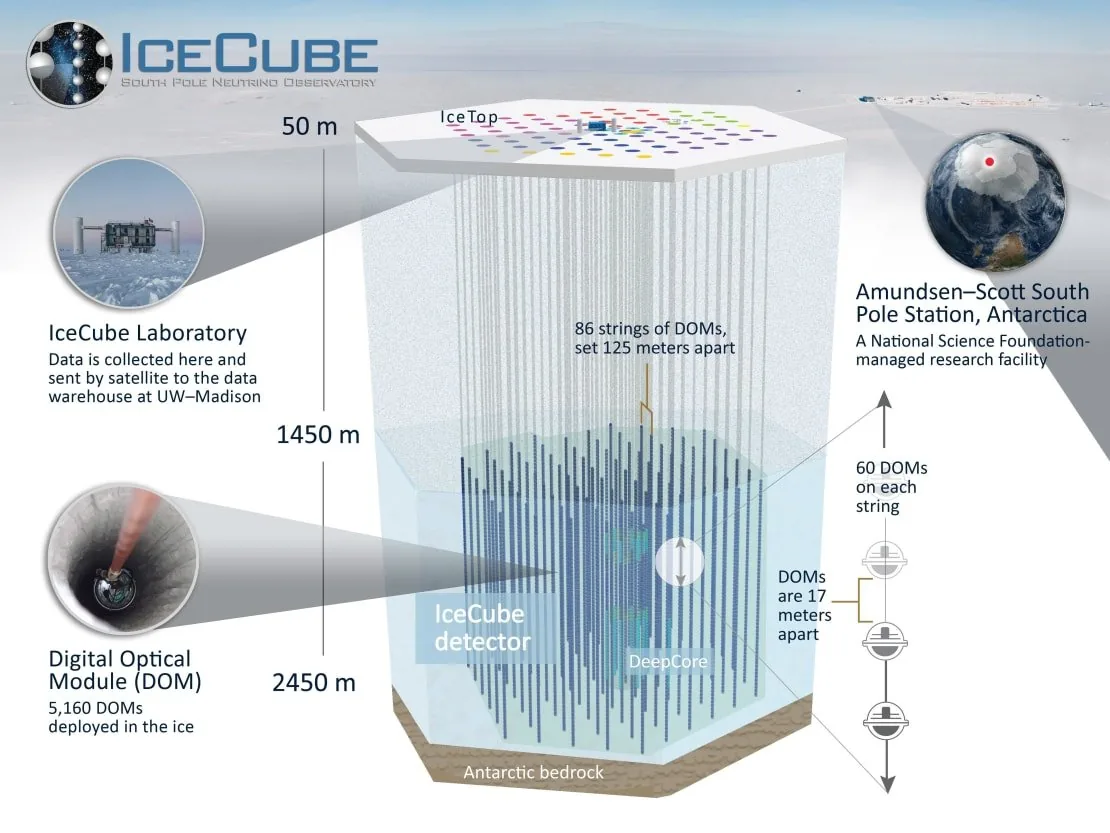
- Situated at the Amundsen-Scott South Pole Station in Antarctica, IceCube is the world’s largest particle detector (a device used to detect and measure subatomic particles). It utilizes a full cubic kilometre of incredibly pure, deep glacial ice.
- IceCube contains 5,160 optical sensors embedded in about one cubic kilometre of Antarctic ice.
- The South Pole is particularly suitable because its deep ice is clear, stable, dark and relatively free from interference.
- Detection Mechanism:
- When a high-energy neutrino occasionally collides with an atomic nucleus in the ice, it produces charged particles that generate faint flashes of blue light.
- The embedded sensors capture this light, allowing scientists to reconstruct the energy and exact cosmic origin of the neutrino.
- Significance:
- Pioneering a “New Kind of Astronomy”:
- For centuries, scientists have relied on the electromagnetic spectrum (visible light, radio waves, X-rays, and gamma rays) to observe the cosmos.
- Francis Halzen’s successful deployment of the IceCube Neutrino Observatory has established a revolutionary observational paradigm known as neutrino astronomy. This allows humanity to study the universe using elusive subatomic particles rather than conventional light.
- Decoding Uncorrupted Cosmic Messengers:
- Traditional observation methods have major limitations: high-energy protons (cosmic rays) are charged and get deflected by interstellar magnetic fields, while gamma radiation is often absorbed by cosmic dust.
- Because neutrinos carry no electrical charge and interact very weakly with matter, they travel across billions of light-years in perfectly straight lines, undisturbed by magnetic fields or dense physical obstructions.
- This unique property allows physicists to trace them directly back to their exact cosmic origins.
- Mapping the Universe’s Environments:
- The continuous capture of high-energy astrophysical neutrinos allows astrophysicists to probe the internal mechanics of the most extreme and energy-rich environments in the distant cosmos.
- This provides unprecedented insights into previously obscured phenomena like supermassive black holes, active galactic nuclei (such as galaxy NGC 1068), and massive exploding stars (supernovae).
- Solving the Mystery of Cosmic Accelerators: High-energy neutrinos help scientists trace the origin of ultra-high-energy cosmic rays and identify the universe’s powerful natural particle accelerators.
- Pioneering a “New Kind of Astronomy”:
- Location and Scale:
- About:
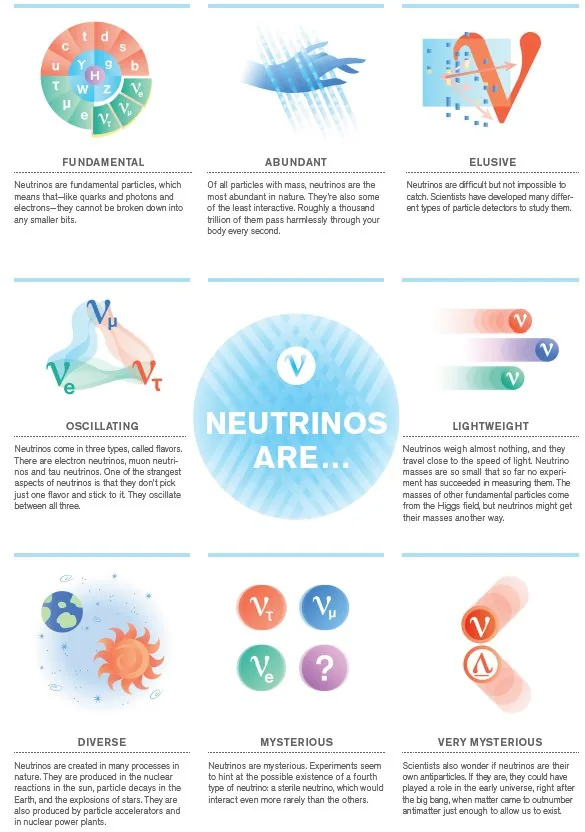
- Neutrinos are fundamental, elementary subatomic particles that belong to the lepton family.
- Because they rarely interact with normal matter, scientists often call them “ghost particles.”
- Despite their elusive nature, they are the second most abundant particles in the universe, outnumbered only by photons (light particles).
- Every second, around 65 billion solar neutrinos pass through every square centimetre of Earth and the human body, almost entirely undetected.
- Primary Sources of Neutrinos: Stars, cosmic rays, supernovae, radioactive decay, nuclear reactors, and particle accelerators.
- Key Properties:
- Charge: Neutrinos are completely electrically neutral (zero charge). This means they are not affected by magnetic or electromagnetic fields in space.
- Interaction: They interact only via the weak nuclear force and gravity. They do not interact with the strong nuclear force or electromagnetic force, allowing them to penetrate vast amounts of matter effortlessly.
- Mass: For decades, physicists believed neutrinos were completely massless. However, the 2015 Nobel Prize in Physics (awarded to Takaaki Kajita and Arthur B. McDonald) confirmed that they do have a tiny, nearly zero mass.
- Three Types (Flavors) of Neutrinos:
- Electron neutrino: Produced during the radioactive beta decay of atomic nuclei, primarily originating from the massive nuclear fusion reactions in the core of the Sun.
- Muon neutrino: Created when high-energy cosmic rays (mainly protons) slam into the Earth’s upper atmosphere, producing particles that decay into muons and muon neutrinos.
- Tau neutrino: The rarest flavor, associated with the much heavier tau lepton. It was experimentally confirmed in 2000.
 What is the India Neutrino Observatory (INO) Project?
- About:
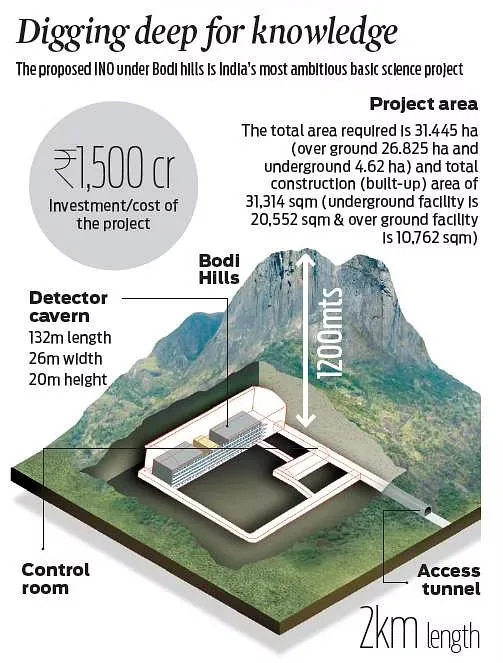
- The INO was included by the Planning Commission as a Mega Science Project under the 11th Five-Year Plan. It is a proposed underground facility at Bodi West Hills, Theni district, Tamil Nadu, aimed at studying the fundamental properties of neutrinos, particularly atmospheric neutrinos.
- Its deep underground location, with over 1 km of rock cover, helps shield detectors from background cosmic radiation.
- Structure: The project involves excavating a 2,100-meter-long access tunnel leading to a massive underground cavern designed to house the primary detector.
- ICAL Detector:
- The Iron Calorimeter (ICAL) is the core detector of the INO project. It will use 50,000 tonnes of magnetized iron and is designed to distinguish neutrinos from antineutrinos.
- When a neutrino very rarely collides with an iron nucleus, it produces a charged particle (a muon). Because the iron is magnetized, the path of the resulting muon will curve.
- The direction of this curve allows ICAL to uniquely distinguish between neutrinos and anti-neutrinos - a major scientific advantage over other global observatories.
- India’s Neutrino Legacy: During 1964–65, an international collaboration installed detectors about 2.3 km underground in the Kolar Gold Fields in Karnataka and recorded atmospheric neutrinos in 1965, making India one of the earliest centres of experimental neutrino research.
- Current Status: The INO project is stalled due to environmental concerns, its location in a tiger corridor, and pending wildlife clearance. Local opposition also stems from misconceptions about radioactivity, though neutrino research is non-radioactive.
Economic Scenario
SME Growth Fund
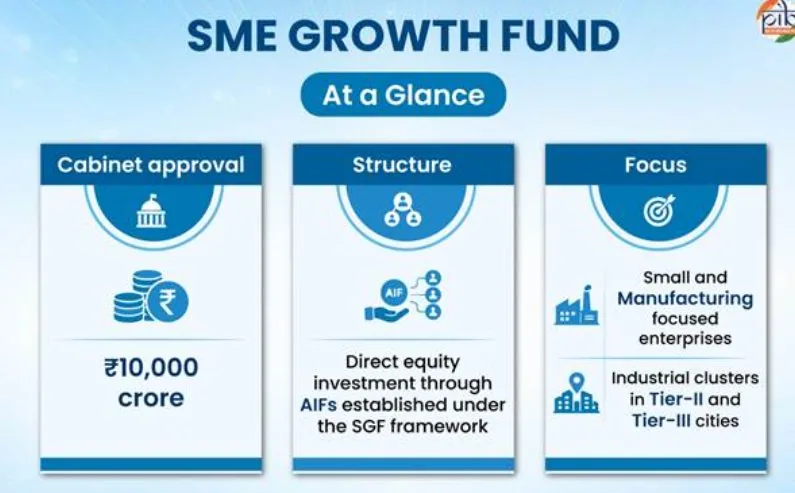
Source Why in News?- The Union Cabinet, chaired by the Prime Minister, has approved a landmark commitment of Rs 10,000 crore towards the establishment of the SME Growth Fund (SGF). This fund is designed to provide direct equity investments to Small and Medium Enterprises (SMEs) to create “future champions” capable of competing at the global level.
- About:
- The SME SGF is a state-backed financing vehicle announced in Union Budget 2026–27 to provide long-term equity capital to high-potential SMEs.
- It aims to address the “missing middle” financing gap and help viable SMEs scale into global champions, supporting Atmanirbhar Bharat and Viksit Bharat @ 2047.
- Fund Allocation and Purpose: The fund is designed to provide “patient equity capital” to high-potential enterprises that have demonstrated business viability and scalability.
- Target Sectors: It aims to support the emergence of champion enterprises across manufacturing, services, technology, innovation-driven sectors, and strategic value chains.
- Strategic Focus on Manufacturing: A majority of the SGF’s allocations will be directed towards small and medium manufacturing-focused enterprises seeking to expand capacity, adopt advanced technologies, and improve productivity.
- Focus on Industrial Clusters: The fund will specifically prioritize SMEs operating in industrial clusters located in Tier-II and Tier-III cities to promote balanced regional industrial development and strengthen local supply chains.
- Operational Framework:
- The SME Growth Fund is structured as a direct equity investment fund and will operate as an Alternative Investment Fund (AIF) established under the SGF framework.
- An Alternative Investment Fund is a privately pooled investment vehicle established in India that raises capital from sophisticated investors (both domestic and foreign) and invests it according to a defined investment policy for the benefit of its investors.
 Classification of MSMEs in India
- As per the revised MSME classification framework, effective from April 2025, MSMEs in India are classified based on a composite criterion of investment in plant, machinery or equipment and annual turnover.
- Micro Enterprise: Investment up to Rs 2.5 crore and an annual turnover of up to Rs 10 crore.
- Small Enterprise: Investment up to Rs 25 crore and an annual turnover of up to Rs 100 crore.
- Medium Enterprise: Investment up to Rs 125 crore and an annual turnover of up to Rs 500 crore.
- Economic Contribution: According to the Economic Survey 2025-26, MSMEs account for 31.1% of India’s GDP, 35.4% of its manufacturing output, and a massive 48.58% of its exports.
- Expanding Formal Base: As of October 2026, total MSME registrations under the Udyam portal and the Udyam Assist Platform (UAP) reached ~9.78 crore.
- Employment Generation: Registered MSMEs are a primary driver of job creation, having reported approximately 43.28 crore employment opportunities.
- Women’s Participation: Female entrepreneurship is robust within the sector, with women-owned enterprises accounting for 37.6% of total registrations.
- Sectoral Spread: The registered base is heavily diversified. Trading accounts for ~4.08 crore registrations, followed closely by services at ~3.77 crore, and manufacturing at ~1.93 crore.
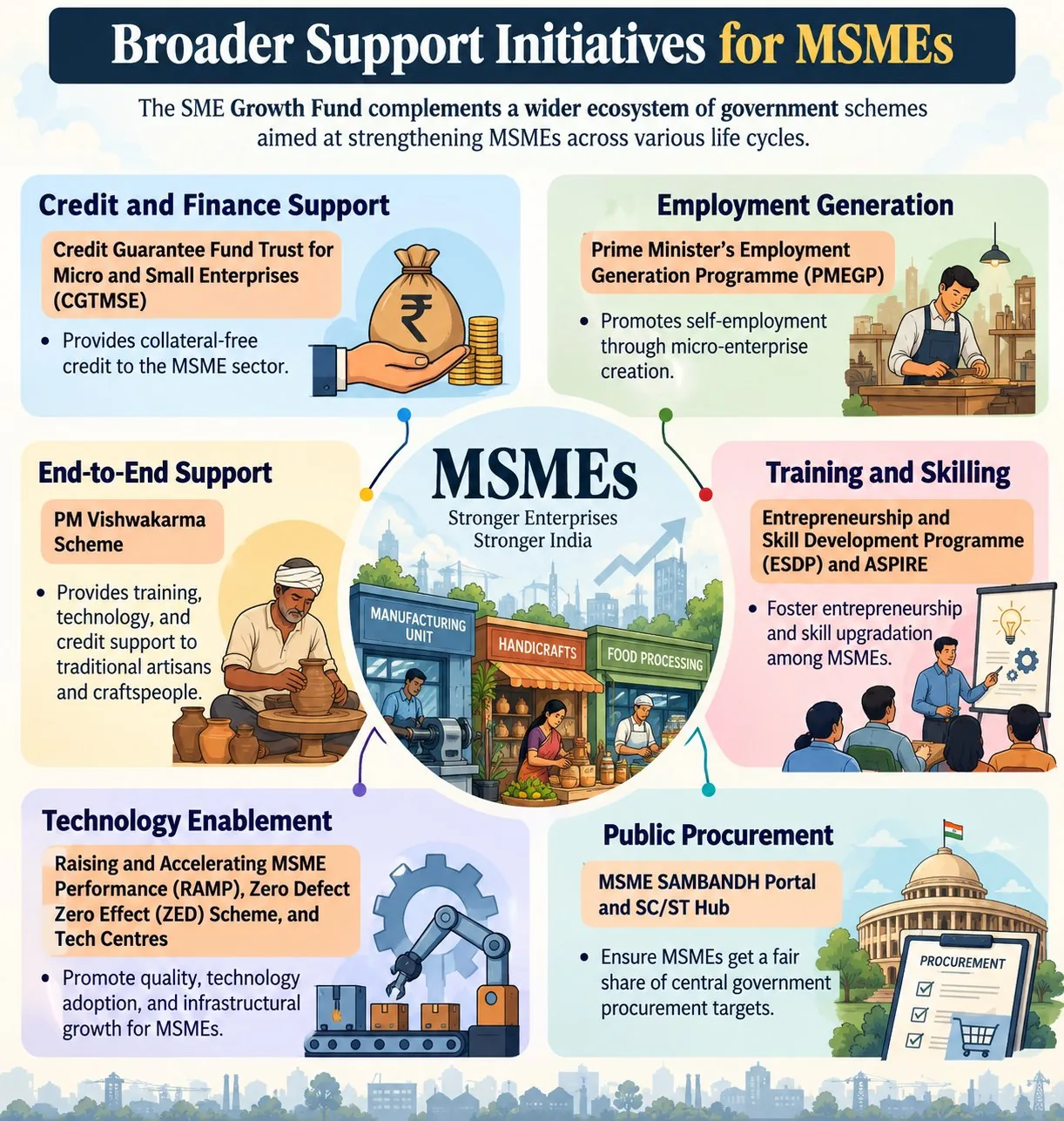
- Green & Sustainable Growth: MSMEs are adopting renewable energy, energy-efficient technologies, recycling, and cleaner production, supported by initiatives like RAMP, ZED Certification, and energy-efficiency programmes.
 What are the Challenges Faced by the MSME Sector?
- Massive Credit Gap:
- A vast majority of MSMEs operate informally without a documented financial track record, making risk assessment difficult for banks.
- According to the U.K. Sinha Committee (constituted by the RBI in 2019), the MSME sector faces an estimated formal credit gap of Rs 20 to Rs 25 lakh crore. This acute shortage forces them to rely on informal lenders with exorbitant interest rates.
- The Delayed Payments Crisis:
- MSMEs frequently suffer from delayed payments by large corporate buyers and Public Sector Undertakings (PSUs).
- A study by the Global Alliance for Mass Entrepreneurship (GAME) estimated that approximately Rs 10.7 lakh crore is tied up annually in delayed payments.
- This staggering amount - nearly 5.9% of India’s Gross Value Added (GVA) - creates severe working capital distress and disrupts production cycles.
- Regulatory “Cliff Effect”:
- MSMEs are overwhelmed by complex regulatory frameworks across labor, taxation (GST), and environmental clearances.
- The fear of complex compliance requirements intentionally keeps businesses small.
- According to industry reports on ease of doing business, a significant percentage of employer compliance obligations in India carry potential imprisonment clauses, discouraging formal expansion.
- Around 95% of registered MSMEs remain Micro or Small, showing the persistent gap in scaling despite higher classification limits under Budget 2025–26.
- Technological Obsolescence & Digital Divide:
- Many small enterprises rely on legacy machinery and outdated processes.
- Only a fraction around 23%, have integrated advanced technologies like Artificial Intelligence (AI) or IoT. This leads to low productivity and an inability to integrate into modern global supply chains.
- Skilled Labor Shortages:
- Finding and retaining a workforce with the right specialized skill sets is a constant struggle.
- Over 50% of MSMEs cite a severe lack of in-house technical skills as the primary barrier to adopting modern digital and manufacturing solutions, as they lack the financial capacity to offer salaries competitive with large corporations.
- Marketing & Market Access:
- Around 70% of MSMEs rely on traditional marketing, limiting visibility, branding and market expansion.
- High logistics costs, limited export finance, and Environmental, Social, and Governance (ESG) compliance requirements constrain MSME exports, while EU CBAM may raise costs for coal-dependent exporters.
- Strict Resolution of Delayed Payments:
- The government must ensure strict enforcement of the MSME Samadhaan portal.
- Large corporates and PSUs must be mandated to register on the Trade Receivables Discounting System (TReDS) to ensure immediate liquidity for MSMEs against pending invoices. Highlighting the platform’s success, Budget 2026–27 announced its further expansion, noting that it has already unlocked over ₹7 lakh crore for small businesses.
- Enhancing Alternative Risk Assessment:
- To bridge the credit gap, banks and NBFCs must move away from traditional collateral-based lending.
- Developing MSME-focused credit scoring models using alternative data such as GST returns and digital transaction histories can lower risk perception and improve credit flow.
- Driving Technology & Innovation (Industry 4.0):
- Targeted incentives must be provided to MSMEs for adopting automation and cloud-based software.
- Expanding shared R&D labs, Common Facility Centres (CFCs), and plug-and-play industrial infrastructure can raise productivity without massive upfront capital investment from the SMEs.
- Simplifying the Regulatory Framework:
- The government should focus on the digitization of approvals, the decriminalization of minor economic offenses, and extending self-certification for low-risk MSMEs.
- This will reduce transaction costs and encourage micro-enterprises to scale up into the formal economy.
- Bridging the Skill Gap: Strengthening Industry-Academia-ITI linkages and expanding apprenticeship programs will ensure continuous upgradation of workforce capabilities tailored to the specific needs of regional MSME clusters.
- The MSME sector is the true growth engine of the Indian economy, driving employment generation, rural industrialization, and export diversification. However, the sector has long suffered from the “missing middle” syndrome, stunted by chronic credit gaps and the crippling burden of delayed payments.
Health & Medicine
Plague Risk Emerges in Russia
Source Russia has reported that the plague situation is under control following reports of the suspected death of a 28-year-old laboratory worker at an anti-plague research institute in the Irkutsk region of Siberia.- About Plague: It is a zoonotic infectious disease caused by the bacterium Yersinia pestis, generally found in small mammals and their fleas.
- Transmission: Humans can become infected through infected flea bites, contact with infected tissues/materials or inhalation of respiratory particles from a pneumonic plague patient.
- Major Forms:
- The three main clinical forms are bubonic, pneumonic and septicaemic plague.
- Bubonic plague is the most common form, while pneumonic plague is the most virulent and can spread between humans through respiratory particles.
- Treatment: Plague can be effectively treated with antibiotics, particularly when diagnosed and treated early.
- Global Presence: Human plague remains endemic in several countries; during 2019-2025, most cases reported to the World Health Organization (WHO) occurred in the Democratic Republic of the Congo and Madagascar.
Infrastructure & Energy
Integrated Transport and Logistics Authority (ITLA)
Source Why in News?- Recently, the Union Cabinet approved the setting up of the Integrated Transport & Logistics Authority (ITLA) as a Special Purpose Vehicle (SPV) to strengthen research, planning, project appraisal, monitoring and impact assessment across the transport and logistics sectors.
- About:
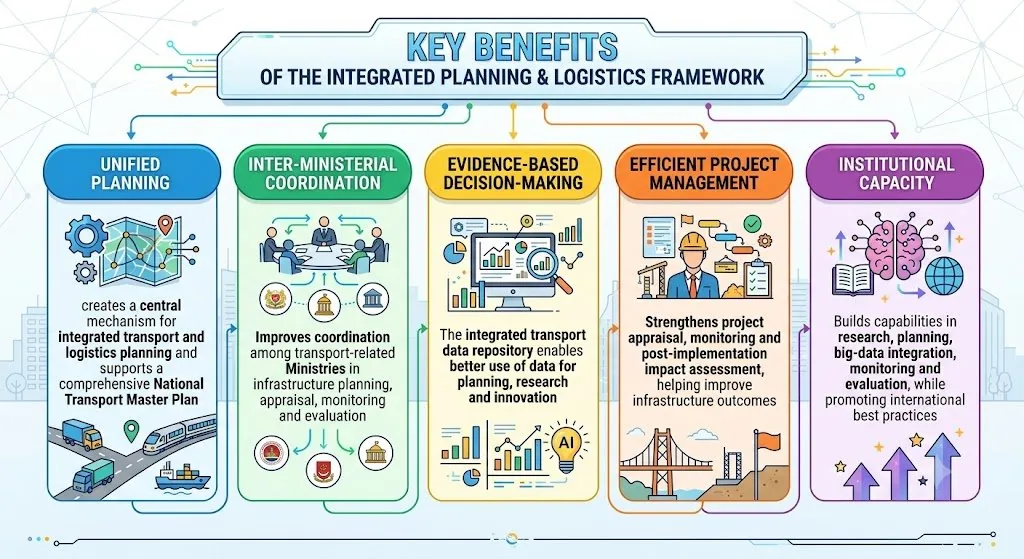
- The Integrated Transport and Logistics Authority (ITLA) is a specialised apex institutional mechanism aimed at addressing fragmented planning across transport-related Ministries and agencies.
- It will promote coordinated, multimodal and long-term infrastructure development through integrated planning, policy support, data analytics, project appraisal, monitoring and impact assessment.
- ITLA will complement existing initiatives such as the PM GatiShakti National Master Plan and the National Logistics Policy.
- National Transport Master Plan: ITLA will prepare a comprehensive National Transport Master Plan with a planning horizon of 10 years or more, covering roads, railways, ports and shipping, civil aviation, inland waterways, coastal shipping, urban mobility and logistics.
- Integrated Planning: It will evaluate five-year sectoral plans and annual plans of transport Ministries to ensure alignment with the National Transport Master Plan and promote multimodal infrastructure development.
- Project Appraisal and Monitoring: ITLA will undertake technical appraisal of Government infrastructure projects costing ₹500 crore or more, while financial appraisal will continue through existing mechanisms. It will also monitor projects above ₹500 crore and conduct post-implementation impact assessments.
- National Transport Data Repository: ITLA will establish a unified National Transport Data Repository integrating datasets such as GSTN e-way bills, FASTag, Vahan, GPS-based systems and urban traffic management systems for freight-flow and origin-destination analysis.
- Policy and Capacity Support: It will assist in reviewing and updating the National Logistics Policy, support capacity building, training and skilling, and promote research and innovation in transport and logistics.
- Significance: ITLA is expected to improve inter-ministerial coordination, strengthen evidence-based planning, enhance multimodal connectivity, improve infrastructure efficiency, reduce logistics costs and support India’s global logistics competitiveness and Vision 2047.
International Relations
Kaliningrad: A Flashpoint in Russia-NATO Tensions
Source Russia warned the North Atlantic Treaty Organization (NATO) against attempting to isolate or attack Kaliningrad, highlighting the risk of escalation around the strategically located Russian exclave. Kaliningrad- Location:
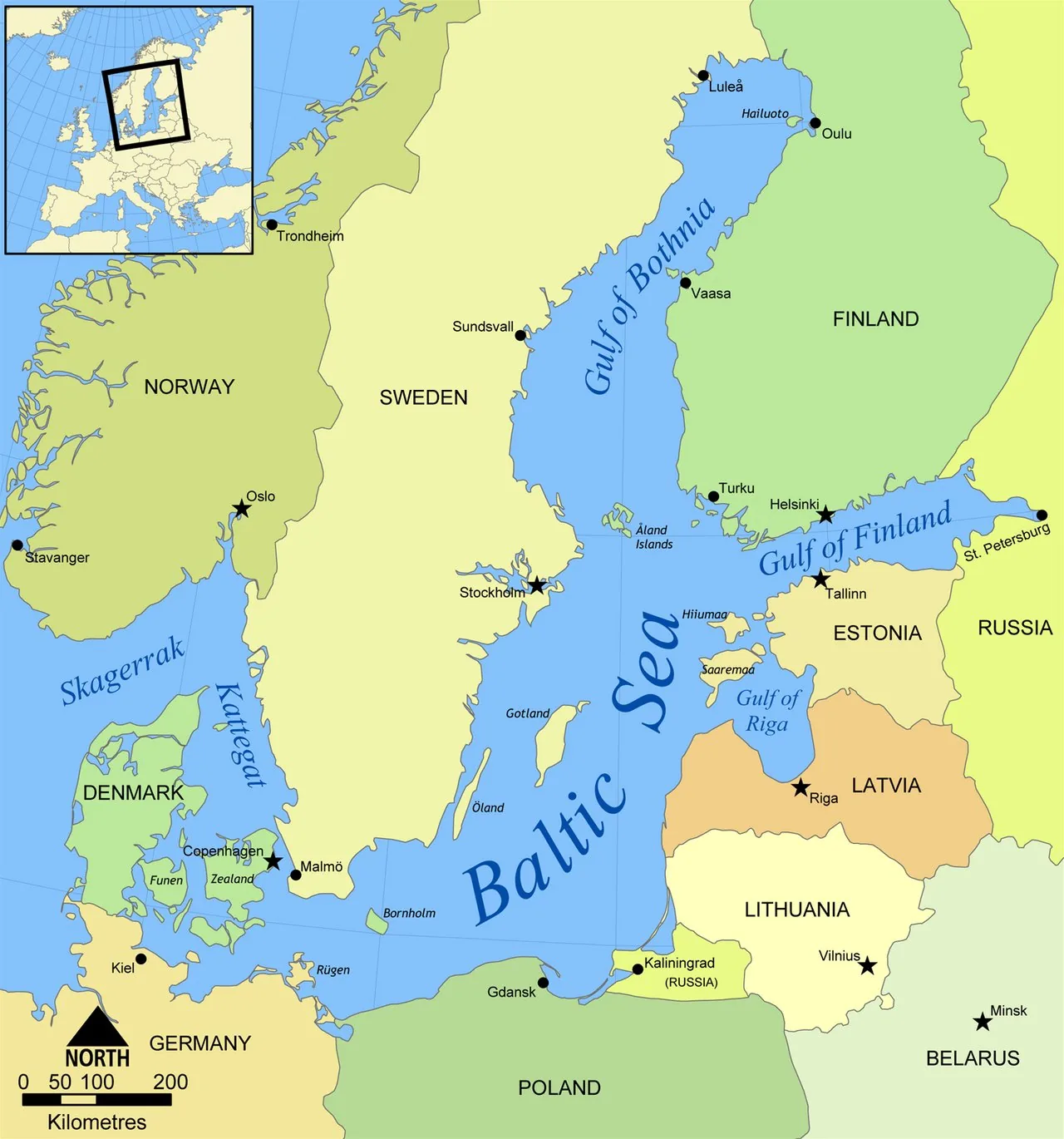
- Kaliningrad is Russia’s westernmost region, separated from mainland Russia and situated on the Baltic Sea.
- It borders Lithuania to the north and east and Poland to the south, both NATO and European Union (EU) members.
- Kaliningrad lies northwest of the strategically important Suwałki Gap, the narrow Poland-Lithuania corridor separating it from Belarus.
- The corridor provides the only land connection between the Baltic States and the rest of NATO.
- Historical Background: Formerly Königsberg, the capital of German East Prussia, the city was transferred to the Soviet Union in 1945 under the Potsdam Agreement. after World War II and was renamed Kaliningrad in 1946.
- Geopolitical/Geostrategic Significance:
- NATO’s growing military presence in the Baltic region and Russia’s military concentration in Kaliningrad make the region a potential Russia-NATO flashpoint.
- The region hosts Russia’s Baltic Fleet and significant military capabilities, including nuclear-capable Iskander-M missiles.
Military Exercises
Exercise MOUNTAIN GUARDIAN 2026
Source The India-UAE Joint Military Exercise MOUNTAIN GUARDIAN 2026 is being conducted at the Foreign Training Node, Chaubatia, Uttarakhand, from 5th to 18th October 2026.- About the Exercise: MOUNTAIN GUARDIAN is a bilateral military exercise between the Indian Army and the UAE Army, aimed at strengthening interoperability, mutual understanding and defence cooperation.
- Focus Area: The 2026 edition is centred on mountain warfare, with training designed for operations in difficult and high-altitude terrain.
- Participation: A total of 92 personnel, with equal representation from both armies, are participating. The Indian contingent comprises troops from a Bhairav Battalion, while the UAE contingent is drawn from a Mountain Infantry Battalion.
- Women Participation: Women officers and combatants from both armies are participating in specialist roles, reflecting broader operational integration.
- Training Activities: The exercise includes joint planning, tactical drills, firing practices, surveillance-grid establishment, drone operations, physical endurance training, rock climbing, obstacle training and integrated field exercises.
- Technology and Knowledge Exchange: Training incorporates technology-enabled operations and exchange of tactics, techniques and procedures (TTPs) relevant to warfare in challenging mountainous terrain.
- Significance: The exercise is expected to improve tactical proficiency and interoperability, facilitate exchange of best practices, and further strengthen military-to-military cooperation and strategic ties between India and the UAE.
Schemes & Initiatives
1st Meeting of the DCTI and the Kasturi Cotton Bharat Initiative
Source The convening of the First Meeting of the Development Council for Textile Industry (DCTI) in New Delhi, coupled with the rapid expansion of the Kasturi Cotton Bharat initiative, highlights India’s strategic push to establish a globally competitive, sustainable, and highly traceable textile value chain.- DCTI:
- It is an apex high-level advisory body constituted by the Ministry of Textiles that brings together the government, academia, and industry stakeholders to position India as a global textile leader.
- The DCTI established dedicated working groups to tackle critical priorities: Production and Productivity; Research & Development (R&D); Export & Market Access; Raw Material Availability; and Investment, Skilling, and Sustainability.
- The council is driving a comprehensive “Farm to Fibre, Fibre to Factory, Factory to Fashion, and Fashion to Foreign” vision to eliminate supply chain bottlenecks.
- Kasturi Cotton Bharat Initiative:
- Launched as India’s premium cotton brand, it aims to establish a distinct global identity for Indian cotton, rivaling premium global standards like SUPIMA (USA) or Giza (Egypt) cotton.
- The initiative is jointly executed by the Cotton Corporation of India (CCI) and the Cotton Textiles Export Promotion Council (TEXPROCIL), operating on the principle of industry self-regulation.
- Cotton bales under Kasturi Cotton Bharat, must meet strict benchmarks for fiber length and reduced contamination, with mandatory certification from NABL-accredited laboratories, ensuring adherence to specific criteria including Micronaire value, Rd value (colour/reflectance), fibre strength, uniformity index, trash, and moisture content.
- Cotton that does not comply with these standards cannot carry the assurance of Kasturi quality.
- Kasturi Cotton is a strict confirmation of Indian origin. Cotton imported from other parts of the world cannot qualify or be branded as Kasturi Cotton, protecting the integrity of domestic farmers and producers.
One Year of PM-SETU
Source Why in News?- Recently, PM-SETU came into focus as it completed one year of implementation, with 850 Industrial Training Institutes (ITIs) identified and 14 ITI clusters approved under its Hub-and-Spoke model.
- About:
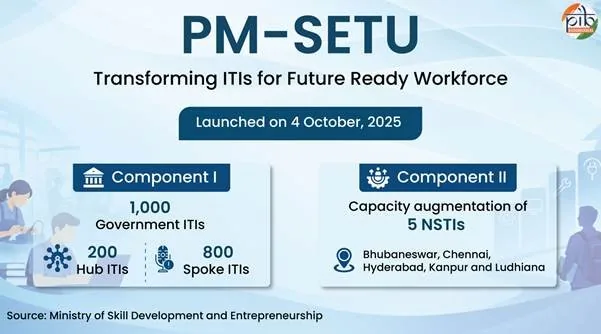
- Launched on 4th October 2025, PM-SETU aims to modernise Government ITIs and make vocational training more industry-aligned and demand-driven.
- It is a ₹60,000-crore vocational education and training upgradation scheme designed to align skilling with evolving industry requirements.
- The scheme promotes industry-led skilling by involving companies in curriculum design, training delivery, infrastructure development and institutional governance
- Hub-and-Spoke Model: Component I covers 1,000 Government ITIs comprising 200 Hub ITIs and 800 Spoke ITIs. Each Hub is connected to an average of four Spoke ITIs, enabling shared access to modern infrastructure, advanced training facilities, digital learning systems and incubation facilities.
- Modernised Training Infrastructure: Hub ITIs have innovation centres, training-of-trainers facilities, production units and placement services, while Spoke ITIs expand access to these resources. Upgradation includes smart classrooms, modern laboratories, digital content and industry-aligned courses.
- Strengthening NSTIs: Component II focuses on capacity augmentation of five National Skill Training Institutes (NSTIs) at Bhubaneswar, Chennai, Hyderabad, Kanpur and Ludhiana. It includes sector-specific National Centres of Excellence and advanced training of trainers through global partnerships.
- State–Industry–Centre Coordination: States and UTs lead the selection of ITIs in consultation with industry and submit upgradation proposals with industry partners based on emerging skill requirements and regional industrial potential. At the national level, the National Steering Committee (NSC), chaired by the Secretary, MSDE, provides policy direction, finalises guidelines, monitors implementation and undertakes course correction.
- Industry-Led Governance: PM-SETU establishes Special Purpose Vehicles (SPVs) for upgraded ITI clusters. The proposed ownership structure gives 51% to the Anchor Industry Partner, while the Centre and State Governments hold 24.5% each.
- Industry-Aligned Training: SPVs will drive cluster development and operations based on local industry needs, including interventions in curriculum, training delivery, infrastructure and industry exposure. Prospective industry partners are also required to submit a Strategic Investment Plan (SIP).
 How is PM-SETU Transforming ITIs?
- Implementation Progress: In the first year, 850 Government ITIs have been identified, comprising 172 Hub ITIs and 678 Spoke ITIs. Thirty-six States/UTs have identified clusters and created dedicated State budget heads, 35 have constituted State Steering Committees, and 26 have initiated the process of inviting industry participation.
- Nationwide Rollout: The National Steering Committee (NSC) has approved the transition from the pilot phase to nationwide rollout across 200 ITI clusters, based on industry readiness and implementation capacity.
- Industry Investment: 14 Strategic Investment Plans (SIPs) covering 8 States and 1 UT have been approved, involving ₹3,446 crore investment. The projects span sectors such as steel, manufacturing, healthcare, pharmaceuticals, infrastructure, automotive and defence electronics.
- 32 New-Age Courses: Directorate General of Training (DGT) has introduced 32 new-age courses under the Craftsmen Training Scheme covering AI, Cyber Security, Additive Manufacturing, EVs, Semiconductor Technology, Robotics, Green Hydrogen, Drones, IoT, Solar Energy and 5G, among others.
- International Partnerships: MoUs have been signed with Singapore for NSTI Chennai, France for NSTI Kanpur and Australia for NSTI Bhubaneswar, while a Joint Declaration of Intent has been exchanged with Germany for NSTI Hyderabad.
- Vocational Training: Industrial Training Institutes (ITIs) provide practical vocational training to equip youth with skills required for employment and industry. Under the Craftsmen Training Scheme (CTS), training is offered in engineering and non-engineering trades through Government and Private ITIs.
- Course Duration: The duration of ITI courses ranges from six months to two years, depending on the trade.
- National-Level Coordination: The Directorate General of Training (DGT), Ministry of Skill Development and Entrepreneurship (MSDE), is the apex organisation responsible for the development and coordination of vocational training at the national level. Its functions include policy formulation, framing norms and standards, curriculum development, affiliation, instructor training and trade testing.
- Administrative Control: ITIs function under the administrative and financial control of State Governments and Union Territory Administrations.
- Expansion of ITI Network: The number of Government and Private ITIs increased from 9,776 in 2014 to 13,888 in 2026, representing a 42% increase.
- Rising Enrolment: ITI enrolment increased from 9.51 lakh in 2014–15 to 14.70 lakh in 2025–26, registering a 54% increase.
- PM-SETU represents a shift from conventional vocational training towards a modern, industry-led and technology-oriented skilling ecosystem. Its Hub-and-Spoke model, industry-led SPVs, Strategic Investment Plans, new-age courses and international partnerships seek to make ITIs more responsive to changing labour-market requirements. By connecting skills, industry and employment, PM-SETU can strengthen India’s human capital and support the creation of a skilled workforce capable of contributing to emerging sectors and the broader objective of Viksit Bharat.