Comrades Editorial · 08 Oct 2026 (PDF)
In this edition
- West Asian Crisis and Securing India’s Strategic Interests International Relations
International Relations
West Asian Crisis and Securing India’s Strategic Interests
Source This editorial is based on “Three years later, in West Asia, a peace still out of reach” published in the Indian Express on 07/10/2026. The article highlights that ongoing Gaza devastation, disarmament deadlocks, widening regional conflict, and fraying US-Israel ties keep West Asian peace elusive. The Hamas-led attacks on Israel on 7th October 2023 and the ensuing Gaza war intensified the longstanding Israeli–Palestinian conflict, with subsequent escalation across West Asia. For India, regional instability threatens energy supplies, maritime trade, diaspora welfare and connectivity projects. Understanding these risks requires examining both historical grievances and contemporary political choices.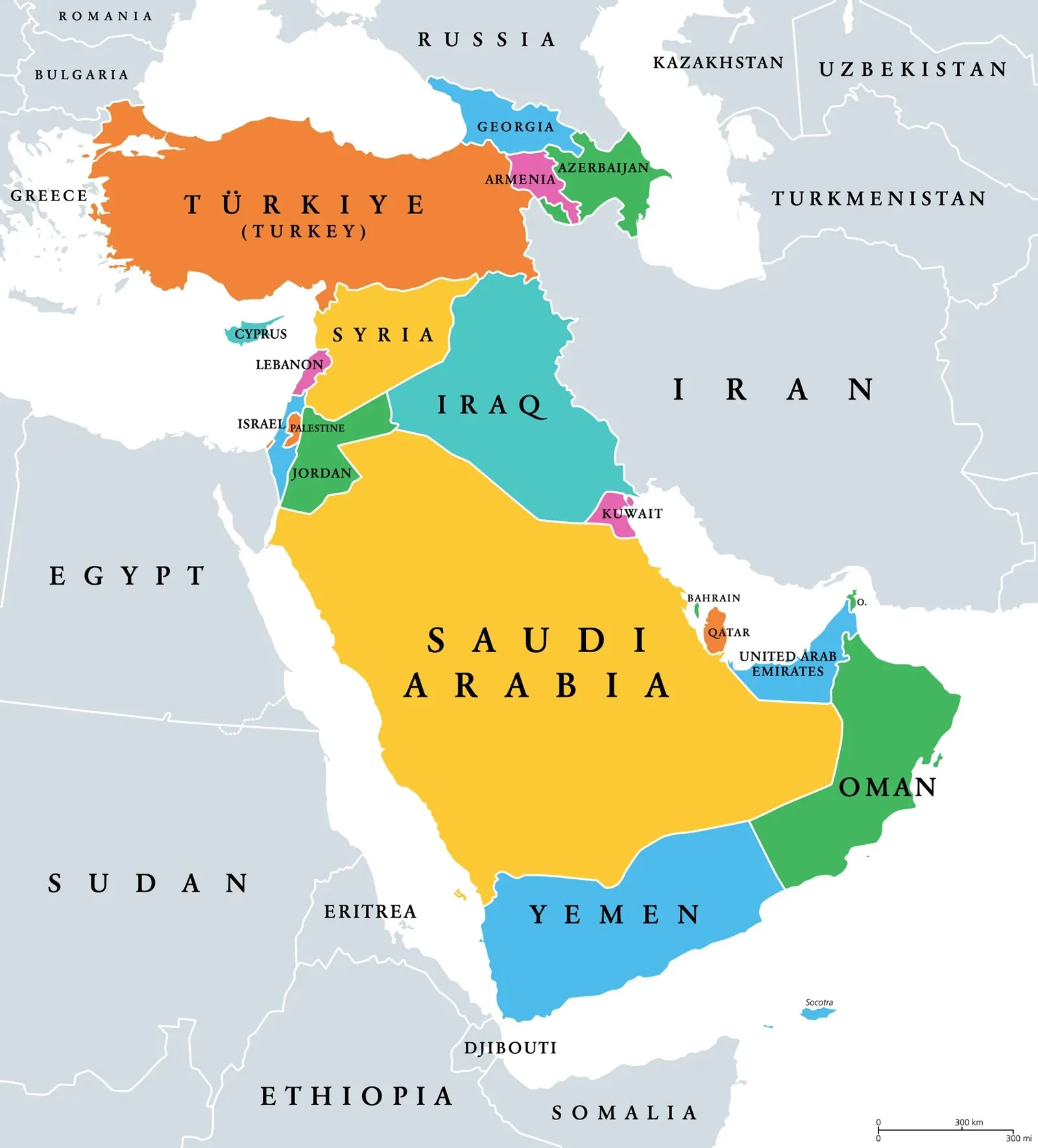 How Have Historical Events Contributed to Recurring Crises in West Asia?
- Colonial Partition, Unresolved Claims and Self-Determination:
- Post-Ottoman arrangements created lasting tensions between territorial sovereignty and the aspirations of communities divided across states.
- The Sykes–Picot Agreement (1916) envisaged British and French spheres of influence while the Balfour Declaration (1917) expressed British support for a Jewish national home in Palestine. These arrangements often prioritised imperial interests over local political consent.
- The Kurdish question, spanning Türkiye, Iraq, Iran and Syria, illustrates the continuing conflict between self-determination, minority rights and state sovereignty.
- Palestinian Displacement and Intergenerational Refugee Grievances:
- Unresolved displacement sustains competing claims over homeland, return, citizenship and historical justice.
- The 1948 Arab–Israeli War accompanied Israel’s establishment and the Nakba (mass displacement and dispossession of Palestinians). When the United Nations Relief and Works Agency for Palestine Refugees in the Near East (UNRWA) began operations in 1950, it responded to the needs of approximately 750,000 Palestine refugees. UNRWA now maintains active files for approximately 5.9 million Palestine refugees, including eligible descendants.
- The absence of an agreed settlement on return, compensation and resettlement keeps historical dispossession central to Palestinian politics and complicates negotiations with Israel.
- Territorial Occupation and Settlement Expansion:
- Unresolved territorial control repeatedly turns disputes over land into wider political and security crises.
- The Six-Day War (1967) brought the West Bank, including East Jerusalem, and Gaza under Israeli occupation. UN Security Council Resolution 242 established withdrawal and a negotiated peace as central principles, but a comprehensive territorial settlement remained unresolved.
- Israeli settlement expansion fragments Palestinian territory and makes a contiguous, viable Palestinian state harder to establish, reinforcing resistance, insecurity and recurring confrontation.
- Iranian Revolution and Rivalry Over Regional Political Leadership:
- Iran’s revolutionary transformation reshaped alliances and intensified competition over regional influence.
- The 1953 overthrow of Mohammad Mossadegh (former PM of Iran), involving US covert intervention, strengthened Iranian mistrust of Western intentions; the 1979 Revolution subsequently overturned the Shah’s pro-American alignment. These experiences influence Iranian perceptions of sovereignty, regime security and foreign interference.
- Iran–Saudi competition subsequently interacted with local struggles, including Yemen’s civil war and the Saudi-led intervention in 2015. Religious identities became instruments of political mobilisation alongside strategic interests.
- Iraq Invasion and the Destruction of Institutional Capacity:
- Following the US-led invasion of Iraq in 2003, de-Ba’athification (to remove the influence of Saddam Hussein’s Arab Socialist Ba’ath Party) and the dissolution of the Iraqi Army removed personnel and disrupted administrative and security institutions. It contributed to insurgency, militia expansion and opportunities for extremist recruitment.
- The legacy extends beyond Iraq. The UN Secretary-General’s July 2026 report estimated that Islamic State of Iraq and the Levant (ISIL) retained up to 3,000 fighters in Syria.
- This illustrates how organisations emerging from interconnected Iraqi and Syrian conflicts can survive territorial defeat through clandestine networks and exploit renewed governance failures.
- Lebanese Civil War and Incomplete Restoration of State Sovereignty:
- Peace settlements remain vulnerable when armed power and political authority operate through competing institutions.
- Lebanon’s 1975–1990 civil war entrenched militia networks and external patronage. The 1989 Taif Agreement called for militia disarmament, but incomplete implementation left a continuing struggle over the state’s monopoly over legitimate force, especially concerning Hezbollah’s weapons.
- Failed Nuclear Bargains and Persistent Regional Security Dilemmas:
- The breakdown of negotiated restraints encourages coercion, strategic uncertainty and fears of proliferation.
- The 2015 Joint Comprehensive Plan of Action (JCPOA) linked nuclear restrictions and verification with sanctions relief. The US withdrawal in May 2018, followed by renewed sanctions and Iran’s subsequent reduction of commitments, weakened confidence in reciprocal agreements and their durability across governments.
- The IAEA estimated Iran held 440.9 kg of 60% enriched uranium in June 2025, but noted that lack of access prevented confirmation of the stockpile’s actual status and whereabouts. This verification deficit increases uncertainty and escalation risks
- Unfinished Peace Processes and Deferral of Political Settlement:
- The Oslo Accords (1993) envisaged an interim period of no more than 5 years, with negotiations on Jerusalem, refugees, settlements, security and borders. Failure to conclude these issues prolonged provisional arrangements and undermined confidence in negotiated compromise.
- UN Security Council Resolution 2803 welcomed the Board of Peace (BoP) as a transitional administration to coordinate Gaza’s redevelopment and funding until a reformed Palestinian Authority can securely and effectively resume control. It provides a framework for recovery, but does not itself settle the Palestinian question.
- Oil Warfare and Coercion through Maritime Chokepoints:
- Historical conflicts established energy supplies and shipping routes as instruments of pressure, a pattern continuing through disruptions in Hormuz and Bab el-Mandeb.
- The 1973 Arab oil embargo demonstrated the geopolitical leverage of energy supplies, while the Tanker War during the 1980–1988 Iran–Iraq conflict extended warfare to commercial shipping and drew foreign naval forces into the Gulf.
- Current Iranian restrictions and tanker attacks continue to impede navigation. The Houthis declared a blockade against Saudi-affiliated shipping in July 2026, threatening a crucial Red Sea export route.
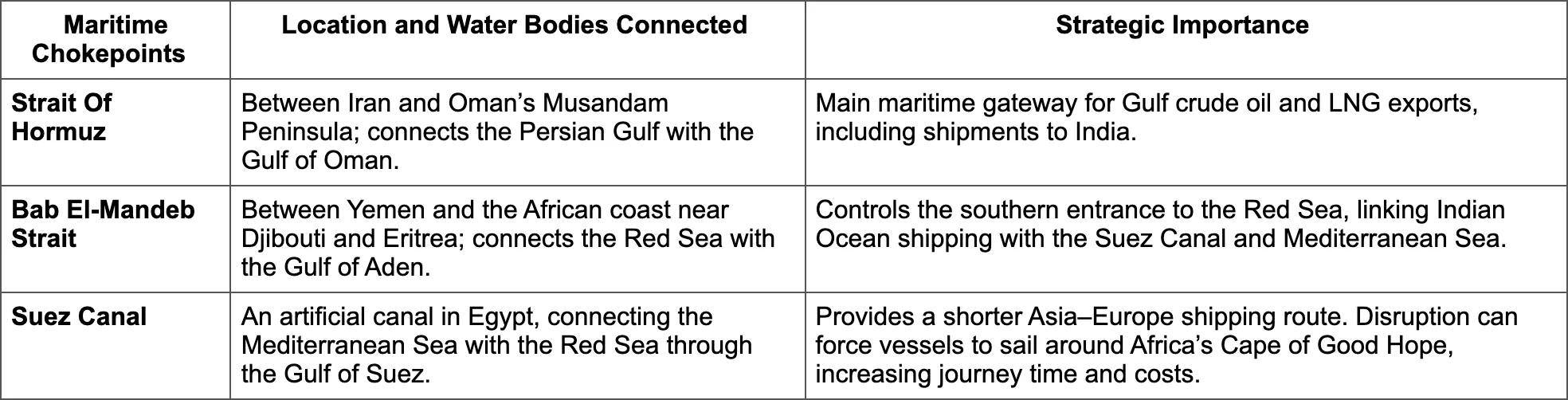
- The Suez Canal lies in Egypt, but forms an integral part of the maritime network serving West Asia.
- Energy Import Dependence, and Industrial Supply Disruptions:
- Conflict threatens the availability of crude oil, LPG and industrial feedstocks, making alternative supplies more expensive.
- Before the 2026 conflict, West Asian producers supplied nearly 90% of India’s LPG imports. Disruptions forced India to prioritise household cooking fuel and curtail supplies to some commercial and industrial consumers. This exposed the vulnerability of restaurants, small manufacturers and other LPG-dependent businesses.
- Diversification also faces constraints. Reduced Russian exports and stronger Chinese demand are tightening Russian crude availability for Indian refiners. Consequently, replacing disrupted Gulf supplies can involve costlier barrels, longer voyages and competition for alternative sources.
- Imported Inflation, Rupee Pressure and Monetary Policy Trade-Offs:
- Higher energy costs transmit regional instability into India’s prices, borrowing costs and external accounts.
- In October 2026, the RBI increased the repo rate by 25 basis points to 5.50% and shifted its stance to calibrated tightening. Its inflation projection rose to 5.2%, with war-driven oil prices contributing to price pressures alongside domestic factors, including weak monsoon rainfall.
- The resulting policy dilemma is significant. Higher interest rates can contain inflation expectations but also raise business financing costs and household loan repayments. Meanwhile, a larger energy-import bill increases dollar demand; rupee depreciation can further inflate the domestic cost of imported inputs.
- Fertiliser Feedstock Vulnerabilities and Rising Agricultural Subsidy Burdens:
- The crisis threatens agriculture through both imported fertilisers and the inputs needed for domestic production.
- Gulf countries supply 20–30% of India’s urea imports, 30% of DAP imports and nearly 50% of LNG imports. Gas availability to urea plants had initially fallen to approximately 60%, demonstrating that domestic manufacturing remains exposed to imported feedstocks.
- Export Logistics Disruptions, Working Capital Stress and Market Losses:
- Shipping uncertainty damages exporters through delayed deliveries, additional charges and slower payment realisation. It leads to vessel diversions, longer routes, transshipment congestion and emergency conflict surcharges.
- These disruptions can create a cash-flow squeeze. Firms pay for production and freight while goods remain undelivered and buyer payments are delayed.
- Perishable consignments face deterioration, while delivery-sensitive manufacturers risk cancellations and customers shifting to competing suppliers.
- Diaspora Safety, and Remittance-Dependent Household Vulnerabilities:
- Approximately 10 million Indians are living and working in the Gulf and send more than USD 52 billion in remittances from GCC countries. These figures underline the exposure of both overseas workers and families dependent on their earnings.
- Prolonged instability can interrupt construction, hospitality, transport and service-sector employment, producing unpaid wages, contract termination or premature return.
- Maritime Security Burdens, and Seafarer Casualties:
- Protecting commercial shipping increasingly requires naval vigilance, emergency assistance and coordination across jurisdictions.
- Attacks on MT Al Bahiyah and MT Mombasa, together carrying 30 Indian seafarers, killed one Indian and injured others. India consequently instituted vessel-by-vessel monitoring, dedicated liaison officers and continuous inter-agency coordination.
- Connectivity Delays, Sanctions Exposure and Investment Uncertainty:
- Instability undermines India’s efforts to secure reliable access to Europe, Afghanistan and Central Asia.
- Chabahar port faces a concrete sanctions challenge as the US conditional sanctions waiver expired in April 2026. This creates uncertainty over banking, insurance and operational arrangements for a gateway connecting India with Afghanistan and Central Asia.
- IMEC’s proposed ship–rail network requires dependable cooperation across the Gulf and onward to Europe. Continuing conflict raises risks for financing, cross-border coordination and infrastructure security.
- Strategic Autonomy Pressures and Competing Partnerships:
- India elevated relations with Israel to a Special Strategic Partnership in February 2026, encompassing defence, critical technologies and innovation. Simultaneously, Gulf countries remain vital economic partners, while engagement with Iran supports India’s continental connectivity interests. Escalation makes this multi-alignment harder to sustain.
- India’s March 2026 statement in Geneva rejected attacks on civilian and energy infrastructure and supported de-escalation. The diplomatic challenge is to apply these principles consistently while protecting practical interests. Perceived partiality can weaken trust with partners, whereas maintaining dialogue with all sides requires careful, sustained diplomacy.
- Independent Diplomacy, Crisis Hotlines and Issue-Based Cooperation:
- Establish an MEA-led West Asia crisis contact group, maintaining separate communication channels with Iran, Israel, Gulf governments and key mediators, including Oman and Qatar. Its immediate agenda should cover civilian protection, humanitarian access, merchant shipping and consular emergencies.
- Use the India–Arab Cooperation Forum’s Executive Programme for 2026–2028 to institutionalise regular consultations on economic and security disruptions.
- Complement this with bilateral engagement with Iran and Israel, preserving multi-alignment and India’s freedom to assess each issue independently.
- Diversified Energy Contracts and Distributed Strategic Reserves:
- Translate the May 2026 ISPRL–ADNOC agreement into enforceable storage and emergency-access arrangements. It envisages potential crude storage in India of 30 million barrels, storage at Fujairah, and cooperation on LNG and LPG storage.
- Negotiate destination flexibility, alternative loading ports and emergency cargo swaps in long-term contracts.
- Integrated Maritime Surveillance and Civilian Shipping Protection:
- Connect IFC-IOR, the Directorate General of Shipping, naval commands, shipping companies and partner maritime authorities through a shared incident-management system. Combine satellite imagery, AIS data and verified crew reports to detect suspicious vessel behaviour and issue route-specific warnings.
- Prioritise agreements with Oman, the UAE and other willing partners for emergency berthing, repairs, medical evacuation and replenishment.
- Arrange risk-based escorts and coordinated sailing windows where operationally feasible. Joint exercises should include merchant-vessel evacuation, navigation-system disruption and port cyberattacks, alongside conventional naval scenarios.
- Sovereign Maritime Insurance and Rapid Exporter Liquidity Support:
- Strengthen the Bharat Maritime Insurance Pool, launched in May 2026 with US$1.5 billion capacity and a ₹12,980-crore sovereign guarantee.
- Create a single emergency trade-finance window linking insurers, ECGC and banks. Verified shipment delays should enable expedited assessment for working-capital extensions, receivables finance and partial claim advances, particularly for MSMEs.
- Portable Migrant Protection and Pre-Arranged Mobility Agreements:
- Build on e-Migrate, MADAD and the Indian Community Welfare Fund (ICWF) to provide an optional, secure digital emergency record containing employment contracts, insurance, emergency contacts and essential documents.
- Negotiate bilateral arrangements for temporary visa extensions, lawful employer transfers, unpaid-wage claims and emergency accommodation during conflict. Pilot employer-funded wage-protection guarantees in vulnerable sectors, with independent grievance channels.
- Humanitarian Partnerships and Reconstruction for Durable Influence:
- Use the planned 200-bed Indian super-speciality hospital in Jenin (West Bank) and Palestinian vocational-training cooperation as foundations for medical training, telemedicine, equipment maintenance and scholarships.
- Develop India–Gulf–Palestinian partnerships combining Indian technical expertise, Gulf financing and Palestinian implementation. Prioritise repairable water systems, rehabilitation services and training that creates local employment.
- The West Asian crisis demonstrates that India’s strategic interests are inseparable from regional stability, secure energy supplies, maritime safety and diaspora welfare. India must therefore combine independent diplomacy, diversified energy sourcing, maritime preparedness, migrant protection and resilient connectivity. A calibrated policy of multi-alignment, humanitarian engagement and crisis preparedness can protect India’s interests while preserving its strategic autonomy and enabling it to remain a credible partner in the evolving West Asian order.