Comrades Dispatch · 09 Oct 2026 (PDF)
In this edition
- Study Flags Widespread Illegal GM Cotton Cultivation Agriculture & Rural
- 2026 Nobel Prize in Literature Awards & Recognition
- RBI MPC Raises Repo Rate to 5.50% Banking & Finance
- Strategy for Environmental-Economic Accounts in India 2026–2030 Environment & Ecology
- WHO Pandemic Agreement International Relations
- India-Ghana Advance Strategic Cooperation International Relations
- Additive Manufacturing in India Science & Technology
- GPS Tracking of Elephants in Assam Wildlife
Agriculture & Rural
Study Flags Widespread Illegal GM Cotton Cultivation
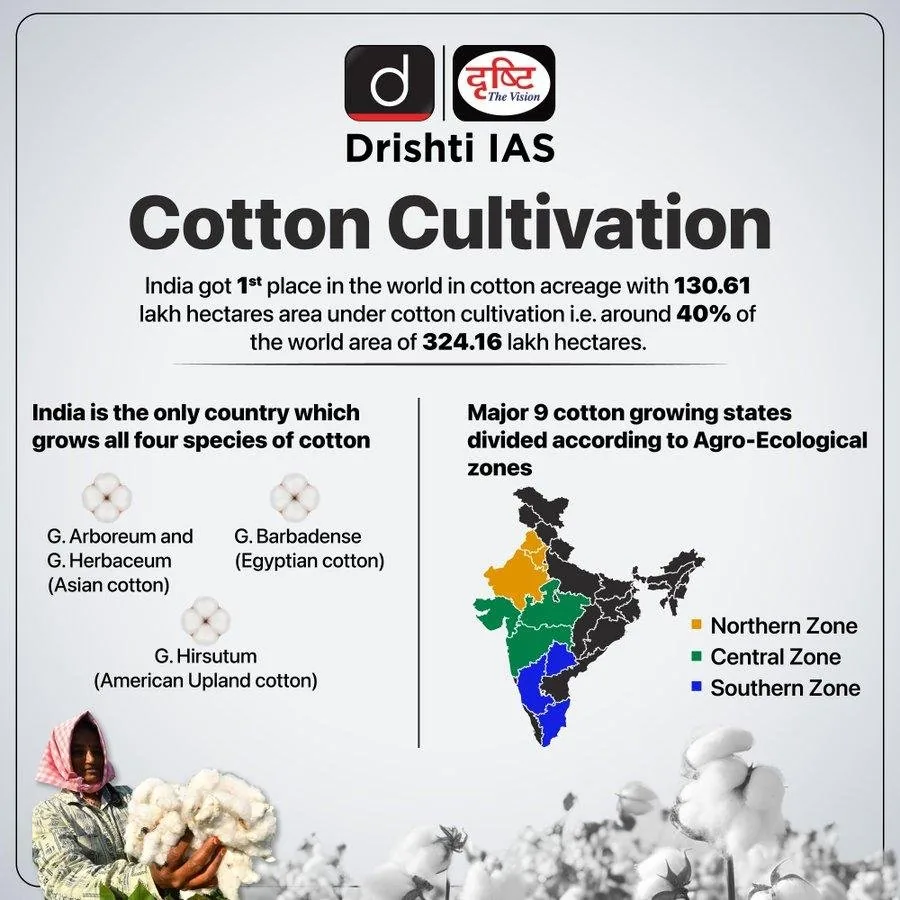
Source A field study found that cotton hybrids with unapproved genetically modified (GM) traits were grown on 24–30% of India’s cotton-growing area in 2025–26. Around 26.2-29 lakh hectares out of India’s 114.8 lakh hectares under cotton had such hybrids.- GM Traits Found:
- The hybrids carried:
- cp4-epsps, which makes cotton tolerant to the herbicide glyphosate.
- Vip3A, which protects the crop from a wider range of bollworm larvae.
- The hybrids carried:
- Current Practice:
- India allows farmers to grow GM cotton hybrids and varieties containing only cry1Ac and cry2Ab genes, obtained from the soil bacterium Bt.
- These genes help cotton plants produce proteins that are toxic to certain bollworm pests.
- Regulatory Status:
- In India, Bt cotton is the only GM crop approved for commercial cultivation. The unapproved traits found in these hybrids have not been cleared by the Genetic Engineering Appraisal Committee (GEAC).
- GEAC functions in the Ministry of Environment, Forest and Climate Change (MoEF&CC).
- It assesses the environmental safety of using hazardous microorganisms and genetically modified organisms on a large scale in research and industry.
Awards & Recognition
2026 Nobel Prize in Literature
Source Canadian poet, essayist and translator Anne Carson won the 2026 Nobel Prize in Literature. The Swedish Academy honoured her for her bold and inventive writing, which combines classical traditions with new forms of modern literature.- About Anne Carson: Born in Toronto, Canada, in 1950, she is also a classicist and translator known for drawing on ancient Greek and Roman literature.
- Writing Style: Her works often combine poetry, prose, essays, dialogue and translation, making them difficult to fit into a single literary genre.
- Major Works:
- Her notable books include:
- Eros the Bittersweet (1986): Explores desire through ancient Greek tradition.
- Autobiography of Red (1998): A verse novel based on the Greek myth of Geryon.
- Other prominent works include Men in the Off Hours and Nox (2010).
- Her notable books include:
- Prize:
- 12 million Swedish kronor, awarded by the Swedish Academy.
- The Academy selects the Nobel Prize in Literature laureate and has awarded the prize since 1901, as directed by Alfred Nobel’s will.
- It was founded in 1786 by Swedish King Gustav III.

Banking & Finance
RBI MPC Raises Repo Rate to 5.50%
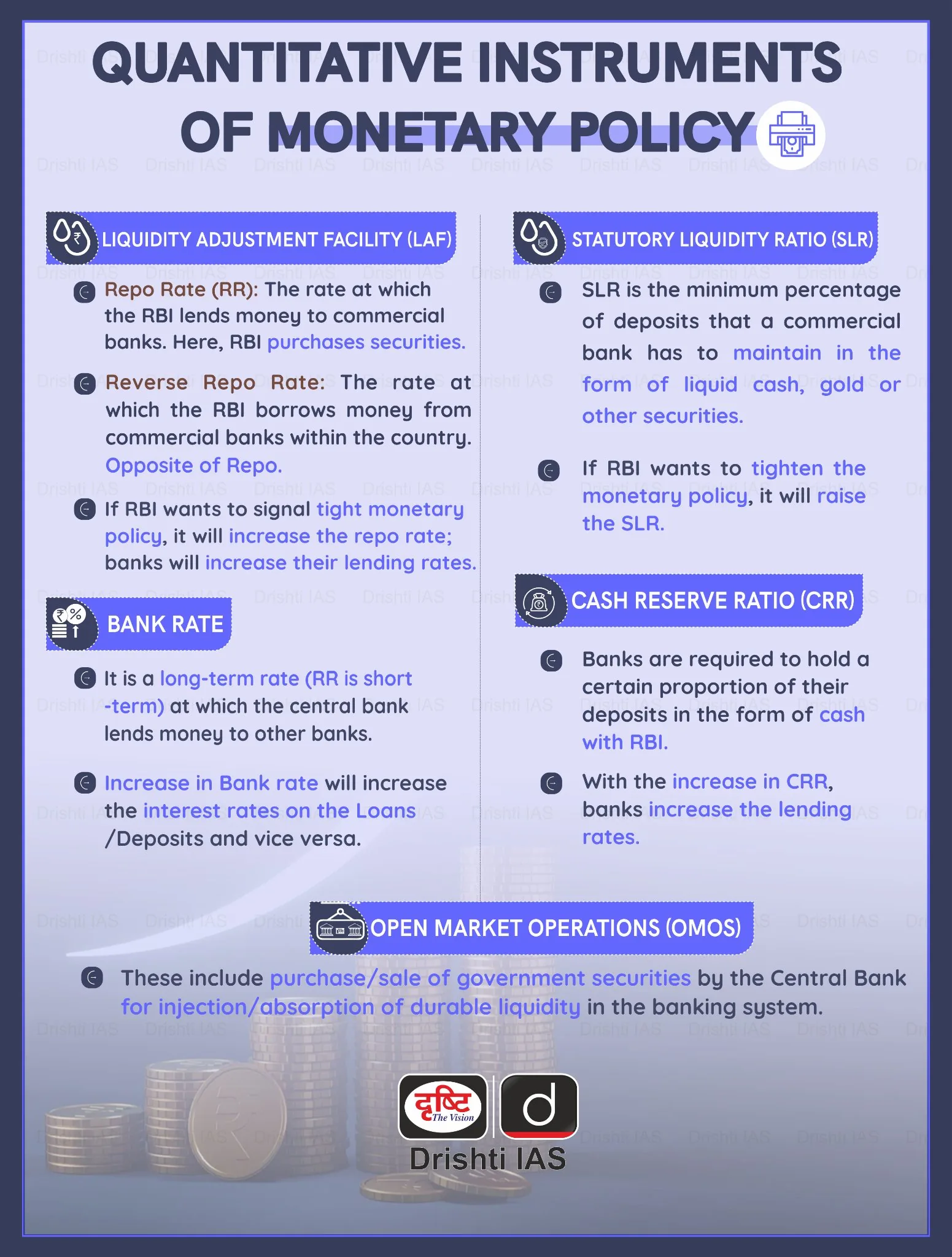
Source The Reserve Bank of India (RBI) Monetary Policy Committee (MPC) raised the policy repo rate by 25 basis points to 5.50%. Marking its first rate hike since February 2023, the MPC also officially shifted its policy stance to “calibrated tightening” to address persistent inflationary pressures.- Policy Rates Adjusted: Alongside the repo rate hike to 5.50%, the Standing Deposit Facility (SDF) rate has been adjusted to 5.25%, while the Marginal Standing Facility (MSF) rate and Bank Rate stand at 5.75%.
- Inflation Projections:
- The RBI raised its inflation forecast for FY27 by 20 basis points to 5.2%.
- The MPC noted that headline consumer price index (CPI) inflation rose to 4.8% in August 2026, driven primarily by food and fuel costs. Core inflation was projected at 4.4% for FY27.
- Growth Outlook: Despite inflationary pressures, the RBI revised its real GDP growth projection for FY 2026–27 from 6.7% to 7.1%, reflecting resilient domestic demand and economic activity.
- ‘Calibrated Tightening’:
- It implies a tightening of monetary policy (raising interest rates or reducing liquidity) in a measured, step-by-step manner rather than adopting aggressive rate hikes.
- It serves as forward guidance to the market that the central bank’s next move will not be a rate cut. The RBI will carefully assess the impact of previous hikes, underlying inflation data, and second-round effects of supply shocks before deciding on further increases.
- Reasons Behind the Rate Hike
- Broadening Price Pressures: CPI items with inflation above 4% rose to about 37% in August 2026, indicating that inflationary pressures were spreading across a wider range of goods and services.
- Weather and Agricultural Disruptions:
- A deficient south-west monsoon, ongoing El Niño conditions, and reservoir levels sitting around 20% below the previous year’s levels have raised severe concerns regarding agricultural output and rural demand.
- Drought-like conditions in several states have triggered a spike in food prices, notably for staples like sugar and onions.
- Global Geopolitics and Energy Costs: Geopolitical tensions, particularly the lingering West Asia conflict, have kept global supply chains under pressure. Crude oil prices crossing the USD 100 per barrel mark risk importing inflation into the Indian economy.
- Narrowing Interest-Rate Differential:
- With global central banks like the US Federal Reserve keeping interest rates elevated, the interest-rate differential between India and the US has narrowed.
- A rate hike helps prevent the outflow of foreign portfolio investments and reduces downward pressure on the Indian Rupee.
Environment & Ecology
Strategy for Environmental-Economic Accounts in India 2026–2030
Source Why in News?- The Ministry of Statistics and Programme Implementation (MoSPI) released the Strategy for Environmental-Economic Accounts in India 2026–2030, a roadmap to strengthen environmental-economic accounting in India.
- About:
- The Strategy for Environmental-Economic Accounts in India 2026–2030, released by the National Statistics Office (NSO) under the Ministry of Statistics and Programme Implementation (MoSPI), provides a strategic roadmap for strengthening environmental accounting in India, improving data quality, addressing data gaps and expanding the coverage of environmental accounts.
- It builds upon the Strategy for Environmental-Economic Accounts in India 2022–2026, which prioritised Material Flow Accounts (MFAs), Ocean Accounts, Energy Accounts, and thematic accounts for biodiversity and urban areas.
- It is envisaged as a dynamic, self-evolving guidance framework, identifying priority areas, implementation milestones and potential data sources to support the systematic development and monitoring of environmental accounts.
- Framework: The strategy follows the UN-endorsed System of Environmental-Economic Accounting (SEEA) framework, which integrates environmental and economic data to measure the relationship between natural resources, ecosystems and economic activities.
- Priority Areas:
- The strategy seeks to develop new accounts and expand existing coverage of forests, minerals, soil resources, land, water, carbon stocks, environment-related activities, biodiversity and environmental statistics.
- These areas are guided primarily by the recommendations of Green National Accounts in India – A Framework and the SEEA Central Framework (SEEA-CF).
- Strategic Focus:
- The roadmap identifies two broad areas:
- Strategic Area A – Quality Improvements, Coverage and Bridging Data Gaps: Improving the quality, timeliness and comparability of environmental accounts by identifying potential data sources, addressing data gaps, standardising methodologies and strengthening data collection.
- Strategic Area B – Communication and Outreach: Improving awareness, accessibility and utilisation of environmental accounts among policymakers and other stakeholders.
- The roadmap identifies two broad areas:
- Alignment with National Accounting: The strategy complements the System of National Accounts (SNA) 2025, which strengthens the recognition of natural resources and non-produced assets within national wealth accounting, facilitating better integration of environmental and economic statistics.
- Significance
- Evidence-Based Policymaking: Enables better assessment of the relationship between economic growth, natural resource utilisation and environmental sustainability.
- Strengthening State-Level Accounting: Serves as a guiding framework for States and Union Territories to initiate or strengthen environmental accounting.
- Sustainable Development: Supports natural resource management, identification of environmental data gaps and monitoring of sustainability-related policies and commitments.
International Relations
WHO Pandemic Agreement
Source Why in News?- At the United Nations High-Level Meeting (UN HLM) in New York in September 2026, India delivered its official intervention on the Political Declaration on Pandemic Prevention, Preparedness, and Response (PPPR) - an instrument closely aligned with the emerging global framework under the WHO Pandemic Agreement.
- With unresolved negotiations over the Pathogen Access and Benefit-Sharing (PABS) System under the Pandemic Agreement, India has taken center stage to bridge the sharp geopolitical divide between the Global North (high-income countries) and the Global South (low- and middle-income countries).
- About:
- The WHO Pandemic Agreement (often referred to as the Pandemic Accord or WHO Convention, Agreement, or Other International Instrument on PPPR) is a legally binding international treaty negotiated under Article 19 of the WHO Constitution. It was adopted in May 2025 but has not yet entered into force.
- Negotiated by the Intergovernmental Negotiating Body (INB) comprising over 190 WHO member states it establishes a standardized global architecture to govern surveillance, response, and resource allocation during public health emergencies of international concern (PHEIC).
- It is only the second binding convention created under Article 19 in the WHO’s history (the first being the 2003 WHO Framework Convention on Tobacco Control, or FCTC).
- Need:
- Covid-19 Inequities (“Vaccine Apartheid”): Advanced economies pre-booked and stockpiled vaccine supplies, therapeutics, and personal protective equipment (PPE), leaving low- and middle-income countries (LMICs) with prolonged delays.
- Failure of Ad-Hoc Initiatives: Voluntary mechanisms like the COVAX Facility and the Access to Covid-19 Tools Accelerator (ACT-A) struggled with underfunding, bilateral supply contracts, and export bans.
- Pathogen Sharing Without Reciprocity: Developing countries regularly shared pathogen genetic sequence data (GSD) through platforms like GISAID, but private multinational pharmaceutical companies monetized this data to create vaccines without reciprocal access guarantees for the originating nations.
- Emerging Biological Threats: The rapid rise of zoonotic spillover threats including Avian Influenza (H5N1), Mpox, Marburg virus, and Ebola demands an automated, binding protocol rather than reliance on goodwill.
- Key Pillars:
- Pathogen Access and Benefit-Sharing (PABS) System: Mandates that rapid sharing of pathogen samples and genetic sequences triggers an automatic allocation of real-time production (e.g., a reserved quota of vaccines and diagnostics for WHO distribution).
- One Health: Integrates human, animal and environmental surveillance to detect zoonotic threats early.
- Technology Transfer: Promotes sharing of technical know-how, manufacturing technologies and licences to expand regional manufacturing hubs across Africa, Asia, and Latin America.
- Supply Chain and Logistics Network: Sets up the Global Supply Chain and Logistics Network to prevent export curbs, reduce bottlenecks, and secure raw materials (such as single-use bioreactors, glass vials, and lipids).
- Sustainable Financing & Capacity Building: Directs dedicated financial mechanisms to build laboratory, cold-chain, and clinical capacities in health systems with constrained resources.
- Current Status:
- The draft agreement achieved consensus among 124 member states at the World Health Assembly, with 0 negative votes and 11 abstentions.
- Formal ratification remains paused because member states are yet to finalise the PABS Annex, which will define the exact percentage allocations of emergency countermeasures and monetary contributions from private manufacturers.
- Dilution of Intellectual Property (IP):
- Developing countries pushed for mandatory technology transfer, patent waivers, and TRIPS (Trade-Related Aspects of Intellectual Property Rights) flexibilities during pandemics to support regional production of vaccines, diagnostics, and therapeutics.
- However, the final agreement limits technology transfer to “mutually agreed terms” (MAT), making it largely voluntary and potentially weakening its effectiveness during public health emergencies.
- Deadlock over the PABS System:
- Developing countries fear bio-piracy, where pathogen samples and genetic data shared by them could be used to develop patented products without guaranteed access to the resulting vaccines and treatments.
- Negotiators remain divided over the PABS technical annex, particularly the share of real-time production that manufacturers must reserve for WHO distribution to low- and middle-income countries.
- Unfunded Mandates Under the ‘One Health’ Approach:
- The agreement promotes a One Health approach by strengthening surveillance at the human-animal-environment interface to detect zoonotic outbreaks early.
- However, developing countries argue that rural veterinary surveillance, wildlife monitoring, and laboratories require significant investment, creating an unfair burden without guaranteed international financing.
- National Sovereignty vs. Supranational Oversight:
- Countries fear that treaty obligations could limit national sovereignty over public health, border controls, and medical regulations.
- The US has opposed stronger WHO authority, citing concerns over the PABS framework and potential interference with domestic commercial and national interests.
- Resistance from the Global Pharmaceutical Industry: Pharmaceutical companies argue that mandatory benefit-sharing and IP waivers could reduce incentives for costly biomedical R&D. They also warn that price controls and forced technology sharing may disrupt supply chains and slow pandemic response.
- Respect for Sovereignty: India stressed that global health cooperation must respect national sovereignty, domestic legal systems, regulatory approvals, and national policy space.
- Actionable Global Solidarity: India called for affordable and guaranteed access to essential medicines and diagnostics for developing countries, while reducing vulnerabilities in global supply chains.
- DPI as a Global Public Good: India highlighted its Digital Public Infrastructure (DPI), including CoWIN, eSanjeevani and Ayushman Bharat Digital Mission (ABDM), as scalable platforms that can support global health cooperation.
- Reducing Supply-Chain Dependencies: Despite being the “Pharmacy of the World”, India remains dependent on external sources for APIs and key starting materials (KSMs). It therefore supports resilient and diversified global pharmaceutical supply chains.
- India’s Contribution to Global Pandemic Preparedness:
- Vaccine Maitri Initiative: Supplied over 300 million COVID-19 vaccine doses to nearly 100 countries and UN peacekeeping missions/agencies, prioritizing low- and middle-income countries (LMICs).
- Pharmacy of the World: Exported essential therapeutics, generic medicines, testing kits, and active ingredients to more than 150 nations during acute global supply chain disruptions.
- Contract & Volume Manufacturing: Served as the primary global hub for high-volume vaccine production (e.g., Serum Institute of India, Bharat Biotech), providing cost-effective doses to international procurement mechanisms such as COVAX and Gavi.
- Champion Consensus on the PABS System: Use its unique standing as both a major bio-data contributor and a leading generic manufacturer to negotiate a balanced PABS compromise: ensuring realistic commercial terms for manufacturers alongside guaranteed, affordable quotas for LMICs.
- Deepen South–South Technical Coalitions:
- Establish technical partnerships in One Health surveillance, genomic sequencing (leveraging platforms like INSACOG), and healthcare workforce training across Africa, ASEAN, and Latin America.
- This builds field-level trust outside contested diplomatic negotiating tables.
- Export Open-Source Platforms: India can offer its battle-tested digital platforms—such as CoWIN (for universal vaccination management), Aarogya Setu, and the ABDM architecture as free, open-source global public goods for low- and middle-income countries (LMICs).
- Leverage Influence in Multilateral Health Platforms:
- Drive pandemic preparedness through the upcoming H20 Summit (G7–G20 health partnership).
- Scale the Global Initiative on Digital Health (GIDH), instituted during India’s 2023 G20 Presidency, to establish interoperable health-data architectures across developing countries.
- Coordinate joint strategies within the Partners for Multilateralism coalition (co-sponsored in 2026 with the EU, Kenya, Brazil, Canada, Australia, and Barbados).
- Upgrade the Domestic Health and Manufacturing Architecture:
- Strengthen domestic biosafety and biological material governance under the Biological Diversity Act to set high-standard national benchmarks for access and benefit-sharing.
- Accelerate domestic Production Linked Incentive (PLI) schemes for APIs, medical devices, and advanced biopharma to minimize supply chain vulnerabilities.
- Defend TRIPS Flexibilities: Ensure that the Pandemic Agreement unequivocally safeguards the Doha Declaration on TRIPS and Public Health, preserving the sovereign right of nations to issue compulsory licenses during acute emergencies.
- The WHO Pandemic Agreement provides an opportunity to build a more equitable, resilient and coordinated global health architecture in the post-COVID era. India can contribute significantly by leveraging its Digital Public Infrastructure (DPI), strong vaccine manufacturing capacity, and leadership in platforms such as the G20 and BRICS to strengthen global health security, technology sharing and equitable access to vaccines and medical resources.
India-Ghana Advance Strategic Cooperation
Source India’s External Affairs Minister S. Jaishankar visited Ghana to strengthen bilateral cooperation in trade, investment, pharmaceuticals, defence and technology, while deepening engagement with the African Union and ECOWAS. Ghana- About:
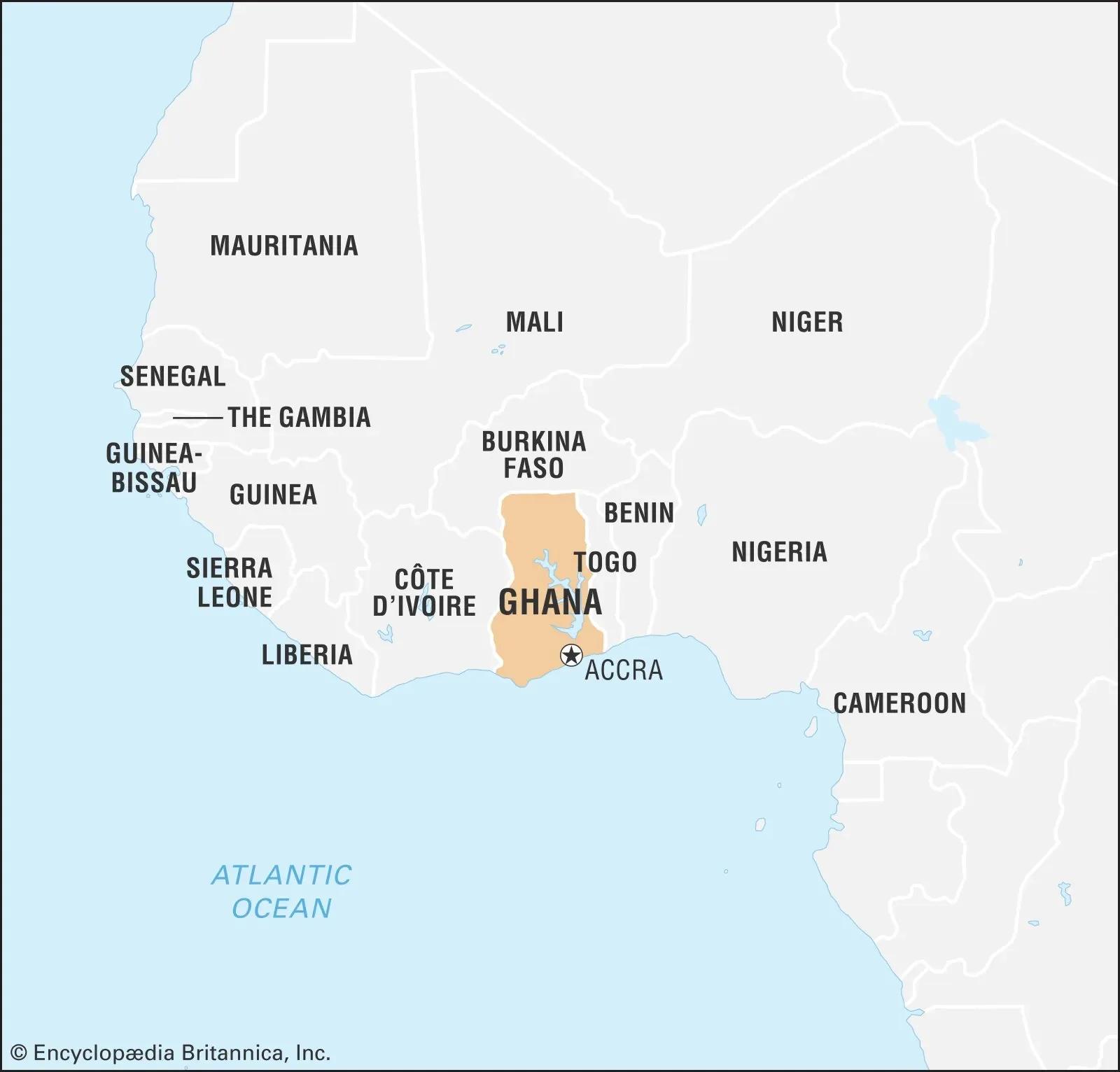
- Ghana lies in West Africa on the Gulf of Guinea. It borders Côte d’Ivoire in the west, Burkina Faso in the north and Togo in the east. Its capital is Accra.
- In 1957, it became the first sub-Saharan African nation to gain independence from colonial rule.
- The Prime Meridian (0° longitude) passes through Tema in Ghana, placing the country in both the Eastern and Western Hemispheres.
- Physical Features:
- River and Lake System: The Volta River system and Lake Volta, formed by the Akosombo Dam, support hydropower, irrigation and inland transport.
- Mineral Wealth: Ghana is Africa’s leading gold producer. It also possesses manganese, bauxite, diamonds, iron ore and lithium resources.
- Regional Importance: Ghana is a founding member of ECOWAS. Accra hosts the African Continental Free Trade Area Secretariat, enhancing its importance for India’s engagement with West Africa and continental trade integration.
Science & Technology
Additive Manufacturing in India
Source Why in News?- India is transitioning from being a technology user to a technology developer, extending its success in Digital Public Infrastructure (DPI) to physical manufacturing through Additive Manufacturing (AM), which transforms digital designs into physical objects.
- This shift positions AM as an emerging frontier of India’s manufacturing sector, with the potential to strengthen indigenous production, reduce import dependence and advance the vision of Atmanirbhar Bharat and Viksit Bharat.
- About: Additive Manufacturing (AM), commonly known as 3D printing, is a form of digital engineering that converts digital designs into physical objects through layer-by-layer material deposition, rather than removing material as in conventional manufacturing.
- Technology Integration:
- AM integrates computing, electronics, design software and materials science, using digital files to control material deposition and, in some processes, material composition.
- It is closely linked with Computer-Aided Design (CAD), Artificial Intelligence (AI) and pattern recognition technologies.
- Global Market Potential: The global AM machines market is projected to reach USD 149 billion by 2035, while the AM-electronics supply chain is expected to expand from USD 18 billion to USD 112 billion.
- Significance for India: AM offers India an opportunity to become a competitive manufacturer of advanced manufacturing platforms using polymers, metals, composites, ceramics and semiconductor-grade materials, strengthening indigenous manufacturing capabilities.
- Thermoplastics:
- The most widely used AM materials include Acrylonitrile Butadiene Styrene (ABS), Polycarbonate (PC) and Polylactic Acid (PLA), each offering distinct properties for different applications.
- Water-soluble Polyvinyl Alcohol (PVA) is used to create temporary support structures that can later be dissolved.
- Metals: AM uses various metals and alloys, ranging from precious metals (gold and silver) to engineering and strategic materials such as stainless steel and titanium.
- Ceramics:
- Materials such as zirconia, alumina and tricalcium phosphate are used in specialised AM applications.
- Glass-based products can also be manufactured by depositing alternate layers of powdered glass and adhesive, followed by heating.
- Biomaterials:
- Materials such as calcium phosphate, silicon-containing compounds and zinc-based materials are used or explored for supporting bone structures and promoting bone regeneration.
- Bio-inks derived from stem cells are being researched to develop blood vessels, bladders and other biological structures.
- 3D bioprinting using biomaterials and living cells is being explored to develop liver, kidney and cardiac tissues, although fully functional transplantable organs remain under research.
-
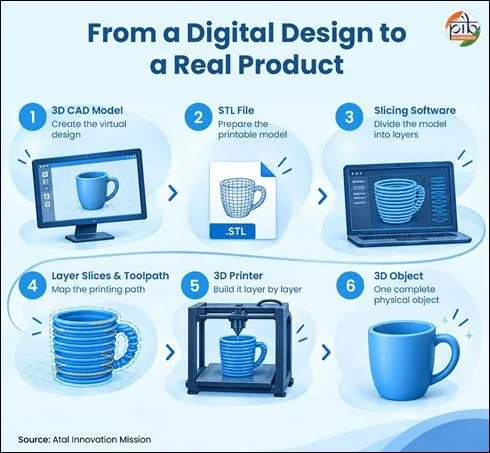
Additive Manufacturing converts a digital design into a physical object through the following steps:
- Virtual Design: A 3D digital model is created using Computer-Aided Design (CAD), 3D scanning or AI-based tools.
- STL File: The model is converted into an STL (Standard Tessellation Language) file, which represents the object’s surface geometry using triangular facets.
- Slicing: Specialised software divides the model into multiple horizontal layers and generates layer-wise printing instructions.
- Printing: The AM machine follows these digital instructions to progressively build the object.
- Additive Process: Material is deposited or solidified layer by layer, with advanced technologies enabling precise control over material deposition and, in some processes, composition.
- Final Object: The completed three-dimensional object undergoes post-processing to achieve the required finish and functional properties.
- Space and Aerospace:
- AM enables the development of lightweight and complex space hardware. In May 2024, IIT Madras-incubated start-up Agnikul Cosmos launched Agnibaan SOrTeD, featuring a single-piece, AM-printed semi-cryogenic rocket engine, demonstrating AM’s potential for complex engine designs and faster indigenous development.
- The National Strategy for Additive Manufacturing (NSAM) also supports start-ups in R&D for critical engine components.
- Defence:
- The Indian Armed Forces are using AM for rapid and disaster-resilient construction and maintenance applications. The Indian Army inaugurated its first AM-printed two-storey dwelling unit in Ahmedabad, constructed in 12 weeks, and has extended the technology to precast defence structures in operational areas such as Ladakh.
- NSAM supports all three Services in establishing workshop-level facilities for Maintenance, Repair and Overhaul (MRO).
- Healthcare:
- AM enables the development of indigenous medical devices and customised implants, reducing import dependence. MeitY supports AM-based medical-device manufacturing and start-ups such as OsteoForge, which is developing natural silk-based implants.
- The Technology Development Board (TDB) supports 3D-printed bone grafts using indigenous bioceramic materials, enabling patient-specific healthcare solutions.
- Electronics: AM is strengthening indigenous electronics-grade manufacturing through a network of specialised centres. NSAM has demonstrated AM-printed batteries, antennas, varistors and capacitors, while the Indian Institute of Science (IISc) has demonstrated AM-printed Photonic Integrated Circuit (PIC) blocks, a pioneering development in photonic manufacturing.
- Construction:
- AM enables faster, more sustainable and resource-efficient construction. The Kelvin 6K Pro on-site 3D construction printer has demonstrated the capability to build 2,500 sq. ft. homes in under 30 days using low-carbon geopolymer materials.
- Early applications indicate the potential for 30% lower material and logistics costs and up to 90% lower emissions compared with cement-based construction.
- Energy Storage: NSAM is developing concrete-based supercapacitors for solar energy storage, expanding AM applications into sustainable energy technologies.
-
National Strategy for Additive Manufacturing (NSAM)
- About:
- The Ministry of Electronics and Information Technology (MeitY) released NSAM in February 2022 to develop India’s domestic AM ecosystem, aligned with Make in India and Atmanirbhar Bharat.
- It promotes collaboration among the Centre, States, industry and academia to strengthen indigenous AM capabilities.
- Key Targets:
- Global Market Share: Capture 5% of the global AM market and contribute nearly USD 1 billion to India’s GDP.
- Technology Development: Develop 50 India-specific AM technologies covering materials, machines, processes and software.
- Start-ups and Products: Nurture 100 new AM start-ups and develop 500 new products.
- Skill Development: Train 1 lakh skilled workers for the AM ecosystem.
- Sectoral Expansion: Develop AM capabilities across 10 existing and emerging manufacturing sectors.
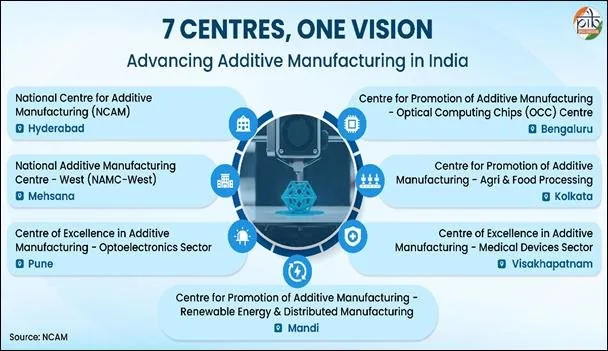
- Institutional Support: Seven specialised Development and Deployment Centres have been established to support R&D, skill development and access to AM technologies.
- School-Level Innovation:
- Atal Tinkering Labs (ATLs) promote early exposure to AM among students from Grades VI to XII.
- Each lab receives a grant of ₹20 lakh to establish an innovation workspace of 1,200–1,500 sq. ft., equipped with 3D printers, robotics and Internet of Things (IoT)-based Do-it-Yourself (DIY) kits.
- About:
-
Progress Under NSAM
- Skilling: More than 1.54 lakh individuals have been trained in AM-related skills.
- Start-up Support: 56 AM start-ups have been supported to strengthen innovation and entrepreneurship.
- Indigenous Technologies: 65 India-specific technologies have been developed, covering materials, machines, Design for Additive Manufacturing (DfAM) and printed products.
- Sectoral Applications: These developments support products and prototypes across aerospace, medical devices, electronics, energy, food processing and photonics.
-
National Strategy for Additive Manufacturing (NSAM) 2.0
- About: NSAM 2.0 is being conceptualised to accelerate India’s AM market growth, strengthen indigenous capabilities and promote wider commercial adoption.
- Key Priorities:
- Innovation and Commercialisation: Accelerate Intellectual Property Rights (IPR) generation and develop globally competitive AM technologies for commercialisation.
- Digital Integration: Expand the national AM network through digital integration.
- Affordability: Reduce the cost of AM machines and materials through cluster-based development.
- Electronics Manufacturing: Strengthen the domestic AM-electronics value chain.
- Start-ups and Defence: Expand the AM start-up ecosystem and support defence applications.
- Sustainability: Promote Sustainable Development Goal (SDG)-driven pilot programmes.
- International Cooperation: Strengthen collaboration through standards, joint research and technology partnerships.
-
National Additive Manufacturing Symposium (NAMS)
- About: NAMS is a national platform bringing together policymakers, scientists, industry, start-ups and academia to strengthen collaboration in AM research, policy and industrial adoption.
- NAMS 2026:
- MeitY organised the 2nd edition on 13 March 2026 in New Delhi, featuring:
- Exchange of MoUs to strengthen ecosystem partnerships and launch of new AM products.
- Discussions on NSAM 2.0, defence applications, industry perspectives and MeitY-supported R&D centres.
- Greater inter-ministerial coordination and participation from State Governments, industry and research institutions.
- MeitY organised the 2nd edition on 13 March 2026 in New Delhi, featuring:
-
Emerging Science, Technology and Innovation Conclave (ESTIC) 2026
- About: The 2nd edition of ESTIC will be held from 27th–29th October 2026 at Bharat Mandapam, New Delhi, under the theme “Creative Minds, Catalyzing Science, Empowering Technologies.”
- Organiser: The Council of Scientific & Industrial Research (CSIR).
- Focus: The conclave will cover 12 thematic areas, including Additive Manufacturing (AM) and other emerging technologies, through plenary sessions, technical discussions and exhibitions.
- Significance: It aims to promote strategic collaborations, scientific innovation and technology partnerships, supporting India’s vision of Viksit Bharat 2047.
- Additive Manufacturing is transforming India’s manufacturing ecosystem by strengthening indigenous production, reducing import dependence and generating skilled employment. Supported by NSAM and the proposed NSAM 2.0, it advances Industry 5.0 through digitalisation, automation and flexible manufacturing while contributing to the Sustainable Development Goals (SDGs) through resource efficiency and sustainable production. Its wider adoption will strengthen Atmanirbhar Bharat and support India’s vision of Viksit Bharat 2047.
Wildlife
GPS Tracking of Elephants in Assam
Source The Assam Forest Department and World Wide Fund for Nature–India (WWF-India) released Tracking the Giants: Movement and Habitat-Use Patterns of GPS-Collared Elephants in Assam during the 72nd Wildlife Week.- The study underscores the need to strengthen conservation of the Asian elephant amid rising habitat fragmentation and human-elephant conflict.
- Population & Distribution (India):
- Global Share: India is home to more than 60% of the global wild Asian elephant population.
- Distribution Landscape: Over half of India’s elephants reside in the Western Ghats. State-wise, Karnataka has the highest elephant population, followed by Assam and Tamil Nadu.
- Census Milestone: India released its scientific baseline DNA-based All India Elephant Estimation (SAIEE), marking a major shift from traditional visual counts.
- Legal Protection:
- Asian elephants receive Schedule I protection under the Wild Life (Protection) Act, 1972.
- The mainland Asian elephant was added to Appendix I of the Convention on Migratory Species (CMS) at the CMS COP13 summit in Gandhinagar, India.
- Conservation Projects & Frameworks
- Project Elephant: Launched in 1992 to conserve elephants, habitats and corridors and mitigate human-elephant conflict (HEC).
- Elephant Reserves: India has 33 notified Elephant Reserves across 14 states, including Singhbhum (first), Terai and Agasthyamalai.
- MIKE Programme: A CITES-linked monitoring system tracking illegal elephant killings and population trends.
- Gajraj: Refers to an AI-based railway safety system for detecting elephants near railway tracks.
- Key Ecological Role
- Keystone Species & Ecosystem Engineers: Elephants modify habitats, disperse seeds, create water sources and open dense vegetation, supporting wider ecosystem health