Comrades Dispatch · 12 Oct 2026 (PDF)
In this edition
- Navi Pillay Awarded Nobel Peace Prize 2026 Awards & Recognition
- 57th GST Council Meeting Economic Scenario
- Separation of Powers and Judicial Independence Polity & Governance
- JOSH Teams Launched for TB Elimination Schemes & Initiatives
- Mission for Aatmanirbharta in Pulses Schemes & Initiatives
- National SC-ST Hub Schemes & Initiatives
- TRISHNA Satellite Science & Technology
- National Conclave on Tribal Rights Visits & Conferences
Awards & Recognition
Navi Pillay Awarded Nobel Peace Prize 2026
Source South African jurist and human rights champion of Indian descent (Tamil Nadu), Navanethem “Navi” Pillay, was named the recipient of the 2026 Nobel Peace Prize. However, the historic announcement was immediately overshadowed by a major geopolitical development.- Hours after the award was announced, the United States imposed sweeping economic sanctions on the International Criminal Court (ICC), an institution where Pillay formerly served as a judge.
- 2026 Nobel Peace Prize Laureate:
- Navi Pillay, a South African jurist of Indian Tamil ancestry, pioneered anti-apartheid legal advocacy and contributed to international criminal jurisprudence.
- As a judge of the International Criminal Tribunal for Rwanda (ICTR), she contributed to landmark jurisprudence recognising rape and sexual violence as acts of genocide, particularly in the Akayesu case (1998).
- She subsequently served as a judge at the International Criminal Court (ICC), as the UN High Commissioner for Human Rights (2008–2014) and as an ad hoc judge at the International Court of Justice (ICJ) in the Rohingya genocide case concerning Myanmar.
- She also chaired the UN Independent International Commission of Inquiry on the Occupied Palestinian Territory (2021–2025).
- Navi Pillay became the first South African woman and the fifth South African overall to win the Nobel Peace Prize, joining laureates such as Nelson Mandela and Desmond Tutu.
- US Sanctions on the International Criminal Court (ICC): The US administration imposed comprehensive economic penalties targeting ICC officials and service vendors (telecom and software providers), citing resistance against the tribunal exercising jurisdiction over citizens of non-member states.
- ICC: Established by the Rome Statute of 1998 (in force since 2002) with headquarters at The Hague, Netherlands, the ICC functions as an independent permanent court prosecuting genocide, war crimes, crimes against humanity, and the crime of aggression.
- Principle of Complementarity: The ICC operates strictly as a “court of last resort,” stepping in only when domestic legal systems are unwilling or unable to genuinely carry out proceedings.
- State Party Status and India’s Stand:
- While the ICC comprises 125 member states, major powers including the US, China, and Russia are not parties.
- India is not a party to the Rome Statute, citing state sovereignty concerns, the non-inclusion of certain weapons categories, and the overarching powers given to the UN Security Council.

Economic Scenario
57th GST Council Meeting
Source Why in News?- The 57th Goods and Services Tax (GST) Council meeting, chaired by the Union Finance Minister, approved comprehensive procedural and structural reforms to simplify GST registration, refunds, input tax credit, exports and litigation, with most changes expected to take effect from 1st April 2027.
- GST Rate Rationalisation: No rate changes were made in the meeting. GST rate decisions will now be taken once a year and implemented from the beginning of the subsequent financial year.
- Simplified Registration: The Council approved greater certainty regarding documents required for GST registration. 61% of taxpayers currently receive automatic registration within three working days.
- Faster refunds: Refund applications are proposed to be acknowledged within 10 days instead of 15 days.
- Inverted duty structure: Input services will become eligible for refunds under the inverted duty structure from 1st November 2026.
- Reduced Litigation: No GST notices will be issued for tax amounts below Rs 10,000, while existing pending notices below this threshold will be withdrawn.
- Inter-State Movement of Goods: Goods can be inspected, detained or seized only by officers of the supplier or destination State. Interception will require specific intelligence and authorisation from a Joint Commissioner-level officer.
- Decriminalisation: The Council recommended removing arrest powers under GST and raising the prosecution threshold from Rs 1 crore to Rs 5 crore.
- Faceless Assessment: The Central Government plans to introduce a faceless assessment system for Central GST, modelled on the income-tax system. A framework will be released for public consultation before Budget 2027, with implementation planned for 2027–28.
- Service exports:
- Services provided by an Indian company to a foreign client through its overseas branch can qualify for export benefits.
- Testing, repair, certification and research conducted in India for foreign clients may also qualify as exports of services even when the goods remain in India.
- Overall significance: The reforms seek to improve ease of doing business, tax certainty, compliance efficiency, movement of goods and taxpayer trust, while reducing unnecessary litigation and enforcement.
- About: The GST Council is a constitutional body established under Article 279A through the 101st Constitutional Amendment Act, 2016, responsible for recommending policies to create a harmonised GST regime and a unified national market.
- Composition: Chaired by the Union Finance Minister and includes the Union Minister of State for Finance/Revenue and State Finance or Taxation Ministers.
- Key Function: Makes recommendations on GST rates, exemptions, threshold limits, model GST laws, place of supply and principles for apportionment of IGST.
- Petroleum Products: Under Article 279A(5), the Council recommends the date from which GST may be levied on petroleum crude, diesel, petrol, natural gas and aviation turbine fuel.
- Quorum: At least 50% of the total members must be present for a meeting to constitute a quorum.
- Voting: Decisions require a 3/4th weighted majority of members present and voting. The Centre has 1/3rd weightage, while States collectively have 2/3rd weightage.
- Cooperative Federalism: The GST Council is a key institution of Centre-State fiscal cooperation, bringing both levels of government together for GST policymaking.
- About:
- The GST is a destination-based, value-added indirect tax introduced through the 101st Constitutional Amendment Act, 2016, aimed at creating a unified national market and simplifying India’s indirect tax system.
- GST subsumes several Central and State taxes, including Central Excise Duty, Service Tax, VAT, Central Sales Tax and Luxury Tax, and is levied on the supply of goods and services.
- India follows a dual GST model, under which the Centre levies CGST and States levy SGST on intra-State supplies, while IGST is levied on inter-State supplies and imports along with applicable customs duties.
- Goods and Services Tax Network (GSTN): It provides the technology backbone for GST registration, return filing, e-invoicing and compliance.
- Next-Generation GST reforms (GST 2.0):
- Approved by the 56th GST Council meeting in 2025, sought to simplify the GST rate structure, reduce the compliance burden and improve tax administration.
- The reforms streamlined GST mainly into 5% and 18% tax slabs, while introducing a 40% GST rate for specified luxury and sin goods such as tobacco products, certain high-end vehicles, yachts and private aircraft.
- They also provide consumer and household relief through lower GST rates and exemptions on selected essential goods, medicines and insurance, while supporting MSMEs, startups, manufacturers and artisans through lower taxation on key inputs and sectors such as cement and handicrafts.
- At the administrative level, GST is increasingly becoming technology-driven through GSTN, e-invoicing, pre-filled returns, real-time data validation, Artificial Intelligence AI, Machine Learning ML and data analytics, helping improve compliance, reduce errors, detect tax evasion and strengthen India’s indirect tax administration.
Polity & Governance
Separation of Powers and Judicial Independence
Source Why in News?- The Supreme Court of India declined a proposed meeting with the Joint Parliamentary Committee (JPC) examining the Constitution (129th Amendment) Bill, 2024, which seeks to implement ‘One Nation, One Election’ (simultaneous elections).
- The proposed interaction was called off after the judiciary and opposition members cited concerns regarding the doctrine of the separation of powers and the prospect of future judicial review.
- Definition & Origin:
- Coined by the French philosopher Montesquieu in his work The Spirit of the Laws, the doctrine mandates the division of state power into three distinct branches: the Executive, the Legislature, and the Judiciary.
- The goal is to prevent the concentration of power, avoid authoritarianism, and safeguard civil liberties.
- Indian Constitutional Scheme:
- Unlike the rigid “watertight compartments” seen in the US Constitution, India follows a functional separation with a robust system of Checks and Balances.
- Article 50: A Directive Principle of State Policy (DPSP) that directs the State to separate the judiciary from the executive in public services.
- Articles 121 & 211: Expressly restrict Parliament and State Legislatures from discussing the conduct of judges of the Supreme Court and High Courts in the discharge of their duties.
- Articles 122 & 212: Prohibit the courts from inquiring into the validity of the proceedings of the Legislature, ensuring parliamentary autonomy.
- Basic Structure Doctrine: In landmark judgements such as Kesavananda Bharati v. State of Kerala (1973) and Indira Nehru Gandhi v. Raj Narain (1975), the Supreme Court firmly established that the separation of powers is an inviolable part of the Basic Structure of the Indian Constitution, beyond the amending power of Parliament.
- Threat of Pre-Adjudication and Bias:
- The legislature’s exclusive domain is drafting and enacting laws, while the judiciary’s mandate is Judicial Review (Article 13).
- If sitting judges advise or discuss a bill during its drafting stage, it inherently compromises their neutrality.
- If the same bill is later passed into law and challenged in court, those judges would face a massive conflict of interest.
- Erosion of Judicial Independence:
- The judiciary relies on public trust in its absolute impartiality.
- Closed-door meetings between parliamentary panels (dominated by political representatives) and judges risk creating a perception of judicial alignment with the government’s legislative agenda, damaging the credibility of the courts.
- Bypassing Established Constitutional Channels:
- The Constitution already provides a formal mechanism for the State to seek the Supreme Court’s legal opinion. Under Article 143 (Advisory Jurisdiction), the President can refer a question of law or public importance to the Supreme Court.
- Bypassing this formal, transparent route for informal “study visits” undermines constitutional architecture.
- Blurring of Institutional Silos:
- While a rigid separation is not practical, involving the judiciary in the law-making process crosses a bright constitutional line.
- It blends legislative drafting with judicial insight, leading to institutional overreach where the courts might inadvertently become co-authors of legislation.
- Background:
- India originally conducted simultaneous elections for the Lok Sabha and state assemblies between 1951 and 1967.
- This cycle was broken due to political instability and the premature dissolution of various legislative bodies.
- To explore restoring this system, the Union Government constituted a High-Level Committee led by former President Ram Nath Kovind in September 2023. The committee submitted its report in March 2024, recommending a phased transition to simultaneous polls.
- About:
- The Constitution (129th Amendment) Bill, 2024, introduced in December 2024, is the primary legal framework to implement ‘One Nation, One Election’ (ONOE).
- It aims to synchronise elections for the Lok Sabha and all State Legislative Assemblies. The overarching goal is to reduce public expenditure, ease the logistical burden on security forces, and prevent governance disruptions caused by the frequent application of the Model Code of Conduct.
- The current Bill strategically excludes local bodies (Panchayats and Municipalities).
- Key Provisions:
- Insertion of Article 82A: Creates the overarching constitutional mechanism mandating the Election Commission of India (ECI) to conduct simultaneous elections for the House of the People (Lok Sabha) and all State Legislative Assemblies.
- The “Unexpired Term” Rule (Amending Articles 83 & 172): If a State Assembly or the Lok Sabha is dissolved prematurely (e.g., due to a fallen government), mid-term elections will be held. However, the newly elected body will only serve for the remaining (unexpired) duration of the original five-year cycle, ensuring the next elections re-align nationally.
- Election Deferment: Article 82A empowers the ECI to advise the President to defer a specific state assembly election in case of localized emergencies. Even if deferred, that assembly’s term will end simultaneously with the Lok Sabha.
- Expanding Parliament’s Purview (Amending Article 327): Adds the phrase “conduct of simultaneous elections” to Parliament’s existing powers regarding the delimitation of constituencies, granting it clearer authority over state legislature elections.
- Utilizing Independent Legal Experts: Instead of approaching sitting judges, parliamentary committees should rely on former judges, the Attorney General of India (Article 76), the Law Commission, and independent constitutional scholars for legal insights on complex pending bills.
- Strict Adherence to Constitutional Propriety: Both Parliament and the Judiciary must actively self-regulate and respect the boundaries demarcated by the Constitution. The Supreme Court’s decision to decline the recent JPC meeting serves as an excellent precedent for maintaining this distance.
- Institutionalising Protocols for JPCs: Parliament should frame explicit internal guidelines within the Rules of Procedure and Conduct of Business. These rules should formally restrict parliamentary committees from seeking informal policy discussions or “study visits” with members of the higher judiciary.
- Invoking Formal Advisory Routes: If constitutional clarity on a pending reform is absolutely critical to the nation’s interest, the Executive should advise the President to formally invoke Article 143, ensuring that the Supreme Court’s opinion is sought on record and through proper legal proceedings.
- Preserving the Doctrine of Separation of Powers is not merely an academic exercise; it is a practical imperative to ensure that the Legislature remains supreme in lawmaking, while the Judiciary remains a fearless, independent, and unbiased arbiter of constitutional justice.
Schemes & Initiatives
JOSH Teams Launched for TB Elimination
Source Recently, the Ministry of Health and Family Welfare has launched JOSH (Joint Squad for Health) Teams under the TB Mukt Bharat Abhiyaan at Bharat Mandapam, New Delhi, to strengthen youth-led community participation in TB elimination.- Youth-Led Action: JOSH Teams will mobilise MY Bharat Volunteers and NCC Cadets to promote TB prevention, early diagnosis, timely treatment, treatment adherence and stigma reduction at the grassroots.
- Grassroots Outreach: Teams will undertake household and community interactions, identify people with TB symptoms, encourage testing, support treatment completion and address myths, misconceptions and discrimination.
- Scale of Initiative: In the first phase, teams have been deployed in 55 districts across 11 States and Union Territories, with nationwide expansion planned.
- Institutional Convergence: The initiative brings together the Ministries of Health and Family Welfare, Youth Affairs and Sports, and Defence, promoting a whole-of-government and whole-of-society approach to TB elimination.
- 2030 Goal: JOSH Teams seek to accelerate India’s efforts towards TB elimination before 2030 by strengthening Jan Bhagidari, youth participation and last-mile community engagement.
- TB Progress: India has recorded a 21% decline in TB incidence, compared with a 12% global decline, while TB treatment coverage has increased to 92%, compared with 78% globally.
- TB Mukt Panchayats: In 2026, 67,933 Panchayats across 697 districts were recognised as TB Mukt, reflecting increased community-level participation in TB prevention and control.
- Technology for TB Control: India is using AI-supported portable X-ray systems and rapid molecular diagnostic technologies to strengthen early detection and identify drug resistance.
- Digital Support: The JOSH Flipbook, JOSH Brochure, Khushi Avatar e-Sangini service (available in 12 Indian languages) and a dedicated JOSH Teams feature on the TB Mukt Bharat App were launched to strengthen awareness, treatment adherence and community engagement.
Mission for Aatmanirbharta in Pulses
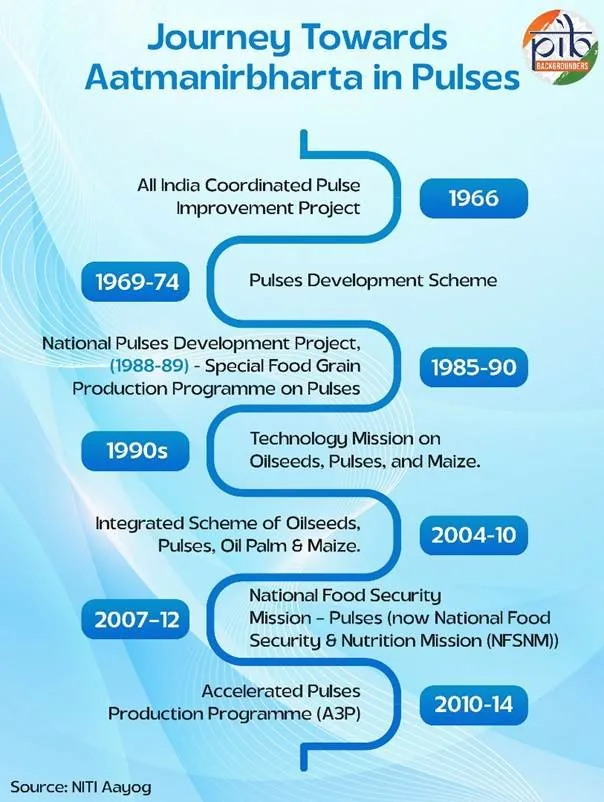
Source Why in News?- The Mission for Aatmanirbharta in Pulses completed its first year, marking progress towards self-sufficiency in pulses by 2030–31 through increased domestic production, reduced import dependence and enhanced farmers’ incomes.
- About: Launched on 11th October 2025, with an outlay of ₹11,440 crore for 2025–26 to 2030–31, the Mission aims to achieve self-sufficiency in pulses, reduce imports and enhance farmers’ incomes.
- Production Target: Increase pulses production to 350 lakh tonnes, productivity to 1,130 kg/ha and cultivation area to 310 lakh hectares by 2030–31, including expansion into 35 lakh hectares of additional land.
- Priority Crops: Focus on Tur, Urad and Masur, promoting high-yielding, pest-resistant and climate-resilient varieties.
- Seed Support: Distribute 87.5 lakh free seed kits and 126 lakh quintals of certified seeds over six years, supported by seed traceability through the Seed Authentication, Traceability and Holistic Inventory (SATHI) portal.
- Assured Procurement: The National Agricultural Cooperative Marketing Federation of India (NAFED) and National Cooperative Consumers’ Federation of India (NCCF) will undertake 100% procurement of Tur, Urad and Masur at Minimum Support Price (MSP) from registered and willing farmers in participating States under the Pradhan Mantri Annadata Aay Sanrakshan Abhiyan (PM-AASHA) for four years (2025–26 to 2028–29).
- Cluster-Based Approach: Promote region-specific interventions across 489 districts, including cultivation in rice-fallow areas, intercropping and crop diversification.
- Processing Infrastructure: Establish 1,000 processing and packaging units, with financial assistance of up to ₹25 lakh per unit, to strengthen value addition and rural employment.
- CEFPPC Projects: Under the Creation and Expansion of Food Processing and Preservation Capacities (CEFPPC) component of the Pradhan Mantri Kisan SAMPADA Yojana (PMKSY), 23 pulse processing units have been approved, of which 18 units have been completed.
- Beneficiaries: Nearly 2 crore farmers are expected to benefit from assured procurement, improved seeds and enhanced value-chain support.
- Implementation: Promote technology adoption, soil-health management, mechanisation and farmer support through the Indian Council of Agricultural Research (ICAR), Krishi Vigyan Kendras (KVKs) and State agricultural departments.
 Digital Monitoring and Seed Traceability
- Three-Tier Monitoring: A three-tier Steering Committee mechanism at the national, State and district levels monitors planning, implementation and progress of the Mission.
- Krishi Mapper: The Krishi Mapper application enables geo-fencing, land geo-tagging and real-time tracking of seed-variety demonstrations and crop yields.
- SATHI Portal: The Seed Authentication, Traceability & Holistic Inventory (SATHI) Portal digitises the seed supply chain, covering seed production, certification and sale across the seed life cycle.
- AgriStack and Digital Crop Survey: AgriStack and Digital Crop Survey integrate Farmer IDs, Soil Health Card analytics and verified plot surveys to support targeted nutrient delivery and more accurate harvest forecasts.
- E-Samriddhi and Vistaar: E-Samriddhi and Vistaar support direct payments, real-time market information and monitoring of domestic pulse prices, strengthening transparency and market stability.
- Rising Production: India’s pulse production reached 274.09 lakh tonnes in 2025–26 (3rd Advance Estimates), up from 256.83 lakh tonnes in 2024–25.
- Area Expansion: Pulse cultivation increased to 286.46 lakh hectares in 2025–26, from 277.20 lakh hectares.
- Improved Productivity and Trade: Yield rose to 957 kg/ha from 926 kg/ha, while import value declined by 31.52% and export value increased by 13.40% in 2025–26.
- Major Pulse-Producing Regions: Major pulse-growing States include Madhya Pradesh, Maharashtra, Rajasthan, Uttar Pradesh, Gujarat, Andhra Pradesh, Karnataka, Jharkhand, Odisha and West Bengal.
- Major Export Destinations: Key destinations included China, UAE, Bangladesh, USA and Sri Lanka
- The Mission for Aatmanirbharta in Pulses represents a significant step towards nutritional security, agricultural self-reliance and farmers’ prosperity. Its long-term success will depend on addressing productivity gaps, strengthening market linkages and promoting climate-resilient farming practices to build a sustainable and import-resilient pulses sector.
National SC-ST Hub
Source Why in News?- The National SC-ST Hub (NSSH) is strengthening inclusive entrepreneurship by helping SC/ST-owned Micro and Small Enterprises (MSEs) overcome barriers related to finance, technology, skills, mentoring and market access.
- About: Launched on 18 October 2016 under the Ministry of Micro, Small and Medium Enterprises (MSME), the National Scheduled Caste and Scheduled Tribe Hub (NSSH) promotes entrepreneurship among Scheduled Caste (SC) and Scheduled Tribe (ST) communities.
- It is implemented through the National Small Industries Corporation (NSIC).
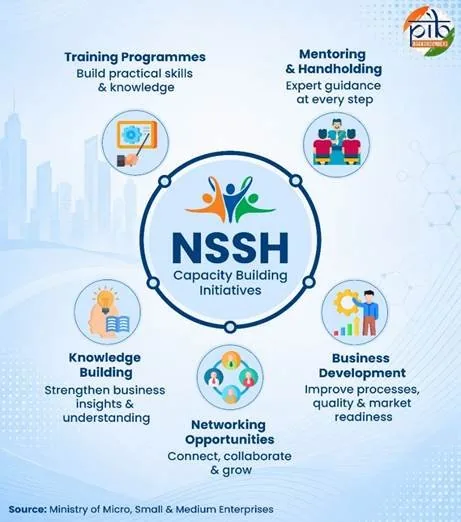
- Objective: Enhance the competitiveness of SC/ST-owned Micro and Small Enterprises (MSEs) by improving access to finance, technology, skills, mentoring and market opportunities, particularly public procurement.
- Special Credit Linked Capital Subsidy Scheme (SCLCSS): Supports new and existing SC/ST-owned MSEs in upgrading plant, machinery and equipment through a 25% capital subsidy capped at ₹25 lakh. It covers manufacturing and service enterprises without product or sector restrictions.
- SCLCSS Progress: Since 2016 till March 2026, 3,160 MSEs received ₹356.10 crore support across 233 districts in 27 States/UTs.
- Single Point Registration Scheme (SPRS): Enables MSEs to access Government procurement through NSIC registration, including free tender sets and EMD exemption.
- Public Procurement Support: Under the Public Procurement Policy, Central Ministries, Departments and CPSEs must procure 25% of annual purchases from MSEs, including 4% from SC/ST-owned MSEs.
- Special Marketing Assistance Scheme (SMAS): Improves market access and competitiveness through exhibitions, trade fairs, vendor development programmes, workshops and awareness campaigns. Enterprises can participate in up to 4 domestic and 2 international events annually.
-
Key Achievements of the National SC-ST Hub
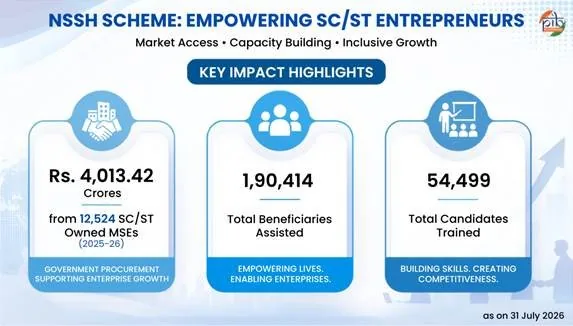
- Procurement Growth: Procurement from SC/ST-owned MSEs increased nearly 39-fold, from ₹99.37 crore in 2015–16 to ₹4,013.42 crore in 2025–26.
- Leading States: Uttar Pradesh, Maharashtra, Karnataka, Tamil Nadu and Assam emerged as the five leading States under NSSH.
- Women’s Participation: 55% of candidates trained were women, highlighting the scheme’s contribution to inclusive entrepreneurship.
- Market-Oriented Training: Training was aligned with public procurement and GeM opportunities, covering cafeteria management and food production, welding, CAD/CAM, laundry services, fashion designing and tailoring, and bamboo-based work.
- SMAS Financial Support: International exhibition assistance is capped at ₹3 lakh for micro, ₹2.5 lakh for small and ₹1.5 lakh for medium enterprises. Enterprises must be registered on the Udyam Registration Portal and MSME Data Bank.
- SMAS Progress in 2025–26: 141 SC/ST MSEs participated in 4 domestic exhibitions, while 247 vendor development programmes, 197 e-tendering workshops and 230 awareness workshops were organised.
- Bank Loan Processing Reimbursement: Reimburses 80% of loan processing fees or ₹1 lakh, whichever is lower, excluding taxes, for loans from Scheduled Commercial Banks, NBFCs and State Finance Corporations.
- Bank Guarantee Charges Reimbursement: Reimburses 80% of eligible Performance Bank Guarantee charges or ₹1 lakh, whichever is lower, to reduce tender participation costs for SC/ST MSEs.
- Testing Fee Reimbursement: Reimburses 80% of eligible testing fees or ₹1 lakh, whichever is lower, for product testing, licensing and BIS certification through NABL/BIS-accredited, Government or PSU laboratories.
- Export Promotion Council Membership Reimbursement: Supports 80% of eligible EPC membership charges or ₹20,000, whichever is lower, including annual membership, subscription and entry fees. Applicants require a valid IEC and RCMC.
- Capacity Building Support: Provides 90% reimbursement of course fees, up to ₹1 lakh annually, for 1–30-day programmes at the top 50 National Institutional Ranking Framework (NIRF) management institutes, with up to two courses supported annually. The Business Accelerator Programme (BAP) offers mentoring in business strategy, pricing, operational efficiency and market positioning.
- E-Commerce Market Access: Supports membership of Government-promoted platforms such as GeM, e-Khadi, TRIFED, Tribes India and MSME Mart, with reimbursement of 80% of membership fees or ₹25,000, whichever is lower.
- The National SC-ST Hub advances inclusive entrepreneurship and economic empowerment by enabling historically marginalised communities to participate more effectively in India’s industrial economy. Sustained institutional support and stronger market linkages can promote employment generation, equitable opportunities and long-term enterprise growth.
Science & Technology
TRISHNA Satellite
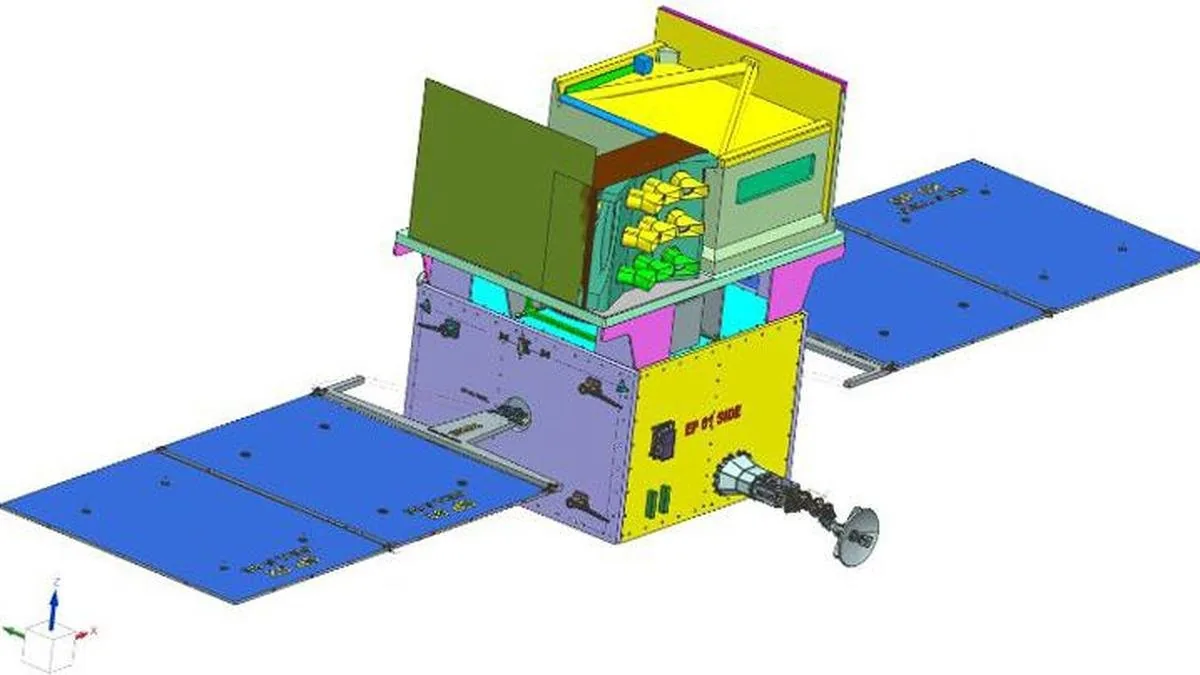
Source The Indo-French TRISHNA (Thermal Infra-Red Imaging Satellite for High-resolution Natural Resource Assessment) mission has entered an advanced stage of development, with ISRO expecting its launch within the next 12–16 months.- About: TRISHNA is a joint Earth-observation mission of the Indian Space Research Organisation (ISRO) and France’s National Centre for Space Studies (CNES), aimed at high-resolution monitoring of Earth’s surface temperature, water resources and ecosystem dynamics.
- Objective: It will provide high spatial and temporal resolution data on surface temperature, emissivity, biophysical variables and radiation to support surface energy-budget assessment and sustainable natural resource management.
- Applications: The satellite will help monitor agricultural water use, irrigation efficiency, crop water stress, evapotranspiration, drought conditions, urban heat islands and ecosystem health, supporting climate studies and water-resource planning.
- Payloads:
- The satellite will carry two primary payloads:
- Thermal Infra-Red (TIR): Developed by CNES, France, to measure Earth’s surface thermal emissions.
- Visible-Near Infra-Red and Short-Wave Infra-Red (VNIR-SWIR): Developed by ISRO, to observe surface characteristics and vegetation conditions.
- The satellite will carry two primary payloads:
- Launch Vehicle: TRISHNA is planned to be launched using India’s Polar Satellite Launch Vehicle (PSLV).
- India–France Cooperation: TRISHNA is the third joint satellite mission following Megha-Tropiques and SARAL. ISRO is responsible for the satellite bus and VNIR-SWIR payload, while CNES provides the TIR payload. Scientific data will be processed jointly by India and France.
Visits & Conferences
National Conclave on Tribal Rights
Source The Ministry of Tribal Affairs organised the National Conclave on “Constitutional Rights and Legal Provisions for Tribal Communities” at SCOPE Complex, New Delhi.- Objective: Identify difficulties faced by tribal communities in accessing constitutional rights and develop practical recommendations through field-level feedback and sharing of best practices.
- Constitutional Provisions
- Articles 15(4) and 16(4): Enable special provisions and reservation for STs in education and public employment.
- Article 19(5): Permits restrictions to protect the interests of Scheduled Tribes.
- Article 29: Safeguards the distinct language, script and culture of communities, including tribal groups.
- Article 46: Directs the State to promote STs’ educational and economic interests and protect them from social injustice and exploitation.
- Article 342: Specifies Scheduled Tribes in relation to particular States or Union Territories.
- Article 338A: Establishes the NCST to monitor safeguards and investigate complaints regarding tribal-rights deprivation.
- Fifth Schedule: Provides for Scheduled Areas, Tribal Advisory Councils and safeguards over tribal land and administration.
- Legal Provisions:
- Forest Rights Act, 2006: Recognises individual and community forest rights and addresses historical injustice.
- PESA Act, 1996: Strengthens Gram Sabhas’ role in self-governance, resources and development in Scheduled Areas.
- SC/ST (Prevention of Atrocities) Act, 1989: Protects STs against atrocities, discrimination and exploitation.