Comrades Dispatch · 14 Oct 2026 (PDF)
In this edition
- Global Initiative on AI for Agri-Food Systems Agriculture & Rural
- Foreign Exchange Risk Reserve Economic Scenario
- NBA Disburses Access and Benefit Sharing (ABS) Funds Environment & Ecology
- CERVAVAC Becomes India’s 1st WHO-Prequalified Indigenous HPV Vaccine Health & Medicine
- 5 Years of PM GatiShakti Infrastructure & Energy
- 1st BIMSTEC Home Ministers’ Meeting Adopts Delhi Declaration International Organisations
- INS Tarkash Participates in IBSAMAR IX 2026 Military Exercises
- RIS Report on Ayush Services Sector and Women’s Employment Reports & Indices
- The Need to Reform UAPA, 1967 Security
Agriculture & Rural
Global Initiative on AI for Agri-Food Systems
Source Why in News?- The 2nd meeting of the UN Global Initiative on AI for Agri-Food Systems (GI-AI4FS) was held at the India Mobile Congress (IMC) 2026 in New Delhi. The event was jointly hosted by the Telecommunication Engineering Centre (TEC) (under the Department of Telecommunications) and the Indian Council of Agricultural Research (ICAR).
- The meeting emphasised the need for trustworthy, interoperable, and farmer-centric AI frameworks to strengthen international cooperation on digital governance.
- About:
- It is a United Nations-backed multilateral platform aimed at harnessing Artificial Intelligence (AI) and the Internet of Things (IoT) to transform global agri-food systems.
- It aligns with Sustainable Development Goals, particularly SDG 2 (Zero Hunger) and SDG 12 (Responsible Consumption and Production).
- Coordinating Agencies: The initiative is coordinated by the International Telecommunication Union (ITU) in close partnership with the Food and Agriculture Organization (FAO), the International Fund for Agricultural Development (IFAD), and the World Food Programme (WFP).
- Core Objective: To promote trustworthy, interoperable, and farmer-centric AI solutions while strengthening international cooperation on governance, standards, and capacity building.
- India’s Role: Hosting the 2nd global meeting (following the first at FAO headquarters in June 2026) reinforces India’s emerging role as a convenor on AI governance and digital public infrastructure for the Global South.
- Precision Farming:
- AI shifts agriculture from being “input-intensive” to “intelligence-intensive” by converting data from IoT sensors, GPS, and drones into localized, farm-level insights.
- This ensures water and fertilizers are applied only where needed, reducing input costs and environmental footprints.
- Project Farm Vibes (a Microsoft initiative) deployed in Maharashtra utilized AI to boost crop yields by 40% while reducing fertilizer use by 25%.
- Climate-Responsive Advisory:
- AI blends historical rainfall data with advanced modeling (like NeuralGCM) to predict micro-level weather patterns.
- An AI-based pilot for local monsoon onset forecasting for Kharif 2025 reached 3.88 crore farmers across 13 states. Resultantly, 31–52% of surveyed farmers adjusted their land preparation and sowing decisions, significantly reducing climate risk.
- Resource Optimization:
- AI utilizes sensors and mobile platforms to automate farm operations and prevent over-irrigation.
- Farm Again, a Tamil Nadu-based startup, deployed indigenous solar-powered sensors (costing just Rs 2.5 Lakh) across 4,000 acres. This doubled coconut yields and saved 4,00,000 cubic metres of water and 20,000 tonnes of CO₂-equivalent emissions annually.
- Early Pest and Disease Detection:
- AI eliminates the need for lab infrastructure by using image recognition to analyze field photos.
- The National Pest Surveillance System (NPSS) uses AI to support 66 crops and over 432 pest types, providing real-time advisories to more than 10,000 extension workers.
- Climate Resilience and Hyper-local Forecasting:
- AI models process vast meteorological datasets to predict erratic weather patterns, providing early warnings that allow farmers to adjust land preparation and sowing dates to save crops.
- Key technological interventions include YES-TECH (Yield Estimation System based on Technology), which leverages AI and remote sensing for accurate yield assessments (fully adopted by Madhya Pradesh), and CROPIC, a mobile tool allowing farmers to upload geotagged, time-stamped images for real-time, evidence-based damage evaluation.
- Supported by the WINDS platform for hyper-local weather data and an AI-driven WhatsApp Chatbot for farmer assistance, these digital frameworks have transformed Pradhan Mantri Fasal Bima Yojana (PMFBY) into a highly credible safety net.
- Improving Price Realisation: AI-driven predictive analytics utilize datasets from platforms like e-NAM and AGMARKET to assess price movements and regional demand, helping farmers time their sales to avoid distress selling.
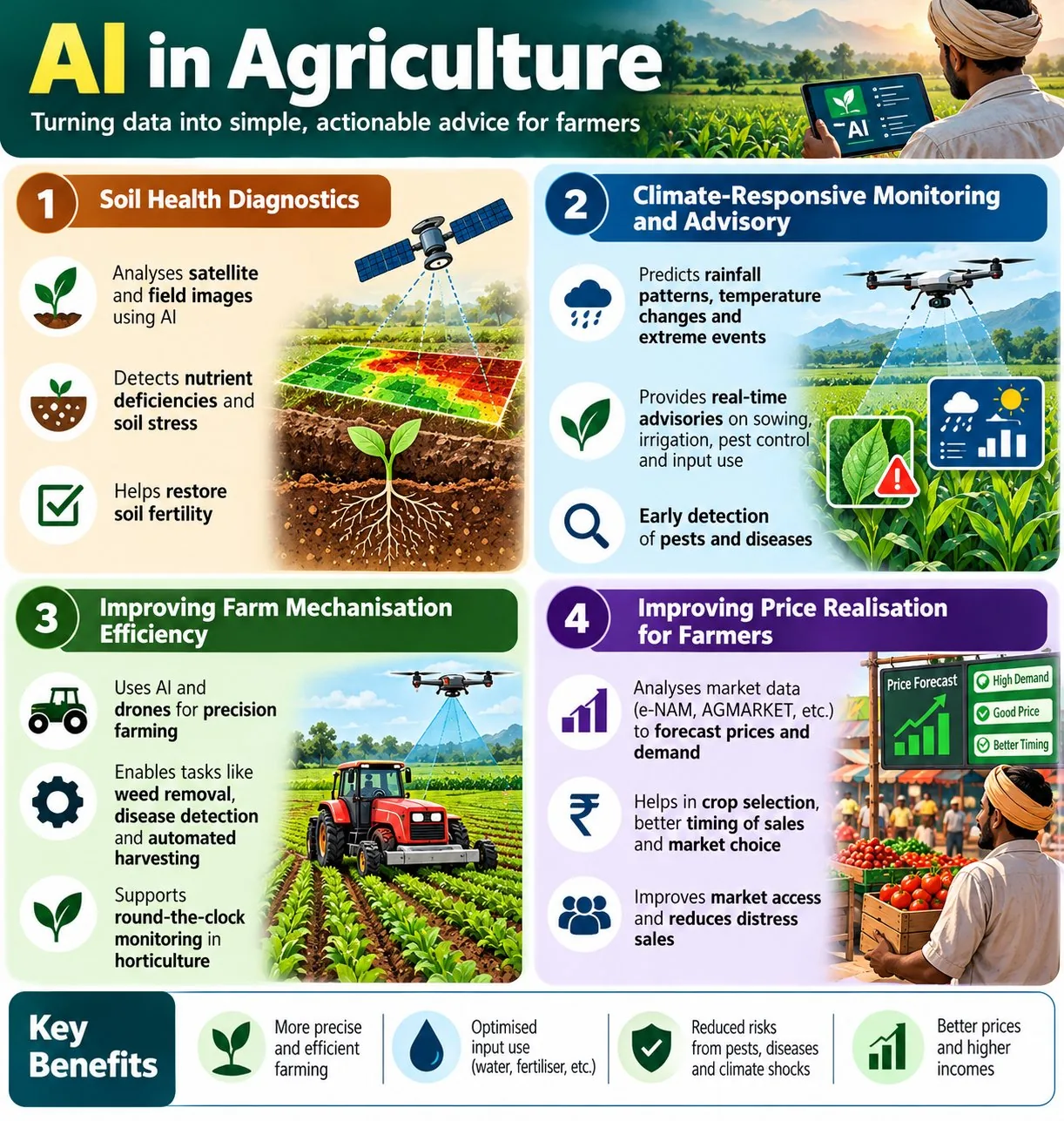 India’s Key Initiatives for AI-Driven Agriculture
- India has established a massive Digital Public Infrastructure (DPI) for agriculture under the Digital Agriculture Mission.
- AgriStack:
- Creates a unique digital identity (Farmer ID) linked to land, livestock, and crop records to ensure secure service delivery.
- Over 7.63 crore IDs have been generated (target: 11 crore by 2026-27). It also drives the mobile-based Digital Crop Survey, which captures real-time data across 23.5 crore plots (Rabi 2024-25) to strengthen policy planning.
- Krishi Decision Support System (KDSS): Integrates satellite, weather, and soil data (with 29 million hectares mapped by the Soil and Land Use Survey of India (SLUSI)) to generate digital crop maps, yield estimates, and drought assessments.
- Bharat-VISTAAR (Virtually Integrated System to Access Agricultural Resources): Proposed in the Union Budget 2026-27, it is a multilingual AI tool designed to integrate AgriStack portals and ICAR packages into a unified AI advisory system.
- Kisan e-Mitra:
- An AI-powered, voice-enabled chatbot operating in 11 regional languages.
- As of December 2025, it has answered over 93 lakh queries, handling 8,000 daily queries regarding schemes like PM-KISAN and PMFBY.
- Nationwide Soil Resource Mapping Project:
- Led by the SLUSI to create high-resolution (1:10,000) village-level soil inventories.
- Utilizing a localized ‘camp-mode’ approach, approximately 29 million hectares have been mapped (target: 142 million hectares) across six funded states to guide scientific land-use and sustainable farming practices.
- Promoting Agri-Tech Startups:
- Under the RKVY programme, Knowledge Partners (KPs) and RKVY Agribusiness Incubators (R-ABIs) provide financial support of up to Rs 5 lakh at the idea stage and Rs 25 lakh at the seed stage.
- A total of 2,282 agri-startups have received support for innovations in AI, drones, robotics and other agricultural technologies.
-
To guide ecosystem-wide action, the Government released the “Future Farming in India: AI Playbook for Agriculture” (in collaboration with WEF, IndiaAI, and BCG) in October 2025. It introduces the IMPACT AI Framework based on three pillars:
- Enable: Developing clear AI strategies, supportive policies, and digital public infrastructure (like AgriStack) to allow scalable adoption.
- Create: Fostering collaboration between start-ups, tech providers, and institutions (like ICAR) to design and validate localized AI solutions.
- Deliver: Integrating AI into extension services and using field feedback to ensure solutions effectively reach small and marginal farmers.
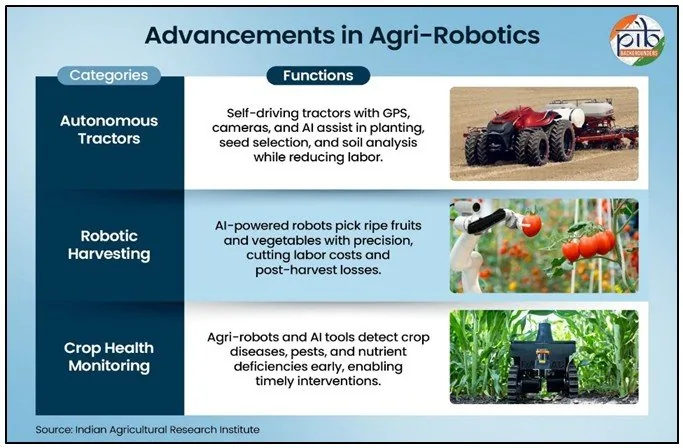
- The “Smallholder Data Gap” and Algorithmic Bias:
- 86% of landholdings in India are small and marginal (less than 2 hectares).
- AI models trained on large, mechanized, mono-cropped global farms often generate skewed advisories when applied to India’s highly fragmented, multi-cropped, and rain-dependent micro-climates.
- Trust Deficit and Information Clutter:
- The World Economic Forum’s (WEF) “Future Farming in India” (2025) report highlights a behavioural barrier: farmers face “information clutter” from disparate digital sources and exhibit technology adoption anxiety.
- There is a pronounced fear of abandoning tried-and-tested traditional practices for algorithmic advice without physical validation.
- Cadastral Digitization Discrepancies:
- The success of AI platforms like AgriStack relies on the Digital India Land Records Modernization Programme (DILRMP).
- While a 2026 parliamentary report notes that 97.4% of cadastral maps are now digitized, critical legacy issues such as un-updated spatial records, unresolved tenancy disputes, and the lack of conclusive titling continue to hinder the creation of a seamless “single source of truth.”
- Data Sovereignty Risks: Lack of agricultural data protection may enable misuse of farmers’ data for predatory pricing and discriminatory credit scoring.
- The Capital Expenditure (CapEx) Barrier: Deploying precision agriculture (IoT sensors, drones, autonomous machinery) involves prohibitive initial capital costs, threatening to consolidate the benefits of AI exclusively among wealthy landowners and widening the rural technological divide.
- AI’s Water Footprint: While AI improves irrigation efficiency, water-intensive data centres may consume 9.3 trillion litres annually by 2030, potentially worsening water scarcity and offsetting agricultural water savings.
- AI-Driven E-Waste: Rapid replacement of AI hardware could generate 2.5 million tonnes of e-waste annually by 2030, risking soil and groundwater contamination due to unsafe disposal thereby degrading the very agricultural environments AI is meant to protect.
- Promoting the ‘Farming-as-a-Service’ (FaaS) Model:
- To overcome the CapEx barrier, the government must institutionalize AI access through Custom Hiring Centres (CHCs), Farmer Producer Organizations (FPOs), and initiatives like the Kisan Drones.
- This “Uberization” of agriculture allows smallholders to rent AI-enabled machinery such as agricultural spraying drones operated by Women Self-Help Groups (SHGs) on an affordable, pay-per-use basis, simultaneously democratizing technology access and driving rural women’s empowerment.
- Creating a ‘Phygital’ Extension Network:
- Technology cannot replace human trust. India’s physical extension network Krishi Vigyan Kendras (KVKs) must be merged with digital systems.
- Empowering community resource persons, such as Krishi Sakhis (aligned with the Lakhpati Didi initiative), with AI diagnostic tablets will ensure effective last-mile delivery and overcome digital literacy barriers.
- Scaling DPI: The full rollout of AgriStack and the Digital Crop Survey across all districts by FY 2026 must be expedited to serve as the bedrock for all AI applications.
- Capacity Building: Traditional extension workers must be upskilled into “digital agropreneurs” capable of translating AI insights into practical field advice for farmers.
- Global Collaboration: Leveraging platforms like the UN’s GI-AI4FS to share open-source AI models and establish global standards for agricultural data governance.
- Agri-Data Protection Architecture: The Data Empowerment and Protection Architecture (DEPA) must be explicitly extended to the agricultural sector. This would grant farmers explicit, consent-based control over who accesses their farm-level data, preventing corporate monopolization while enabling secure data sharing with verified agri-tech startups.
- AI can transform Indian agriculture into a climate-resilient and data-driven sector. Inclusive technology access, agricultural data protection and a human-centric phygital approach are essential to empower smallholders, ensure sustainable growth and strengthen food security.
Economic Scenario
Foreign Exchange Risk Reserve
Source Why in News?- The Reserve Bank of India (RBI) has unveiled a comprehensive suite of emergency measures to stem the ongoing slide of the Indian rupee. A central highlight of this intervention is the Foreign Exchange Risk Reserve (FERR).
- The RBI’s strategic deployment of the FERR is being widely analyzed by economists as a reversal of the “China playbook” on currency management.
- The Mechanism:
- In October 2026, the RBI introduced a 20% FERR on specified rupee-linked forex derivative contracts involving the purchase of foreign currency against INR.
- Initially, the 20% cash reserve requirement applied to eligible customer contracts exceeding USD 2 million. It is extended to authorised dealers’ own hedging contracts, regardless of the contract value. The reserve must be maintained daily with the RBI in cash until the contract ends.
- Raising the Cost of Hedging: By mandating this reserve, the central bank intentionally makes purchasing forward dollar protection more expensive for domestic banks and traders.
- Curbing Speculative and Precautionary Demand: The mandate disincentivizes entities from indiscriminately forward-booking dollars to hedge against potential future rupee depreciation, which itself fuels immediate downward pressure on the currency.
- Domestic Focus: The measure specifically targets domestic institutions and onshore traders rather than offshore entities, penalizing local market activity contributing to self-fulfilling sell-offs and curbing localized speculative bets.
- Costlier Hedging for Importers: While targeting speculators, FERR inadvertently penalizes firms with genuine dollar liabilities, raising their protection costs and exposure to market volatility.
- Provides Only “Breathing Room”: Reminiscent of the 2013 Taper Tantrum curbs, these measures offer merely short-term tactical relief. Long-term stability remains dependent on global crude prices and Foreign Portfolio Investment (FPI) flows.
- Regulatory Unpredictability: Sudden interventions make market participants wary and can disrupt natural price discovery in the forex market.
- Unresolved Structural Deficit: FERR may not address underlying pressures such as the Current Account Deficit (CAD), trade imbalances, elevated crude oil prices and foreign capital outflows.
- The RBI’s use of a risk reserve ratio is a direct adaptation of a counter-cyclical macroprudential tool used by the People’s Bank of China (PBoC).
- China’s Application (To Weaken Currency):
- In March 2026, when the Chinese yuan was continuously strengthening against the US dollar (which hurts their export competitiveness), the PBoC cut its FX risk reserve ratio from 20% to zero.
- By removing this reserve, China eliminated the cost of betting against its own currency.
- India’s Reverse Application (To Strengthen Currency):
- India faces the exact opposite scenario - a rapidly weakening currency.
- By imposing a 20% FERR, the RBI has made it financially burdensome to bet against the rupee, choking the speculative demand for dollars and providing artificial support to the domestic exchange rate.
Environment & Ecology
NBA Disburses Access and Benefit Sharing (ABS) Funds
Source The National Biodiversity Authority (NBA) disbursed Rs 2.02 crore in Access and Benefit Sharing (ABS) funds received from seed-sector companies to 27 State Biodiversity Boards (SBBs) and 3 Union Territory Biodiversity Councils (UTBCs), strengthening biodiversity conservation and equitable benefit-sharing ahead of 17th Conference of the Parties (COP 17) to the Convention on Biological Diversity (CBD), commencing in October 2026 in Yerevan, Armenia.- Cumulative Milestone: With this latest release, cumulative ABS disbursement by the NBA has reached Rs 202 crore, reflecting India’s operational compliance with equitable benefit-sharing under the Biological Diversity Act, 2002.
- Seed-Sector Contributions: Funds were collected from seven major seed firms for the commercial utilization of parental varieties and hybrids of staple and vegetable crops (e.g., rice, eggplant, tomato, okra, and cucurbits).
- Cultivation-Area-Based Apportionment: Because individual grassroots benefit-claimers could not be traced for market-procured crops, funds were allocated based on the cultivation area of respective resources using data from the Ministry of Agriculture and Farmers Welfare, with Madhya Pradesh receiving the highest allocation followed by West Bengal.
- Utilization of Funds: Disbursed capital will directly fund the operationalization of Biodiversity Management Committees (BMCs), the updating of People’s Biodiversity Registers (PBRs), conservation of local landraces and medicinal flora, and habitat restoration.
- Definition:
- ABS is a framework ensuring that the benefits (monetary or non-monetary) arising from the commercial or research utilization of genetic resources and associated traditional knowledge are shared fairly and equitably with the indigenous or local communities that conserve and provide them.
- The ABS mechanism is a core pillar of the CBD and was further operationalized globally by the Nagoya Protocol (adopted in 2010).
- Indian Legal Framework:
- ABS is governed by the Biological Diversity Act, 2002, which provides for benefit-sharing through the NBA to support local communities and biodiversity conservation.
- ABS outlays converge with flagship central schemes like PM-JANMAN, Pradhan Mantri Janjatiya Vikas Mission, and Pradhan Mantri Van Dhan Yojana to build bio-resource-based micro-enterprises and tribal welfare.
- ABS disbursement reinforces India’s progress under the National Biodiversity Strategy and Action Plan (NBSAP) 2024–2030, Target 13 (Equitable ABS) and Target 19 (Resource Mobilisation) of the Kunming–Montreal Global Biodiversity Framework (KMGBF).
- SDG Linkages: ABS directly advances SDG 2 (Zero Hunger), SDG 8 (Decent Work), SDG 12 (Responsible Consumption and Production), SDG 15 (Life on Land), and SDG 17 (Partnerships for the Goals).
Health & Medicine
CERVAVAC Becomes India’s 1st WHO-Prequalified Indigenous HPV Vaccine
Source Serum Institute of India’s indigenously developed quadrivalent HPV vaccine, CERVAVAC, received WHO prequalification effective 25th September 2026, making it eligible for procurement by UN agencies and potentially for national HPV immunisation programmes globally.- Development: Developed and manufactured by the Serum Institute of India (SII) with support from the Department of Biotechnology (DBT) and Biotechnology Industry Research Assistance Council (BIRAC), alongside contributions from the Gates Foundation and WHO’s International Agency for Research on Cancer (IARC).
- Indigenous Vaccine: CERVAVAC is India’s first indigenously developed gender-neutral quadrivalent HPV vaccine, licensed for girls and boys aged 9–26 years, with a two-dose schedule for ages 9–14 and a three-dose schedule for ages 15–26.
- Vaccine Coverage: Targets four HPV types—6, 11, 16 and 18. Types 16 and 18 are associated with cervical and other cancers, while types 6 and 11 primarily cause genital warts.
- WHO Assessment:
- WHO prequalification confirms that the vaccine meets required standards of quality, safety and efficacy, based on an assessment of product data, manufacturing processes and facilities.
- It is not a marketing authorisation or national regulatory approval, but provides internationally recognised assurance of vaccine quality and suitability for procurement.
- India’s HPV Vaccination Programme:
- Launched on 28th February 2026, it provides free HPV vaccination to eligible 14-year-old girls using a single-dose schedule of Gardasil-4. CERVAVAC’s WHO prequalification does not automatically qualify it for inclusion in the national programme.
- More than 80 lakh HPV vaccine doses had been administered under the programme by September 2026, according to the Union Health Ministry.
- Global Linkage: Supports WHO’s cervical cancer elimination strategy, which aims by 2030 to achieve 90% HPV vaccination coverage among girls by age 15, 70% cervical screening coverage among women at specified ages, and treatment of 90% of women with cervical precancer or cancer.
- Serum Institute of India: Founded in 1966 by Cyrus Poonawalla, SII is headquartered in Pune, Maharashtra, and is the world’s largest vaccine manufacturer by number of doses produced.
Infrastructure & Energy
5 Years of PM GatiShakti
Source Why in News?- Recently, the PM GatiShakti National Master Plan (PMGS-NMP) completed five years, marking its evolution from an infrastructure mapping platform into an integrated, GIS-based planning framework for coordinated infrastructure development, multimodal connectivity and efficient resource utilisation.
- About: The PM GatiShakti National Master Plan (PMGS-NMP) was launched on 13th October 2021 to promote integrated and coordinated infrastructure planning across different sectors and modes of transport.
- Objective: It aims to strengthen multimodal connectivity, last-mile connectivity and infrastructure efficiency by reducing project delays, optimising resource utilisation and improving coordination among Ministries and States.
- GIS-Based Platform: PM GatiShakti integrates infrastructure networks, geographical features, economic zones and other relevant data on a common Geographic Information System (GIS)-based platform, enabling data-driven infrastructure planning and decision-making.
- Whole-of-Government Approach: The National Master Plan covers 58 Central Ministries and Departments and all 36 States and Union Territories, facilitating cross-sectoral coordination and integrated project planning.
- Six Guiding Principles: PM GatiShakti promotes integrated development, multimodal infrastructure, last-mile connectivity, expedited land acquisition, minimised clearances and reduced ecological impact to make infrastructure planning more efficient and sustainable.
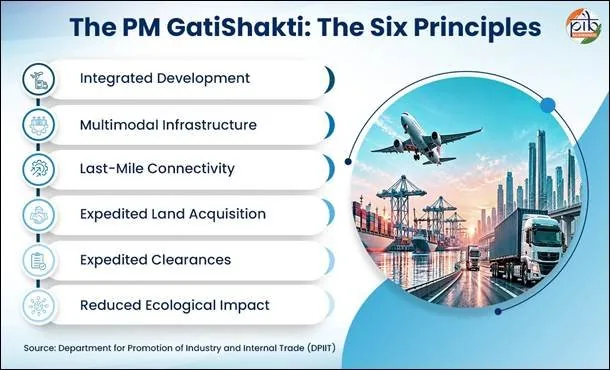
- Key Features of PM GatiShakti
- Seven Infrastructure Engines: The plan focuses on Roads, Railways, Ports, Waterways, Airports, Mass Transport and Logistics Infrastructure to strengthen multimodal connectivity.
- Scheme Convergence: PM GatiShakti incorporates infrastructure initiatives of various Ministries and State Governments, including Bharatmala, Sagarmala, inland waterways, dry/land ports and UDAN.
- Public Data Access: The PM GatiShakti Public platform provides access to 230 approved datasets for applications such as site suitability analysis, connectivity mapping, alignment planning and compliance checks.
- Extensive Data Layers: More than 23,493 data layers had been integrated into the common GIS-based platform as of 12th October 2026, covering infrastructure and other relevant information.
- ITLA and Integrated Transport Planning
- Institutional Complementarity: The Integrated Transport & Logistics Authority (ITLA) complements PM GatiShakti by providing a dedicated institutional mechanism for long-term transport planning and coordination.
- National Transport Master Plan: ITLA will prepare a National Transport Master Plan with a planning horizon of 10 years or more, covering major transport and logistics sectors.
- Project Appraisal and Monitoring: ITLA will assess sectoral and annual transport plans and undertake technical appraisal of infrastructure projects costing ₹500 crore or more, besides monitoring their implementation.
- National Transport Data Repository: ITLA will develop a National Transport Data Repository (NTDR) by integrating datasets from sources such as FASTag, Vahan and GSTN e-way bills.
- PM GatiShakti operates through a three-tier institutional framework, supported by a GIS-based digital platform for integrated infrastructure planning and coordination.
- Empowered Group of Secretaries (EGoS): Chaired by the Cabinet Secretary, the EGoS oversees the implementation of PM GatiShakti and reviews, considers and approves changes in the National Master Plan.
- Network Planning Group (NPG): The NPG comprises the Heads of Network Planning Divisions from infrastructure Ministries and Departments and examines infrastructure proposals to ensure unified planning, integration and optimisation while monitoring developments under the National Master Plan.
- Technical Support Unit (TSU): The TSU consists of domain and subject-matter experts who support the evaluation process and assist the Logistics Division in functioning as the PM GatiShakti Secretariat.
- Project Appraisal Progress: As of 11th August 2026, the NPG had evaluated 396 infrastructure projects worth about ₹18.66 lakh crore, of which 256 projects had been sanctioned and 198 were under implementation.
- Digital Planning Support: The institutional framework is supported by a digital platform providing planners with geospatial data, satellite imagery and analytical tools for integrated project planning.
- About: Gati Shakti Vishwavidyalaya (GSV), established in 2022, is a first-of-its-kind university focused exclusively on the transport and logistics sectors.
- Education and Research: GSV integrates education, executive training and research across transport-related disciplines and supports the PM GatiShakti National Master Plan and National Logistics Policy, 2022.
- Nodal Agency: GSV serves as a nodal agency for developing and delivering courses related to PM GatiShakti and the National Logistics Policy, while also supporting knowledge centres for sharing best practices, research and innovation.
- Capacity Building: As of July 2026, GSV had trained more than 2.4 lakh officers through courses designed for PM GatiShakti.
- Applied Research: The university is expanding applied research in integrated transport planning, maritime transport, bridge and tunnel engineering and defence logistics.
- Integrated GIS-Based Planning: The NMP integrates infrastructure networks, geographical features, demographic data and economic zones on a common GIS-based platform, enabling coordinated and data-driven infrastructure planning.
- Spatial Planning and Analytical Tools: The platform supports project mapping, proximity analysis, identification of Go/No-Go areas (where development may be restricted) and clearance-related assessments, improving project planning and decision-making.
- Mapping Economic and Logistics Nodes:
- It maps economic, social and logistics nodes alongside multimodal infrastructure to identify connectivity gaps and required infrastructure linkages.
- Economic zones such as textile and pharmaceutical clusters, defence corridors, electronic parks, industrial corridors, fishing clusters and agricultural zones are mapped to improve connectivity.
- Example: The Khagaria–Purnea corridor in Bihar is planned to connect five PM GatiShakti Economic Nodes and 11 logistics nodes, facilitating faster movement of goods and passengers.
- Digital Logistics Integration:
- The Unified Logistics Interface Platform (ULIP) enables API-based integration of government logistics systems, while the Logistics Data Bank (LDB) provides real-time tracking of EXIM (export-import) containers.
- As of July 2026, ULIP had connected 46 government systems across 12 Central Ministries through 142 APIs.
- Private Sector Access:
- In October 2025, the NMP platform was opened to private-sector users through a Query-Based Analytics Mechanism developed by BISAG-N (Bhaskaracharya National Institute for Space Applications and Geo-informatics).
- It provides regulated access to selected non-sensitive datasets for site suitability analysis, connectivity mapping, alignment planning and investment decisions.
- Digital Monitoring and Data Management: The PM GatiShakti NMP Dashboard facilitates multi-sector project monitoring, while the Data Uploading and Management System (DUMS) enables decentralised, real-time updating and management of infrastructure data.
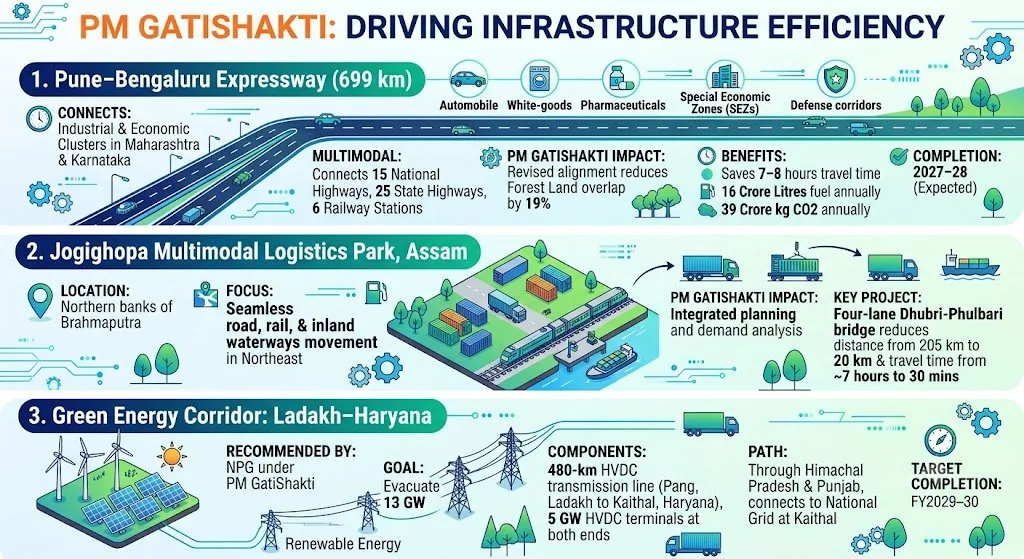 Conclusion
- PM GatiShakti has transformed India’s infrastructure planning through GIS-based integration, inter-ministerial coordination and multimodal connectivity. By reducing infrastructure gaps, optimising resources and improving project efficiency, it can strengthen logistics competitiveness, sustainable development and inclusive economic growth, contributing to the Viksit Bharat @2047 vision.
International Organisations
1st BIMSTEC Home Ministers’ Meeting Adopts Delhi Declaration
Source Recently, the first BIMSTEC Home Ministers’ Meeting concluded in New Delhi with the adoption of the Delhi Declaration, under the chairmanship of Union Home Minister.- Regional Security Cooperation: Seven BIMSTEC members—Bangladesh, Bhutan, India, Myanmar, Nepal, Sri Lanka and Thailand—reaffirmed cooperation based on sovereign equality, territorial integrity, non-interference and peaceful coexistence.
- Counter-Terrorism: The declaration strongly condemned terrorism, including cross-border terrorism, and called for effective implementation of UN Security Council sanctions, particularly the 1267 Sanctions Committee.
- Terror Financing and Emerging Technologies: Emphasised combating radicalisation, terrorist recruitment, money laundering and terror financing, while preventing the misuse of emerging technologies for terrorist activities.
- Human Trafficking and Cybercrime: Called for coordinated action against human trafficking, cyber slavery, online scams and forced criminality, adopting a victim-centred approach.
- Key BIMSTEC Conventions: Urged implementation of the Convention on Combating International Terrorism, Transnational Organised Crime and Illicit Drug Trafficking (in force since March 2021) and the Convention on Mutual Legal Assistance in Criminal Matters (signed in March 2022).
- Pending Agreements: Called for early finalisation of conventions on extradition, transfer of sentenced persons and combating trafficking in persons, along with an SOP for rescuing, repatriating and reintegrating trafficking victims.
- Information Sharing and Capacity Building: Called for developing the BIMSTEC Drug Offences Monitoring Desk (BDOMD), exploring regional information-sharing mechanisms and strengthening training and capacity-building against transnational crimes.
- Institutional and Global Cooperation: Recognised the role of the Joint Working Group on Counter-Terrorism and Transnational Crime (JWG-CTTC), welcomed BIMSTEC’s observer status in the Asia/Pacific Group on Money Laundering (APG) and encouraged partnerships with UNODC, INTERPOL and FATF, alongside regular Home Ministers’ Meetings.
- About BIMSTEC: The Bay of Bengal Initiative for Multi-Sectoral Technical and Economic Cooperation (BIMSTEC) was established on 6th June 1997 through the Bangkok Declaration. It serves as a bridge between South Asia and Southeast Asia, with its Secretariat in Dhaka, Bangladesh.
Military Exercises
INS Tarkash Participates in IBSAMAR IX 2026
Source The Indian Navy’s frontline guided-missile stealth frigate INS Tarkash is on an overseas deployment to South Africa to participate in the ninth edition of the India-Brazil-South Africa Maritime Exercise (IBSAMAR IX) 2026.- About IBSAMAR: It is a biennial trilateral maritime exercise involving the navies of India, Brazil and South Africa under the IBSA framework, conducted since 2008 to promote joint training and the exchange of operational best practices.
- Theme of IBSAMAR IX: “Stronger Together Towards a Shared Future in the Maritime Domain.”
- Objectives: To enhance interoperability among the three navies, strengthen professional exchanges, improve operational coordination and develop a shared understanding of maritime challenges.
- Major Exercise Activities: The exercise covers surface warfare, anti-air warfare, anti-submarine warfare, naval air operations, maritime interdiction, Visit, Board, Search and Seizure (VBSS), anti-piracy operations, search and rescue, damage control and firefighting.
- Significance: The exercise strengthens India’s maritime partnerships, enhances collective maritime security and operational preparedness, and promotes a secure and stable Indian Ocean Region (IOR).
- About:: INS Tarkash is a Talwar-class guided-missile stealth frigate, built at Yantar Shipyard, Russia, and commissioned into the Indian Navy in 2012.
- Armament and Capabilities: It is equipped with anti-ship missiles, air-defence systems, torpedoes and anti-submarine rocket launchers, enabling it to conduct surface, aerial and underwater warfare operations.
Reports & Indices
RIS Report on Ayush Services Sector and Women’s Employment
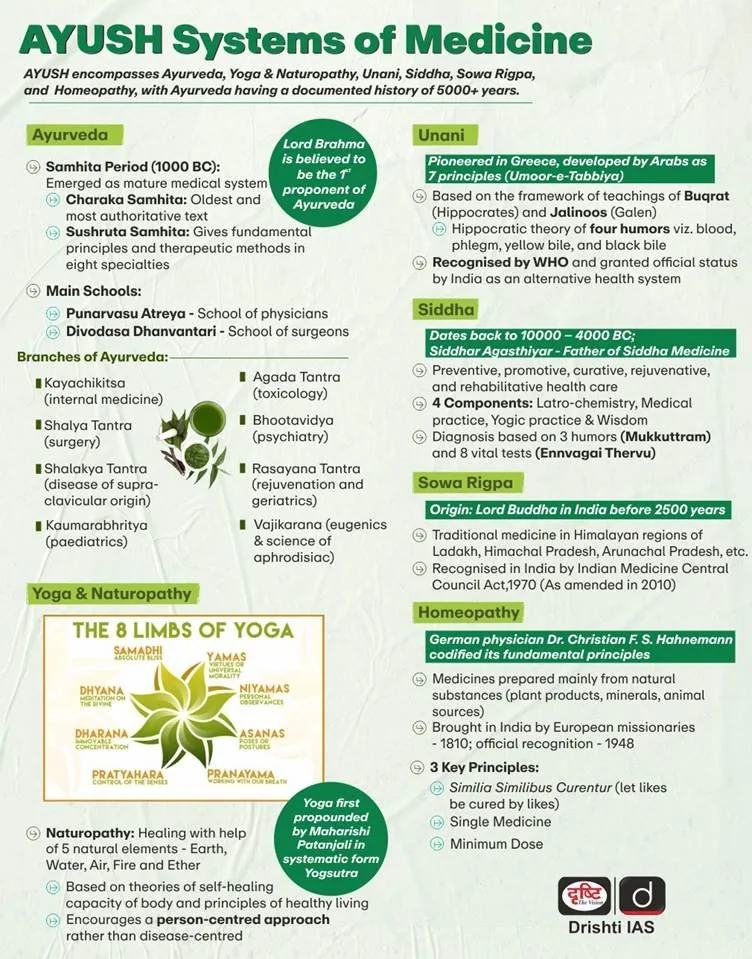
Source Why in News?- The Ministry of Ayush released a study by the Research and Information System for Developing Countries (RIS), highlighting the rapid growth of India’s Ayush services sector, valued at US$36.92 billion in FY 2024–25, and its contribution to employment generation, women’s workforce participation and economic growth.
- The report, based on a survey of 15,914 establishments across six Ayush systems, was released during the 11th Ayurveda Day celebrations in Nagpur on 23rd September 2026.
- Growing Economic Sector: The Ayush services sector, covering Ayurveda, Yoga & Naturopathy, Unani, Siddha, Sowa-Rigpa and Homoeopathy, was valued at US$36.92 billion in FY 2024–25, registering a 16.91% CAGR since FY 2022–23.
- Employment Generation: The sector directly supports an estimated 1.76 million livelihoods across healthcare, wellness, education and allied services, with more than one million livelihoods concentrated in local and standalone clinics.
- Women’s Participation: Women constitute 43% of the overall Ayush services workforce, with their representation exceeding 50% in several organised segments, including spas and wellness resorts, educational institutes, day-care centres and hospitals.
- Segment-wise Representation: Female participation stands at over 60% in spas and wellness resorts, 58% in educational institutes, 57% in day-care centres and 53% in hospitals, highlighting the sector’s potential for women’s economic participation.
- Major Revenue Segments: Standalone clinics are the largest revenue-generating segment at US$16.21 billion, accounting for 43.9% of sector revenue, followed by day-care centres at US$10.13 billion. Together, they contribute more than 70% of sector revenue.
- Ayurveda’s Dominance: Ayurveda remains the largest individual Ayush system, generating an estimated US$17.73 billion, or around 48% of total Ayush services revenue.
- Wellness and Yoga Growth: The wellness segment recorded a 21.29% CAGR, while Yoga centres registered around 75% revenue growth over two years, reflecting increasing demand for preventive healthcare and wellness services.
- Medical Value Travel: The Ayush sector generated an estimated US$1.77 billion from Medical Value Travel in FY 2024–25. International patients account for around 5% of patient volumes but contribute 15–25% of hospital-segment revenue.
- Future Growth Potential: The Ayush services economy is projected to reach US$216–318 billion by 2047, creating opportunities in healthcare, wellness, education, medical travel, research and digital health, while supporting women’s economic empowerment, inclusive growth and the Viksit Bharat@2047 vision.
 Conclusion
- The rapid growth of the Ayush services sector highlights its potential to drive employment generation, women’s economic empowerment and inclusive growth. Strengthening quality standards, digital infrastructure, skill development and global market access can enhance its contribution to India’s healthcare economy and the Viksit Bharat @2047 vision.
Security
The Need to Reform UAPA, 1967
Source Why in News?- There have been growing calls to reform the Unlawful Activities (Prevention) Act (UAPA), 1967, amid concerns over prolonged trials and pre-trial detention, which can make the legal process itself a form of punishment.
- About: The UAPA, 1967, serves as India’s primary anti-terror and national security legislation, originally designed to combat secessionist threats and progressively expanded to tackle complex modern terrorism and economic security challenges.
- Historical Context: Colonial-era laws such as the Criminal Law Amendment Act, 1908, and the Rowlatt Act, 1919, provided historical precedents for extraordinary state security powers.
- Genesis: Originated from recommendations by the National Integration Council (under PM Jawaharlal Nehru) to combat communalism, regionalism, and linguistic chauvinism.
- Constitutional Backing: The Act was enacted to enforce the 16th Constitutional Amendment (1963), which introduced “reasonable restrictions” on the freedom of speech, assembly, and association in the interest of India’s sovereignty and integrity.
- Initial Scope (1967): Initially focused solely on “unlawful activities” threatening territorial integrity and sovereignty. It did not explicitly cover “terrorism” in its original form.
- Evolution Through Amendments:
- POTA Legacy: Following the repeal of the Prevention of Terrorism Act (POTA), 2002, in 2004, several of its terrorism-related provisions were incorporated into the UAPA, including definitions of terrorist acts, terrorist organisations and terrorist gangs.
- 2004 Amendment: Introduced terrorism into the UAPA by adding Chapter IV. It defined terrorist acts as violent actions intended to threaten national security or strike terror, expanding “unlawful activity” to include disaffection against India.
- 2008 Amendment (Post-26/11):
- It widened the scope of Section 15 (“Terrorist Act”) by adding the phrase “by any other means”, allowing a broader range of acts to be classified as terrorism.
- The Act imposes stringent bail restrictions under Section 43D, barring anticipatory bail and limiting regular bail under Section 43D(5), which requires denial of bail when the court finds reasonable grounds to believe the accusations are prima facie true.
- Further, Section 43E introduces a presumption of guilt in specified circumstances involving arms or explosives, placing the burden on the accused to rebut it.
- The Act allows police custody to be extended to 30 days and the filing of a chargesheet to be postponed up to 180 days, allowing prolonged detention without formal charges.
- 2012 Amendment: Expanded terrorism to include threats to economic security, encompassing counterfeit currency offenses, food, energy, livelihood, and environmental security. It also introduced corporate liability for trusts and societies.
- 2019 Amendment: Empowered the Central Government to designate individuals (not just organizations) as terrorists and granted the National Investigation Agency (NIA) authority to seize properties without requiring prior consent from state police.
- Vague and Overbroad Definitions:
- The Act criminalizes “membership” of unlawful organizations and “terrorist acts” using highly ambiguous language.
- This allows investigating agencies to introduce extra-legal concepts like “intellectual architects” (as seen in the Delhi Riots cases) to incarcerate students and academicians without direct evidentiary links to violence, violating the legal principle of Nullum crimen sine lege (no crime without law).
- Terms like “likely to threaten” or “likely to strike terror” undermine legal certainty and proportionality by penalising anticipated acts.
- UN Special Rapporteurs (2020) flagged UAPA as incompatible with global human rights standards like the International Covenant on Civil and Political Rights (ICCPR) and Universal Declaration of Human Rights (UDHR), noting the absence of a clear, narrow definition of terrorism.
- Reversal of the Presumption of Innocence:
- Courts are legally barred from granting bail if the allegations in the police chargesheet appear prima facie true.
- This forces the accused to prove their innocence at the pre-trial stage while forcing judges to accept the prosecution’s narrative blindly.
- The “Process as Punishment” Paradigm:
- The National Crime Records Bureau (NCRB) data consistently reflects an abysmally low conviction rate (often below 3%) under UAPA, despite thousands of arrests.
- Cases like the Bhima Koregaon arrests, where individuals like Father Stan Swamy died in custody awaiting trial, demonstrate that indefinite pre-trial detention has replaced judicial sentencing.
- Chilling Effect on Fundamental Rights:
- The routine application of terror laws against political dissenters, journalists, and civil rights activists severely curbs Article 19(1)(a) (Freedom of Speech) and Article 21 (Right to Life, Liberty, and a Speedy Trial).
- Fear of arrest, prolonged incarceration and social stigma discourages activism, journalism and political participation, undermining democratic values.
- Concerns over Disproportionate Impact: Critics argue that prolonged detention and stringent bail restrictions can disproportionately affect marginalised communities, particularly those lacking adequate legal representation and financial resources.
- Judicial Pronouncements
- NIA v. Zahoor Ahmad Shah Watali (2019): The Supreme Court (SC) severely restricted bail by ruling that courts must not conduct a “mini-trial” or scrutinize evidence at the bail stage, forcing them to accept the police chargesheet at face value.
- Arup Bhuyan vs State Of Assam (2011 vs. 2023 Review):
- Section 10(a)(i) of the UAPA criminalizes the act of continuing to be a member of an association after it has been officially declared “unlawful” by the government.
- 2011: The Supreme Court initially held that mere membership of a banned organization is not a criminal offence unless it is accompanied by an overt act of violence or incitement.
- 2023:
- A three-judge bench overruled the 2011 decision, upholding the constitutional validity of Section 10(a)(i).
- The Court clarified that mere “continued membership” of an association declared unlawful is sufficient to constitute an offence, and proof of an overt act of violence is not required.
- Union of India v. K.A. Najeeb (2021): Established the “Meltdown Doctrine.” The Court ruled that the stringent bar on bail under Section 43D(5) dissolves if inordinate trial delays violate the fundamental right to a speedy trial (Article 21).
- Thwaha Fasal v. Union of India (2021): Clarified that mere association with a terror outfit or possession of radical literature does not attract UAPA charges unless explicit criminal intent (mens rea) is proven.
- Defining “Terrorism” with Precision: Align the UAPA’s definition of terrorism with the UN Special Rapporteur on Counter-Terrorism’s guidelines. A terrorist act must explicitly require both an intent to cause death/serious bodily injury and a political/ideological motive. Vague terms like “likely to threaten” must be struck down.
- Amending Section 43D(5) to Restore Judicial Discretion: The UK Terrorism Act 2000 model should be adopted, where the burden remains on the state to prove the absolute necessity of continued detention. Judges must be empowered to independently scrutinize the veracity of the police evidence at the bail stage.
- Establishment of Independent Statutory Review Committees: Borrowing from the safeguards of the repealed Prevention of Terrorism Act (POTA), 2002, independent review committees comprising retired judges should evaluate the merit of police charges before the executive sanctions prosecution, acting as a filter against politically motivated cases.
- Statutory Compensation for Wrongful Incarceration: The legislature must codify a framework for financial compensation and rehabilitation for individuals acquitted after prolonged UAPA incarceration, institutionalizing the constitutional tort mechanism (a legal remedy where the state is held financially liable and ordered by courts to pay damages for violating a citizen’s fundamental rights) recognized in Rudul Sah v. State of Bihar (1983).
- Strict Timelines and Default Bail: Fast-track special courts must be mandated to commence and conclude UAPA trials within a strict statutory timeframe (e.g., two years). Failure to do so should trigger an automatic right to default bail.
- While UAPA is essential to address national security threats, its implementation must balance security with constitutional liberties, due process and human rights. Reforms are needed to prevent prolonged pre-trial incarceration and ensure that national security does not undermine democratic values and fundamental rights.