Comrades Dispatch · 17 Oct 2026 (PDF)
In this edition
- India’s Coir Sector Agriculture & Rural
- Surge in Global Bond Yields and Implications for India Economic Scenario
- Strengthening Inland Waterways and Navigation in India Infrastructure & Energy
- South Korea Completes Trial Voyage via Arctic Shipping Route International Relations
- Smriti Mandhana Named UNICEF India Celebrity Advocate Persons in News
- 21 Years of the Right to Information Act, 2005 Polity & Governance
- Facial Recognition Technology Science & Technology
- Keralam Senior Citizens Bill, 2026 and the Need for Elderly Care Social Issues
Agriculture & Rural
India’s Coir Sector
Source Recently, the Ministry of MSME highlighted the growing role of India’s coir sector in promoting rural livelihoods, women’s empowerment, entrepreneurship and sustainable economic growth, contributing to Viksit Bharat@2047.- About: Coir is a natural fibre extracted from the outer husk of coconuts, used to manufacture eco-friendly products such as ropes, mats, mattresses, brushes and coir pith-based products.
- Global Position: India is the world’s largest producer and exporter of coir and coir products, accounting for about two-thirds of global production.
- Economic Contribution: The Indian coir industry has a turnover of approximately ₹16,000 crore and contributes nearly 1% to India’s GDP.
- Exports: India’s exports of coir and coir products, including coir pith, fibre, yarn and tufted mats, reached ₹6,614.40 crore in FY 2025–26, with the US, China, Netherlands, Spain and UK as major export destinations.
- Employment: The sector has more than 21,000 coir units and provides direct and indirect employment to over 7 lakh workers, around 80% of whom are women from rural households.
- Coir Vikas Yojana (CVY): A Central Sector Scheme implemented by the Ministry of MSME to promote sustainable development of the coir industry through technology development, skill training, financial assistance, market promotion and export facilitation.
- Entrepreneurship and Market Promotion: Over 1,000 exporters have been facilitated to participate in international exhibitions, with more than ₹20 crore in assistance provided to over 850 entrepreneurs. The Prime Minister’s Employment Generation Programme (PMEGP) has also supported coir-based enterprises.
- Sustainable and Inclusive Growth: By converting coconut husks into biodegradable, value-added products, the coir industry promotes waste utilisation, circular economy principles, rural industrialisation, women-led entrepreneurship and export diversification, supporting sustainable development.
Economic Scenario
Surge in Global Bond Yields and Implications for India
Source Why in News?- Global financial markets are currently witnessing a stark macroeconomic divergence. Bond yields in major advanced economies have surged to multi-year highs, with the US 10-year Treasury yield recently topping 5%; in contrast, China’s bond yields are hitting record lows.
- This anomaly highlights the contrasting economic realities of post-pandemic recovery, inflation trajectories, and structural economic shifts between China and the rest of the world.
- Bond:
- A bond is a fixed-income financial instrument that functions as a formal acknowledgement of debt (an IOU). It represents a loan made by an investor to a borrower, typically a corporation or a government.
- When issued by the sovereign, they carry a sovereign guarantee and are considered the safest investments.
- In India, they are known as Government Securities (G-Secs); in the US, they are called Treasuries; and in the UK, Gilts.
- Components: Every bond has a Face Value (the principal amount), a Tenure (maturity period), and a Coupon Payment (the fixed annual interest paid to the bondholder).
- Bond Yield:
- The bond yield is the effective annualized rate of return an investor earns on that bond.
- The coupon rate is fixed at the time of issuance (e.g., 5% on a Rs 100 face value pays Rs 5 annually). However, the yield is dynamic and changes continuously based on the price at which the bond is currently trading in the secondary market.
- Mechanics of Bond Yields:
- Bond prices and bond yields share a strict inverse relationship. When the market demand for a bond increases, its price rises, causing its yield to fall.
- Conversely, if demand drops and investors sell bonds, the price falls, driving the yield up.
- Yield Curve:
- The yield curve is a graphical line chart that plots the interest rates (yields) of bonds with equal credit quality but differing maturity dates (ranging from short-term to long-term).
- Typically slopes upward, indicating that long-term investments carry higher yields to compensate for the risk of locking money away for a longer period.
- Inverted Yield Curve occurs when short-term yields become higher than long-term yields. Historically, an inverted yield curve is viewed by economists as a highly reliable leading indicator of an impending economic recession.
- Role of the RBI: The Reserve Bank of India (RBI) acts as the debt manager for the government and actively manages bond yields to maintain monetary stability.
- Open Market Operations (OMOs):
- To inject liquidity and stimulate growth, the RBI buys G-Secs from the market. This increases bond demand, drives prices up, and pushes yields down, making borrowing cheaper.
- To absorb excess liquidity and tame inflation, the RBI sells G-Secs. This increases bond supply, drives prices down, and pushes yields up, making borrowing costlier.
- Operation Twist: A specialized OMO where the RBI simultaneously buys long-term G-Secs (to lower long-term yields and boost investment) and sells short-term G-Secs (to manage immediate liquidity), effectively flattening the yield curve.
- Policy Rates: The RBI also uses broader monetary tools like the Repo Rate, Cash Reserve Ratio (CRR), and Statutory Liquidity Ratio (SLR) to signal baseline interest rates, which directly steer bond yields.
- Stubborn Inflation:
- Economies are battling persistent inflation driven by energy prices and supply-demand mismatches.
- Because inflation erodes the fixed return of bonds, investors demand higher yields to compensate for the loss of purchasing power.
- ‘Higher for Longer’ Monetary Policies: To tame inflation, major central banks (like the US Federal Reserve) have raised interest rates and signaled they will keep them elevated. Rising central bank rates directly push up sovereign bond yields.
- Massive Fiscal Deficits and Borrowing:
- Governments are spending heavily, leading to expanded fiscal deficits.
- To finance this, governments issue more bonds. This increased supply of bonds lowers their price, subsequently driving the yields up.
- Bond Yields in India:
- India’s 10-year G-Sec yield rose from around 6.67% at the start of 2026 to 7.40% in October 2026.
- Persistent food inflation, reduced expectations of RBI rate cuts, and heavy Centre-State government borrowing have pushed yields upward.
- Unlike the global trend, Chinese bond yields are hitting record lows (e.g., AAA corporate bonds at just 1.7%) due to a confluence of unique domestic macroeconomic factors:
- Deflation & Accommodative Policy:
- While the West battles inflation, China faces deflation (0% inflation in 2025).
- Consequently, the People’s Bank of China (PBOC) is actively keeping interest rates low and injecting liquidity to stimulate sluggish economic growth, natively depressing yields.
- Real Estate Collapse: The structural downturn in China’s property sector and highly volatile equity markets have wiped out traditional wealth-creation avenues, leaving investors with very few domestic alternatives.
- Trapped Capital & Flight to Safety:
- Strict capital controls prevent China’s massive USD 41 trillion pool of household savings from exiting the country to chase higher global yields.
- This trapped capital is aggressively flooding into safe-haven government bonds, driving bond prices up and pushing yields to record lows.
- Deflation & Accommodative Policy:
- For the Global Economy:
- Debt–Interest Rate Feedback Loop: Rising yields increase government debt-servicing costs, worsening fiscal pressures and potentially prompting investors to demand even higher yields.
- Fiscal Crowding Out: Higher interest payments reduce the fiscal space available for infrastructure, health, education and other developmental expenditure.
- Sluggish Growth:
- Persistently high borrowing costs will eventually cool down global investment and consumption, slowing down overall economic growth.
- When the effective interest rate on government debt exceeds nominal GDP growth, stabilising the debt-to-GDP ratio generally requires a stronger primary fiscal balance.
- For India:
- Capital Outflows:
- Rising yields in the US and Europe make their safe-haven bonds more attractive than emerging market assets.
- This leads to Foreign Portfolio Investment (FPI) outflows from Indian equity and debt markets.
- Currency Depreciation: Capital flight exerts downward pressure on the Indian Rupee (INR) against the US Dollar.
- Imported Inflation: A weaker Rupee makes imports especially crude oil more expensive, potentially widening India’s Current Account Deficit (CAD) and fueling domestic inflation.
- Higher Domestic Borrowing Costs: To prevent massive capital flight and manage inflation, the RBI may be forced to keep domestic interest rates elevated, increasing borrowing costs for the government and private sector.
- Capital Outflows:
Infrastructure & Energy
Strengthening Inland Waterways and Navigation in India
Source Why in News?- Recently, India has intensified efforts to develop its inland waterways as a cost-effective, environmentally sustainable and efficient mode of freight transport, strengthening multimodal connectivity and reducing dependence on road and rail networks.
- National Waterways: India has 111 National Waterways, spanning 20,187 km across 23 States and 4 Union Territories, of which 32 waterways are currently operational.
- Cargo Growth:
- Inland waterway cargo movement increased from 29 million metric tonnes (MMT) in 2014–15 to 218 MMT in 2025–26, recording a Compound Annual Growth Rate (CAGR) of 20.13%.
- It has surpassed the 200 MMT target under Maritime India Vision 2030.
- Economic and Environmental Benefits: Water transport costs approximately one-third of road transport and half of rail transport, while generating comparatively lower carbon emissions.
- Institutional Framework: The Inland Waterways Authority of India (IWAI) undertakes navigation-related infrastructure development, hydrographic surveys and fairway maintenance across National Waterways.
- Hydrographic Surveys
- About: Hydrography involves measuring and describing water bodies, including river-bed structure, water depth, flow direction and navigational hazards, to support navigation, scientific research, environmental protection and forecasting.
- Implementing Agency: The Inland Waterways Authority of India (IWAI) conducts hydrographic surveys across National Waterways to support fairway development, dredging, navigational safety and infrastructure planning.
- Types of Surveys:
- Thalweg Surveys: Identify and monitor the deepest navigable channel along a river stretch.
- Terminal and Jetty Surveys: Assess water depths and approach conditions near terminals and jetties.
- Dredging: Involves removing sediments from the beds of water bodies to maintain or improve navigability.
- Coverage: As of September 2026, regular thalweg surveys covered 22 National Waterways and the Indian portion of the Indo-Bangladesh Protocol Route, with surveys conducted weekly, fortnightly or monthly as required.
- Least Available Depth (LAD): Refers to the minimum water depth available in a navigational channel over a specified stretch and period. It determines permissible vessel draft, influences cargo-carrying capacity and supports route planning and seasonal navigation decisions.
- Guiding Vessels Safely
- About: Aids to Navigation (AtoN) are devices, systems or services external to vessels that facilitate safe and efficient navigation by identifying routes, hazards and changing conditions. They are recognised under the Marine Aids to Navigation Act, 2021.
- Major Types:
- Buoys: Anchored floating markers used to guide vessels, indicate navigational hazards and mark safe channels.
- Radar Beacons (Racon): Radar-responsive devices that help vessels identify navigational markers even during poor visibility and adverse weather conditions.
- Other Aids: Lighthouses, lightships, channel markers and beacon lamp posts.
- Regulatory Authority: The Directorate General of Lighthouses and Lightships (DGLL) develops, maintains and manages general AtoN along India’s coastline and serves as the national authority for training in AtoN and Vessel Traffic Services (VTS).
- International Framework: India is a signatory to the International Convention for the Safety of Life at Sea (SOLAS) and follows guidelines issued by the International Organization for Marine Aids to Navigation (IALA).
- Inland Waterways:
- The Inland Waterways Authority of India (IWAI) maintains AtoN infrastructure across National Waterways to improve navigation safety.
- National Waterway-3 (Kerala): The West Coast Canal system, connecting Kottapuram to Kollam through the Champakkara and Udyogamandal Canals, is equipped with 312 solar-powered lighted Fibreglass Reinforced Plastic (FRP) buoys and 17 beacon lamp posts, supporting 24×7 navigation.
- Riverine Lighthouses
- About: In March 2026, India announced its first four riverine lighthouses on the Brahmaputra River (National Waterway-2) to strengthen navigational safety and support round-the-clock vessel movement.
- Locations: The four lighthouses are being established at Pandu, Bogibeel, Silghat and Biswanath Ghat in Assam, under a ₹74-crore project.
- Key Features:
- Height: 20 metres, with a geographical range of 14 nautical miles and a luminous range of 8–10 nautical miles.
- Solar-Powered Infrastructure: Equipped with solar energy systems and weather-observation sensors to support sustainable and safe navigation.
- Tourism Facilities: Include museums, amphitheatres, cafeterias, landscaped public spaces and children’s recreational facilities.
- National Waterway-2 (NW-2): Extends 891 km from Dhubri to Sadiya in Assam along the Brahmaputra River, supporting cargo, passenger and tourism activities.
- Cargo Movement: Freight movement on NW-2 increased from 0.90 million metric tonnes (MMT) in FY 2024–25 to 1.29 MMT in FY 2025–26, highlighting the growing importance of inland navigation.
- Digital Navigation & Real-Time Information
- About: Digital navigation systems integrate waterway conditions, vessel movements, river depths, weather and traffic information to enhance the safety and efficiency of inland water transport.
- Electronic Navigational Charts (ENCs): Digital hydrographic charts provide updated navigation information to vessel operators. As of September 2026, ENCs had been prepared for 18 operational and tidal waterways, compared to only National Waterway-1 (Ganga–Bhagirathi–Hooghly system) before 2014.
- PANI Portal:
- The Portal for Asset and Navigation Information (PANI) provides information on National Waterways, fairways, infrastructure, cross-river structures, jetty connectivity and emergency services.
- Together with the IWAI Vessel Tracker, it enables real-time vessel tracking, updated navigation routes and depth information through web and mobile platforms.
- Naudarshika: Launched in 2025, the National River Traffic and Navigation System facilitates safe and efficient vessel movement by integrating real-time Least Available Depth (LAD) information and supporting river traffic management.
- River Information Services (RIS):
- Integrates vessel tracking, weather and water sensors, and communication technologies to provide real-time information and improve coordination between vessels and control centres.
- RIS on NW-1 (Ganga): Implemented across three stretches—Haldia–Farakka, Farakka–Patna and Patna–Varanasi—with 4 control stations and 13 base stations.
- The system uses Automatic Identification System (AIS), Very High Frequency (VHF) communication and meteorological sensors, with RIS consoles installed on 30 departmental vessels.
- India’s inland waterways are evolving into a cost-effective, environmentally sustainable and technology-driven transport network. Integrating hydrographic surveys, modern navigation aids and real-time digital systems will strengthen multimodal connectivity, logistics efficiency and safer round-the-clock navigation.
International Relations
South Korea Completes Trial Voyage via Arctic Shipping Route
Source South Korea’s container ship PanStar Acro completed the country’s first commercial container-ship round-trip voyage between Busan and Europe via the Arctic, returning to Busan after a 50-day journey.- About: The trial voyage tested the Northern Sea Route (NSR), an Arctic shipping corridor running along Russia’s northern coastline connecting the Pacific and Atlantic sides of Eurasia.
- Voyage Details: Voyage Details: PanStar Acro departed from Busan, South Korea, on 22 August 2026, carrying commercial cargo, and called at Felixstowe (UK), Rotterdam (Netherlands) and Gdańsk (Poland) before returning to Busan.
- Strategic Objective: South Korea aims to develop Busan into a major global maritime and logistics hub and establish regular Arctic shipping services by 2030.
- Time & Distance Advantage: The Arctic route could reduce the sailing distance between Asia and Europe by approximately 35% compared with the traditional route through the Suez Canal , potentially reducing transit time and improving trade connectivity.
- Major Challenges: Commercial viability remains uncertain due to seasonal sea ice, unpredictable weather, specialised insurance costs, fuel consumption, limited navigation windows and geopolitical risks along Russia’s Arctic coast.
- Environmental Concerns: Increased Arctic shipping could raise risks of black carbon emissions, oil spills and ecological disturbances in the region’s fragile ecosystems.
- Strategic Significance: The NSR could diversify global shipping corridors, strengthen supply-chain resilience and reduce dependence on conventional maritime chokepoints.
Persons in News
Smriti Mandhana Named UNICEF India Celebrity Advocate
Source On the occasion of the International Day of the Girl Child (11th October 2026), UNICEF India announced the appointment of Indian cricketer Smriti Mandhana as its Celebrity Advocate to promote equal rights and opportunities for children, especially adolescent girls.- An Arjuna Awardee and two-time ICC Women’s Cricketer of the Year, Mandhana was part of India’s historic 2025 ICC Women’s Cricket World Cup-winning team.
- She has previously supported UNICEF–International Cricket Council (ICC) campaigns on gender equality and life skills, as well as UNICEF’s Promise to Children campaign.
- About:
- Founded on 11th December 1946 by the UN General Assembly to assist children affected by World War II.
- Originally called the United Nations International Children’s Emergency Fund, it was renamed the United Nations Children’s Fund in 1953, when it became a permanent part of the UN system.
- Headquarters: New York City, USA.
- Mandate: It advocates for children’s rights, helps meet their basic needs and expands opportunities for children to reach their full potential.
- Guiding Framework: The Convention on the Rights of the Child (1989), which recognises children’s civil, political, economic, social and cultural rights.
- Organisational Structure: Governed by a 36-member Executive Board, elected by the UN Economic and Social Council (ECOSOC) for three-year terms.
- Funding: Financed through voluntary contributions from governments, private-sector organisations, civil society and individual donors.
- UNICEF and India: UNICEF began working in India in 1949 and established its Delhi office in 1952. India is a member of UNICEF’s Executive Board in 2026, representing the Asia-Pacific region, with its current term extending until 31st December 2027.

Polity & Governance
21 Years of the Right to Information Act, 2005
Source Why in News?- The landmark Right to Information (RTI) Act, 2005 completed 21 years of its implementation on 12th October 2026. Marking the occasion, a report released by the Satark Nagrik Sangathan (SNS), highlighted severe implementation gaps and an institutional crisis that is systematically diluting the citizen’s “Right to Know”.
- Background: The genesis of the RTI Act lies in the Supreme Court’s interpretation of the Constitution. In landmark judgments like the State of U.P. v. Raj Narain (1975) and PUCL v. Union of India (2003). The apex court recognized the “Right to Know” as an intrinsic and inseparable part of the Fundamental Right to Freedom of Speech and Expression under Article 19(1)(a).
- Civil Society Movement: The legislation was the culmination of years of grassroots campaigning by civil society groups, most notably the Mazdoor Kisan Shakti Sangathan (MKSS), eventually replacing the largely ineffective Freedom of Information Act, 2002.
- About: Enacted in 2005, the Right to Information (RTI) Act transitions Indian governance from a colonial culture of official secrecy to a modern paradigm of structural transparency, empowering citizens to hold elected functionaries and bureaucrats accountable.
- Coverage: It provides a statutory regime for citizens to secure access to information under the control of “public authorities” (which includes any body owned, controlled, or substantially financed by the government).
- Mechanism: It establishes a multi-tier, quasi-judicial grievance redressal mechanism: Public Information Officers (PIOs) at the base level, First Appellate Authorities within departments, and independent State and Central Information Commissions (SICs and CIC) as the final appellate bodies.
- Key Provisions:
- Section 4 (Suo Motu Disclosure): Legally binds every public authority to proactively publish 16 specific categories of information on their websites (e.g., budgets, procurement, policies) to minimize the need for citizens to file formal applications.
- Section 8 (Exemptions): Outlines specific scenarios where information can be denied (e.g., national security, sovereignty).
- Section 20 (Penalties): Empowers Information Commissions to impose financial penalties up to Rs 25,000 on errant PIOs for unreasonable delays, malafide denials, or providing misleading information.
- Right to Information (Amendment) Act, 2019:
- Originally under the RTI Act, 2005, the Chief Information Commissioner and Information Commissioners served for 5 years or until age 65, whichever is earlier and their salary and terms of service matched those of the Chief Election Commissioner and Election Commissioners.
- However, the 2019 amendment changed this, giving the Central Government the power to set their term of office, salaries, allowances, and terms of service.
- Massive Public Usage: It is one of the most widely utilized transparency laws globally, with an estimated 4 to 6 million applications filed annually.
- Exposing Systemic Corruption: The Act has been instrumental in unearthing high-profile irregularities, ranging from the Adarsh Housing Scam and 2G spectrum allocation to securing vital data that led the Supreme Court to strike down the Electoral Bonds scheme.
- Institutional Transparency: Expanded the purview of accountability, notably bringing the Office of the Chief Justice of India (CJI) under the Act’s scrutiny.
- Empowering the Marginalised:
- Citizens secured rations, pensions, scholarships, housing and wages under schemes such as the Public Distribution System (PDS), Janani Suraksha Yojana (JSY) and the Mahatma Gandhi National Rural Employment Guarantee Act (now Viksit Bharat–Guarantee for Rozgar and Ajeevika Mission (Gramin) Act, 2025 (VB–G RAM G)).
- Examples include Below Poverty Line (BPL) ration-card fraud exposed in Bilaspur (Chhattisgarh), and the Janani Suraksha Yojana maternity incentive released to a mother in Bikaner (Rajasthan).
- Education:
- In CBSE v. Aditya Bandopadhyay (2011), the Supreme Court of India ruled that evaluated answer scripts are “information” and “records” under the Right to Information (RTI) Act, 2005.
- This gave students the right to inspect their marked scripts, including in UPSC and other recruitment exams.
- Mounting Pendency and Inordinate Delays:
- According to the 2025-26 SNS report, an alarming 3.85 lakh appeals and complaints are pending across 28 Information Commissions.
- The waiting time to dispose of an appeal has reached crisis levels. The estimated waiting period is 19 years and eight months in Tripura, 19 years and two months in Madhya Pradesh, and 18 years in Chhattisgarh.
- Failure of Proactive Disclosure:
- The CIC’s 2024–25 report reveals that only 62.7% of registered Public Authorities submitted their third-party transparency audit reports.
- Of those submitted, over 50% scored Grade C or below, indicating extremely poor compliance with digital transparency norms.
- Weaponizing Procedural Hurdles:
- Commissions are increasingly returning appeals over minor technical defects.
- Between July 2025 and June 2026, nine commissions returned over 37,700 cases without passing orders. Up to 95% of these are never refiled, disproportionately affecting the poor.
- Legislative Dilution:
- RTI (Amendment) Act, 2019: Granted the Central Government the power to fix the tenure, salaries, and terms of service of Information Commissioners, compromising their operational autonomy.
- Digital Personal Data Protection (DPDP) Act, 2023:
- Amended Section 8(1)(j) of the RTI Act to enforce a rigid, blanket exemption on disclosing “personal information.”
- By removing the “larger public interest” caveat, it created a shield that can hide corrupt officials’ track records and assets from public scrutiny.
- Institutional Apathy and Whistleblower Vulnerability:
- Information Commissions frequently suffer from chronic vacancies, with some State Information Commissions (like Jharkhand and Himachal Pradesh) remaining completely defunct for long periods.
- Furthermore, over 108 RTI activists have been killed and hundreds harassed due to the non-implementation of the Whistle Blowers Protection Act, 2014.
- Technological Modernization & DPI Integration:
- The government must leverage India’s Digital Public Infrastructure (DPI) by integrating online RTI portals with platforms like DigiLocker for seamless applicant verification and real-time tracking.
- States should transition from static PDFs to dynamic, machine-readable open-data platforms (modelled after Rajasthan’s Jan Soochna Portal) to automate Section 4 suo motu disclosures.
- Additionally, deploying AI-assisted chatbots can help citizens navigate the drafting process, while blockchain technology can be used to ensure the tamper-proof integrity of sensitive public records.
- Adhering to Supreme Court Mandates:
- State governments must strictly comply with the Supreme Court’s directives in the Kishan Chand Jain v. Union of India (2023) case to continuously monitor and audit proactive disclosures.
- Public authorities must internalize the apex court’s observation in CBSE v. Aditya Bandopadhyay (2011) that maintaining and disseminating information is an “inescapable duty,” ensuring that formal RTI requests become the exception rather than the rule.
- Aligning with Global Transparency Standards: India’s transparency framework must uphold the universal “Right to Know” as enshrined in the Universal Declaration of Human Rights (UDHR) and the International Covenant on Civil and Political Rights (ICCPR).
- Harmonizing Privacy and Transparency:
- Judicial or legislative course correction is required to balance the DPDP Act, 2023, with the RTI Act.
- The “larger public interest” test must be reintroduced to ensure privacy laws do not inadvertently shield administrative malpractice.
- Enforce Section 4 through annual third-party transparency audits, updated departmental websites and public disclosure of audit findings.
- Reforming Information Commissions:
- Establish rigid statutory timelines for the government to fill vacancies in Central and State Commissions to prevent functional paralysis.
- Fix a statutory limit (e.g., 90 days) for the disposal of second appeals to prevent waiting periods from stretching into decades.
- Discontinuing Arbitrary ‘Returns’: Commissions must adopt a citizen-centric approach, admitting appeals as long as the basic material is provided, rather than discarding them over hyper-technical procedural flaws.
- Protecting Information Seekers: The government must immediately notify the operational rules for the Whistle Blowers Protection Act, 2014, to ensure physical and legal protection for grassroots transparency workers.
- Adopting State-Level Best Practices: Promote searchable RTI databases, following Maharashtra’s example, and community-based RTI assistance programmes such as Gujarat’s RTI on Wheels initiative.
- The RTI Act, 2005 empowers citizens and strengthens democratic accountability. The effective implementation of transparency laws directly aligns with SDG 16 (Peace, Justice and Strong Institutions). Addressing pendency, vacancies and institutional resistance through reforms and capacity building is essential to safeguarding transparency and citizens’ right to information.
Science & Technology
Facial Recognition Technology
Source The debate around facial recognition technology (FRT) and surveillance evasion gained traction after suggestions emerged that creative makeup could help evade facial recognition cameras during protests.- Facial Recognition Technology (FRT):
- It is an advanced biometric system that identifies or authenticates individuals by mapping their facial features from digital images or video.
- Rather than comparing images pixel-by-pixel, modern FRT leverages Artificial Intelligence (AI) to extract distinguishing patterns and convert visual traits into a numerical representation, known as a face embedding or template.
- Use Cases:
- **1:**1 Verification: Unlocking smartphones or verifying identity at airport gates (e.g., Digi Yatra).
- **1:**n Identification: Scanning crowds via CCTV to find matches in a criminal database (law enforcement use).
- Accuracy Limitations: FRT relies on similarity scores and matching thresholds. A positive match is not conclusive proof of identity and requires independent verification.
- Evading FRT:
- The CV Dazzle Project (2010):
- Artist Adam Harvey explored using high-contrast, bold makeup and asymmetrical hairstyles to break automated pattern recognition systems.
- This was inspired by World War I (WW I) naval “Dazzle” camouflage, which used geometric shapes to confuse enemy targeting rather than conceal the ships.
- Scientific Evasion: A 2021 study by Ben-Gurion University demonstrated that machine-learning-generated makeup patterns (targeting highly identifiable facial regions) could bypass FRT software with up to 98% success.
- The CV Dazzle Project (2010):
- Judicial Observation:
- The Supreme Court noted that it will evaluate the deployment of FRT on the touchstone of “proportionality,” a key tenet established in the K.S. Puttaswamy (Right to Privacy) judgment (2017).
- It directed that law enforcement must strictly tie real-time FRT deployment to existing criminal data to curb broader crowd monitoring.
- Key Concerns Surrounding FRT in India:
- While the Digital Personal Data Protection (DPDP) Act, 2023 regulates personal data, India lacks a dedicated statutory framework governing police FRT deployment, particularly concerning watchlists, matching thresholds, data retention and independent audits.
- Algorithms are prone to “false positives,” particularly concerning race and gender, which can lead to wrongful arrests and bias against marginalized communities.
- The fear of being identified, profiled, and added to state databases can deter citizens from exercising their fundamental right to peaceful assembly (Article 19).
Social Issues
Keralam Senior Citizens Bill, 2026 and the Need for Elderly Care
Source Why in News?- The Keralam government tabled the Keralam Senior Citizens (Care and Protection of Rights) Bill, 2026, seeking to regulate elder-care centres, certify caregivers, and introduce progressive healthcare autonomy measures like ‘living wills’. This legislative move coincides with India’s urgent need to develop a professionally trained elderly-care workforce as the nation undergoes a massive demographic transition.
- Rapid Expansion:
- India is aging at an unprecedented rate, shifting from a youth-heavy demographic to an older society.
- According to the United Nations Population Fund (UNFPA) India Ageing Report 2023, the elderly population (aged 60 and above) is projected to double from 10.5% (roughly 149 million) in 2022 to 20.8% (347 million) by 2050.
- The “Oldest-Old”: The population of individuals aged 80 and above is expected to grow by a staggering 279% between 2022 and 2050.
- Feminisation of Ageing: Women generally have a higher life expectancy at age 60 than men, resulting in a demographic predominance of highly dependent, widowed older women.
- Regional Disparities: Southern states like Kerala are aging faster than the rest of the country, acting as an early indicator of the demographic challenges the entire nation will soon face.
- Living Wills: Recognises advanced medical directives for end-of-life care, protecting patient autonomy.
- Caregiver Certification: Mandates training, police verification, and refresher courses every three years.
- Elderly Rights: Guarantees affordable home care, digital inclusion, free legal aid, and safe public spaces.
- Anti-Abuse Measures: Provides imprisonment of up to 3 years for cruelty and mandates reporting suspected abuse within 48 hours.
- Ageing at Home: Promotes home-based care while ensuring caregivers’ fair wages, safe working conditions, and social security.
- Managing India’s Demographic Transition:
- The growing burden of chronic diseases, dementia, and age-related illnesses is sharply increasing the demand for long-term, geriatric, palliative, and home-based care.
- Additionally, 26.8 million Indians live with disabilities. Developing a skilled caregiving workforce can address these rising care needs while generating employment.
- Promoting Women’s Economic Empowerment:
- Women bear a disproportionate share of India’s unpaid caregiving responsibilities. According to the NSO Time Use Survey (2024), 41% of women in the 15–59 age group participated in caregiving activities, compared to 21.4% of men.
- Women also spent 140 minutes per day on caregiving, nearly twice as much as men (74 minutes).
- Formalising the caregiving sector can reduce this unpaid burden, generate dignified employment, and enhance female labour force participation (FLFP).
- Strengthening India’s Demographic Dividend: Developing a professional caregiving workforce will not only address rising domestic care needs but also convert India’s demographic dividend into a source of skilled employment and human capital for Viksit Bharat@2047.
- Enhancing Global Competitiveness:
- The global demand for caregivers is rising rapidly. According to the World Health Organization (WHO), the world faces a shortage of nearly 11 million health workers by 2030, while OECD countries will require 13.5 million additional care workers by 2040.
- Building on successful healthcare exports to the Gulf Cooperation Council (GCC) leveraging agreements like the India-UAE Comprehensive Economic Partnership Agreement (CEPA), India is uniquely positioned to solve the surging geriatric care deficits in aging markets like Japan and Europe.
- By upskilling its informal caregiving base into a globally certified workforce with cultural and language proficiency, and expanding Government-to-Government (G2G) mobility pathways, India can seamlessly meet this international demand.
- This strategic redesign will cement India as the world’s premier supplier of skilled caregivers, driving youth employment, inward remittances, and global soft power.
- Fostering Purple Economy:
- The Indian care services market, valued at USD 29.62 billion in 2023, is projected to reach USD 72.31 billion by 2030.
- An organised caregiving ecosystem can improve access to quality care for the elderly and vulnerable groups. It also advances the Purple Economy by enabling Persons with Disabilities (PwDs) to participate as trained caregivers.
- Breakdown of Traditional Support Systems:
- The rise of nuclear families and increased urban migration mean fewer family members are available for full-time informal caregiving.
- Millions of family members currently provide informal care without training, learning only through stressful medical emergencies. Formal training reduces preventable complications and eases the immense physical and emotional burden on families.
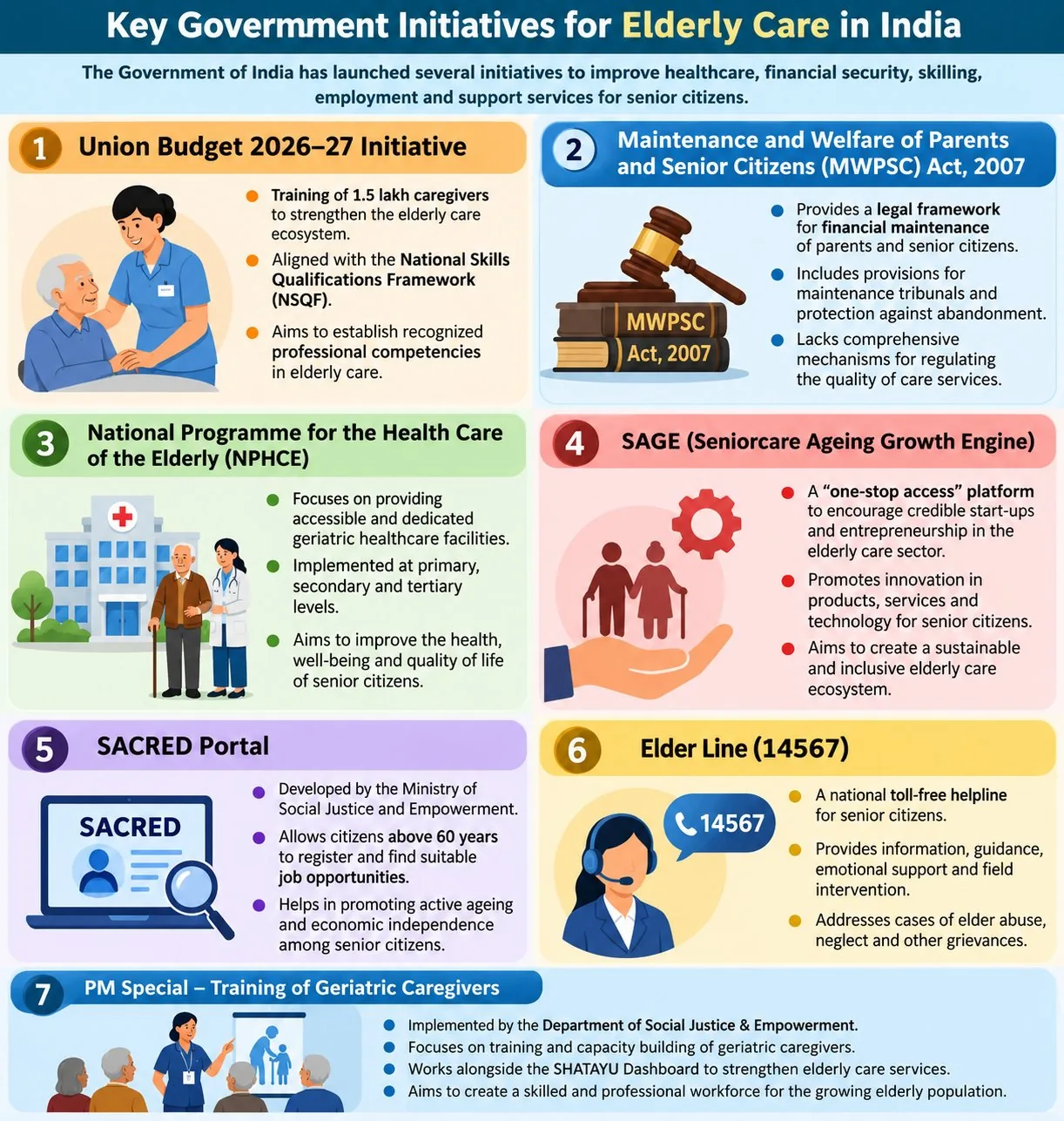 What are the Challenges in Elderly Care in India?
- Policy and Financial Void for Informal Caregivers:
- According to NITI Aayog’s 2024 senior-care position paper, more than 75% of elderly Indians have at least one chronic condition, while only 18% have health insurance, increasing households’ financial vulnerability.
- While the Rights of Persons with Disabilities (RPwD) Act, 2016 acknowledges family caregivers, informal caregiving lacks institutional backing and long-term care financing. The absence of health, accident, and pension coverage severely burdens low- and middle-income households.
- This “unpaid care penalty” directly constrains female labour force participation and widens socio-economic inequalities.
- Epidemiological Transition and Multimorbidity:
- India’s healthcare infrastructure remains skewed toward acute maternal and child care.
- Roughly 75% of the elderly suffer from chronic diseases, yet specialized palliative and psychogeriatric care facilities remain largely non-existent.
- The “Feminisation of Ageing” and Poverty: Women are living longer but often in prolonged destitution. Over 40% of India’s elderly fall into the poorest wealth quintile, forcing catastrophic out-of-pocket health expenditures.
- Regulatory Voids in the Commercial Sector: The current legal framework, anchored by the Maintenance and Welfare of Parents and Senior Citizens (MWPSC) Act, 2007, focuses on legally compelling adult children to provide financial maintenance.
- Shortage of Skilled Caregivers: Union Budget 2026–27 announced National Skills Qualifications Framework (NSQF)-aligned training for 1.5 lakh caregivers. However, India’s rapidly ageing population and extensive dependence on informal care indicate the need for a much larger trained workforce.
- National Policy on Caregiving: As recommended by NITI Aayog, India must establish a National Caregiver Council (NCC) to act as an apex regulatory body to set skill benchmarks, standardise curricula, and manage a national registry of certified caregivers.
- Standardized Training & Certification: Introduce NSQF-aligned certification for mobility assistance, palliative care, and dementia care. States should adopt models like the Keralam Geriatric Care Certification Framework to mandate background checks.
- State-Level Innovations:
- Kerala has pioneered initiatives such as the K4Care programme under the Kudumbashree mission, which trains certified geriatric care executives. Karnataka provides a Carer’s Monthly Allowance Scheme and supports caregivers through Self-Help Groups (SHGs).
- Earlier in 2026, Kerala became the first Indian state to introduce a specialized ‘Elderly Budget’ document alongside its main budget, allocating funds for retirement homes, palliative care networks, and the Vayomithram scheme for doorstep medicines.
- Social Security for Caregivers: To reduce turnover, certified caregivers must be guaranteed fair minimum wages, safe working conditions, and social security coverage under the Unorganised Workers’ Social Security Act, 2008.
- Support for Unpaid Family Caregivers: Acknowledge informal caregivers by providing formal care leave provisions, community respite-care centers, and Certification of Prior Learning (RPL).
- Legalizing Living Wills: Clear, accessible legal pathways must be established nationwide so individuals can register advance medical directives, sparing families from agonizing decisions.
- India must formalise the care economy through standardised geriatric training, fair wages and social security. This can ensure elderly dignity, boost women’s workforce participation and create jobs, turning the ageing challenge into an economic opportunity for Viksit Bharat@2047.