Comrades Dispatch · 19 Oct 2026 (PDF)
In this edition
- Kufri Jamunia: India’s Biofortified Purple Potato Agriculture & Rural
- India’s Crude Oil Import Dynamics Economic Scenario
- India and Mali Commemorate World Cotton Day 2026 Important Days
- UNIFIL in Lebanon International Relations
- Transforming Connectivity in Jammu and Kashmir Nation & States
- National Human Rights Commission Polity & Governance
- Indian Scientists Identify Martian Analogue Sites Science & Technology
- Ramya Anche to Lead NASA’s PUFFINS Space Telescope Mission Space
- KAUMARACON-2026 Visits & Conferences
- 153rd Assembly of the Inter-Parliamentary Union Visits & Conferences
Agriculture & Rural
Kufri Jamunia: India’s Biofortified Purple Potato
Source Why in News?- Recently, the ICAR–Central Potato Research Institute (ICAR-CPRI) highlighted Kufri Jamunia, a biofortified purple potato variety, for its potential to address hidden hunger and improve nutritional security.
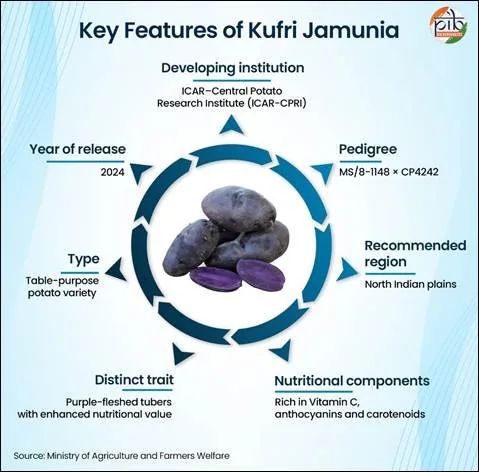
- About: Kufri Jamunia is a biofortified purple potato variety developed by the ICAR–Central Potato Research Institute (ICAR-CPRI) and officially released in 2024.
- Biofortification: It involves improving the nutritional content of crops through plant breeding to address hidden hunger (micronutrient deficiencies), even among populations consuming adequate calories.
- Characteristics: It is a medium-maturing variety with dark purple skin, purple flesh, oblong tubers, shallow eyes and a mealy texture. Each plant produces 10–12 medium to large tubers.
- Yield:
- It produces 32–35 tonnes per hectare under recommended cultivation practices, with yields reaching 49 tonnes per hectare in station trials over 90 days.
- Nearly 90% of the total yield was marketable in trials, and the variety has a 6–8 week dormancy period with good storage quality.
- Nutritional Value:
- It contains Vitamin C, anthocyanins, carotenoids, iron and zinc, with higher levels of Vitamin C, anthocyanins and carotenoids than earlier coloured potato varieties such as Kufri Neelkanth and Kufri Manik..
- Anthocyanins, responsible for its purple colour, are natural pigments with antioxidant properties.
- Culinary Uses: Its purple flesh and mealy texture make it suitable for traditional dishes, snacks and processed foods, including parathas, puris, bakery products and anthocyanin-rich potato flour.
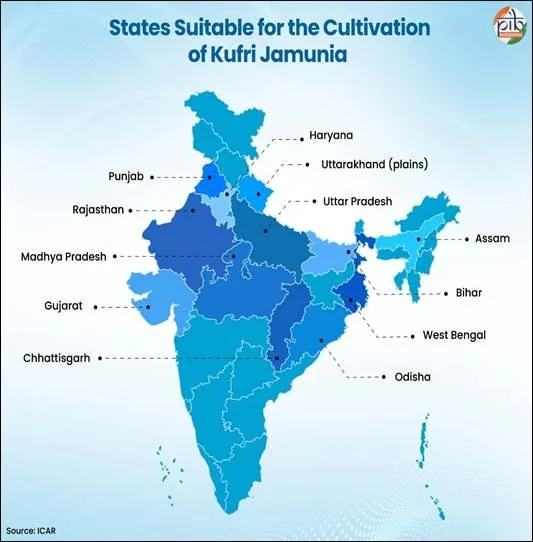
- Cultivation: Kufri Jamunia has demonstrated stable performance in multi-location trials and is recommended for cultivation in the North Indian plains, where climatic and soil conditions are favourable for potato cultivation.
- Significance: Its enhanced nutritional profile, high yield and culinary versatility offer potential to address hidden hunger, promote dietary diversity and strengthen nutritional security.
 Other Potato Varieties Developed by ICAR-CPRI
- Kufri Neelkanth: Developed by ICAR-CPRI as the 1st purple-skinned specialty potato variety and released in 2018. It is suitable for cultivation in Punjab, Haryana, Uttar Pradesh, Uttarakhand, Bihar, Madhya Pradesh and Chhattisgarh and is known for its high antioxidant content.
- Kufri Manik: Released in 2021, it produces deep red, round tubers with yellow flesh and is rich in anthocyanin, zinc and iron.
Economic Scenario
India’s Crude Oil Import Dynamics
Source Why in News?- India sourced a record 66.8% of its crude oil imports from three countries i.e. Russia (44.3%), United Arab Emirates (UAE) (17.4%) and the United States (US) (5.1%) in August 2026, with Russia remaining its largest supplier.
- Indian Crude Basket (ICB):
- It represents the mix of crude oil grades imported by Indian refineries.
- It comprises sweet crude oil (Brent Dated) and sour crude oil (the average of Oman and Dubai crude prices).
- The ratio of sweet and sour crude varies each month. In October 2026, the ratio stood at 65.27 : 34.73.
- Dynamics:
- India’s crude oil security remains constrained by its dependence on imports, which account for approximately 88–89% of domestic consumption.
- However, diversification of suppliers and shipping routes, particularly since 2022, has strengthened its ability to withstand supply disruptions.
- India now sources crude oil from around 40 countries, compared with 27 in 2006–07, while nearly 70% of its imports reportedly arrive through routes outside the Strait of Hormuz.
- This broader sourcing network reduces the risk of excessive dependence on a single supplier or transit corridor, although it does not insulate India from global price volatility.
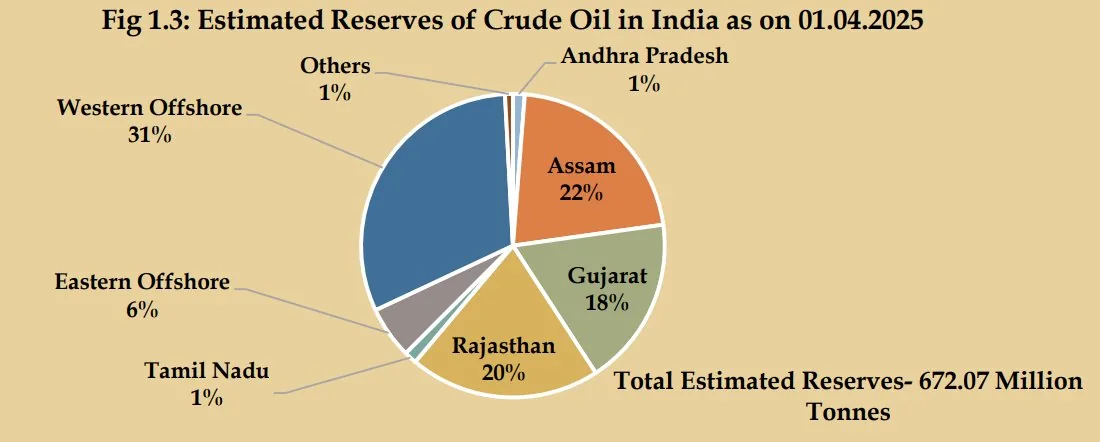
- As of April 2025, India’s estimated crude oil reserves stood at 672.07 million tonnes. Region-wise, the Western Offshore with 31% (largest share), followed by Assam (22%) and Rajasthan (20%).
 What is the Current Status of India’s Oil and Petroleum Industry?
- India’s Petroleum Industry:
- India is the world’s 4th largest oil refining country and 7th largest exporter of refined petroleum products.
- Since the first oil well in Digboi (1867), India’s petroleum industry has expanded through public-private investments, increased exploration and regulatory reforms.
- India is also promoting cleaner and alternative energy sources through initiatives such as the Ethanol Blending Programme (20% target by 2025–26), SATAT initiative for Compressed Biogas, Strategic Petroleum Reserves and National Green Hydrogen Mission.
- Strategic Petroleum Reserves (SPRs):
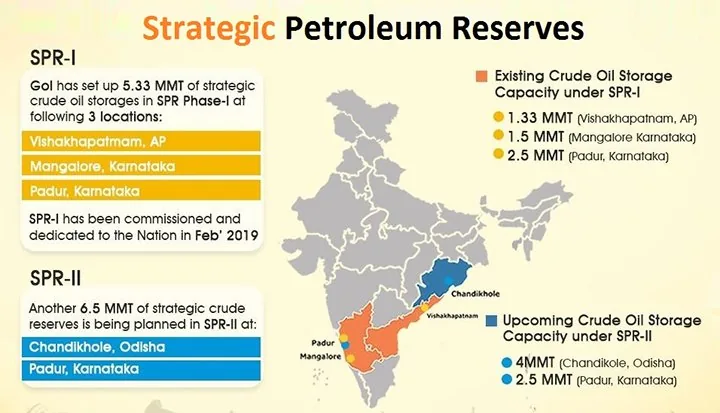
- India has 5.33 million tonnes of underground crude oil storage capacity at Visakhapatnam (Andhra Pradesh), Mangaluru and Padur (Karnataka).
- These reserves are managed by Indian Strategic Petroleum Reserves Limited (ISPRL) under the Ministry of Petroleum and Natural Gas.
- ISPRL was created by the Government of India as a Special Purpose Vehicle in 2004.
- At the international level, India also engages with the International Energy Agency (IEA) to promote energy security and cooperation.
 International Energy Agency (IEA):
- The International Energy Agency (IEA) is an autonomous intergovernmental organization established in 1974 during the 1973–1974 oil crisis.
- India has been an Association country since 2017, but is not a full member.
- Headquarters: Paris, France.
- Mexico became the 30th member of the IEA in February 2018, making it the first member country from Latin America.
Important Days
India and Mali Commemorate World Cotton Day 2026
Source Recently, India and Mali jointly organised an event at the United Nations Headquarters, New York, to commemorate World Cotton Day under the theme “Cotton for Sustainability: Livelihoods, Value Addition and Partnership.”- UN Recognition: The UN General Assembly proclaimed 7th October as World Cotton Day in 2021, highlighting cotton’s role in economic development, international trade and poverty alleviation.
- Global Celebration: The main World Cotton Day 2026 celebration was held in Tashkent, Uzbekistan, under the theme “Cotton for Good: Building Prosperity Through Trade, Transformation and Partnership.”
- Global Significance: According to the FAO, cotton is cultivated by around 24 million farmers worldwide and provides employment to approximately 125 million people across its value chain. India is among the world’s leading cotton-producing countries.
- India’s Priorities: India highlighted four priorities for the cotton sector, namely producer livelihoods, value addition and market access, sustainability, and technology and partnerships.
- South-South Cooperation: The event stressed South-South and triangular cooperation to help cotton-producing countries retain greater value and advance the Sustainable Development Goals (SDGs).
- Traditional Crafts and Women: Kantha embroidery in Bolpur, West Bengal was highlighted as an example of cotton-based value addition that supports women’s livelihoods, traditional craftsmanship, reuse and resource efficiency.
- Mission for Cotton Productivity: India highlighted the Mission for Cotton Productivity for improving cotton productivity and quality, particularly benefiting small and marginal farmers.
- Kasturi Cotton Bharat: The Kasturi Cotton Bharat initiative was highlighted for promoting quality and traceability in India’s cotton sector.
International Relations
UNIFIL in Lebanon
Source The UN has stressed the need to sustain stability in southern Lebanon as the final mandate of the United Nations Interim Force in Lebanon (UNIFIL) approaches its end.- About Lebanon:
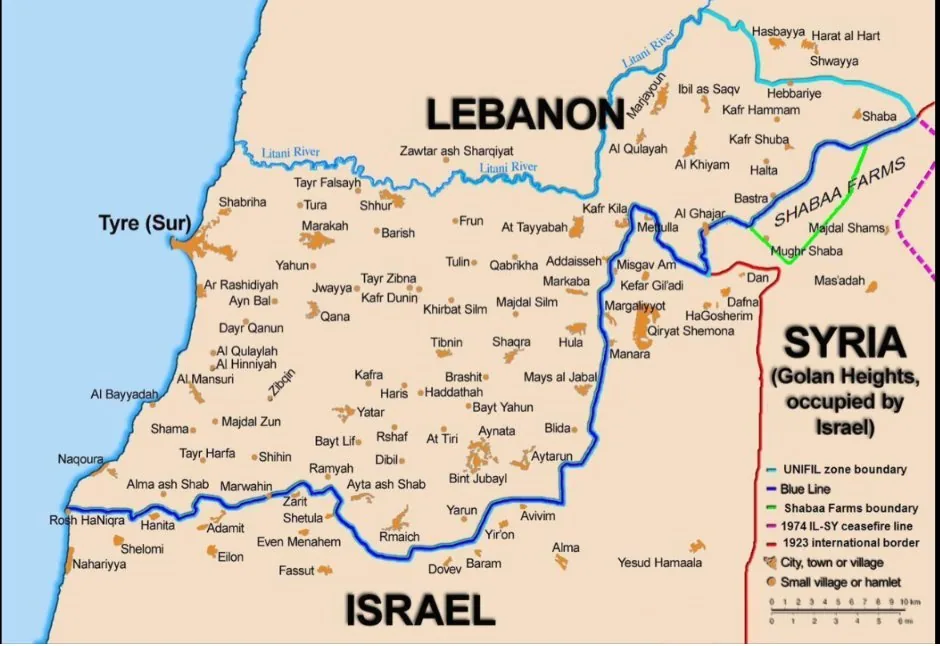
- Lebanon is a country on the eastern coast of the Mediterranean Sea, bordered by Syria and Israel, with Beirut as its capital.
- Historically, Lebanon was home to the Phoenicians, whose coastal cities, including Tyre, Sidon and Byblos, served as major trading centres during the Bronze Age.
- Hezbollah remains a pivotal domestic actor within Lebanon’s political landscape and a key combatant in regional friction with Israel.
- Also, the Blue Line is a UN-demarcated withdrawal line between Lebanon and Israel, established in 2000 to confirm Israeli withdrawal from southern Lebanon.
- About UNIFIL:
- The United Nations Interim Force in Lebanon (UNIFIL) was established by the UN Security Council in March 1978 to verify Israel’s withdrawal from Lebanon, restore peace and security, and help the Lebanese Government re-establish its authority in southern Lebanon.
- Its mandate was revised in 1982 and 2000. Following the 2006 conflict, UNIFIL’s responsibilities were expanded to include monitoring the cessation of hostilities, supporting the deployment of the Lebanese Armed Forces, facilitating humanitarian assistance.
- UNSC Resolution 2790 (2025) extended UNIFIL for the final time until 31 December 2026.
- India has contributed to UNIFIL since 1998. As of September 2026, 600+ Indian peacekeepers served in the mission.
Nation & States
Transforming Connectivity in Jammu and Kashmir
Source Why in News?- India is strengthening multimodal connectivity in Jammu and Kashmir through major railway, highway, tunnel and airport projects, including the Udhampur–Srinagar–Baramulla Rail Link (USBRL), to improve all-weather accessibility, regional economic integration and strategic mobility.
- Udhampur–Srinagar–Baramulla Rail Link (USBRL) Project
- About: The 272-km USBRL project, inaugurated in June 2025 at a cost of ₹43,780 crore, connects the Kashmir Valley with India’s national railway network.
- Infrastructure: The fully electrified project includes 36 tunnels (119 km) and 943 bridges, along with over 215 km of access roads.
- Employment: The project generated more than 5 crore person-days of employment, supporting regional economic development.
- Vande Bharat Express:
- Services began between Katra and Srinagar in June 2025 and were extended to Jammu Tawi in April 2026.
- The Jammu–Srinagar journey now takes less than five hours, with trains designed for extreme weather conditions and equipped with snow-clearance support and seismic safety features.
- Major Engineering Achievements
- Chenab Rail Bridge: The world’s highest railway arch bridge, located in Reasi district, rises 359 metres above the Chenab riverbed. Inaugurated in June 2025, it is 1,315 metres long, with a 467-metre arch span.
- Anji Khad Bridge: India’s first cable-stayed railway bridge, located in Reasi district, features a 193-metre-high inverted-Y tower and measures 473.25 metres in length.
- Tunnel T50: The 12.77-km-long rail tunnel, inaugurated in 2024, connects Khari and Sumber. It is India’s longest transportation tunnel, constructed using the New Austrian Tunnelling Method (NATM) and includes a parallel escape tunnel.
- Supporting Railway Infrastructure
- Railway Electrification: The entire existing Broad Gauge network in Jammu and Kashmir is electrified, compared with approximately 99.6% electrification nationwide.
- Amrit Bharat Station Scheme: Four stations in Jammu and Kashmir have been identified for redevelopment: Budgam, Jammu Tawi, Martyr Captain Tushar Mahajan (Udhampur) and Shri Mata Vaishno Devi Katra.
- Proposed Railway Projects: These include the Jalandhar Cantt.–Jammu Tawi third line (216 km), Jammu–Katra additional line (78 km) and Jammu/Reasi–Poonch new line (190 km).
- Key Tunnel Connectivity Projects
- Sonamarg (Z-Morh) Tunnel:
- The 6.4-km bi-directional tunnel, inaugurated in January 2025, provides all-weather connectivity between Srinagar and Sonamarg along the route to Leh.
- Built at a cost of over ₹2,700 crore, it bypasses avalanche-prone stretches and supports winter tourism, adventure sports and local livelihoods.
- Zojila Tunnel:
- The 13.153-km bi-directional tunnel, under construction between Baltal and Minamarg on NH-1, achieved its main tunnel breakthrough in June 2026.
- Upon completion, the ₹6,808-crore project will provide all-weather connectivity between Jammu and Kashmir and Ladakh, reducing Sonamarg–Minamarg travel time from approximately two hours to 30 minutes.
- It will strengthen defence logistics, strategic mobility, tourism and trade, while reducing disruptions caused by snowfall and avalanches.
- Dr Syama Prasad Mookerjee Tunnel:
- The 9-km tunnel, formerly known as the Chenani–Nashri Tunnel, opened in 2017 and connects Udhampur and Ramban.
- It reduces travel distance by 31 km and travel time by approximately two hours.
- Sonamarg (Z-Morh) Tunnel:
- Major Highway Projects
- Pradhan Mantri Gram Sadak Yojana (PMGSY)-IV: In August 2026, foundation stones were laid for 110 road projects covering 598.455 km, costing over ₹1,500 crore, benefiting 46,972 people in the Udhampur–Kathua–Doda–Kishtwar region. Several projects use waste plastics for sustainable construction.
- Delhi–Amritsar–Katra Expressway: The 667-km greenfield expressway aims to reduce Delhi–Katra travel time from approximately 14 hours to six hours. Key sections were inaugurated in July 2026, improving pilgrimage, industrial and logistics connectivity.
- Rafiabad–Kupwara Road (NH-701): The widening and strengthening project, launched in June 2025 under Project Beacon, aims to improve last-mile and border-area connectivity.
- Shopian Bypass (NH-444): The 8.925-km bypass, sanctioned at ₹224.44 crore, will improve connectivity between Shopian, Pulwama and Kulgam, facilitating faster transportation of agricultural produce.
- Airport and Regional Air Connectivity Projects
- Srinagar International Airport Expansion:
- A ₹1,677-crore project, approved in February 2026, aims to expand the Civil Enclave at Srinagar International Airport within the IAF’s Budgam Airbase.
- The project includes a 71,500 sq m terminal with an annual capacity of 10 million passengers and 15 aircraft parking bays.
- The terminal will incorporate traditional Kashmiri architecture, rainwater harvesting, natural lighting and eco-friendly materials, targeting a 5-star GRIHA rating.
- Regional Air Connectivity: Airports at Udhampur and Kishtwar are planned under the UDAN scheme to improve regional accessibility, tourism, employment and investment opportunities.
- Srinagar International Airport Expansion:
- Multimodal Logistics and Economic Integration
- PM Gati Shakti: Launched in October 2021, the PM Gati Shakti National Master Plan integrates railways, roads, ports, waterways, airports and logistics infrastructure through a GIS-based planning platform, covering 44 Central Ministries and 36 States/UTs.
- Gati Shakti Cargo Terminals:
- The Gati Shakti Multi-Modal Cargo Terminal (GCT) Policy, launched in December 2021, promotes modern rail-linked cargo terminals through private investment.
- 142 GCTs have been commissioned nationwide. The Samba GCT, commissioned in 2024, is operational, while Kathua, Anantnag and Jammu have received in-principle approvals for additional terminals.
- The expansion of rail, road, air and multimodal connectivity in Jammu and Kashmir is improving market access, tourism, trade and local livelihoods, particularly for farmers, artisans and businesses. Integrated infrastructure development is also strengthening regional economic integration, border security, disaster response and strategic mobility, contributing to the region’s long-term development.
Polity & Governance
National Human Rights Commission
Source Why in News?- Recently, the National Human Rights Commission (NHRC) took cognisance of allegations involving the use of children in a protest in Mumbai and directed an investigation into possible violations of child rights, bringing attention to the NHRC’s role in protecting human rights.
- About: The National Human Rights Commission (NHRC) is a statutory body established on 12th October 1993 under the Protection of Human Rights Act, 1993. It protects and promotes human rights relating to life, liberty, equality and dignity.
- Composition:
- Under Section 3 of the Act, the NHRC comprises a Chairperson, five full-time Members and seven deemed (ex-officio) Members.
- The Chairperson must have been the Chief Justice of India or a Judge of the Supreme Court, while at least one of the three human rights experts must be a woman.
- Appointment: The President of India appoints the Chairperson and Members on the recommendation of a six-member committee headed by the Prime Minister, comprising the Lok Sabha Speaker, Union Home Minister, Deputy Chairman of the Rajya Sabha and Leaders of the Opposition in both Houses of Parliament.
- Tenure: The Chairperson and Members hold office for three years or until the age of 70 years, whichever is earlier, and are eligible for reappointment.
- Functions: The NHRC can inquire into human rights violations or negligence by public servants, intervene in court proceedings with permission, visit jails and institutions, review legal safeguards, undertake research and promote human rights awareness.
- Powers During Inquiry: While conducting an inquiry, the NHRC has certain powers of a civil court, including summoning persons, requiring documents and obtaining relevant records.
- International Standards: The NHRC is guided by the Paris Principles, which emphasise independence, a broad human rights mandate, adequate resources and pluralism for national human rights institutions.
- Limited Enforcement Powers: The NHRC’s recommendations are advisory and non-binding, as it cannot directly punish human rights violators or enforce compensation, leading to criticism of it as a “toothless tiger.”
- Concerns over Independence: The involvement of government officials in appointments and investigations raises concerns about the NHRC’s institutional autonomy, impartiality and transparency.
- Lack of Diversity and Representation: Inadequate representation of women, minorities and civil society has raised concerns about pluralism and inclusivity within the Commission.
- Accreditation Challenges:
- The Global Alliance of National Human Rights Institutions (GANHRI) recommended downgrading the NHRC’s accreditation from ‘A’ to ‘B’ status in March 2025, citing concerns over its independence, transparency and compliance with the Paris Principles.
- The NHRC’s appeal was rejected in December 2025, while the final accreditation review was deferred to November 2026. The proposed downgrade had not been finalized as of October 2026.
- Investigative Constraints: Dependence on government investigative agencies, including police personnel, raises concerns about conflicts of interest, particularly in cases involving alleged custodial violence and police misconduct.
- Limited Jurisdiction: The NHRC generally cannot investigate alleged human rights violations more than one year after their occurrence, while its powers concerning violations involving the armed forces are restricted.
- Special Procedure for Armed Forces: Under Section 19 of the Protection of Human Rights Act, complaints involving the armed forces follow a special procedure in which the Commission seeks a report from the Central Government before making recommendations.
- Strengthening Enforcement Powers: Amend the Protection of Human Rights Act, 1993, to strengthen mechanisms for implementing NHRC recommendations, ensuring greater accountability and timely redressal of human rights violations.
- Ensuring Institutional Independence: Introduce a transparent and merit-based appointment process, reduce executive influence and safeguard the Commission’s administrative and financial autonomy.
- Promoting Diversity and Inclusivity: Ensure adequate representation of women, minorities, civil society and human rights experts in accordance with the Paris Principles.
- Enhancing Investigative Capacity: Establish an independent investigation mechanism, recruit trained personnel and reduce dependence on government agencies to avoid potential conflicts of interest.
- Expanding Jurisdiction: Review the one-year limitation period for investigating complaints and strengthen oversight mechanisms concerning alleged human rights violations involving the armed forces.
- Strengthening Resources and Accountability: Provide adequate funding, skilled staff and modern technology, alongside regular monitoring of government action on NHRC recommendations.
- Improving International Compliance: Address concerns raised by the Global Alliance of National Human Rights Institutions (GANHRI) to strengthen compliance with the Paris Principles and maintain the NHRC’s international credibility.
- Better Case Management: Digital case-management systems, stronger monitoring of Action Taken Reports and improved inter-divisional coordination can help reduce pendency and improve efficiency.
- The National Human Rights Commission (NHRC) plays a vital role in safeguarding human rights and protecting vulnerable sections. Strengthening its institutional independence, investigative capacity, enforcement mechanisms and accountability is essential to ensure effective redressal of human rights violations and uphold constitutional values, human dignity and the rule of law.
Science & Technology
Indian Scientists Identify Martian Analogue Sites
Source Indian Scientists from Kerala have identified sites in Tamil Nadu and Chile that have geological, chemical and physical similarities with Mars.- Minerals Identified:
- Melanterite was detected in Neyveli, Tamil Nadu.
- Gypsum was identified in the Atacama Desert in Chile and the Tiruchirappalli Badlands Tamil Nadu.
- Both are hydrous sulphates formed through water-rock interactions. Gypsum records past watery conditions, while melanterite indicates short-lived wet, acidic and oxidising conditions.
- Technology Used: Scientists used a Laser Raman Spectrometer, supported under the Department of Science and Technology-Fund for Improvement of S and T Infrastructure (DST-FIST).
- About Mars:
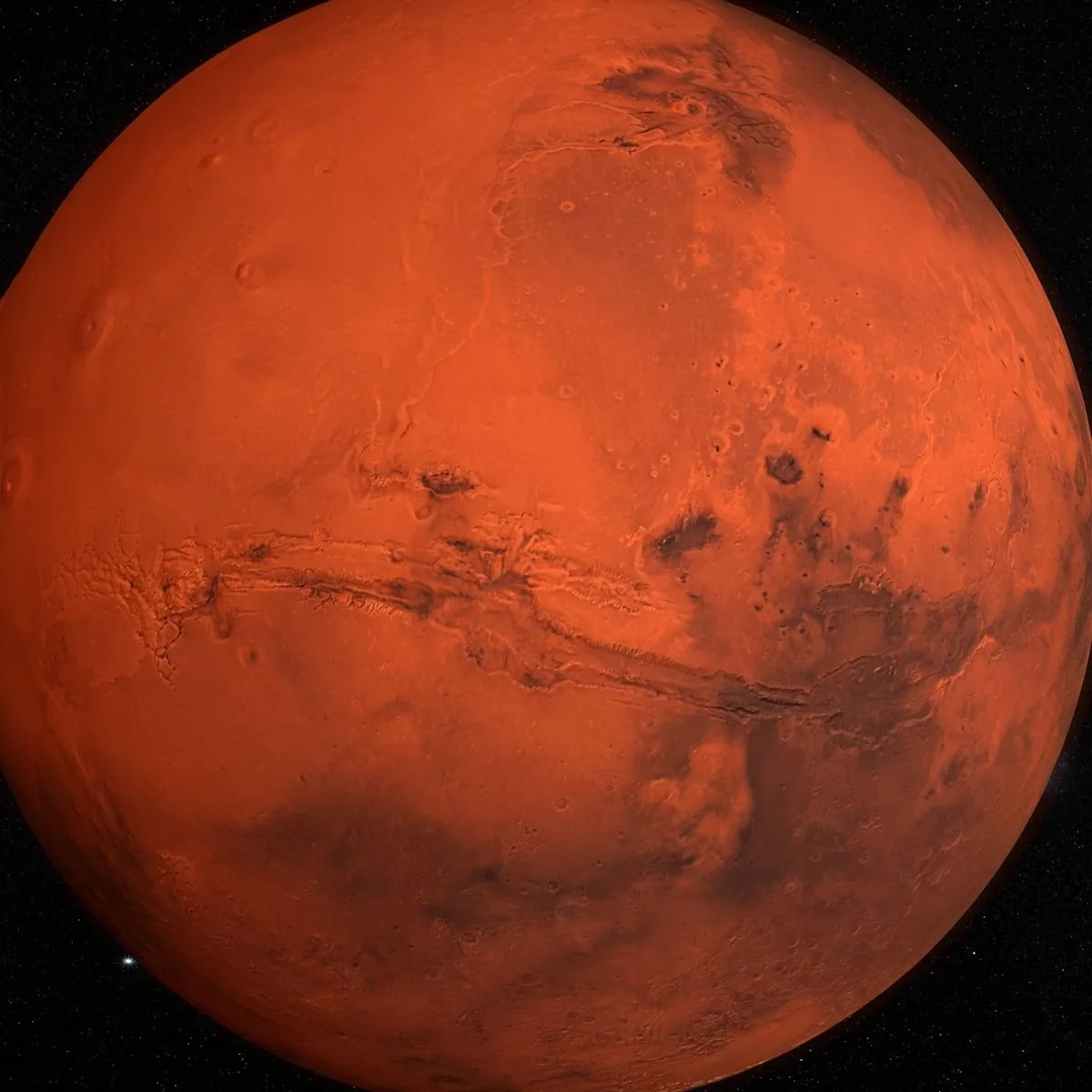
- Mars is the fourth planet from the Sun, often called the Red Planet because iron-rich dust gives its surface a reddish colour.
- It is a cold, rocky desert with volcanoes, deep canyons, and polar ice caps.
- Here, a day lasts about 24.6 hours; a year lasts 687 Earth days.
- Its atmosphere is very thin and mostly carbon dioxide, making it unsuitable for humans to breathe.
- Mars has water ice and evidence of ancient rivers and lakes. No life has been confirmed.
- It has two small moons, Phobos and Deimos.
Space
Ramya Anche to Lead NASA’s PUFFINS Space Telescope Mission
Source Recently, NASA selected Dr. Ramya Anche, an Indian-origin astronomer and assistant research professor at the University of Arizona, as the Principal Investigator of the PUFFINS mission, targeted for launch in 2030.- About PUFFINS: It stands for Polarimetry in the Ultraviolet to Find Features in INterStellar dust and is a SmallSat mission selected under NASA’s Astrophysics Pioneers programme.
- Objective: The mission aims to study tiny interstellar dust grains to improve understanding of star and planet formation and the evolution of the universe.
- Technology:
- A 10-inch telescope will use ultraviolet spectropolarimetry to observe light from approximately 70 distant stars.
- UV observations can study extremely small dust grains (around 0.05 microns) that are difficult to examine using visible-light and infrared telescopes.
- Spectropolarimetry measures how dust grains aligned with galactic magnetic fields polarise starlight, helping scientists determine their properties.
- Interstellar Dust: These microscopic particles, primarily composed of silicate and carbonaceous materials, influence how starlight travels through space and contribute to star and planet formation.
- Indian Collaboration: The mission involves Indian institutions, including the Inter-University Centre for Astronomy and Astrophysics (IUCAA), Pune, and the Indian Institute of Astrophysics (IIA), Bengaluru.
Visits & Conferences
KAUMARACON-2026
Source The Vice-President inaugurated the 3rd International Conference on Kaumarabhritya, KAUMARACON-2026, organised by the All India Institute of Ayurveda (AIIA).- The theme of the Conference was “Shaping the Future of Child Health: Global Perspectives, Research Innovations, and Clinical Frontiers in Kaumarabhritya.”
- The conference stressed combining traditional knowledge with scientific research to improve evidence-based healthcare and global acceptance of Ayurveda.
- The event saw the launch of the AYUSH Start-up Portal, AIIA-iCAINE website, Ayurveda Digital Innovation and Venture Acceleration Facility (AyuDIVA), Vamana App and Panchakarma Assessment App.
- Panchakarma, meaning “five actions” in Sanskrit, is an Ayurvedic treatment system that aims to remove toxins (Ama), balance the three doshas, Vata, Pitta and Kapha, and improve overall health and well-being.
- About Ayurveda:
- Ayurveda is one of the oldest traditional systems of medicine. Its Brihat Trayi comprises the Charaka Samhita, Sushruta Samhita and Ashtanga Hridayam.
- The Ministry of AYUSH, established in 2014, promotes traditional systems of medicine. The Ministry has undertaken several initiatives to promote traditional medicine such as:
- Establishment of the WHO Global Traditional Medicine Centre in Jamnagar,
- Integration of traditional medicine classifications into ICD-11
- Creation of the Traditional Knowledge Digital Library (TKDL)
- Implementation of the National AYUSH Mission (NAM)
- About Kaumarabhritya:
- It is the branch of Ayurveda concerned with child healthcare, including nutrition, growth, development and disease prevention.
- Kaumara: Derived from ‘Kumara’, pertaining to a child from birth up to 16 years of age.
- Bhritya: Derived from the Sanskrit root ‘Bhri’- meaning nourishment, upbringing, support, maintenance, and protection.
153rd Assembly of the Inter-Parliamentary Union
Source Recently, India participated in the 153rd Assembly of the Inter-Parliamentary Union (IPU), held in Arusha, Tanzania, focusing on good governance, inclusivity, trust and global cooperation.- About: The 153rd IPU Assembly brought together parliamentarians from across the world under the theme “Enhancing good governance and empowering communities through inclusivity, trust and opportunities for all.”
- Indian Delegation: The delegation was led by Harivansh, Deputy Chairman of the Rajya Sabha, and included Members of Parliament from both the Lok Sabha and Rajya Sabha.
- Key Outcomes:
- Arusha Communiqué: Adopted to promote inclusive governance, public trust, accountability and community empowerment.
- Resolutions: Adopted on the rights and empowerment of persons with disabilities and strengthening resilience against climate-related disasters, particularly in the Himalayan region.
- New IPU President: Milton Dick, Speaker of Australia’s House of Representatives, was elected the 32nd President of the IPU, succeeding Tulia Ackson of Tanzania.
- About: It was founded on 30th June 1889 in Paris, France, by William Randal Cremer of Britain and Frédéric Passy of France.
- Headquarters: Based in Geneva, Switzerland, since 1921, the IPU serves as the global organisation of national parliaments.
- Membership: As of October 2026, the IPU comprises 184 Member Parliaments and 15 Associate Members, with the Parliament of Naoero (Nauru) joining as its 184th member during the 153rd Assembly.
- Main Objective: It promotes parliamentary diplomacy, peace, democracy, human rights, gender equality and sustainable development through dialogue and cooperation among parliaments.
- IPU Assembly: The Assembly is the IPU’s main political body and adopts parliamentary resolutions on major global issues. It is generally held twice a year.
- International Day of Parliamentarism: 30th June is observed as the International Day of Parliamentarism, marking the foundation of the IPU in 1889.
- India and IPU: India is a member of the IPU and participates through its parliamentary delegations, making the organisation an important platform for parliamentary diplomacy.