Comrades Dispatch · 20 Oct 2026 (PDF)
In this edition
- Climate Risk Insurance in India Environment & Ecology
- Pumped Storage Hydropower in India Infrastructure & Energy
- Exercise AUSTRAHIND 2026 Military Exercises
- Exercise KONKAN-26 Military Exercises
- India Rolls Over ₹30 Billion Currency Swap Facility for Maldives MOU’s & Agreements
- Right to Internet Access is a Fundamental Right Polity & Governance
- Supreme Court on Religious Conversion and Reservation in India Polity & Governance
- BHASHINI and IISc Develop Text-to-Speech Models for Sourashtra Science & Technology
- Reorganisation of CISF Security
Environment & Ecology
Climate Risk Insurance in India
Source Why in News?- The 2026 southwest monsoon highlighted India’s vulnerability to extreme weather, as El Niño and regional rainfall deficits coincided with localised extreme rainfall, underscoring the need for climate risk insurance to protect vulnerable households and farmers from financial losses.
- High Vulnerability:
- According to the Climate Risk Index (CRI) 2026, India is ranked 15th among countries most affected by climate change.
- Over three decades, extreme weather events have caused an estimated USD 170 billion in losses and affected over a billion people.
- The Climate Vulnerability Index (CVI), released by the Council on Energy, Environment and Water (CEEW), analysed 640 districts in India based on the 2011 Census and found that:
- 463 districts are vulnerable to extreme floods, droughts and cyclones.
- Over 45% of these vulnerable districts have experienced unsustainable changes in land use and infrastructure.
- 183 districts are hotspots, highly vulnerable to more than one extreme climate event. More than 60% of Indian districts have medium to low adaptive capacity.
- Protection Gap:
- According to reinsurance giant Swiss Re, Indian properties worth an estimated USD 26 trillion to USD 29 trillion are currently exposed to natural catastrophe risks.
- Yet, a staggering 93% of this exposure remained uninsured as of 2022.
- This domestic crisis mirrors a global trend.
- Climate disasters act as a risk multiplier for the poor. Studies indicate that 222 million children in India are gripped by the “double threat” of grinding poverty and climate disaster.
- Stagnant Agricultural Coverage:
- Crop insurance remains the most widespread form of weather protection in India.
- However, the 16th Finance Commission notes that despite the Union and state governments subsidizing 85-90% of premiums under the Pradhan Mantri Fasal Bima Yojana (PMFBY), farmer penetration has stagnated at roughly 40% over the past eight years.
- Burden on the Uninsured: Because disaster insurance outside of agriculture remains at a nascent stage (plagued by low awareness and affordability issues), the massive financial burden of recovery falls squarely on individual citizens and the state exchequer.
- Advances in Risk Modeling: India is gradually developing sharper catastrophe models to predict climate impacts down to specific pin codes and street levels. However, integrating this data into affordable public protection remains a hurdle.
- The “Paradox of Knowing More”:
- The insurance industry is shifting from broad regional risk assessments to hyper-local mapping.
- For example, Indian risk management firm RMSI now uses 80,000 simulated flood events across 28 river basins and 19,000 pin codes. While this allows insurers to understand risks at the street level, it creates a paradox: highlighting elevated risks in specific neighborhoods can make premiums unaffordable for the residents who need protection the most.
- Underwriting Indiscipline:
- Industry veterans warn that despite the availability of sophisticated catastrophe models (like those from Moody’s and Aon), underwriting discipline (the process of assessing risks and deciding insurance premiums) in India’s insurance market is lagging.
- Fierce competition for market share has led to artificially low, aggressive pricing that ignores unraveling long-term climate realities.
- Cascading Economic Impacts:
- Disasters cause cross-category losses. Crop failures, infrastructure damage, and supply chain disruptions act as a regressive tax on the poor and can trigger macroeconomic instability, with warnings that mounting weather-related insurance losses could trigger future financial crises.
- More than 80% of Indians live in districts vulnerable to climate risks, and repeated disasters continuously disrupt local economies and disproportionately impact low-income households, farmers, and marginalized communities.
- Advances in Risk Modelling:
- India is developing high-resolution catastrophe models to assess climate risks at pin-code and street levels. RMSI’s India FloodRisk Model covers over 19,000 pin codes and simulates 80,000 flood events across major river basins
- RMSI’s India Cyclone Hazard Model provides 1 km × 1 km risk mapping and advanced cyclone forecasting. However, translating these granular risk assessments into affordable insurance and effective public protection remains a major challenge.
 What Measures can Ensure Effective Climate Risk Protection?
- National Catastrophe Risk Insurance Pool:
- World Resources Institute research examining 320 adaptation and resilience investments across 12 countries. It reports that every USD 1 invested could generate more than USD 10.50 in benefits over ten years.
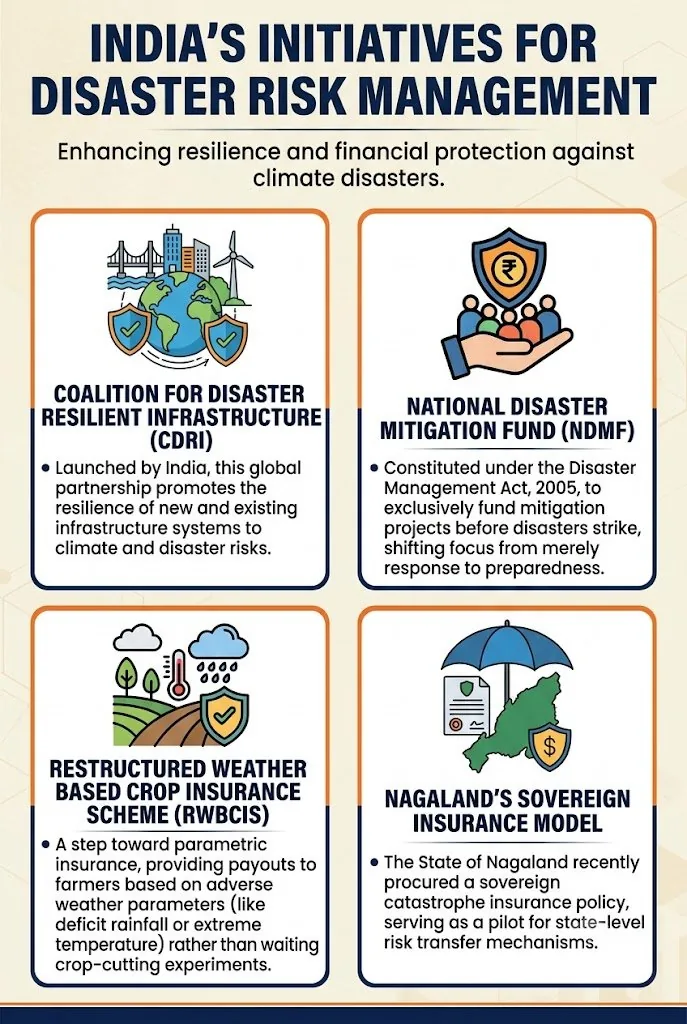
- UNDP and NDMA have worked on developing a proposed national catastrophe risk insurance pool to aggregate public resources and expand disaster-risk financing. Such a mechanism could distribute catastrophic losses among governments, insurers and reinsurers.
- This would spread extreme climate risks across the government, domestic insurers, and global reinsurers, keeping retail premiums manageable.
- Scaling Parametric (Index-Based) Insurance: Shifting from indemnity-based to parametric insurance. If a predetermined weather trigger is breached (e.g., rainfall exceeds 200mm in 24 hours, or cyclonic winds exceed 150 km/h), direct benefit transfers (DBT) should be automatically triggered to the bank accounts of affected populations without waiting for damage assessments.
- Targeted Premium Subsidies:
- The government must step in to subsidize disaster insurance premiums for Below Poverty Line (BPL) households and marginal farmers.
- Accurate risk pricing should apply to wealthy coastal real estate, but the state must absorb the risk premium for the vulnerable.
- Micro-Insurance Distribution via JAM Trinity: Leveraging Jan Dhan accounts, Aadhaar, and Mobile connectivity (JAM) to distribute bite-sized, low-cost disaster insurance products directly to rural and informal workers.
- Risk-Informed Urban Planning: Insurance cannot replace adaptation. Urban local bodies must strictly enforce zoning laws to prevent the construction of affordable housing in floodplains and low-lying areas, thereby naturally bringing down the risk and cost of insurance
- Best Practices in Parametric Insurance
- Regional Risk Pooling: Initiatives like the African Risk Capacity (ARC) pool climate risks to reduce premiums and spread disaster-related losses.
- Anticipatory Financing: Fiji and Samoa trigger payouts based on cyclone forecasts to fund evacuation and preparedness before disasters strike.
- Multi-Year Risk Covers: Nagaland uses disaster mitigation funds to purchase multi-year parametric insurance against landslides and extreme rainfall.
- Climate-Linked Microfinance: Rajasthan and Uttar Pradesh use a water balance index to provide automatic loan support to women smallholder farmers during droughts
- India must adopt actuarially sound climate risk pricing to discourage development in high-risk zones, supported by sovereign risk pools and targeted premium subsidies to protect vulnerable households and farmers from unaffordable insurance costs.
Infrastructure & Energy
Pumped Storage Hydropower in India
Source Why in News?- India is accelerating the development of Pumped Storage Projects (PSPs) to support its clean energy transition, with the Central Electricity Authority (CEA) identifying 345.38 GW of potential across 320 projects and projecting substantial capacity expansion by 2035–36.
- About: Pumped Storage Hydropower (PSH) is a large-scale, long-duration energy storage technology that uses water and gravity to store surplus electricity and generate power during periods of high demand.
-
Working Mechanism:
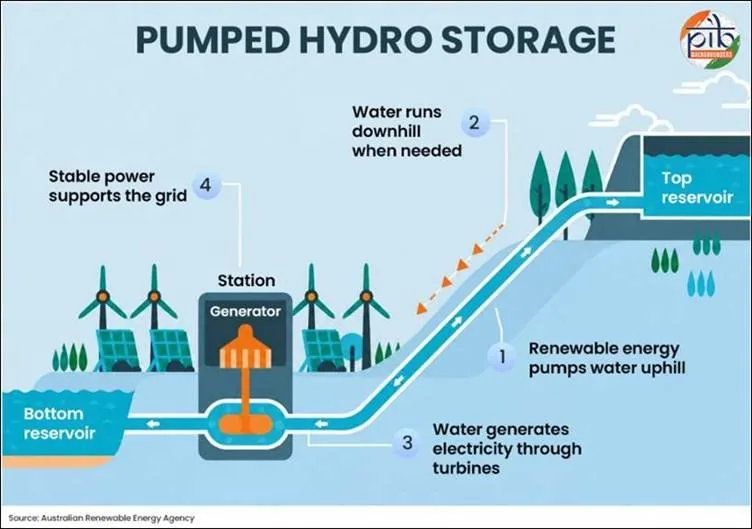
- Storage Phase: Surplus electricity, particularly from solar and wind sources, is used to pump water from a lower reservoir to an upper reservoir, storing energy as gravitational potential energy.
- Generation Phase: During peak demand or low renewable generation, stored water flows back through turbines to generate electricity.
- Recycling: Water is repeatedly circulated between the two reservoirs, enabling multiple energy storage and generation cycles.
- Role in Renewable Energy: PSPs address the intermittency of solar and wind energy by storing surplus electricity and supplying it during periods of low renewable generation.
-
Types of Energy Storage
- Battery Energy Storage Systems (BESS): Provide rapid-response, short-duration energy storage, supporting frequency regulation, peak demand management and grid balancing. They can be deployed quickly and near renewable energy generation or consumption centres.
- Pumped Storage Projects (PSPs): Offer long-duration storage, high capacity and a long operational life, but require suitable geographical conditions and longer development timelines.
-
Different Types of Pumped Storage Projects
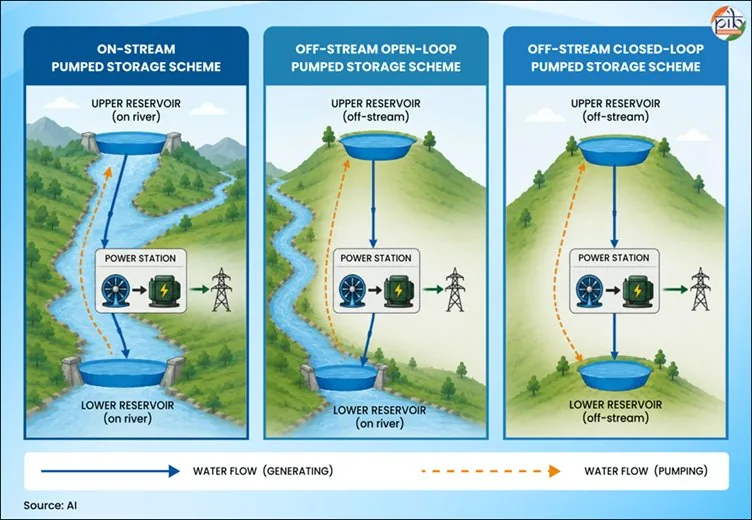
- On-Stream Pumped Storage: Both reservoirs are located on a river, stream or nallah.
- Off-Stream Open-Loop Pumped Storage: One reservoir is located on a natural watercourse, while the other is situated away from rivers or perennial streams/nallahs.
- Off-Stream Open-Loop Pumped Storage: One reservoir is located on a river, stream or nallah, while the other is located away from rivers or perennial streams and nallahs.
- Environmental Significance: Off-stream PSPs are increasingly being explored to facilitate faster project execution and potentially reduce impacts on aquatic ecology, depending on site-specific conditions.
- Operational Capacity: As of August 2026, India has 7.43 GW across 10 operational PSPs, with another 15.87 GW across 11 projects under construction/implementation and 10.40 GW across 8 projects concurred/appraised by CEA.
- National Potential: India has identified 345.38 GW across 320 PSPs, comprising 56.67 GW from 62 on-stream and 288.71 GW from 258 off-stream projects.
- Regional Distribution: The Western Region leads with 129.72 GW, followed by Southern (97.76 GW), Eastern (53.41 GW), Northern (50.32 GW) and North Eastern (14.18 GW) regions.
- Maharashtra has the highest identified state-level potential at 67.36 GW.
- Energy Storage Requirement: The CEA projects 73.93 GW of energy storage capacity by 2031–32, comprising 26.69 GW from PSPs and 47.24 GW from Battery Energy Storage Systems (BESS).
- Projected Expansion: The CEA envisages 100.81 GW of PSP capacity additions during 2025–26 to 2035–36, raising cumulative capacity to approximately 105.56 GW.
- Global Position: According to the International Renewable Energy Agency (IRENA), global pumped storage capacity reached 159.8 GW at the end of 2025, led by China (66 GW), Japan (22 GW) and the US (19 GW). India ranked fourth globally with 7.18 GW.
- PSP Development Guidelines: The Ministry of Power notified the Guidelines to Promote Development of Pumped Storage Projects (PSPs) in April 2023 to facilitate faster project development.
- Infrastructure Support: Budgetary support for roads, bridges, railway sidings, ropeways, communication facilities and transmission lines to improve project viability.
- Competitive Procurement: Tariff-Based Competitive Bidding (TBCB) Guidelines, 2025 provide a transparent framework for procuring PSP storage capacity and stored energy.
- Transmission Charge Waiver: PSPs awarded for construction by 30th June 2028 are eligible for a 100% Inter-State Transmission System (ISTS) charge waiver for 25 years from commercial operation.
- Faster Approvals: Revised Central Electricity Authority (CEA) guidelines reduced Detailed Project Report (DPR) concurrence timelines from 90 to 50 days and removed the requirement for clearance of inter-state aspects.
- Environmental Clearances: The Ministry of Environment, Forest and Climate Change (MoEFCC) has introduced Category B2 classification for eligible PSPs, subject to applicable conditions, and reduced baseline data requirements for off-stream projects, alongside revised forest survey and borehole exploration provisions.
- Integrated Grid Planning: National electricity planning integrates energy storage and transmission infrastructure development to facilitate renewable energy integration, reduce grid congestion and improve power system reliability.
- Digital Monitoring: The CEA’s Jal Vidyut DPR portal enables real-time monitoring of surveys and investigations, improving project coordination.
- CEA Concurrence Exemption: In August 2025, the capital expenditure threshold requiring CEA concurrence for hydroelectric projects was revised to ₹3,000 crore, while off-stream closed-loop PSPs were exempted irrespective of project cost.
- Pumped Storage Hydropower (PSH) is emerging as a critical pillar of India’s clean energy transition by providing large-scale, long-duration energy storage, grid stability and renewable energy integration. With India’s target of 500 GW of non-fossil fuel capacity by 2030, accelerated PSP development through policy support, streamlined approvals and integrated grid planning will be essential for strengthening energy security, grid resilience and sustainable development.
Military Exercises
Exercise AUSTRAHIND 2026
Source The 5th edition of India–Australia Joint Military Exercise AUSTRAHIND 2026 commenced at the Foreign Training Node, Thiruvananthapuram, Kerala, to enhance military interoperability and operational coordination between the two armies.- About: An annual bilateral military exercise between the Indian Army and Australian Army, instituted in 2022 and conducted alternately in India and Australia.
- Participating Contingents: Personnel from India’s Garhwal Rifles and other arms and services, alongside Australia’s 13 Brigade, with New Zealand participating for the first time as an observer delegation.
- Theme:
- Joint Sub-Conventional Operations in Island and Coastal Environment under Chapter VII of the UN Mandate.
- Chapter VII of the UN Charter deals with actions concerning threats to peace, breaches of peace and acts of aggression.
- Key Training Activities: Include joint tactical planning, surveillance and reconnaissance, coastal and island operations, protection of vital installations and Humanitarian Assistance and Disaster Relief (HADR) incorporating aerial and maritime dimensions.
- Significance: Strengthens India–Australia defence cooperation, interoperability, mutual trust and exchange of professional best practices, while developing a common understanding of tactics, techniques and procedures (TTPs) for operations in island and coastal environments, reinforcing peace, stability and security in the Indo-Pacific region.
Exercise KONKAN-26
Source Recently, the India–UK bilateral maritime exercise KONKAN-26 concluded off Plymouth, United Kingdom, strengthening naval interoperability and maritime cooperation between the two countries.- About:
- An annual bilateral naval exercise between the Indian Navy and the United Kingdom’s Royal Navy, institutionalised in 2004.
- KONKAN-26 involved both navies and was conducted by the Royal Navy’s Fleet Operational Standards and Training (FOST) organisation.
- Participating Warships:
- India: INS Trishul, a stealth frigate of the Indian Navy.
- United Kingdom: HMS Sutherland, a Duke-class anti-submarine warfare frigate.
- Sea Phase: The intensive four-day phase involved advanced naval operations in a multi-threat maritime environment. Key activities included seamanship manoeuvres, joint tactical exercises, communication drills, anti-surface asymmetric warfare, anti-submarine warfare and weapon firings.
- Significance: Enhanced interoperability, exchange of professional expertise and best practices, and the ability of both navies to operate jointly in complex maritime scenarios, reinforcing the India–UK maritime partnership.
- Other India–UK Defence Exercises: Ajeya Warrior (Army), Indradhanush(Air Force), Konkan Shakti (Tri-service exercise).
MOU’s & Agreements
India Rolls Over ₹30 Billion Currency Swap Facility for Maldives
Source Recently, India approved the Maldives’ request for the rollover of the first ₹30 billion drawdown under the bilateral currency swap arrangement, reaffirming India’s Neighbourhood First Policy.- Currency Swap Facility:
- An arrangement between central banks to temporarily exchange currencies, with an agreement to reverse the transaction later, providing short-term foreign-exchange liquidity and support during balance-of-payments difficulties.
- Under the SAARC Currency Swap Framework (2024–27), the RBI offers swap facilities to the seven other SAARC countries, subject to bilateral agreements.
- The framework provides an ₹25,000 crore INR Swap Window and a US$2 billion USD/Euro Swap Window.
- Historical Support: Since the SAARC currency swap framework began in 2012, the RBI has provided over US$1.1 billion in aggregate currency swap support to the Maldives.
- India–Maldives Agreement:
- Signed between the Reserve Bank of India (RBI) and the Maldives Monetary Authority (MMA) in October 2024.
- It provides the Maldives access to US$400 million under the USD/Euro Swap Window and ₹30 billion under the INR Swap Window, on concessional terms.
- Other Financial Assistance: India extended financial support through two long-term Maldivian Treasury bonds worth US$250 million and US$100 million. Additionally, the Maldives settled three Treasury bills totalling US$150 million, with India bearing US$42.8 million in interest costs.
- Strategic Significance: The rollover strengthens the Maldives’ financial stability and bilateral economic ties, reinforcing India’s MAHASAGAR vision (Mutual and Holistic Advancement for Security and Growth Across Regions).
Polity & Governance
Right to Internet Access is a Fundamental Right
Source Why in News?- The Supreme Court of India, in Just Rights for Children Alliance v. S. Harish (2026), held that the right to access and use the internet is a fundamental right under Articles 21 and 19(1)(a) of the Constitution, including for children.
- The Court earlier sought responses from the Centre and National Commission for Protection of Child Rights on a regulatory framework for children’s social-media safety, including privacy-preserving age verification and age-appropriate platform features.
- Concurrently, a 2025 study supported by the Indian Council of Social Science Research (ICSSR) and analysis of digital impacts on developing minds have highlighted the urgent need to balance digital innovation with children’s cognitive, emotional, and social well-being in a rapidly changing India.
- Fundamental Right Acknowledgment:
- The Supreme Court ruled that the right to access and use the internet is a fundamental right enjoyed by children irrespective of their age.
- The Court emphasized that children’s safety and their freedom are not mutually exclusive.
- Rejection of Blanket Bans:
- The Court consciously decided against endorsing blanket bans on minors’ social media or internet use, terming such curbs as “unproven measures of proven disproportionality.”
- It noted that barring children mistakes the victim for the problem and pushes them toward unregulated, unsafe platforms.
- Constitutional Precedents:
- Anuradha Bhasin v Union of India (2020): Protected internet-based freedom of speech, expression, and trade under Articles 19(1)(a) and 19(1)(g).
- Pragya Prasun v Union of India (2025): Ruled that digital access is an intrinsic component of the right to life under Article 21.
- Cricket Association of Bengal (1995): Established that Article 19(1)(a) includes the right to receive and impart information.
- Three-Pronged Test for Restrictions: Any restriction on this fundamental right must be through enacted legislation, demonstrate a legitimate state interest, and ensure the encroachment is strictly proportionate to the objective.
- Targeting the Source, Not the User: The Court directed that safety measures must target harmful material specifically Child Sexual Exploitation and Abuse Material (CSEAM) and its creators, rather than restricting the children themselves.
- Neurodevelopmental Alterations:
- The prefrontal cortex, central to sustained attention, impulse control, and decision-making, matures into early adulthood.
- A 2025 study supported by the ICSSR found that 97.6% of school-going children access the internet from home, primarily via smartphones, spending an average of 4.5 hours per day.
- High, repetitive digital engagement during this highly plastic phase can structurally alter brain pathways, potentially underdeveloping critical cognitive circuits.
- Attention and Reinforcement Loops: Social media algorithms use rapid, unpredictable rewards (likes, shares) to create continuous reinforcement loops.
- This cultivates an ability to rapidly shift attention among sources but impairs the capacity to sustain focus on a single task, making ordinary, offline experiences feel unrewarding.
- Cognitive Offloading via AI: While using tools for cognitive offloading is natural, the rapid adoption of Artificial Intelligence (AI) platforms to generate essays, arguments, and ideas risks replacing the “productive struggle” necessary for critical thinking and learning.
- Frictionless Design: Features like infinite scrolling, autoplay, disappearing stories and read receipts remove natural stopping cues and create social pressure, encouraging children to consume content continuously and remain constantly connected.
- Erosion of Boredom: The constant stimulation of digital devices eliminates idle moments. The loss of boredom removes the essential cognitive space required for imagination, reflection, creativity, and the cultivation of a rich inner life.
- Mental and Physical Health: Excessive social media use increases anxiety, depression, loneliness and body-image issues, disrupts sleep and cognitive development, and may cause irritability and compulsive behaviour when restricted. It can also impair academic performance, real-world social interaction and social skills.
- Precedents for Regulating Children’s Social Media Access
- Global Approaches: Australia introduced a minimum age of 16 for social media access in December 2025, while Norway has pursued restrictions for users under 16.
- State-Level Measures: Karnataka announced an under-16 restriction in March 2026, while Andhra Pradesh proposed restrictions for children below 13.
- Digital Literacy in Schools: State education boards are considering digital safety and responsible social media use in school curricula.
- Grassroots Protection: Mission Shakti promotes awareness among girls and young women about online grooming, privacy and cyberbullying.
- NCERT Initiatives: The NCERT Safe Online Learning handbook, school Cyber Clubs and cyber hygiene education promote safer digital practices among students.
- Surveillance Risks:
- The DPDP Act, 2023 and DPDP Rules, 2025 require verifiable parental consent for processing children’s data and restrict behavioural monitoring and targeted advertising, subject to exemptions.
- However, self-declared age limits are easily bypassed, while digital KYC and biometric verification may increase data collection, raising privacy and proportionality concerns under the K.S. Puttaswamy v. Union of India (2017) judgment, including risks of mass surveillance and data breaches.
- Low Parental Digital Literacy: While the regulatory focus often relies heavily on parental supervision, many parents (particularly across diverse socio-economic backgrounds) lack the technical skills needed to configure complex parental controls, manage privacy settings, or monitor algorithmic feeds, rendering parental consent frameworks difficult to implement effectively.
- Privacy vs. Traceability Conflict:
- Rule 4(2) of the Information Technology (Intermediary Guidelines and Digital Media Ethics Code) Rules, 2021 mandates significant social media intermediaries providing messaging services to identify the “first originator” of unlawful information (such as CSEAM).
- This creates a direct clash between tracing malicious actors and weakening end-to-end encryption, which poses constitutional and privacy risks for all citizens.
- The ‘Safe Harbour’ Ambiguity:
- Under Section 79 of the IT Act, 2000, online intermediaries enjoy legal immunity (“safe harbour”) for third-party content provided they observe due diligence.
- However, modern platforms no longer act as passive conduits; through engagement-driven algorithmic curation, auto-recommendation loops, and monetization, they actively promote content, blurring the line between passive intermediaries and active publishers.
- Lapses in Intermediary Reporting and Compliance: The Supreme Court noted significant failures by platforms in fulfilling statutory reporting obligations.
- While some intermediaries forward reports of CSEAM to foreign non-profits like the US-based National Center for Missing & Exploited Children (NCMEC), they frequently fail to report directly to local Indian law enforcement agencies or the Special Juvenile Police Units as required by the POCSO Act, 2012.
- Migration to Unregulated Platforms: The Supreme Court observed that blanket bans or harsh access restrictions on mainstream platforms are often counterproductive.
- Children do not stop using the internet; instead, they migrate to shadowy, unregulated spaces, hide their digital footprints, and become significantly less likely to report grooming or exploitation.
- Targeting the User Rather than the Perpetrator: The Supreme Court emphasized that regulatory action must be directed at the harmful content and the syndicates responsible for creating and circulating it, rather than restricting the victims’ constitutional rights.
- Infringement on the Right to Knowledge and Education:
- Internet access has been recognized by the Court as a fundamental right under Article 19(1)(a) (freedom of expression and the right to receive information) and Article 21 (right to life).
- For marginalized children, students in remote geographies, and children with special needs, arbitrary or blunt restrictions sever access to educational resources and support systems.
- Implementation of a ‘Child Mode’: The Supreme Court supported proportionate safeguards, suggesting a dedicated “child mode” for social media accounts that is private-by-default, alongside a greater emphasis on parental supervision.
- National Database and Timely Reporting:
- The Court directed the creation of a national Hash and URL Database for CSEAM and appointment of dedicated grievance officers.
- Platforms must report unknown-origin CSEAM within two hours of removal or complaint resolution, while known-origin CSEAM must be reported weekly in consolidated reports.
- Financial Accountability for Tech Platforms: To ensure compliance, the Supreme Court called for exemplary monetary fines for intermediaries that persistently fail to remove exploitative material, creating direct financial consequences rather than just a theoretical loss of safe harbor immunity.
- Digital Literacy in the Curriculum: Schools must provide digital safety and age-appropriate sex education, covering topics like consent, safe and unsafe touch, online exploitation, and reporting mechanisms
- The Supreme Court’s ruling affirms that children’s digital freedom and safety must coexist through intermediary accountability, technological safeguards and digital literacy, rather than blanket bans
Supreme Court on Religious Conversion and Reservation in India
Source Why in News?- The Supreme Court of India in Secretary to Government v. Sameer Ahamed N. (2026) upheld a Madras High Court decision striking down a 2024 Tamil Nadu Government Order (GO), which had permitted individuals converting from Hinduism to Islam to automatically claim reservation under the Backward Class (Muslim) quota.
- The Supreme Court ruled that affirmative action under Article 16(4) cannot be claimed solely on pre-conversion backwardness, as antecedent social backwardness cannot automatically carry forward into the new religion.
- Non-Transferability of Reservation:
- The Court held that reservation is attached to a constitutionally identified class and is not an individual’s transferable personal entitlement.
- While poverty or lack of education may persist after conversion, antecedent social backwardness under the Hindu caste system cannot be automatically imported into the new religion.
- Immediate Loss of Status: Conversion to religions like Islam or Christianity results in the immediate loss of Scheduled Caste (SC) status under the 1950 Constitution Order.
- Theological Incompatibility: Because Islam and Christianity’s foundational doctrines recognize equality and do not equate to a uniform caste hierarchy, conversion cannot act as a “one-way bridge” to transport prior caste-based social status into the new religious identity.
- Invalidity of Private Certificates: The Court clarified that private religious bodies (such as a Jamath) cannot conclusively determine or certify a person’s statutory backward-class or SC entitlement.
- Reconversion:
- In the event of reconversion to the Hindu social order, reclaiming reservation entitlements requires an independent, fact-specific determination by a competent statutory authority to verify if the original caste identity has genuinely revived.
- Muslims and Christians may qualify for BC/OBC reservations if they independently satisfy the applicable eligibility requirements.
- Expert Recommendations vs. Legislation:
- Rejecting the defense that the GO was based on the Tamil Nadu Backward Classes Commission’s recommendation (2024), the Court ruled that an expert recommendation is not legislation.
- Any executive order violating Articles 14, 15(4), and 16(4) remains subject to judicial review.
- The 1950 Presidential Order: SC status is governed by the Constitution (Scheduled Castes) Order, 1950, issued under Article 341. Paragraph 3 explicitly mandates that: “No person who professes a religion different from the Hindu, the Sikh or the Buddhist religion shall be deemed to be a member of a Scheduled Caste.”
- Strict Exclusions: Individuals professing Christianity, Islam, Judaism, or Zoroastrianism are legally barred from holding SC status, regardless of historical disadvantage.
- Constitutional Authority (Article 341): The President of India specifies the initial SC list. Once published, only the Parliament can add or remove communities through legislation.
- State-Specific Status: SC status is specific to a State or Union Territory. A community recognized as SC in one state may be an OBC or General category in another.
- Impact of Conversion and Reconversion:
- Immediate Loss of Status: The Supreme Court ruled that conversion to any religion outside Hinduism, Sikhism, or Buddhism results in the “immediate and complete loss” of SC status from the exact moment of conversion, regardless of birth caste.
- The Concept of “Professing”: The Court clarified that “professing” means publicly practicing. Since Islam and Christianity theologically reject the caste system, one cannot publicly practice them while claiming SC status.
- Loss of Statutory Protection: Converts lose protection under specialized laws like the SC/ST (Prevention of Atrocities) Act, 1989.
- Rules for Reconversion: To reclaim SC status by reconverting to Hinduism, Sikhism, or Buddhism, strict proof is required: genuine renunciation of the converted religion, adoption of original caste practices, and clear acceptance back into the original caste community.
- Persistent Discrimination: Despite the legal loss of status upon conversion, it was noted that individuals like the petitioner still face persistent ground-level social discrimination, raising significant concerns about the intersectionality of disadvantage and the gap between theological equality and sociological realities.
- Key Judicial Pronouncements on SC Status:
- C.M. Arumugam v. S. Rajgopal (1976): Recognised caste as a social reality but required proof of continued discrimination and community acceptance to retain SC status after reconversion.
- Soosai v. Union of India (1985): Denied SC status to Dalit Christians due to a lack of empirical evidence proving the continuation of caste-based discrimination post-conversion.
- Chinthada Anand v. State of Andhra Pradesh (2026): The Supreme Court reaffirmed that conversion to Christianity results in the immediate loss of Scheduled Caste (SC) status and, consequently, the individual can no longer claim protection as an aggrieved person under the SC/ST (Prevention of Atrocities) Act.
- Important Commissions on SC Status and Conversion:
- Kaka Kalelkar Commission (1955) & Mandal Commission (1980): Recognized that caste discrimination extended into non-Hindu religions, paving the way for OBC reservations for certain Christian and Muslim communities.
- Justice Ranganath Mishra Commission (2007): Recommended that SC status be completely de-linked from religion and made religion-neutral, similar to ST status.
- Justice K.G. Balakrishnan Commission (Current/2022): A three-member Union Government commission currently examining the sensitive issue of granting SC status to persons historically belonging to SCs who converted to religions other than Hinduism, Buddhism, and Sikhism.
- Contrast with Scheduled Tribes (ST) Status
- No Religious Bar: Under the Constitution (Scheduled Tribes) Order, 1950, ST status is religion-neutral.
- An ST individual converting to Christianity or Islam does not automatically lose tribal status, provided they maintain their tribal customs, identity, and are accepted by their community. Status is only denied if the tribal identity is completely lost post-conversion.
Science & Technology
BHASHINI and IISc Develop Text-to-Speech Models for Sourashtra
Source The Digital India BHASHINI Division under Ministry of Electronics and Information Technology (MeitY), in collaboration with Indian Institute of Science (IISc) Bengaluru, has developed AI-based Text-to-Speech (TTS) models for Sourashtra, a minority Indo-Aryan language spoken mainly in Tamil Nadu.- About Sourashtra: An Indo-Aryan language spoken predominantly by the Sourashtra community in Tamil Nadu, with approximately 2.48 lakh speakers (Census 2011).
- Technology: Uses VITS architecture (Variational Inference with adversarial learning for end-to-end TTS) to convert written text directly into speech.
- Language and Voices: The models support male and female voices and can process text written in both Tamil and Sourashtra scripts.
- AIKOSH: BHASHINI’s AIKOSH platform hosts the SPICOR TTS 3.0 Sourashtra Corpus to support Indian-language AI research.
- Significance: Supports the use of low-resource languages in digital applications, language learning, accessibility solutions, documentation and research.
Security
Reorganisation of CISF
Source The Ministry of Home Affairs (MHA) has approved a landmark overhaul of the administrative and operational framework of the Central Industrial Security Force (CISF), with effect from 1st November 2026.- Shift to Functional Supervision:
- The reorganisation replaces eight geographically organised sectors with sector-specific functional commands, while retaining three existing specialised sectors, aligning CISF operations with sector-specific security threats.
- Industrial and Energy Commands: To strengthen technical expertise and operational efficiency, dedicated commands have been established: Coal Sector (Ranchi), Steel Sector (Bhilai), Petroleum and Natural Gas Sector (Guwahati), and Power Sectors (New Delhi and Kolkata).
- Urban Infrastructure Consolidation: The erstwhile National Capital Region command has been restructured into the GBMM & MRTS Sector (Government Building, Museums & Monuments, and Mass Rapid Transit System) to standardise urban security frameworks.
- Dedicated Coastal Commands: To secure maritime trade infrastructure, the Western and Southern territorial sectors have been transformed into the West Coast Port Sector (Mumbai) and East Coast Port Sector (Chennai).
- Maritime Compliance under ISPS Code: The CISF has been designated as a Recognised Security Organisation (RSO) for port facilities under the International Ship and Port Facility Security (ISPS) Code (an IMO framework under the SOLAS Convention), enhancing standard operating procedures and technical coordination across major ports.
- Status Quo for Strategic Assets: The highly specialised, existing functional arrangements for Aviation, the Department of Atomic Energy (DAE), and the Department of Space (DoS) will remain unchanged. .
- Expanded Security Mandate: The CISF has been entrusted with security responsibilities at high-security correctional facilities in Jammu and Kashmir and designated as the nodal agency for aerial security of critical infrastructure.
- Background: The CISF is one of the Central Armed Police Forces (CAPFs) in India, operating under the administrative control of the Ministry of Home Affairs (MHA).
- Establishment: It was set up in 1969 under the CISF Act, 1968 with a primary mandate to provide integrated security cover to Public Sector Undertakings (PSUs).
- Evolving Mandate: Over the decades, its mandate has expanded significantly beyond traditional PSUs to address modern internal security dynamics. Today, the CISF provides security to:
- Strategic assets like nuclear installations, space establishments, and defense production units.
- Critical public transport infrastructure, including major Airports and the Delhi Metro.
- Private sector establishments (enabled by an amendment to the CISF Act following the 2008 Mumbai terror attacks), such as the Infosys and Reliance Jamnagar campuses.
- Consultancy Wing: The force also operates a unique consultancy wing that provides expert security and fire protection consultancy services to various private and government organizations.