Comrades Dispatch · 21 Oct 2026 (PDF)
In this edition
- Ramesh Chand Committee on Sugarcane Farmers’ Issues Agriculture & Rural
- Open Coalition on Compliance Carbon Markets Environment & Ecology
- Police Commemoration Day 2026 Important Days
- 25th SCO Council of Heads of Government Meeting International Relations
- China’s Export Controls: Implications for India International Relations
- India to Host 61st International Committee of Legal Metrology Meeting International Relations
- Nationwide Protests and Unrest in France Places in News
- 10 Years of UDAN Scheme Schemes & Initiatives
- 5th Asian Para Games Sports
Agriculture & Rural
Ramesh Chand Committee on Sugarcane Farmers’ Issues
Source Why in News?- The Government of India has constituted a committee under the chairmanship of Prof. Ramesh Chand, former Member of NITI Aayog, to examine issues raised by sugarcane farmers and recommend measures to address their concerns.
- Remunerative Returns: Examine the demand for higher returns to sugarcane farmers, considering cultivation costs, input costs and other relevant factors.
- Ex-Mill Sugar Price:
- Review the Minimum Selling Price (MSP) of sugar, considering production costs, market realisations, increases in sugarcane Fair and Remunerative Price (FRP) and the financial viability of sugar mills.
- Background: Sugar MSP was introduced at ₹29/kg in June 2018, raised to ₹31/kg in February 2019, and has remained unchanged since.
- Sugar Recovery: Review testing and reporting mechanisms to ensure independent verification, accuracy and transparency in sugar recovery.
- Cane Weighment: Assess sugarcane weighment practices at mills, including calibration, inspection and verification mechanisms to ensure accuracy and transparency.
- Mechanised Harvesting: Examine weight deductions for mechanically harvested sugarcane, actual losses, if any, and their financial impact on payments to farmers.
- About: Sugarcane (Saccharum spp.) is a tropical and subtropical perennial cash crop belonging to the Poaceae (grass) family. Modern cultivated sugarcane varieties largely originated through hybridisation involving Saccharum officinarum and Saccharum spontaneum.
- Climatic Conditions: It requires a hot, humid climate, abundant sunshine and adequate water. It grows best in well-drained, fertile loamy soils and is a water-intensive crop.
- Production: India is the world’s second-largest sugarcane producer. Its production was estimated at 500 million metric tonnes (MMT) in 2025–26, covering 58.87 lakh hectares, according to the Third Advance Estimates.
- Major Producing States: Uttar Pradesh and Maharashtra are the leading sugarcane-producing states, followed by other major producers such as Karnataka and Tamil Nadu.
- Economic Significance: The sugarcane sector supports the livelihoods of nearly 5 crore farmers and their dependents and around 5 lakh workers in sugar mills and allied industries.
- Fair and Remunerative Price (FRP): The government fixed the FRP for the 2026–27 sugar season at ₹365/quintal, based on a sugar recovery rate of 10.25%.
- Major Uses: Sugarcane is used to produce sugar, jaggery, ethanol and molasses, while its fibrous residue (bagasse) is used for electricity generation and paper production.
- Research: The ICAR-Sugarcane Breeding Institute, Coimbatore, and ICAR-Indian Institute of Sugarcane Research, Lucknow, are major institutions engaged in sugarcane research and varietal improvement.
- Ethanol Production: Sugarcane-based ethanol contributes to India’s Ethanol Blended Petrol (EBP) Programme, helping diversify sugar mills’ revenue and reduce dependence on fossil fuels.
Environment & Ecology
Open Coalition on Compliance Carbon Markets
Source Why in News?- The Open Coalition on Compliance Carbon Markets (OCCCM) adopted its first work plan at a meeting in Wuhan, China. The coalition, launched in May 2026 aims to align global compliance carbon markets.
- Simultaneously, India’s domestic Carbon Credit Trading Scheme (CCTS) has become operational, with nearly 500 companies filing their first compliance reports. This has sparked a debate on whether India should join the OCCCM to shape global carbon market rules.
- About: The OCCCM is an international collaborative initiative launched to foster technical alignment, equivalence, and interoperability among national compliance carbon markets.
- Formation & Leadership:
- Launched in May 2026, the coalition is chaired by Brazil, with the European Union (EU) and China serving as Co-Chairs.
- Other key members include Germany, New Zealand, Canada, France, Norway, Singapore, Türkiye, and the United Kingdom.
- Observers include UNDP, UNEP, the World Bank’s Partnership for Market Implementation, and other international organisations.
- Core Mandate: It functions as a platform for exchanging knowledge on domestic compliance carbon markets, aiming to align how the world’s carbon pricing architectures communicate with each other.
- Key Areas of Focus:
- Carbon Pricing Mechanisms: Sharing strategies on emissions trading systems (ETS) and carbon taxes.
- MRV Systems: Standardizing Monitoring, Reporting, and Verification (MRV) frameworks.
- Carbon Accounting: Developing common methodologies for measuring emissions.
- High-Integrity Offsets: Establishing rules for the potential cross-border use of carbon offsets.
- Non-Binding Nature: Crucially, the OCCCM does not impose emission-reduction targets or mandate specific domestic policies; it is primarily designed for technical alignment and interoperability.
- Legislative Backing:
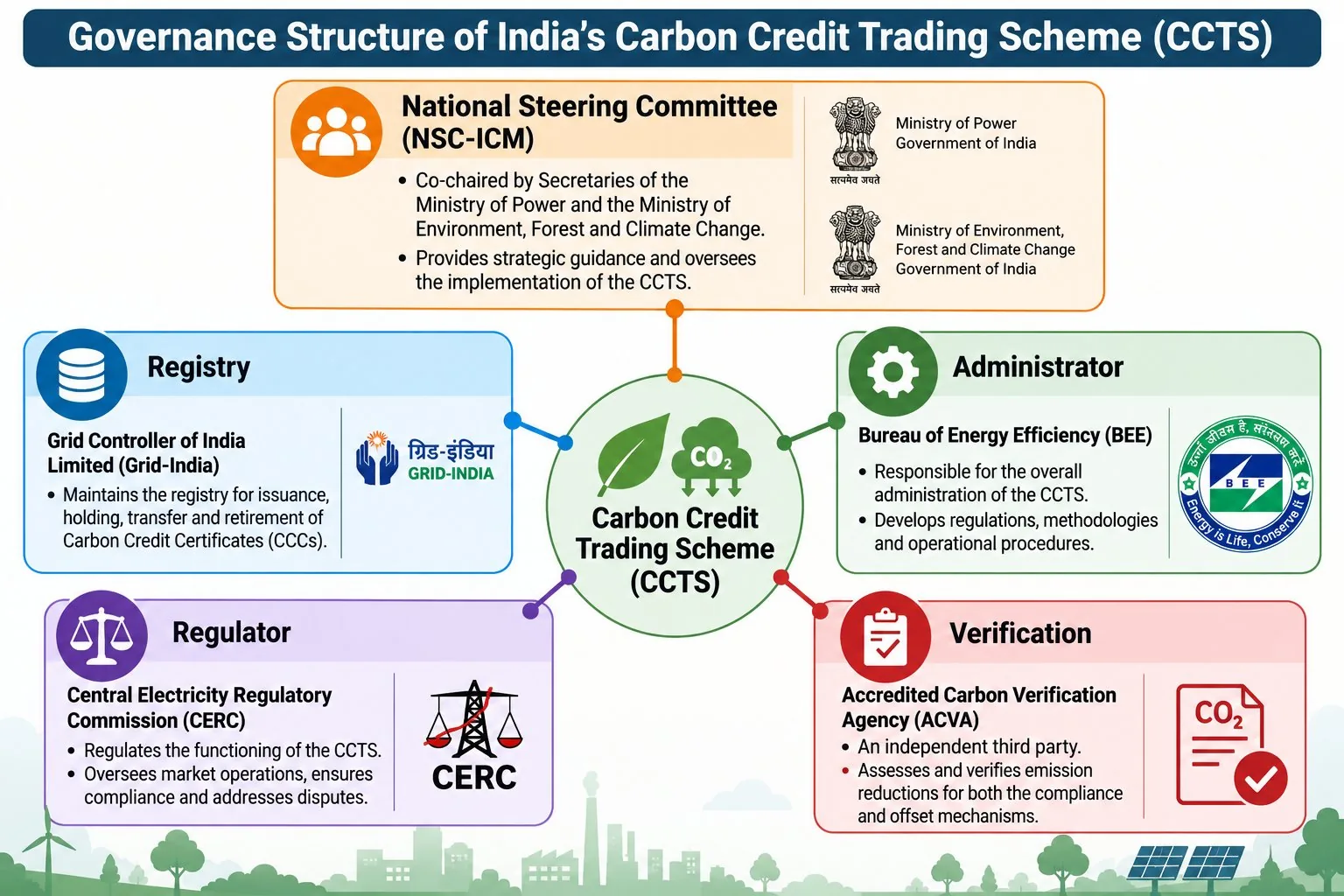
- The CCTS is a market-based mechanism under the Indian Carbon Market (ICM), enabled by the Energy Conservation (Amendment) Act, 2022, to reduce greenhouse gas emissions and support India’s NDCs and 2070 Net-Zero target.
- Unlike the Perform, Achieve and Trade (PAT) scheme, which incentivised energy efficiency through Energy Saving Certificates (ESCerts), the CCTS focuses on reducing GEI through sector-specific targets.
- Sectors Covered:
- CCTS initially covers major emission-intensive sectors such as aluminium, cement, chlor-alkali, pulp and paper, iron and steel, fertilizer, petroleum refineries, petrochemicals, and textiles.
- Although the thermal power sector contributes a significant share of India’s emissions, thermal power plants have not yet been transitioned into the CCTS compliance mechanism.
- Baseline-and-Credit Mechanism: Unlike EU’s absolute “cap-and-trade” systems, India utilizes a GHG emission-intensity approach. It permits industrial output growth while mandating a reduction in emissions per unit of product.
- Mechanisms under CCTS:
- Compliance Mechanism: Obligated entities (industries in specified sectors) are given binding GHG intensity targets. Overachievers earn tradable Carbon Credit Certificates (CCCs), while underachievers must purchase them or face penalties.
- Offset Mechanism: Non-obligated entities like renewable energy producers and others can voluntarily register mitigation projects under the offset mechanism to earn and sell CCCs.
 What is the Need for India to Join OCCCM?
- Shaping the Rules from the Inside:
- OCCCM’s governance structure (high-level meetings, thematic working groups) can dictate the future standards of global carbon accounting.
- The geopolitical risk of being an outsider is that India may eventually be forced to comply with MRV standards written entirely by developed nations.
- Proliferation of Carbon Pricing:
- Over 50 countries currently utilize carbon pricing. It minimizes the economy-wide cost of mitigation and generates critical fiscal revenues for climate adaptation.
- Joining the coalition early positions India at the forefront of this inevitable global economic shift.
- Market Interoperability & Revenue Generation:
- A long-term strategic outcome of the OCCCM is linking domestic trading systems.
- Linking India’s CCTS to international markets could allow Indian green projects to earn higher revenues by selling credits to jurisdictions with more stringent, higher-priced mitigation targets.
- Mitigating the Threat of “Climate Clubs” & CBAM:
- As UNFCCC negotiations face continuous logjams, plurilateral “climate clubs” are re-emerging.
- The EU’s Carbon Border Adjustment Mechanism (CBAM) converts carbon intensity directly into an international trade cost.
- While the OCCCM does not explicitly mention CBAM, standardizing MRV and carbon accounting through the coalition is the most effective preparation for Indian exporters facing border carbon taxes.
- Erosion of CBDR-RC: There is a persistent concern among developing nations that global carbon market integration might blur the lines of Common But Differentiated Responsibilities and Respective Capabilities (CBDR-RC), placing undue burdens on emerging economies.
- Protectionism in Disguise: Alignment forums can inadvertently become echo chambers for the Global North to legitimize carbon border taxes, which act as disguised trade barriers against the Global South.
- Domestic Policy Autonomy: Prematurely linking India’s nascent CCTS with highly mature markets (like the EU ETS) could restrict domestic policy flexibility, potentially harming Micro, Small, and Medium Enterprises (MSMEs) through overly stringent MRV compliance costs.
- Integrity Risks: Without robust baselines, carbon markets face risks such as “leakage” (shifting emissions to other regions) or generating non-additional credits, which undermine genuine climate action.
- Robust Institutional Capacity (MRV): The BEE must ensure that domestic Accredited Carbon Verification Agencies (ACVAs) operate at global standards. The credibility of an Indian CCC depends entirely on the rigor of its MRV system.
- Ensure a Just Transition: Implement complementary socio-economic policies and financial subsidies to protect vulnerable workers and MSMEs in emission-intensive sectors (like coal and traditional textiles) from sudden compliance shocks.
- Phased Transition to Absolute Caps: As the Indian economy matures, the CCTS should structurally transition from “emission-intensity” targets to an absolute “Cap and Trade” model to align with true Net-Zero trajectories.
- Integrating Climate and Trade Policy: The Ministry of Commerce and the MoEFCC must work in tandem. Export-heavy sectors (like steel and aluminium) must be prioritized for decarbonization subsidies to shield them from CBAM.
- Capacity Building for MSMEs: The government must provide financial and technical assistance to MSMEs to help them adopt carbon accounting software (like Carbon-OS) and integrate into the compliance market without facing existential financial burdens.
- India’s Carbon Credit Trading Scheme (CCTS) marks a major step towards a low-carbon economy. Joining the OCCCM could help India promote equitable carbon accounting, protect exporters from carbon border taxes and balance climate action with economic growth.
Important Days
Police Commemoration Day 2026
Source On the occasion of Police Commemoration Day 2026, the Union Home Minister paid tribute to police martyrs at the National Police Memorial, New Delhi, and flagged off a nationwide motorcycle rally themed “Fight Against Drugs.”- About: Police Commemoration Day is observed annually on 21st October to honour police personnel who sacrificed their lives in the line of duty. It commemorates the sacrifice of 10 Central Reserve Police Force (CRPF) personnel killed in an ambush by Chinese troops at Hot Springs, Ladakh, on 21st October 1959.
- National Police Memorial (NPM): Located in Chanakyapuri, New Delhi, it was dedicated to the nation on 21st October 2018, to honour police personnel who lost their lives in the line of duty.
- Police Sacrifices: According to the Union Home Minister’s 2026 address, 36,852 police personnel have sacrificed their lives since Independence, including 154 personnel commemorated in 2026.
- Significance: Highlights the role of police forces in internal security, law enforcement, disaster response and public safety, while recognising the sacrifices made by personnel and their families.
International Relations
25th SCO Council of Heads of Government Meeting
Source Why in News?- India’s Defence Minister addressed the 25th meeting of the Shanghai Cooperation Organisation (SCO) Council of Heads of Government (CHG) in Dushanbe, Tajikistan. During the summit, India strongly called upon member states to firmly and collectively dismantle terrorism and warned against adopting double standards in combating the menace.
- Zero Tolerance for Terrorism:
- India emphasized that there can be no justification for terrorism and called for the destruction of its entire ecosystem, including terror financing, recruitment, and safe havens.
- India stressed that double standards on terrorism severely compromise regional security and that terrorism directly deprives the youth of economic opportunities.
- Hosting the SCO Civilisational Dialogue Forum: India announced it will host the first SCO Civilisational Dialogue Forum by the end of 2026. This initiative, originally proposed by India at the 2025 Tianjin summit, aims to strengthen people-to-people ties and share the heritage of ancient civilizations.
- Economic Cooperation and Trade:
- India reaffirmed its support for the adoption of the Action Plan for 2026-2030 under the Programme for Multilateral Trade and Economic Cooperation (PMTEC).
- The focus was on building resilient supply chains and leveraging technology to bridge emerging economic divides.
- Sovereignty and Connectivity:
- India reiterated that regional connectivity projects must be strictly guided by the principles of consultation, mutual respect, and territorial integrity.
- This acts as a firm reiteration of India’s principled opposition to China’s Belt and Road Initiative (BRI), notably the China-Pakistan Economic Corridor (CPEC) passing through Pakistan-occupied Kashmir (PoK).
- Climate and Clean Energy Initiatives: India highlighted its global environmental commitments by urging SCO members to collaborate on platforms like the International Solar Alliance (ISA), the Coalition for Disaster Resilient Infrastructure (CDRI), and the Global Biofuel Alliance.
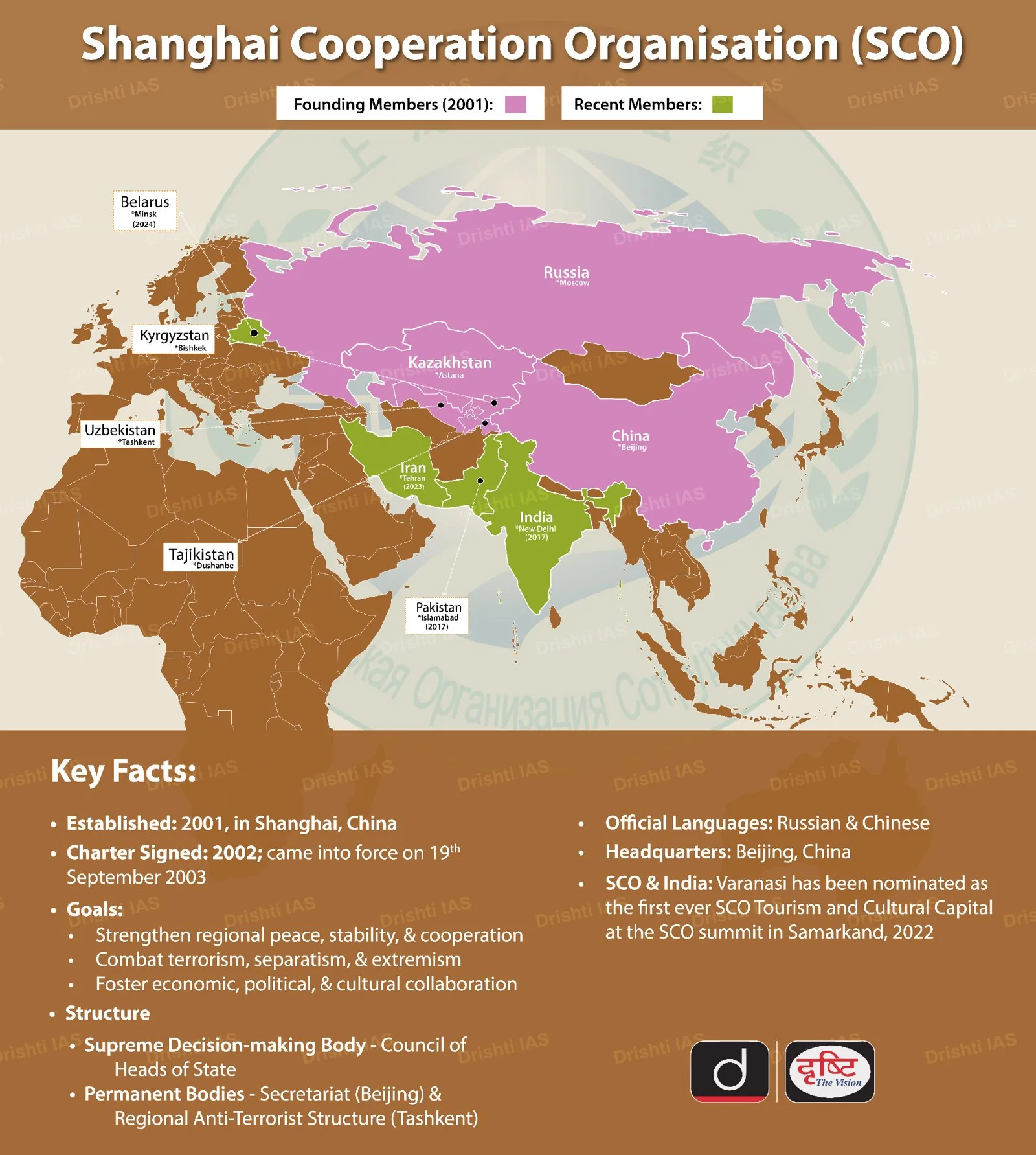
- About: The SCO is a Eurasian political, economic, and international security organization established in 2001. It is the world’s largest regional organization by both geographic scope and population, covering approximately 65% of Eurasia and 42% of the global population.
-
Member States:
- Founding Members (2001): China, Kazakhstan, Kyrgyzstan, Russia, Tajikistan, and Uzbekistan. The first five nations originally formed the precursor group, the “Shanghai Five,” in 1996 to resolve border disputes.
- Subsequent Expansions: India and Pakistan joined in 2017, Iran joined in 2023, and Belarus became the newest member in July 2024.
- Observer States & Dialogue Partners: Several other nations, including Afghanistan and Mongolia, engage with the SCO as observers, while countries like Turkey, Azerbaijan, and Sri Lanka hold Dialogue Partner status.
-
Core Objectives:
- Security: The SCO’s primary mandate is combating what it defines as the “three evils”: terrorism, separatism, and extremism. It facilitates intelligence sharing, border demilitarization, and joint military exercises among member states.
- Economic & Political Cooperation: The organization focuses on building regional trade networks, developing energy transport corridors, and fostering diplomatic alignment among Eurasian nations.
-
Institutional Structure
- Heads of State Council (HSC): The supreme decision-making body of the SCO, which meets annually to adopt major guidelines and strategic priorities.
- SCO Secretariat: The primary administrative body, headquartered in Beijing, China.
- SCO CHG: It is the second-highest council in the organization (after the Council of Heads of State). It is primarily responsible for handling the grouping’s trade, economic, and cultural agenda, as well as approving the SCO’s annual budget.
- Regional Anti-Terrorist Structure (RATS):
- A permanent counter-terrorism body headquartered in Tashkent, Uzbekistan.
- RATS coordinates day-to-day intelligence sharing, maintains databases on terrorist organizations, and oversees capacity-building operations for member states’ security agencies.
-
Significance of SCO for India
- Counter-Terrorism Cooperation: The RATS of the SCO, based in Tashkent, is a vital mechanism for India to share intelligence and conduct joint counter-terrorism exercises to stabilize the Afghan-Pak region.
- Connect Central Asia Policy: Central Asia is part of India’s extended neighborhood. The SCO provides a platform to advance connectivity projects like the International North-South Transport Corridor (INSTC) and the Chabahar Port in Iran.
- Geopolitical Balancing:
- Engagement in the SCO allows India to maintain a strategic balance between Western blocs (like the Quad) and Eurasian powers (Russia and China), reinforcing its policy of strategic autonomy.
- However, India-China-Pakistan rivalries, economic disparities and implementation challenges limit the organisation’s effectiveness.
China’s Export Controls: Implications for India
Source Why in News?- China announced new export controls on critical heavy machinery, including Tunnel Boring Machines (TBMs), walking excavators and plateau-type wet shotcrete machines. The restrictions will take effect on 18th November 2026, introducing a dual-use export licensing regime on national security grounds.
- The move highlights China’s expanding use of supply-chain controls, extending beyond critical minerals to strategic industrial equipment with potential implications for India’s infrastructure development and supply-chain security.
- Export Control Law (2020): Moving away from informal bans, China enacted a comprehensive Export Control Law in late 2020. This unified scattered trade rules under a single “national security” mandate, providing a statutory foundation to legally throttle exports and target foreign entities.
- Semiconductor & Battery Minerals (2023):
- In July 2023, China imposed strict licensing requirements on Gallium and Germanium, elements critical for advanced microchips and radar systems.
- In October 2023, these controls were extended to Graphite, an indispensable material for Electric Vehicle (EV) battery anodes.
- Locking the “Know-How” (Late 2023): Realizing that competitor nations were attempting to bypass mineral embargoes, China revised its export catalogue to outright prohibit the outward transfer of technology used for rare earth extraction, separation, and magnet production, cementing its midstream monopoly.
- Munitions and Escalation (2024–2025):
- By late 2024, China restricted exports of Antimony, a mineral essential for armor-piercing munitions and solar technology, and later banned shipments to U.S. military end-users.
- Throughout 2025, licensing was expanded to include medium and heavy rare earths, targeting global defense and clean energy supply chains.
- Supply-Chain Security Regulations (2026):
- China introduced State Council Orders 834 and 835, strengthening its legal framework for protecting industrial supply chains and countering foreign extraterritorial restrictions.
- These measures could expose companies operating across Chinese and Western markets to overlapping or conflicting compliance requirements.
- Advanced Technology Controls (2026):
- China proposed export restrictions on 40 technologies, including 23 artificial intelligence (AI), 12 photovoltaic and five biotechnology technologies.
- These cover advanced AI models, semiconductor design technologies, polysilicon production and next-generation solar-cell manufacturing, raising concerns over international technology access and supply-chain dependencies.
- Broadening to Industrial Goods (2026):
- In October 2026, Beijing expanded its playbook to heavy manufacturing, implementing licensing requirements on TBMs, dredger components, and high-altitude excavators, directly targeting the infrastructure capabilities of its competitors.
- Currently, Chinese manufacturers account for roughly 70% of the world’s TBM production.
- Strategic Objectives Behind the Curbs
- Asymmetric Retaliation:
- The export controls serve as a geopolitical counterweight to Western restrictions on advanced semiconductors and Extreme Ultraviolet (EUV) lithography systems.
- While the US and EU leverage high-tech software and semiconductor chokepoints, China leverages physical hardware and raw input constraints.
- Leveraging the Midstream Bottleneck:
- China currently accounts for roughly 70% of global rare-earth refining capacity.
- By banning the export of processing technology alongside the raw materials, China prevents other countries from easily setting up competing refineries, thus solidifying its monopoly.
- China solidifies its manufacturing chokehold, preventing competitor nations from easily establishing parallel supply chains.
- Economic Coercion and Relocation By creating artificial material scarcity abroad, Beijing incentivizes downstream foreign manufacturers (like EV battery makers and electronics companies) to relocate their production facilities inside China to guarantee supply access.
- The “Geography of Manufacturing” Vulnerability:
- The curbs enforce the reality that possessing Western Intellectual Property is insufficient if the manufacturing plant is physically located in China.
- The Herrenknecht Precedent: Since 2024, Chinese customs have repeatedly blocked the export of TBMs destined for Indian infrastructure projects. Even though these machines were manufactured by Herrenknecht, a renowned German company, they were built at its facility in China, making them subject to Beijing’s political leverage.
- Asymmetric Retaliation:
- India’s heavy reliance on Chinese imports exposes multiple sectors to potential economic coercion. India’s exports to China rose by 40.7%, while the bilateral trade deficit widened to USD 105.93 billion during January–September 2026.
- Infrastructure Stalling and Mega-Projects:
- India utilizes massive TBMs weighing around 3,000 tonnes for flagship projects like the Mumbai-Ahmedabad High-Speed Rail Corridor (Bullet Train) and extensive underground metro networks across metropolitan cities.
- Licensing hurdles in China will likely cause severe project delays and cost overruns.
- The curbs on walking excavators and plateau-type wet shotcrete machines (used for applying concrete on uneven terrain) directly impact India’s strategic tunnelling projects in high-altitude border regions (e.g., the Himalayas), which are critical for swift military mobilization.
- Pharmaceutical Vulnerability (APIs):
- India is known as the “Pharmacy of the World,” yet it is critically vulnerable upstream. India imports approximately 70% of its Active Pharmaceutical Ingredients (APIs) from China.
- For certain essential antibiotics (like penicillin and cephalosporin) and generic drug building blocks, dependence approaches 80-90%. Any weaponization of API exports by China could trigger severe domestic healthcare crises.
- Green Energy Transition & Electronics:
- India’s ambitious solar energy and Electric Vehicle (EV) targets are highly vulnerable to disruptions.
- India depends on China for over 75% of electronic components and over 80% for solar panels, EV batteries, and laptops.
- Disruptions in graphite, antimony, and NdFeB permanent magnets directly threaten India’s decarbonization goals.
- Defense Preparedness; Modern defense platforms are heavily reliant on critical minerals. Advanced military radars require gallium, while armor-piercing munitions and night-vision goggles require antimony.
- Artificial shortages threaten India’s military modernization and indigenous defense manufacturing.
- Retaliatory Trade Dynamics: The restrictions reflect a highly combative, tit-for-tat dynamic in bilateral trade. To counter Chinese dumping, India launched 18 anti-dumping and anti-subsidy investigations in the July-September 2026 quarter alone (the highest globally) with China being the single largest target.
- AI Access Vulnerability: India risks being squeezed between US restrictions on AI hardware and China’s control over advanced AI models. Reliance on Chinese-hosted AI services could expose government data, defence systems and citizens’ personal information to security and privacy risks.
- National Critical Mineral Mission (NCMM): India must rapidly implement the NCMM to fast-track domestic exploration, mining, and beneficiation of critical minerals, reducing upstream vulnerabilities.
- Accelerating Indigenization (Aatmanirbhar Bharat):
- The export curbs should act as a catalyst to accelerate the localization of heavy, strategic construction machinery.
- The government must explore targeted Production Linked Incentive (PLI) schemes for the heavy engineering sector to build a purely Indian design and manufacturing ecosystem.
- Building Midstream Capabilities: Mining raw ore is insufficient if it must be sent to China for processing. India must deploy fiscal subsidies and public-private partnerships to build domestic hydrometallurgical refining plants and solvent extraction complexes to neutralize Beijing’s midstream leverage.
- Capitalising on the China Plus One Strategy:
- India’s revised Press Note 3 framework permits up to 10% non-controlling beneficial ownership from countries sharing a land border with India under the automatic route, subject to applicable conditions. It also provides 60-day fast-track approval for eligible manufacturing joint ventures in specified sectors.
- Global Original Equipment Manufacturers (OEMs) are diversifying manufacturing to reduce geopolitical and supply-chain risks associated with excessive dependence on China.
- German TBM manufacturer Herrenknecht’s planned manufacturing facility in India highlights the potential to localise critical machinery production. India should facilitate technology transfer and Foreign Direct Investment (FDI) to strengthen domestic manufacturing and supply-chain resilience.
- International Alliances (Friend-shoring) India must utilize multilateral platforms to build resilient, “China-free” supply chains. Participation in the US-led Minerals Security Partnership (MSP) and leveraging the Quad (India, US, Japan, Australia) for technology transfers is critical.
- Promoting a Circular Economy Urban mining and recycling are crucial. The Battery Waste Management Rules, 2022, which mandate Extended Producer Responsibility (EPR) for end-of-life batteries, will help India recover critical metals from electronic waste, reducing import dependence.
- China’s growing use of export controls, from rare earth minerals to advanced tunnelling machinery, highlights the weaponisation of global supply chains. For India, these restrictions threaten critical infrastructure projects but also underscore the need to accelerate indigenisation, diversify imports and strengthen domestic manufacturing to build long-term industrial resilience.
India to Host 61st International Committee of Legal Metrology Meeting
Source India will host the 61st Meeting of the International Committee of Legal Metrology (CIML) for the first time in New Delhi, with participation from over 100 international delegates and legal metrology experts.- Organiser: The Department of Consumer Affairs, in collaboration with the International Organization of Legal Metrology (OIML).
- Focus Areas: Development and revision of international recommendations, technical activities, OIML Certification System (OIML-CS), capacity building and harmonisation of legal metrology standards.
- Significance for India: Provides an opportunity to showcase India’s legal metrology reforms, including simplified compliance procedures, trust-based regulation and Ease of Doing Business. Harmonisation of measurement standards can reduce technical barriers to trade, minimise duplication in testing and certification, improve export competitiveness and strengthen consumer protection.
- About:
- An intergovernmental organisation established in 1955 to promote the global harmonisation of legal metrology procedures.
- Legal Metrology: Application of legal requirements to measurements and measuring instruments used in trade, industry, healthcare, safety and environmental protection.
- Functions: Develops international recommendations, standards and technical documents to ensure reliable and consistent measurements across countries.
- International Committee of Legal Metrology (CIML):
- The principal decision-making body guiding the technical and administrative activities of OIML.
- The 60th CIML Meeting (2025) was held in Paris, France.
- OIML Certification System (OIML-CS): Facilitates international acceptance of type evaluation and certification of measuring instruments, helping reduce duplication in testing and certification.
Places in News
Nationwide Protests and Unrest in France
Source France witnessed nationwide demonstrations against rising living costs, deteriorating public services and poor conditions in schools, with incidents of violent clashes, looting and arson reported in several cities.- Location: Located primarily in Western Europe. with overseas regions and territories across the Atlantic, Pacific and Indian Oceans.
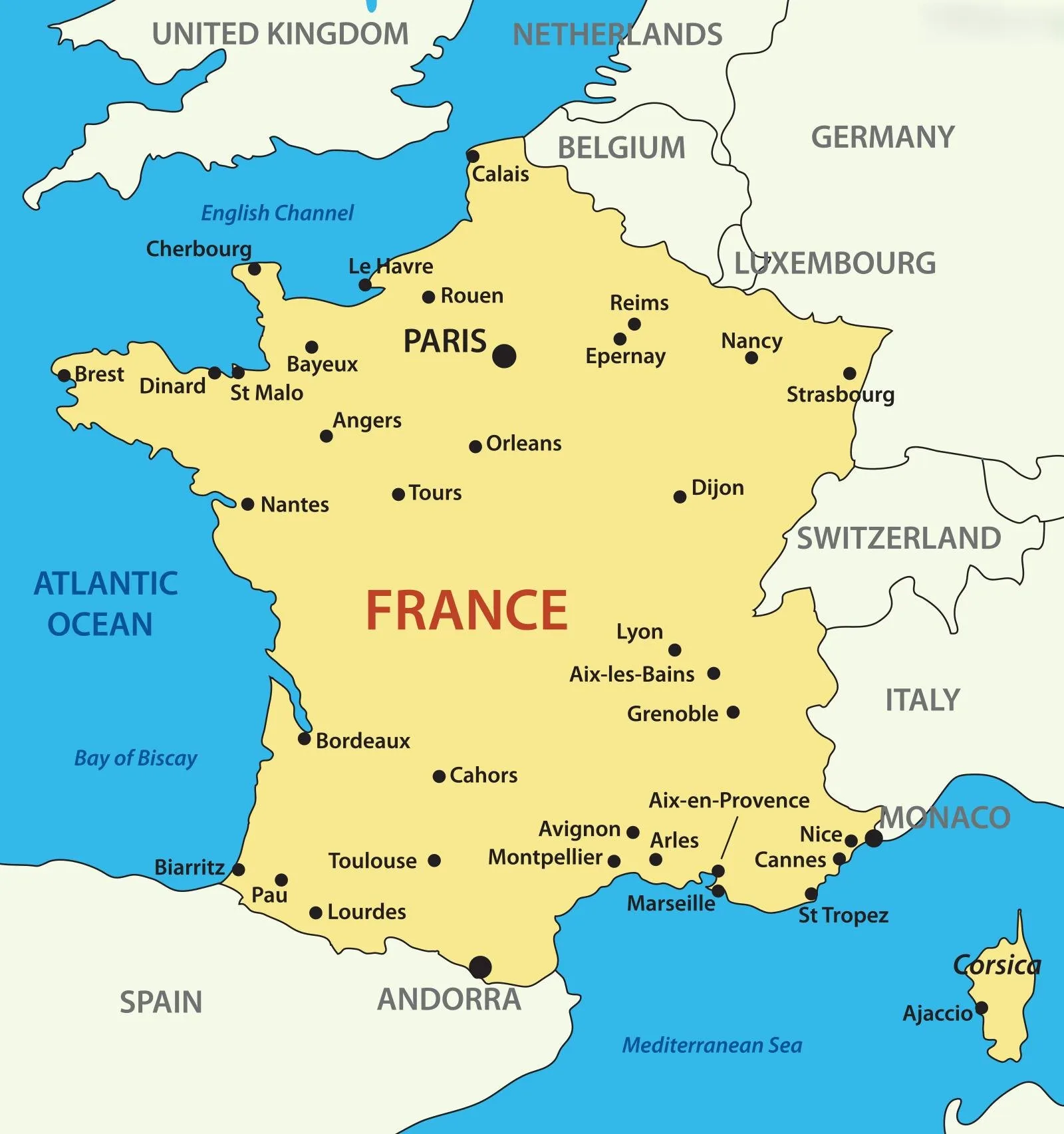
- Capital: Paris, situated on the banks of the Seine River.
- Bordering Countries: Metropolitan France shares land borders with eight countries: Belgium, Luxembourg, Germany, Switzerland, Italy, Monaco, Spain and Andorra.
- Geographical Features:
- Mountain Ranges: The Alps lie in southeastern France, while the Pyrenees form much of its border with Spain.
- Rivers: The Seine flows through Paris; the Loire is France’s longest river, while the Rhône and Garonne are other major rivers.
- Coastline: France has coastlines along the Atlantic Ocean, English Channel and Mediterranean Sea.
- Important Cities: Paris (capital, on the Seine River), Marseille (major Mediterranean port), Lyon (confluence of Rhône and Saône rivers), Bordeaux (on the Garonne River) and Limoges (central-western France, where the historic town hall was damaged by fire during protests).
- Political System: Semi-presidential republic, with an elected President and a government headed by the Prime Minister.
- International Groupings: France is a member of the European Union (EU), Eurozone, Schengen Area, NATO and G7.It is also one of the five permanent members of the United Nations Security Council (UNSC) with veto power.
Schemes & Initiatives
10 Years of UDAN Scheme
Source Why in News?- The Regional Connectivity Scheme (RCS)-UDAN (Ude Desh ka Aam Nagrik) completed 10 years on 21st October 2026, marking a decade of expanding affordable air connectivity to unserved and underserved regions. The launch of Modified UDAN in July 2026 marks a shift towards sustainable regional aviation, infrastructure development and indigenous aircraft manufacturing.
- About UDAN:
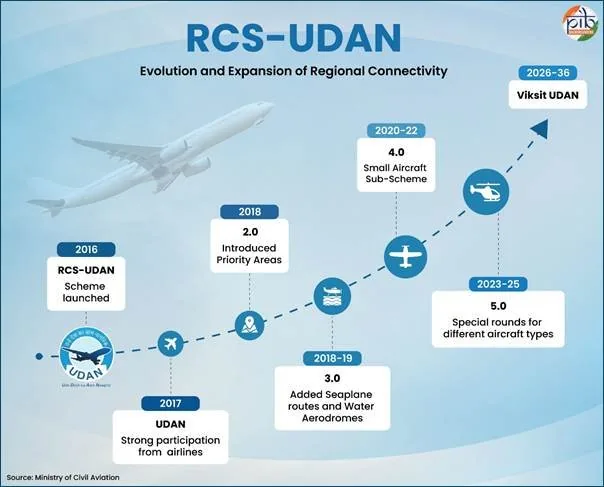
- The Regional Connectivity Scheme (RCS), UDAN, was launched on 21 October 2016 under the National Civil Aviation Policy 2016 to provide affordable and economically viable air connectivity to unserved and underserved regions through financial support and infrastructure development.
- The first UDAN flight was inaugurated between Shimla and Delhi in April 2017.
- Ten Years of UDAN: The scheme has contributed to expanding regional connectivity, with India emerging as the world’s third-largest domestic aviation market and the number of operational airports increasing from 74 in 2014 to 166 in 2026.
- UDAN Outcomes: The scheme has operationalised 687 regional routes and 95 aerodromes, including 17 heliports and 2 water aerodromes, while facilitating over 3.68 lakh flights and 1.72 crore passengers.
- Financial Support: UDAN uses airfare caps, concessions, market-based selection and Viability Gap Funding (VGF) to encourage airline participation. As of 15th October 2026, ₹5,091.23 crore had been disbursed under VGF.
- Employment Impact: Employment in the civil aviation sector increased from around 3 million in 2014 to 7.7 million in 2026, with potential to reach 25 million by 2040.
- North-Eastern Region:
- To improve connectivity across the region’s difficult terrain, 90 priority RCS routes have been operationalised.
- Of the 52 identified aerodromes, including heliports and water aerodromes, 12 have been operationalised.
- Significance: The operationalisation of regional airports under UDAN has improved access to markets, healthcare, tourism and employment opportunities, contributing to socio-economic development in underserved regions.
 What are the Key Features of Modified UDAN Scheme 2026?
- Launch and Duration: The Modified UDAN Scheme, launched on 4th July 2026, will be implemented over 10 years (FY 2026–27 to FY 2035–36) with a total outlay of ₹28,840 crore.
- Key Focus: It focuses on affordable air travel, sustainable regional aviation, infrastructure development and indigenous civil aircraft manufacturing under Atmanirbhar Bharat.
- Aerodrome Development: 100 airports will be developed from existing unserved airstrips with an outlay of ₹12,159 crore over eight years.
- Operation and Maintenance (O&M) Support: Around 441 aerodromes will receive three years of operation and maintenance support, with an estimated outlay of ₹2,577 crore.
- Modern Helipads: 200 modern helipads will be developed at an estimated cost of ₹15 crore each, with a total outlay of ₹3,661 crore over eight years.
- Viability Gap Funding: ₹10,043 crore will be allocated over ten years to support airlines operating regional routes, with funding available for up to five years.
- Indigenous Aviation: An additional ₹400 crore is proposed for procuring two HAL Dhruv helicopters for Pawan Hans and two HAL Dornier aircraft for Alliance Air, strengthening connectivity in remote and difficult terrain.
-
3-Pronged Approach under Modified UDAN
- The next phase of UDAN focuses on strengthening Centre–State/UT partnerships, developing aviation infrastructure and expanding regional air connectivity.
- Centre–State/UT Coordination: A total of 21 MoUs have been signed among the Union Government, participating States/UTs and the Airports Authority of India (AAI) to facilitate coordinated identification, development and operationalisation of aviation infrastructure based on regional priorities.
- Challenge Mode Portal for Aerodrome Development: A dedicated portal enables States and UTs to nominate airstrips and helipads for development or upgradation, ensuring infrastructure planning aligns with local connectivity needs.
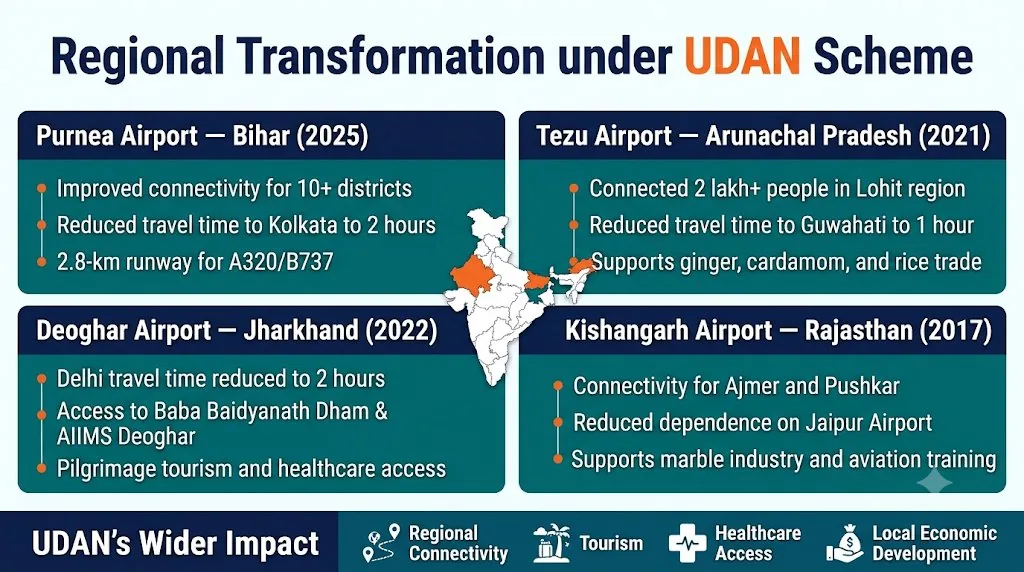
- Over the past decade, UDAN has strengthened regional air connectivity, improving accessibility and supporting inclusive economic development. The Modified UDAN Scheme seeks to build on these achievements by addressing infrastructure and operational viability challenges, promoting indigenous aviation capacity and ensuring sustainable air connectivity across underserved regions.
Sports
5th Asian Para Games
Source Ravi Baby Sahana and Prachi Pandey became the first Indian para table tennis players to win medals in the standing category at the 5th Asian Para Games 2026 in Aichi-Nagoya, Japan.- India secured five bronze medals in para table tennis, surpassing its previous tally of two bronze medals.
- Host and Venue: The 5th Asian Para Games are being held in Aichi-Nagoya, Japan, from 18th to 24th October 2026, with the opening ceremony at Paloma Mizuho Stadium, Nagoya.
- Slogan: “Imagine One Heart”, reflecting unity and inclusion, while “WABI: We Are Beautiful Individuals” is the theme of the opening and closing ceremonies.
- Flag-Bearers: Para-badminton player Pramod Bhagat and and para-athlete Simran Sharma were India’s opening ceremony flag-bearers.
- Previous Edition: At the 2023 Asian Para Games in Hangzhou, China, India achieved a record 111 medals (29 gold, 31 silver and 51 bronze).
- Significance: The Games promote inclusive sports participation, recognition of athletes with disabilities and accessible sporting opportunities, while challenging social barriers.