Comrades Editorial · 21 Oct 2026 (PDF)
In this edition
- Recalibrating India–China Ties International Relations
International Relations
Recalibrating India–China Ties
Source This editorial is based on “Time to engage smartly with China: Push premium Indian exports” published in The Economic Times on 19/10/2026. The article highlights that recalibrating economic ties with Beijing requires leveraging its offer to import premium Indian goods. Achieving balanced trade involves expanding PLIs for upstream components, dismantling entry barriers in IT and pharma, and securing critical rare earth supply chains. The Union Minister of Commerce and Industry’s recent call for a calibrated rebuilding of economic engagement with China underlines the need for a pragmatic dialogue that balances active trade stabilization with safeguards against structural vulnerabilities and strategic friction. New Delhi and Beijing are engaging in high-level talks to stabilize trade gains and build a shared vision for globalization, addressing both economic vulnerabilities and ongoing strategic friction. A pragmatic recalibration must reconcile competitive security needs with economic cooperation. As Dr. S. Jaishankar observes, “The key to a more settled Sino-Indian relationship is a greater acceptance by both countries of multipolarity and mutuality, building on a larger foundation of global rebalancing.”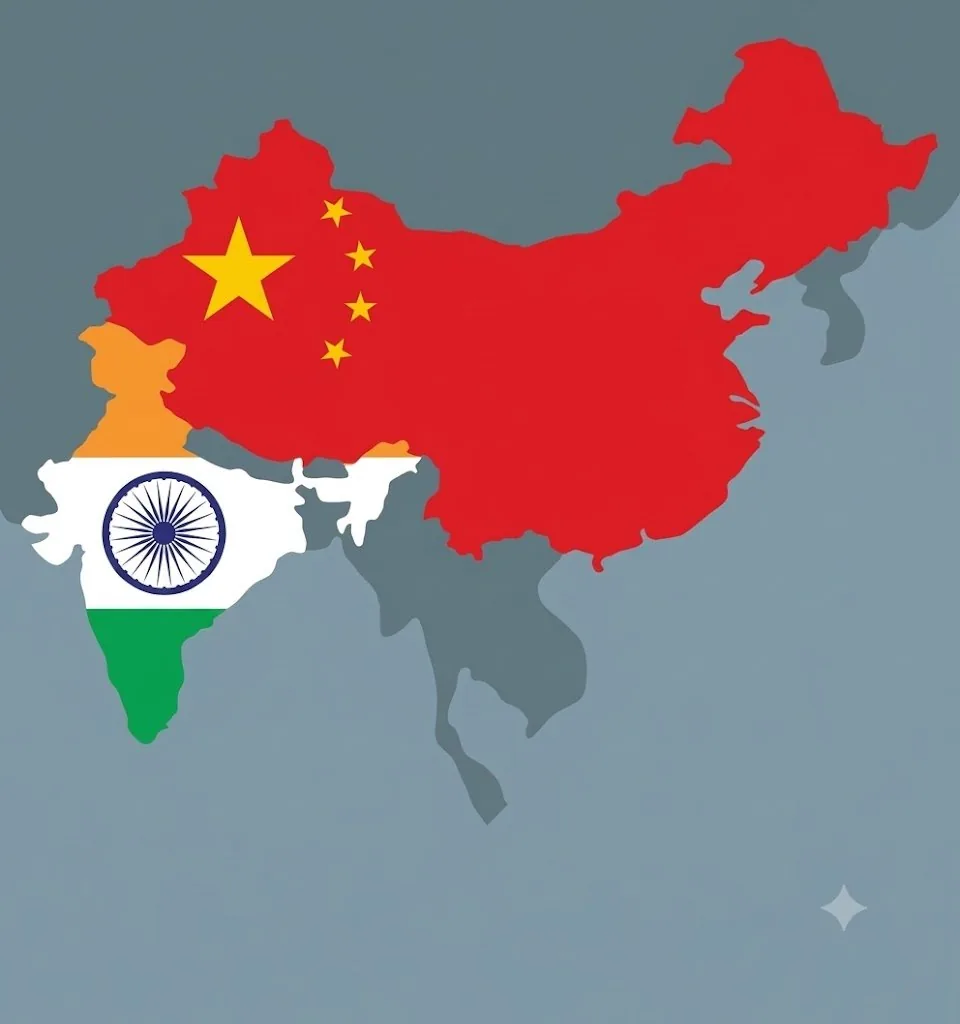 What are the Key Areas of Convergence between India and China?
- Border Stability, Confidence-Building and Strategic Communication:
- Both countries recognise the importance of peace and tranquillity along the Line of Actual Control (LAC) for improving bilateral relations.
- At the 25th Special Representatives’ talks in August 2026, they agreed to two additional military meeting points and two additional border hotlines in the Eastern and Middle sectors. These confidence-building measures (CBMs) strengthen crisis communication and reduce the risk of miscalculation.
- Dr. S Jaishankar’s formulation “manage China” offers a useful lens for this approach i.e., sustained diplomacy, military communication and negotiation remain essential even while the boundary question is unresolved.
- Economic Complementarities, and Supply-Chain Predictability:
- Large trade flows give both countries an economic stake in sustaining engagement, while India seeks reciprocity, diversified sourcing and meaningful market access.
- Official figures indicate bilateral merchandise trade of approximately USD 151 billion in FY2025–26, comprising Indian exports of USD 19.5 billion and imports of USD 131.6 billion.
- Indian industrial sectors depend heavily on Chinese intermediate capital goods. GTRI estimates indicate that industrial products constitute approximately 98.5% of India’s imports from China. Separately, China accounts for around 43% of India’s electronics imports, 40% of machinery and computer imports, and 44% of organic-chemical imports, demonstrating significant sector-specific sourcing dependence.
- As Jaishankar highlights, Asia is being shaped by “the power of China… and the rise of India,” necessitating a pragmatic economic interface to sustain domestic industrial output.
- People-to-People Connectivity, Pilgrimage and Cultural Exchanges:
- Both sides support restoring civilian mobility, business travel and cultural interaction, creating visible public benefits from diplomatic normalisation.
- For example, Air India announced four weekly Delhi–Shanghai flights from February 2026, following bilateral agreements to restore air links.
- The Sikkim government also confirmed that the first batch of Kailash Mansarovar Yatra 2026 returned through Nathu La on 1st July, 2026.
- Such exchanges promote pilgrimage diplomacy, societal contact and tourism livelihoods, while providing practical opportunities to rebuild familiarity between the two populations.
- Transboundary River Dialogue, and Disaster Preparedness:
- Shared river systems create a practical need for technical communication, hydrological transparency and flood-risk reduction.
- During the August 2026 Special Representatives’ talks, both countries agreed to convene the next Expert-Level Mechanism on Trans-border Rivers meeting and maintain communication on hydrological data sharing and renewal of relevant memoranda of understanding.
- Providing real-time water flow, rainfall, and discharge metrics (for rivers like the Brahmaputra and Sutlej) during the critical monsoon window (May to October) assists Indian flood-management authorities in issuing early warnings across Assam and Arunachal Pradesh, balancing upstream dam construction with downstream disaster mitigation.
- Reformed Multilateralism, and Greater Global South Representation:
- India and China share an interest in international institutions reflecting the growing economic weight of emerging markets and developing economies (EMDEs).
- The 2026 BRICS New Delhi Declaration, endorsed by both, supported stronger representation in the IMF and World Bank, inclusive leadership selection and meaningful quota realignment under the 17th General Review of Quotas.
- Joint participation as important members of the BRICS+ bloc and the Shanghai Cooperation Organisation (SCO) aligns both nations in challenging Western-centric global financial and diplomatic dominance.
- Climate Equity, and Development-Sensitive Transitions:
- Both countries support climate action based on equity and Common but Differentiated Responsibilities and Respective Capabilities (CBDR-RC), including financial and technological support for developing countries.
- Cooperation also covers practical environmental priorities. China participated in the August 2026 BRICS environment meetings hosted by India, which advanced discussions on sustainable lifestyles, afforestation, forest-fire management, disaster resilience, circular economy and adaptation.
- Both nations present a united front against unilateral Western environmental tariffs—such as the EU’s Carbon Border Adjustment Mechanism (CBAM)—demanding predictable climate finance transfers and equitable carbon space for industrializing economies.
- WTO-Centred Trade Governance, and MSME Internationalisation:
- Both countries support an effective rules-based multilateral trading system, which offers predictability for exporters and institutional avenues to address discriminatory restrictions.
- At the August 2026 BRICS Trade Ministers’ Meeting in Jaipur, attended by China’s trade representative, outcomes supported restoring a fully functioning, two-tier, binding WTO dispute-settlement system.
- Coordinating through the G33 coalition and Like-Minded Group (LMG) at the World Trade Organization (WTO) enables India and China to protect agrarian safety nets for hundreds of millions of smallholders.
- Ministers also adopted credit-assessment principles for export-oriented MSMEs and agreed to study a BRICS invoice-discounting mechanism.
- Development Finance, Infrastructure Investment and South–South Cooperation:
- India and China cooperate as founding members of the New Development Bank (NDB), supporting additional financing channels for infrastructure and sustainable development.
- By 31st December 2025, the bank had approved USD 9.53 billion across 32 projects in India and USD 10 billion across 31 projects in China.
- Coordinated participation under the G20 Common Framework for Debt Treatments prevents Western Paris Club creditors from dictating unilateral debt write-offs while ensuring that multilateral development banks (MDBs) de-risk infrastructure investments across the Global South.
- Unresolved Line of Actual Control (LAC) and Militarization of Frontier Zones:
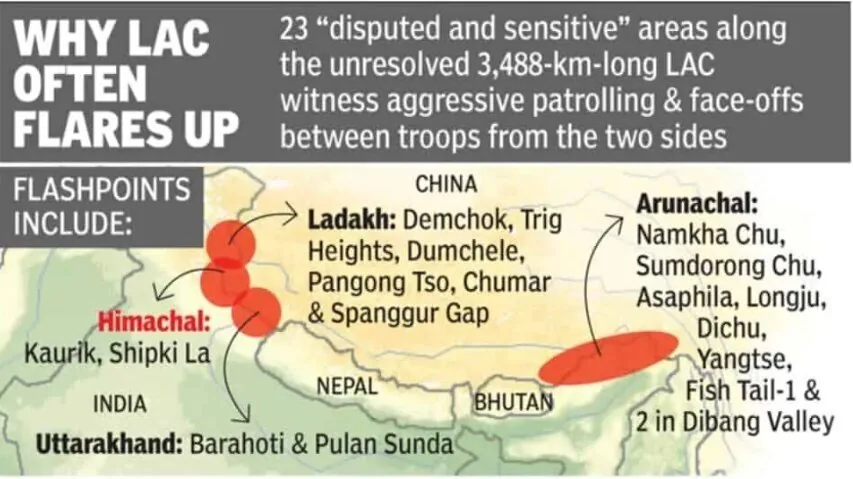
- Persistent disagreement over the demarcation of the 3,488-km Line of Actual Control (LAC)—compounded by China’s aggressive infrastructure building and deployment of troops across Western (Ladakh) and Eastern (Arunachal Pradesh) sectors—maintains a state of active military tension.
- Despite disengagement protocols across specific friction points following the 2020 Galwan Valley clash, China’s refusal to finalize a mutually agreed clarification of the LAC, coupled with illegal territorial claims over Arunachal Pradesh (which Beijing labels Zangnan), prevents normalization, forcing India to maintain permanent high-altitude deployments.
- E.g., in April 2026, India rejected China’s assignment of new names to places in Indian territory. Such actions demonstrate how cartographic assertions and competing sovereignty narratives persist alongside diplomatic engagement.
- China–Pakistan Strategic Alignment, CPEC and India’s Security Concerns:
- China’s extensive defence partnership with Pakistan complicates India’s security calculations, while the China–Pakistan Economic Corridor (CPEC) raises sovereignty objections because it passes through Pakistan-occupied Indian territory.
- SIPRI’s 2026 assessment reports that China supplied 80% of Pakistan’s major-arms imports during 2021–25, illustrating the depth of this military relationship.
- Meanwhile, Beijing and Islamabad agreed in May 2026 to accelerate CPEC 2.0. Strategically, this reinforces India’s concern about a two-front security challenge.
- Jaishankar’s insistence that connectivity requires “credible assurances that projects are not used to exert influence” captures the broader strategic sensitivity surrounding infrastructure corridors.
- Severe Structural Trade Deficit and Asymmetric Market Barriers:
- Economic commerce between the two Asian giants remains starkly unequal, driving India’s bilateral trade deficit to a historic $112.16 billion in FY 2025–26 (with imports scaling to $131.63 billion against Indian exports of just $19.47 billion).
- Chinese non-tariff trade barriers, stringent local registration norms, and state-subsidized dumping severely restrict Indian market access for IT services, generic pharmaceuticals, and agricultural commodities, reducing India to a primary raw-material exporter while creating dangerous supply-chain dependencies in critical sectors like Active Pharmaceutical Ingredients (APIs) and solar wafers.
- String-of-Pearls Maritime Encirclement and Indian Ocean Power Projection:
- China’s rapid naval expansion across the Indian Ocean Region (IOR)—manifested in militarized dual-use deep-water ports in Hambantota (Sri Lanka), Kyaukpyu (Myanmar), Chittagong (Bangladesh), and Gwadar (Pakistan)—directly threatens India’s maritime security sphere.
- Frequent deployments of Chinese nuclear-powered submarines and satellite-tracking research vessels (Yuan Wang class) into Indian Ocean waters challenge India’s traditional role as the primary net security provider in the region, forcing New Delhi to expand its naval footprints through the Quad framework and MAHASAGAR initiative.
- Water Hegemony and Transboundary Upper-Riparian Infrastructure:
- China’s aggressive construction of mega-dams along the upper reaches of transboundary rivers—most notably the 60-gigawatt dam cascade on the Yarlung Tsangpo (Brahmaputra) in Tibet near the Great Bend—gives Beijing asymmetric strategic control over India’s downstream water security.
- The lack of a binding, transparent bilateral water-sharing treaty enables China to weaponize water flows, leading to sudden seasonal flash-floods, downstream siltation, or severe water diversion that threatens ecological stability across Assam and Arunachal Pradesh.
- Systemic Blockade at the UN Security Council and Global Bodies:
- Beijing consistently uses its permanent veto power at the United Nations Security Council (UNSC) to block India’s rightful claim to a permanent seat, seeking to preserve its status as Asia’s sole permanent member.
- Furthermore, China continues to obstruct India’s entry into the Nuclear Suppliers Group (NSG)—citing non-signatory status to the NPT—while repeatedly placing technical holds at the UNSC 1267 Sanctions Committee to shield Pakistan-based cross-border terror operatives.
- Indo-Pacific Alignment vs. Anti-Quad Containment Narrative:
- Divergent visions for the Indo-Pacific architecture represent a deep strategic divide, with Beijing condemning the Quadrilateral Security Dialogue (Quad) as an “Asian NATO” created to contain China’s rise.
- In contrast, India views the Quad (comprising India, US, Japan, Australia) as a vital counterweight to enforce a free, open, and rules-based Indo-Pacific.
- This fundamental ideological rift is reflected in Jaishankar’s observation: “In fact, the ability of India, Japan and the US to work together in a trilateral framework has been one of the novel elements of the changing Asian political landscape.”
- State Support for Cross-Border Separatism and Information Warfare:
- China’s covert support for insurgent groups along India’s northeastern frontier, combined with sophisticated cyber intrusions into critical national infrastructure, represents an ongoing hybrid warfare challenge.
- Highlighting the unacceptability of foreign state interference, Dr. Jaishankar directly challenges this stance: “If sympathy, succour and support are given abroad to separatists in the name of democratic freedoms, should we display equanimity?”
- Critical-Mineral Dependence, Technology Controls and Industrial Competition:
- India’s pursuit of technological sovereignty and supply-chain diversification encounters China’s restrictions on access to strategic inputs and manufacturing know-how.
- Official assessment reveals that China supplied approximately 85–90% of India’s permanent-magnet imports by quantity during 2022–25, exposing downstream industries to concentrated sourcing risks.
- More recently, China had proposed export controls covering 12 solar-manufacturing technologies. Such developments highlight chokepoint vulnerability.
- Tibet, Religious Freedom and the Dalai Lama’s Succession:
- India’s hosting of the Dalai Lama and Tibetan religious institutions remains sensitive for China, which asserts state authority over the succession process.
- In July 2025, the Dalai Lama reaffirmed that the Gaden Phodrang Trust (non-profit charitable organisation to preserve Tibetan culture and Buddhism, established in 2011 and registered in Dharamshala, India) alone would recognise his future reincarnation. Beijing reiterated its contrary position and, in May 2026, warned India against interference in the process.
- India’s stated position emphasises freedom of religion and refraining from taking positions on matters of faith.
- The issue therefore connects religious autonomy, Tibetan identity, Chinese sovereignty claims and Himalayan geopolitics, creating a continuing diplomatic fault line.
- Verified Border Stabilisation and a Sequenced Security Roadmap:
- India should negotiate a measurable progression from disengagement to de-escalation and longer-term confidence building, with each stage dependent on verified implementation.
- The Working Mechanism for Consultation and Coordination (WMCC) and military commanders could maintain a confidential incident register, conduct periodic compliance reviews and agree on procedures for disputed patrol encounters.
- Progress should be assessed through fewer confrontations, faster incident resolution and adherence to agreed arrangements, while preserving India’s territorial claims and legitimate patrolling interests.
- Institutionalised Strategic Dialogue and Reciprocal Political Restraint:
- India should establish a predictable calendar of annual leadership reviews, regular foreign-minister consultations and quarterly implementation assessments, reducing dependence on occasional summit diplomacy.
- A confidential agenda should explicitly address sovereignty, China–Pakistan security cooperation, terrorism, Tibet-related sensitivities and third-country partnerships.
- An agreed implementation matrix—with responsible ministries, deadlines and unresolved issues—would translate the existing commitment to revive bilateral dialogue mechanisms into accountable diplomacy and sustained strategic communication.
- Sector-Specific Market-Access Bargains and Regulatory Reciprocity:
- India should negotiate a time-bound market-access package covering sectors where identifiable regulatory barriers restrict Indian exports, including pharmaceuticals, agricultural products and selected services.
- Each sectoral annex should specify documentation requirements, inspection procedures, application timelines and written reasons for rejection.
- A business grievance mechanism and quarterly scorecard should measure approvals, clearance times and actual export orders.
- Investment Cooperation and Stronger Domestic Technological Capabilities:
- India should implement transparent, risk-based investment screening, facilitating productive collaboration while applying closer scrutiny to sensitive infrastructure and data access.
- The 2026 FDI reforms already provide a starting point through defined beneficial-ownership criteria and a 60-day decision timeline for specified manufacturing proposals.
- India should complement these provisions with commercially negotiated technology licensing, workforce training, Indian supplier development and enforceable intellectual-property arrangements.
- Parallel diversification and strategic inventories of critical inputs would reduce disruption risks. Jaishankar’s observation that “Atmanirbhar Bharat does coexist with Vasudhaiva Kutumbakam” captures the compatibility of domestic capability building with selective international cooperation.
- Reliable River-Data Agreements and Joint Disaster Preparedness:
- India should seek renewed river-data arrangements specifying reporting stations, transmission frequency, quality standards, emergency alerts and continuity during diplomatic tensions.
- A technical subgroup could propose a shared flood-information dashboard combining agreed upstream observations with satellite rainfall and downstream monitoring. Advance notification of exceptional releases, dam-safety emergencies and significant upstream project changes should form part of negotiations.
- The WMO Information System 2.0, operational since 2025, offers a relevant model for interoperable data exchange; WMO-supported Nile Basin work in 2026 also demonstrates approaches to combining forecasts and risk information. These are adaptable models, rather than existing India–China arrangements.
- Maritime Risk Reduction and Cooperation on Shared Security Needs:
- India should propose a bilateral maritime incident-prevention protocol covering communication procedures, safe manoeuvring and rapid clarification of potentially dangerous encounters.
- The Code for Unplanned Encounters at Sea (CUES) offers an established reference for communication and safety procedures involving naval ships and aircraft.
- India could also explore limited cooperation in search and rescue, anti-piracy coordination and humanitarian assistance and disaster relief (HADR), beginning with tabletop exercises.
- Small, Auditable Cooperation Projects with Visible Development Benefits:
- India should use BRICS, the SCO and development-finance institutions to propose a limited portfolio of jointly designed projects in areas such as urban heat resilience, municipal recycling and climate-resilient agriculture.
- Each pilot should have clearly allocated responsibilities, transparent procurement, agreed rules for research outputs and independent technical evaluation.
- Progress could be measured through outcomes such as improved warning lead times, reduced waste or adoption of resilient farming practices. The environmental priorities discussed under India’s 2026 BRICS chairship provide an institutional starting point.
- Re-energizing Academic, Media, and Track-1.5 Civil Society Exchanges:
- Restoring reciprocal visa issuance for researchers, business executives, and accredited journalists rebuilds critical analytical capacity and prevents cognitive miscalculations on both sides.
- Establishing structured Track-1.5 dialogue platforms between premier think tanks—such as the Indian Council of World Affairs (ICWA) and China Institutes of Contemporary International Relations (CICIR)—fosters nuanced strategic communication, supporting the principle that “diplomacy is not about liking or disliking people, it is about managing interests.”
- Sustaining a calibrated rebuilding of India–China relations requires transitioning from reactive crisis management to institutionalized strategic reciprocity. While foundational divergences in border security and trade deficits demand firm safeguard mechanisms, operationalizing key convergences across climate action, river data, and local market access provides a pragmatic path forward. As Dr. S. Jaishankar aptly notes, “Unlike other nations that rose earlier in Asia, China is much harder to fit into the Western-led global order,” necessitating a balanced approach anchored in national sovereignty and global multipolarity.