Comrades Dispatch · 22 Oct 2026 (PDF)
In this edition
- Unlocking the Agricultural Potential of Forest Rights Act Lands Agriculture & Rural
- Innovative Wastewater Treatment Technologies under Namami Gange Environment & Ecology
- Southeast Asia Haze Crisis: Limitations of AATHP Environment & Ecology
- Earthquake Strikes Russia’s Kamchatka Peninsula Geography
- World Bank Group Launches 1st Digital Strategy International Relations
- India-US Relations: Strategic Convergence and Energy Diplomacy International Relations
- LAHDC (Amendment) Regulation, 2026 Nation & States
- India Calls for Stronger Safeguards Against WMD Proliferation Security
- Badr Defence Cooperation Pact Signed in Doha Security
Agriculture & Rural
Unlocking the Agricultural Potential of Forest Rights Act Lands
Source Why in News?- Policy experts, civil society organizations, and the government have highlighted the urgent need to unlock the agricultural potential of lands distributed under the Forest Rights Act (FRA), 2006.
- Despite millions of tribal and forest-dwelling families receiving land titles, a lack of convergence with mainstream agricultural schemes has kept these lands underutilized, hindering the true economic empowerment of marginalized communities.
- IFR Titles: Since the inception of the FRA, over 24 lakh Individual Forest Rights (IFR) titles have been distributed, covering millions of acres of land. Unlocking this potential can yield massive dividends.
- Vast Ecological Diversity: FRA is being implemented in 20 States (including Himachal Pradesh) and 1 Union Territory, reflecting immense agro-ecological and socio-economic diversity.
- Hub for Organic Farming: FRA lands are traditionally untouched by chemical fertilizers and pesticides, making them naturally suited for high-value organic agriculture.
- Agroforestry and Non-Timber Forest Products (NTFPs): These lands can support a mix of timber, fruit-bearing trees, and medicinal plants, providing year-round income and enhancing carbon sequestration.
- Climate Resilience:
- Traditional tribal farming practices, specifically the cultivation of millets (Shree Anna) and indigenous drought-resistant seeds, offer solutions for climate-resilient agriculture.
- Promoting pulses and oilseeds on FRA lands can boost tribal incomes and productivity. These crops suit rain-fed conditions, require less water and improve soil health.
- Cultivating sesame, spices and horticultural crops based on local agro-ecology can further strengthen livelihoods and reduce India’s import dependence on edible oils and pulses.
- Food and Nutritional Security: Maximizing output on IFR lands directly addresses malnutrition in tribal belts (such as central India’s tribal corridor).
- About:
- Under the Scheduled Tribes and Other Traditional Forest Dwellers (Recognition of Forest Rights) Act, 2006 (commonly known as the Forest Rights Act (FRA)), Individual Forest Rights (IFR) titles grant legally recognized ownership and land-use rights to eligible forest dwellers for self-cultivation and habitation.
- These titles serve to correct historical colonial injustices by securing the livelihoods of marginalized communities who have lived in harmony with forests for generations.
- Core Features of IFR Titles:
- Scope & Limits:
- The title recognizes land actively farmed or occupied by a family up to a maximum of 4 hectares.
- It only recognizes pre-existing occupation; no new land is granted or cleared under this provision.
- Legal Status: IFR titles are heritable but non-transferable. The land cannot be sold, leased, or transferred to anyone outside the family.
- Joint Titling: Titles are typically registered jointly in the names of both spouses, protecting women’s land security.
- Protection from Displacement: The Forest Rights Act strictly prohibits the eviction or displacement of forest dwellers until their claim verification process is fully completed.
- Scope & Limits:
- Eligibility Criteria:
- Dwellers & Dependency: Must be a member of a Scheduled Tribe (FDST) or an Other Traditional Forest Dweller (OTFD) who primarily resides in and depends on the forest for their livelihood.
- Scheduled Tribes: Must have occupied the forest land prior to 13th December 2005.
- Other Traditional Forest Dwellers (OTFD): Must prove continuous residence and dependency in the forest for at least three generations (75 years) prior to 13th December 2005.
- Three-Tier Approval Mechanism:
- Gram Sabha: The initiating authority that receives, verifies, and passes resolutions on claims.
- Sub-Divisional Level Committee (SDLC): Reviews and compiles the Gram Sabha’s records.
- District Level Committee (DLC): The final appellate authority that approves or rejects claims and issues the legal titles.
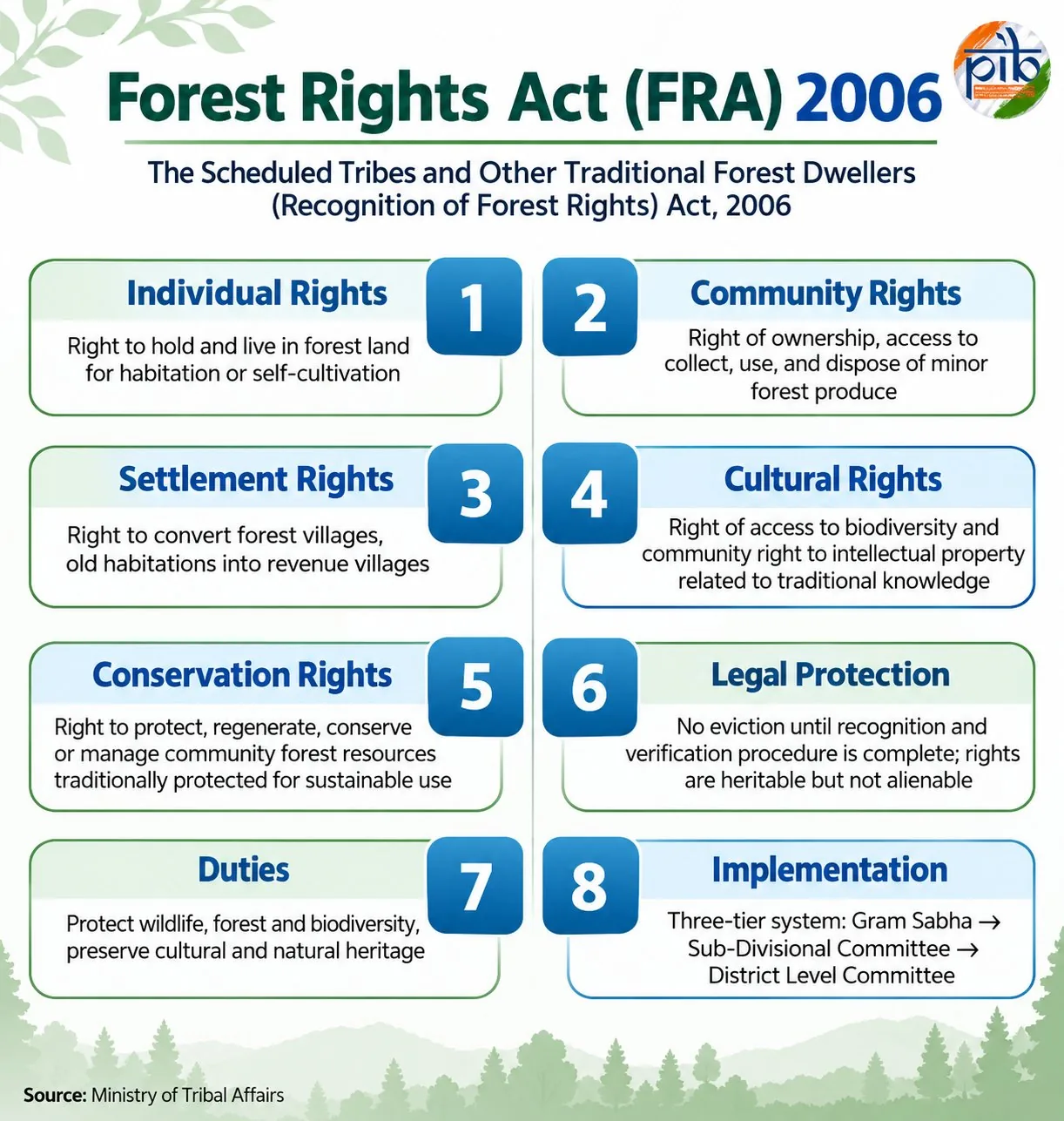 IFR vs. Community Rights
- While IFR secures the immediate homestead and farm plots of a specific household, the FRA also grants two types of collective rights:
- Community Rights (CR): Grants shared access to grazing lands, water bodies, and the collection of minor forest produce (like honey, bamboo, or leaves).
- Community Forest Resource Rights (CFRR): Empowers the village Gram Sabha to protect, manage, and regenerate the broader forest area sustainably.
- Lack of Institutional Credit: IFR titles are rights of use, not absolute ownership. Hence, banks often refuse to accept FRA titles as collateral, denying farmers access to the Kisan Credit Card (KCC) and institutional crop loans.
- Exclusion from Agricultural Schemes: Because IFR lands are recorded as “Forest Land” and not “Revenue Land,” titleholders are frequently excluded from direct benefit transfers like PM-KISAN, PM Fasal Bima Yojana (PMFBY), and fertilizer subsidies.
- Irrigation Deficit: Most FRA lands are located in undulating, hilly, or remote terrains and remain entirely rainfed. Access to the Pradhan Mantri Krishi Sinchayee Yojana (PMKSY) is highly limited in these zones.
- Inadequate Land Development: Forest lands often require leveling, bunding, and soil conditioning before intensive agriculture can begin, which requires heavy initial capital investment.
- Market Linkages: Absence of nearby APMC mandis and Farmer Producer Organizations (FPOs) leaves tribal farmers vulnerable to exploitation by middlemen.
- Targeted Cluster Development: Out of 244 tribal districts, 60 have major oilseed potential, 31 for pulses, and 23 for both. Developing region-specific production clusters in these high-potential districts is critical.
- Mandatory Scheme Convergence: Converging FRA land development with schemes such as PMKSY, the National Food Security and Nutrition Mission, the National Mission on Edible Oils and Van Dhan Yojana can improve irrigation, crop productivity, tribal livelihoods and value addition of Non-Timber Forest Products (NTFPs).
- Leveraging DA-JGUA:
- The Dharti Aaba Janjatiya Gram Utkarsh Abhiyan can strengthen post-title livelihood support through sustainable agriculture, allied activities and coordinated development interventions in tribal villages.
- The scheme includes livelihood support for FRA patta holders and Gram Sabha-led Community Forest Resource Management Plans.
- RBI Directives for Credit: The Reserve Bank of India (RBI) must mandate scheduled commercial banks to recognize IFR titles as legitimate documents for extending institutional credit (KCC) without demanding collateral.
- Leveraging MGNREGA: Funds under the Viksit Bharat–Guarantee for Rozgar and Ajeevika Mission (Gramin) (VB–G RAM G) Act, 2025 should be prioritized for land development on IFR lands (e.g., building farm ponds, contour trenching, and land leveling).
- Promoting Tribal FPOs: Empowering organizations like TRIFED to establish tribal-specific Farmer Producer Organizations (FPOs) can help aggregate organic produce, process NTFPs, and connect farmers directly to global markets via the Van Dhan Yojana.
- Updating Revenue Records: States must actively integrate FRA titles into their digital land revenue portals (like Bhoomi, Dharani) to ensure administrative seamlessness.
- Strengthening Gram Sabhas: Gram Sabhas should participate in planning land and water development, crop diversification and community-based resource management to ensure that agricultural expansion respects customary rights and ecological sustainability.
- Distributing titles under the Forest Rights Act is only the first step toward tribal justice; it must be followed by robust post-claim support. By converging agricultural, financial, and rural development schemes with FRA lands, India can uplift millions from poverty while advancing sustainable, climate-resilient agriculture in its forested hinterlands.
Environment & Ecology
Innovative Wastewater Treatment Technologies under Namami Gange
Source Why in News?- Recently, the Ministry of Jal Shakti highlighted the role of innovative wastewater treatment technologies under the Namami Gange Programme (NGP) in improving sewage management, enhancing treatment efficiency and promoting treated-water reuse.
- About: The Namami Gange Programme (NGP) is an Integrated Conservation Mission launched by the Government of India in June 2014 to achieve the twin objectives of pollution abatement and conservation and rejuvenation of the National River Ganga.
- Implementation: The programme is implemented by the National Mission for Clean Ganga (NMCG) under the Ministry of Jal Shakti.
- Phases and Funding:
- Phase I: Implemented up to March 2021, with an outlay of ₹20,000 crore.
- Phase II: Extended up to March 2026, with an outlay of ₹22,500 crore.
- Major Components: The programme focuses on sewage treatment infrastructure, riverfront development, river-surface cleaning, biodiversity conservation, afforestation, public awareness, industrial effluent monitoring and Ganga Gram.
- Key Interventions:
- Nirmal Ganga: Reducing pollution through sewage and industrial effluent treatment.
- Aviral Ganga: Improving river ecology and maintaining continuous river flow.
- Jan Ganga: Strengthening public participation and community awareness.
- Gyan Ganga: Promoting scientific research, monitoring and evidence-based river management.
- Technology-Neutral Approach:
- The programme adopts sewage treatment technologies based on local geography, land availability, sewage characteristics and treatment requirements. These include:
- Conventional Technologies: Activated Sludge Process, Sequential Batch Reactor (SBR), Upflow Anaerobic Sludge Blanket (UASB) and Moving Bed Biofilm Reactor (MBBR).
- Innovative Technologies: NEREDA, Food Chain Reactor (FCR), electrocoagulation, constructed wetlands, Soil Biotechnology and decentralised Johkasou systems.
- The programme adopts sewage treatment technologies based on local geography, land availability, sewage characteristics and treatment requirements. These include:
- Sewage Infrastructure Development:
- The programme has undertaken 199 sewerage infrastructure projects worth ₹31,327 crore, of which 116 projects have been completed.
- New Treatment Capacity: Targets 5,270 million litres per day (MLD) of new sewage treatment capacity, with 2,237 MLD created.
- Rehabilitation: Targets rehabilitation of 925 MLD of existing STP capacity, of which 873 MLD has been rehabilitated.
- Advanced Biological Treatment Technologies
- Food Chain Reactor (FCR):
- An advanced biological treatment system combining activated sludge, fixed artificial media and plant roots to remove organic pollutants and nutrients with lower land and energy requirements.
- Five FCR-based STPs are operational, including two in Bhatpara (West Bengal) and three in Prayagraj (Uttar Pradesh), while another is under construction at Bhagalpur (Bihar).
- NEREDA Technology:
- Uses aerobic granular sludge containing compact microbial granules with efficient settling properties, reducing the space and energy required for sewage treatment.
- Provides approximately 50% power savings over the Activated Sludge Process and 20% savings over Sequential Batch Reactor (SBR) technology.
- Food Chain Reactor (FCR):
- Electrochemical and Advanced Oxidation Technologies
- Electrocoagulation:
- A non-biological treatment process using electric current and metal electrodes to destabilise and remove suspended and emulsified pollutants from wastewater.
- Suitable for cold climates, mountainous terrain and space-constrained locations, with 17 installations in Uttarakhand, including Badrinath and Chamoli.
- Advanced Oxidation Process (AOP): Uses oxidation-based treatment to remove pollutants, enabling on-site wastewater treatment with reduced dependence on extensive sewer networks.
- Electrocoagulation:
- Nature-Based and Decentralised Treatment Systems
- Constructed Wetlands:
- Engineered ecosystems that use aquatic plants, soil, substrates and microorganisms to remove pollutants through natural physical, chemical and biological processes.
- At Bithoor (Uttar Pradesh), six constructed wetlands treat approximately 2 MLD of wastewater, reducing Biochemical Oxygen Demand (BOD) from around 75 mg/L to below 10 mg/L.
- Soil Biotechnology (SBT): A nature-based wastewater treatment process combining filtration, sedimentation, infiltration and microbial decomposition to remove organic and inorganic pollutants.
- Johkasou Technology:
- A prefabricated, decentralised sewage treatment system integrating biological treatment, settling, disinfection and filtration within a compact unit.
- Useful in small settlements, hilly areas and locations lacking conventional sewerage networks, with six installations recorded in Uttarakhand.
- Constructed Wetlands:
- Space-Efficient and On-Site Treatment Infrastructure
- Multi-Storey STPs:
- Use vertical infrastructure to minimise land requirements in densely populated or geographically constrained locations.
- India’s first four-storey municipal STP was developed at Muni Ki Reti, Uttarakhand, with a capacity of 7.5 MLD.
- Faecal Sludge and Septage Management (FSSM):
- Treats faecal sludge collected from septic tanks and on-site sanitation systems, extending wastewater management to areas without sewer networks.
- A 10 kilolitres per day Faecal Sludge Treatment Plant pilot was sanctioned at Chunar (Uttar Pradesh) to address sanitation requirements in smaller habitations.
- Multi-Storey STPs:
- The Namami Gange Programme demonstrates a shift from conventional sewage treatment infrastructure towards technology-driven, decentralised and resource-efficient wastewater management. Integrating innovative treatment processes, nature-based solutions, renewable energy and performance-linked operations can strengthen river rejuvenation, water security and sustainable urban development.
Southeast Asia Haze Crisis: Limitations of AATHP
Source A severe transboundary haze crisis in Southeast Asia in October 2026, driven by forest and peatland fires in Indonesia, has affected neighbouring countries, including Malaysia and Singapore, triggering health emergencies and diplomatic tensions within ASEAN. The crisis highlights the enforcement limitations of the ASEAN Agreement on Transboundary Haze Pollution (AATHP).- Unprecedented Scale:
- Over 1 million wildfire hotspots have scorched approximately 900,000 hectares of land in Indonesia, predominantly on the islands of Kalimantan (Borneo) and Sumatra.
- The primary driver is “slash and burn” agriculture—an illegal but widespread practice of using fire as a cheap method to clear forest.
- Peatland Fires:
- Fires in drained peatlands can smoulder underground for prolonged periods, releasing fine particulate matter (PM2.5) and greenhouse gases, making them difficult to control.
- The annual dry season fires are significantly intensified this year by an unusually strong El Niño, a natural climate phenomenon that creates severe drought conditions, making the fires harder to extinguish.
- Diplomatic Tensions:
- The crisis has strained bilateral relations. Singapore initiated action involving 10 Indonesian companies under its Transboundary Haze Pollution Act, 2014, which enables legal action against entities responsible for haze affecting Singapore.
- Indonesia’s President condemned slash-and-burn practices as “ecological terrorism” and suspended 26 companies’ licences, while civil society groups demanded a national disaster declaration.
- About:
- Established in 2002 and effective since 2003, the AATHP is a legally binding regional agreement aimed at preventing and monitoring transboundary haze from land and forest fires through regional cooperation.
- Indonesia became the last of the original ten ASEAN members to ratify the agreement in 2015.
- Institutional Mechanism: The agreement provides for the ASEAN Coordinating Centre for Transboundary Haze Pollution Control (ACC THPC) to facilitate information sharing, coordination and assistance in managing forest fires and haze.
- Regional Initiatives:
- Second ASEAN Haze-Free Roadmap (2023–2030): Aims to achieve a transboundary haze-free ASEAN by 2030 through improved monitoring, prevention and regional cooperation.
- ASEAN Peatland Management Strategy (2023–2030): Promotes sustainable peatland management, fire prevention and restoration of degraded peatlands.
- Enforcement Challenges: Despite its legally binding nature, the AATHP lacks strong regional sanctions and enforcement mechanisms. The “ASEAN Way,” emphasising sovereignty, consensus and non-interference, limits collective accountability and effective implementation.
Geography
Earthquake Strikes Russia’s Kamchatka Peninsula
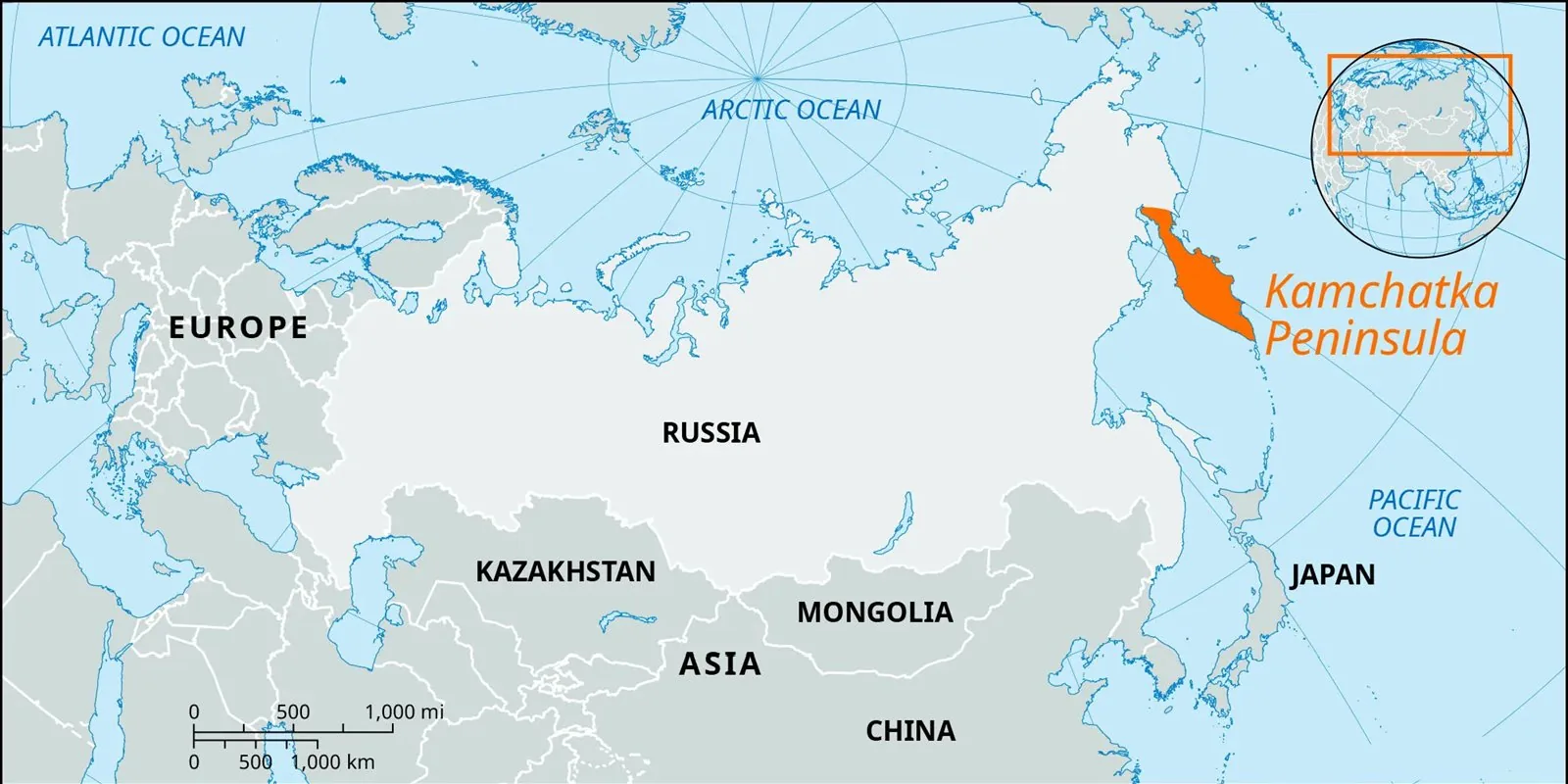
Source Recently, a magnitude 7.0 earthquake struck Russia’s Kamchatka Peninsula at a reported depth of 152 km. Kamchatka Peninsula- Location: The Kamchatka Peninsula lies in Russia’s Far East, between the Sea of Okhotsk to the west and the Pacific Ocean and Bering Sea to the east.
- Pacific Ring of Fire: The peninsula lies within this zone of intense seismic and volcanic activity, associated with tectonic plate boundaries.
- Climate: Much of the region experiences harsh subarctic or tundra-like conditions, contributing to low population density.
- Tectonic Setting: The region is highly earthquake-prone due to the subduction of the Pacific Plate beneath the Okhotsk microplate, commonly treated as part of the larger North American Plate.
- Mountain Ranges: The two principal mountain ranges are the Sredinny Range and the Vostochny Range.
- Volcanic Activity: The peninsula contains numerous volcanoes, including the Volcanoes of Kamchatka UNESCO World Heritage Site, comprising six protected components.
- Klyuchevskoy Volcano: It is the highest active volcano in Eurasia and one of the most active volcanoes on the peninsula.
- Major River: The Kamchatka River is the peninsula’s principal waterway.
- Biodiversity: The region supports exceptional biodiversity, including salmonid fish, sea otters, brown bears and Steller’s sea eagles.
- Kuril Archipelago: The Kuril Islands extend from the Kamchatka region towards Japan and are subject to a territorial dispute between Russia and Japan.
International Relations
World Bank Group Launches 1st Digital Strategy
Source The World Bank Group (WBG) launched its first comprehensive Digital Strategy in Seoul, South Korea, to expand affordable digital connectivity, digital skills, artificial intelligence (AI) adoption and employment opportunities in developing countries.- Digital Divide: Over 2 billion people remained offline globally in 2025, with internet usage at only 23% in low-income countries, compared to 94% in high-income countries.
- Employment Challenge: Around 1.2 billion young people will reach working age in developing countries over the next 10–15 years, while their economies are projected to generate only 420 million jobs.
- About: The WBG’s first integrated digital development framework, combining its public and private sector capabilities, financing, policy advice, investment and guarantees to support country-specific digital transformation.
- Four Priority Areas:
- Digital Connectivity: Expand reliable internet infrastructure through shared networks, public-private investment, improved competition and coordinated electricity-connectivity planning in underserved regions.
- Affordable Devices and Data: Reduce smartphone and broadband costs through partnerships with manufacturers, telecom operators and financial institutions, including device refurbishment and responsible financing options.
- Digital Services and Skills: Strengthen digital identification, payment systems, secure data exchange, digital literacy and employment-oriented training to improve access to public and private services.
- AI Readiness: Improve access to computing infrastructure, local datasets and AI skills, promoting practical applications of Small AI.
- AI Infrastructure and Readiness Initiative: A complementary initiative offering emerging economies access to shared, pay-as-you-go Graphics Processing Unit (GPU) infrastructure, providing an affordable alternative to standalone national data centres.
- Significance: Aims to bridge the global digital divide, promote inclusive economic growth, employment generation and digital public infrastructure, and improve access to essential services in developing economies.
India-US Relations: Strategic Convergence and Energy Diplomacy
Source Why in News?- The US Secretary of State embarked on a high-profile three-day official visit to India. During the visit, he described India as a “refining superpower,” pitched increased exports of US and Venezuelan crude oil to help India diversify its energy basket, and underscored that despite tactical differences, India and the US remain “perfectly aligned on core issues” of national interest.
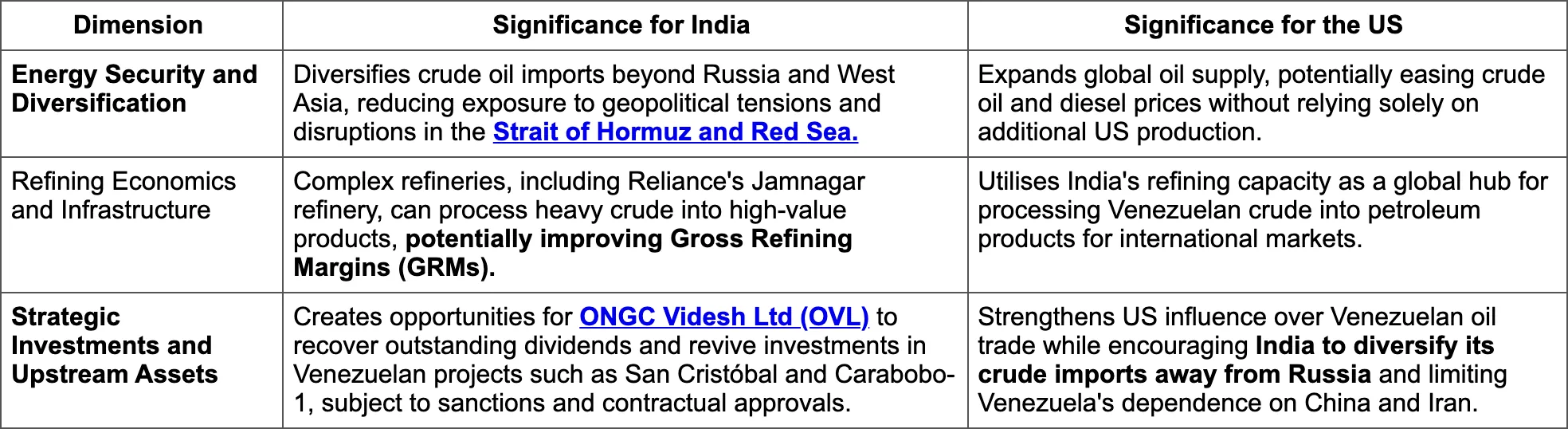
- Energy Security & Refining Partnership: The US urged India to leverage its high-complexity refining infrastructure (specifically visiting Reliance Industries’ Jamnagar refinery) to process heavy Venezuelan crude and expand imports of US petroleum products.
- Sanctions Waivers on Russian Oil: Recognizing global energy vulnerabilities, the US suspended certain sanctions against major buyers of Russian oil, including India, to facilitate market stability and ease supply pressures.
- Progress Toward a Bilateral Trade Deal: Both sides signaled that negotiations on a comprehensive trade agreement are in their final stages.
- Convergence on Emerging Technologies & AI: Both nations reaffirmed cooperation on Artificial Intelligence (“Superintelligence”), agreeing on a shared framework to harness advanced AI for human development while mitigating systemic security risks.
- Defence & Indo-Pacific Reaffirmation: Washington pushed for deeper defence procurement ties and reiterated that the 21st-century global order will be defined by peace, stability, and deterrence in the Indo-Pacific region.
-
Significance of Venezuelan Oil
- Venezuela possesses the world’s largest proven crude oil reserves (concentrated in the Orinoco Heavy Oil Belt). However, its primary export blend (Merey) is extra-heavy (low API gravity) and sour (high sulphur), requiring specialized, capital-intensive refinery equipment (such as delayed cokers) to process.
- The India–US relationship has evolved from post-Cold War estrangement into a “Comprehensive Global Strategic Partnership.” Rather than a rigid, treaty-bound military alliance, it operates as a convergent alignment of democracies driven by shared geopolitical realities, economic complementarity, and technological synergy.
- Foundational Defence Frameworks: Operationalized through the four foundational agreements LEMOA, COMCASA, BECA, and GSOMIA alongside co-production initiatives like the INDUS-X defence innovation bridge and GE F414 jet engine manufacturing.
- Critical and Emerging Technologies: Cooperation is advanced through the US–India TRUST initiative (2025), which succeeded iCET (Initiative on Critical and Emerging Technology) and covers AI, semiconductors, quantum technologies, critical minerals, biotechnology, energy and space (NISAR, Artemis Accords) .
- Minilateral Plurilateralism: Institutionalized through the Quad (India, US, Japan, Australia) in the Indo-Pacific and I2U2 .
- Significance of the Alignment
- Multipolar Indo-Pacific & Rule-Based Order: Acts as the primary structural counterbalance to unilateral assertiveness and maritime coercion in the Indo-Pacific, ensuring freedom of navigation along critical Sea Lines of Communication (SLOCs).
- Supply Chain Decoupling & Resilience: Positions India as a trusted “China-Plus-One” manufacturing and technology hub under initiatives like the Mineral Security Partnership (MSP) and Indo-Pacific Economic Framework (IPEF).
- Net Security Provider: Enhances India’s Intelligence, Surveillance, and Reconnaissance (ISR) capabilities along its continental borders and across the Indian Ocean Region (IOR).
- Global South Bridge: Enables Washington to engage constructively with the Global South through New Delhi’s diplomatic credibility, while helping India pitch for reformed multilateralism.
- Trade Protectionism & Tariff Frictions: Recurring disputes over punitive tariffs, market access in agriculture and dairy, digital trade taxes, and US “America First” reciprocal tariff threats continue to delay a comprehensive Bilateral Trade Agreement.
- Skilled Mobility & Immigration Curbs: Steep hikes in H-1B visa fees and recent restrictions on key green-card processing programmes directly hurt major Indian IT service providers (such as TCS and Wipro) and constrain people-to-people economic integration.
- Strategic Autonomy vs. Sanctions Regimes: Friction persists over India’s defence and energy ties with Russia and Iran (e.g., Chabahar port, S-400 systems, and proposed US secondary sanctions bills on Russian energy buyers).
- Divergence on Neighbourhood Geopolitics: Periodic US diplomatic postures regarding Pakistan (including Washington’s claims regarding mediation during the May 2025 India-Pakistan military clashes) clashes with India’s red lines on cross-border terrorism.
- Regulatory & Technology Transfer Bottlenecks: Strict US export control regimes (International Traffic in Arms Regulations (ITAR) and Export Administration Regulations (EAR)) often slow down the actual transfer of proprietary military and dual-use technologies despite high-level political clearances.
- Commercial Hurdles in US and Venezuelan Crude: High trans-oceanic freight rates caused US crude shipments to India to nearly halve in 2026, while scaling up Venezuelan crude requires navigating lingering US sanctions provisions, payment channels, and degraded Venezuelan upstream infrastructure
- Institutionalizing “Sanctions-Proof” Energy Corridors: Establish long-term sovereign waivers and transparent payment-settlement mechanisms so Indian refiners and PSUs can invest in and process Venezuelan crude without facing sudden snapback sanctions.
- Early Harvest Trade Architecture: Utilize the current 60-day tariff review window to finalize a mutually beneficial “Early Harvest” trade deal that locks in predictable tariff rates, resolves non-tariff barriers, and protects service-sector mobility.
- Carve-Outs for Tech & Talent Mobility: Create a dedicated trusted-partner visa and green-card track under the iCET framework for STEM professionals to insulate technological collaboration from domestic immigration politics.
- Accelerating Co-Production over Buyer-Seller Models: Fast-track defence industrial roadmaps by streamlining US Congressional notifications and export licensing for jet engines, unmanned systems, and seabed sensors.
- Expanding Trilateral & Minilateral Synergy: Scale up the India–US–UAE trilateral framework to operationalize the IMEC corridor, linking West Asian capital, Indian refining and digital infrastructure, and U.S. technological leadership.
- In a rapidly changing world order, expanding strategic convergence should anchor India–US relations. By combining energy security, technological cooperation and Indo-Pacific alignment, both countries can overcome short-term trade and visa disputes and build a durable, mutually beneficial strategic partnership.
Nation & States
LAHDC (Amendment) Regulation, 2026
Source The President of India promulgated the Ladakh Autonomous Hill Development Councils (LAHDC) (Amendment) Regulation, 2026, extending Hill Councils to all eight districts of Ladakh. Subsequently, 100 elected constituencies were notified across the eight councils.- Meanwhile, the Centre’s proposed framework for a UT-level elected body has sparked debate over the Lieutenant Governor’s (L-G) authority and Ladakh’s demand for greater autonomy.
- Councils for All Eight Districts: Hill Councils will be constituted in Leh, Kargil, and the newly created districts: Sankoo, Changthang, Nubra, Sham, Zanskar, and Drass.
- Rationalization of Seats: The previous fixed structure of 26 seats per council has been amended. Now, constituencies will range from a minimum of 7 to a maximum of 24, depending on the district’s demographic and geographic realities.
- Inclusive Representation: The regulation permits the nomination of up to four members from women and unrepresented communities, subject to a ceiling linked to one-sixth of the elected seats.
- Administrative Parity with Panchayats: The councils are granted powers equivalent to district-level panchayats under the Jammu and Kashmir Panchayati Raj Act, 1989.
- Election Authority: The State Election Commission for the UT of Ladakh will have superintendence, direction, and control over these council elections.
- The L-G Veto: The Ministry of Home Affairs (MHA) draft explicitly states that any law or regulation passed by the proposed UT-level elected body will only take effect after receiving assent from the Lieutenant Governor.
- Constitutional Framework: The proposal envisages a constitutional arrangement under Article 371, alongside regulations under Article 240, which empowers the President to make regulations for the peace, progress and good government of specified Union Territories, including Ladakh.
- Unresolved Institutional Questions: The draft seeks input from civil society on critical issues: whether delimitation should be population-based or area-based, if women’s reservation should be 33% or 50%, and whether the UT body members should be elected directly or indirectly through the LAHDCs.
- Concerns:
- Activists argue that subjecting every law of the newly proposed UT body to an L-G veto reduces the elected representatives to an advisory role, falling far short of the substantive legislative autonomy guaranteed under the Sixth Schedule.
- The sweeping changes do not address the foundational demands of the Ladakhi people: full Statehood, Sixth Schedule status, a dedicated Public Service Commission (PSC), and separate Lok Sabha seats for Leh and Kargil.
Security
India Calls for Stronger Safeguards Against WMD Proliferation
Source Recently, India called for stronger safeguards against Weapons of Mass Destruction (WMD) proliferation and terrorist access to sensitive technologies during the discussion on “Other Weapons of Mass Destruction” at the United Nations General Assembly’s First Committee.- India’s Position: India reaffirmed its commitment to the full, effective and non-discriminatory implementation of the Chemical Weapons Convention (CWC) and Biological Weapons Convention (BWC), emphasising stronger international cooperation to address emerging WMD threats.
- Emerging Technologies: Scientific and technological advancements pose proliferation risks through the potential misuse of dual-use technologies, which have both civilian and military applications.
- India-Sponsored UN Resolution: Since 2002, India has introduced the UNGA resolution “Measures to prevent terrorists from acquiring weapons of mass destruction”, advocating stronger national and international measures to prevent terrorist access to WMDs and their delivery systems.
- India’s Domestic Safeguards: India has established legal and export-control mechanisms against WMD proliferation, including the Weapons of Mass Destruction and their Delivery Systems (Prohibition of Unlawful Activities) Act, 2005, and controls on sensitive dual-use materials and technologies.
- Chemical Weapons Convention (CWC): Entered into force in April 1997, it aims to eliminate chemical weapons and prohibits their development, production, acquisition, stockpiling, retention, transfer and use. India is a State Party, having ratified it in 1996.
- Biological Weapons Convention (BWC): Entered into force in March 1975, it prohibits the development, production, acquisition, stockpiling, retention and transfer of biological and toxin weapons, with the objective of excluding their use as weapons. India is a State Party, having ratified it in 1974.
- UNSC Resolution 1540 (2004): Adopted under Chapter VII of the UN Charter, it requires states to establish effective laws and domestic controls to prevent non-state actors from acquiring nuclear, chemical and biological weapons and their delivery systems.
- UN General Assembly First Committee: Also known as the Disarmament and International Security Committee, it addresses disarmament, international security and related global threats.
- Significance: Stronger safeguards and international cooperation can reduce WMD proliferation risks, prevent terrorist access to dangerous technologies and strengthen the global disarmament and non-proliferation framework.
Badr Defence Cooperation Pact Signed in Doha
Source Recently, Qatar, Turkiye, Pakistan and Indonesia signed the Badr Memorandum of Understanding (MoU) in Doha, Qatar, amid growing regional security concerns. Other friendly countries may join the MoU, subject to criteria agreed upon by the four signatories.- About: A four-nation defence cooperation initiative aimed at strengthening technological self-reliance and integrating complementary industrial capabilities. Badr, meaning “full moon” in Arabic, symbolises the complementary strengths of the participating nations.
- Major Objectives:
- Promote joint defence production, technology transfer, research and development (R&D) and technical military training.
- Strengthen domestic defence manufacturing capabilities by leveraging the resources and expertise of participating countries.
- Facilitate cooperation to meet the defence requirements of participating countries and friendly nations.
- Complementary Capabilities:
- Turkiye: Advanced defence technology, systems integration and manufacturing expertise.
- Pakistan and Indonesia: Manufacturing infrastructure, skilled workforce and domestic defence markets.
- Qatar: Investment capacity and financial support for defence industrial projects.
- Existing Defence Partnerships:
- Turkiye–Pakistan: Cooperation in the construction of MILGEM naval warships, with production facilities in Istanbul and Karachi.
- Turkiye–Indonesia: Joint development and production of military tanks.
- Turkiye–Qatar: Existing defence industry cooperation and Turkish military presence in Qatar.
- Distinction from Makkah Joint Defence Agreement: Unlike the Makkah Joint Defence Agreement (August 2026) involving Pakistan, Saudi Arabia and Turkiye, which provides for mutual defence commitments, the Badr MoU does not establish a collective defence obligation.
- Significance: Amid heightened West Asian security tensions, the MoU could facilitate integrated defence supply chains, reduce dependence on external suppliers and diversify regional security partnerships across the Gulf, South Asia and Southeast Asia.