Comrades Dispatch · 23 Oct 2026 (PDF)
In this edition
- Bharat Pavilion Showcases Indian Water Technologies at WETEX 2026 Infrastructure & Energy
- Fair International Law: Navigating the Authoritarian Challenge International Relations
- Singapore-India Maritime Bilateral Exercise (SIMBEX) 2026 Military Exercises
- India’s Accession to Southern Indian Ocean Fisheries Agreement MOU’s & Agreements
- India’s Highest High Court Bench Inaugurated in Leh Polity & Governance
- Pradhan Mantri Samajik Sahayata Yojana Schemes & Initiatives
- IISER Develops Solid Material for Hydrogen and Methane Production Science & Technology
Infrastructure & Energy
Bharat Pavilion Showcases Indian Water Technologies at WETEX 2026
Source Recently, Indian companies showcased indigenous water treatment, environmental and sustainability technologies at the Water, Energy, Technology and Environment Exhibition (WETEX) 2026, held at the Dubai World Trade Centre, UAE.- About WETEX: The 28th edition of a major international exhibition organised by the Dubai Electricity and Water Authority (DEWA), focusing on water, energy, technology and environmental sustainability.
- Bharat Pavilion: Organised by the Services Export Promotion Council (SEPC) under the Ministry of Commerce and Industry, Government of India, to promote Indian services exports and strengthen international business partnerships.
- Technologies Showcased:
- Water Management: Water treatment plants, sewage treatment systems, membranes, pumps and filtration technologies.
- Advanced Technologies: Underwater robots, artificial intelligence (AI)-powered facility intelligence systems and indigenous water quality monitoring solutions.
- Environmental Solutions: Bioculture, odour control, automation and sustainable industrial processes.
- Export Promotion Mission: Supported eligible Indian exhibitors with assistance towards exhibition participation costs, facilitating their entry into international markets.
- Business Opportunities: Enabled Indian companies to explore distribution agreements, joint ventures, technology partnerships and project collaborations with global industry participants.
- Significance: Highlights India’s growing capabilities in Make in India water technologies, promotes services exports, and strengthens India–UAE economic cooperation in sustainable infrastructure and environmental solutions.
International Relations
Fair International Law: Navigating the Authoritarian Challenge
Source Why in News?- The awarding of the 2026 Nobel Peace Prize to South African jurist Navi Pillay (former UN High Commissioner for Human Rights) has arrived at a critical geopolitical juncture. Amidst the ongoing wars in Ukraine and West Asia, and the brazen violation of the United Nations Charter, international law is facing an existential crisis.
- However, the Nobel Committee’s recognition serves as a definitive global endorsement that a fair, rights-based international legal order remains indispensable in countering the aggressive rise of “Authoritarian International Law.”
- Definition: International law is the body of legal rules, norms, and standards that apply between sovereign states and other entities legally recognized as international actors.
- Core Objective: It seeks to maintain international peace and security, primarily codified by Article 2(4) of the UN Charter, which explicitly prohibits the threat or use of force against the territorial integrity or political independence of any state.
- Sources of Law: As per Article 38 of the International Court of Justice (ICJ) Statute, International Law is derived from international conventions (treaties), international custom (state practice), general principles of law, and judicial decisions.
- The Subject of Law: The post-WW II liberal order fundamentally shifted international law to make the individual a subject of law, institutionalizing civil, political, and human rights.
- Current Status
- A “Discipline of Crisis”: As described by ICJ, international law is currently operating in a crisis mode, battered by imperialistic designs and a precipitous decline in human rights compliance.
- The “Silent Efficacy”:
- While the breaches of the UN Charter regarding the “use of force” dominate media headlines, the vast majority of international law operates silently, seamlessly, and with near-universal compliance every single day. This “functional” international law sustains global interdependence across multiple domains:
- Global Connectivity: The International Civil Aviation Organization (ICAO) and the International Telecommunication Union (ITU) quietly coordinate thousands of daily cross-border flights and global internet/GPS spectrums without dispute.
- Maritime & Global Commons: UNCLOS peacefully regulates 90% of global shipping trade, complemented by the recent High Seas Treaty (BBNJ) and the Outer Space Treaty, which helps prevent the militarisation of space.
- Ecological Triumphs: The Montreal Protocol stands as a historic success, actively healing the ozone layer through universally enforced phase-outs.
- Routine Transnational Governance: Agencies like WIPO (patents/IP), Universal Postal Union (cross-border postal delivery), and the WHO’s International Health Regulations manage daily global cooperation, even among bitter diplomatic rivals.
- While the breaches of the UN Charter regarding the “use of force” dominate media headlines, the vast majority of international law operates silently, seamlessly, and with near-universal compliance every single day. This “functional” international law sustains global interdependence across multiple domains:
- Weaponizing State Sovereignty:
- While developing nations historically invoked sovereignty to resist colonialism, regimes now use it as an absolute shield against international scrutiny.
- China routinely dismisses UN OHCHR reports regarding human rights in Xinjiang as “illegal interference in internal affairs.”
- Similarly, Israel systematically rejects resolutions and reports by UN Human Rights bodies regarding Gaza and the West Bank on the grounds of sovereign interference.
- The US has withdrawn from international frameworks such as the Paris Agreement and UNESCO, illustrating how major powers can disengage from multilateral institutions when they conflict with domestic priorities.
- Creating Pliant, Weak International Organizations (IOs):
- Instead of joining IOs with independent regulatory or supranational authority (like the EU or early UN), authoritarian states prefer establishing forums where member-states retain absolute control and the IO cannot enforce accountability.
- The US-backed Board of Peace for Gaza has raised concerns about creating alternative global mechanisms outside established UN structures. This, alongside the US veto of a Gaza ceasefire resolution in June 2025, highlights concerns about the selective use of multilateral institutions.
- The Shanghai Cooperation Organisation (SCO), prioritizes regime security and “non-interference” over human rights or democratic accountability, possessing no independent judicial body to hold its member states accountable.
- Rejecting third-party adjudication:
- There is a growing global backlash against independent international courts, with powerful states increasingly preferring opaque bilateral negotiations where they can exploit their military and economic advantages.
- For instance, China rejected the 2016 Permanent Court of Arbitration (PCA) ruling in favour of the Philippines in the South China Sea dispute.
- Similarly, the US has historically opposed the International Criminal Court (ICC) and imposed economic sanctions in 2025 targeting ICC officials over investigations into alleged war crimes, undermining the independence of international judicial institutions.
- Securitization of Economic Law (Protectionism):
- Major hegemonic powers are dismantling the neoliberal economic consensus, violating free-trade norms under the guise of “national security.”
- For instance, the US blocking of appointments to the WTO’s Appellate Body, effectively paralyzing global trade dispute resolution.
- Additionally, the US Inflation Reduction Act (IRA) and CHIPS Act, which offer massive domestic industrial subsidies that arguably violate WTO non-discrimination principles, are justified as national security imperatives against China.
- “Rules-Based Order”:
- Democratic powers have contributed to this retooling by replacing the binding term “International Law” (which requires strict treaty compliance) with the politically ambiguous phrase “Rules-Based Order.”
- Western nations frequently invoke the “rules-based order” to condemn Russia’s invasion of Ukraine or China’s maritime incursions, but bypass the UN Security Council for their own military interventions (e.g., the 2003 Iraq War or NATO’s intervention in Libya/Kosovo).
- This allows powerful nations to selectively apply rules to adversaries while exempting themselves.
- Global
- Erosion of Jus Cogens Norms: Peremptory norms like the prohibition of genocide, territorial conquest, and war crimes are being systematically undermined, creating a dangerous precedent for future state conduct.
- Credibility Deficit: The selective application of international law where the Global North demands compliance from adversaries but shields its allies is eroding the legitimacy of multilateral institutions across the Global South.
- Return of “Spheres of Influence”: A shift away from universal law invites a fragmented world order governed by neo-imperialism and raw military might.
- India
- The Maritime Security Dilemma:
- India heavily relies on a universally respected UNCLOS to maintain a free and open Indo-Pacific and counter Chinese expansionism.
- The weakening of international law directly threatens India’s maritime security.
- Trade and Economic Vulnerability:
- As a rapidly growing developing economy, India requires a functional, rules-based multilateral trading system.
- The paralysis of the WTO Dispute Settlement Mechanism leaves India vulnerable to unilateral protectionist tariffs from major powers.
- Strategic Balancing: India faces the complex task of navigating between a hypocritical Western “rules-based order” and the Sino-Russian authoritarian retooling, requiring New Delhi to champion strict adherence to the UN Charter while protecting its strategic autonomy.
- Commitment to Multilateralism: India has consistently advocated reforms in global institutions while upholding the existing international order, demonstrated through its contributions to UN peacekeeping, participation in international judicial bodies and acceptance of negotiated legal settlements.
- The Maritime Security Dilemma:
- Coined by legal scholars like Tom Ginsburg, Authoritarian International Law refers to a framework where international legal norms are reinterpreted to prioritize regime survival, executive power, and state sovereignty over individual rights and democratic accountability.
- Contrast with Liberal Order:
- The traditional liberal international law (established post-1945) views the individual as a subject of international law, emphasizing human dignity, fairness, and accountability.
- Authoritarian international law, conversely, seeks to shield governments from external scrutiny.
- Core Philosophy: It views international law purely as a tool for coordinating regime survival, rejecting the idea that international law should protect civil liberties or hold executive power accountable.
- The Enforcement Deficit: Unlike domestic law, international law lacks a global police force. Courts like the ICJ rely on the UN Security Council (UNSC) for enforcement, which is frequently paralyzed by the veto power of the P5 nations.
- Populist Nationalism: Ethno-nationalist regimes globally frame international law as “foreign interference,” attacking international institutions to appease domestic political constituencies.
- Outdated Global Architecture:
- The Bretton Woods and UN systems reflect the geopolitical realities of 1945.
- The continued marginalization of Africa, Latin America, and India in global decision-making reduces the universal legitimacy of international law.
- Normative Interaction vs. Immediate Compliance:
- A major conceptual challenge is judging international law solely by immediate compliance.
- Scholars like Harold Hongju Koh argue that its true efficacy lies in Transnational Legal Processes (the gradual internalization of global norms by domestic systems) which is currently being stunted by nationalist pushback.
- Address the Enforcement Deficit (UNSC Reform):
- Adopt the French-Mexican initiative demanding the P5 nations voluntarily suspend their veto power in cases of genocide, mass atrocities, and jus cogens violations.
- Urgent structural reform of the UN Security Council is required, including the expansion of permanent membership (incorporating the G4).
- When the UNSC is paralyzed, it aggressively invoke Resolution 377 (Uniting for Peace) in the UN General Assembly to recommend collective international action.
- Reclaim the Legal Vocabulary: Middle powers (like India and Brazil) must reject the Western-coined, hypocritical “Rules-Based Order” and demand a return to strict, universally applied “Binding International Law” based on the UN Charter.
- Bypass Sabotaged Courts:
- Expand the Multi-Party Interim Appeal Arbitration Arrangement (MPIA) to ensure trade disputes are resolved legally despite the US blockade of the WTO Appellate Body.
- Pass UNGA resolutions forbidding unilateral sanctions or political intimidation against ICC and ICJ judges.
- Localize Enforcement via ‘Universal Jurisdiction’: Empower domestic courts to prosecute severe international crimes (crimes against humanity) regardless of where they occurred, similar to Germany’s prosecution of Syrian war criminals, ensuring accountability when global bodies are blocked.
- Codify Laws for ‘Grey Zone’ Domains:
- Draft binding multilateral treaties for emerging domains to prevent “might makes right” tactics.
- This includes codifying cyber warfare limits (building on the Tallinn Manual) and updating the 1967 Outer Space Treaty to ban anti-satellite (ASAT) weapons.
- Reform the Global Financial Architecture: Implement immediate quota reforms in the IMF and World Bank to give the Global South equitable voting rights, preventing the unilateral weaponization of global financial systems (like SWIFT) for economic coercion.
- Leverage Middle-Power Diplomacy (The G20 Model): India’s successful G20 Presidency (G20 Leaders’ New Delhi Declaration) proved that middle powers can bridge the divide between a fractured West and the Sino-Russian bloc, offering a template for consensus-building in polarized times.
- As a champion of strategic autonomy and the voice of the Global South, India is uniquely positioned to act as a ‘Vishwa Mitra’ (Global Friend). By pushing for reformed multilateralism, New Delhi can help build an international legal order that is equitable, universally binding, and free from both Western hypocrisy and authoritarian manipulation.
Military Exercises
Singapore-India Maritime Bilateral Exercise (SIMBEX) 2026
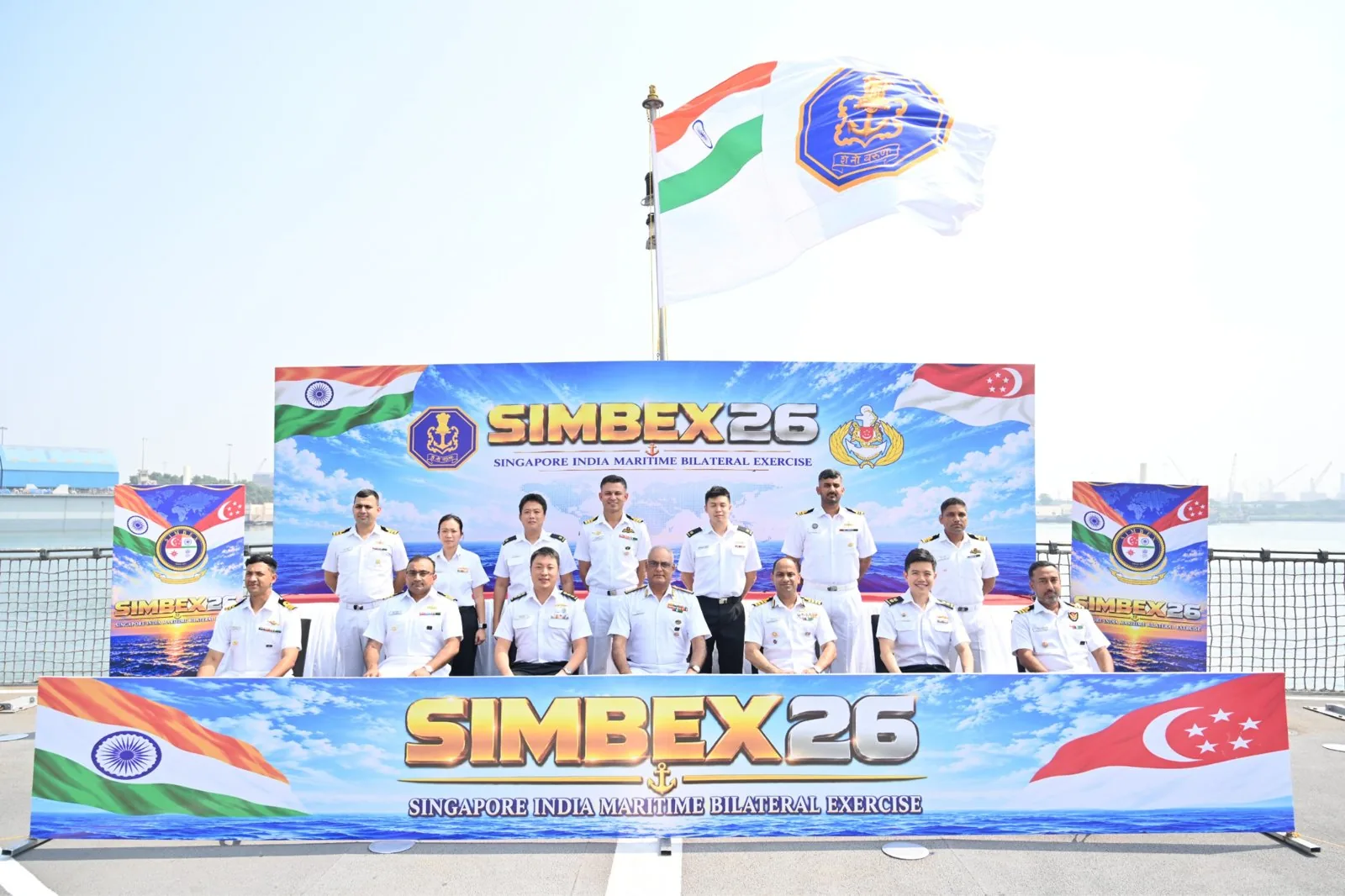
Source Recently, the 33rd edition of the Singapore-India Maritime Bilateral Exercise (SIMBEX-2026) commenced at Visakhapatnam, Andhra Pradesh, with the participation of the Republic of Singapore Navy (RSN) ship RSS Supreme.- Origin: Initiated in 1994 as Exercise Lion King, SIMBEX is one of the Indian Navy’s longest-running bilateral maritime exercises, conducted annually without interruption, including during the COVID-19 pandemic through modified formats.
- Objective: The exercise aims to enhance operational interoperability, professional cooperation and mutual understanding between the two navies.
- Harbour Phase: Involves professional interactions, Subject Matter Expert Exchanges (SMEEs), cross-deck visits, sporting engagements and planning conferences.
- Sea Phase: Conducted in the Bay of Bengal, featuring anti-submarine warfare (ASW), anti-surface and anti-air warfare drills, seamanship evolutions and tactical manoeuvres.
- Significance: SIMBEX strengthens India-Singapore defence cooperation, operational interoperability and mutual understanding, while supporting efforts to address common maritime security challenges and promote peace and stability in the Indo-Pacific region.
MOU’s & Agreements
India’s Accession to Southern Indian Ocean Fisheries Agreement
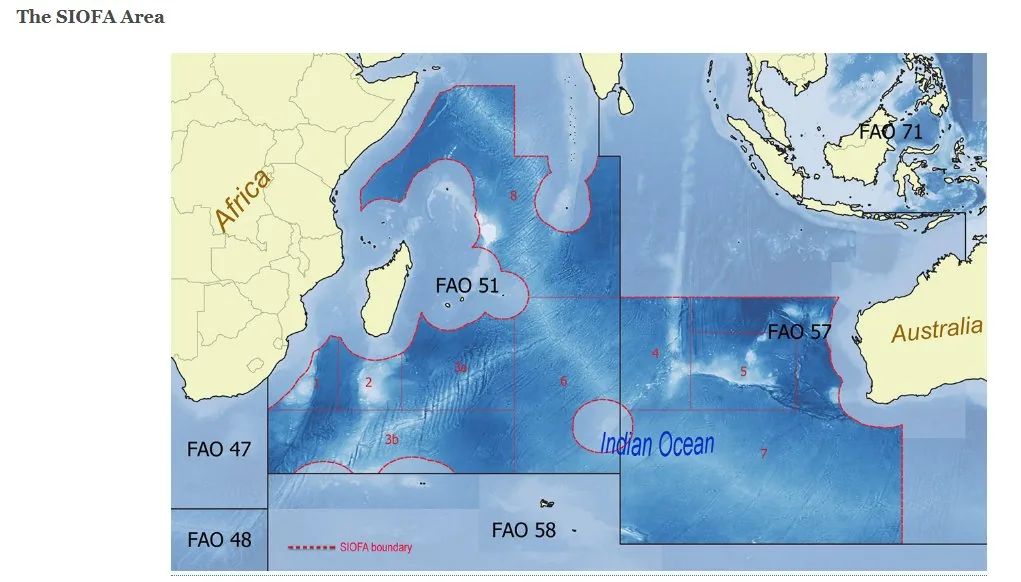
Source Why in News?- The Central Government approved India’s accession to the Southern Indian Ocean Fisheries Agreement (SIOFA). This decision elevates India’s status from a Cooperating Non-Contracting Party (CNCP) to a full Contracting Party, marking a strategic milestone in India’s role in global fisheries governance.
- About: SIOFA is a multilateral regional fisheries agreement and Regional Fisheries Management Organisation (RFMO) aimed at ensuring the long-term conservation and sustainable use of fishery resources in the high seas of the Southern Indian Ocean.
- Origin & Enforcement:
- The agreement was adopted in July 2006 at the Food and Agriculture Organization (FAO) headquarters in Rome and entered into force in June 2012 and became fully operational in 2016.
- It was established following the abolition of the Indian Ocean Fisheries Commission (IOFC) in 1999. SIOFA headquarters is located in Le Port, Reunion Island.
- Core Mandate: Its primary objective is to manage fishery resources on the high seas through multilateral cooperation, specifically taking into account the developmental needs of developing States and Small-Island Developing States (SIDS) bordering the area.
- Species Coverage: SIOFA actively manages and assesses resources including fish, molluscs, crustaceans, and other sedentary species.
- Key Exclusions: The agreement strictly excludes highly migratory species (which are listed in Annex I of UNCLOS, such as tuna) and sedentary species subject to the fishery jurisdiction of coastal states (as defined under Article 77(4) of the 1982 UNCLOS).
- Conservation & Management Measures: In 2016, SIOFA established robust regulatory measures, including Vessel Monitoring Systems (VMS) requirements, regulations on bottom fishing to protect Vulnerable Marine Ecosystems (VMEs), and a stringent listing system to combat Illegal, Unreported, and Unregulated (IUU) fishing.
 Key Implications of India’s Accession
- Enhanced Decision-Making Power: India has held Cooperating Non-Contracting Party (CNCP) status since 2022, which limited its role in decision-making. Accession grants India a full seat on the Scientific Committee and the Compliance Committee, providing direct access to scientific data, research programs, and stock assessments.
- Expansion of the High-Seas Fleet:
- Currently, Indian fishing vessels operate largely within 60 to 80 nautical miles of its Exclusive Economic Zone (EEZ).
- Full membership allows Indian-flagged vessels and enterprises to undertake authorized commercial fishing in the vast SIOFA jurisdiction.
- Security and Compliance:
- It enables India to actively participate in the High Seas Boarding and Inspection (HSBI) Scheme adopted under SIOFA.
- This strengthens national coastal security and helps prevent Illegal, Unreported, and Unregulated (IUU) fishing.
- Alignment with National Policy: The accession operationalizes the Guidelines for High Sea Fisheries issued by the Indian government in December 2025, which provided the policy framework to expand deep-sea fishing operations and boost the Blue Economy.
- Geopolitical Counterbalance: The High Seas constitute roughly 65% of the global ocean and are currently dominated by fleets from China (21%), Taiwan, Japan, South Korea, and Spain. India’s accession secures its legitimate rights and establishes a recognized presence to counterbalance foreign dominance in the Southern Indian Ocean.
Note: SIOFA is one of two major Regional Fisheries Management Organisations (RFMOs) in the Indian Ocean. The other is the Indian Ocean Tuna Commission (IOTC). SIOFA differs from IOTC in its mandate, as SIOFA manages non-highly migratory fish stocks in the Southern Indian Ocean, while IOTC regulates highly migratory tuna and tuna-like species across the Indian Ocean. India has been a Contracting Party to IOTC since 1996.
Polity & Governance
India’s Highest High Court Bench Inaugurated in Leh
Source Chief Justice of India (CJI) inaugurated the permanent Ladakh Bench of the Jammu and Kashmir and Ladakh High Court in Leh, at an altitude of approximately 3,500 metres, making it India’s highest-altitude High Court bench.- Establishment: The bench was established under the Union Territory of Ladakh (Sitting of Bench of the High Court of Jammu and Kashmir, and Ladakh in Ladakh) Regulation, 2026, promulgated by the President under Article 240 of the Constitution and Section 58(2) of the Jammu and Kashmir Reorganisation Act, 2019.
- Jurisdiction:
- It functions as a permanent bench of the Jammu and Kashmir and Ladakh High Court, providing judicial access to litigants in the Union Territory of Ladakh.
- Under the Jammu and Kashmir Reorganisation Act, 2019, the erstwhile Jammu and Kashmir High Court became the common High Court for the two Union Territories.
- Digital Access: The inaugural proceedings adopted a hybrid hearing model, while the Supreme Court plans to facilitate video conferencing for Ladakh-related cases, reducing travel requirements for litigants and lawyers.
- Significance: Strengthens access to justice, judicial decentralisation and affordable legal services in the geographically remote Himalayan region, while encouraging greater participation of Ladakh’s youth in the legal profession.
Schemes & Initiatives
Pradhan Mantri Samajik Sahayata Yojana
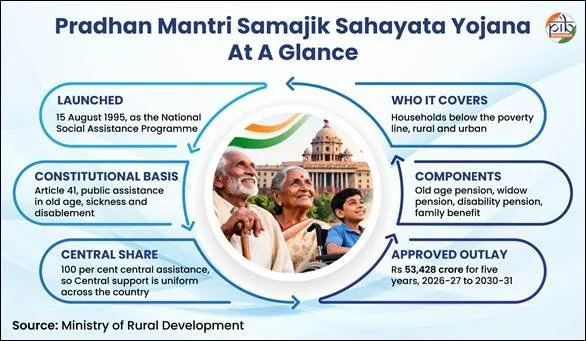
Source Why in News?- Recently, the Union Cabinet approved the continuation and renaming of the National Social Assistance Programme (NSAP) as the Pradhan Mantri Samajik Sahayata Yojana, along with revisions to the disability pension.
- About: Originally launched as the National Social Assistance Programme (NSAP) on 15th August 1995, it provides financial assistance to Below Poverty Line (BPL) households facing old age, widowhood, disability or the death of a primary breadwinner.
- Constitutional Basis: Gives effect to Article 41 under the Directive Principles of State Policy (DPSP), which directs the State to provide public assistance in cases of unemployment, old age, sickness and disablement, within its economic capacity.
- Nodal Ministry and Funding: Implemented under the Ministry of Rural Development as a 100% centrally funded Centrally Sponsored Scheme, providing minimum financial assistance to eligible beneficiaries in rural and urban areas.
- Implementation: Implemented by States and Union Territories, with Gram Panchayats and municipalities assisting in beneficiary identification and payments largely facilitated through Direct Benefit Transfer (DBT).
- Financial Outlay: Approved allocation of ₹53,428 crore for five years (2026–2031), covering approximately 3.20 crore beneficiaries across all 36 States and UTs.
- State Supplementation: States and UTs provide additional pension assistance above the Central contribution, with top-ups ranging from ₹50 to ₹5,700 per month (September 2026), resulting in average monthly pensions of around ₹1,100 in several States/UTs.
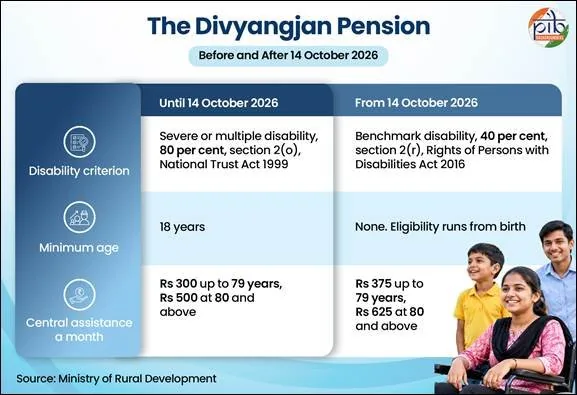
- Continuity: The old-age pension, widow pension and family benefit schemes continue unchanged, while the disability pension has been revised in terms of eligibility, coverage and assistance rates.
-
Revised Components
-
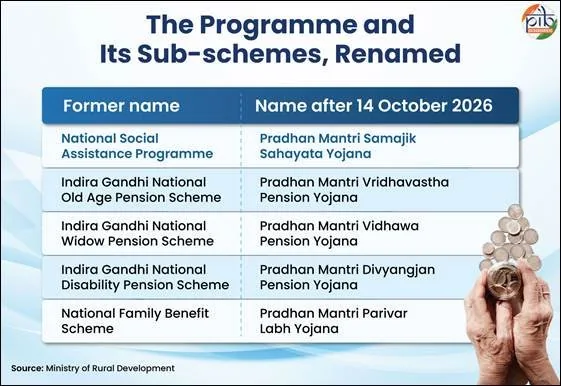
The programme comprises three monthly pension schemes and one lump-sum family benefit scheme, all renamed under the revised framework:
-
The programme comprises three monthly pension schemes and one lump-sum family benefit scheme, all renamed under the revised framework:
-
Significance
- Inclusive Social Protection: Extends financial assistance to persons with 40–79% disabilities, reducing exclusion under the earlier 80% eligibility threshold.
- Childhood Disability Support: Removal of the minimum age requirement enables early financial assistance to eligible children with disabilities from BPL households.
- Financial Security: Enhanced pension rates strengthen basic income support for economically vulnerable persons with disabilities.
- Cooperative Federalism: Central assistance supplemented by State and UT contributions enables locally responsive social protection, while maintaining a common national minimum.
- Background: Introduced in February 2009 as the Indira Gandhi National Disability Pension Scheme, it originally provided pensions to Below Poverty Line (BPL) persons aged 18 years and above with at least 80% disability.
- Legal Basis:
- The revisions align the scheme with the Rights of Persons with Disabilities Act, 2016, enacted to give effect to the UN Convention on the Rights of Persons with Disabilities (UNCRPD).
- Section 2(r) of the Act defines a person with a benchmark disability as someone with at least 40% of a specified disability, as certified by the competent authority.
- Revised Eligibility: The minimum disability requirement has been reduced from 80% to 40%, while the minimum age of 18 years has been removed, extending eligibility from birth.
- Enhanced Pension:
- Monthly Central assistance has been increased by 25%:
- Below 80 years: Increased from ₹300 to ₹375 per month.
- 80 years and above: Increased from ₹500 to ₹625 per month.
- Monthly Central assistance has been increased by 25%:
- Expanded Coverage: The number of beneficiaries has been increased from 8.33 lakh to 27.48 lakh.
- Implementation: Revised guidelines covering eligibility, beneficiary numbers and assistance rates are to be issued and implemented within three months of the Cabinet’s approval.
 Conclusion
- The Pradhan Mantri Samajik Sahayata Yojana strengthens India’s social security framework through expanded disability coverage, enhanced financial assistance and continued support for vulnerable households. Aligning disability pensions with the Rights of Persons with Disabilities Act, 2016 represents an important step towards inclusive, rights-based and accessible social protection.
Science & Technology
IISER Develops Solid Material for Hydrogen and Methane Production
Source Researchers at the Indian Institute of Science Education and Research (IISER), Thiruvananthapuram, developed a solid compound that releases hydrogen and methane when heated.- The compound, called magnesium hydridomethylzincate, is made of magnesium, zinc, hydrogen and carbon and remains solid at room temperature.
- Why It Matters: Hydrogen is difficult and costly to store because of its very low density. A solid material could provide an alternative to transporting fuel gases in compressed form.
- Limitation: The material is highly sensitive to moisture, and researchers have not yet shown whether it can be recharged with gases after use.
- About Methane:
- Methane is the simplest hydrocarbon and the first member of the alkane series, consisting of one carbon atom bonded to four hydrogen atoms.
- It is a colourless, odourless, highly flammable gas, lighter than air, and is the main constituent of natural gas.
- It is found in underground natural gas deposits and is produced through the decomposition of organic matter in oxygen-deficient environments.
- It is widely used as a fuel for cooking, heating and electricity generation and as a raw material for producing hydrogen, methanol and other chemicals.
- About Hydrogen:
- Hydrogen is the lightest and most abundant chemical element in the universe.
- It is a colourless, odourless, tasteless and highly flammable gas.
- It is found in water (H₂O), organic compounds and stars, but rarely occurs in its free form on Earth.
- It is used in ammonia production, petroleum refining, rocket fuel and hydrogen fuel cells.
- Green Hydrogen is produced by splitting water through electrolysis using renewable energy sources, it offers a low-emission alternative to hydrogen produced from fossil fuels.