Comrades Dispatch · 24 Oct 2026 (PDF)
In this edition
- France Reports 1st Human Case of Shamonda Virus Health & Medicine
- Ukraine Strikes Oil Infrastructure in St. Petersburg Places in News
- UNEP Emissions Gap Report 2026 Reports & Indices
- Green Diwali Campaign 2026 Schemes & Initiatives
- Japan’s MMX Mars Mission Space
- India-Poland Relations Visits & Conferences
- AgriVoltaics World Conference 2026 Visits & Conferences
Health & Medicine
France Reports 1st Human Case of Shamonda Virus
Source France documented the world’s first-ever human fatality caused by the Shamonda virus, a pathogen previously known to infect only livestock, prompting health investigations by the World Health Organization (WHO).- Classification: Shamonda virus is a vector-borne virus belonging to the genus Orthobunyavirus (under the family Peribunyaviridae) and is part of the Simbu serogroup.
- Origin & Spread: First isolated in cattle in Nigeria in 1965, it was historically confined to parts of Africa and Asia before emerging in Europe (including France and Germany) in 2026.
- Primary Hosts: It primarily infects livestock, particularly cattle, sheep, goats and horses, with infections also reported in alpacas.
- Transmission Mechanism:
- The virus spreads via the bites of infected Culicoides midges (small flies).
- There is no evidence of human-to-human transmission, and no direct animal-to-human transmission has been documented. However, vertical transmission (infected mother to offspring) can occur in livestock.
- Impact on Livestock: It causes fever, reduced milk yield, and severe reproductive disorders, including spontaneous abortions, stillbirths, and congenital deformities in newborns.
- Treatment & Prevention:
- Currently, there are no specific vaccines or antiviral treatments available.
- Disease management relies strictly on vector-control measures (eliminating midge breeding sites, insect repellents).
- Public Health Risk: Global health bodies like the WHO state that the threat to the general population remains low. This spillover event is considered a rare anomaly attributed to the victim’s severely immunocompromised state.
Places in News
Ukraine Strikes Oil Infrastructure in St. Petersburg
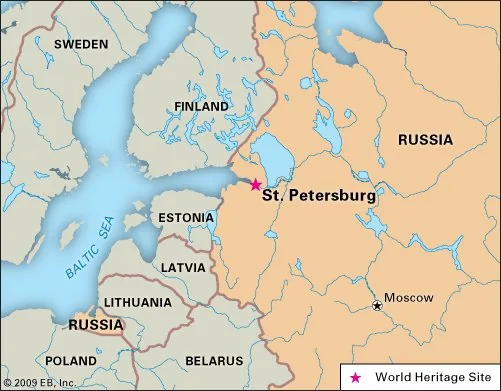
Source Ukraine launched a major long-range drone offensive against Russia, with strikes causing fires at an oil-export terminal and depot in St. Petersburg, Russia.- St. Petersburg:
- St. Petersburg is a major port city in northwestern Russia, situated on the Neva River at the head of the Gulf of Finland, which forms part of the Baltic Sea.
- Founded by Tsar Peter the Great in 1703, it served as the capital of the Russian Empire from 1712 to 1918.
- Formerly known as Petrograd (1914–1924) and Leningrad (1924–1991), it is Russia’s second-largest city and an important cultural, industrial and maritime centre.
- Its strategic location provides access to the Baltic Sea.
- St. Petersburg serves as the northern gateway of the 7,200-km multimodal International North–South Transport Corridor (INSTC), connecting Russia with India’s Mumbai Port through Azerbaijan and Iran.
Reports & Indices
UNEP Emissions Gap Report 2026
Source Why in News?- The United Nations Environment Programme (UNEP) has released the 17th edition of its flagship Emissions Gap Report (EGR) 2026, titled “The Point of Return: Urgent emissions cuts needed to come back from overshoot of 1.5°C”.
- The report notes that the opportunity to limit global warming to 1.5°C with “no or limited” overshoot has been lost. The report arrives just before COP31 (31st Conference of the Parties to the UNFCCC) (Antalya, Türkiye, November 2026).
- The End of the “No Overshoot” 1.5°C Pathway:
- Decades of insufficient climate action have made overshooting the 1.5°C warming limit inevitable.
- UNEP’s lowest-overshoot scenario estimates a 66% chance of limiting peak warming to 1.7–1.8°C and a 50% chance of returning to 1.5°C by 2100, provided stringent emission cuts begin immediately.
- Without immediate mitigation, every five years of emissions at current levels would add approximately 200 GtCO₂, increasing peak warming by around 0.1°C.
- The pathway also requires about 320 GtCO₂ of carbon dioxide removal this century, whose large-scale feasibility remains uncertain.
- Emissions Trends and the Widening Gap:
- The gap between conditional NDCs and the lowest 1.5°C overshoot pathway is projected to widen from 5 GtCO₂e in 2030 to 16 GtCO₂e in 2035.
- The apparent narrowing of the 2030 implementation gap largely reflects the USA’s withdrawal from the Paris Agreement, rather than stronger climate action.
- G20 members (excluding the African Union) account for approximately 76% of global GHG emissions, making accelerated action by major emitters critical to closing the emissions gap.
- Under current policies, only six G20 members are likely to meet their unconditional 2030 Nationally Determined Contributions (NDCs) targets.
- Temperature outlook:
- Global warming is projected to reach 2.8°C by 2100 under current policies, falling to 2.6°C if all NDCs are implemented and to 2.1°C if all net-zero pledges are also fulfilled.
- The efforts under the Paris Agreement have reduced projected warming from 4°C to 2.8°C, but this remains above the 1.5°C goal.
- Progress on the First GST outcomes:
- The first Global Stocktake (GST) at COP28 called for tripling renewable energy capacity, doubling energy-efficiency improvement rates by 2030, transitioning away from fossil fuels, reducing methane emissions and halting deforestation.
- Progress is evident, with renewable capacity growing three times faster than projected in 2015 and solar PV seven times faster.
- Global renewable capacity could reach 11,500 GW by 2030, while electric vehicles account for around one in four cars sold worldwide. However, fossil fuel consumption and subsidies continue to rise.
- Deforestation must decline more than ten times faster to meet the 2030 target. Thus, renewable energy expansion alone is insufficient without fossil fuel phase-down and stronger action on non-CO₂ emissions.
- NDCs:
- As of September 2026, 124 Parties covering 76% of global emissions had submitted new NDCs.
- However, their impact on projected warming remains negligible, as emission reduction targets remain insufficient.
- Only India, Tunisia and Uzbekistan retain emissions-intensity targets, and full implementation would reduce 2035 emissions by just 3.5–4 GtCO₂e compared with 2030 NDC levels.
- Required Mitigation Efforts: Limiting the 1.5°C overshoot requires global GHG emission reductions of 18% by 2030, 45% by 2035 and 69% by 2040, relative to 2025 levels, far exceeding existing NDC commitments.
- Low Per Capita Burden:
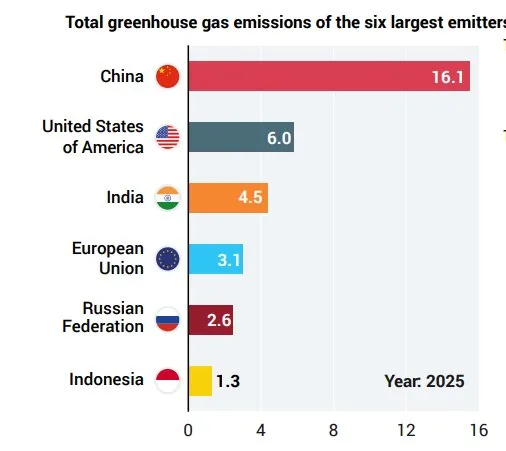
- Despite being the third-largest absolute emitter (~4.5 GtCO₂e) after China and the US.
- India’s per capita emissions (~3.1 tCO₂e) are less than half the world average (6.4 tCO₂e), underscoring the principle of Common But Differentiated Responsibilities (CBDR-RC).
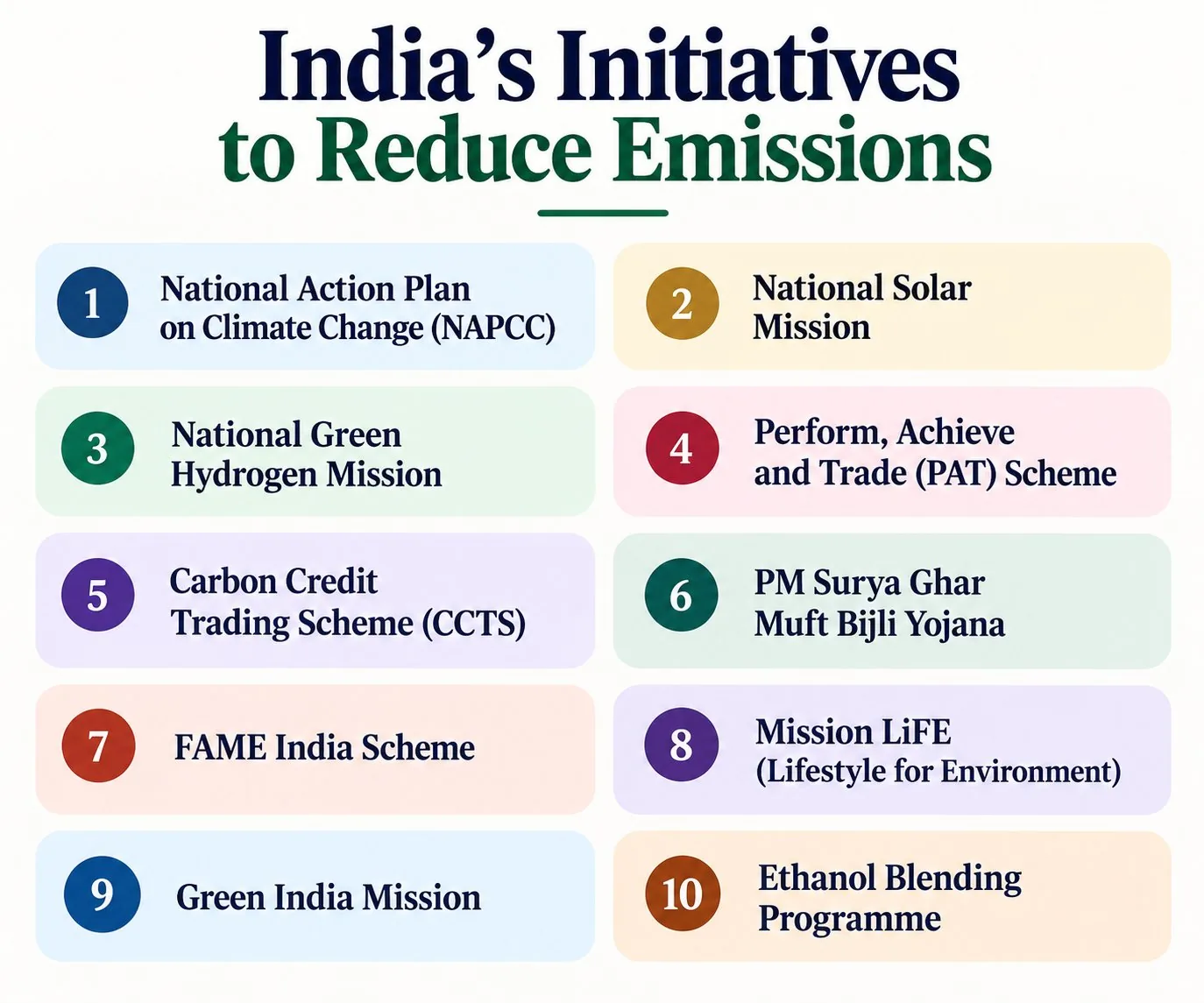
- NDC Compliance: India is one of only six G20 members projected to meet its unconditional 2030 targets under current policies, driven by structural shifts towards renewables and robust domestic policies like the Carbon Credit Trading Scheme (CCTS) and PM Surya Ghar: Muft Bijli Yojana.
- Intensity Targets vs. Absolute Emissions: However, the report notes a caveat, because India uses an intensity target rather than an absolute reduction target, absolute emissions are projected to rise between 2030 and 2035 due to GDP growth.
 United Nations Environment Programme (UNEP)
- About:
- Founded in 1972, the UNEP is the world’s leading authority on environmental protection.
- UNEP unites 193 Member States to tackle the triple planetary crisis: climate change, biodiversity loss, and pollution.
- As the host of the UN Environment Assembly, UNEP facilitates critical international agreements and champions the Sustainable Development Goals (SDGs).
- UNEP Major Flagship Publications: Emissions Gap Report, State of Finance for Nature 2026, Global Cooling Watch, and Global Environment Outlook.
- Equity vs. Ambition:
- The lowest overshoot pathway demands deep emission cuts from all large emitters.
- This disproportionately pressures developing nations like India, violating the principle of CBDR-RC, given that the Global North has largely exhausted the global carbon budget.
- Unproven Reliance on Carbon Dioxide Removal (CDR): The 1.5°C return pathways heavily depend on removing ~320 GtCO₂ from the atmosphere later this century using unproven, costly technologies, risking catastrophic failure if these technologies do not scale.
- The Climate Finance Chasm:
- Ambitious transitions in the Global South (like India’s 60% non-fossil capacity target by 2035) are strictly conditional on international finance.
- The ongoing deadlock over the New Collective Quantified Goal (NCQG) on climate finance halts progress.
- Weaponization of Climate via Trade: The operationalization of unilateral, protectionist measures like the EU’s Carbon Border Adjustment Mechanism (CBAM) unfairly penalizes exporters from developing economies, shifting the economic burden of climate action to the Global South.
- The Implementation Deficit: A glaring gap exists between long-term Net Zero promises and the immediate domestic legislative actions required to phase down fossil fuels.
 What Measures are Needed to Strengthen Global Climate Action?
- Global
- Strengthening Future NDCs: Countries should accelerate implementation of existing commitments and use the second Global Stocktake in 2028 to guide stronger, economy-wide emission reduction targets, particularly for 2040.
- Redirecting Subsidies: The global community must immediately phase out the USD 920 billion in fossil fuel subsidies, redirecting these funds toward green technology transfer and adaptation in vulnerable countries.
- Climate Finance Gap: Inadequate and uncertain concessional climate finance constrains developing countries’ ability to implement ambitious mitigation measures, highlighting the need to fulfil and strengthen commitments under the New Collective Quantified Goal (NCQG).
- India
- Operationalize Domestic Carbon Pricing: To safeguard against trade barriers like CBAM, India must rapidly scale and strictly monitor the Carbon Credit Trading Scheme (CCTS), ensuring domestic carbon pricing mechanisms retain revenues within the country.
- Targeting Hard-to-Abate Sectors: While renewable electricity is on track, India must intensify policy focus on reducing non-CO₂ gases (methane from agriculture) and decarbonizing heavy industries (steel and cement).
- Charting the 2040 Pathway: To maintain its leadership in the Global South and deflect international pressure, India should begin charting a roadmap for when its absolute emissions will peak, aligning with its long-term Net-Zero by 2070 commitment.
- The UNEP EGR 2026 highlights the shift from preventing temperature overshoot to managing its impacts. For India, the priority is to accelerate the low-carbon transition while safeguarding developmental needs and advocating climate justice and equitable global climate action.
Schemes & Initiatives
Green Diwali Campaign 2026
Source Recently, WWF-India’s Environment Information, Awareness, Capacity Building and Livelihood Programme (EIACP) Programme Centre–Resource Partner (PC-RP), supported by the Ministry of Environment, Forest and Climate Change (MoEFCC), launched the nationwide Green Diwali Campaign to promote cracker-free and environmentally responsible celebrations under Mission LiFE.- Objective: The campaign aims to encourage environmentally responsible celebrations and reduce air pollution and waste generated during Diwali.
- Target Areas: It will engage schools, colleges, educational institutions, resident welfare associations and local communities, with special focus on the 130 cities covered under the National Clean Air Programme (NCAP).
- Green Diwali Pledge: Citizens are encouraged to avoid firecrackers, motivate family and neighbours to do the same, use diyas and energy-efficient lights, avoid single-use plastics, segregate waste and buy local products.
- Community Participation: Educational institutions and community groups are encouraged to organise pledge drives through assemblies, classes, rallies and community meetings.
- Carbon Footprint Survey: WWF-India encourages citizens to assess the environmental impact of their daily activities and consumption patterns through its online Carbon Footprint Survey and adopt sustainable lifestyle habits.
- Mission LiFE: The campaign aligns with Mission LiFE (Lifestyle for Environment), which promotes sustainable consumption, environmentally conscious behaviour and community participation in environmental protection.
- Established in 1961, the World Wide Fund for Nature (WWF) is a global conservation organisation headquartered in Gland, Switzerland, dedicated to protecting nature, conserving biodiversity and reversing environmental degradation.
- Operates across six continents and nearly 100 countries, focusing on conserving critical ecosystems, including forests, rivers, wetlands, savannas and oceans, while supporting sustainable livelihoods.
Space
Japan’s MMX Mars Mission
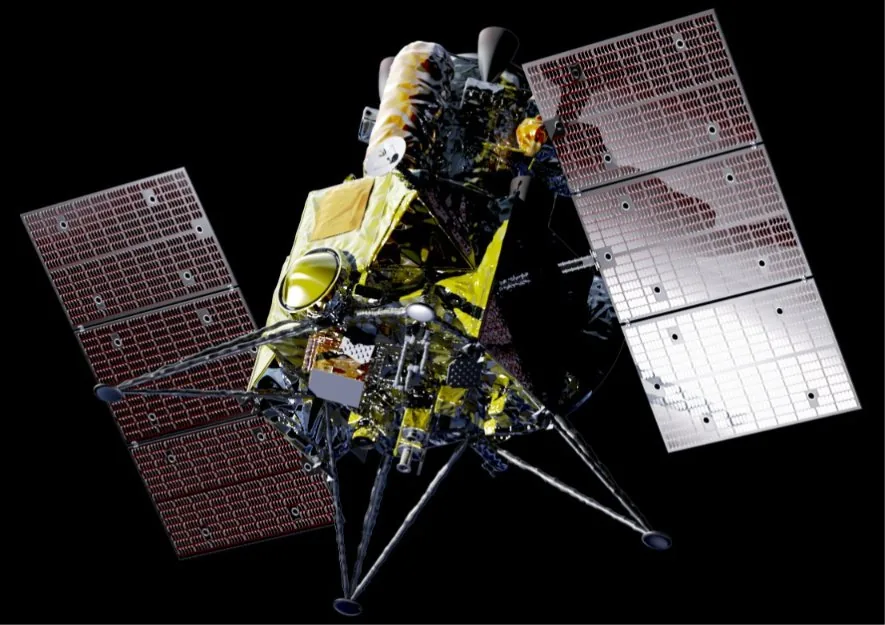
Source Japan’s Martian Moons eXploration (MMX) mission, led by JAXA, was launched aboard an H3 launch vehicle to study Mars’s moons, Phobos and Deimos, and return material from Phobos to Earth.- Objective:
- MMX will study the origin, composition, gravity, internal structure and surface of Phobos, while also observing Deimos, Mars’s only two natural satellites.
- It will collect regolith, loose dust, soil and rock fragments, from Phobos. This would be the world’s first sample-return mission from the Martian system.
- A small French-German rover, IDEFIX, will examine the low-gravity surface and help assess terrain conditions for sampling.
- MMX builds on JAXA’s asteroid sample-return experience through Hayabusa and Hayabusa2, demonstrating advanced navigation, landing and return-capsule capabilities.
- Major Mars Missions:
- NASA (USA):
- Viking 1 and 2 achieved successful Mars landings in 1976; Pathfinder deployed the Sojourner rover (1997). Curiosity and Perseverance examine Martian habitability and evidence of ancient life, while Ingenuity achieved the first controlled powered flight on another planet.
- NASA Orbiters: Mars Odyssey and the Mars Reconnaissance Orbiter (MRO) study Martian geology and support communications with surface missions.
- CNSA (China): Tianwen-1 deployed the Zhurong rover to investigate Martian geology and subsurface water.
- ISRO (India): The Mars Orbiter Mission (Mangalyaan), launched in 2013, made India the first country to reach Mars orbit on its maiden attempt.
- ESA (Europe): Mars Express studies the surface and subsurface, while the ExoMars Trace Gas Orbiter analyses atmospheric gases.
- UAE Space Agency: The Hope Probe, launched in 2020, studies Martian weather and atmospheric dynamics.
- NASA (USA):
Visits & Conferences
India-Poland Relations
Source Why in News?- The Prime Minister of the Republic of Poland paid an official visit to India. During the visit, high-level bilateral talks were held to review and impart fresh momentum to the India-Poland Strategic Partnership, which was established during the Indian Prime Minister’s landmark visit to Warsaw in August 2024.
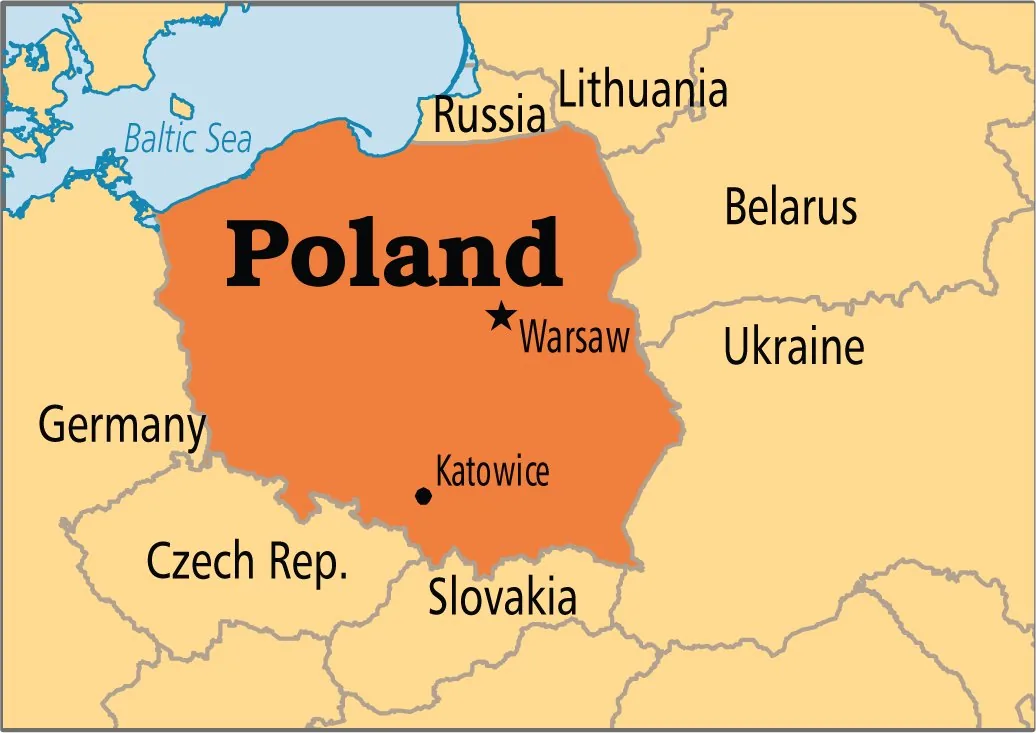 What are the Key Outcomes of the Polish Prime Minister’s Visit to India?
- Economic and Trade Targets: Acknowledging Poland’s recent achievement of crossing the USD 1 trillion GDP mark and India’s trajectory toward a USD 10 trillion economy, the leaders set a target to double bilateral trade by 2030 (from the current level of over USD 6 billion). They also agreed to resume the bilateral working group on agriculture.
- Defence Industry Dialogue: A new forward-looking framework was proposed to support military manufacturing, joint development, co-production, and technology partnerships.
- Agreements and Treaties: The leaders stressed the urgency of signing the pending Agreement on Mutual Protection and Exchange of Classified Information, a critical prerequisite for deep defense-technology sharing.
- Emerging Technologies and Critical Minerals: Both countries agreed to strengthen collaboration in artificial intelligence (AI), semiconductors, quantum technologies and startups, alongside cooperation in critical minerals, battery recycling and rare-earth refining.
- Multilateral & Climate Cooperation:
- Poland officially announced its decision to join the Coalition for Disaster Resilient Infrastructure (CDRI).
- India also invited Poland to join the International Solar Alliance (ISA), Global Biofuels Alliance (GBA), and the Indo-Pacific Oceans Initiative (IPOI).
- UNSC Reforms: Poland reaffirmed its support for India’s membership of a reformed and expanded United Nations Security Council (UNSC) and its candidature for a non-permanent seat for 2028–29.
- Counter-Terrorism:
- Both nations strongly condemned the April 2025 terrorist attack in Pahalgam (J&K).
- They called for the early adoption of the UN Comprehensive Convention on International Terrorism (CCIT) and agreed to initiate a specific bilateral dialogue on counter-terrorism.
- Historical & Cultural Bridges: Ties are rooted deeply in World War II humanitarianism. The Maharaja of Nawanagar (Jam Saheb Digvijay Sinhji) famously provided shelter to 1,000 Polish orphans evacuated from the USSR, and the Valivade camp in Kolhapur hosted 5,000 Polish refugees.
- Crisis Assistance: Poland played a vital logistical role during Operation Ganga (2022), assisting in the evacuation of over 2,000 Indian students stranded in Ukraine.
- Economic Engagement:
- Poland is India’s largest trading and investment partner in Central and Eastern Europe (CEE).
- Bilateral trade reached EUR 5.681 million in 2025, consistently maintaining a trade surplus in India’s favor.
- Key Indian exports include textiles, machinery, and pharmaceuticals, while Poland exports turbojet engines and mineral products. Notably, India is the second-largest target market in Asia for Polish investment.
- Diplomatic Framework: The relationship is currently guided by the Action Plan (2024-2028), which underwent a mid-term review by the respective Foreign Ministers in Warsaw (September 2026).
- Culture:
- Polish artist Stefan Norblin found refuge in India during WWII, blending Polish art with Indian mythology at the Umaid Bhawan Palace in Jodhpur.
- Additionally, academic ties date back to the 19th century with the establishment of a Chair of Sanskrit at the Jagiellonian University in Kraków.
- Significance of the Relations:
- Gateway to the European Union (EU): As an influential EU member, Poland serves as a strategic launchpad and gateway for Indian businesses looking to expand their presence in Central and Eastern Europe and the broader EU single market.
- Defence Indigenisation:
- India’s push for Atmanirbhar Bharat aligns with Poland’s defense manufacturing capabilities.
- Poland’s historical use of Soviet-era military platforms combined with its integration into Western defense networks makes it a valuable partner for upgrading and maintaining India’s legacy military hardware.
- Synergy with EU-India Frameworks: Deepening ties with Warsaw directly complements broader continental strategies, notably the historic India-EU Security and Defence Partnership signed in January 2026, and the EU-India Free Trade Agreement (FTA).
- Geopolitical Divergence on Russia: Poland’s strict stance as a frontline NATO state directly clashes with India’s Strategic Autonomy and its continued energy/defense imports from Moscow.
- Defence Tech-Sharing Hurdles:
- Joint military production under Atmanirbhar Bharat is stalled.
- European firms cannot transfer critical technology without a finalized bilateral Agreement on Exchange of Classified Information.
- High Trade Deficit: Bilateral trade is skewed with a USD 3 billion deficit against Poland. Poland demands the removal of high Indian tariffs and Sanitary and Phytosanitary (SPS) barriers to export its agricultural goods.
- Supply Chain & Connectivity:
- Trade is hampered by Red Sea maritime disruptions and a lack of direct flights.
- The integration of Polish Baltic ports into the India-Middle East-Europe Economic Corridor (IMEC) remains non-operational.
- Diaspora & Mobility Friction: Visa bottlenecks and dual-taxation issues plague Indian IT professionals and students due to the absence of a Migration and Mobility Partnership Agreement (MMPA) and a Social Security Agreement.
- Establish a Dedicated Investment Desk: Set up a specialized ‘Poland Plus’ desk within Invest India to handhold Polish SMEs and tech firms, cutting through bureaucratic red tape to boost reciprocal Foreign Direct Investment (FDI).
- Nearshoring Partnerships: Leverage Poland as a nearshoring base not just for IT services, but for semiconductor design and pharmaceutical distribution, ensuring Indian products seamlessly enter the EU single market without breaching regulatory walls.
- Integration into Defence Corridors:
- Actively invite Polish defense manufacturers to establish joint ventures in the Uttar Pradesh and Tamil Nadu Defence Industrial Corridors.
- Focus should shift from legacy hardware to niche domains like electronic warfare, drone swarms, and cybersecurity.
- Move beyond academic MoUs by facilitating B2B contracts between ISRO’s commercial arm (NSIL) and the Polish Space Agency for low-cost satellite launches and remote sensing applications.
- Clean Coal and Tech Transfer:
- As both nations rely heavily on coal, Poland’s experience in gradually transitioning its mining sector can provide a blueprint for India’s Just Energy Transition.
- Both should establish a joint R&D fund specifically for Small Modular Reactors (SMRs) and green hydrogen electrolyser manufacturing.
- Institutionalize V4+India: Upgrade the Visegrad Group (V4) engagement from irregular meetings to an annual institutionalized summit, cementing India’s footprint in Central and Eastern Europe.
- India and Poland are deepening their Strategic Partnership in trade, defence, clean energy and emerging technologies, strengthening India’s access to the European Union. Addressing geopolitical differences, trade barriers and mobility challenges is key to achieving stronger bilateral cooperation.
AgriVoltaics World Conference 2026
Source Recently, the 7th AgriVoltaics World Conference (AWC) 2026 was held at Bharat Mandapam, New Delhi, under the theme “Powering the Global South.” It marked the first time the conference was hosted in the Global South. India hosted the conference for the first time in the Global South.- About Agrivoltaics: Agrivoltaics refers to the dual use of land for agriculture and solar photovoltaic energy generation, allowing farming and electricity production to coexist.
- Organiser: Hosted by the Ministry of New and Renewable Energy (MNRE), with support from Germany’s Federal Ministry for the Environment, Climate Action, Nature Conservation and Nuclear Safety (BMUV), in partnership with Conexio-PSE.
- Objective: It aims to increase farmers’ incomes, improve land-use efficiency, promote clean energy and build climate-resilient agricultural systems.
- Startup Innovation: The AgriVoltaics Pitch Hub provided a platform for startups to showcase technologies and connect with investors and industry leaders.
- Knowledge Resources Released: These included the India Agrivoltaics Alliance’s Decision-Making Tool, the International Water Management Institute’s Book of Abstracts, and MNRE’s AgriPV Policy Handbook.
- Annadatas to Urjadatas: The initiative promotes farmers’ transition from traditional food producers (Annadatas) to clean-energy producers (Urjadatas), creating additional rural income opportunities.
- PM-KUSUM Linkage: The Government announced plans to introduce a major agrivoltaics programme under the next phase of PM-KUSUM, enabling farmers to generate solar electricity while continuing agricultural cultivation.
- India’s Agrivoltaic Potential: India’s estimated agrivoltaic potential ranges from 3,000 GW to nearly 14,000 GW, with Maharashtra, Rajasthan, Andhra Pradesh, Madhya Pradesh, Karnataka and Uttar Pradesh identified as high-potential states.