Comrades Dispatch · 26 Oct 2026 (PDF)
In this edition
- Upgraded Agri Welfare Portal Launched for Farmers Apps & Portals
- Ashoke Sen Wins 2026 Oskar Klein Medal Awards & Recognition
- India’s Wetland Conservation Journey Environment & Ecology
- Biomarkers (Chemical Signatures) and Early Disease Detection Health & Medicine
- Madras HC Condemns use of Children in Political Campaigns Polity & Governance
- Media Regulation and the Need for National Media Council Polity & Governance
- National SARAS Mela 2026 Schemes & Initiatives
- PHP Vulnerabilities: Cybersecurity Threats in the AI Era Security
Apps & Portals
Upgraded Agri Welfare Portal Launched for Farmers
Source The Ministry of Agriculture and Farmers Welfare launched the upgraded Agri Welfare Portal to provide farmers with single-window, mobile-based access to government schemes, financial assistance and agricultural information.- About: It is a single-window digital platform providing farmers access to government schemes, financial assistance and reliable agricultural information through mobile phones.
- Single-Window Access: The portal brings information and services related to schemes, subsidies, rules and digital services onto one platform, reducing the need to visit multiple offices or websites.
- Key Schemes: It provides access to major initiatives including PM-KISAN, AgriStack and Pradhan Mantri Fasal Bima Yojana (PMFBY) through a common interface.
- Transparency and DBT: Online eligibility checks, direct applications and Direct Benefit Transfer (DBT) aim to simplify processes, improve transparency and reduce intermediaries.
- Farmer-Centric Design: The portal is lightweight, mobile-friendly and accessible on basic smartphones, even in areas with weak internet connectivity, providing information on weather, scientific farming practices, seeds, fertilisers and market prices.
- Agricultural Ecosystem: It also provides a common digital platform connecting Farmer Producer Organisations, Primary Agricultural Credit Societies, scientists, researchers and startups.
- Capacity Building: Krishi Vigyan Kendras will conduct training campaigns to help farmers, particularly small and marginal farmers, effectively use the portal and other digital tools.
- Digital Standards: The portal has been developed in accordance with the Digital Brand Identity Manual 3.0 and Guidelines for Indian Government Websites 3.0, focusing on security, accessibility and usability.
Awards & Recognition
Ashoke Sen Wins 2026 Oskar Klein Medal
Source Renowned Indian theoretical physicist Ashoke Sen became the first Indian to receive the Oskar Klein Medal (2026) for his pioneering contributions to string theory, quantum gravity and black hole physics.- About Oskar Klein Medal: Established in 1988 to honour Swedish theoretical physicist Oskar Klein (1894–1977), it is awarded by Stockholm University and the Nobel Committee for Physics to recognise outstanding contributions to theoretical physics.
- Oskar Klein’s Contribution: Building on Theodor Kaluza’s work, Oskar Klein advanced Kaluza-Klein theory. This theory sought to unify gravity and electromagnetism through an additional spatial dimension, influencing later developments in string theory.
- About Ashoke Sen: He is the ICTS-Infosys Madhava Chair Professor at the International Centre for Theoretical Sciences (ICTS), Bengaluru. He delivered the 2026 Oskar Klein Memorial Lecture in Stockholm on “Gravity from Strings and Strings from Gravity.”
- Key Contributions:
- S-Duality: Helped establish that apparently different descriptions of physical interactions can be mathematically equivalent, particularly strongly and weakly coupled theories.
- Sen Conjectures (1999): Proposed three conjectures on tachyon condensation and unstable D-branes, advancing the understanding of string dynamics.
- String Field Theory: Advanced the mathematical understanding of string interactions and dynamics.
- Black Hole Physics: Developed methods to explain black hole entropy through the counting of microscopic quantum states.
- Major Honours: ICTP Prize (1989), Shanti Swarup Bhatnagar Prize (1994), Padma Shri (2001), Infosys Prize (2009), Breakthrough Prize in Fundamental Physics (2012), Padma Bhushan (2013) and Dirac Medal (2014).
- Concept: A theoretical framework proposing that fundamental particles are tiny vibrating strings rather than point-like particles, with different vibrations representing different particles.
- Objective and Significance: Seeks to reconcile quantum mechanics and general relativity, providing a unified framework for understanding gravity, other fundamental forces and black hole physics.
- Limitation: Despite its mathematical sophistication, string theory remains experimentally unverified.

Environment & Ecology
India’s Wetland Conservation Journey
Source Why in News?- India’s network of Ramsar Sites has expanded to 103 wetlands in October 2026, with Sukhna Wetland in Chandigarh and Sauj Jheel in Uttar Pradesh as the latest additions, strengthening the country’s efforts towards biodiversity conservation, water security and climate resilience.
- About: Ramsar Sites are wetlands designated as Wetlands of International Importance under the Ramsar Convention because of their ecological, botanical, zoological, limnological or hydrological significance.
-
Ramsar Convention:
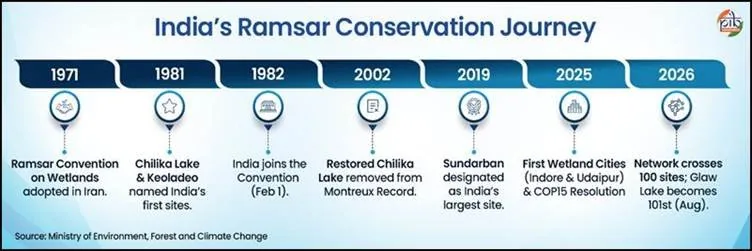
- An intergovernmental treaty adopted in 1971 at Ramsar, Iran, which entered into force in 1975 to promote the conservation and wise use of wetlands.
- It has 172 Contracting Parties and over 2,536 Ramsar Sites globally as of October 2026.
- India’s Membership: India became a Contracting Party to the Ramsar Convention in 1982.
-
India’s Diverse Wetland Ecosystems
- India’s Ramsar Sites include high-altitude lakes, river floodplains, mangroves, coral reefs, village tanks and urban marshes, reflecting the country’s diverse wetland ecosystems.
- Major Achievements:
- India’s Ramsar network increased from 26 sites in 2014 to 103 in October 2026, covering over 13.87 lakh hectares across 28 States and Union Territories.
- India ranks first in Asia and third globally in terms of the number of Ramsar Sites.
- Tamil Nadu has the highest number of Ramsar Sites (20), followed by Uttar Pradesh (14).
- First Ramsar Sites: Chilika Lake (Odisha) and Keoladeo National Park (Rajasthan) were India’s first Ramsar Sites, designated in 1981.
- Largest Ramsar Site: Sundarban Wetland (West Bengal), covering approximately 4.23 lakh hectares. It holds over 60 per cent of India’s mangrove area and a tiger population with unique aquatic hunting skills.
- Chilika Lake Restoration: Chilika Lake was removed from the Montreux Record in 2002, and the Chilika Development Authority later received the Ramsar Wetland Conservation Award.
- Wetland City Accreditation: Indore (Madhya Pradesh) and Udaipur (Rajasthan) became India’s first Ramsar-accredited Wetland Cities in January 2025, recognising urban wetland conservation.
- Wetlands (Conservation and Management) Rules, 2017: Notified under the Environment (Protection) Act, 1986, these rules establish State/UT Wetlands Authorities and prohibit activities such as encroachment, solid-waste dumping and discharge of untreated effluents into notified wetlands.
- National Plan for Conservation of Aquatic Ecosystems (NPCA): A centrally sponsored scheme integrating the conservation of lakes and wetlands. The revised NPCA Guidelines, 2024 promote scientific, integrated and sustainable wetland management.
- Amrit Dharohar:
- Promotes the conservation values of Ramsar Sites through species and habitat conservation, nature tourism, livelihood development and wetland carbon assessment.
- Inventories of flora and fauna have been undertaken for 75 Ramsar Sites, while carbon stock assessments have been conducted at 39 sites.
- Mission Sahbhagita:
- Promotes community-led wetland conservation through public participation and ecological awareness.
- Under the Save Wetlands Campaign, more than 20 lakh volunteers have helped map over 1.7 lakh wetlands.
- Mangrove Initiative for Shoreline Habitats and Tangible Incomes (MISHTI): Targets the restoration of 540 sq. km of mangroves across nine States and four UTs, strengthening coastal resilience and livelihoods.
- Wetlands of India Portal: Launched in 2021, it provides a digital repository of wetland information, conservation initiatives, research and training resources.
- Definition of Wetlands: Includes natural or artificial, permanent or temporary marshes, peatlands and water bodies, with fresh, brackish or saline water, including marine areas up to six metres deep at low tide.
- Three Pillars of the Convention:
- Wise Use: Maintaining the ecological character of all wetlands through sustainable ecosystem-based management.
- Ramsar Site Designation: Identifying and effectively managing Wetlands of International Importance.
- International Cooperation: Promoting cooperation on shared wetlands, transboundary water systems and migratory species.
- Designation Process in India: The State Government or UT Administration identifies eligible wetlands, while the Ministry of Environment, Forest and Climate Change (MoEFCC) coordinates approval and submits proposals to the Ramsar Secretariat.
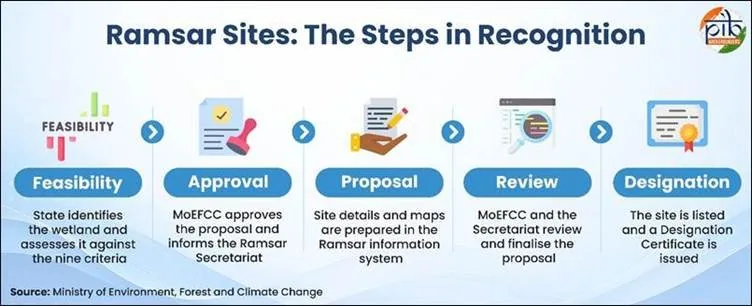 Ramsar Criteria for Identifying Wetlands of International Importance
- Group A – Wetland types
- Criterion 1: A wetland is internationally important if it contains a representative, rare, or unique example of a natural or near-natural wetland type found within the appropriate biogeographic region.
- Group B – Biological diversity:
- Species and ecological communities
- Criterion 2: It supports vulnerable, endangered, or critically endangered species or threatened ecological communities.
- Criterion 3: It supports populations of plant and/or animal species important for maintaining biological diversity of a particular biogeographic region.
- Criterion 4: It supports plant and/or animal species at a critical stage in their life cycles or provides refuge during adverse conditions.
- Group B – Biological diversity:
- Waterbirds
- Criterion 5: It regularly supports 20,000 or more waterbirds.
- Criterion 6: It regularly supports 1% of the individuals in a population of one species or subspecies of waterbird.
- Group B – Biological diversity:
- Fish
- Criterion 7: It supports a significant proportion of indigenous fish subspecies, species or families, life-history stages, species interactions and/or populations that represent wetland benefits or values and contribute to global biological diversity.
- Criterion 8: It is an important source of food for fishes, spawning ground, nursery and/or migration path on which fish stocks within or outside the wetland depend.
- Group B – Biological diversity:
- Other taxa
- Criterion 9: It regularly supports 1% of the individuals in a population of one species or subspecies of wetland-dependent non-avian animal species.
- Benefits of Designating Wetlands to Ramsar List
- International Representation: Provides countries a platform to raise concerns at the principal intergovernmental forum on wetland conservation and wise use. India introduced the resolution on “Promoting Sustainable Lifestyles for the Wise Use of Wetlands” at the Ramsar COP15, which was adopted with broad support.
- Enhanced Visibility and Recognition: Increases the international visibility of Ramsar Sites and strengthens support for their conservation and wise use.
- International Standards and Guidance: Provides access to internationally accepted standards for identifying wetlands of international importance, along with guidance on wise use and management planning.
- Expert Assistance: Enables countries to seek expert advice on national and site-specific wetland conservation and management challenges through the Ramsar Secretariat, its collaborators and Ramsar Advisory Missions.
- International Cooperation and Financial Support: Promotes international cooperation in wetland conservation and management and can facilitate project support through Ramsar’s small-grant programmes and multilateral and bilateral funding agencies.
- Commitments After Designation
- Wise Use and Conservation: Designation commits the concerned State or Union Territory to the wise use and conservation of the wetland and its resources.
- Legal and Management Framework: The Ramsar Site is deemed notified under the Wetlands (Conservation and Management) Rules, 2017, with guidelines recommending formal notification along with an Integrated Management Plan.
- Periodic Monitoring and Reporting: The Ramsar Information Sheet (RIS) must be updated every six years, while the ecological character of the site must be monitored regularly.
- National Wetland Network: These criteria and commitments have supported the development of India’s large and diverse network of Ramsar Sites.
- Meaning: The Montreux Record is a register of Ramsar Sites where changes in ecological character have occurred, are occurring, or are likely to occur.
- Purpose: It identifies wetlands requiring priority conservation attention and supports monitoring, remedial action and resource allocation.
- Inclusion and Removal: Sites are included in consultation with the concerned country and relevant scientific experts and may be removed once successful remedial measures are documented or the threat of ecological change no longer exists.
- Biodiversity Conservation:
- Wetlands provide breeding, feeding and migratory habitats for numerous species, including threatened waterbirds, fish and aquatic mammals.
- Example: Chilika Lake (Odisha) supports approximately 118 fish species and important migratory bird habitats.
- Climate Resilience:
- Wetlands, particularly mangrove ecosystems, act as natural buffers against floods, cyclones, storm surges and coastal erosion.
- Example: Sundarban Wetland protects coastal settlements from extreme weather events and saltwater intrusion.
- Water Security: Wetlands contribute to groundwater recharge, freshwater storage, water purification and hydrological regulation.
- Sustainable Livelihoods:
- Wetlands support fisheries, agriculture, tourism and traditional occupations, improving local economic security.
- Example: East Kolkata Wetlands naturally treat wastewater through approximately 4,000 hectares of fish ponds, supporting fisheries and local livelihoods.
- Species Recovery:
- Protection of wetland ecosystems supports the conservation and recovery of threatened species.
- Example: Beas Conservation Reserve (Punjab) supports India’s only known population of the Indus River dolphin.
- Community Participation:
- Local stewardship strengthens long-term conservation through traditional ecological knowledge and collective action.
- Example: Khichan Wetland (Rajasthan) supports over 22,000 wintering demoiselle cranes, with active protection by local communities.
- International Cooperation: Ramsar designation promotes access to scientific expertise, international conservation standards and opportunities for collaborative wetland management.
- India’s expanding Ramsar network reflects growing recognition of wetlands as critical natural infrastructure for biodiversity conservation, water security and climate resilience. Strengthening scientific monitoring, community participation and integrated ecosystem management is essential to translate international recognition into lasting ecological conservation outcomes.
Health & Medicine
Biomarkers (Chemical Signatures) and Early Disease Detection
Source Why in News?- Scientists have emphasised the growing potential of chemical signatures (commonly known as biomarkers) in revolutionising early disease diagnosis, particularly for neurological conditions like Alzheimer’s and Parkinson’s.
- However, despite their promise, integrating these diagnostic tools into routine clinical practice remains hindered by significant hurdles related to accuracy, cost, and accessibility.
- About: Chemical Signature is a measurable biological indicator found in bodily fluids (like blood or cerebrospinal fluid) consisting of a unique pattern of specific proteins, molecules, elements, isotopes, or by-products.
- Function: It objectively signifies what is happening inside the body, indicating a normal biological process, a pathogenic disease state, or a response to medical treatments.
-
Working of Chemical Signatures:
- When a disease develops, it triggers changes at the molecular level long before physical symptoms appear.
- By measuring the presence, absence, or altered behaviour of specific proteins, doctors can identify underlying physiological shifts.
- Detection Instruments: Advanced analytical tools like spectrometers (which measure molecules by mass or light absorption) and chromatographs (which separate mixture components) are used to detect these minute chemical patterns.
-
State of Biomarkers in India:
- GenomeIndia Project:
- Launched in January 2020 and funded by the Department of Biotechnology (DBT), the project has completed the whole-genome sequencing of over 10,000 individuals representing diverse Indian populations.
- As one of the world’s largest genetic databases, Genome India Project serves as a critical foundation for discovering population-specific biomarkers and genetic risk factors tailored to South Asians.
- BHARAT Study:
- The Indian Institute of Science (IISc), under its Longevity India Programme, has launched the BHARAT (Biomarkers of Healthy Aging, Resilience, Adversity, and Transitions) Study to establish a “Bharat Baseline” tailored to the Indian population, reducing reliance on Western-derived biomarkers.
- Since ageing is influenced by molecular, cellular, environmental and socioeconomic factors, chronological age may not accurately reflect biological age. The study aims to develop biomarkers that better capture ageing patterns among Indians.
- GenomeIndia Project:
-
Significance of Biomarkers in Healthcare
- Early and Pre-symptomatic Detection: Biomarkers allow physicians to transition from late-stage symptomatic management to early molecular triage, detecting conditions years before cognitive or physical decline begins.
- Non-Invasive Diagnostics: Blood-based biomarker assays offer a cheaper, safer, and less painful alternative to invasive procedures like lumbar punctures (spinal taps) or expensive nuclear PET (Positron Emission Tomography) scans.
- Targeted Therapies:
- By differentiating between diseases with overlapping symptoms (e.g., differentiating types of dementia), biomarkers ensure patients receive the correct targeted therapies rather than broad-spectrum symptom suppressants.
- India’s precision medicine market is projected to grow at a CAGR of 16%, exceeding USD 5 billion by 2030. Biomarkers can accelerate this growth by personalised treatments and more targeted therapies.
- Tracking Disease Progression: Serial blood tests allow doctors to monitor how well a patient is responding to experimental drugs or ongoing treatments dynamically over time.
-
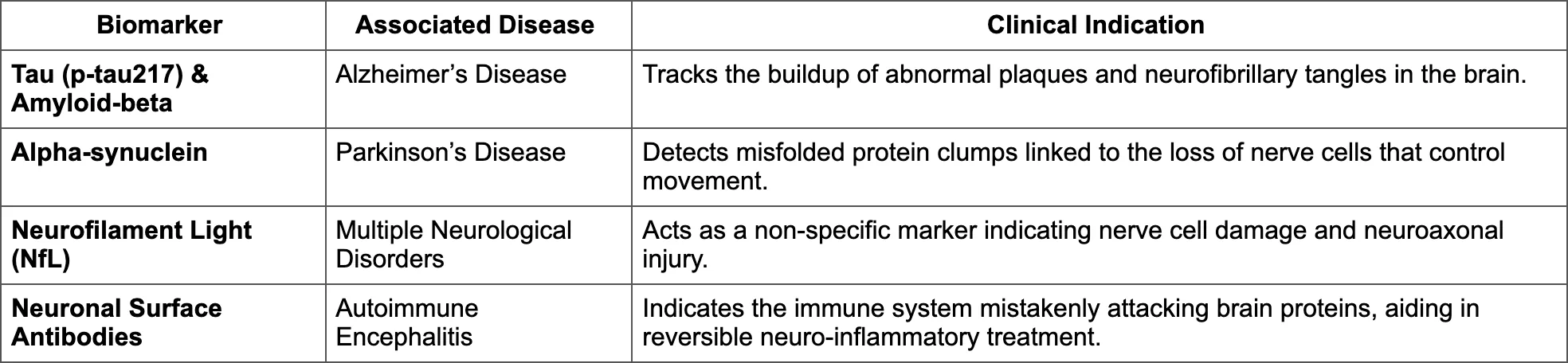
Common Biomarkers and Linked Diseases
 What are the Challenges in Testing and Diagnosis through Biomarkers?
- Accuracy and Specificity Issues:
- Many biomarkers lack absolute specificity. For instance, the Neurofilament Light (NfL) protein indicates nerve damage but cannot pinpoint the exact disease causing it.
- Furthermore, factors like age, kidney function, and other concurrent medications can alter biomarker levels, leading to a risk of false-positive or false-negative results.
- High Costs and Lack of Infrastructure:
- Specialised tests requiring advanced immunoassays are expensive and largely confined to major metropolitan centres.
- District and rural hospitals often lack the automated platforms required for these tests, resulting in severe diagnostic deficits in rural India.
- Lack of Uniform Standards:
- There is a lack of harmonisation across testing laboratories.
- Variations in laboratory methods and equipment can affect the consistency and interpretation of biomarker test results.
- Ethical and Socio-economic Concerns:
- Identifying preclinical diseases in asymptomatic individuals creates “patients-in-waiting,” triggering severe psychological anxiety.
- Additionally, a positive biomarker test on medical records could expose individuals to socio-economic discrimination, such as denial of life insurance or workplace bias.
- Promoting Indigenous R&D: The government and public sectors must support domestic biotechnology firms to engineer affordable, locally manufactured diagnostic reagents. This will reduce dependency on costly imported testing platforms and democratise access.
- Standardisation of Protocols: The Indian Council of Medical Research (ICMR) and the Central Drugs Standard Control Organisation (CDSCO) should establish unified clinical guidelines and standard operating procedures (SOPs) for biomarker testing to ensure uniform laboratory interpretation.
- Ethical Safeguards: Clear legal frameworks must be established regarding genetic and biomarker data privacy to prevent insurance and employment discrimination against asymptomatic ‘at-risk’ individuals.
- Capacity Building: Expanding diagnostic infrastructure at the district hospital level and training medical professionals in biomarker interpretation is critical for integrating these tools into mainstream public health planning.
Polity & Governance
Madras HC Condemns use of Children in Political Campaigns
Source The Madras High Court observed that Parliament should consider whether involving children in political campaigning should be a ground for setting aside a candidate’s election, raising concerns about child rights, voter autonomy and electoral ethics.- Legal Standing:
- The Madras High Court clarified that an appeal to children to persuade their parents does not amount to “undue influence” or a “corrupt practice” under Section 123(2) of the Representation of the People Act (RPA), 1951.
- The court determined that persuasion by children does not overpower the free will or volition of adult voters, who retain the ultimate agency to make informed electoral choices.
- Judicial Criticism: The court strongly condemned the practice, calling it “in bad taste,” reflective of “poor parenting,” and a “cheap and politically motivated act”.
- Election Commission of India (ECI) Directives:
- The ECI maintains a strict “zero tolerance” policy regarding the use of children in any election-related activities, including rallies, carrying party flags, or slogan shouting.
- However, merely accompanying a parent or guardian near a political leader, without participating in campaigning, does not constitute a violation.
- Political parties and candidates must comply with the Child and Adolescent Labour (Prohibition and Regulation) Act, 1986, as amended in 2016. District Election Officers and Returning Officers are responsible for ensuring compliance by election machinery.
- The Legislative Gap: While ECI guidelines exist as administrative advisories, the Representation of the People Act, 1951, lacks explicit provisions that automatically void a candidate’s election for violating these specific child-protection directives under Section 100 (grounds for declaring an election void).
- International Framework: The UN Convention on the Rights of the Child (UNCRC) recognises children’s rights to expression and participation, while UNICEF’s child-participation framework distinguishes meaningful civic participation from manipulation and tokenism.
Media Regulation and the Need for National Media Council
Source Why in News?- The debate over establishing a National Media Council (NMC) has gained fresh momentum following the crackdown on freelance journalists and content creators during the October 2026 protests in New Delhi.
- The debate has further intensified as the Supreme Court, while hearing a Public Interest Litigation (PIL) concerning the protection of freelance journalists, raised questions about the definition of a journalist in the digital age and highlighted the need for a national protocol and a unified media regulatory framework.
- In 2024, the Press Club of India drafted the Media Transparency and Accountability Bill, proposing the establishment of an NMC, among other reforms.
- Defining a Journalist: Under the Occupational Safety, Health and Working Conditions (OSHWC) Code, 2020, a working journalist is someone whose principal avocation is journalism in print, electronic, or digital media, excluding those in managerial roles.
- Government Accreditation:
- The Central and State governments grant accreditation via bodies like the Press Information Bureau (PIB) and the Directorate of Information and Publicity (DIP).
- However, this is governed by strict quotas based on a newspaper’s circulation, a news agency’s subscriber base, or a digital portal’s unique visitors.
- Consequently, many genuine independent and freelance working journalists fail to secure accreditation.
- Institutional Regulation:
- Print Media:
- Regulated by the Press Council of India (PCI), a statutory, quasi-judicial autonomous body established under the Press Council Act, 1978.
- It acts as a moral watchdog but has no punitive powers to enforce its guidelines.
- Electronic/Television Media:
- Primarily self-regulated through bodies like the News Broadcasting & Digital Standards Authority (NBDSA), set up by the News Broadcasters & Digital Association (NBDA), independent of statutory government control.
- Television Broadcasting Regulation governed by the Cable Television Networks (Regulation) Act, 1995, and the Programme and Advertising Codes under the 1994 Rules. The 2021 amendments introduced a three-tier grievance redressal mechanism involving broadcasters, self-regulatory bodies and Central Government oversight.
- Digital Media and OTT: Governed by the Information Technology (Intermediary Guidelines and Digital Media Ethics Code) Rules, 2021, which provide a three-tier grievance redressal mechanism but face criticism for excessive executive interference.
- Films/Cinema: Regulated by the Central Board of Film Certification (CBFC) under the Cinematograph Act, 1952.
- Online Content Regulation:
- Governed by the Information Technology Act, 2000. Section 69A empowers the Central Government to block online content on specified grounds, while Section 79(3)(b) concerns intermediaries’ safe-harbour protection when they fail to act against unlawful content after legally valid notice.
- The Sahyog portal facilitates communication between authorised government agencies and online platforms.
- Print Media:
- The Crisis of Defining a “Journalist”:
- The proliferation of smartphones has blurred the line between professional journalists and content creators.
- The Solicitor General noted that many individuals claim to be journalists merely to create social media reels for monetary gain by sensationalising events.
- An NMC could establish clear, professional parameters to distinguish genuine journalists from bad actors.
- Need for a Professional Licensing Body:
- Currently, professions like law and accounting are regulated by statutory bodies (the Bar Council of India and Institute of Chartered Accountants of India (ICAI) respectively).
- A MNC could act similarly, mandating a degree or diploma in journalism to issue professional licenses and recognize all working journalists, freelancers, and camerapersons uniformly, bypassing the government quota system.
- Tackling Media Convergence:
- A single corporate entity today operates print, television, and digital media simultaneously.
- Regulating them through separate silos (PCI, NBDSA, IT Rules) creates administrative loopholes.
- An NMC would serve as a single, unified statutory authority reflecting the modern converged media landscape.
- Empowering the Watchdog: The existing PCI is widely considered a “toothless tiger” because its jurisdiction excludes TV and digital media, and it lacks the authority to impose fines, suspend licenses, or enforce primetime apologies for severe ethical breaches (such as media trials or coordinated fake news).
- Failure of Self-Regulation in TV Media: Electronic media’s self-regulatory models have largely failed to curb sensationalism, toxic debates, prioritizing TRPs (Television Rating Points) over journalistic ethics.
- Fake News and Misinformation: The rapid proliferation of digital platforms and AI-driven deepfakes has exacerbated the problem of coordinated misinformation, necessitating a comprehensive statutory mechanism that covers all mediums.
- Cross-Media Ownership:
- There is a growing threat of corporate and political monopolies over media houses, affecting editorial diversity, while engagement-driven digital algorithms can amplify sensationalism, misinformation and polarising content.
- A modern regulatory framework could promote cross-media ownership transparency, disclosure of conflicts of interest, algorithmic accountability and media pluralism.
- Appointments & Executive Overreach:
- Government control over member appointments risks turning the NMC into a censorship tool.
- Ensuring true independence requires a multi-partisan or judicial collegium, which governments are often reluctant to establish.
- Financial Autonomy: Relying on the Ministry of Information and Broadcasting (MIB) for funding compromises operational independence, yet alternative models (like a corporate media cess) face heavy industry resistance.
- Government Advertising Leverage:
- State and Union governments frequently use the allocation or withdrawal of government advertising funds (via the Directorate of Advertising and Visual Publicity - DAVP) to engineer editorial compliance.
- Even if an independent NMC is established, it will struggle to protect media autonomy if the government retains this financial leverage.
- As the Supreme Court ruled in the landmark Bennett Coleman & Co. vs. Union of India (1972) case, policies causing the financial strangulation or limiting the economic viability of the press directly violate Article 19(1)(a). The Court termed the “Ark of the Covenant of Democracy” from such covert financial censorship.
- Constitutional Hurdles:
- Granting the NMC punitive powers (fines/suspensions) or mandating professional licenses risks gatekeeping.
- This could stifle investigative journalism and conflict with the fundamental right to free speech under Article 19(1)(a).
- Corporate Resistance:
- Large media conglomerates strongly prefer current self-regulatory models (like NBDSA).
- They are likely to lobby against an NMC that threatens their commercial interests, TRP-driven models, and cross-media monopolies.
- Digital Complexity: The modern “creator economy” blurs the line between a professional journalist and a social media content creator. Furthermore, borderless digital platforms create severe jurisdictional hurdles for enforcing NMC rulings.
- Establishing a National Police Protocol: As argued by legal experts in the Supreme Court, there is an immediate need for a standardized national protocol directing law enforcement not to obstruct journalists who carry valid identity cards from their employers, regardless of PIB/DIP accreditation.
- Independent Co-Regulation Model:
- The Parliamentary Standing Committee on Communications and Information Technology, in its 27th Report (2021) on ‘Ethical Standards in Media Coverage’, highlighted the need to balance regulation with free speech.
- Instead of direct government control, the NMC should operate on a “co-regulation” model (a mix of statutory backing and self-regulation). Its selection committee must be insulated from the executive, ideally comprising the Chief Justice of India, the Leader of the Opposition, and eminent media veterans.
- Regulating Cross-Media Ownership: As strongly recommended by the Telecom Regulatory Authority of India (TRAI) in its 2014 report on “Issues relating to Media Ownership”, strict regulations must be enforced to restrict cross-media monopolies.
- Inclusive Standard Setting: While the NMC can issue licenses or press cards to formally recognize freelancers and protect them during protests, it must explicitly ensure that holding such a license is a privilege for access, not a mandatory requirement to publish news, thereby safeguarding the constitutional right to free speech.
- Anti-SLAPP Legislation: Enact laws to protect journalists from SLAPP (Strategic Lawsuits Against Public Participation) suits, which are frivolous defamation cases filed by powerful entities to drain journalists financially and stifle investigative reporting.
- Curbing Fake News: The 2025 Parliamentary Standing Committee on Communications and IT recommended fact-checking mechanisms, internal media ombudsmen, stricter penalties and a clear legal definition of fake news, while safeguarding freedom of speech.
- Independent News Ombudsman: Encourage media organisations to appoint independent ombudsmen to address complaints about accuracy, fairness, bias and ethical misconduct, promoting self-regulation, transparency and public trust.
- Adopting Global Best Practices:
- Australia’s News Media Bargaining Code: Mandates Big Tech to pay news publishers for content, ensuring the financial sustainability of independent media.
- EU’s Digital Services Act (DSA): Holds large online platforms accountable for algorithmic transparency and curbing fake news, hate speech, and election manipulation.
- The ultimate goal of these measures is to strike a delicate balance between Article 19(1)(a) (Freedom of Speech and Expression) and Article 19(2) (Reasonable Restrictions). By safeguarding reporters from intimidation and insulating newsrooms from corporate-political nexus, India can ensure that its media remains a fearless watchdog of democracy.
Schemes & Initiatives
National SARAS Mela 2026
Source Why in News?- The National SARAS Mela 2026, organised in Vijayawada, Andhra Pradesh, marks the first National SARAS Mela outside Delhi-NCR, bringing together women entrepreneurs from 34 States and Union Territories to promote Self-Help Group (SHG) enterprises, market access and sustainable rural livelihoods under DAY-NRLM.
- About: SARAS Mela is a government-supported platform organised under the Deendayal Antyodaya Yojana–National Rural Livelihoods Mission (DAY-NRLM) to connect rural women entrepreneurs particularly Self-Help Groups (SHGs), with consumers, institutional buyers and wider markets.
- Evolution: The first National SARAS Mela was organised in Delhi in 1999, with approximately 65 beneficiaries. It has since expanded to national, regional, state and district levels.
- Major Achievements:
- A total of 117 National SARAS Melas have been organised, with annual sales exceeding ₹200 crore.
- States and UTs are expected to organise at least two State-level SARAS Melas annually, contributing to an average of around 50 events nationwide.
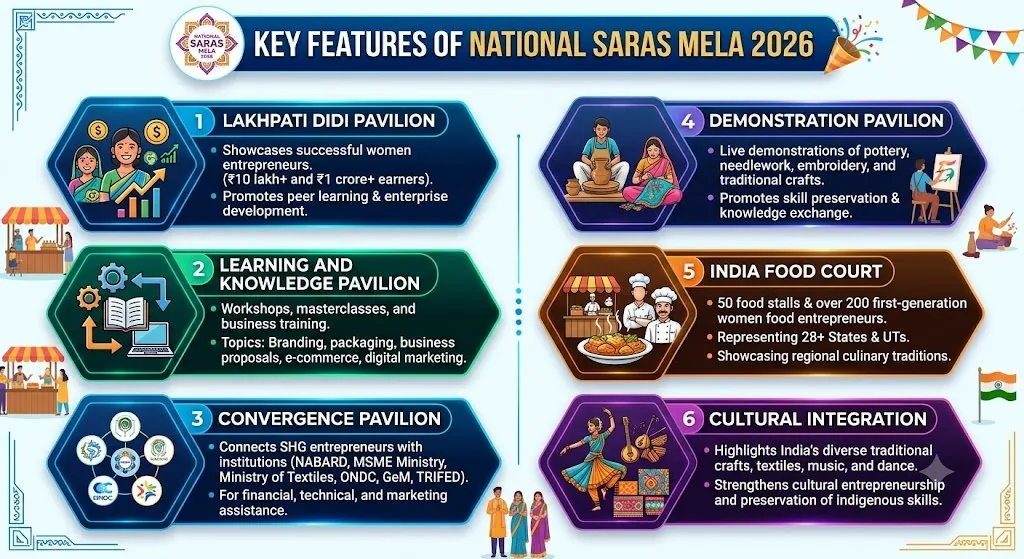
- Products Showcased: Handlooms, handicrafts, traditional textiles, natural products, processed foods and regional cuisines, alongside an India Food Court, cultural showcases and dedicated learning spaces.
- Institutional Support: The initiative involves collaboration with institutions such as NABARD, the National Institute of Rural Development and Panchayati Raj (NIRDPR) and other government and private-sector stakeholders.
- Digital Market Access:
- eSARAS Platform: An e-commerce initiative enabling customers to discover and purchase products made by SHG entrepreneurs beyond physical exhibitions.
- SARAS Mela Digital App (2025): Facilitates SHG nominations, attendance management and event-related information.
- Digital Payments: Promotes UPI-based transactions, while retaining alternative payment arrangements for financial inclusivity.
 What is the Role of DAY-NRLM and Lakhpati Didi in Rural Women Empowerment?
- DAY-NRLM:
- A flagship rural poverty alleviation programme that promotes women’s economic empowerment through SHGs, providing access to credit, skills, technology, institutional support and sustainable livelihood opportunities.
- SARAS Melas supports DAY-NRLM by strengthening product branding, direct sales, buyer–seller linkages and access to national markets.
- Lakhpati Didi Initiative:
- An outcome-oriented initiative under DAY-NRLM aimed at enabling SHG women to achieve sustainable annual household incomes of at least ₹1 lakh.
- Income sustainability is assessed over at least four agricultural seasons and/or business cycles.
- The target increased from 2 crore in 2023 to 3 crore in 2024, with the 3-crore milestone achieved by December 2025.
- In February 2026, the government announced an enhanced target of 6 crore Lakhpati Didis.
- Enterprise Development: SARAS Melas support the transition from subsistence livelihoods towards women-led microenterprises, enabling income diversification, business expansion and sustainable market participation.
- SARAS Mela 2026 reflects a shift from traditional livelihood promotion towards market-oriented rural entrepreneurship and women’s economic empowerment. By integrating SHG enterprises, institutional support, digital marketplaces and the Lakhpati Didi initiative, it strengthens inclusive rural development and advances the vision of Atmanirbhar Bharat.
Security
PHP Vulnerabilities: Cybersecurity Threats in the AI Era
Source Why in News?- Two critical vulnerabilities in PHP (Hypertext Preprocessor), collectively known as PHP2Shell, have raised global cybersecurity concerns due to their potential to enable remote code execution and compromise sensitive data on affected servers.
- About: PHP (Hypertext Preprocessor) is an open-source, back-end programming language that runs on web servers, originally developed in the early 1990s.
- Scale: It is the foundational backbone of the internet, powering 70% of the world’s websites, including Wikipedia, WordPress, online shops, and popular frameworks like Laravel and Drupal.
- Maintenance: PHP is developed and maintained by its open-source community, with support from the PHP Foundation.
- PHP Vulnerabilities:
- The vulnerabilities being tracked as CVE-2026-109618 and CVE-2026-109619, collectively known as PHP2Shell, have a reported severity score of 9.2/10.
- CVE-2026-109618: This vulnerability involves improper handling of out-of-memory errors, which can corrupt memory during request processing.
- CVE-2026-109619: This vulnerability involves accessing previously freed memory, potentially allowing attackers to enable unauthenticated Remote Code Execution (RCE).
- These vulnerabilities potentially allow attackers to take control of web servers and compromise the Confidentiality, Integrity and Availability (CIA) Triad. Hackers have actively tried to use these flaws to install variants of the Mirai botnet.
- The vulnerabilities were identified using AI-powered code analysis, highlighting how AI can strengthen cybersecurity by detecting flaws while also being misused to develop cyberattacks.
- User Awareness: While backend developers bear the primary responsibility for patching, end-users are advised to remain vigilant against phishing attacks that exploit the public panic surrounding massive cyber incidents.
- Impact on Critical Information Infrastructure (CII):
- The disclosure prompted precautionary shutdowns and emergency maintenance of websites and digital services worldwide.
- Major entities like Wikipedia, the UK and Finnish governments, and telecom giants suspended services.
- Notably, Japan’s SoftBank had to temporarily suspend emergency mobile alerts for natural disasters (earthquakes/tsunamis) to protect its systems, highlighting how software bugs can cripple real-world emergency response systems.
- In countries like India, CII heavily relies on older systems built for functionality rather than security. These legacy systems are exceptionally vulnerable to AI-enabled exploit generation.