> ## Documentation Index
> Fetch the complete documentation index at: https://signals.joincomrades.com/llms.txt
> Use this file to discover all available pages before exploring further.
# 27 Oct 2026 · Dispatch
> Comrades Dispatch of 27 Oct 2026, by news group.
> **[Comrades Dispatch · 27 Oct 2026 (PDF)](https://dl.joincomrades.com/d/27-10-26)**
***
## In this edition
1. [India Achieves 11 Crore Farmer IDs Under Digital Agriculture Mission](#h-1) Agriculture & Rural
2. [RBI’s Data Centre and Cybersecurity Training Institute](#h-2) Banking & Finance
3. [Need for a National Sentencing Council](#h-3) Polity & Governance
4. [Cabinet Secretary of India](#h-4) Polity & Governance
5. [Viksit Bharat–G RAM G Act, 2025](#h-5) Schemes & Initiatives
6. [Immersive Technologies and India's AVGC-XR Ecosystem](#h-6) Science & Technology
7. [Long-Term Strategic Vision and Land Warfare Doctrine](#h-7) Security
8. [NVS-03 and NavIC Navigation System](#h-8) Space
## Agriculture & Rural
### India Achieves 11 Crore Farmer IDs Under Digital Agriculture Mission
[Source](https://www.drishtiias.com/current-affairs-news-analysis-editorials/news-analysis/27-10-2026#38282)
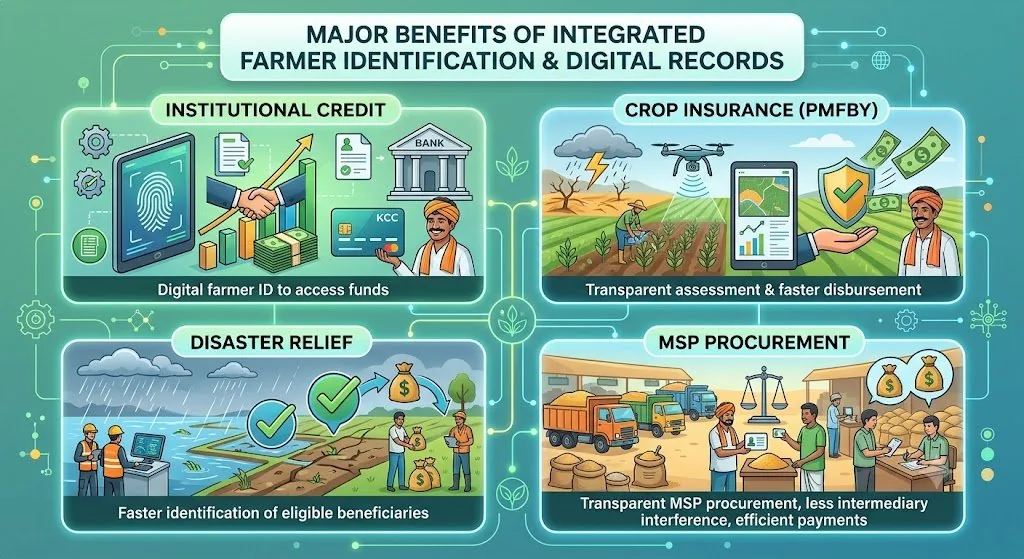
The Ministry of Agriculture and Farmers’ Welfare achieved the target of creating 11 crore Farmer IDs under the Digital Agriculture Mission, five months ahead of the 31st March 2027 deadline.
* **Achievement:** The target was completed on 23rd October 2026, with over 6 crore farmers already receiving benefits through Farmer ID-based service delivery.
* **About Farmer ID:** A unique digital identity for farmers, created by linking farmers' details with their digitised land records under the Farmer Registry of AgriStack, facilitating access to agricultural services and government schemes.
**Digital Agriculture Mission**
* **About:** Approved by the Union Cabinet on 2nd September 2024, under the Ministry of Agriculture and Farmers’ Welfare, with a total outlay of ₹2,817 crore, including a central share of ₹1,940 crore.
* **Objective:** Develop Digital Public Infrastructure (DPI) for agriculture to enable data-driven governance, efficient service delivery and farmer-centric digital solutions.
* **Key Components:**
* **AgriStack:** Includes the Farmer Registry, Geo-referenced Village Maps and Crop Sown Registry, created and maintained by States/UTs.
* **Krishi Decision Support System (Krishi DSS):** Integrates satellite imagery, weather, soil, reservoir and groundwater data to support crop mapping, yield estimation, drought/flood monitoring and evidence-based agricultural planning.
* **Soil Profile Mapping:** Supports village-level mapping of soil characteristics for sustainable land use and crop planning.
## Banking & Finance
### RBI’s Data Centre and Cybersecurity Training Institute
[Source](https://www.drishtiias.com/current-affairs-news-analysis-editorials/news-analysis/27-10-2026#38281)
Recently, the Prime Minister inaugurated the Reserve Bank of India’s newly established Data Centre and Cybersecurity Training Institute in Bhubaneswar, Odisha.
* **Key Features:** The ₹169-crore project includes four state-of-the-art data centres, certified to the Uptime Institute's Tier IV standard, the highest tier for data-centre infrastructure resilience.
* **Critical Financial Infrastructure:** The facility will support mission-critical payment and settlement systems, including NEFT and RTGS, along with RBI's e-Kuber platform for government banking operations, enhancing operational continuity and reducing service disruptions.
* **Digital Sovereignty:** The RBI-operated facility will function independently of third-party cloud service providers, strengthening control over critical financial infrastructure.
* **Cybersecurity Training Institute:** It will provide specialised training and research opportunities for RBI personnel, banks and other financial-sector institutions, focusing on Artificial Intelligence, Big Data Analytics, Quantum Computing and Blockchain.
* **Disaster Resilience:** Bhubaneswar offers geographical separation from RBI's three existing data centres in Maharashtra and is situated in a different seismic zone, reducing the risk of simultaneous disruptions.
* **Significance:** The facilities will strengthen financial-system resilience, cybersecurity preparedness, digital sovereignty and institutional capacity, supporting secure and reliable financial services.
## Polity & Governance
### Need for a National Sentencing Council
[Source](https://www.drishtiias.com/current-affairs-news-analysis-editorials/news-analysis/27-10-2026#38288)
**Why in News?**
* The Supreme Court in Sunita Devi vs State of Bihar (2024) observed that "sentencing shall not be a mere lottery," highlighting glaring disparities where convicts of the exact same crime often receive vastly different punishments.
* Emphasizing the need to standardize criminal justice administration, the Supreme Court directed the Union Government to examine the feasibility of a comprehensive national sentencing policy, potentially by establishing a Sentencing Commission.
* Consequently, the Centre has tasked the Law Commission of India to study this issue and recommend a structured framework.
**What is the Current Sentencing Framework in India?**
* **Sentencing Framework:**
* India follows a statutory system with wide judicial discretion rather than a formalized grid, a framework recently overhauled by the transition from colonial-era codes to the Bharatiya Nyaya Sanhita (BNS), 2023 and Bharatiya Nagarik Suraksha Sanhita (BNSS), 2023.
* **Types of Punishments (Section 4 of the BNS):**
* **Death Penalty:** Restricted to "rarest of rare" cases, balancing aggravating and mitigating circumstances.
* **Life Imprisonment:** Typically spans the convict's natural life unless remitted by the state.
* **Imprisonment:** Strictly categorized as either Rigorous (with hard labor) or Simple.
* **Community Service:** A landmark non-custodial alternative introduced for minor offenses to promote rehabilitation and reduce prison crowding, empowered by Section 23 of the BNSS.
* Forfeiture of Property (confiscating crime-linked assets) and Fines.
* **Procedural Mandates (BNSS, 2023):**
* **Bifurcated Trial Process:** Mandates a separate hearing on sentence after a conviction is recorded under Section 258(2) of the BNSS.
* **Evaluation of Factors:** Allows the defense and prosecution to argue on socio-economic background, age, prior records, and potential for reform before the judge determines the exact quantum of punishment.
* **Unguided Discretion:** Within these statutory boundaries, the exact quantum of punishment is left almost entirely to the individual discretion of a judge or a Bench.
What are the Key Issues Arising from the Sentencing Framework?
* **Constitutional Violations:**
* Articles 14 and 21 of the Indian Constitution prohibit arbitrary State action and require fair and reasonable procedures.
* If one judge treats an offender's social standing as a mitigating factor while another does not, it violates the fundamental principle of equality before the law.
* **Absence of Standardized Checklists:** There is currently no legally binding checklist defining what constitutes a serious aggravating factor (e.g., weapon use, extreme cruelty), what counts as genuine mitigation (e.g., age, poverty, remorse), or how these factors should be mathematically or logically weighed.
* **Appellate Bottlenecks:**
* Because trial courts lack uniform yardsticks, sentences are often perceived as either unduly harsh or overly lenient.
* This forces appellate courts (High Courts and the Supreme Court) to spend valuable judicial time correcting sentences on a case-by-case basis, worsening pendency.
* **Underutilization of Alternatives:**
* Despite robust provisions for non-custodial sentences (Sec 401/402 BNSS and the Probation of Offenders Act, 1958) and mandatory separate sentencing hearings (Sec 258(2) BNSS), alternatives like probation are frequently neglected.
* This occurs because there is no structural framework to help judges balance competing aims like deterrence, reformation, and rehabilitation.
* As noted by the Supreme Court in Soman vs State of Kerala (2012), sentencing remains one of the weakest parts of India's criminal justice administration.
* **Inconsistent Judicial Reasoning:** Research on sentencing in sexual offence cases has highlighted reliance on legally irrelevant considerations, such as a survivor's perceived chastity or subsequent marriage, while sometimes overlooking psychological harm and abuse of trust. Such practices can undermine proportionality and equality in sentencing.
**What Measures Can Strengthen India's Sentencing System?**
* **Establishment of a Statutory Sentencing Council:** India should establish an independent, multidisciplinary Statutory Sentencing Council, as recommended by the Malimath Committee (2003), to formulate consistent sentencing guidelines based on culpability and harm caused, modelled on the UK Sentencing Council established under the Coroners and Justice Act, 2009.
* **Formulating a Three-Stage Guideline Framework:**
* **Assess Seriousness:** Classify the offense by evaluating the offender's culpability and the actual harm caused.
* **Determine Starting Point:** Establish an indicative "starting point" and a category range within the broad statutory envelope.
* **Individualize Sentence:** Adjust punishment based on clearly defined aggravating factors (e.g., extreme cruelty) and mitigating factors (e.g., age and remorse), in line with the Law Commission’s 47th Report, which emphasised their role in ensuring fair and consistent sentencing.
* **Presumptive, Not Mandatory Guidelines:** To preserve judicial independence, these guidelines should be advisory but strongly presumptive. Judges must be required to consider them in every case but retain the discretion to depart from them, provided they record written reasons for the departure.
* **Building a National Sentencing Database:**
* Leveraging the infrastructure of the National Judicial Data Grid (NJDG), India must build an anonymized national database to track sentencing patterns.
* This will allow Parliament and the judiciary to monitor disparities, ensuring that criminal justice policies remain empirically grounded rather than driven by penal populism.
* **Victim-Centric and Rehabilitative Sentencing:** India could strengthen sentencing decisions through victim impact statements, pre-sentence assessment reports and rehabilitation-oriented alternatives, drawing lessons from New Zealand's victim participation framework and France's system of judicial supervision of sentence implementation.
* **Federal Coordination:**
* A national sentencing framework should account for India's federal structure, as criminal law falls under the Concurrent List (Entry 1), while prisons fall under the State List (Entry 4).
* Guidelines should therefore consider variations in prison capacity, correctional infrastructure and rehabilitation facilities across States.
* **Global Best Practice:**
* Under the US federal sentencing system, judges calculate sentences using structured guidelines but retain discretion to depart from the recommended range, subject to reasoned justification and appellate review.
* India could adopt a similar approach to balance sentencing consistency with judicial independence.
**Conclusion**
* Public discourse on criminal justice reform in India has largely focused on the "front-end"—police reforms, victims' rights, and speedy trials. However, the "back-end" of justice (how a court decides what punishment is just after conviction) is equally critical. Transitioning from an unguided, "lottery-like" system to one governed by a structured Sentencing Council will not only reduce appellate pendency but will crucially uphold the core constitutional promise of equality before the law.
### Cabinet Secretary of India
[Source](https://www.drishtiias.com/current-affairs-news-analysis-editorials/news-analysis/27-10-2026#38285)
**Why in News?**
* The Cabinet Secretariat declined to initiate disciplinary action against a senior IAS officer serving in the Election Commission of India (ECI), following separate complaints by two Election Commissioners.
* The Secretariat cited the ECI’s constitutional autonomy, noting that the complaints were made in the commissioners’ individual capacities rather than through a formal ECI decision, bringing the powers and jurisdictional limits of the Cabinet Secretary into focus.
**What is the Cabinet Secretariat?**
* **About:**
* The Cabinet Secretariat is an apex administrative office that operates directly under the Prime Minister of India.
* It is responsible for handling paperwork, setting the agenda, recording decisions, and ensuring follow-up for the Union Cabinet. Structurally, it consists of three wings:
* **Civil Wing:** The primary wing that assists the Cabinet and manages business rules.
* **Military Wing:** Coordinates defence-related matters.
* **Intelligence Wing:** Oversees bodies like the Research and Analysis Wing (R\&AW), which was set up in 1968 as a wing of the Cabinet Secretariat.
* **Origin:**
* The Cabinet Secretariat evolved from the portfolio system established under the Indian Councils Act, 1861 (enacted under Lord Canning).
* Initially, the Viceroy’s Private Secretary headed the Executive Council Secretariat. Lord Willingdon introduced the practice of having the Private Secretary attend meetings.
* By 1935, the Private Secretary was also designated Secretary to the Executive Council, though the roles were later separated.
* In September 1946, it was renamed the Cabinet Secretariat, and its head became the Cabinet Secretary.
* Gopalaswami Ayyangar Report (1949), which emphasised the need for a highly senior, impartial Cabinet Secretary capable of ensuring effective coordination among government departments.
* The office was formally established in independent India in 1950, with N.R. Pillai was appointed as the country's first Cabinet Secretary.
* **Constitutional and Legal Basis:**
* While the post of Cabinet Secretary is not explicitly mentioned in the Constitution of India, the Secretariat's functions are primarily governed by the Government of India (Allocation of Business) Rules, 1961, and the Transaction of Business Rules, 1961.
* These rules are framed by the President under Article 77(3) of the Constitution.
* **Attached Offices and Organisations:** The Cabinet Secretariat is associated with institutions such as the Directorate of Public Grievances (DPG), National Authority for the Chemical Weapons Convention, Office of the Principal Scientific Adviser (PSA) and Direct Benefit Transfer (DBT) Mission, supporting public grievance redressal, international treaty obligations, scientific advice and welfare delivery.
**Who is the Cabinet Secretary?**
* **About:** The Cabinet Secretary is the administrative head of the Cabinet Secretariat and the senior-most civil servant in the Government of India. It is the highest position an Indian Administrative Service (IAS) officer can hold while in active service.
* **Current Incumbent:** T. V. Somanathan, a 1987-batch IAS officer of the Tamil Nadu cadre, has served as India's 32nd Cabinet Secretary since 30th August 2024. His tenure was extended in August 2026 until August 2027.
* **Order of Precedence:** The official ranks 11th on the Indian Order of Precedence.
* **Tenure:**
* The tenure of the Cabinet Secretary is typically fixed at two years.
* Under the All India Services (Death-cum-Retirement Benefits) Rules, 1958 (Rule 56(d)), the central government can grant extensions.
* In 2010, the maximum limit was extended to four years, and a 2019 amendment allowed an additional extension of up to one year in the "public interest".
* Currently, a Cabinet Secretary can serve a maximum total tenure of five years.
* The Cabinet Secretary is exempt from standard superannuation rules, allowing them to serve beyond the retirement age of 60 until their prescribed tenure expires.
* **Ex-Officio Roles:** The Cabinet Secretary serves as the ex-officio Chairman of the Civil Services Board and the National Crisis Management Committee (NCMC).
* **Key Functions and Powers:**
* **Secretarial Assistance to the Cabinet:** The core function involves preparing the agenda for Cabinet meetings, circulating relevant papers, recording discussions, and tracking the implementation of Cabinet decisions.
* **Monitoring and Administrative Oversight:** The Cabinet Secretariat monitors the implementation of Cabinet decisions and receives monthly reports from Ministries/Departments on major policy developments, implementation issues, inter-ministerial coordination and compliance with government procedures.
* **Crisis Management:** During national emergencies or major crises, the Cabinet Secretary coordinates the activities of various ministries to ensure administrative stability and continuity.
* **Cadre Management and Appointments:** As the head of the civil services, the official handles all senior administrative appointments in the central government and serves as a "conscience keeper" to protect civil servants from political victimization.
* **Union-State Liaison:** The Cabinet Secretary convenes the Annual Conference of Chief Secretaries to harmonize the execution of policies and government schemes between the Centre and the States.
* **Limits of the Office’s Powers:**
* **No Jurisdiction Over Constitutional Bodies:** The Cabinet Secretariat cannot intervene in the internal administrative or disciplinary matters of independent bodies like the ECI. Bypassing these bodies' internal mechanisms is outside its legal purview.
* **Administrative, Not Political:** The office holds no independent political portfolio. It acts purely as a neutral, executive facilitator operating under the Prime Minister’s direction.
* **Bound by Business Rules:** The office operates strictly within the Government of India (Allocation and Transaction of Business) Rules, 1961. It coordinates government functions but cannot override the statutory authority of line ministries.
* **Risk of Overlap:** Its coordination functions often overlap with the Prime Minister's Office (PMO) and the National Security Council Secretariat (NSCS), which can occasionally blur lines of responsibility.
## Schemes & Initiatives
### Viksit Bharat–G RAM G Act, 2025
[Source](https://www.drishtiias.com/current-affairs-news-analysis-editorials/news-analysis/27-10-2026#38286)
**Why in News?**
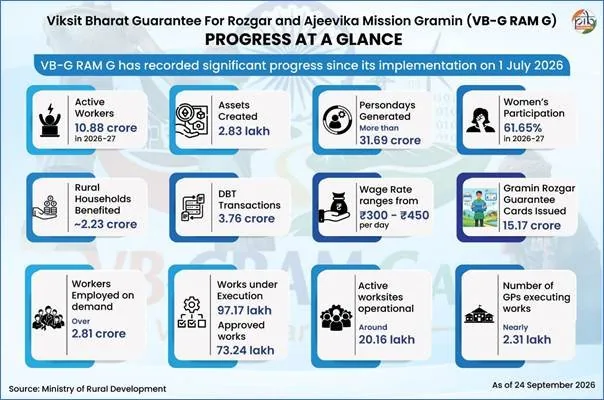
* The Viksit Bharat–Guarantee for Rozgar and Ajeevika Mission (Gramin) (VB-G RAM G) generated 31.69 crore person-days of employment, benefiting over 2.81 crore workers, with 61.65% women’s participation as of 24th September 2026, bringing into focus the implementation of the VB-G RAM G Act, 2025, which replaced MGNREGA on 1st July 2026.
What are the Key Features of the VB-G RAM G Act, 2025?
* **About:** The Viksit Bharat–Guarantee for Rozgar and Ajeevika Mission (Gramin) (VB-G RAM G) Act, 2025, effective from 1st July 2026, replaced MGNREGA to strengthen rural employment, livelihood security and productive asset creation, aligned with Viksit Bharat @2047.
* **Employment Guarantee:** Provides a statutory guarantee of 125 days of wage employment per financial year, increased from 100 days under MGNREGA, to every eligible rural household whose adult members volunteer for unskilled manual work.
* **Priority Areas:**
* Focuses on four thematic areas to promote sustainable and resilient rural development:
* **Water Security:** Water conservation and related infrastructure.
* **Core Rural Infrastructure:** Development of essential rural assets.
* **Livelihood-related Infrastructure:** Creation of productive assets supporting rural livelihoods.
* **Extreme Weather Mitigation:** Works to strengthen resilience against climate-related disasters.
* **Decentralised Planning:**
* Introduces Viksit Gram Panchayat Plans (VGPPs), prepared by Gram Panchayats and approved by Gram Sabhas through participatory planning, ensuring that works reflect local development needs.
* Promotes a Whole-of-Government approach through convergence of Central, State and local schemes under a single-plan, multi-funding framework.
* **Employment and Wage Protection:**
* Employment must be provided within 15 days of application, failing which workers are entitled to unemployment allowance.
* Wages are paid through Direct Benefit Transfer (DBT), generally within a fortnight after closure of the muster roll, with compensation for delays.
* Employment is preferably provided within 5 km of the applicant's village, with an additional 10% wage allowance for work beyond this distance but within the block.
* **Funding Pattern:** Provides Central–State cost sharing of 90:10 for North-Eastern and Himalayan States, 60:40 for other States/UTs with legislatures, and 100% Central funding for UTs without legislatures.
* **Transparency and Accountability:** Introduces face authentication-based attendance, public disclosure of work and payment details, and mandatory Janata Boards at worksites to improve monitoring and accountability.
* **Agricultural Labour Availability:** States are required to notify periods during peak sowing and harvesting seasons when works under the Act will not be undertaken, ensuring labour availability for agricultural activities.
* **Technology-Enabled Transparency and Governance:** Integrates e-KYC, face authentication, geo-tagging, electronic Measurement Books (e-MB), real-time dashboards and AI-enabled analytics for worker verification, work monitoring, transparent asset creation and data-driven oversight. Mandatory Janata Boards and public disclosures further strengthen accountability.
**What are Viksit Gram Panchayat Plans (VGPPs)?**
* **About:**
* Viksit Gram Panchayat Plans (VGPPs) are participatory, evidence-based and convergence-driven local development plans under the VB-G RAM G Act, 2025, aimed at integrating rural employment generation with sustainable infrastructure and asset creation.
* They are prepared by Gram Panchayats and approved by Gram Sabhas, ensuring bottom-up planning based on local needs and development priorities.
* **Key Features:**
* **Asset Mapping and Gap Assessment:** Identify existing infrastructure, public assets and service delivery gaps to prioritise development works and avoid duplication.
* **GIS-Based Planning:** Use Yuktdhara, PM Gati Shakti, Geographic Information System (GIS) and other digital tools for geospatial mapping, integrated planning and evidence-based decision-making.
* **Scheme Convergence:** Adopt a Whole-of-Government approach, integrating resources and interventions from Central, State and local schemes for coordinated village development.
* **Multi-level Integration:** VGPPs are consolidated at the Block, District, State and National levels, contributing to the Viksit Bharat National Rural Infrastructure Stack.
* **Permissible Works:** The VGPP framework identifies 318 types of permissible works across four thematic areas: water security, core rural infrastructure, livelihood-related infrastructure and extreme weather mitigation.
* **Significance:** VGPPs strengthen decentralised governance, participatory planning, efficient resource utilisation and sustainable rural infrastructure development, while linking employment generation with long-term community assets.
**Conclusion**
* The VB-G RAM G Act, 2025 represents a shift towards integrating statutory employment guarantees, participatory grassroots planning and productive rural asset creation. Its long-term effectiveness will depend on timely employment provision, transparent wage payments, strong Gram Panchayat capacity and inclusive digital governance, ensuring that rural development remains both employment-oriented and sustainable.
## Science & Technology
### Immersive Technologies and India's AVGC-XR Ecosystem
[Source](https://www.drishtiias.com/current-affairs-news-analysis-editorials/news-analysis/27-10-2026#38284)
**Why in News?**
* India is advancing the adoption of immersive technologies, driven by AI, high-speed connectivity and computing, to transform education, healthcare, urban planning and the creative economy, strengthening its potential as a global hub for immersive innovation.
**What are the Key Facts About Immersive Technologies?**
* **About:** Immersive technologies create interactive, realistic digital experiences by combining physical and virtual environments or simulating real-world settings. They engage multiple senses, enabling users to interact with digital objects and experience a greater sense of presence.
* **Extended Reality (XR):**
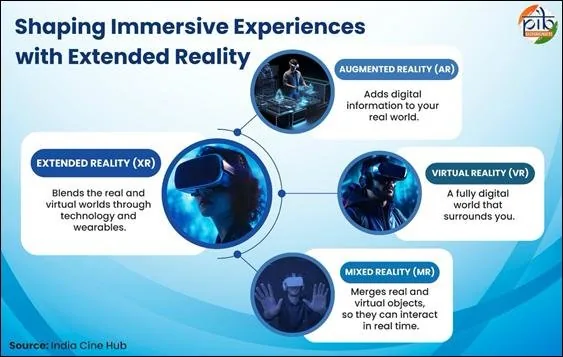
* An umbrella term encompassing Virtual Reality (VR), Augmented Reality (AR) and Mixed Reality (MR).
* **Virtual Reality (VR):** Creates a completely computer-generated environment, allowing users to experience and interact with simulated surroundings through specialised devices.
* **Augmented Reality (AR):** Superimposes digital information, images or three-dimensional objects onto the physical environment while keeping the real world visible.
* **Mixed Reality (MR):** Integrates physical and virtual environments, allowing digital objects to interact with real-world surroundings.
* **Related Technologies:**
* **360-Degree Video:** Enables users to explore recorded environments by changing their viewing direction.
* **Haptic Technology:** Uses vibrations, pressure or other tactile sensations to simulate physical touch during digital interactions.
* **Digital Twin:** A data-driven virtual representation of a physical object, system or location that enables real-time monitoring, simulation and predictive analysis. It can be integrated with XR technologies for immersive visualisation.
* **Enabling Technologies:** Advances in Artificial Intelligence (AI), high-speed connectivity and computing support the development of immersive experiences across education, healthcare, tourism, gaming and other sectors.
* **Market Potential:** According to market estimates, India's immersive technology market generated approximately USD 1.26 billion in 2023 and is projected to reach USD 7.82 billion by 2030, growing at a CAGR of 29.8%, making India a potentially fast-growing market in the Asia-Pacific region.
What are the Key Applications of Immersive Technologies in India?
* **Education and Skill Development:**
* AR/VR-based simulations enable experiential learning and interactive visualisation of complex concepts improving student engagement and understanding.
* IIT Madras is developing AR/VR-enabled learning solutions for rural secondary schools, allowing students to explore subjects such as history, science and languages through virtual environments.
* **Healthcare and Medical Training:** Immersive simulations support surgical simulations, medical education and clinical skill development through realistic virtual environments, enabling risk-free practice and improved training.
* **Cultural Heritage and Tourism:**
* Digital museums, virtual tours and AR experiences help preserve heritage and improve accessibility.
* The JATAN software has facilitated the digitisation of collections at eight national-level museums and two Archaeological Survey of India (ASI) museums, accessible through the Museums of India digital repository.
* Indian Museum, Kolkata, and ASI museums at Hampi and Nalanda use interactive digital and virtual visitor experiences.
* **Urban Planning and Infrastructure:**
* Digital twins, AI, 5G and Internet of Things (IoT) enable simulation-based infrastructure planning and management.
* **The Department of Telecommunications' Sangam:** Digital Twin initiative supports digital infrastructure modelling, while the Varanasi Urban 3D Spatial Planning Project demonstrates its application in urban planning.
* **National Digital Twin Vision:** India aims to develop a National Digital Twin for major urban centres by 2035, supporting data-driven urban planning and infrastructure management.
* **Transport and Mobility Management:**
* Digital twins can analyse commuting patterns, transport demand and tourist movement to improve infrastructure and mobility planning.
* A Mobility Digital Twin, demonstrated at India Mobile Congress 2025, analysed mobility patterns in Delhi and tourist flows in Ayodhya.
* **Creative Economy and Entertainment:** AR, VR and spatial computing support gaming, animation, virtual production and interactive media, creating opportunities for skilled employment and digital entrepreneurship.
What are the Key Government Initiatives Promoting Immersive Technologies?
* Immersive technologies are supported through India's broader Animation, Visual Effects, Gaming, Comics and Extended Reality (AVGC-XR) framework, focusing on skill development, innovation, startups and digital content creation.
* **AVGC Promotion Task Force:** Constituted by the Ministry of Information and Broadcasting (MIB) in April 2022 to strengthen the AVGC ecosystem through public-private collaboration, inter-ministerial coordination and integrated sectoral development.
* **Indian Institute of Creative Technologies (IICT):** Established in Mumbai in 2025 as a National Centre of Excellence for AVGC-XR education, training and innovation following the Task Force's recommendations. It collaborates with global technology companies such as Google, Meta, Adobe and Netflix.
* **AVGC Content Creator Labs:** The Union Budget 2026–27 allocated ₹250 to establish labs in 15,000 secondary schools and 500 colleges, with IICT Mumbai as the nodal implementing agency, to develop practical skills in animation, visual effects, gaming and digital content creation.
* **GENESIS Scheme(Gen-Next Support for Innovative Startups):** Launched in 2022 by the Ministry of Electronics and Information Technology (MeitY) to support approximately 1,600 technology startups over five years, particularly in Tier-II and Tier-III cities.
* **WaveX:** A media-tech startup accelerator and incubator launched by the Ministry of Information and Broadcasting to support startups developing AVGC-XR and emerging media technologies.
* **Emerging Science, Technology and Innovation Conclave (ESTIC) 2026:** Scheduled for 27th–29th October 2026 at Bharat Mandapam, New Delhi, organised by CSIR under the theme “Creative Minds, Catalyzing Science, Empowering Technologies.”
**States Leading India’s AVGC-XR Growth Story**
* **Karnataka:** AVGC-XR Policy 3.0 supports skill development, infrastructure, production grants and financial incentives. Its KITVEN AVGC Fund has a ₹20-crore corpus.
* **Maharashtra:** AVGC-XR Policy 2025 has a ₹3,268-crore financial plan and a long-term vision up to 2050, focusing on ecosystem development and infrastructure.
* **Telangana:** The 2016 IMAGE Policy established a dedicated AVGC framework around Hyderabad’s IMAGE Tower, supporting 150+ AVGC/VFX companies, 30,000 direct jobs and 100 startups.
* **Tamil Nadu:** AVGC-XR Policy 2026 targets 200+ startups, 2 lakh jobs and up to 20% of India’s AVGC-XR market by 2030, supported by a hub-and-spoke Centre of Excellence model.
* **Kerala:** AVGC-XR Policy 2024 focuses on specialised skills and industry-aligned education, with a target of creating 50,000 jobs by 2029.
* **Madhya Pradesh:** AVGC-XR Policy 2025 promotes Centres of Excellence, AVGC-XR labs, skilling and investment incentives, including support for IP creation.
* **Uttar Pradesh:** An AVGC-XR Park in Jewar is being developed with facilities for animation, VFX, gaming, motion capture and virtual production.
* **Rajasthan:** AVGC-XR Policy 2024 provides production incentives of up to ₹50 lakh for eligible animation/VFX/AR/VR projects and ₹1 crore for eligible game development.
* **Gujarat:** Gujarat is preparing a comprehensive AVGC-XR policy focused on infrastructure, skilling and startups, supported by 16 institutions offering Animation, VFX and Gaming courses.
**Conclusion**
* Immersive technologies are transforming interactions between the physical and digital worlds, creating new opportunities in education, healthcare, governance and the creative economy. Strengthening India's AVGC-XR ecosystem through skilling, research, startup support and indigenous innovation can promote digital inclusion and support the vision of Viksit Bharat 2047.
## Security
### Long-Term Strategic Vision and Land Warfare Doctrine
[Source](https://www.drishtiias.com/current-affairs-news-analysis-editorials/news-analysis/27-10-2026#38280)
The Defence Minister addressed the Army Commanders' Conference in New Delhi, where he unveiled the Land Warfare Doctrine 2026.
* **Need for a 20-30 Year Vision:**
* Given the rapid shifts in global geopolitics and military technology, the Defence Minister stressed that ad-hoc planning must be replaced with a long-term strategic blueprint (20-30 years) to future-proof the armed forces.
* Emphasizing that modern warfare is constantly evolving, noted that military strategies cannot be static. They must remain highly flexible and dynamic to enable timely adjustments to changing operational circumstances.
* **Year of Reforms:** Referring to 2025 as the 'Year of Reforms,' the Defence Minister urged commanders to ensure that structural and administrative reforms translate into tangible operational capabilities on the ground.
* **Multi-Domain Operations (MDO):** Emphasised jointness across military branches, the continued importance of ground forces, and the integration of emerging technologies such as Artificial Intelligence (AI), autonomous weapon systems (drones), data analytics, cybersecurity, and secure communication networks.
* **Aatmanirbharta in Defence (Self-Reliance):** Celebrated massive milestones in indigenisation, noting that defence production reached a record Rs 1.78 lakh crore and defence exports hit an all-time high of Rs 38,000 crore in FY 2025-26.
* **Global Peacekeeping Footprint:** Released the annual United Nations Journal and felicitated Indian Army personnel for their exemplary contributions to UN Peacekeeping missions and international security.
**Land Warfare Doctrine 2026**
* **About:** The land warfare doctrine provides a strategic framework for preparing and conducting land-based operations, integrating unmanned systems, manned-unmanned teaming (MUM-T), and resilient logistics to address future conflicts.
* **Strategic Context:** The doctrine updates the previous 2018 version, drawing crucial lessons from the prolonged standoff with China along the Line of Actual Control (LAC), recent global conflicts (Russia-Ukraine, Iran-US), and Operation Sindoor against Pakistan.
* **Centrality of Land Power:** Despite the rise of new warfare domains, the doctrine reiterates the continued centrality of land power in achieving decisive military and political outcomes.
## Space
### NVS-03 and NavIC Navigation System
[Source](https://www.drishtiias.com/current-affairs-news-analysis-editorials/news-analysis/27-10-2026#38283)
**Why in News?**
* The Indian Space Research Organisation (ISRO) is set to launch the NVS-03 navigation satellite aboard the GSLV-F18 (Mk II) rocket from Sriharikota, Andhra Pradesh. This crucial mission is intended to restore and strengthen the capabilities of India's indigenous navigation system, NavIC (Navigation with Indian Constellation), following a shortage of operational satellites in orbit.
**What are the Key Facts About the NVS-03?**
* **About:** NVS-03 is the third satellite in ISRO's second-generation NVS series, designed to replace the ageing first-generation IRNSS satellites. It has a planned mission life of 12 years.
* **Restoration of Navigation Services:** Following successful orbital deployment and commissioning, NVS-03 could increase the number of operational NavIC satellites from three to four, meeting the minimum requirement for basic standalone positioning.
* **Indigenous Rubidium Clock:**
* A standout feature is the inclusion of a highly stable, indigenous Rubidium atomic clock developed by the Space Applications Centre (SAC) in Ahmedabad.
* This was developed to solve the issues caused by the failure of imported atomic clocks in earlier satellites.
* **L1 Band for Civilians:** Unlike the earlier generation, NVS-03 incorporates the civilian L1-band signal (along with L5 and S bands). This makes the satellite compatible with modern commercial platforms like smartphones, smartwatches, and fitness trackers.
**What is the NavIC System?**
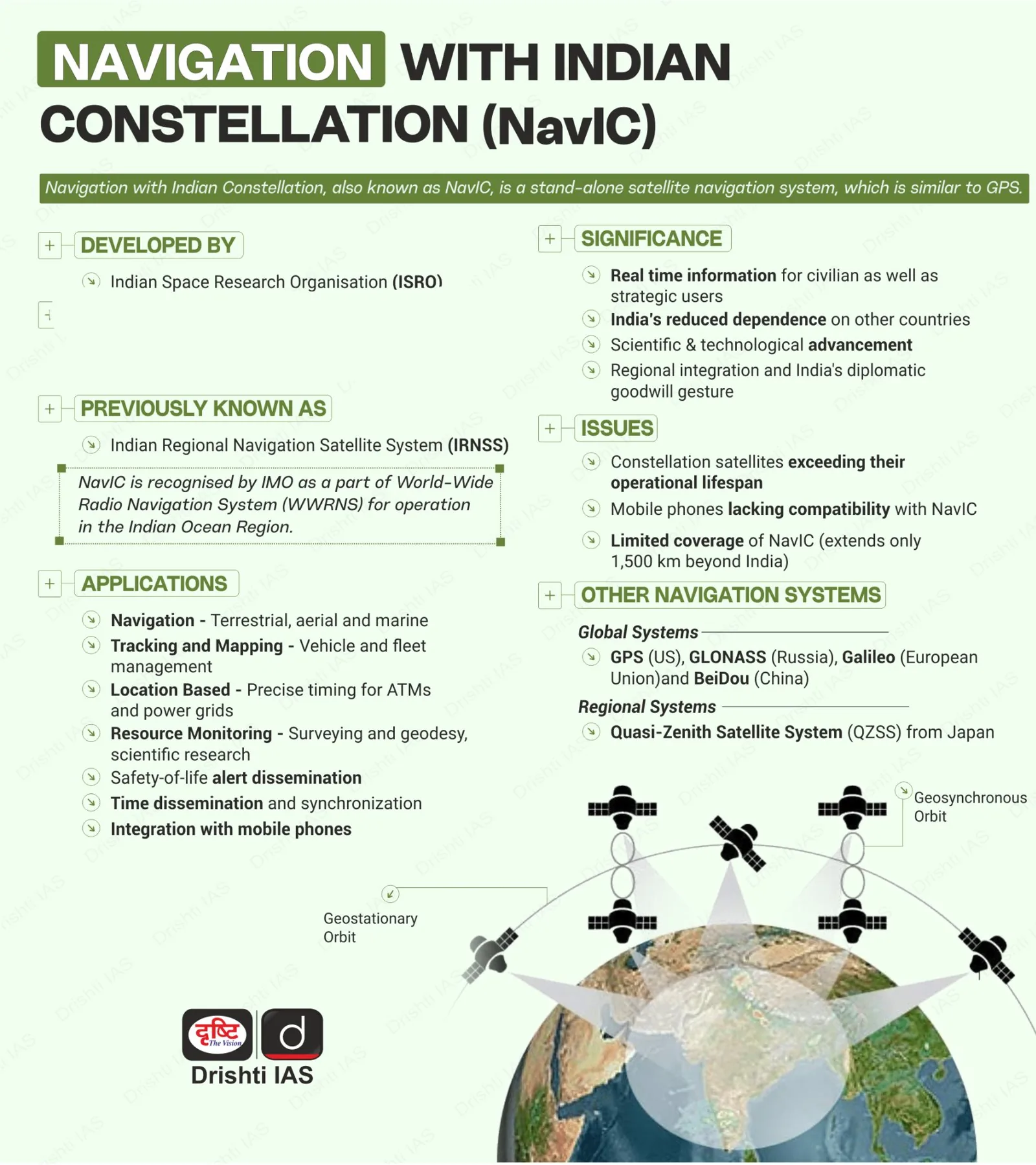
* **About:** The NavIC is the operational name of the Indian Regional Navigation Satellite System (IRNSS), an indigenous regional satellite-based navigation system developed by ISRO to provide precise positioning and navigation services and enhance India’s strategic autonomy.
* **System Architecture:** NavIC comprises three segments: Space Segment (navigation satellites), Ground Segment (satellite control, monitoring and timing infrastructure) and User Segment (single-frequency, multi-frequency and multi-constellation receivers).
* **Service Areas:**
* NavIC covers a Primary Service Area encompassing India and up to 1,500 km beyond its borders.
* It also features an Extended Service Area falling between the primary region and a rectangle bounded by 30° South to 50° North latitude and 30° East to 130° East longitude.
* **Navigation Services:**
* NavIC offers Standard Positioning Service (SPS) for civilian users and encrypted Restricted Service (RS) for authorised users, including strategic and defence applications.
* Its SPS is designed to provide positioning accuracy better than 20 metres and timing accuracy better than 40 nanoseconds (2σ) in the primary service area.
* **First Generation (IRNSS Series - 2013 to 2018):**
* It comprised the IRNSS-1 series (1A, 1B, 1C, 1D, 1E, 1F, 1G) with a 10-year mission life.
* **Setbacks:** IRNSS-1H (2017) failed to reach orbit due to a heat shield separation failure. It was subsequently replaced by the successful launch of IRNSS-1I in 2018.
* Many satellites in this series have suffered from imported atomic clock failures or are nearing the end of their mission lifespan.
* **Second Generation (NVS Series):**
* Developed to enhance reliability, these satellites feature an upgraded 12-year mission life and broadcast in a new L1 frequency band (along with L5 and S bands).
* The L1 band enables interoperability with global systems like GPS and allows integration into low-power civilian wearables like smartwatches.
* **NVS-01 (Launched 2023):** Currently operational, it successfully hosts an indigenously developed rubidium atomic clock.
* **NVS-02 (Launched 2025):** NVS- 02 faced onboard technical issues preventing it from reaching its final operational orbit. (NVS-04, and NVS-05 are planned for the future).
* **Current Constellation Status :**
* A fully operational NavIC system is designed to have a constellation of seven satellites (three in Geostationary Orbit and four in Inclined Geosynchronous Orbit).
* Following the completion of IRNSS-1F’s 10-year mission, NavIC has three operational satellites (IRNSS-1B, IRNSS-1I and NVS-01).
* **Four-Satellite Requirement:** A navigation receiver generally needs signals from at least four satellites to determine latitude, longitude, altitude and receiver clock error, enabling reliable three-dimensional positioning.
* **Residual Services:** Despite the loss of standalone positioning, NavIC continues to provide timing services, while some satellites retain one-way messaging capabilities useful for maritime safety and emergency alerts.
* **Indigenous Tech Integration:** NavIC receivers are slated to integrate the AJIT microprocessor, which is the first-ever microprocessor conceptualised and developed in India by IIT Bombay.
* **Policy and Global Recognition:**
* NavIC tracking is mandatory for commercial vehicles (registered from 1st April 2019) in India.
* Furthermore, the US recognized it as an allied navigation system in 2019.
* **International Recognition:** The International Maritime Organization (IMO) has recognised NavIC as a component of the World-Wide Radio Navigation System (WWRNS), supporting its use in maritime navigation.
**What are the Concerns Regarding the NavIC System?**
* **Threat to Strategic Autonomy:** Conceived after the US denied GPS access during the 1999 Kargil War, any NavIC downtime forces the Armed Forces and critical infrastructure (power grids, high-frequency financial trading, railways) to rely on foreign systems during geopolitical crises.
* **Electronic Warfare Risks:** NavIC signals remain vulnerable to localized jamming and spoofing (manipulating signals to feed false locations), requiring constant cryptographic upgrades to its military-grade Restricted Service (RS).
* **Import Reliance & Atomic Clock Failures:** Navigation requires microsecond precision. The premature failure of imported rubidium atomic clocks in early IRNSS satellites crippled the system, highlighting the vulnerability of depending on foreign critical components.
* **CAG Report Indictment:** A Comptroller and Auditor-General of India (CAG) highlighted severe delays in the development of consumer-end receivers began years late, effectively wasting a massive chunk of the early satellites' mission life before civilians could even use the system.
* **Global Competition:** As a strictly regional system, NavIC struggles to attract international tech manufacturers (like Apple or Qualcomm) who prefer to integrate global systems with larger economies of scale, such as GPS (US), Galileo (Europe), or BeiDou (China).
What Measures are Needed to Strengthen India’s Regional Navigation System?
* **Ensure Launch Continuity:** ISRO must successfully deploy the remaining NVS series satellites (NVS-04, NVS-05) to maintain redundant satellites in orbit and prevent future service blackouts.
* **Indigenisation of Critical Components:** The successful deployment of the indigenous Rubidium Atomic Clocks, must be standard across all future NVS series satellites to end import reliance.
* **Ecosystem Development:** The government should incentivize the domestic manufacturing of NavIC-compatible chipsets and receivers to drive civilian adoption and make it the default navigation system in Indian smartphones
* **Global Expansion:** As outlined in the 2021 satellite navigation draft policy, the long-term vision should be to expand NavIC's coverage from a regional system into a fully-fledged Global Navigation Satellite System (GNSS).
* **Leverage for Space Diplomacy:** India should proactively offer NavIC positioning services to friendly neighboring countries in the SAARC, BIMSTEC, and ASEAN regions. This acts as a soft-power counterweight to China’s aggressive expansion of its BeiDou system in the Indo-Pacific.
* **Interoperability Pacts:** Sign agreements with allied global systems (like Europe’s Galileo and Japan's QZSS) to ensure seamless signal interoperability for users transitioning between different geographic zones.
**Conclusion**
* The ongoing transition to the second-generation NVS series, featuring indigenous atomic clocks and L1 civilian frequencies, will strengthen NavIC’s reliability, self-reliance, and global usability, reinforcing its role in India’s strategic autonomy and expanding commercial space capabilities.
This documentation is built and hosted on [Mintlify](https://mintlify.com), a developer documentation platform.