> ## Documentation Index
> Fetch the complete documentation index at: https://signals.joincomrades.com/llms.txt
> Use this file to discover all available pages before exploring further.
# 28 Oct 2026 · Dispatch
> Comrades Dispatch of 28 Oct 2026, by news group.
> **[Comrades Dispatch · 28 Oct 2026 (PDF)](https://dl.joincomrades.com/d/28-10-26)**
***
## In this edition
1. [RBI Urges States to Adopt Prudent Borrowing for Fiscal Sustainability](#h-1) Banking & Finance
2. [India’s Core Sector Records Strong Growth](#h-2) Economic Scenario
3. [Carbon Capture, Utilisation and Storage (CCUS) in India](#h-3) Environment & Ecology
4. [Janjatiya Gaurav Pakhwada 2026](#h-4) Important Days
5. [India-Middle East-Europe Economic Corridor to Boost Regional Connectivity](#h-5) International Relations
6. [Exercise Garuda Shakti 2026](#h-6) Military Exercises
7. [Atal Vayo Abhyuday Yojana (AVYAY)](#h-7) Schemes & Initiatives
8. [Democratizing AI for Inclusive Growth in India](#h-8) Science & Technology
9. [Decoding the Genetics of Personality](#h-9) Science & Technology
## Banking & Finance
### RBI Urges States to Adopt Prudent Borrowing for Fiscal Sustainability
[Source](https://www.drishtiias.com/current-affairs-news-analysis-editorials/news-analysis/28-10-2026#38311)
**Why in News?**
* The Reserve Bank of India (RBI) Governor, while addressing the 36th Conference of State Finance Secretaries, urged State governments to adopt prudent borrowing strategies and efficient cash management practices to maintain their long-term fiscal health.
**What is Prudent Borrowing?**
* **About:**
* Prudent borrowing refers to a fiscal management strategy where a government limits its debt intake strictly to its long-term repayment capacity, ensuring that the borrowed funds are utilized efficiently.
* A core tenet of prudent borrowing is the "Golden Rule of Public Finance" borrowing should primarily be directed toward Capital Expenditure (Capex) (infrastructure, health, and education facilities) that generates future revenue, rather than Revenue Expenditure (day-to-day administrative costs or non-merit subsidies).
* **Effective Cash Management:** Prudent Borrowing involves aligning the borrowing calendar with actual cash-flow mismatches, preventing the accumulation of idle cash balances that incur unnecessary interest costs.
* Significance of Prudent Borrowing
* **Macroeconomic Stability:** It prevents the "crowding out" effect, ensuring that the government does not absorb the entire domestic credit pool, thereby leaving adequate and affordable credit for the private sector.
* **Fiscal Space for Welfare:**
* A large debt stock leads to massive interest payments. Currently, a significant portion of the Union and State revenue receipts is consumed merely by servicing debt.
* Lower debt through Prudent Borrowing lowers interest payment obligations, freeing up the budget (fiscal space) for critical developmental sectors like public health, green transitions, and education.
* **Vulnerability to Sovereign Downgrades:** High debt-to-GDP ratios keep sovereign credit ratings in the lower investment grades (e.g., BBB-), making external commercial borrowings expensive for Indian corporates.
* **Inflationary Pressures:** Unchecked fiscal deficits, if monetised, or if they drive up aggregate demand without commensurate supply, can lead to persistent structural inflation.
* **Inter-Generational Equity:** Prudent borrowing ensures that current consumption is not financed by imposing an unsustainable tax burden on future generations.
What is the Current State of Fiscal Health of Indian States?
* While the consolidated General Government Debt (Centre + States) hovers around 81- 85% of GDP, state government debt accounts for a massive one-third of this overall figure. The fiscal health across states is highly asymmetric, characterised by the following trends:
* **Elevated and Divergent Debt-to-GSDP Ratios:**
* Aggregate state debt stood at 29.2% of GDP at the end of March 2026, remaining significantly above the 20% prudence limit recommended by the FRBM Review Committee.
* **Highly Stressed States:** States like Punjab and West Bengal struggle with severe fiscal stress, carrying debt burdens near or above 40% of their GSDP.
* **The Prudent Performers:** Conversely, Gujarat, Maharashtra, and Odisha have successfully contained their debt-to-GSDP ratios within the 20% limit.
* **Consolidation Efforts:** States such as Kerala (35.5%) and Tamil Nadu (29.2%) have shown fiscal discipline, reducing their outstanding liabilities by nearly 4 to 5 percentage points since 2021.
* **Breaching Fiscal Deficit Targets:**
* The states' consolidated Gross Fiscal Deficit (GFD) has widened and is budgeted at 3.3% of GDP for FY 2025-26.
* Alarmingly, 16 states budgeted a GFD exceeding the standard 3% limit, driven largely by a decline in central grants and revenue shortfalls.
* **Rising Cost of Borrowing & Expenditure Rigidity:**
* The sharp rise in government bond yields in October 2026 threatens to inflate the cost of financing state deficits.
* Furthermore, states are trapped by high committed expenditures collectively spending over 60% of their revenue receipts strictly on interest payments, salaries, pensions, and subsidies. This leaves minimal fiscal space for discretionary developmental projects.
* **Crucial Role in the Economy:**
* States account for two-thirds of total public spending and one-third of total revenue in India.
* Their fiscal performance, particularly their capacity to sustain Capital Expenditure (Capex) currently heavily supported by the Centre's 50-year interest-free loans under the SASCI scheme is central to the nation's long-term developmental trajectory.
What are the Key Issues in Current Borrowing Practices of States?
* **Off-Budget Borrowings:** States frequently bypass the Fiscal Responsibility and Budget Management (FRBM) borrowing limits by raising funds through State Public Sector Enterprises (SPSEs) or Special Purpose Vehicles (SPVs). These loans are often backed by state government guarantees, circumventing legislative scrutiny.
* **Revenue vs. Capital Expenditure:**
* Borrowing is economically justified if utilized for Capex, which creates income-generating assets and has a high fiscal multiplier (approx. 2.45).
* However, states increasingly borrow to fund Revenue Expenditure (subsidies, loan waivers, and freebies), which yields no or less future returns.
* **Contingent Liabilities:** State guarantees to DISCOMs (power distribution companies) remain a ticking fiscal time bomb, threatening to devolve onto state budgets if these entities default.
* **Market Volatility:** Uncalibrated borrowing calendars by the Centre and States can lead to sudden spikes in bond yields, disrupting the bond market and monetary policy transmission.
What Measures are Needed for Sustaining Long-Term Fiscal Health of States?
* **Leveraging Digital Financial Platforms:**
* As advised by the RBI Governor, states must onboard onto the Unified Lending Interface (ULI) and utilize Programmable CBDC (P-CBDC) for Direct Benefit Transfers.
* Programmable CBDCs can ensure that welfare funds are strictly utilized for their intended purpose, plugging leakages and enhancing the efficiency of public spending.
* **Effective Use of the SLBC Forum:**
* The State Level Bankers’ Committee (SLBC) is a vital inter-institutional forum for coordinating banking and development.
* States must actively use SLBCs to monitor credit disbursement, resolve bottlenecks in priority sector lending, and improve rural infrastructure financing, thereby stimulating local economic growth and increasing state revenues.
* **Strict Adherence to FRBM Targets:** States must strictly adhere to the fiscal deficit glide path mandated by their respective State Fiscal Responsibility Legislations (typically capped at 3 to 3.5% of GSDP).
* **Establishing an Independent Fiscal Council:** As recommended by the 13th and 14th Finance Commissions and the N.K. Singh Committee (2016), an independent Fiscal Council should be established to assess government forecasts, ensure debt sustainability, and bring transparency to off-budget financing.
* **Capping Off-Budget Borrowings:**
* The RBI and the Ministry of Finance must enforce strict accounting standards.
* The move by the Union Government to equate state off-budget borrowings with their standard borrowing limits under Article 293(3) is a positive step.
* **Dynamic Debt Management:**
* States should adopt the practices outlined in the RBI's 'Compendium on Cash and Debt Management'.
* This includes aligning market borrowings accurately with expenditure needs and adopting the Benchmark Issuance Strategy to improve liquidity and yield curves.
**Conclusion**
* Prudent borrowing is not synonymous with zero borrowing; rather, it is about maintaining a delicate balance between leveraging debt for productive capital formation and avoiding the debt trap of consumption-led borrowing. As India navigates the Amrit Kaal towards becoming a developed nation, institutionalizing fiscal discipline and inter-generational equity will be the bedrock of its macroeconomic resilience.
## Economic Scenario
### India’s Core Sector Records Strong Growth
[Source](https://www.drishtiias.com/current-affairs-news-analysis-editorials/news-analysis/28-10-2026#38314)
India’s core industrial growth rose to 7.9% in September 2026, the highest under the new series since at least April 2024.
* **Major Drivers:** Growth was led by iron ore (18.4%), electricity (11.4%), coal (10.7%) and refinery products (10.3%).
* **About Core Industries:**
* The Index of Core Industries (ICI) tracks key infrastructure sectors and serves as an important indicator of overall industrial performance.
* The Index of Eight Core Industries (ICI) is compiled monthly by the Office of the Economic Adviser (OEA), under the Department for Promotion of Industry and Internal Trade (DPIIT), Ministry of Commerce and Industry.
* ICI is compiled on a monthly basis and the objective is to track the performance of key infrastructure industries.
* The base year of the Index of Core Industries (ICI) has been revised from 2011–12 to 2022–23 and Iron Ore has been included as the 9th core sector (following Praveen Mahto Committee’s recommendations).
* The 9 core industries are:
* Petroleum Refinery Products
* Electricity
* Steel
* Coal
* Crude Oil
* Natural Gas
* Cement
* Fertilizers
* Iron Ore
## Environment & Ecology
### Carbon Capture, Utilisation and Storage (CCUS) in India
[Source](https://www.drishtiias.com/current-affairs-news-analysis-editorials/news-analysis/28-10-2026#38318)
**Why in News?**
* India is strengthening its Carbon Capture, Utilisation and Storage (CCUS) ecosystem through research, industrial demonstration projects and a ₹20,000-crore government initiative to decarbonise hard-to-abate industries and support its Net Zero emissions target by 2070.
**What is Carbon Capture, Utilisation and Storage (CCUS)?**
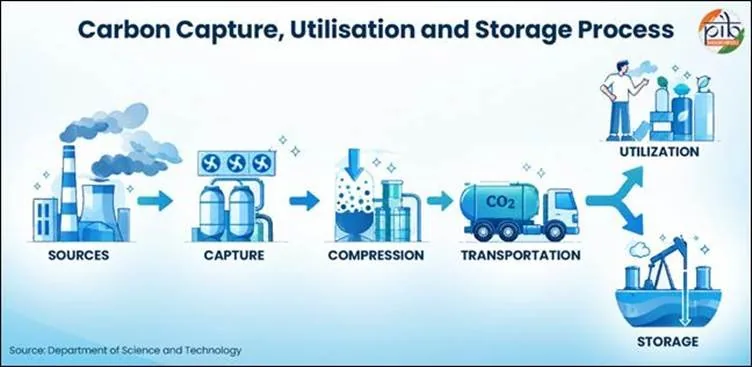
* **About:** CCUS is a set of technologies that capture carbon dioxide (CO₂) from industrial processes or energy-related emissions and subsequently utilise it in industrial applications or store it in geological formations, preventing its release into the atmosphere.
* **Objectives:** Supports industrial decarbonisation, carbon management, resource efficiency and emissions reduction, particularly in sectors where electrification alone cannot eliminate emissions.
* **Working Mechanism:**
* **Carbon Capture:** CO₂ is separated from industrial exhaust gases, followed by purification, drying and compression for transportation or utilisation.
* **Transportation:** Captured CO₂ is transported through pipelines, ships or other suitable modes to utilisation facilities or geological storage sites.
* **Carbon Utilisation:** Captured CO₂ is converted into useful industrial products or used as a feedstock in manufacturing processes.
* **Geological Storage:** CO₂ is injected deep underground into suitable geological formations for long-term isolation from the atmosphere.
* **Geological Storage Options:** Include depleted oil and gas reservoirs, deep saline aquifers and basaltic rock formations, where CO₂ can be trapped through physical and geochemical processes.
* **CCUS Hubs and Clusters:** The NITI Aayog framework promotes regional hubs connecting multiple industrial emitters with shared CO₂ transportation, utilisation and storage infrastructure to reduce costs and improve economies of scale.
**What are the Key Applications of CCUS?**
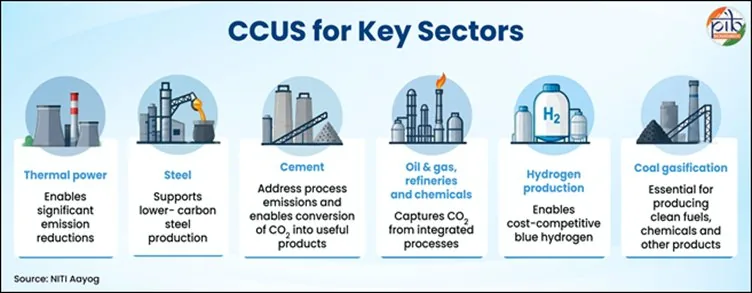
* **Decarbonising Hard-to-Abate Industries:** Captures process-related CO₂ emissions from steel, cement, refineries, chemicals and fertiliser industries, where electrification and renewable energy alone may not eliminate emissions. Emissions from these sectors and thermal power generation are projected to reach nearly 2,300 million tonnes annually by 2030.
* **Low-Carbon Hydrogen Production:**
* Supports blue hydrogen production by capturing CO₂ generated during hydrogen production from fossil fuels, including natural gas reforming and coal gasification.
* Green Hydrogen is produced through water electrolysis powered by renewable electricity, while Blue Hydrogen is produced from fossil fuels combined with carbon capture.
* **Carbon Utilisation in Industrial Products:** Converts captured CO₂ into useful products, including building materials, synthetic fuels, methanol, polymers and chemicals, promoting resource efficiency and a circular carbon economy.
* **Enhanced Oil Recovery (EOR):** Injects captured CO₂ into oil reservoirs to increase oil extraction while potentially storing a portion underground. Its net climate benefit depends on lifecycle emissions and permanent CO₂ retention.
* **Retrofitting Existing Infrastructure:** Enables thermal power plants and existing industrial facilities to incorporate carbon capture systems, reducing emissions without immediately replacing essential industrial infrastructure.
* **Carbon Mineralisation:** Reacts captured CO₂ with suitable minerals to form stable carbonates that can be used in construction materials, enabling long-term carbon storage.
* **Biological Carbon Utilisation:** Uses captured CO₂ in algae cultivation and biological processes to produce products such as biofuels and other biomass-derived materials.
**Major CCUS Demonstration Projects**
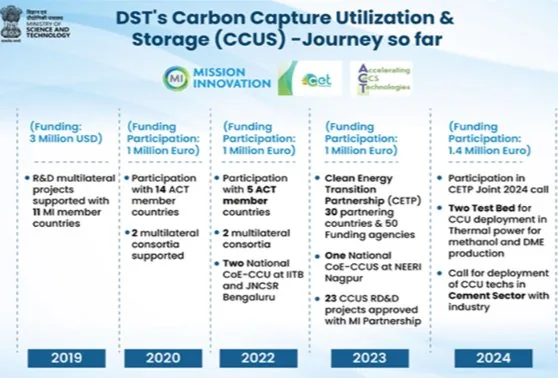
* **India's First Integrated Pilot-scale Facility:** Inaugurated at IIT Bombay in May 2026, with a capacity to capture up to 3 tonnes of CO₂ per day and convert it into carbonate and bicarbonate products. Planned scientific drilling in the Deccan Traps basalt formations will assess their potential for safe, long-term geological CO₂ storage.
* **CCU Testbeds for the Cement Industry:** The Department of Science and Technology (DST) launched India's first cluster of five CCU testbeds in May 2025, using a Public-Private Partnership (PPP) model involving cement companies and research institutions to demonstrate carbon capture, mineralisation and conversion into concrete-based products.
* **CCU Testbeds in Coal Gasification:** DST supports two pilot-scale industry–research collaborations involving IIT Delhi–Thermax Limited and CSIR-IICT Hyderabad–BHEL to demonstrate CO₂ utilisation in coal gasification facilities for producing methanol and Dimethyl Ether (DME).
* **International Research Partnerships:** DST participates in multinational platforms such as Accelerating CCUS Technologies (ACT) and the Clean Energy Transition Partnership (CETP), supporting four multilateral research consortia to advance CCUS technologies towards commercial readiness.
* **Expansion of India's CCU Project Pipeline:**
* As of April 2026, India had 3 operational, 6 under execution and 16 proposed CCU projects across various States.
* **Operational Projects (3):** One each in Madhya Pradesh, Tamil Nadu and Maharashtra.
* **Under Construction/Execution (6):** Andhra Pradesh (3), Telangana (2) and Maharashtra (1).
* **Proposed Projects (16):** Assam (4), Odisha (4), Gujarat (2) and Rajasthan (2), with one each in Andhra Pradesh, Madhya Pradesh, Haryana and Tamil Nadu.
What are the Key Government Initiatives to Promote CCUS in India?
* **Union Budget 2026–27 CCUS Initiative:** Proposed an outlay of ₹20,000 crore over five years to promote CCUS technology development and deployment across five sectors—Power, Steel, Cement, Refineries and Chemicals.
* **DST CCUS Research and Development Roadmap (2025):**
* Provides a framework for research funding, indigenous technology development, commercial readiness and industrial deployment of CCUS technologies.
* It identifies regions such as the Gujarat coast (refineries and chemicals), Odisha–Jharkhand belt (steel and cement) and Northeast India (oil and gas) for developing integrated CCUS infrastructure.
* **NITI Aayog CCUS Policy Framework (2022):** Outlines sector-specific strategies and policy mechanisms to support deep decarbonisation of hard-to-abate sectors, including the development of shared infrastructure.
* **National CCUS Centres (2022):** Established at IIT Bombay and Jawaharlal Nehru Centre for Advanced Scientific Research (JNCASR), Bengaluru, with DST support for research, pilot demonstrations and industry collaboration.
* **Mission Innovation Collaboration:** DST and the Department of Biotechnology (DBT) collaborate with international partners to develop technologies for CO₂ capture, separation, utilisation and secure storage.
* **Emerging Science, Technology and Innovation Conclave (ESTIC) 2026:** Organised by CSIR from 27–29 October 2026 at Bharat Mandapam, New Delhi, under the theme “Creative Minds, Catalyzing Science, Empowering Technologies.” It includes CCUS among emerging energy technologies.
**Conclusion**
* Carbon Capture, Utilisation and Storage (CCUS) can play a crucial role in advancing India's Panchamrit commitments and Net Zero target by 2070 by reducing emissions from hard-to-abate industries. Strengthening research, financing and industrial deployment can enhance resource efficiency, promote a circular carbon economy and accelerate India's transition towards sustainable, low-carbon growth.
## Important Days
### Janjatiya Gaurav Pakhwada 2026
[Source](https://www.drishtiias.com/current-affairs-news-analysis-editorials/news-analysis/28-10-2026#38317)
The Ministry of Tribal Affairs will observe Janjatiya Gaurav Pakhwada from 1st to 15th November 2026, culminating in Janjatiya Gaurav Diwas on 15th November, commemorating the birth anniversary of Dharti Aaba Bhagwan Birsa Munda.
* **About:** The Government of India designated 15th November as Janjatiya Gaurav Diwas in 2021 to honour the contributions of tribal freedom fighters and celebrate India's tribal heritage. Birsa Munda's 150th birth anniversary was commemorated through Janjatiya Gaurav Varsh (2024–25).
* **Tribal Development Projects:**
* Over 300 projects are planned across States, including 228 inaugurations and 74 foundation stone-laying ceremonies.
* Major projects include a Tribal Research Institute in Itanagar, Arunachal Pradesh, and the Ropuiliani Tribal Freedom Fighter Museum in Mizoram.
* **National Digital Initiatives:**
* **Jan-HIT Portal:** The Janjatiya Health Intelligence and Technology Portal, developed with ICMR, is proposed as India's first tribe-disaggregated health data platform, covering 20 States.
* **National FRA Digital Platform:** Will digitise the entire process of forest rights claims under the Forest Rights Act, 2006, from Gram Sabha applications to digitally signed titles.
* **Tribal Education and Cultural Promotion:**
* National Tribal Literary Festival in New Delhi to promote tribal literature and languages.
* **Adi Vaani Initiative:** A national workshop at IIT Delhi to strengthen the digital repository of tribal languages and preserve linguistic heritage.
* **Rani Durgavati Adivasi Mahila Sammelan:** Will bring together 500 tribal women entrepreneurs from 30 States/UTs to promote market linkages.
* **Community Outreach:** Under the Dharti Aaba Janbhagidari Abhiyan, through Adi Sewa Samay and Adi Sewa Din, around 1.54 lakh Adi Karmayogi volunteers across 76,963 villages are being trained to strengthen community participation and last-mile welfare delivery.
* **Health and Livelihood Initiatives:** Include health and nutrition camps for Particularly Vulnerable Tribal Groups (PVTGs), training for traditional tribal healers, scholarship assistance and conservation of 200–300 medicinal plant species with CSIR-NBRI Odisha.
* **State-Level Participation:** Over 160 activities across 19 States/UTs, including tribal cultural festivals, exhibitions, livelihood camps and awareness programmes.
## International Relations
### India-Middle East-Europe Economic Corridor to Boost Regional Connectivity
[Source](https://www.drishtiias.com/current-affairs-news-analysis-editorials/news-analysis/28-10-2026#38315)
**Why in News?**
* The India-Middle East-Europe Economic Corridor (IMEC) was highlighted by the External Affairs Minister as a key initiative to improve regional connectivity amid rising global competition and trade disruptions.
**What is India-Middle East-Europe Economic Corridor?**
* **About:**
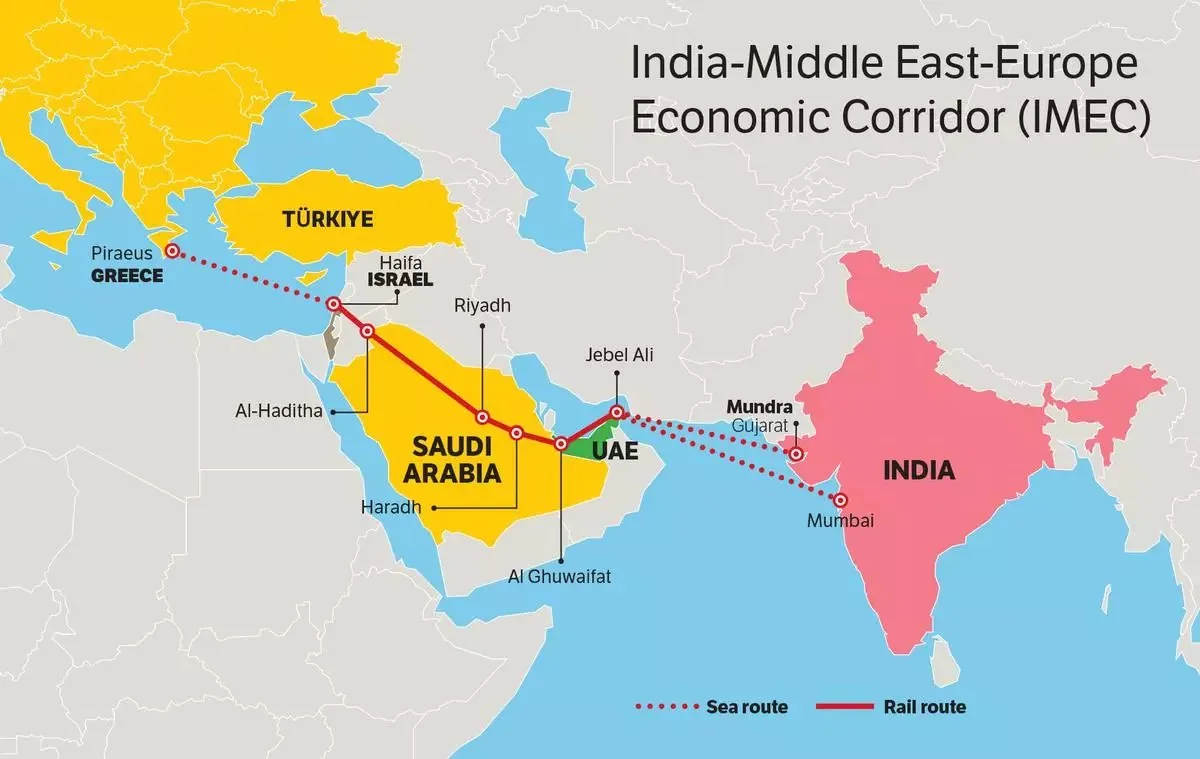
* IMEC is a proposed multimodal trade and connectivity corridor linking India, the Middle East and Europe through maritime routes, railways, energy pipelines and digital infrastructure.
* It was announced in 2023 at the G20 Summit in New Delhi through a Memorandum of Understanding (MoU).
* Eight participants signed the MoU: India, the United States (US), Saudi Arabia, the United Arab Emirates (UAE), France, Germany, Italy and the European Union (EU).
* It is linked to the Partnership for Global Infrastructure and Investment (PGII), launched by the G7 in 2022, and is viewed as a potential alternative to China's Belt and Road Initiative (BRI).
* **Corridors:**
* **Eastern Corridor:** Connects India to the Arabian Gulf through maritime routes.
* **Northern Corridor:** Connects the Arabian Gulf to Europe through rail and maritime networks.
* **Proposed Route:**
* India → UAE → Saudi Arabia → Jordan → Israel → Europe.
* Major proposed ports include Mundra (India), Jebel Ali (UAE), Haifa (Israel) and Piraeus (Greece).
What are the Other Major International Connectivity Projects Involving India?
* **International North–South Transport Corridor (INSTC):** A multi-modal transportation network that integrates ship, rail, and road routes for moving freight between India, Russia, Iran, Europe, and Central Asia.
* Kaladan Multimodal Transit Transport Project: Connects Kolkata Port in India with Sittwe Port in Myanmar through maritime, inland waterway, and road transport, improving connectivity to India's northeastern states.
* **India-Myanmar-Thailand Trilateral Highway:** A highway project linking Moreh in India with Mae Sot in Thailand through Myanmar to strengthen regional connectivity and trade with Southeast Asia.
## Military Exercises
### Exercise Garuda Shakti 2026
[Source](https://www.drishtiias.com/current-affairs-news-analysis-editorials/news-analysis/28-10-2026#38312)
The 11th edition of the India-Indonesia Joint Special Forces Exercise GARUDA SHAKTI commenced at Banyuwangi, Indonesia.
* **Participating Forces:** The Indian contingent comprises personnel from the Parachute Regiment (Special Forces) of the Indian Army, while the Indonesian contingent includes personnel from the Indonesian Special Forces.
* **Objective:** Strengthen mutual understanding, operational coordination and interoperability between the Special Forces of India and Indonesia.
* **Training Activities:** Jungle warfare tactics, obstacle crossing, combat marksmanship, mountaineering, air assault training, combat-hardening sessions and exchange of expertise on weapons, equipment and operational practices.
* **Validation Exercise:** The joint training will conclude with a simulated operational exercise to assess the endurance, coordination and combat readiness of both contingents.
* **Significance:** Strengthens India-Indonesia defence cooperation, promotes military interoperability and reinforces bilateral security ties in the Indo-Pacific region.
* **Other Exercises:** Samudra Shakti (bilateral naval exercise), IND-INDO CORPAT (coordinated naval patrol).
## Schemes & Initiatives
### Atal Vayo Abhyuday Yojana (AVYAY)
[Source](https://www.drishtiias.com/current-affairs-news-analysis-editorials/news-analysis/28-10-2026#38316)
**Why in News?**
* The Atal Vayo Abhyuday Yojana (AVYAY) is gaining significance amid India’s rapidly ageing population, rising geriatric care needs and weakening traditional family support systems.
What are the Key Facts About Atal Vayo Abhyuday Yojana?
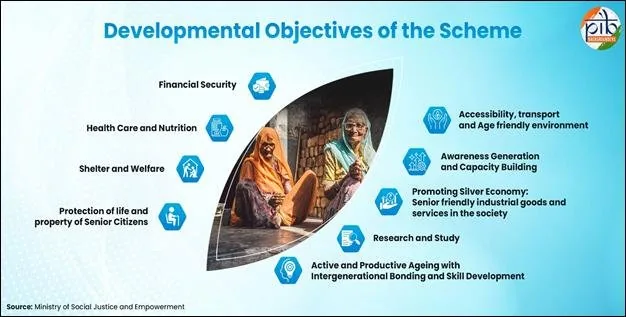
* **About:** Launched in 2021 by the Ministry of Social Justice and Empowerment, AVYAY is an umbrella scheme that subsumed the earlier National Action Plan for Senior Citizens (NAPSrC) to provide comprehensive welfare support to senior citizens.
* **Objectives:** Promotes healthy, dignified, secure and productive ageing through shelter, nutrition, healthcare, recreational facilities, community-based support and capacity building.
* **Ageing Population:** As per Census 2011, India had 10.38 crore senior citizens (aged 60+), comprising 5.11 crore males and 5.27 crore females, with the population projected to reach 23 crore by 2036.
* **Growing Care Needs:** Rapid urbanisation, migration and the rise of nuclear families are weakening traditional elderly support systems, increasing the need for geriatric care and institutional and community-based support.
* **Guiding Principles:**
* **Ageing with Dignity:** Ensuring respectful, inclusive and empowering care that safeguards the independence and well-being of senior citizens.
* **Ageing in Place:** Enabling elderly persons to live safely in their homes and communities through accessible infrastructure, assistive technologies and community-based support.
* **Institutional Framework:**
* **Nodal Ministry:** Ministry of Social Justice and Empowerment, through the Department of Social Justice and Empowerment.
* **State/UT Governments:** Prepare and implement state-specific elderly welfare plans under SAPSrC.
* **District-Level Committees:** Headed by the District Collector/Magistrate, oversee beneficiary selection and local monitoring.
* **Financial Support:** During 2026–27, ₹77.98 crore in grants-in-aid was released to 755 projects under the Integrated Programme for Senior Citizens (IPSrC) for the quarter ending September 2026.
* Monitoring and Accountability
* **Project Monitoring Unit (PMU):** Conducts periodic field inspections of IPSrC projects.
* **Financial Accountability:** NGOs submit progress reports, Utilisation Certificates (UCs) and audited financial statements.
* **Digital Monitoring:** Uses the e-Anudaan portal, cloud-based contactless biometric attendance and live CCTV feeds to enhance transparency and oversight.
What are the Key Components of Atal Vayo Abhyuday Yojana?
* Integrated Programme for Senior Citizens (IPSrC)
* **Objective:** Provides grants-in-aid to NGOs, Panchayati Raj Institutions and local bodies for developing and maintaining elderly care facilities.
* **Key Services:** Supports Senior Citizen Homes, Continuous Care Homes, Mobile Medicare Units, Physiotherapy Clinics and Regional Resource and Training Centres.
* **Achievements:** Currently supports 764 Senior Citizen Homes, 13 Continuous Care Homes, 17 Mobile Medicare Units and 3 Physiotherapy Clinics.
* **Institutional Care:** Prioritises shelter, nutrition, healthcare and recreational facilities for indigent senior citizens who lack adequate social and family support.
* State Action Plan for Senior Citizens (SAPSrC)
* **Objective:** Provides financial assistance to State and UT Governments for preparing and implementing locally appropriate senior citizen welfare programmes.
* **Major Interventions:** Includes training geriatric caregivers, conducting cataract surgery drives and strengthening elderly welfare infrastructure.
* **State-Level Flexibility:** Permits States to utilise up to 20% of their allocated funds for approved state-specific initiatives, supporting decentralised planning.
* Rashtriya Vayoshri Yojana (RVY)
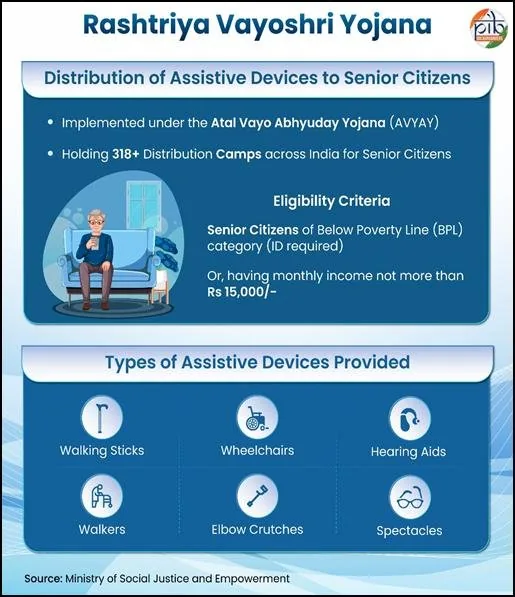
* **About:** Launched in 2017 and subsequently subsumed under AVYAY, the scheme provides assistive living devices to eligible elderly persons suffering from age-related disabilities or infirmities.
* **Implementation:** Devices are distributed through camps and Pradhan Mantri Divyasha Vayoshri Kendras (PMD-VKs) associated with the Artificial Limbs Manufacturing Corporation of India (ALIMCO).
* **Achievements:** Over 10.45 lakh senior citizens have benefited through the distribution of approximately 55.88 lakh assistive living devices.
* Regional Resource and Training Centres (RRTCs)
* **Objective:** Serve as regional institutional centres for capacity building, research, training, advocacy and monitoring of senior citizen welfare programmes.
* **Institutional Status:** RRTCs function as regional support structures under IPSrC rather than as an independent component of AVYAY.
* **Major Functions:** Support database development, project inspections, geriatric training and coordination between government agencies and implementing organisations.
* **Financial Assistance:** Each designated RRTC receives annual financial support of approximately ₹19.58 lakh under the scheme guidelines.
What are the Major Digital and Support Initiatives for Senior Citizens?
* **Elderline (14567):**
* Launched in October 2021, the National Helpline for Senior Citizens provides free information, guidance, emotional support, grievance redressal and field intervention.
* It has received over 8.66 lakh actionable calls, facilitating assistance through district authorities and NGOs.
* **JEEVAN Mobile Application:**
* Launched in May 2026, the Joint Elderly Empowerment and Virtual Assistance Network (JEEVAN) provides information on welfare schemes, elderly care facilities and emergency services.
* Includes a one-tap calling facility for accessing important helplines and assistance services.
* **SHATAYU Dashboard:**
* Launched in May 2026, the Senior Holistic Care Assistance and Training for Your Utility (SHATAYU) platform connects senior citizens with trained geriatric caregivers.
* Maintains a district- and state-wise database of 30,151 caregivers, including 23,334 women and 6,817 men.
* **Anubhav Bolta Hai:** A knowledge-sharing initiative enabling senior citizens to share life experiences, practical knowledge and inspirational stories through the Senior Citizens Portal and JEEVAN application. It also disseminates information on healthy ageing, legal rights and welfare schemes.
* **Monitoring and Accountability:** The e-Anudaan Portal, biometric attendance, project inspections and financial reporting mechanisms support transparency in the implementation of elderly welfare projects.
* **Seniorcare Ageing Growth Engine (SAGE):** Promotes innovation and entrepreneurship in elderly care by supporting startups developing products, technologies and services for senior citizens. Provides equity support of up to ₹1 crore to selected startups, alongside mentorship and market linkages, strengthening the Silver Economy.
* **Senior Citizen Opportunities for Productive Engagement (SCOPE):** Facilitates employment and productive engagement opportunities for senior citizens by connecting their experience and skills with suitable organisations.
* **PM-SPECIAL:** The System for Provision of Eldercare in House and Assisted Living provides free, structured skill-based training through empanelled institutes to develop professional geriatric caregivers and address workforce shortages.
* **Intergenerational Bonding Initiative:** On 1st September 2026, the Government signed an MoU with Ramakrishna Math and Ramakrishna Mission to strengthen relationships between children and senior citizens. It envisages 200 pilot schools, co-learning games, bilingual digital resources and teacher certification to promote intergenerational learning and cultural exchange.
**Conclusion**
* The Atal Vayo Abhyuday Yojana (AVYAY) provides an integrated framework for promoting dignified, healthy and productive ageing through institutional care, geriatric services and community-based support. By strengthening coordination among governments, NGOs and specialised institutions, it reinforces India’s social protection system and addresses the evolving needs of its ageing population.
## Science & Technology
### Democratizing AI for Inclusive Growth in India
[Source](https://www.drishtiias.com/current-affairs-news-analysis-editorials/news-analysis/28-10-2026#38309)
**Why in News?**
* The global Artificial Intelligence discourse is shifting from infrastructure development to practical applications for inclusive growth. India can lead this transition by leveraging its successful Digital Public Infrastructure (DPI) model to democratise AI access and promote equitable economic growth.
What is the Economic Potential of Artificial Intelligence in India?
* **Massive Value Addition:** AI has the potential to add an estimated USD 1.7 trillion to the Indian economy by 2035 by raising capabilities across businesses, households, and governments.
* **Transforming MSMEs:**
* India's "AI-cost geography" favours the deployment of cheap, narrow, and "good-enough" AI.
* This allows Micro, Small, and Medium Enterprises (MSMEs) to affordably automate bookkeeping, inventory management, and quality inspection, bridging the productivity gap with large corporations.
* **Emergence of New Job Categories:**
* While AI disrupts traditional roles, it is simultaneously generating entirely new professions in India, such as AI conversation designers, ethical AI specialists, AI trainers, and remote robot operators (e.g., upskilling manual scavengers to operate robotic cleaning systems).
* According to NITI Aayog, India could create up to 4 million AI jobs by 2031. Strengthening AI skills could position India as the global AI workforce hub, drive innovation and reverse brain drain.
* **Task-Specific Augmentation:**
* Only 4.5% of jobs in developing countries are exposed to total automation.
* For the vast majority, AI will act as a co-pilot like helping ASHA workers with preliminary health diagnostics (e.g., Wadhwani AI’s tuberculosis-screening tools) and supporting farmers via localized advisories.
* India has approximately 490 million informal workers, constituting around 90% of its workforce and contributing substantially to GDP. AI can improve their productivity, market access, financial inclusion and livelihood security through personalised advisory services, digital tools and targeted skilling.
What are the Primary AI Economic and Ecological Challenges for India?
* **Job Crisis:**
* As per IIT Madras research, AI automates tasks before it automates entire jobs.
* However, this "task automation" freezes the entry-level career pipeline. Fresh graduates face shrinking opportunities as AI takes over routine data processing and basic coding, while a thin layer of highly skilled, experienced professionals commands massive wage premiums.
* NITI Aayog estimates that over 60% of India's formal-sector jobs possess some exposure to AI-driven task changes by 2030.
* **Severe Ecological Footprint:**
* AI data centres are immensely resource-intensive.
* India’s data centre sector consumes an estimated 150 billion litres of water annually, projected to exceed 358 billion litres by 2030.
* Alarmingly, over 70% of India's capacity is concentrated in heavily water-stressed urban centres like Chennai, Bengaluru, Mumbai, and Hyderabad.
* This has triggered local protests over concerns that the AI projects could threaten municipal drinking water supplies and agricultural irrigation.
* **Market Monopolies:**
* The fundamental building blocks of AI advanced chips, large-scale compute, risk capital, and research talent are heavily concentrated in a few Western hyperscalers.
* This dependence creates geopolitical vulnerabilities and threatens to establish unassailable tech monopolies.
* **The "Complements" Gap:** AI's value is entirely dependent on its ecosystem. Without investments in reliable electricity, high-speed connectivity, affordable devices, and local-language datasets, AI will only benefit the urban elite, widening the digital divide.
* **Pilot-to-Scale Gap:** Despite the proliferation of AI pilot projects, limited institutional ownership, sustainable financing, interoperability and rigorous impact evaluation can prevent successful innovations from achieving population-scale adoption.
Lessons from India’s DPI Model to Democratise AI Access
* India’s experience with the "India Stack" demonstrates that technology need not be a driver of inequality. The DPI approach can be adapted for AI through three core pillars:
* **Technology (Open and Interoperable):** Just as UPI provided an open protocol for payments, an AI-DPI must provide open-source foundational models, particularly for regional languages (e.g., Bhashini), enabling developers to build hyper-local solutions without starting from scratch.
* **Institutions (Public Rails, Private Innovation):**
* Strong institutional frameworks (like the NPCI for payments) are needed.
* Public institutions can lay down the "AI rails" such as the National Data Governance Framework and public computer infrastructure (e.g., AIRAWAT) while private players compete to offer consumer-facing innovations.
* **Market Incentives (Low Cost, High Volume):**
* By subsidising the underlying infrastructure and enforcing interoperability, the cost of AI transactions can be driven down to zero or near-zero.
* This incentivises startups to create high-volume, low-margin business models that serve the bottom of the pyramid in sectors like agriculture, education, and healthcare.
What Measures are Needed for India to Maximise and Democratise AI’s Economic Impact?
* **Resource-Efficient Operations:** Approvals must hinge on the regional ecological carrying capacity, making zero-liquid-discharge systems and the use of reclaimed wastewater mandatory to prevent conflicts over municipal and agricultural water supplies.
* **Subsidising Sovereign Compute:** The IndiaAI Mission must be rapidly operationalised to provide subsidized Graphics Processing Unit (GPU) access and national computing grids to domestic deep-tech startups and academic institutions.
* **Expanding Sector-Specific AI:**
* The “World Development Report 2026: The Promise of Artificial Intelligence” report recommends an “Adopt, Adapt, Advance” approach, focusing on locally adapted, cost-effective AI rather than expensive frontier models. India must aggressively scale AI-integrated DPIs in critical sectors.
* In agriculture, the national platform Bharat VISTAAR should deploy local-dialect voice bots for personalised crop and weather advisories, bypassing literacy barriers.
* Concurrently, to revolutionise rural healthcare, the government must mandate the public procurement of proven domestic AI tools such as Cerebra AI (which achieved 94% TB detection accuracy in Uttar Pradesh) ensuring advanced diagnostics reach the most vulnerable populations.
* **Democratising Data via AI Kosha:** AI models are only as good as their training data. The IndiaAI Datasets Platform (AI Kosha), which currently hosts over 5,500 non-personal public datasets across sectors like agriculture and health, must be expanded to ensure startups can train models without Western data bias.
* **Portable Social Protection:**
* As AI disrupts the labour market, gig and informal workers will face frequent career transitions.
* Establishing portable social safety nets (health, pension, and unemployment benefits) that move with the worker is essential to absorb economic shocks.
* **Private Capital:** The government must expand the Rs 1 lakh crore Deep-Tech Fund of Funds and the Anusandhan National Research Foundation (ANRF) to catalyse private sector investments into domestic R\&D, ensuring India becomes an innovator, not just a consumer.
* **Decentralising AI Education:** To mitigate the entry-level job freeze. The IndiaAI FutureSkills pillar must accelerate the establishment of Data and AI Labs in Tier-2 and Tier-3 cities through ITIs, shifting focus from basic coding to AI literacy and prompt engineering.
* **Targeting Jobs Deficit:** Through the MSDE- WEF India Skills Accelerator and targeted research fellowships, India must enact a robust talent-retention framework to reverse brain drain, aiming to capture the 4 million new deep-tech jobs projected by 2031.
* **Safe and Trusted AI Pillar:** To prevent algorithmic discrimination and deepfakes, India must operationalise self-assessment checklists and ethical frameworks as envisioned under the IndiaAI Mission, aligning with the proposed Digital India Act.
**Conclusion**
* The transition to an AI-driven economy is inevitable, but its trajectory is a matter of policy choice. India must pivot from being a mere consumer of Western AI models to an active architect of inclusive AI infrastructure. By leveraging its proven DPI playbook, India can ensure that AI acts not as a moat for the elite, but as an escalator for the masses, driving the nation toward sustainable and inclusive growth in the Amrit Kaal.
### Decoding the Genetics of Personality
[Source](https://www.drishtiias.com/current-affairs-news-analysis-editorials/news-analysis/28-10-2026#38310)
A study published in Nature revealed that there is no single ‘personality gene’, establishing that while personality has a biological basis, individual genetic variations have a minuscule effect compared to environmental factors.
* **The ‘Big Five’ Framework:** The research analyzed the genetic architecture of the five broad buckets of human psychology: openness to experience, conscientiousness, extraversion, agreeableness, and neuroticism.
* **No Single 'Personality Gene':**
* Utilizing a Genome-Wide Association Study (GWAS) across 1.14 million participants, researchers identified roughly 1,250 tiny DNA variations associated with personality traits.
* This proves that behavioral traits are a complex phenotype governed by patterns spread across the genome, rather than a single gene or particular brain chemicals.
* **The Polygenic Index and Health Outcomes:**
* Researchers tallied these gene variants into a polygenic index.
* They found that genetic patterns associated with certain traits correlate with health and social outcomes (e.g., higher conscientiousness is linked to lower body mass index; neuroticism is linked to psychiatric disorders).
* **Nature vs. Nurture:**
* By studying siblings with shared environments but different DNA, researchers isolated the genetic impact.
* The findings revealed that the environmental transfer of personality from parents to children is neither strong nor straightforward.
* **Macroscopic vs. Individual Utility:** For an individual, genetic sequencing provides less predictive value about personality. However, the genetic data is highly valuable at the macroscopic level for population-based psychological, biological, and social sciences.
* **Limitations:**
* A major bottleneck in applying this research globally is that current genomic databases are heavily dominated by individuals with European-like genomes, making predictions less reliable for diverse genetic ancestries.
* To overcome global data bottlenecks, experts suggest that DNA sequencing within families exhibiting extreme behavioral variants is the way forward.
* In India, this approach is already being pioneered for psychiatric conditions through joint efforts by the National Centre for Biological Sciences (NCBS) and the National Institute of Mental Health and Neurosciences (NIMHANS) in Bengaluru.
This documentation is built and hosted on [Mintlify](https://mintlify.com), a developer documentation platform.