Comrades Dispatch · 02 Sep 2026 (PDF)
In this edition
- 9th Foundation Day of India Post Payments Bank (IPPB) Banking & Finance
- Diaspora to Shape India’s Next Growth Chapter International Relations
- India Rejects Hague Court’s Ruling on Indus Waters Treaty International Relations
- Cyber-Physical Systems Science & Technology
- C-DOT Unveils 14 Indigenous Quantum Products for Secure Communication Networks Science & Technology
- India’s 1st “Green Forge” Complex Inaugurated Science & Technology
- Rani Avanti Bai Lodhi Security
- Vultures in India Wildlife
Banking & Finance
9th Foundation Day of India Post Payments Bank (IPPB)
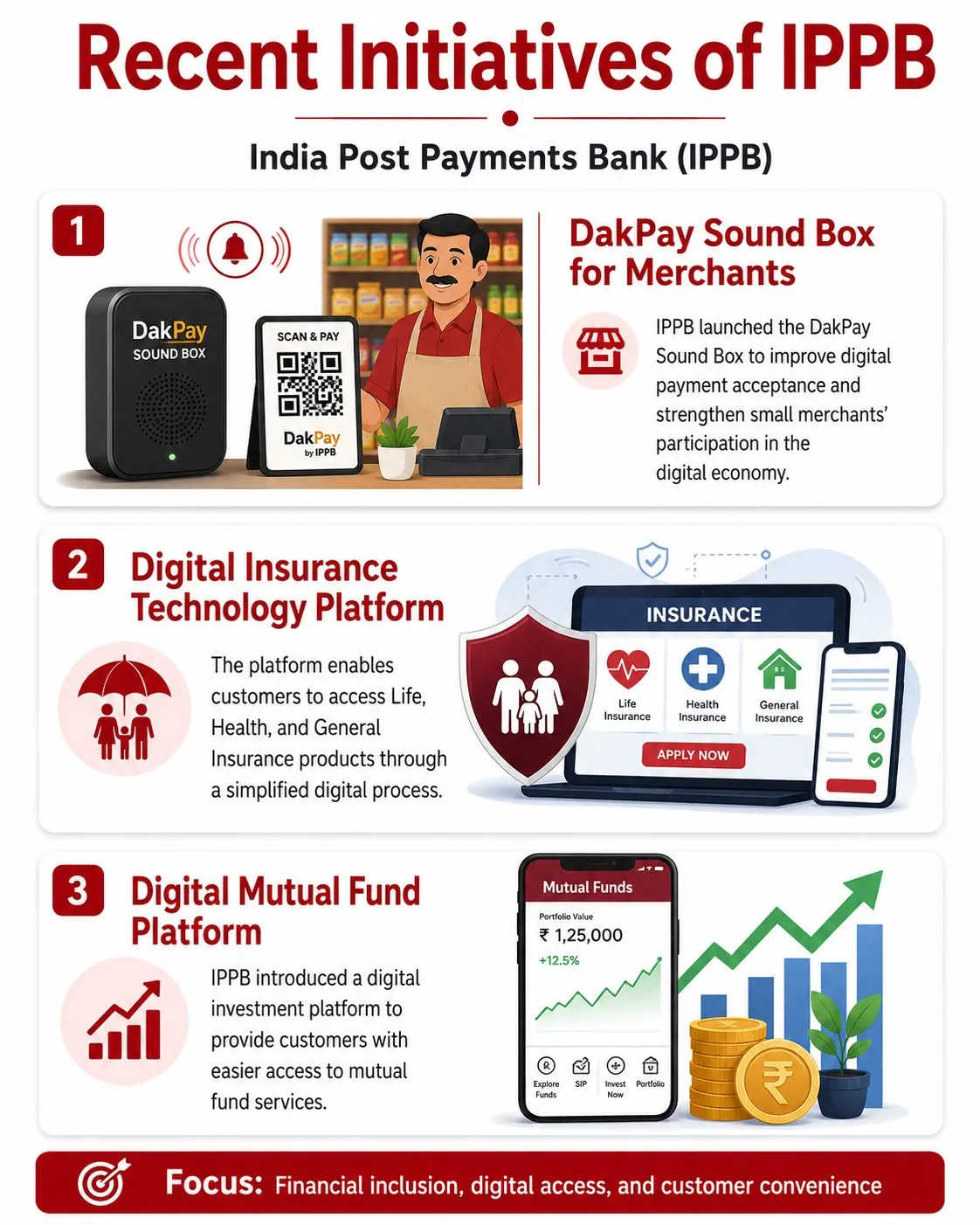
Source Why in News?- India Post Payments Bank (IPPB) celebrated its 9th Foundation Day (IPPB Day 2026) on 1st September 2026.
- Establishment: India Post Payments Bank (IPPB) was launched on 1st September 2018 under the Department of Posts, Ministry of Communications, with 100% equity ownership by the Government of India.
- Objective: IPPB was established to create an accessible, affordable, and trusted banking system for the common citizen by removing barriers faced by the unbanked and underbanked population.
- Last-Mile Banking Model: IPPB leverages the extensive India Post network of around 1.65 lakh post offices, including approximately 1.40 lakh rural post offices, and nearly 3 lakh postal employees to provide doorstep banking services.
- Customer Reach: IPPB has a customer base of 13.25 crore, with 77% customers from rural areas and 49% women customers. Around 6.5 crore DBT beneficiaries received government benefits worth approximately ₹1.55 lakh crore through IPPB.
- Digital Banking Framework: IPPB operates on the principles of Paperless, Cashless, and Presence-less banking by using India Stack, Core Banking System (CBS)-integrated smartphones, and biometric devices.
-
New Savings Products:
- SHG Savings Account: It provides a simple and secure banking solution for Self Help Groups (SHGs) and rural micro-entrepreneurs.
- Surakshit Savings Account: It offers enhanced protection through ₹25,000 cyber-insurance coverage against risks such as phishing, spoofing, and SIM jacking.
- Sampoorna Savings Account: It combines financial security with health and cyber protection benefits through wellness and insurance features.
-
Significance of IPPB
- Promoting Financial Inclusion: IPPB strengthens access to banking services for rural and underserved communities by using the widespread India Post network.
- Supporting Digital India: Through digital payments, Aadhaar-based services, and DBT delivery, IPPB contributes to India’s transition towards a less-cash and digitally enabled economy.
- Women and Rural Empowerment: Higher rural and women customer participation highlights IPPB’s role in expanding inclusive financial services.
- Bridging the Banking Gap: By providing doorstep banking facilities, IPPB supports the government’s objective of achieving universal financial inclusion.
International Relations
Diaspora to Shape India’s Next Growth Chapter
Source Why in News?- India’s 35-million-plus global diaspora is increasingly emerging as a potential source of long-term investment and growth capital, beyond its traditional role as a major source of remittances.
- India received USD 143.6 billion in remittances in FY26, making it the world’s largest recipient. With stronger economic fundamentals, expanding capital markets and improved digital infrastructure, Non-Resident Indians (NRIs) are increasingly exploring investment opportunities in India.
- From Remittances to Growth Capital:
- India remains the world’s largest recipient of remittances. Remittances contribute over 10% of Gross Current Account Receipts, supporting the Current Account and foreign exchange reserves strengthening India’s external-sector resilience.
- The diaspora is increasingly moving beyond family support towards structured investment and growth capital.
- This reflects growing confidence in India as a long-term investment destination, with the diaspora increasingly contributing to investment, entrepreneurship and economic growth.
- Shift to Advanced Economies:
- The US has overtaken the Gulf as the single largest source (accounting for ~27.7%) of remittances.
- Advanced economies now contribute over 51% of total inflows, reflecting the higher earning capacity of the knowledge-based diaspora.
- Diversification Across Modern Asset Classes:
- Previously, NRI wealth was disproportionately locked in assets like real estate, gold, or traditional bank deposits.
- Today, diaspora capital is actively deepening India’s capital markets. They are channeling funds into advanced financial vehicles like Alternative Investment Funds (AIFs), Real Estate Investment Trusts (REITs), and Infrastructure Investment Trusts (InvITs), directly funding infrastructure, renewable energy, and the manufacturing ecosystem.
- Their growing participation has contributed to India’s booming equity market (reaching a USD 5.18 trillion capitalization in July 2026).
- Capitalizing on India’s Macroeconomic Rebound:
- They are capitalizing on the formalization driven by the GST, the Insolvency and Bankruptcy Code (IBC), and manufacturing boosts via PLI schemes.
- The influx of global Indian capital is accelerated by a cleaned-up, well-capitalized banking sector and robust macroeconomic indicators, including inflation control and forex reserves exceeding $700 billion.
- Digital & Institutional Infrastructure:
- The deployment of India’s Digital Public Infrastructure (DPI) specifically Aadhaar, UPI, DigiLocker, and the Account Aggregator framework has eliminated the geographical friction of cross-border investing.
- Electronic KYC (e-KYC) and digital onboarding have made it seamless for NRIs to deploy capital.
- Regulatory upgrades by the RBI and SEBI have strengthened market integrity. Concurrently, the operationalization of the GIFT IFSC (Gujarat International Finance Tec-City) is providing the diaspora with a globally competitive, dollar-denominated financial gateway directly within India.
- Brain Gain and Technological Transfer: Indian professionals leading global tech giants and R&D labs are instrumental in facilitating knowledge transfer. This is pivotal for sunrise initiatives like the India Semiconductor Mission (ISM) and the National Quantum Mission.
- Strategic and Diplomatic Leverage: The diaspora serves as an organic soft-power asset. Their growing political and corporate representation in countries like the US, UK, and Canada helps shape favorable foreign policies, secure strategic partnerships, and influence bilateral trade agreements.
- Economic Vulnerability of Low-Skilled Workers:
- A significant portion of the Indian diaspora consists of semi-skilled and low-skilled workers in the Gulf Cooperation Council (GCC) countries.
- They face severe job insecurity tied to volatile oil prices and remain subjected to exploitative labor practices, such as the restrictive “Kafala” system, which limits their mobility and wage security.
- Restrictive Immigration and Visa Policies:
- Advanced economies are increasingly adopting protectionist measures.
- Tightened visa norms and rising costs (such as the steep hikes in H-1B visa fees in the US) directly restrict the mobility, earnings, and professional growth of highly skilled Indian talent in the West.
- Brain Drain vs. Brain Circulation:
- India continues to lose top-tier scientific, medical, and engineering talent to countries offering better research ecosystems and remuneration.
- Domestic institutions lack the absorptive capacity, funding, and infrastructure required to incentivize these professionals to return or meaningfully contribute to India’s domestic R&D.
- Generational Disconnect:
- Second and third-generation Overseas Citizens of India (OCIs) and Persons of Indian Origin (PIOs) often possess weaker cultural and economic ties to India compared to first-generation migrants.
- Without highly targeted engagement models, their venture capital and intellectual expertise do not flow back to India.
- Limited Political Participation:
- Non-Resident Indians (NRIs) face a democratic deficit because they are required to be physically present in India to vote.
- The lack of postal or online voting alternatives restricts their ability to influence policy formulation, leading to a sense of political exclusion.
- Philanthropic and Regulatory Hurdles: Despite a strong willingness among the diaspora to invest in India’s social development, their efforts are often frustrated by bureaucratic red tape and stringent compliance requirements under the Foreign Contribution (Regulation) Act (FCRA), 2010.
- Data and Policy Fragmentation:
- India lacks a comprehensive, unified, and continuously updated database of its overseas citizens.
- While grievance mechanisms like the e-Migrate and Madad portals exist, their scattered nature often delays rapid response during geopolitical crises or for individual legal aid.
- Racism and Xenophobia: A rising tide of anti-immigrant sentiment and targeted hate crimes in destination countries (such as recent incidents involving students in Australia, the US, and Canada) creates an atmosphere of insecurity, dampening diaspora morale and straining consular resources.
- Asymmetric Remittance Dependence:
- Relying heavily on remittances to manage the CAD masks structural weaknesses in domestic export competitiveness.
- Remittances are essentially private consumption transfers that boost local demand, but they do not substitute for long-term capital investments (FDI) required for industrial capacity building.
- Cost of Remittance: Despite digital advancements, the global average cost of sending money via traditional banking channels remains higher than the UN Sustainable Development Goal (SDG 10.c) target of 3%.
- Informal Channels: The parallel existence of informal channels (such as Hawala) continues to pose a challenge. They are utilized to circumvent KYC documentation and formal forex channels, posing a risk of money laundering.
- Illegal Recruitment and Human Trafficking:
- Fraudulent recruitment agents and touts may lure Indians with false promises of jobs abroad, leading to exploitation, wage theft, forced labour and unsafe working conditions.
- Cases of Indians being wrongly recruited or coerced into supporting the Russia–Ukraine war effort highlight the risks associated with fraudulent overseas recruitment.
- Irregular migration through ‘donkey routes’ exposes Indians to trafficking, exploitation, detention and loss of life, while harming India’s international image.
- India’s Initiatives to Boost Diaspora Engagement
- Overseas Citizen of India (OCI) Scheme: Provides lifelong, multiple-entry visas to eligible overseas Indians and grants parity with NRIs in specified economic, financial and educational matters, while excluding rights such as voting and agricultural land ownership.
- Pravasi Bharatiya Divas (PBD): A biennial diaspora convention held on 9 January that provides a platform for diaspora engagement, networking and diplomacy and includes the Pravasi Bharatiya Samman Award.
- VAJRA (Visiting Advanced Joint Research) Scheme: Enables overseas Indian scientists to conduct high-end collaborative research in Indian public-funded institutions.
- PRABHASS (Pravasi Bharatiya Academic and Scientific Sampark): Connects the global Indian Science and Technology (S&T) community with Indian ministries to help address domestic technological challenges.
- Boost Remittances
- FCNR(B) Swap Facility (2025–26): RBI provides banks with a USD/INR swap facility against fresh FCNR(B) deposits, reducing banks’ hedging costs and encouraging mobilisation of NRI foreign-currency deposits.
- UPI Internationalisation: India is expanding UPI-based cross-border payment connectivity with partner countries, allowing Indians abroad and foreign users to make/receive payments through linked payment systems.
- FDI Parity: Investments by Non-Resident Indians (NRIs) and Overseas Citizens of India (OCIs) on a non-repatriable basis are treated on par with domestic investments, exempting them from stringent Foreign Direct Investment (FDI) caps.
- India–UAE Local Currency Settlement (LCS) Framework (2023): Enables INR–AED settlement for cross-border transactions, reducing dependence on intermediary currencies and lowering conversion costs.
- Foreign Exchange Management (Manner of Receipt and Payment) Regulations, 2023: Expands the permissible modes of cross-border receipts and payments in INR and foreign currencies, facilitating local-currency transactions.
- Globalizing the ‘India Stack’: Expanding the UPI-RuPay footprint to the top remittance corridors (including the US, UK, and Canada) is imperative to sustainably democratize cross-border transactions and eliminate hidden intermediary fees.
- Reviving Diaspora Bonds:
- India has previously mobilised overseas savings through instruments such as India Development Bonds (1991), Resurgent India Bonds (1998) and India Millennium Deposits (2000).
- The government can consider reviving a modern diaspora bond to channel overseas savings into infrastructure, green energy and other long-term development projects.
- Institutionalizing ‘Brain Circulation’: Instead of insisting on permanent return migration, India should create dynamic, flexible frameworks that integrate overseas academics into Indian universities and R&D ecosystems through visiting fellowships, joint patents, and remote mentorships.
- Establishing Sector-Specific Diaspora Advisory Councils: Create formal advisory boards comprising global Indian corporate leaders to guide policy formulation in highly specialized sectors such as Artificial Intelligence, green hydrogen, and biotechnology.
- Diaspora for Economic Diplomacy: Engage influential Indian-origin professionals and business leaders for policy advocacy, trade and strategic partnerships. The Indian diaspora in the US played a vital role in lobbying for the Indo-US Civil Nuclear Agreement, finalised in 2008.
- Strengthening Blue-Collar Protections: Aggressively pursue comprehensive Social Security Agreements (SSAs) and transparent bilateral labor mobility pacts with the Gulf Cooperation Council (GCC) nations to safeguard the rights and financial security of semi-skilled workers.
- Revamping the OCI Framework: Transition from a purely cultural engagement model to a transactional and opportunity-driven investment framework. Offering streamlined regulatory clearances for diaspora-led venture funds will help attract the capital of the younger, second-generation demographic.
- Targeted Financial Literacy: Enhancing digital financial literacy among low-skilled migrant workers in the Gulf is vital to transition them from expensive physical money transfer operators to low-cost digital platforms.
- The diaspora is no longer just a demographic dividend outside India’s borders; it is a critical instrument for capital formation. By combining their global wealth with India’s mature digital public infrastructure (DPI) and strong macroeconomic fundamentals, the diaspora is directly financing India’s transition to a developed economy.
India Rejects Hague Court’s Ruling on Indus Waters Treaty
Source Why in News?- India rejected the Hague-based Court of Arbitration’s (CoA) ruling on the “abeyance” of the Indus Waters Treaty (IWT), terming it illegally constituted and asserting that it has no jurisdiction over India’s sovereign decisions.
- Treaty Remains in Force: The CoA ruled that India’s decision to place the IWT in “abeyance” following the April 2025 Pahalgam terror attack was not permissible under the treaty or international law.
- Terrorism Not a Ground for Suspension:
- The court stated that the treaty governs only water rights and does not address terrorism or the use of force.
- It concluded that cross-border terrorism does not establish a material breach of the water pact by Pakistan.
- Ratle Hydroelectric Project: The Court also imposed interim restrictions on certain construction activities at the Ratle project on the Chenab River until 90 days after the Neutral Expert gives a final decision, expected in 2027.
- India’s Stand
- Parallel Proceedings: In 2016, Pakistan sought a Court of Arbitration, while India requested a Neutral Expert to examine technical issues.
- Violation of Graded Mechanism: India argues that simultaneous proceedings violate the IWT’s sequential dispute-resolution mechanism.
- World Bank’s role:
- The World Bank paused both processes in 2016 but allowed them to proceed simultaneously in 2022. India joined the Neutral Expert process but boycotted the CoA proceedings.
- India mai1ntains that CoA has no jurisdiction over India’s decision to keep the IWT in abeyance.
- About: The IWT is a water-distribution treaty brokered by the World Bank and signed between India and Pakistan in Karachi in 1960.
-
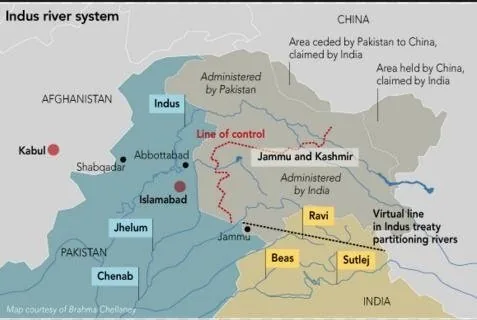
Allocation of Rivers:
- Eastern Rivers: The waters of the Beas, Ravi, and Sutlej were allocated to India for exclusive, unrestricted use.
- Western Rivers: The waters of the Chenab, Indus, and Jhelum were allocated largely to Pakistan.
- India’s Rights on Western Rivers:
- India is permitted limited, non-consumptive uses on the western rivers.
- This includes domestic use, agriculture, and run-of-the-river hydroelectric power generation, provided India adheres to strict technical parameters outlined in the treaty.
-
Dispute Resolution Mechanism under IWT:
- Permanent Indus Commission (PIC): All minor “questions” are first addressed bilaterally by the PIC.
- Neutral Expert: Unresolved technical “differences” are referred to a highly qualified engineer (Neutral Expert) appointed by the World Bank.
- Court of Arbitration (CoA): If the Neutral Expert decides the issue is legal rather than technical, or if both parties agree, the matter escalates to a formal “dispute” before an ad-hoc CoA.
-
Core Dispute Regarding the Hydroelectric Projects
- Kishenganga Project (330 MW): A run-of-the-river project on the Kishenganga River (a tributary of the Jhelum) in Jammu and Kashmir.
- Ratle Project (850 MW): A hydroelectric project on the Chenab River in Jammu and Kashmir.
- The Disagreement: Pakistan argues that India is building pondage (water storage) capacities that are far larger than what is technically required, allegedly impacting water flow. Consequently, Pakistan requested a CoA, while India requested a Neutral Expert to assess the technical designs.
-
Court of Arbitration (CoA)
- The Court of Arbitration (CoA) is an ad-hoc five-member tribunal established under Annexure G of the IWT, 1960, serving as the treaty’s highest dispute-resolution mechanism for legal disputes between India and Pakistan.
- The Permanent Court of Arbitration (PCA) in The Hague serves as its Secretariat, while the present CoA was constituted by the World Bank at Pakistan’s request in 2022–23.
Science & Technology
Cyber-Physical Systems
Source Why in News?- The Government has highlighted the growing importance of Cyber-Physical Systems (CPS) in building a technology-driven future. India is developing a strong CPS ecosystem through the National Mission on Interdisciplinary Cyber-Physical Systems (NM-ICPS).
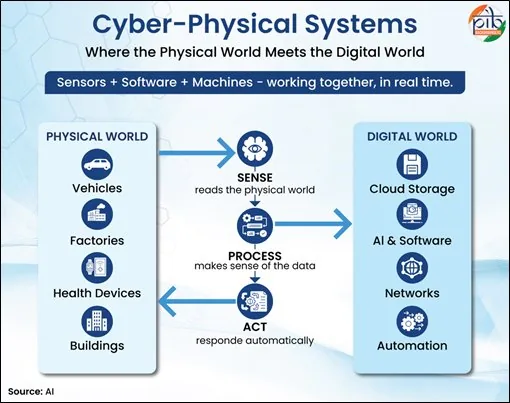
- About: Cyber-Physical Systems (CPS) are intelligent systems that integrate the physical and digital worlds through sensors, computing systems, software, communication networks and actuators. They enable machines to sense, analyse, decide and respond to real-time conditions.
- Working of CPS: CPS connects computation, communication, and physical processes through a continuous feedback loop. Sensors collect data from the environment, computing systems analyse the information, and actuators perform necessary actions.
- Examples of CPS Applications:
- Autonomous Vehicles: Driverless cars use sensors and AI-based systems to navigate roads with minimal human intervention.
- Smart Manufacturing: Smart factories use CPS for automated monitoring, optimisation and Industry 4.0 applications.
- Healthcare: Intelligent medical devices continuously monitor patients and support timely medical interventions.
- Smart Buildings: Automated systems regulate lighting, temperature, and energy use based on real-time conditions.
- Significance: CPS enables the development of intelligent, connected, and responsive systems, supporting advancements in areas such as automation, healthcare, transportation, manufacturing, and smart infrastructure.
 What are the Key Facts About National Mission on Interdisciplinary Cyber-Physical Systems (NM-ICPS)?
- About: The Department of Science and Technology (DST) is implementing NM-ICPS to develop indigenous CPS capabilities in India. The mission was approved by the Union Cabinet in 2018 with an outlay of ₹3,660 crore for nine years.
- Objective: The mission provides a national framework for advancing CPS research, innovation, and applications across priority sectors by integrating academia, industry, government agencies, and international organisations.
- Innovation Ecosystem: NM-ICPS supports the complete innovation cycle, including research and development (R&D), translational research, product development, and start-up incubation, enabling the conversion of scientific knowledge into practical solutions.
- Centres of Excellence: The mission is establishing world-class interdisciplinary Centres of Excellence across the country to promote advanced CPS research, technology development, specialised expertise, and policy support.
- Technology Development: NM-ICPS focuses on developing national-priority technologies, core competencies, and skilled human resources in emerging CPS domains.
-
Achievements of NM-ICPS (as of August 2026)
- Technology Development: The mission has enabled 1,146 technologies and supported the development of 1,329 technology products across sectors such as agriculture, healthcare, mining, cybersecurity, advanced communication, and positioning systems.
- Skill Development: Through the CHANAKYA Fellowship Programme, NM-ICPS supports undergraduate, postgraduate, PhD, and postdoctoral researchers working on CPS challenges.
- Start-up Ecosystem: The mission has supported 1,136 start-ups and spin-offs, generating more than 24,000 jobs by promoting research-based entrepreneurship.
- Global Collaboration: NM-ICPS has established 200 international collaborations to strengthen India’s participation in the global CPS technology ecosystem.
-
Technology Innovation Hubs (TIHs)
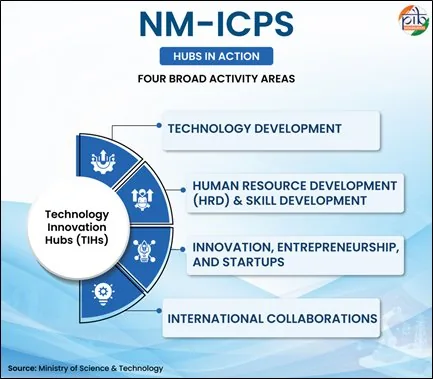
- About: Under NM-ICPS, the Government has established 25 Technology Innovation Hubs (TIHs) as Section 8 companies in leading academic institutions across India. These hubs focus on technology development, human resource development, innovation and start-up support, and international collaborations.
- Role of TIHs: TIHs bridge the gap between research and real-world applications by developing technology platforms, converting research into products, nurturing technology-based start-ups, and working with government agencies to solve national challenges.
-
Technology Translation Research Parks (TTRPs)
- About:
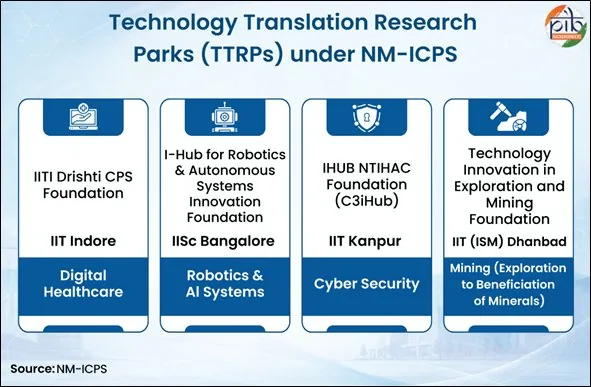
- To accelerate commercialisation of CPS technologies, four high-performing TIHs were selected in 2025 as TTRPs at:
- IIT Kanpur: Cybersecurity
- IISc Bengaluru: Robotics and AI Systems
- IIT (ISM) Dhanbad: Mining Technologies
- IIT Indore: Digital Healthcare
- To accelerate commercialisation of CPS technologies, four high-performing TIHs were selected in 2025 as TTRPs at:
- Objective: TTRPs aim to accelerate the transition of CPS innovations from laboratories to deployable technologies and commercial products.
- About:
-
BharatGen
- About: Supported under NM-ICPS, BharatGen is developing sovereign AI capabilities tailored to Indian languages and contexts. It is led by IIT Bombay along with a consortium of academic institutions.
- Multilingual AI Capability: BharatGen develops text, speech, and vision-language technologies to enable human-machine interaction across India’s linguistic diversity.
- AI Models Developed:
- Param-2: A foundation model with 17 billion parameters supporting all 22 Scheduled Indian languages.
- Shrutam: Speech-to-text model supporting 12 Indian languages.
- Sooktam: Text-to-speech model supporting 12 Indian languages.
- Patram: Enables multilingual access to complex Indian documents through the DocBodh framework.
- Sector-Specific AI Models:
- BharatGen has developed domain-focused models such as:
- Ayur Param for Ayurveda,
- Agri Param for agriculture,
- Legal Param for the Indian legal sector.
- BharatGen has developed domain-focused models such as:
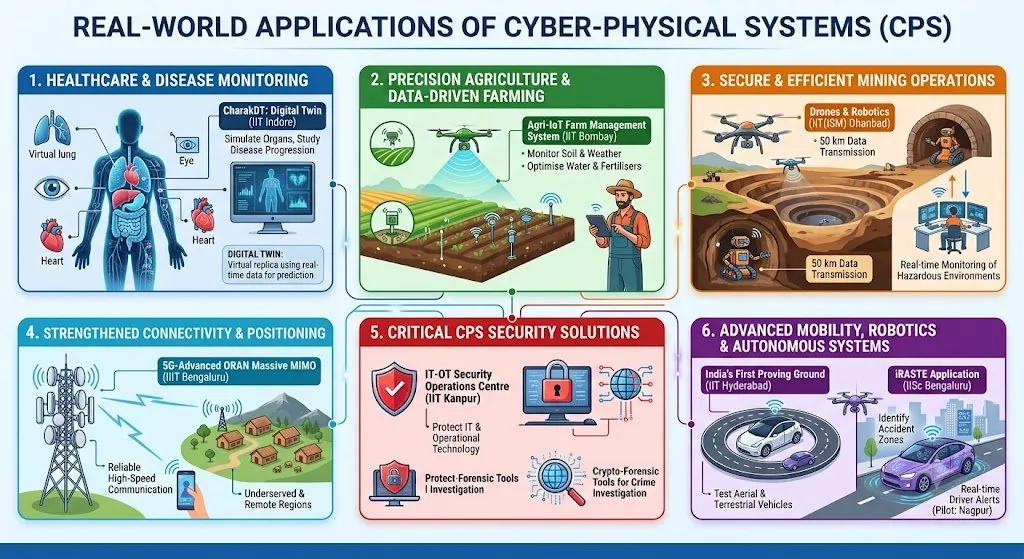
- Cyber-Physical Systems represent the next phase of technological evolution by integrating digital intelligence with physical infrastructure. Through NM-ICPS, India is building future-ready capabilities in AI, robotics, cybersecurity and advanced technologies, paving the way for smarter systems, innovation-led growth and a technology-driven, self-reliant Viksit Bharat.
C-DOT Unveils 14 Indigenous Quantum Products for Secure Communication Networks
Source Why in News?- The Centre for Development of Telematics (C-DOT), under the Department of Telecommunications (DoT), Ministry of Communications, unveiled 14 indigenous quantum products to strengthen the security of India’s communication networks, focusing on Quantum Key Distribution (QKD) and Post-Quantum Cryptography (PQC) during its 43rd Foundation Day celebrations.
-
Quantum Key Distribution (QKD) Systems:
- Q-AKSHAY CD: A compact fibre-based Quantum Key Distribution (QKD) system using Coherent One-Way (COW) and Differential Phase Shift (DPS) protocols, used for secure quantum key generation and distribution over fibre networks.
- Q-AKSHAY MD: A fibre-based QKD system using the Measurement Device Independent (MDI) protocol, used for secure key distribution with enhanced protection against measurement-device vulnerabilities.
-
Quantum-Safe Encryptors:
- Q-VIKRAM & Q-PARAKRAM: Defence-grade quantum-safe encryptors using Post-Quantum Cryptography (PQC) algorithms, operating at Layer 2/3 (Data Link and Network Layers) of the OSI (Open Systems Interconnection) model, used to secure strategic and defence communications.
- Q-AMOGH: A high-capacity optical encryptor providing up to 200 Gbps quantum-safe encryption at Layer 1, used to secure high-speed optical communication networks.
- Q-MAHASETU: A commercial-grade quantum-safe encryptor supporting up to 40 Gbps at Layer 2/3, used to protect enterprise and critical communication networks.
- Q-SETU:
- A quantum-safe encryptor providing up to 80 Mbps at Layer 3, used to secure commercial and enterprise data communications.
- It incorporates National Institute of Standards and Technology (NIST) PQC algorithms to protect data against emerging quantum-era threats.
-
Critical Quantum Hardware Components:
- C-SPD: Single-Photon Detector, used to detect single-photon signals in quantum communication systems.
- C-RD: Wideband Radio Frequency (RF) Driver, used to drive intensity and phase modulators in quantum communication systems.
-
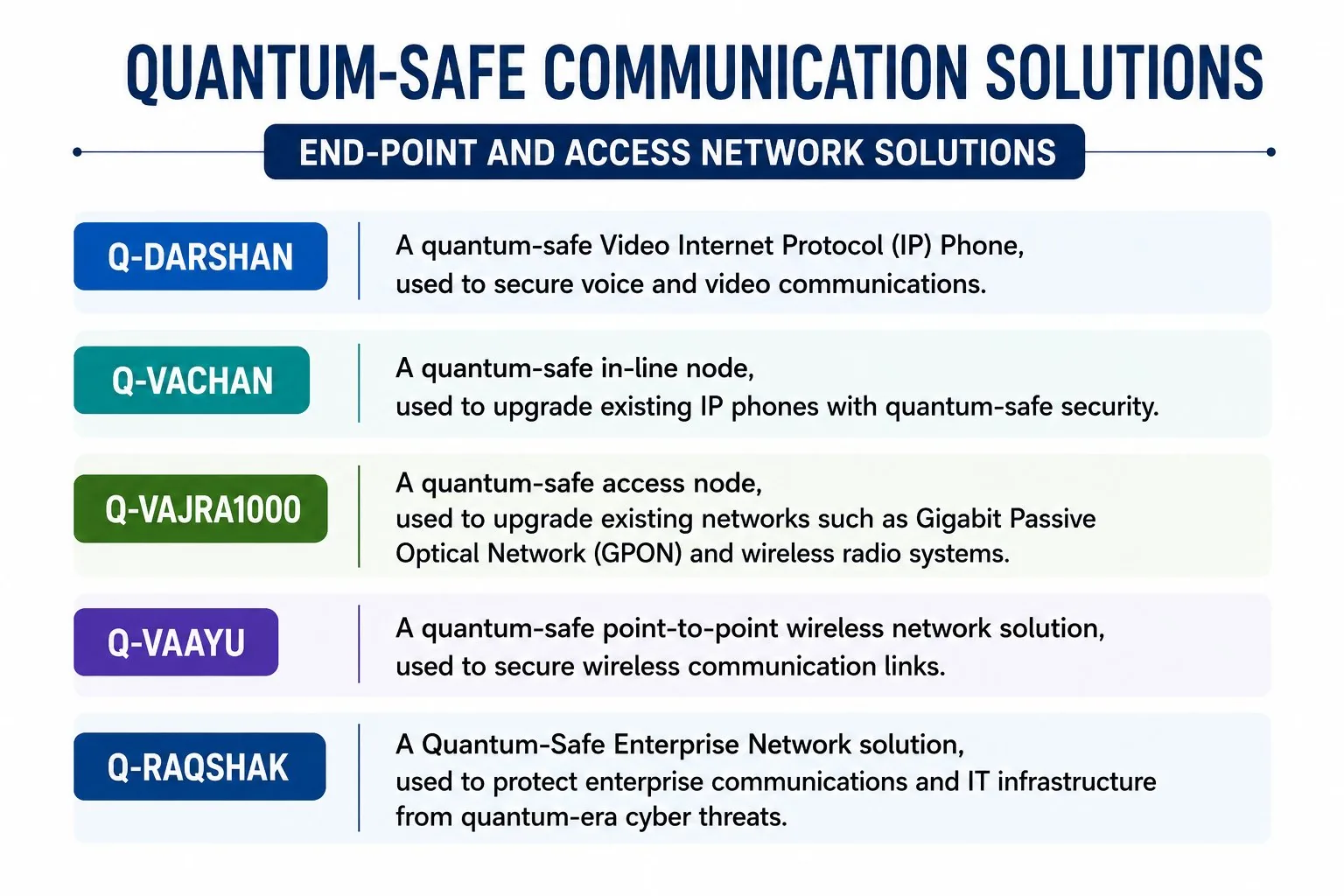
End-Point and Access Network Solutions:
-
OSI (Open Systems Interconnection) Model
- It is a 7-layer framework that explains how data moves between devices over a network:
- Layer 1 – Physical: Transmits raw data as physical signals.
- Layer 2 – Data Link: Handles communication between directly connected devices.
- Layer 3 – Network: Handles routing and addressing of data between networks.
- Layer 4 – Transport: Ensures reliable end-to-end data delivery.
- Layer 5 – Session: Establishes and manages communication sessions.
- Layer 6 – Presentation: Handles data formatting, encryption and compression.
- Layer 7 – Application: Provides network services directly to applications.
- It is a 7-layer framework that explains how data moves between devices over a network:
- Quantum Computing:
- It is an emerging field that uses the principles of quantum mechanics to solve certain complex problems beyond the capabilities of classical computers.
- By harnessing quantum phenomena, quantum computers could perform specific calculations in minutes or hours that would take conventional supercomputers thousands of years.
- Quantum Key Distribution (QKD) Network:
- QKD is a highly secure way to share secret encryption keys between two users using quantum particles (photons). It ensures that communication remains safe from hacking.
- If anyone tries to intercept the key, the quantum particles get disturbed (due to the observer effect and no-cloning rule), which immediately alerts the users about the intrusion.
- Post-quantum cryptography (PQC): It is a type of encryption designed to stay secure against attacks from powerful quantum computers.

- Centre for Development of Telematics (C-DOT)
- About:
- C-DOT established on 24th August 1984 by the Government of India as a telecom technology development centre under the Department of Telecommunications (DoT).
- C-DOT is a premier indigenous telecom R&D institution, instrumental in India’s telecom revolution, particularly in rural telephony and network digitisation.
- Major Technologies: Developed solutions in Next Generation Networks (NGN), Terabit Routers, XGS-PON, DWDM, Wi-Fi, Network Management Systems (NMS), cybersecurity and telecom software.
- IoT/M2M: Developed the oneM2M standards-based Common Services Platform (CCSP) to support Internet of Things (IoT), Machine-to-Machine (M2M), Smart Cities and Industrial IoT.
- Emerging Technologies: C-DOT is also working on 4G/5G, Artificial Intelligence (AI), quantum communication and 6G technologies.
- Technology Transfer: Its Technology Transfer model has helped create a domestic ecosystem of telecom equipment manufacturers and component suppliers.
- Significance:
- C-DOT advances Atmanirbhar Bharat, Digital India and indigenous telecom manufacturing by developing technologies suited to India’s needs.
- Its technologies have contributed to BharatNet, the national optical fibre network aimed at expanding broadband connectivity to rural areas.
- About:
India’s 1st “Green Forge” Complex Inaugurated
Source India’s first-of-its-kind Green Forge Complex was inaugurated at National Agri-food & Biomanufacturing Institute (BRIC-NABI) (an Autonomous Institute of the Department of Biotechnology) in Mohali, marking a major step in agricultural biotechnology and genetically modified (GM) crop research.- Context of the Launch: The facility was inaugurated during the National Conclave on BioE3 (Biotechnology for Economy, Environment and Employment), 2026 reflecting India’s shift toward high-performance biomanufacturing.
- ‘Green Forge’ Facility:
- It provides advanced simulation chambers that can precisely regulate light, humidity, and temperature.
- This allows researchers to cultivate and experiment with GM crops to assess their suitability across varied and controlled environmental conditions before field deployment.
- Technological Integration: The facility highlights the convergence of biotechnology with advanced simulation and Artificial Intelligence (AI), accelerating complex research in both agricultural and medical sciences.
- Surge in India’s Bioeconomy: India’s bioeconomy has expanded from USD 10 billion in 2014 to approximately USD 200 billion, driven by private sector engagement and an enabling policy environment.
- Infrastructure Push:
- Under BioE3 (Biotechnology for Economy, Environment and Employment) 2024 policy, the focus is shifting towards industry-ready manufacturing and translating research into products and technologies.
- The government is developing 22 biomanufacturing hubs and a National Bio-Foundry Network comprising eight specialized facilities to support start-ups, SMEs, and the translation of research into commercial products.
- The Department of Biotechnology (DBT) is actively supporting around 38 Carbon Capture and Utilisation (CCU) projects to capture emissions from hard-to-abate sectors like cement and steel through integrated biomanufacturing.
- Emerging Biotech Frontiers: The initiative is expanding into sustainable aviation fuels (SAF), the I3 PhD programme, and Space Biotechnology—including collaborations with ISRO on myogenesis and cyanobacteria growth experiments in space.
- Waste-to-Wealth: BRIC-NABI is heavily integrating agri-biotechnology with bioprocess engineering to convert agricultural waste into high-value nutraceuticals (products derived from food sources that provide extra health and medical benefits besides basic nutrition) and biomaterials.
- Strategic Alignment: The overall transformation toward a low-carbon, circular bioeconomy is directly aligned with India’s long-term climate and economic goals of achieving Net Zero by 2070 and Atmanirbhar Bharat.
Security
Rani Avanti Bai Lodhi
Source Defence Minister Rajnath Singh paid tribute to Rani Avanti Bai Lodhi, describing her patriotism and bravery as values that transcend social, caste and gender boundaries. Rani Avanti Bai Lodhi- Birth and Family: Rani Avanti Bai Lodhi was born on 16th August 1831 in Manakhedi village of Seoni district, Madhya Pradesh. Her father, Rao Jujhar Singh, was a zamindar, and her mother was Krishna Bai.
- Training and Abilities: From childhood, she developed skills in horse riding, sword fighting and administration, which later helped her in leading resistance against British rule.
- Marriage and Role in Ramgarh State: She married Vikramaditya Singh, son of King Lakshman Singh of Ramgarh princely state. After Vikramaditya Singh became king but remained ill due to health issues, Rani Avanti Bai took charge of the administration. The couple had two sons — Aman Singh and Sher Singh.
- Resistance against British: British authorities brought Ramgarh under the Court of Wards system, declaring the king incapable of ruling and his heirs minors. Rani Avanti Bai opposed British control, removed British-appointed officials from Ramgarh and took over administration.
- Mobilising Farmers and Local Support: She refused to accept British administrative control and encouraged farmers not to follow British revenue-related orders. This increased her popularity among the people.
- Call for Armed Resistance: During the Revolt of 1857, she organised resistance against British rule and sent letters along with two black bangles to local rulers, zamindars, and landlords, urging them either to fight the British or accept defeat by wearing bangles.
- Battle of Kheri (1857): On 23rd November 1857, Rani Avanti Bai and her forces defeated the British army led by Mandla Deputy Commissioner Waddington in the Battle of Kheri, demonstrating her ability to organise armed resistance against British forces.
- Final Resistance and Martyrdom: In March 1858, British forces launched a major attack against Rani Avanti Bai and her troops. When surrounded by the enemy and facing certain capture, she chose self-sacrifice rather than surrender, becoming a symbol of resistance against colonial rule.
- Symbol of Courage and Patriotism: Rani Avanti Bai Lodhi is remembered for her courage, leadership, self-respect and commitment to the freedom struggle. Her role highlights the contribution of women and regional leaders in India’s anti-colonial movement.
- Recognition: Her legacy continues to be honoured through memorials, institutions and public celebrations, including initiatives such as the Rani Avanti Bai Lodhi Women’s Battalion of the Uttar Pradesh Provincial Armed Constabulary (PAC) at Badaun.

Wildlife
Vultures in India
Source A study published in the Journal of Threatened Taxa has highlighted that relocating a livestock carcass dump away from high-tension power lines near Sudhauwala in Dehradun, Uttarakhand helped reduce the risk of vulture electrocution.- About Vultures:
- Vultures are large scavenger birds that feed on dead animals and act as nature’s sanitation workers. They help maintain ecosystem cleanliness by removing carcasses, supporting nutrient cycling and reducing the spread of diseases.
- Their highly acidic digestive system helps destroy harmful pathogens present in carcasses, reducing the risk of diseases such as anthrax and botulism.
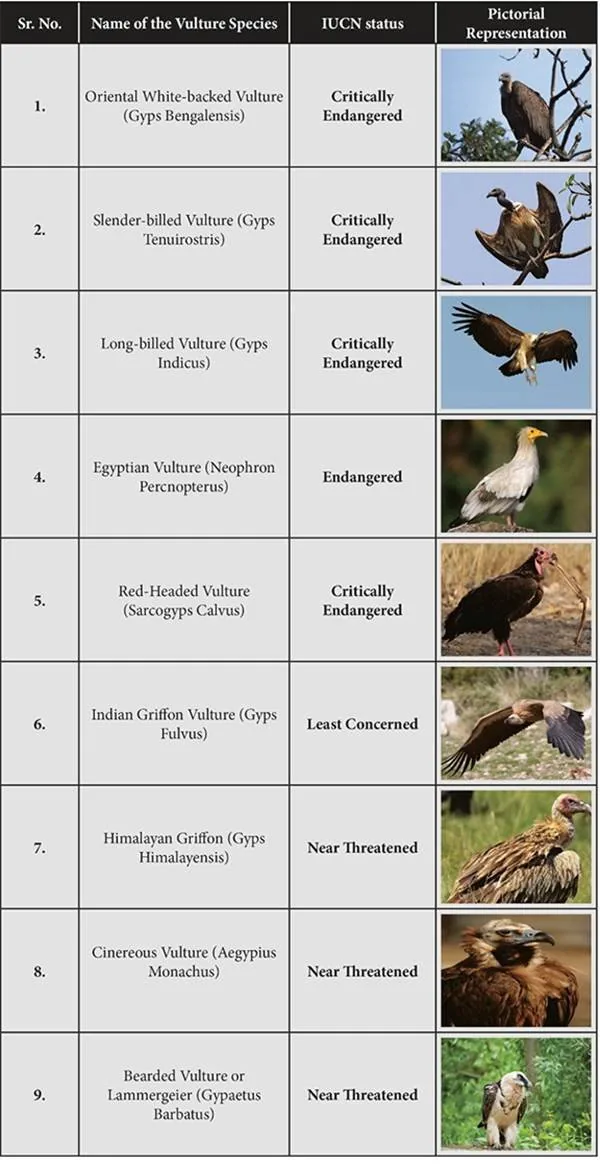
- Vulture Diversity in India: Around 23 species of vultures are found globally. India is home to 9 species of vultures, including the White-rumped Vulture, Indian Vulture, Slender-billed Vulture, Himalayan Griffon, Eurasian Griffon, Egyptian Vulture, Red-headed Vulture, Cinereous Vulture and Bearded Vulture.
- Indicator Species: Vultures are considered indicators of ecosystem health because their decline reflects wider environmental issues such as pollution, food scarcity and habitat degradation.
- Population Decline: Vulture populations in South Asia, particularly India, Pakistan and Nepal, declined sharply due to human-induced threats. The widespread use of veterinary diclofenac (a non-steroidal anti-inflammatory drug, NSAID) was the major cause, resulting in a decline of over 97% in some regions. India banned veterinary diclofenac in 2006.
- Emerging Threats: Vultures face additional threats from other NSAIDs, food scarcity, habitat loss, poisoning and electrocution from high-tension power infrastructure.
- Conservation Measures: India has undertaken measures such as the Vulture Conservation Breeding Programme, promotion of safer alternatives like meloxicam, establishment of Vulture Safe Zones, and habitat-sensitive management practices to support vulture recovery.
- Vulture Awareness Day: The first Saturday of September is recognised annually as Vulture Awareness Day to highlight the ecological importance of vultures and promote their conservation.