Comrades Editorial · 02 Sep 2026 (PDF)
In this edition
- India’s E-Waste Challenge Environment & Ecology
Environment & Ecology
India’s E-Waste Challenge
Source This editorial is based on “The two balance sheets behind every e-waste decision” published in the Hindu on 02/09/2026. The article highlights that rapid digitisation creates massive e-waste. India must adopt life-cycle costing, integrate informal workers, and scale urban mining to secure critical minerals and build a circular economy. Rapid digitisation, frequent replacement of institutional IT equipment and growing demand for critical minerals have turned discarded electronics (e-waste) into both an environmental hazard and a potentially valuable secondary resource. The central policy question is whether India’s computers, servers, batteries and electronic devices will be disposed of through unsafe and informal channels, or systematically collected, refurbished and processed as an urban mine for copper, gold, cobalt, lithium and other strategic materials. What is E-Waste?- About: E-waste (electronic waste) refers to discarded electrical or electronic devices that have reached the end of their useful life or are broken, obsolete, and unwanted.
- Key Categories of E-Waste:
- IT and Telecommunication Equipment: Laptops, desktop computers, mobile phones, routers, and printers.
- Large Household Appliances: Refrigerators, air conditioners, washing machines, and microwaves.
- Small Household Appliances: Toasters, blenders, hair dryers, and electric toothbrushes.
- Consumer & Entertainment Electronics: Televisions, stereos, gaming consoles, and digital cameras.
- Lighting and Tools: LED bulbs, fluorescent tubes, drills, and electric saws.
- E-waste as a Dual-natured Resource: E-waste is neither ordinary municipal waste nor merely scrap. It is a complex material reservoir requiring specialised treatment.

-
Current Status of E-Waste in India:
- According to the Central Pollution Control Board (CPCB), India generated approximately 13.98 lakh tonnes of e-waste in 2024–25, up from 12.54 lakh tonnes in 2023–24, an increase of about 11.5% in one year.
- India is generally identified as the world’s 3rd-largest e-waste-generating country, after China and the United States.
- E-waste generation is concentrated in industrialised and highly urbanised States such as Maharashtra, Uttar Pradesh, Tamil Nadu, Haryana, Karnataka, Gujarat and Telangana. Major IT and commercial centres, including Delhi-NCR, Mumbai, Bengaluru, Chennai and Hyderabad, are prominent hotspots, while many smaller cities lack authorised collection and recycling facilities.
- The share of e-waste reported as collected, dismantled, recycled or disposed of increased from 61.94% in 2023–24 to 70.71% in 2024–25.
-
Reasons Behind Increasing E-waste Generation in India:
- Rapid Digital Expansion: India had about 109 crore internet subscribers in March 2026. Growing use of smartphones, computers, routers and digital-payment devices generates substantial end-of-life electronics.
- Rising Electronics Consumption: India’s electronics production increased from ₹1.9 lakh crore in 2014–15 to ₹13.11 lakh crore in 2025–26, making electronic goods more affordable and widely available.
- Shorter Product Life Cycles: Rapid technological changes, such as the transition from 4G to 5G, encourage consumers and businesses to replace functioning devices frequently.
- Planned Obsolescence: Non-removable batteries, unavailable spare parts and expensive repairs make replacement cheaper than repair, for example, damaged smartphones and printers are commonly discarded entirely.
- Increasing Appliance Ownership: Urbanisation and rising incomes have increased household ownership of televisions, refrigerators, air conditioners and washing machines, enlarging the future waste stream.
- Growth of New Waste Streams: Expanding data centres, solar installations and smart infrastructure generate specialised e-waste. India’s solar capacity reached approximately 165 GW by July 2026, creating a future stream of discarded panels and inverters.
- Weak Repair And Refurbishment Systems: India had only 72 CPCB-registered refurbishers as of February 2025, limiting the formal reuse of discarded equipment.
- Aggressive Consumer Marketing: Exchange offers, frequent model launches, festival discounts and no-cost EMIs promote repeated upgrading and a linear “buy–use–discard” culture.
-
Urban Mining
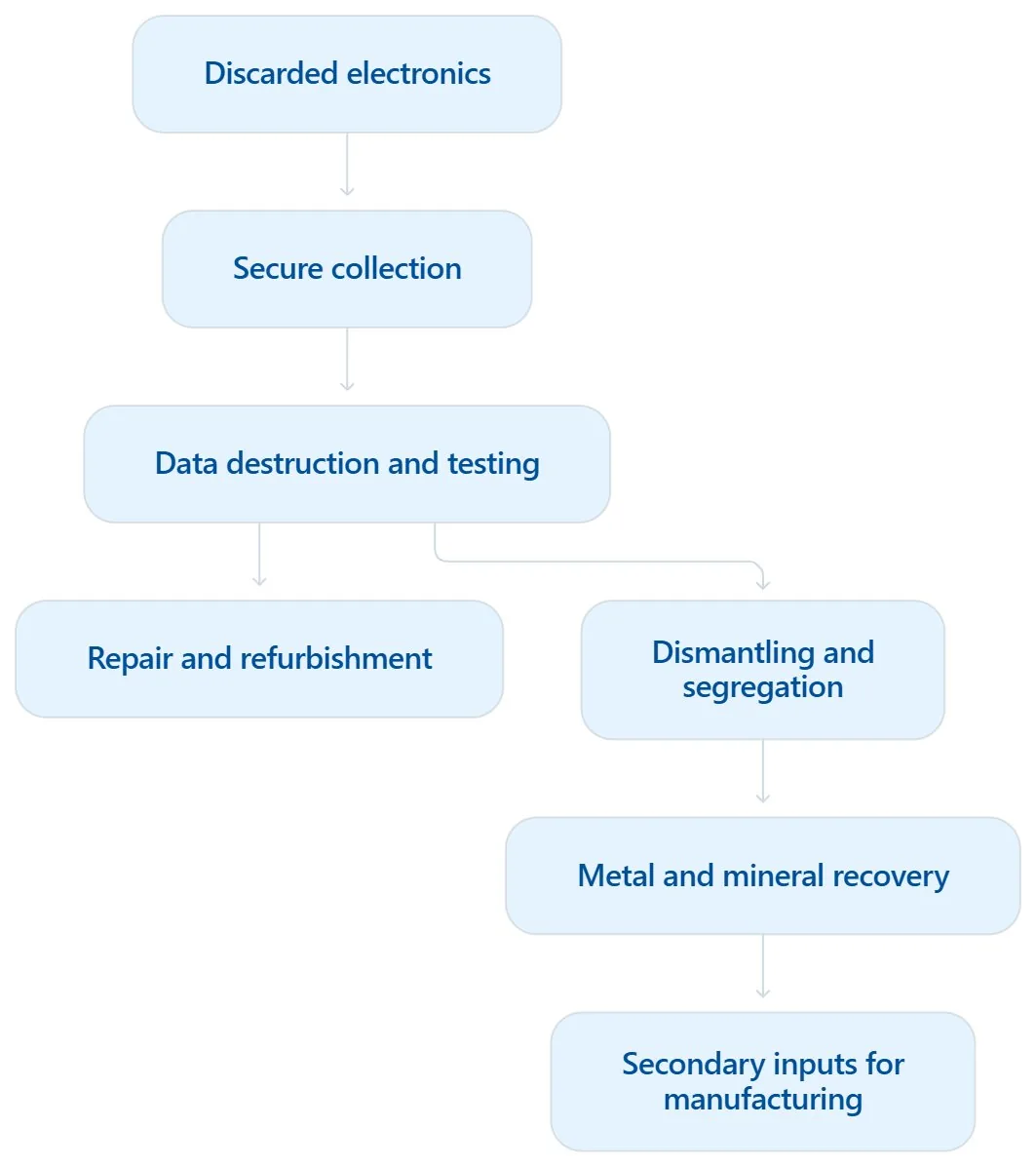
- Urban mining is the process of recovering valuable raw materials, critical minerals, and precious metals from anthropogenic (human-made) stocks, such as discarded electronics, industrial machinery, demolished infrastructure, vehicles, and municipal waste, rather than extracting them from virgin natural ores through traditional mining.
- By viewing modern cities and landfills as “mines” filled with stored resources, urban mining serves as a vital pillar of the circular economy. Key materials recovered are:
- Precious Metals: Gold, silver, platinum, and palladium found in printed circuit boards of smartphones and computers.
- Base and Strategic Metals: Copper, aluminum, iron, and nickel sourced from wiring, structural elements, and appliances.
- Critical Battery Minerals: Lithium, cobalt, nickel, and manganese recovered from spent electric vehicle (EV) batteries and consumer electronics.
- Toxic Environmental Pollution:
- Informal dismantling, acid leaching and open burning release lead, mercury, cadmium and brominated flame retardants into air, soil and groundwater.
- For example, informal recycling clusters around Seelampur in Delhi and Moradabad in Uttar Pradesh face serious contamination risks.
- Severe Public-Health Risks:
- Exposure to toxic e-waste can damage the nervous, respiratory and reproductive systems.
- The WHO warns that children engaged in or living near informal recycling are particularly vulnerable to lead and mercury exposure.
- Dominance of Unsafe Informal Recycling:
- Waste pickers and scrap dealers provide efficient collection but frequently lack protective equipment and pollution-control technology.
- This prevents e-waste from reaching authorised recyclers despite India having 322 registered recycling facilities as of February 2025.
- Loss of Valuable Critical Minerals:
- Discarded electronics contain copper, gold, silver, palladium, lithium and rare-earth elements.
- In India, the annual e-waste stream is valued at nearly ₹51,000 crore, of which about 60% is technically recoverable, however, existing systems capture only 18% of this potential, causing substantial resource loss.
- Failure to recover metals increases energy-intensive mining and manufacturing. The Global E-Waste Monitor estimates that formal recycling avoided nearly 900 million tonnes of primary ore extraction and 93 million tonnes of CO₂-equivalent emissions globally in 2022.
- Data-Security And Privacy Threats:
- Discarded phones, computers and hard drives may retain banking credentials, personal photographs, health records and official information. ‘
- Unscientific resale or dismantling can therefore facilitate identity theft, financial fraud and corporate espionage.
- In 2025, the Directorate General of Foreign Trade (DGFT) alerted the Central Board of Indirect Taxes and Customs (CBIC) about unauthorised imports of refurbished and end-of-life hard drives worth over ₹800 crore, mostly routed through Hyderabad.
- Some drives had tampered usage records and were sold in open markets and through GeM, raising data- and national-security concerns.
- Fire And Safety Hazards: Damaged lithium-ion batteries in phones, laptops and power banks can cause fires during storage or transportation. Such battery fires are difficult to extinguish and may release highly toxic fumes.
- E-Waste (Management) Rules, 2022: Effective from 1st April 2023, these rules cover 106 categories of electrical and electronic equipment, including solar photovoltaic equipment, and mandate environmentally sound recycling.
- Extended Producer Responsibility Framework: Producers must meet recycling obligations by purchasing EPR certificates from registered recyclers. The recycling target is 70% during 2025-26 and 2026-27 and reaches 80% from 2027-28.
- Battery Waste Management Rules, 2022: These rules cover portable, automotive, industrial and electric-vehicle batteries. They mandate collection and recycling through EPR and prohibit the disposal of waste batteries through landfills or incineration.
- Right to Repair Initiative:
- The Department of Consumer Affairs launched the Right to Repair India Portal to provide information on repair manuals, spare parts and authorised service providers.
- It covers sectors such as mobiles, electronics, consumer durables and automobiles, extending product life and reducing premature disposal.
- Hazardous and Other Wastes Rules, 2016:
- It governs the safe handling, generation, recycling, and transboundary movement of hazardous materials in India.
- Also, India is a party to the Basel Convention on the Control of Transboundary Movements of Hazardous Wastes and their Disposal.
- C-MET Centre of Excellence on E-Waste Management: Established at Hyderabad under Ministry of Electronics and Information Technology (MeitY), it develops indigenous technologies to recover valuable materials from printed circuit boards, lithium-ion batteries, permanent magnets and solar cells.
- Formalise and Integrate Informal Collectors:
- Organise kabadiwalas and waste pickers into municipal cooperatives, provide safety equipment and mechanised dismantling tools, and connect them directly with CPCB-registered recyclers.
- Pune’s waste-picker cooperative model (named SWaCH) demonstrates how formalisation can protect livelihoods while improving collection.
- Strengthen EPR Through Digital Verification:
- Link every EPR certificate with geo-tagged collection records, electronic weighing systems and verified processing capacity.
- Digital product passports and blockchain-based tracking can prevent “paper compliance” and ensure that certificates represent actual recycling.
- Create Consumer-Friendly Collection Networks:
- Establish authorised drop-off points at metro stations, Common Service Centres, residential complexes, electronics stores and corporate parks.
- A dynamic deposit-refund system can return part of the product price when consumers surrender obsolete devices through authorised channels.
- Enforce Right to Repair and Repairability Scores:
- Manufacturers should provide spare parts, diagnostic tools, repair manuals and software support at reasonable prices.
- A mandatory 1–10 repairability index on electronic products would enable consumers to choose durable and easily repairable devices.
- Invest in Advanced Urban-Mining Technologies:
- Public-private partnerships should develop hydrometallurgical, bioleaching and high-purity refining facilities to recover lithium, cobalt, gold and rare-earth elements.
- For example, non-pathogenic microbes such as Acidithiobacillus ferrooxidans can extract metals from circuit boards with lower chemical and energy requirements.
- Deploy AI and Robotic Material Recovery: AI-powered optical sorting can identify batteries, circuit boards and hazardous components, while robotic precision disassembly can recover valuable parts without contaminating them through bulk shredding. This would improve worker safety and material-recovery efficiency.
- Develop Decentralised Recycling Microfactories:
- Containerised recycling units located near municipal zones and technology parks can process plastics, glass and selected electronic components locally.
- Recovered materials can be converted into products such as 3D-printing filament and composite construction panels, reducing transport emissions.
- For example, India’s first 3D-printed post office in Bengaluru demonstrates the potential of additive manufacturing.
- Promote Circular Ownership And Community Repair:
- Product-as-a-Service models should encourage companies to lease smartphones, laptops and appliances while retaining responsibility for retrieval and recycling.
- At the community level, repair cafés and skill-sharing centres can extend product life, create local employment and counter the prevailing throwaway culture.
- India’s e-waste crisis sits at the intersection of environmental, health, and strategic challenges, requiring a shift from viewing it purely as hazardous waste or scrap. By balancing immediate financial costs with long-term strategic resilience, India must judge decisions through resource security and public health. To build a sustainable circular economy, India can integrate informal workers, scale advanced urban mining, shift toward life-cycle costing, secure critical minerals, and reduce import dependence to minimize unpaid environmental bills.