Comrades Dispatch · 07 Sep 2026 (PDF)
In this edition
- A Decade of Flexible Inflation Targeting in India Banking & Finance
- Mount Anak Krakatau Geography
- Bhutan Achieves Rabies Elimination Milestone Health & Medicine
- Geothermal Energy in India Infrastructure & Energy
- Falkland Islands Dispute International Relations
- Article 142 of the Constitution Polity & Governance
- Decentralised Grain Storage Plan in Cooperative Sector Schemes & Initiatives
- EOS-05: India’s 1st Dedicated Geosynchronous Earth Observation Satellite Space
Banking & Finance
A Decade of Flexible Inflation Targeting in India
Source Why in News?- India has completed a decade of the Flexible Inflation Targeting (FIT) framework, prompting fresh debate over its effectiveness. Concurrently, a decade-long empirical evaluation of India’s FIT framework published in the Economic and Political Weekly (EPW) has raised critical questions about its underlying theoretical assumptions and its real-world efficacy in the Indian economy.
- About: FIT is a monetary policy framework where the central bank uses interest rates to keep inflation within a specific, publicly announced target range while simultaneously keeping the objective of economic growth in mind.
- Statutory Backing:
- While New Zealand was the first to adopt inflation targeting globally in 1990. India formally adopted FIT in 2016 following the Urjit Patel Committee’s recommendations.
- Section 45-ZA of the amended Reserve Bank of India (RBI) Act, 1934 mandates the government to set the inflation target in consultation with the RBI every five years.
- The Target & Anchor: India has retained the 4% retail inflation target (with +/- 2% band) for the next 5-year period (1st April, 2026, to 31st March, 2031). The primary anchor used to measure this is the Headline Consumer Price Index (CPI-Combined) (with base year 2024).
- Accountability Mechanism: If average inflation breaches the 2–6% tolerance band for three consecutive quarters, the RBI is deemed to have failed its mandate and must submit a written report to the government explaining the reasons and outlining remedial actions.
- The RBI seeks to control inflation through two primary channels:
- The Aggregate Demand Channel:
- When inflation rises, the RBI increases the policy repo rate. This pushes up commercial lending rates, making home and consumer loans expensive.
- Households and businesses postpone spending and investment, which brings down overall demand and, theoretically, cools inflation.
- The Expectations Channel: By setting a clear target, the RBI attempts to tether the public’s future inflation expectations. If people expect prices to remain stable, workers will not demand aggressive wage hikes, and businesses will not preemptively raise prices, preventing a self-fulfilling inflationary spiral.
- The Aggregate Demand Channel:
- A “Flat” Phillips Curve:
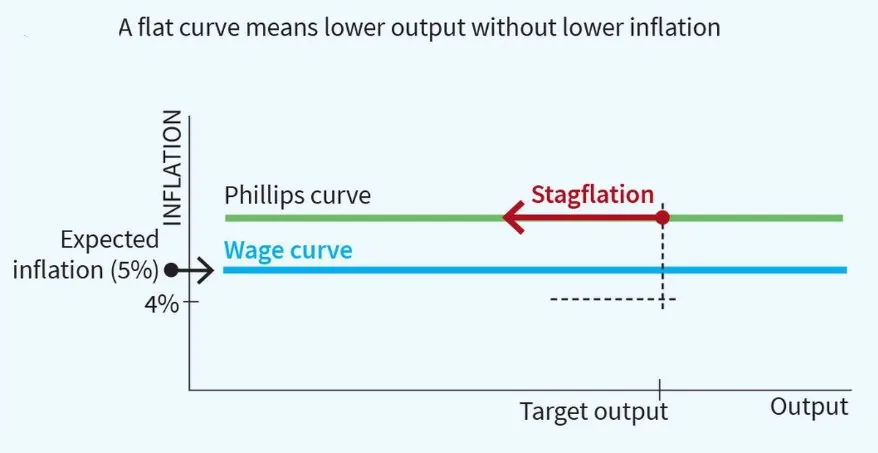
- Empirical data from April 2012 to March 2026 indicates that India’s New Keynesian Phillips Curve (NKPC) is effectively flat.
- This implies a weak relationship between output and inflation. Consequently, aggressive interest-rate hikes could cause significant losses in output and employment without a commensurate decline in inflation, potentially increasing the risk of stagflation.
- Flawed Assumptions on Wages:
- The traditional macroeconomic model assumes that as output rises, workers demand higher wages, which in turn pushes up prices.
- However, in India, nearly 92% of the workforce operates in the informal sector with no wage-bargaining power. They are simply “price takers,” which breaks the assumed theoretical link between output and wage-led inflation.
- Unanchored Inflation Expectations:
- Household inflation expectations have consistently outpaced the RBI own projections by an average of four percentage points.
- This suggests that the monetary policy’s ‘expectations channel’ has not successfully anchored public sentiment.
- Supply-Side Dominance:
- Indian inflation is often driven by food-price volatility, monsoon shocks, fuel-price fluctuations and global supply-chain disruptions. As monetary policy is primarily a demand-management tool, it cannot directly resolve such supply-side shortages.
- Without addressing underlying supply-side constraints, monetary tightening may suppress demand, output and employment without delivering a sustained reduction in inflation.
- High Liquidity Challenges:
- The RBI frequently faces the challenge of managing surplus systemic liquidity (e.g., resulting from forex currency defense operations).
- This surplus liquidity exerts downward pressure on overnight interest rates, working directly against the central bank’s tight inflation stance.
- Macroeconomic Stability:
- Despite recent shocks, average inflation has declined significantly under the FIT regime compared to the pre-2014 era, when CPI frequently hovered near 10%.
- During 2016–2025, FIT showed a hump-shaped performance (“inverted-U curve”), with inflation broadly aligned with the 4% target in the initial and final three-year periods, while the middle period moved towards the 6% upper tolerance limit due to the Covid-19 pandemic and Russia-Ukraine conflict.
- Since the adoption of FIT in 2016, average inflation declined to 4.9%, compared with 6.8% during the pre-FIT period.
- Optimal Growth Threshold: A recent RBI research paper mapping the quadratic inflation-growth curve (from 1991 to 2023, excluding Covid years) found that India’s economic growth is maximized when inflation is kept near the 4% central target.
- Institutional Credibility: The statutory backing of the Monetary Policy Committee (MPC) has enhanced the institutional independence of the RBI, stabilizing inflation expectations of markets and shielding monetary policy from fiscal dominance.
 New Keynesian Phillips Curve (NKPC)
- The NKPC outlines the theoretical relationship between a country’s level of economic output and its inflation. The model proposes that an increase in economic output and employment strengthens workers’ bargaining power, allowing them to demand higher wages.
- Because prices act as a markup over wage costs, a rise in wages inevitably leads to a rise in prices, giving the NKPC an upward-sloping shape.
- According to this theory, policymakers can control inflation either by reducing output (sliding down the curve) or by lowering public expectations (shifting the entire wage curve downward).
- Create a Joint Food Inflation Response Cell: Establish an RBI–Consumer Affairs Ministry mechanism with a 6% three-month food-inflation trigger for automatic buffer-stock releases, pulse sales and calibrated import-duty cuts, reducing pressure on the MPC to respond to supply shocks through rate hikes.
- Re-evaluating the Policy Anchor: Policymakers must continually debate the merits of targeting Core Inflation (which excludes volatile food and fuel prices) versus Headline CPI to ensure that monetary policy is not held hostage by temporary agricultural shocks.
- Strengthen Rate Transmission to Informal Credit: Extend transparent benchmark-linked pricing to NBFCs and MFIs, alongside expanded credit guarantees for MSMEs, so that repo-rate changes reach the informal economy where conventional monetary transmission remains weak.
- Revive Retail Inflation-Indexed Bonds: Reintroduce liquid, retail-oriented inflation-indexed bonds with regular interest payouts, giving households a credible inflation hedge and reducing reliance on physical assets such as gold.
- Set Explicit Second-Round Effect Indicators: Define measurable conditions, such as persistent food inflation alongside a sustained rise in core inflation, for assessing second-round effects before initiating additional monetary tightening. This would make MPC decisions more predictable and reduce unnecessary growth costs.
Geography
Mount Anak Krakatau
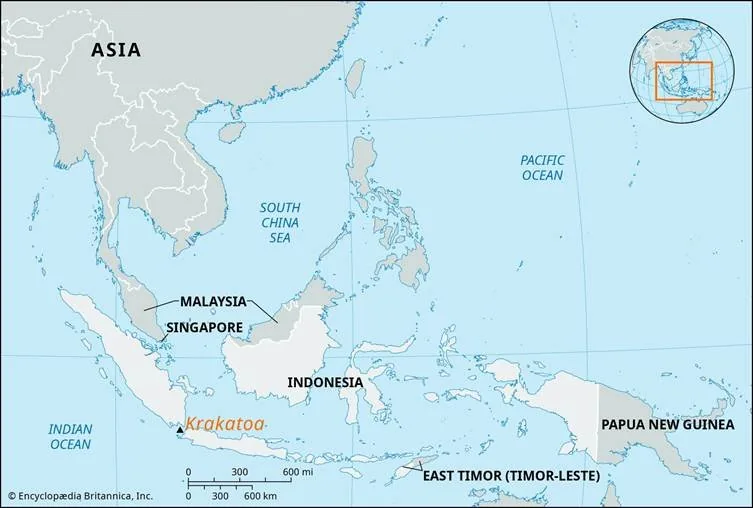
Source Indonesia’s Mount Anak Krakatau erupted, releasing fine volcanic ash particles that disrupted air transport by creating risks to aircraft engines, reducing visibility, and posing health hazards, leading to suspension of operations at several airports and affecting passengers and flights.- About:
- Mount Anak Krakatau is located in the Sunda Strait between Java and Sumatra islands of Indonesia. It is among Indonesia’s around 130 active volcanoes and lies within the Pacific Ring of Fire, a highly tectonically active region associated with frequent earthquakes and volcanic eruptions.
- The volcano is part of the Sunda Arc, formed due to the subduction of the Indo-Australian Plate beneath the Eurasian Plate, making the region highly vulnerable to volcanic activity.
- Origin: Anak Krakatau, meaning “Child of Krakatau,” emerged from the remains of the Krakatau volcanic system after the catastrophic 1883 eruption, which collapsed much of the original island, triggered devastating tsunamis, and caused over 36,000 deaths.
- Significance: Anak Krakatau highlights the importance of volcanic monitoring, disaster preparedness, and tsunami early warning systems, as demonstrated by the 2018 flank collapse that triggered a tsunami in the Sunda Strait.
Health & Medicine
Bhutan Achieves Rabies Elimination Milestone
Source Bhutan became the 1st country in the WHO South-East Asia Region to eliminate dog-transmitted rabies as a public health problem, maintaining zero human deaths since June 2023 through surveillance, vaccination, and a One Health approach.- The validation was conducted as per the World Health Organization (WHO) Expert Consultation on Rabies (2018) criteria, with assessment by experts supported by the WHO and the World Organisation for Animal Health (WOAH), covering surveillance systems, laboratories, records, and field implementation.
- Elimination of dog-mediated human rabies as a public health problem requires no human deaths from dog-transmitted rabies for at least two years along with effective surveillance, vaccination, and control mechanisms to prevent re-emergence.
- About: Rabies is caused by the rabies virus, a neurotropic virus belonging to the Lyssavirus genus, which affects the central nervous system and leads to fatal encephalitis if untreated after symptom onset.
- Nature of the disease: Rabies is a viral, zoonotic disease and a neglected tropical disease (NTD). Once clinical symptoms appear, rabies is almost invariably fatal.
- Transmission: Rabies spreads through the saliva of infected animals, mainly through bites and scratches, or contact with broken skin or mucous membranes. Human-to-human transmission is extremely rare and has mainly been reported through organ transplantation.
- Prevention and Treatment:
- Rabies deaths are completely preventable with timely post-exposure prophylaxis (PEP). PEP includes:
- Immediate wound washing with soap and water (15 minutes)
- A full course of rabies vaccine
- Rabies immunoglobulin (RIG) or monoclonal antibodies for severe exposures
- Rabies deaths are completely preventable with timely post-exposure prophylaxis (PEP). PEP includes:
- Symptoms:
- Incubation period usually 2–3 months (can range from one week to one year). Once clinical symptoms appear, rabies is virtually 100% fatal.
- Two major forms include Furious rabies (hydrophobia, hallucinations, hyperactivity, rapid death) & Paralytic rabies (gradual paralysis, often misdiagnosed).
- Rabies Burden: India continues to face a significant rabies burden, largely linked to dog bites, while the disease imposes an estimated global economic cost of US$8.6 billion annually, including healthcare expenses, livelihood losses, and the financial burden of post-exposure prophylaxis (PEP).
Infrastructure & Energy
Geothermal Energy in India
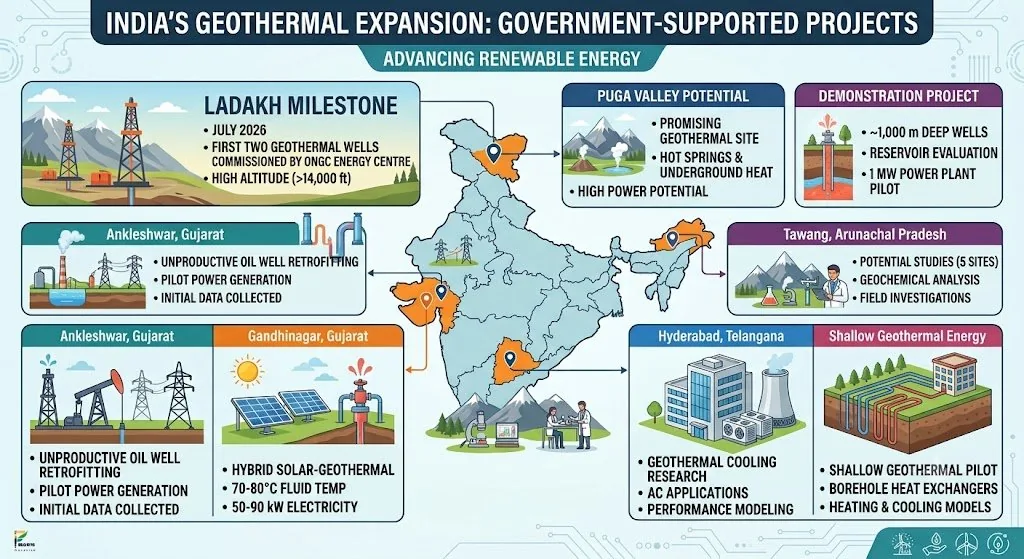
Source Why in News?- The Government of India’s push for geothermal energy development has brought attention to India’s geothermal potential, following the notification of the National Policy on Geothermal Energy, 2025 and the commissioning of the country’s first two geothermal wells at Puga Valley, Ladakh.
- About: Geothermal energy is a renewable energy source derived from the Earth’s internal heat, utilised for electricity generation and direct heating applications in regions with suitable geological conditions.
- Nature: It is a steady, low-carbon and weather-independent renewable energy source that can support clean energy transition by reducing dependence on fossil fuels.
- Formation: Earth’s internal heat is generated through radioactive decay of elements such as uranium, thorium, and potassium, along with residual heat from the planet’s formation. This heat drives mantle convection currents, contributing to tectonic processes such as earthquakes, volcanism, and mountain building.
- Geothermal Reservoir Formation: In geologically active regions, faults and fractures allow heat to move closer to the surface, creating reservoirs of hot water and steam trapped within permeable rocks.
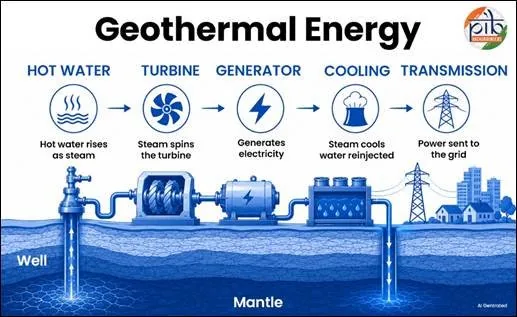
- Power Generation Process: Geothermal power plants extract hot water and steam through deep wells, which drive turbines connected to generators. After electricity generation, cooled water is reinjected into reservoirs to support sustainable energy production.
- Direct Heat Applications: Geothermal energy is also used for district heating, agriculture, aquaculture, and space heating and cooling.
- Earth’s Internal Structure:
- The Earth consists of four major layers:
- Inner Core: Solid iron-nickel layer about 2,400 km wide.
- Outer Core: Liquid layer mainly composed of molten iron and nickel.
- Mantle: Hot, dense rock layer extending nearly 2,900 km.
- Crust: Thin outermost solid layer, ranging from 5–8 km beneath oceans to 24–56 km beneath continents.
- The Earth consists of four major layers:
- Temperature Gradient: Earth’s temperature increases with depth, with temperatures reaching around 3,700°C at the mantle-core boundary and 5,000–6,000°C in the core, providing the heat source for geothermal energy.
 What is India’s Geothermal Energy Potential?
- Global Geothermal Scenario: Geothermal energy is an established renewable energy technology worldwide, with global installed capacity reaching 15.67 GW by the end of 2025. Countries such as Indonesia, the United States, the Philippines, Türkiye and New Zealand are leading the sector and together account for around 67% of global capacity.
- Resource Mapping: India has significant geothermal potential due to its diverse geological features. The Geological Survey of India (GSI) has mapped 381 hot springs and identified 10 geothermal locations across the country.
- Geothermal Potential: India’s theoretical geothermal resource potential is estimated at around 10.6 GW. Among the identified resources, 42 sites have been recognised as promising for electricity generation and direct heat applications.
- Major Geothermal Provinces: India’s geothermal provinces include the Himalayan Geothermal Province, Naga-Lusai Province, Andaman and Nicobar Islands, Son Narmada Tapi (SONATA), West Coast, Cambay Graben, Aravalli, Mahanadi, Godavari and South Indian Cratonic regions.
- Role of Advanced Technologies: Technologies such as Enhanced Geothermal Systems (EGS) and Advanced Geothermal Systems (AGS) can expand geothermal exploration by enabling energy extraction from areas with limited conventional geothermal resources.
- Repurposing Existing Infrastructure: Abandoned or unproductive oil and gas wells can potentially be repurposed for geothermal projects by utilising existing drilling expertise, well data, and infrastructure, subject to technical feasibility.
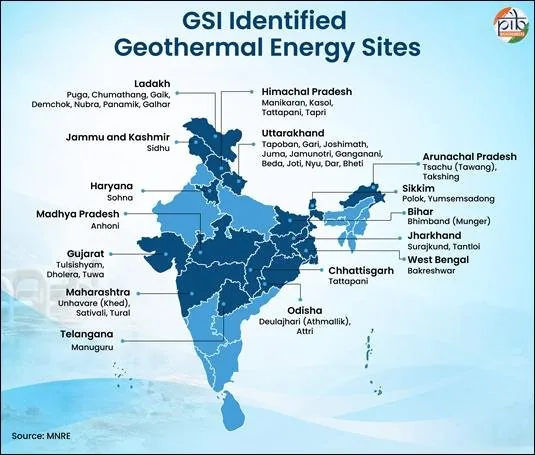 What is India’s Policy Framework for Geothermal Potential?
- National Policy on Geothermal Energy, 2025:
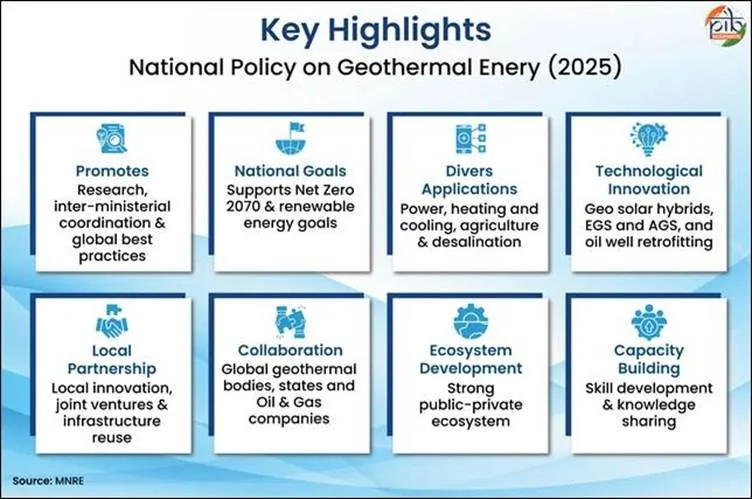
- The Government notified the policy in September 2025 to establish geothermal energy as a major pillar of India’s renewable energy mix. The Ministry of New and Renewable Energy (MNRE) is the nodal ministry responsible for its implementation.
- Policy Focus Areas: The policy promotes systematic exploration, technology development, drilling, reservoir management, direct-use applications, Ground Source Heat Pumps (GSHPs), pilot projects, Centres of Excellence, and development of a national geothermal data repository.
- Private Sector Participation: It provides a regulatory framework to encourage participation of both public and private sector entities and supports the repurposing of abandoned oil and gas wells for geothermal applications.
- Renewable Energy Research and Technology Development Programme (RE-RTD): Implemented by the Ministry of New and Renewable Energy (MNRE), the programme supports research institutions and industry partners in developing indigenous and cost-effective renewable energy technologies, including geothermal solutions.
- International Cooperation: India is strengthening geothermal development through partnerships with Australia and Iceland, where geothermal energy has been identified as an area of cooperation. An MoU with Saudi Arabia has also recognised geothermal energy as a focus area for bilateral collaboration.
 Conclusion
- Geothermal energy represents a promising addition to India’s renewable energy portfolio. With abundant geothermal resources, supportive policy frameworks and early demonstration projects like Puga Valley in Ladakh, India is gradually moving from resource identification towards practical utilisation. As the country advances towards its Net Zero 2070 goal, geothermal energy can become a reliable, indigenous and sustainable pillar of India’s clean energy transition.
International Relations
Falkland Islands Dispute
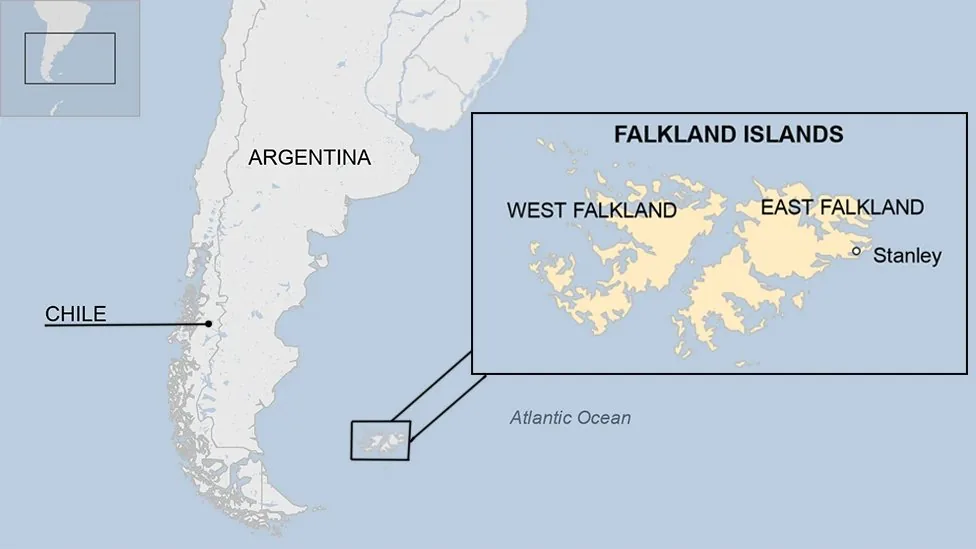
Source The Falkland Islands dispute has resurfaced amid renewed tensions between Argentina and the United Kingdom, particularly over sovereignty claims and oil exploration activities near the islands.- Geographical Location: The Falkland Islands are an archipelago in the South Atlantic Ocean, located approximately 480 km off the southeastern coast of Argentina.
- Political Status: It is a British Overseas Territory that is internally self-governing, with the UK responsible for its defense and foreign affairs.
- Historical Context:
- Britain has asserted an uninterrupted and peaceful display of state authority over the islands since 1833.
- In 1982, Argentina and the UK fought a 10-week war after Argentina’s military dictatorship invaded the Falkland Islands, which it claims as Las Malvinas. The UK subsequently recaptured the territory.
- Competing Claims over the Falkland Islands:
- Argentina’s Claims:
- Argentina argues that it inherited territories formerly held by the Spanish Crown after independence in 1816, including the Falkland Islands.
- Argentina argues that the UK’s 1833 takeover violated its territorial integrity and rejects the islanders’ claim to self-determination.
- United Kingdom’s Claims:
- The UK maintains that Argentina did not inherit the islands from Spain, citing Britain’s prior claim and continuous administration.
- The UK emphasises the UN Charter principle of self-determination, noting that 99.8% of islanders voted in 2013 to remain a British Overseas Territory.
- Argentina’s Claims:
- UN Position: The Falklands have been on the UN list of Non-Self-Governing Territories since 1946. The UN repeatedly urges Britain and Argentina to resume peaceful negotiations.
- Stances of Major Global Powers:
- China: Supports Argentina’s sovereignty claim, linked to Argentina’s support for the One China principle.
- United States: Officially maintains neutrality on sovereignty, while recognising de facto UK administration. During the 1982 war, however, it provided logistical and intelligence support to the UK.
Polity & Governance
Article 142 of the Constitution
Source Why in News?- The Supreme Court of India invoked its extraordinary powers under Article 142 of the Constitution to quash multiple First Information Reports (FIRs) filed across various states against participants of the nationwide examination protests led by the Cockroach Janta Party (CJP).
- The Court’s order gave legal force to a negotiated settlement between the Union government and the protest group over the NEET-UG 2026 exam leak.
- By clubbing and scrapping these cases directly, the Supreme Court bypassed the conventional statutory route for quashing FIRs, sparking a fresh debate on the scope, application, and boundaries of Article 142.
- Defining the Power:
- Article Article 142(1) empowers the Supreme Court to pass any “decree or order as it is necessary for doing complete justice in any cause or matter pending before it.”
- The Constitution notably does not define what constitutes “complete justice” or the specific circumstances for its use.
- Article 142(2) empowers the Court to secure the attendance of persons, discovery or production of documents, investigation, and punishment for contempt, subject to laws made by Parliament.
- Historical Origins: The provision traces its roots to Section 210 of the Government of India Act, 1935, and earlier colonial-era practices of resolving disputes based on “justice, equity and good conscience” when written law was absent.
- Constituent Assembly Adoption: Originally drafted as Article 118, it was adopted by the Constituent Assembly in 1949, without any formal debate. Two proposed amendments were moved but subsequently withdrawn.
- Undefined Scope: Because it was passed without debate, the Constituent Assembly left the definition of this expansive power open, allowing the Supreme Court to interpret and shape its boundaries on a case-by-case basis over the past seven decades.
- Significant Historical Invocations of Article 142:
- Frequent Invocation: Because of its open-ended nature, Article 142 has become one of the Court’s most utilized tools. An IIM Ahmedabad study found 1,579 references and 791 direct invocations of this power between 1950 and 2023, primarily in civil matters.
- Bhopal Gas Tragedy (1989): In the Union Carbide Corporation v. Union of India case, the Supreme Court invoked Article 142 to approve a USD 470 million settlement between the parties and quash the criminal proceedings against the corporation.
- Vishaka Guidelines (1997): In the absence of parliamentary legislation on workplace sexual harassment, the Supreme Court invoked Article 142 to lay down the Vishaka Guidelines in Vishaka v. State of Rajasthan (1997), which remained binding until Parliament enacted the Sexual Harassment of Women at Workplace (Prevention, Prohibition and Redressal) (PoSH) Act, 2013.
- Ayodhya Title Dispute (2019): The power was used to settle the long-standing dispute on a “preponderance of probability” and to direct that five acres of land be allotted to the Sunni Waqf Board.
- A.G. Perarivalan vs The State Of Tamil Nadu State (2022): The Court invoked Article 142 to order the release of convict A.G. Perarivalan.
- Matrimonial Disputes: The Court regularly uses this power to grant divorces in cases of irretrievable breakdown of marriage, bypassing standard statutory waiting periods, and routinely applies it in public interest litigations.
- SC Attempts to Limit Powers under Article 142:
- The Court has made several internal attempts to establish judicial guardrails to prevent undue discretion.
- Consistent with Fundamental Rights: In Prem Chand Garg vs. State of Uttar Pradesh (1962), the Court ruled that orders made under Article 142 must align with fundamental rights and existing substantive law.
- Supplementing, Not Supplanting:
- In Supreme Court Bar Association vs. Union of India (1998), a Constitution Bench clarified that Article 142 is intended to supplement a statute by filling gaps, not to supplant or override an existing statutory framework.
- Despite these self-imposed limitations, the Court has frequently ignored its own cautionary precedents.
- Circumventing Statutory Schemes:
- In the CJP protest order, thousands of FIRs were clubbed and quashed without individual scrutiny.
- Ordinarily, quashing an FIR must be examined on its own facts under Section 528 of the Bharatiya Nagarik Suraksha Sanhita (BNSS), 2023 to see if an offence is made out. Critics argue that utilizing Article 142 for mere “convenience” supplants the legislative procedure.
- Undefined and Unfettered Discretion: The absence of a precise definition of “complete justice” under Article 142 gives the Supreme Court wide discretionary powers. The provision has therefore been criticised for potentially enabling broad and unchecked judicial discretion.
- Magnification in a Polyvocal Court: The Supreme Court consists of 38 judges who largely sit in Division Benches of two. When undefined discretion is wielded by smaller benches, judicial outcomes can heavily depend on the individual philosophy of a specific two-judge bench rather than institutional consistency.
- Judicial Overreach:
- The Supreme Court has sometimes been criticised for entering areas traditionally falling within the legislative or executive domain, raising concerns about separation of powers, a part of the basic structure of the Constitution.
- Highway Liquor Ban: The Court invoked Article 142 to prohibit liquor shops within 500 metres of National Highways and extended the restriction to State Highways, despite the absence of similar notifications by state governments.
- Such interventions raise concerns about the extent of judicial discretion under Article 142 and the balance between judicial activism and judicial restraint.
- Lack of External Checks: The limitations on Article 142 are entirely self-imposed by the judiciary. If a bench disregards the limits set by previous Constitution benches, no institution outside the Court can enforce those guardrails.
- South Africa: Section 172(1)(b) of the Constitution empowers courts to make “any order that is just and equitable” when deciding constitutional matters, providing a constitutional basis for remedial judicial intervention.
- Canada: Courts can grant “appropriate and just” remedies under Section 24(1) of the Canadian Charter of Rights and Freedoms for violations of constitutional rights.
- Larger Benches for Invocation: As suggested by legal luminaries, the power to invoke Article 142 could be restricted to Constitution Benches of at least five judges to ensure collective wisdom and consistency.
- Mandatory Reasoning on Record: The Court should ensure that every exercise of Article 142 is supported by reasoned orders and the principle of proportionality, clearly explaining the statutory gap being addressed and why the intervention is necessary.
- Strict Adherence to Precedent: The judiciary must institutionalize the principles laid down in the Supreme Court Bar Association case, ensuring that Article 142 is strictly used as a curative tool of last resort, and not as a shortcut to bypass established criminal or civil procedure.
Schemes & Initiatives
Decentralised Grain Storage Plan in Cooperative Sector
Source Why in News?- The Decentralised Grain Storage Plan in the Cooperative Sector has gained attention due to its progress in expanding local-level grain storage capacity and strengthening agricultural infrastructure through cooperatives across the country.
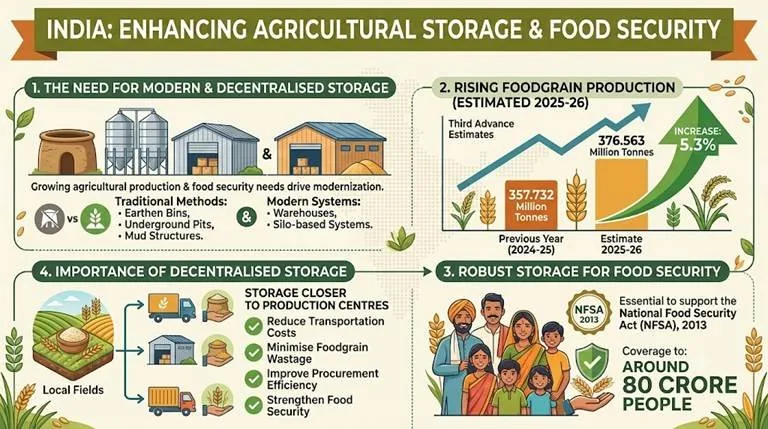
- About: The Decentralised Grain Storage Plan in the Cooperative Sector was launched as a pilot project on 31st May 2023 to expand grain storage capacity through cooperatives and strengthen storage, processing, procurement, and distribution systems.
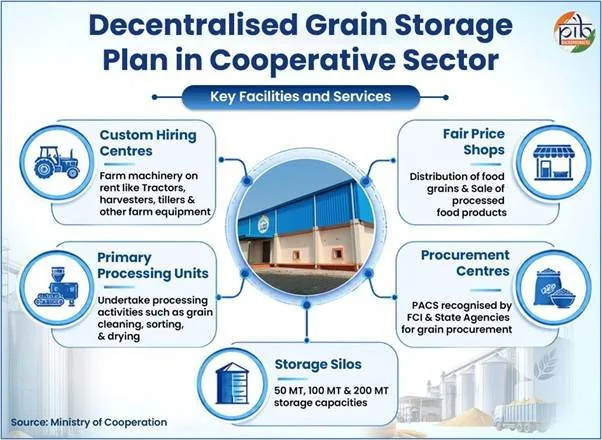
- Integrated Cooperative Approach: The initiative adopts a cooperative-led model by converging existing government schemes and utilising Primary Agricultural Credit Societies (PACS) as decentralised storage and agricultural service centres.
- Role of Cooperatives: The initiative strengthens the role of Primary Agricultural Credit Societies (PACS) by enabling them to diversify into storage and other agricultural activities, thereby improving rural economic opportunities.
- Benefits for Farmers: The plan helps farmers avoid distress sales, provides better storage flexibility, supports improved price realisation and creates additional income opportunities.
- Reducing Supply Chain Challenges: Decentralised storage reduces dependence on distant warehouses by improving connectivity between procurement centres, storage facilities and Fair Price Shops while reducing transportation costs and post-harvest losses.
- Pilot Phase: The Decentralised Grain Storage Plan was initiated through pilot projects in 11 PACS across 11 States, creating 9,750 MT storage capacity and demonstrating the feasibility of cooperative-level storage infrastructure.
- Expansion Phase: The initiative has scaled up significantly, with 1,012 PACS/cooperative societies identified and 313 PACS completing godown construction, creating over 1.80 lakh metric tonnes (LMT) of storage capacity as of July 2026.
 What is the Integrated Infrastructure and Convergence Framework?
- PACS as Integrated Rural Service Hubs: The Decentralised Grain Storage Plan in the Cooperative Sector aims to develop Primary Agricultural Credit Societies (PACS) into integrated agricultural service centres by creating storage, processing and marketing infrastructure at the local level.
- Convergence with Government Schemes:
- The plan integrates multiple schemes to strengthen agricultural infrastructure:
- Agriculture Infrastructure Fund (AIF): Provides financing support and interest subvention for creating and upgrading post-harvest infrastructure.
- Agricultural Marketing Infrastructure (AMI) Scheme: Provides back-ended capital subsidy for construction of foodgrain storage facilities.
- Sub Mission on Agricultural Mechanization (SMAM): Supports establishment of Custom Hiring Centres and access to farm machinery.
- Pradhan Mantri Formalisation of Micro Food Processing Enterprises (PMFME) Scheme: Promotes growth and formalisation of micro food processing units.
- The plan integrates multiple schemes to strengthen agricultural infrastructure:
 Selection of PACS and Institutional Framework
- Selection Process: According to the Margdarshika (Standard Operating Procedure), PACS are identified and approved by District Cooperative Development Committees (DCDCs) based on local storage demand.
- Land Requirements: Participating PACS should preferably have their own land, which should not be waterlogged or located in forest areas. Consent of PACS members is required for land utilisation, while leased land should have a lease period of more than 20 years.
- Implementing Agency: The National Cooperative Development Corporation (NCDC) is responsible for implementing the Decentralised Grain Storage Plan in the cooperative sector.
- National-Level Coordination: An Inter-Ministerial Committee (IMC) oversees overall implementation, while the National Level Coordination Committee (NLCC) ensures coordination among participating institutions.
- State and District-Level Support: State Cooperative Development Committees (SCDCs) and District Cooperative Development Committees (DCDCs) support implementation and coordination at respective levels.
- Enhanced Subsidy Support: The government increased subsidies under the Agricultural Marketing Infrastructure (AMI) Scheme from 25% to 33.33% and reduced the margin money requirement from 20% to 10% to improve project viability.
- Credit Support: NABARD acts as the subsidy-channelising agency under AMI, while State Cooperative Banks and District Central Cooperative Banks provide credit support to PACS.
- Interest Subvention Benefit: Through NABARD’s special refinance facility and 3% interest subvention under AIF, the effective loan interest rate for PACS is reduced to 1%.
- Assured Hiring Support: Food Corporation of India (FCI) provides assured hiring of eligible godowns created under the plan, subject to prescribed conditions, improving financial sustainability of storage projects.
- Standardised Branding: The plan provides uniform branding guidelines for storage infrastructure, including approved grain storage logos and colour schemes to create a recognisable identity among stakeholders.
- Quality Construction Standards: Storage structures must comply with Warehousing Development and Regulatory Authority (WDRA) norms and should be designed according to local environmental conditions. Durable materials, proper ventilation and safety measures are emphasised to prevent grain spoilage.
- Monitoring and Accountability: Regular inspections and quality audits are conducted to ensure compliance with construction and safety standards. PACS members monitor project progress, while Project Management Consultants (PMC) provide updates on construction activities and expenditure.
- The Decentralised Grain Storage Plan represents a shift from a centralised storage model towards a community-based agricultural infrastructure system. By transforming PACS into integrated rural service centres, the initiative can reduce post-harvest losses, improve farmers’ incomes and strengthen India’s food security architecture. A robust cooperative storage network, supported by technology, finance and quality standards, can become a crucial pillar of sustainable agricultural development.
Space
EOS-05: India’s 1st Dedicated Geosynchronous Earth Observation Satellite
Source Why in News?- The Indian Space Research Organisation (ISRO) successfully launched the Earth Observation Satellite-05 (EOS-05) aboard the GSLV-F17 launch vehicle from the Satish Dhawan Space Centre, Sriharikota. This marks a major milestone as it is India’s first dedicated imaging satellite designed to operate from a geosynchronous orbit.
- About the Satellite:
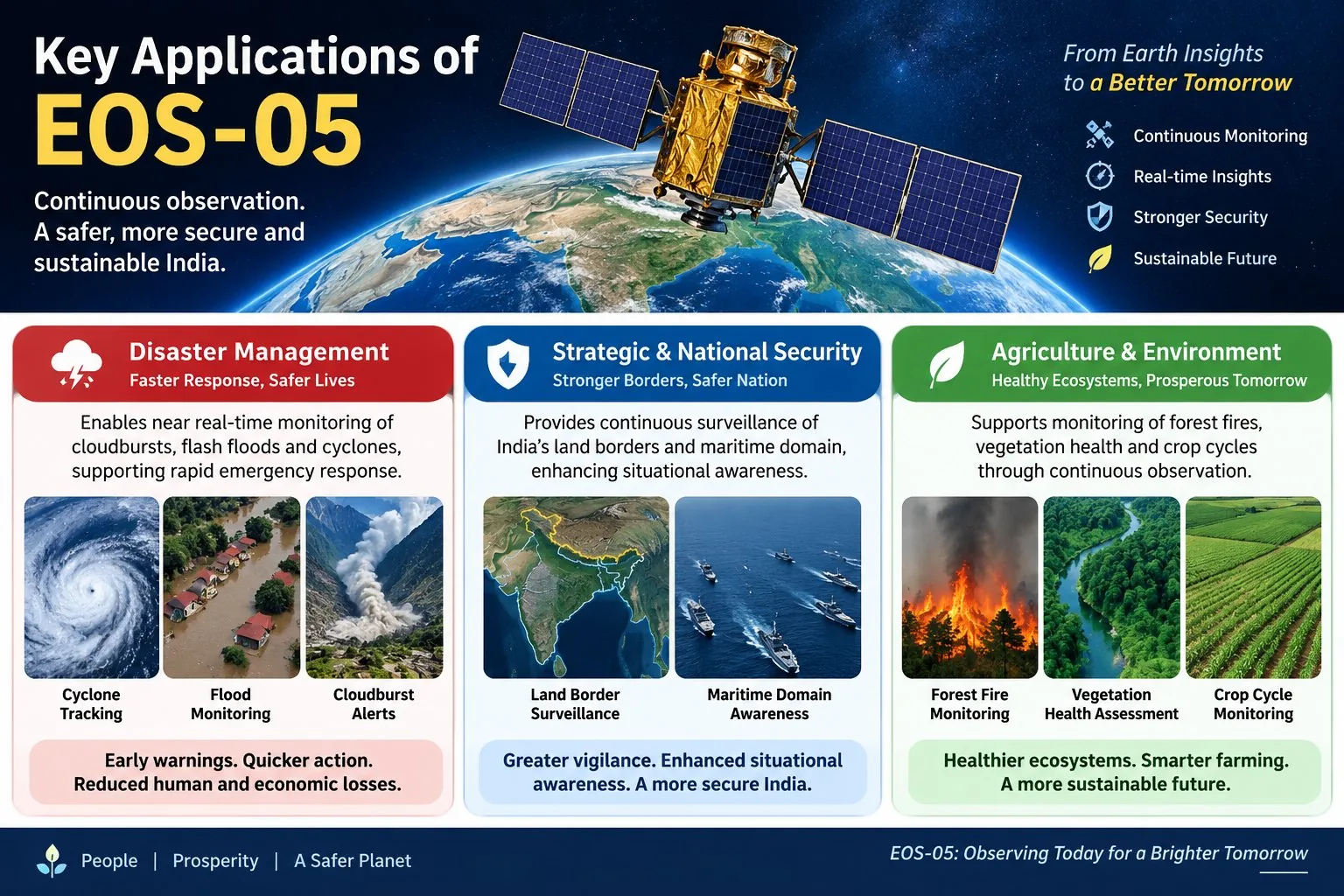
- Dubbed the “Eye in the Sky,” EOS-05 is a state-of-the-art Earth observation spacecraft equipped with advanced optical and infrared imaging payloads to provide continuous, real-time imagery.
- Weighing 2,367 kg, it represents the heaviest payload successfully injected into orbit by a standard GSLV configuration.
- The Launch Vehicle:
- The mission was executed by GSLV-F17, marking the 19th operational flight of India’s Geosynchronous Satellite Launch Vehicle.
- The GSLV is a three-stage launch vehicle. The first stage uses a solid core with four liquid strap-on boosters, followed by a liquid second stage and an indigenous cryogenic upper stage (CUS) for launching heavier payloads into deep transfer trajectories.
- The Orbit: Unlike conventional Earth observation satellites that circle close to the planet in Low Earth Orbit (LEO) with limited revisit windows, EOS-05 is India’s first dedicated imaging satellite designed to operate from a Geosynchronous Orbit (GEO), roughly 36,000 km above the Earth.
- Mission Profile & Orbit Raising:
- GSLV-F17 precisely injected the spacecraft into a Sub-Geosynchronous Transfer Orbit (Sub-GTO).
- The satellite will progressively fire its onboard liquid apogee motor (LAM) over multiple orbit-raising maneuvers to reach its designated geostationary orbital slot over the Indian subcontinent.
- Significance of Imaging Satellites in GEO:
- LEO imaging platforms pass over a specific area in minutes, leaving blind spots of hours or days before the next satellite passes. GEO provides continuous persistence and an unblinking, wide-area view.
- GEO imaging enables persistent, high-frequency tracking of rapidly evolving meteorological hazards, such as cloudbursts, cyclones, flash floods, and forest fires, where hourly updates are vital for disaster relief.
 What are the Different Types of Satellite Orbits?
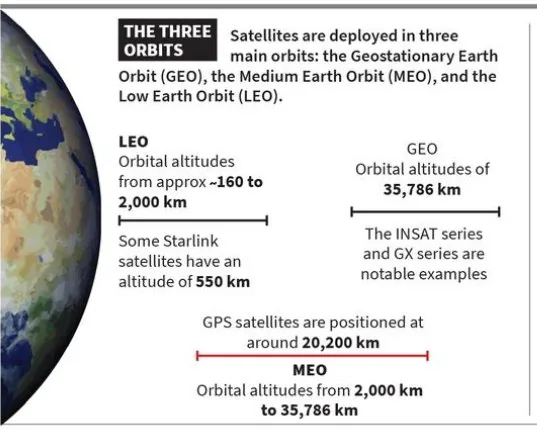
- Orbit: According to the European Space Agency (ESA), an orbit is the curved path an object follows around another body under the influence of gravity. Earth orbits are broadly classified into three altitude classes:
- Low Earth Orbit (LEO):
- Altitude & Speed: Ranges from 160 km to 2,000 km above Earth’s surface. Satellites complete an orbit in 90 to 120 minutes, traveling at high velocities to counteract gravitational pull.
- Applications: Proximity minimizes signal latency, making LEO ideal for high-resolution imaging, broadband mega-constellations, and crewed platforms like the International Space Station (ISS).
- Subsets: Includes Sun-Synchronous Orbits (SSO) (consistent solar illumination) and Very Low Earth Orbit (VLEO) (ultra-high resolution, but prone to high atmospheric drag and fuel expenditure).
- Density: As of late 2026, over 15,500 active satellites operate in LEO, with India maintaining 22 operational satellites in this band.
- Medium Earth Orbit (MEO):
- Altitude: Extends from 2,000 km up to 35,786 km, positioned directly beneath the geosynchronous belt.
- Characteristics: Strikes a balance between low signal latency and expansive ground coverage.
- Applications: Primarily hosts Global Navigation Satellite Systems (GNSS) such as the European Union’s Galileo constellation (30 satellites) and the US GPS network.
- Geosynchronous Orbit (GSO) & Geostationary Orbit (GEO):
- Altitude & Motion: Positioned at approximately 35,786 km. Satellites orbit eastward matching Earth’s rotational period of 23 hours, 56 minutes, and 4 seconds.
- The GEO Distinction:
- When an orbit has a zero-degree inclination directly over the equator, it is a Geostationary Orbit (GEO).
- To an observer on the ground, the satellite appears permanently fixed at a single point in the sky.
- Footprint: A single GEO satellite observes nearly one-third of the globe; three evenly spaced satellites can deliver near-global coverage.