Comrades Dispatch · 08 Sep 2026 (PDF)
In this edition
- Nepal’s Climate Justice Claim: From Disaster Relief to Climate Liability Environment & Ecology
- Swachh Vayu Sarvekshan 2026 Environment & Ecology
- Districts as Export Hubs Schemes & Initiatives
- India-China Border Management Security
- Consensus on Defining Lethal Autonomous Weapons Systems (LAWS) Security
- Khagantak-243 Long Range Glide Bomb Security
- Striped Hyenas Wildlife
Environment & Ecology
Nepal’s Climate Justice Claim: From Disaster Relief to Climate Liability
Source Why in News?- A rock-ice avalanche and flash flood in Nepal in August 2026, destroyed infrastructure and wiped out around 10% of the country’s installed hydropower capacity. The disaster sparked a debate on climate justice and liability, after Nepal’s Foreign Minister called for climate compensation from major greenhouse gases (GHGs) emitters, including the US, China and India.
- In response, India urged developed countries, given their historical responsibility for GHG emissions, to take the lead in emission reductions and provide climate technologies to developing nations.
- The “Third Pole” Paradox: Nepal contributes a negligible 0.1% to global GHG emissions. However, the Hindu Kush Himalayas (HKH) known as the “Third Pole” are experiencing Elevation-Dependent Warming (EDW) at nearly twice the global average, causing glaciers to melt at 10 times their historical norms.
- Macroeconomic Crippling:
- The disaster inflicted damages estimated between USD 4 billion and USD 7 billion, wiping out roughly 10% of Nepal’s GDP.
- The destruction of major Run-of-the-River (RoR) hydropower assets forced Nepal to transition overnight from a regional electricity exporter to an importer, crippling its strategy to offset trade deficits.
- The Climate-Debt Trap: Rebuilding destroyed infrastructure requires climate-resilient engineering, which inherently escalates capital expenditure (CapEx). Without direct compensation, vulnerable nations are forced to take on commercial debt to adapt to a crisis they did not trigger.
- Complex Cryospheric Teleconnections:
- Scientific research links localized glacial destabilization to broader global systems, such as Arctic warming, shifts in atmospheric circulation, and South Asian monsoon variability.
- While these teleconnections connect local disasters to global emissions, establishing direct legal causality requires extensive data modeling.
- Differentiating Responsibility:
- Nepal seeks to shift climate finance from voluntary humanitarian aid to greater accountability, arguing that vulnerable, low-emitting countries should not bear the costs of climate-induced disasters alone.
- Its approach distinguishes between historical responsibility, targeting developed countries such as the US for their cumulative GHG emissions, and proximate responsibility, highlighting China and India as major current emitters and regional powers with greater responsibility for Himalayan climate risks and disaster recovery.
- Climate justice recognises that climate change disproportionately affects vulnerable communities that have contributed least to global emissions. It seeks equitable climate action by addressing both environmental impacts and underlying social inequalities.
 What are the Systemic Challenges in Establishing Climate Compensation and Legal Liability?
- Explicit Exclusion Under International Law:
- Although Article 8 of the Paris Agreement recognises Loss and Damage, it explicitly states that this provision does not provide a basis for liability or compensation.
- Therefore, countries cannot use the UNFCCC framework to establish a legal claim for damages against specific emitters.
- Structural Deficits of the Loss and Damage Fund:
- The Fund for Responding to Loss and Damage (FRLD), operationalized at COP28, is severely undercapitalized.
- It holds roughly USD 700 million against the multi-billion-dollar costs of single disasters. Furthermore, its pilot phase grant ceilings (USD 5 million to USD 20 million) and slow disbursement mechanisms are entirely mismatched for rapid emergency recovery.
- Attribution Science Limitations:
- Establishing legal liability requires proving that a specific disaster such as the sudden rock-ice collapse on the border would not have occurred absent anthropogenic warming.
- The complex interaction between seismic activity, local geomorphology, and weather patterns makes definitive legal attribution difficult.
- Relief as Soft Power vs. Binding Reparations:
- Major powers routinely provide emergency humanitarian relief (deploying helicopters, rescue teams, and medical aid) as an exercise of bilateral diplomacy.
- However, they strictly resist institutionalizing legal frameworks that could expose them to compensatory liability.
- Inversion of the CBDR-RC Doctrine:
- India has consistently defended the principle of Common But Differentiated Responsibilities and Respective Capabilities (CBDR-RC) against the Global North, arguing that developed nations must finance global climate action.
- Nepal’s regional claims invert this argument, putting India as South Asia’s largest economy and emitter under moral pressure to assist smaller neighbors.
- Geopolitical Bottlenecks in Power Trade:
- India’s policy guidelines on the Cross-Border Trade in Electricity (CBET) restrict the import of power generated by projects involving Chinese contractors or capital.
- This policy directly constraints revenue streams for damaged or stalled Nepali hydropower assets, impeding fiscal self-recovery.
- Transboundary Early Warning Vulnerabilities:
- The disaster underscored systemic gaps in cross-border disaster risk reduction.
- Despite bilateral discussions regarding glacial lake outburst floods (GLOFs) and hazard risks in the Tibetan Plateau, real-time hydrometeorological data sharing remains constrained by geopolitical sensitivities.
- Shared Ecological Vulnerability:
- The degradation of the Himalayan cryosphere is not a localized Nepali crisis.
- Glacial destabilization directly threatens downstream perennial river flows in the Indo-Gangetic plain, making mountain climate resilience a shared domestic security issue for India.
- Establish Automated Transboundary Telemetry:
- India, China, Nepal, and Bhutan must operationalize an open-access Himalayan early warning network.
- Real-time satellite radar and hydrological telemetry across the Tibetan Plateau and upper catchments are necessary to achieve Target G of the Sendai Framework for Disaster Risk Reduction.
- Institute Regional Parametric Risk Pooling:
- South Asia should create a regional catastrophe insurance facility (modeled after the Caribbean Catastrophe Risk Insurance Facility).
- Parametric triggers based on scientific thresholds (such as river volume surge or seismic-cryospheric shifts) ensure immediate emergency liquidity without protracted political negotiations.
- Delink Infrastructure Recovery from Geopolitics: Regional energy architectures, including the BBIN (Bangladesh, Bhutan, India, Nepal) initiative, should introduce humanitarian carve-outs in power offtake agreements to allow grid-tied revenue generation from disaster-rehabilitated plants.
- Recondition Global Climate Finance Mechanisms: The UNFCCC must establish rapid-disbursement emergency windows within the Loss and Damage framework to bridge the gap between immediate humanitarian aid and long-term adaptation grants, preventing debt accumulation in vulnerable economies.
- Nepal’s intervention highlights the gap between climate vulnerability and international accountability. While existing frameworks limit legal claims for compensation, Himalayan stability requires a shift from reactive relief to institutionalised climate finance, transboundary data-sharing and resilient infrastructure cooperation.
Swachh Vayu Sarvekshan 2026
Source Why in News?- The Ministry of Environment, Forest and Climate Change (MoEFCC) organized Swachh Vayu Diwas 2026 on the occasion of the International Day of Clean Air for Blue Skies (7thSeptember).
- During the event, the 5th Swachh Vayu Sarvekshan Awards were conferred on the best-performing cities and wards under the National Clean Air Programme (NCAP). Additionally, a Compendium of Best Management Practices under NCAP was released to facilitate the replication of successful air quality interventions across states.
Note: International Day of Clean Air for Blue Skies was designated by the UN General Assembly in 2019 to promote global action and public awareness against air pollution. India observes it as Swachh Vayu Diwas. The 2026 theme is “Clean Air for Climate Action.”
- About:
- Introduced in 2022-23, the framework evaluates cities on specific measures taken to curb air pollution.
- These include managing road dust, solid waste management (SWM), vehicular and industrial emissions, construction and demolition (C&D) waste, and commercial emissions (like DG sets), alongside public outreach activities.
- City Categorization:
- The assessment covers all 130 NCAP cities, dividing them into three distinct groups based on population size:
- Population above 10 Lakh
- Population between 3 to 10 Lakh
- Population below 3 Lakh
- The assessment covers all 130 NCAP cities, dividing them into three distinct groups based on population size:
- Top Performing Cities:
- Category 1 (Population > 10 Lakh):
- Lucknow secured the top rank for proactive measures like inducting EVs into municipal fleets, mechanized road sweeping, and remediating legacy waste.
- It was followed by Indore (2nd) and Jabalpur (3rd). Conversely, Chennai, Jamshedpur, Kota, Kolkata, and Madurai ranked in the bottom five. Delhi stood at the 30th spot.
- Category 2 (Population 3-10 Lakh): Rourkela (Odisha) emerged as the top performer.
- Category 3 (Population < 3 Lakh): Kalinganagar (Odisha) secured the first position.
- Category 1 (Population > 10 Lakh):
- Introduction of Ward-Level Awards:
- The Swachh Vayu Sarvekshan 2026 also introduced ward-level rankings across three population categories.
- Category I: Lucknow (Uttar Pradesh), Bhopal (Madhya Pradesh) and Nashik (Maharashtra) secured the top three ranks for wards with over 30,000 population.
- Category II: Bhubaneswar (Odisha) wards ranked first, followed by Vijayawada (Andhra Pradesh) and Prayagraj (Uttar Pradesh).
- Category III: Rourkela (Odisha) and Nalgonda (Telangana) secured the top two positions among wards with less than 10,000 population.
- Progress under NCAP:
- Data from 2025-26 indicates measurable progress compared to the 2017-18 baseline.
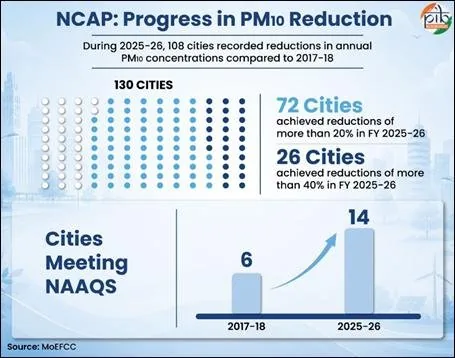
- Out of 130 NCAP cities, 108 recorded reduced PM10 levels. Notably, 72 cities achieved reductions of over 20%, and 26 cities achieved reductions exceeding 40%.
- Compendium of Best Practices: The released document aggregates successful mitigation strategies in road dust control, vehicular/industrial pollution, solid waste, and construction & demolition (C&D) waste management to act as a blueprint for State Pollution Control Boards (SPCBs).
- About: Launched in 2019 by the MoEFCC, the NCAP is a long-term, time-bound, national-level strategy designed to tackle air pollution comprehensively across India.
- Coverage: The programme encompasses 130 Non-Attainment Cities (cities that consistently failed to meet the National Ambient Air Quality Standards (NAAQS), for five consecutive years) alongside Million Plus Cities.
- Statutory Status: NCAP operates as a collaborative, multi-sectoral initiative but lacks statutory backing. It is not legally binding, meaning there are no penal provisions for states or Urban Local Bodies (ULBs) that fail to meet targets.
- Convergence: The programme is designed to synergize with existing government initiatives such as the Swachh Bharat Mission (SBM), Smart Cities Mission, FAME-II, and Pradhan Mantri Ujjwala Yojana (PMUY).
- Target:
- It initially aimed for a 20% to 30% reduction in Particulate Matter (PM10 and PM2.5) concentrations by 2024, with 2017 as the base year.
- The target was subsequently revised to achieve a 40% reduction in particulate matter concentration by 2026.
- On a national aggregate scale, the 2026 target remains largely unachieved. Only 26 out of 130 cities (20%) successfully recorded 40% reduction in particulate matter.
- Implementation and Tracking Mechanisms:
- Financial Framework: A performance-linked grant of ₹16,425 crore has been provisioned as critical gap funding for air-pollution mitigation.
- Digital Monitoring: The PRANA (Portal for Regulation of Air-pollution in Non-Attainment cities) portal tracks the physical and financial progress of city-specific air action plans.
- Source Apportionment (SA): A core operational mandate requires all 130 cities to conduct scientific SA studies and develop Emission Inventories to target specific local polluters rather than relying on generic interventions.
- Governance Structure: Implementation is overseen by a three-tier framework: an Apex Committee (Ministry level), a Steering Committee (Chief Secretary level), and a Monitoring Committee (District Magistrate level).
- Recorded Achievements (2025–26 Data compared to 2017–18 Baseline)
- 108 cities demonstrated an overall improvement in their PM10 levels.
- 72 cities achieved a reduction in PM concentrations of more than 20%.
- 26 cities recorded reductions exceeding 40%.
- 14 cities successfully met the National Ambient Air Quality Standards (NAAQS).
Schemes & Initiatives
Districts as Export Hubs
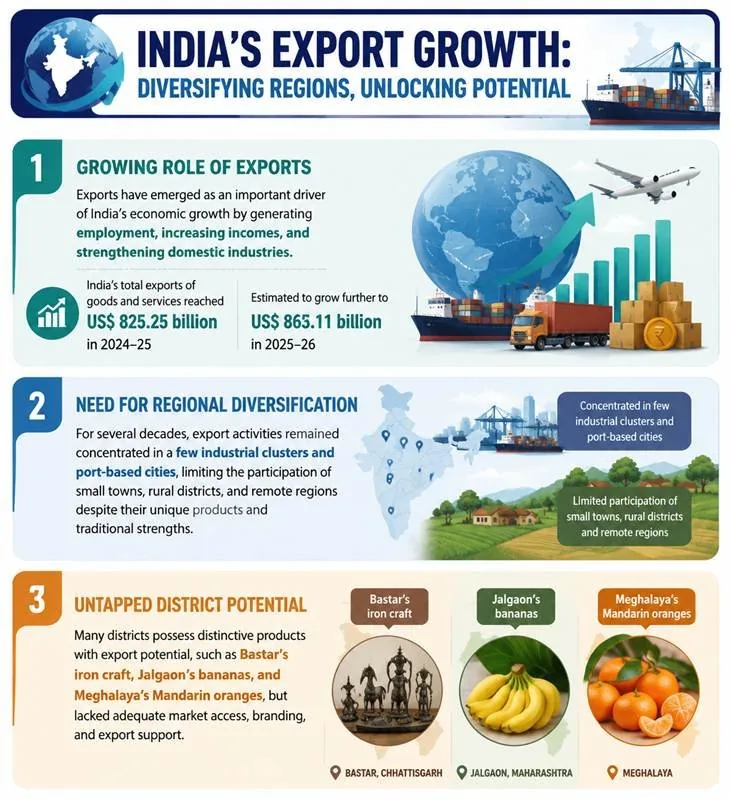
Source Why in News?- The Government has highlighted the role of the Districts as Export Hubs (DEH) Initiative in making India’s export growth more inclusive by connecting local products and producers with international markets. The initiative aims to transform every district into an export planning unit by identifying products and services with global potential.
- Objective: The Districts as Export Hubs (DEH) Initiative aims to utilise the unique strengths, resources, and products of every district to enhance their export potential and integrate local economies with global markets.
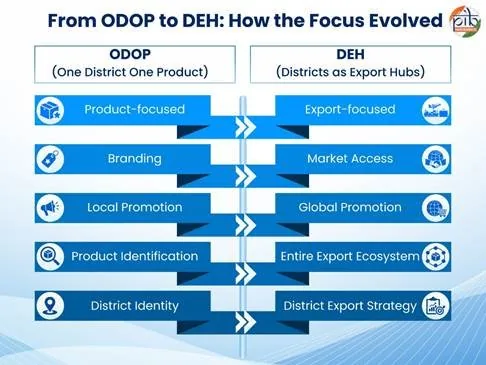
- District as an Export Unit: Unlike traditional approaches that focus mainly on production, DEH treats each district as a unit of export planning, helping local enterprises improve competitiveness, access international markets, and contribute to India’s export growth.
- Alignment with National Vision: The initiative supports the objectives of Aatmanirbhar Bharat and Vocal for Local by promoting local products, strengthening MSMEs, and creating employment opportunities at the grassroots level.
- Expansion through DEH: The story of DEH begins with the One District One Product (ODOP) programme. The Department of Commerce, through the Directorate General of Foreign Trade (DGFT), expanded the ODOP approach into the DEH framework by shifting focus from product promotion to a broader export ecosystem development model.
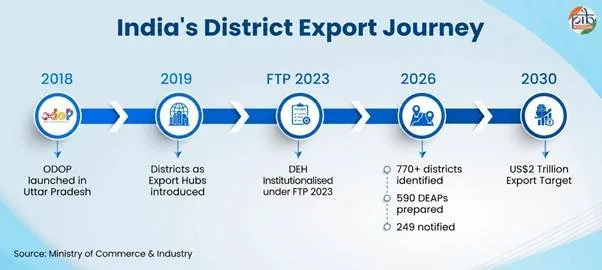
- Coverage: As of January 2026, the DEH initiative covers more than 770 districts across India, integrating district-level strengths with national export planning.
 One District One Product (ODOP)
- About:
- The One District One Product (ODOP) scheme is a flagship programme of the Ministry of Commerce and Industry, implemented through the Department for Promotion of Industry and Internal Trade (DPIIT) with support from Invest India.
- Inspired by Japan’s “One Village One Product” model, ODOP identifies, brands, and promotes one distinctive product from each district. As of 2025, it covers 1,102 products across 761 districts, including agriculture, handicrafts, textiles, and food items.
- Objective:
- The scheme aims to transform local specialities into global brands by supporting artisans, farmers, and small enterprises, while preserving India’s cultural heritage and traditional skills.
- Launched in Uttar Pradesh in 2018, starting with Moradabad’s brassware, the initiative helped revive traditional crafts such as chikankari embroidery, pottery, carpets, leather goods and brassware.
 Nature of the DEH Framework
- Convergence-Based Approach: DEH is not a separate funding scheme but a convergence framework that utilises existing central and state government schemes to address district-specific export challenges.
- Export Ecosystem Development: The initiative focuses on improving manufacturing capacity, export readiness, logistics, quality standards, and market access to enhance district-level competitiveness.
- Grassroots Economic Development: By supporting local industries, agricultural products, handicrafts, and MSMEs, DEH promotes employment generation and inclusive economic growth.
- Role of Department of Commerce and DGFT: The Department of Commerce provides overall policy direction, while the Directorate General of Foreign Trade (DGFT) manages implementation, stakeholder coordination, and monitoring of the initiative.
- State-Level Mechanism: State Export Promotion Committees (SEPCs) guide implementation at the state level and ensure coordination among different government departments.
- District-Level Mechanism:
- District Export Promotion Committees (DEPCs) identify export opportunities, address local challenges, and coordinate with exporters, industries, and stakeholders.
- As of March 2026, draft DEAPs have been prepared for 590 districts, of which 249 have been formally adopted by respective DEPCs.
- Focused Approach for DEH Implementation:
- From 1st June 2026, the Government adopted an outcome-oriented and focused approach to accelerate the implementation of the Districts as Export Hubs Initiative.
- Coverage and Support: The first phase covers districts across 27 States and Union Territories with support from 24 DGFT Regional Authorities and 11 partner agencies.
- Key Outcomes: The initiative focuses on measurable outcomes such as increasing new exporter registrations, expanding district export value, leveraging GI products, strengthening MSME clusters, and improving convergence of existing central and state schemes.
- Identification of Export Potential Products: DEH identifies district-specific products and services with export potential, including GI-tagged products, agricultural clusters, handicrafts, engineering goods, and toy clusters.
- Ensuring Global Quality Standards:
- DEH supports local producers by creating awareness and building capacity regarding international quality standards, testing facilities, packaging, branding, and certification requirements.
- These interventions help district products meet global compliance requirements and improve export competitiveness.
- Promoting Digital Export Opportunities:
- DEH promotes digital access and e-commerce-based exports by connecting MSMEs and local producers with e-commerce platforms.
- These partnerships provide cost-effective logistics solutions and help small businesses overcome challenges related to freight costs and market access.
- Dak Ghar Niryat Kendras provide low-cost postal export facilities for documentation, packaging, and small export consignments.
- Capacity Building and Export Awareness: DGFT Regional Authorities, district administrations, and partner organisations conduct training programmes on export procedures, logistics planning, packaging standards, and regulatory compliance.
- Fostering Grassroot Initiatives for Export Development:
- The DGFT has partnered with EXIM Bank under the Grassroots Initiatives for Development (GRID) programme to strengthen export ecosystems in selected districts.
- Selected Districts: Six districts—Anantapur, Raipur, Solan, Tiruppur, Kanpur and Kolhapur—have been selected under GRID to identify sector-specific challenges, support potential beneficiaries and develop district-specific interventions for enhancing export competitiveness.
 Conclusion
- The Districts as Export Hubs Initiative represents a shift from a concentrated export model to a district-driven export ecosystem. By identifying local strengths, strengthening MSMEs, improving export readiness and connecting producers with global markets, DEH is transforming local economies into engines of trade and employment. As India moves towards the ambition of US$1 trillion exports, empowering districts will be crucial for achieving inclusive, balanced and globally competitive economic growth.
Security
India-China Border Management
Source Why in News?- India and China held their first Corps Commander-level talks in the Eastern Sector at the Wacha-Damai Border Personnel Meeting (BPM) Point in Arunachal Pradesh, against the backdrop of increased People’s Liberation Army (PLA) patrol activity and localised stand-offs in Taksing, Upper Subansiri district of Arunachal Pradesh.
- This marks an expansion of the military dialogue mechanism beyond its earlier focus on Ladakh, bringing India-China border management and the broader Line of Actual Control (LAC) dispute into the spotlight.
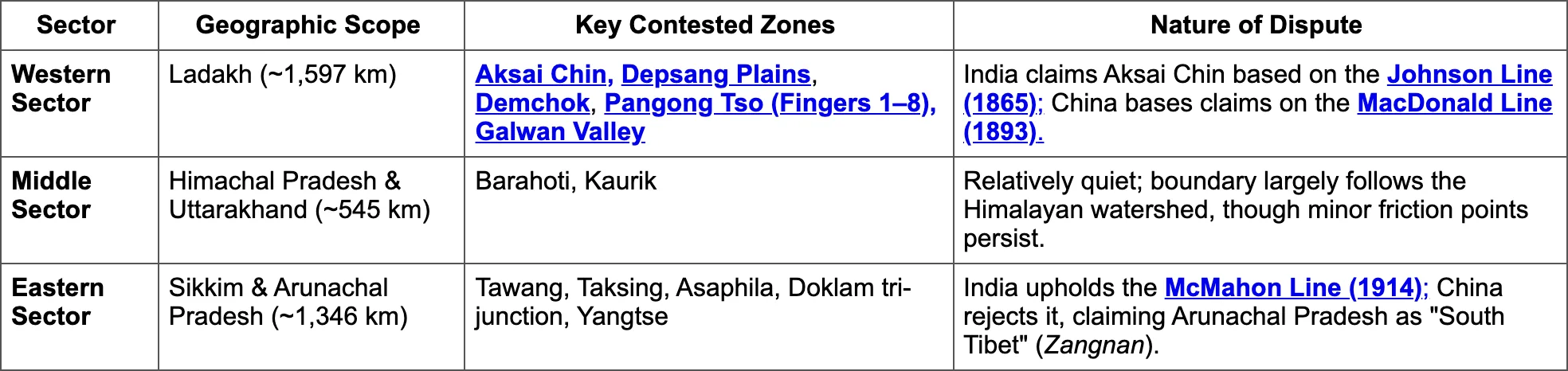
- Special Representatives (SR) on the Boundary Question: Established in 2003, it is the highest political-level mechanism to seek a final political settlement to the 3,488-km boundary dispute.
- Working Mechanism for Consultation and Coordination (WMCC): A diplomatic and military channel set up in 2012 to coordinate on incidents along the LAC and maintain peace, though it lacks the mandate to settle the boundary itself.
- Corps Commander-Level Meetings: High-level military negotiations utilized to achieve tactical disengagement, de-escalation, and buffer zone creation during intense border stand-offs.
- Border Personnel Meeting (BPM) Points: Designated geographical locations along the LAC where local military commanders from both sides meet to resolve ground-level friction.
- Institutional Hotlines: Direct communication channels between regional military commands to quickly defuse misunderstandings before they escalate up the chain of command.
- Foundational Treaties and Protocols: The 1993 Maintenance of Peace and Tranquillity Agreement (recognised the LAC and committed both sides to maintaining peace), 1996 Confidence-Building Measures Agreement (restricted military activities and use of weapons near the LAC), 2005 CBM Protocol (laid down procedures for handling face-to-face troop encounters), and 2013 Border Defence Cooperation Agreement (BDCA) (strengthened communication and coordination between border forces).
 Structural Drivers of Conflict
- Unclear LAC Demarcation: The absence of mutually agreed and physically demarcated maps results in overlapping territorial perceptions and patrol areas.
- Infrastructure Asymmetry: China’s rapid development of roads, railways such as the Lhasa-Nyingchi railway, and airfields across the Tibetan Plateau enables faster troop mobilisation and logistics.
- Dual-Use Border Villages: China has developed ‘Xiaokang’ border villages with civilian and strategic infrastructure near the LAC, strengthening its presence and territorial claims.
- Cartographic Aggression:
- China claims Arunachal Pradesh as ‘South Tibet’ (Zangnan) and periodically assigns standardised Chinese names to places in the region to reinforce its territorial claims. India rejects these claims and naming exercises.
- In August 2026, India formally identified 27 locations in Arunachal Pradesh on the official Survey of India map, in response to China’s repeated attempts to assign alternative names to places in the State.
- Siliguri Corridor Security: The Sikkim sector and the Doklam tri-junction are close to the Siliguri Corridor, India’s narrow land link to the Northeast, making the area crucial for national security.
- Tawang’s Strategic Importance: Tawang and Bum La provide India with important defensive positions overlooking the Assam plains and strengthen its strategic depth in the Northeast.
- Geo-Cultural Significance: Tawang is an important centre of Tibetan Buddhism and houses the historic Tawang Monastery, giving the region wider geopolitical significance in the context of Tibetan identity and religious affairs.
- Countering Territorial Claims: China claims the entire Arunachal Pradesh as ‘Zangnan’ (South Tibet). Maintaining a strong presence in the Eastern Sector is therefore vital for protecting India’s territorial integrity.
- Water Security: The Yarlung Tsangpo-Siang-Brahmaputra river system makes Arunachal Pradesh strategically important for India’s downstream water security and transboundary river cooperation with China.
- Act East Policy: A secure Arunachal Pradesh is essential for strengthening border connectivity, economic integration and India’s Act East Policy, linking the Northeast more effectively with Southeast Asia.
- Shift from Border Defence to Active Deterrence: After the 2020 Galwan Valley clash, India has strengthened its forward military posture by repositioning formations towards the northern borders and deploying Rafale aircraft, S-400 air-defence systems and BrahMos missiles to enhance India’s ability to respond rapidly to PLA mobilisation.
- Closing the Infrastructure Gap: India is accelerating all-weather connectivity along the LAC to overcome its earlier logistical disadvantage. The Arunachal Frontier Highway (NH-913), Sela Tunnel and Nechiphu Tunnel, along with BRO-built roads, bridges and Advanced Landing Grounds, are designed to enable faster troop mobilisation and sustained access to forward posts.
- Securing the Demographic Frontier: Through the Vibrant Villages Programme (VVP), India is developing strategically located border villages to reverse out-migration, strengthen civilian presence and improve last-mile connectivity. This counters China’s use of dual-use border villages to consolidate its presence along the LAC.
- Calibrated Economic De-risking: India tightened Chinese investments under Press Note 3 (2020), but in 2026 eased restrictions to permit limited investments, including from China, while retaining safeguards for strategic and sensitive sectors.
- Building External Balancing: India has strengthened strategic partnerships through the Quad (India, US, Japan and Australia) and wider defence cooperation, enhancing maritime, technological and military capabilities that can offset China’s growing regional influence without creating a formal military alliance.
Consensus on Defining Lethal Autonomous Weapons Systems (LAWS)
Source 128 countries reached a consensus in Geneva under the UN Convention on Certain Conventional Weapons (CCW) on a text defining Lethal Autonomous Weapons Systems (LAWS), or “killer robots.” The non-binding agreement marks an important step towards developing international regulations or a future treaty on autonomous weapons.- Defining “Killer Robots”: Autonomous military systems capable of detecting, selecting and engaging targets based on pre-programmed parameters without meaningful human intervention or approval for each individual attack.
- Ethical and Humanitarian Imperatives: The International Committee of the Red Cross (ICRC) emphasized that unregulated deployment of autonomous weapons violates fundamental tenets of International Humanitarian Law (IHL), creating profound ethical, legal, and accountability vacuums on the battlefield.
- Geopolitical Divide on Binding Norms:
- Opponents of a legally binding ban/treaty: Major powers including the United States, Russia, India, and Israel oppose restrictive treaties, favoring non-binding codes of conduct or relying on existing laws of armed conflict.
- Proponents of strict regulation: A coalition led by Brazil, Ireland, and Norway is pushing for a mandatory, legally binding instrument to restrict autonomous targeting.
- Concerns Over Text Dilution: Watchdogs such as the Stop Killer Robots coalition have criticized the consensus text for being substantially watered down, arguing that core protections for civilian populations and strict operational limits were weakened to accommodate major military powers.
- About:
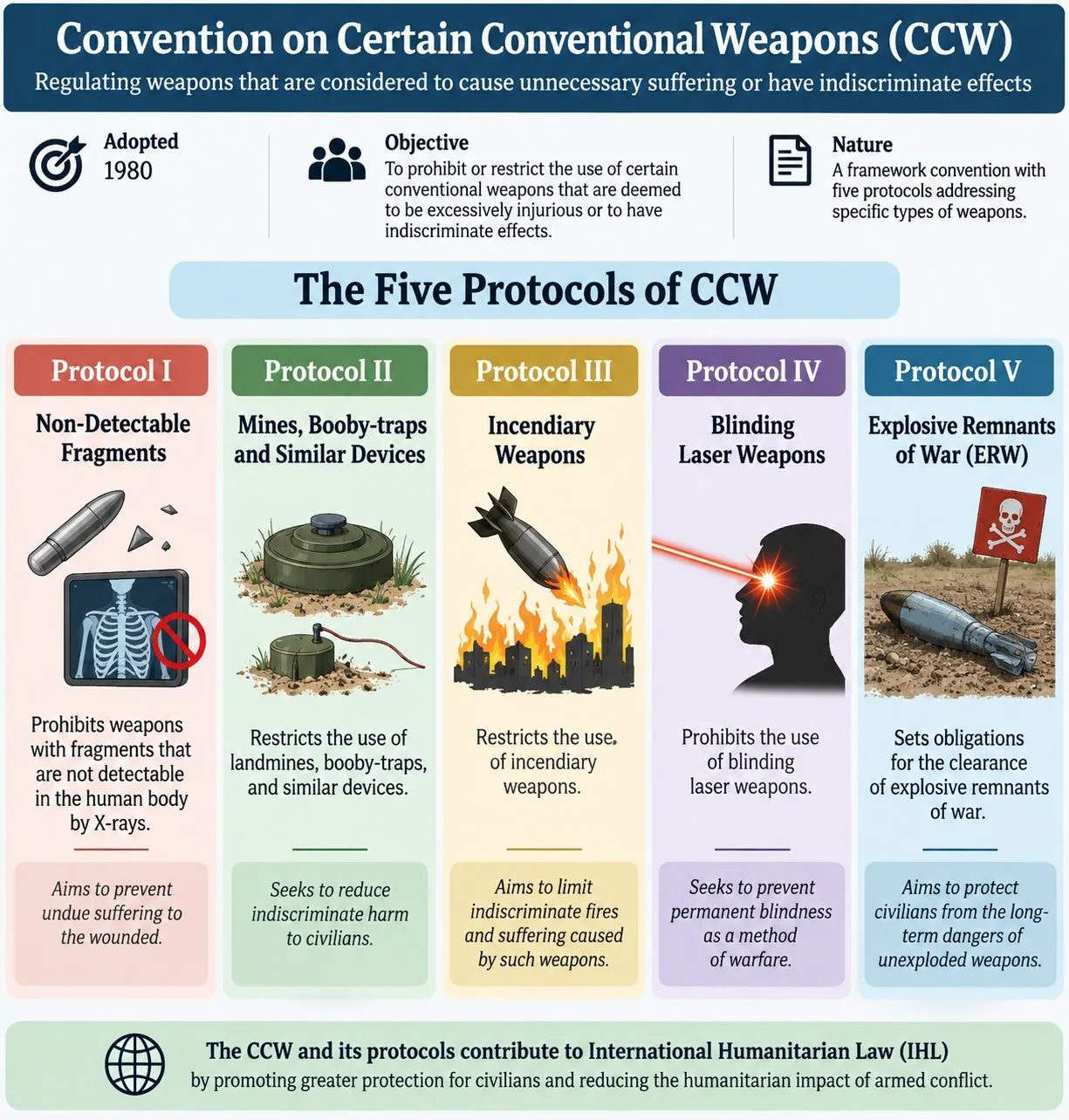
- Adopted in Geneva in 1980 and entering into force in 1983, the CCW (also known as the Inhumane Weapons Convention) is a UN framework treaty.
- It seeks to prohibit or restrict the use of conventional weapons considered to cause unnecessary suffering to combatants or indiscriminate harm to civilians.
- Structure:
- The treaty consists of a framework convention containing general provisions and five annexed protocols containing specific prohibitions.
- Its flexible structure allows new weapons and emerging technologies to be addressed by adding new protocols.
- India’s Position: India is a state party to the CCW and actively participates in the Group of Governmental Experts (GGE) discussions on LAWS, favoring discussions within this existing framework rather than creating separate parallel forums.
Khagantak-243 Long Range Glide Bomb
Source The Indian Air Force (IAF) successfully conducted the test drop of the indigenous Khagantak-243 Long Range Glide Bomb (LRGB), marking a significant advancement in India’s precision strike capabilities and defence self-reliance.- Indigenous Development: The weapon has been developed by Nagpur-based start-up JSR Dynamics Pvt Ltd in collaboration with Bharat Electronics Limited (BEL) under the Development-cum-Production Partner (DcPP) model, highlighting public-private participation in defence manufacturing.
- Technical Features: Khagantak-243 is a 300 kg-class Long Range Glide Bomb equipped with a Mk-81 general-purpose blast fragmentation warhead containing around 125 kg explosive fill. It uses swivel-type glide wings and aft control surfaces to achieve a glide ratio of more than 12.
- Range and Capability: The glide bomb can strike targets at a distance of 144–180 km when released from an altitude of around 12 km at Mach 0.8, allowing fighter aircraft to engage targets without entering hostile air defence zones.
- Aircraft Integration: The weapon was initially tested from the Su-30MKI fighter aircraft at Pokhran and is planned for integration with platforms such as the MiG-29K and Mirage-2000.
- Glide Bomb Technology: Unlike cruise missiles, glide bombs do not have an onboard propulsion system. They use aerodynamic lift generated by wings to extend their range after release, making them a cost-effective precision weapon system.
- Operational Significance:
- Khagantak-243 will enhance the IAF’s ability to conduct long-range precision strikes against targets such as enemy runways, hardened shelters and command centres while reducing risks to aircraft.
- The Khagantak series also includes heavier variants such as Khagantak-306 and Khagantak-225, designed for longer-range strike capabilities.
- Strategic Importance: The induction of indigenous glide bombs will reduce dependence on imported precision munitions and strengthen India’s goal of Aatmanirbhar Bharat in defence manufacturing.
Wildlife
Striped Hyenas
Source The conservation of the striped hyena has gained attention due to limited population data, conservation challenges, and the need for a coordinated national conservation strategy. Striped Hyena- About:
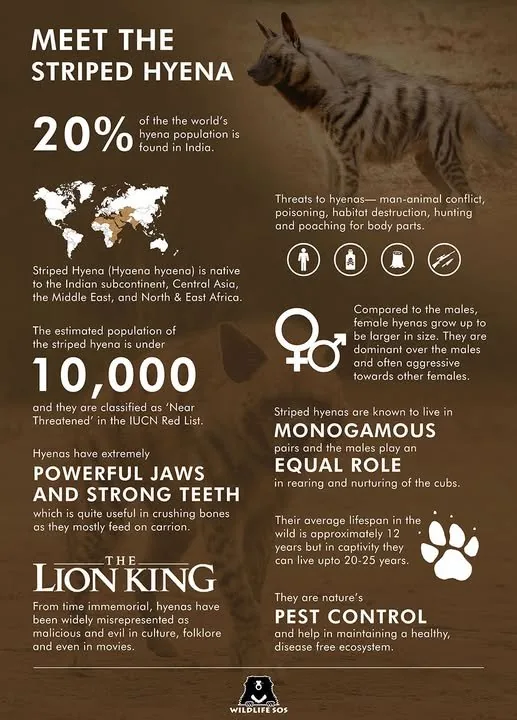
- The striped hyena (Hyaena hyaena) is a member of the Hyaenidae family and one of the three true hyena species, along with the brown hyena and spotted hyena. However, the hyena family (Hyaenidae) also includes the aardwolf.
- It is smaller and less social compared to the widely known spotted hyena and is primarily a nocturnal scavenger.
- Species Status and Distribution: The striped hyena is found across parts of Asia and Africa. Global estimates suggest around 5,000–14,000 striped hyenas, with approximately 1,000–3,000 individuals in India. India does not currently have a comprehensive official census for the species.
- Ecological Role as a Scavenger: Striped hyenas act as natural cleaners of ecosystems by consuming carrion and removing decaying animal remains. Their scavenging behaviour supports ecosystem health by preventing accumulation of organic waste.
- Protection Status:
- IUCN Red List: Near Threatened.
- Wildlife (Protection) Act, 1972: Schedule I
- Need for a National Conservation Framework: Conservation efforts remain fragmented, with regional initiatives in states such as West Bengal and Tamil Nadu. A coordinated National Action Plan can integrate research, funding and conservation initiatives across regions.
- Threats: Negative cultural beliefs and superstitions surrounding hyenas contribute to persecution, human-wildlife conflict, and challenges in their conservation.
- Awareness and Community Participation: Community engagement, awareness campaigns and educational initiatives can promote scientific understanding of striped hyenas and encourage their protection.