Comrades Dispatch · 10 Sep 2026 (PDF)
In this edition
- National Fluorosis Day Health & Medicine
- Gram Sabha Consent and Forest Clearance Nation & States
- Proposed Article 371(K) for Ladakh Nation & States
- Concerns Regarding the Population Enumeration of Census 2027 Polity & Governance
- Emergency Credit Line Guarantee Scheme (ECLGS) 5.0 Schemes & Initiatives
- CosmoCube and PRATUSH Missions Space
- Ophiopogon Japonicus Wildlife
- Orangutans Wildlife
Health & Medicine
National Fluorosis Day
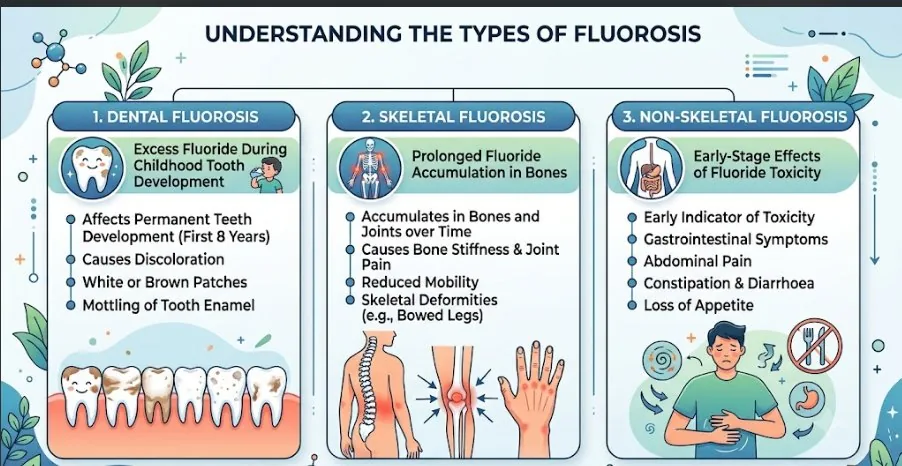
Source Recently, the Union Ministry of Health & Family Welfare organised a National Multi-Stakeholder Workshop on Fluorosis on National Fluorosis Day (9th September) to strengthen prevention, early detection, management and control of fluorosis under the National Programme for Prevention and Control of Fluorosis (NPPCF).- About Fluorosis: Fluorosis is a health condition caused by long-term excessive intake of fluoride through sources such as contaminated drinking water. While fluoride in small quantities helps prevent dental caries, prolonged exposure to high levels can negatively affect teeth, bones and joints.
- Sources: Excess fluoride exposure mainly occurs through fluoride-rich groundwater, particularly in regions where naturally occurring fluoride levels are high. Consumption of water with excessive fluoride concentration over several years increases the risk of fluorosis.
- Safe Limit: According to the Bureau of Indian Standards (BIS), the safe fluoride concentration in drinking water is 1–1.5 mg/L (milligrams per litre), while levels beyond this range may pose health risks.
- Schemes for Fluorosis Control in India: India launched the National Programme for Prevention and Control of Fluorosis (NPPCF) during the 11th Five Year Plan to strengthen surveillance, prevention, early diagnosis and management of fluorosis. Additionally, the Jal Jeevan Mission aims to provide safe and adequate drinking water to households, thereby reducing exposure to fluoride-contaminated water.
Nation & States
Gram Sabha Consent and Forest Clearance
Source Why in News?- The Union Ministry of Tribal Affairs (MoTA) stated in an official communication to the Ministry of Power that the Forest Rights Act (FRA), 2006 has “no provision for obtaining consent of the Gram Sabha for Stage-II forest clearance.”
- The MoTA further asserted that such matters do not fall under its purview, sparking a debate on the dilution of tribal rights and the mandatory requirement of Gram Sabha consent for infrastructure projects.
- Project Delays: The requirement for Gram Sabha consent for forest land diversion has emerged as a major hurdle for large infrastructure projects, particularly hydropower projects of the National Hydroelectric Power Corporation (NHPC).
- Clearance Bottleneck:
- A Parliamentary Standing Committee on Public Undertakings identified the requirement of 100% consent from affected Gram Sabhas as a major bottleneck.
- Under-construction NHPC projects reportedly face an average 106-month delay in forest clearance, compared with 7.2 months for environmental clearance.
- A prime example is the Teesta-IV Hydroelectric Project (HEP), which remains indefinitely stalled because consent is pending from three Gram Panchayats, despite consent having been obtained from seven others.
- Proposal for Qualified Super-Majority: To balance community participation with infrastructure needs, the Parliamentary Committee, drawing on practices in Brazil, Australia and New Zealand, recommended exploring a 70–75% consent threshold among affected Gram Sabhas for large hydropower projects of national importance. The proposal has prompted consultations between the Ministry of Power and MoTA.
- Statutory Text of the FRA, 2006:
- The primary text of the FRA does not explicitly use the phrase “Gram Sabha consent for forest clearance” regarding the diversion of forest land for non-forestry purposes.
- However, Section 5 of the FRA, 2006 explicitly empowers the Gram Sabha to protect wildlife, forest, biodiversity, and community forest resources. This section forms the substantive legal foundation for the community’s right to govern and protect its ancestral lands.
- Integration with Forest Conservation Guidelines:
- The mandate for Gram Sabha consent evolved through executive guidelines under the Forest (Conservation) Act, 1980 (FCA).
- All rights recognition and vesting processes under the FRA, 2006 must be completed prior to formal forest land diversion.
- Forest diversion operates on a two-stage process: Stage-I (in-principle approval) and Stage-II (final formal clearance).
- Historically (solidified through a 2009 MoEF circular and a 2017 FCA amendment), it was mandatory that all FRA rights recognition processes be completed and a formal No-Objection Certificate (NOC) be obtained from the concerned Gram Sabhas before Stage-II clearance could be granted.
- The Forest (Conservation) Rules, 2022 removed the requirement for Gram Sabha consent before forest clearance, allowing project approval before forest-rights settlement and community consultation. Critics argue that this weakens community participation and makes consent a fait accompli.
- Nodal Responsibility:
- The Ministry of Tribal Affairs (MoTA) maintains that although it is the central nodal ministry for the Forest Rights Act (FRA), 2006, its ground-level implementation rests with State and Union Territory administrations.
- This position is also reflected in its stance in other cases, including the Great Nicobar Island development project, where it sought to be removed as a respondent on similar grounds.
- About:
- Institutionalized by the Constitution (Seventy-third Amendment) Act, 1992, Article 243(b) (Part IX) defines the “Gram Sabha” as a body consisting of all persons registered in the electoral rolls of a village within a Panchayat’s jurisdiction, embedding participatory democracy directly into the constitutional framework.
- It has no separately elected representatives. It is a permanent body and forms the foundation of the Panchayati Raj system, although it is not one of its three tiers. Its powers and functions are determined by the State Legislature through law.
- Convening Meetings:
- Mandated by State Acts to meet at least two to four times annually (typically on Republic Day, Labour Day, Independence Day, and Gandhi Jayanti).
- The Panchayat Secretary organizes it, and the Sarpanch must convene a meeting if requested by at least 10% of the members or 50 members (whichever is greater).
- However, the Ministry of Panchayati Raj’s 2026 study identified low Gram Sabha participation due to livelihood constraints, poor awareness and communication, and weak grievance response.
- Presiding Officer: Meetings are chaired by the Mukhia/Sarpanch (Pradhan). In their absence, the Up-Mukhia takes charge, or alternatively, a member elected by the majority of those present.
- Development and Financial Oversight: It holds the critical responsibility of approving village development plans, setting priorities, and reviewing budgets, audits, and fund allocations prior to implementation by the Gram Panchayat.
- Resource and Rights Management: The Sabha oversees public infrastructure, natural resources, and possesses the authority to define individual and community forest rights.
- Accountability Mechanism: It transitions governance from representative to participatory by strictly monitoring the Gram Panchayat, identifying welfare beneficiaries, conducting social audits, and resolving minor local disputes.
- Abdication of Nodal Responsibility: Legal experts view the Ministry of Tribal Affairs’ (MoTA) disengagement as legally untenable. By distancing itself from the consent process, the nodal ministry effectively leaves vulnerable indigenous communities without central representation or protection.
- Violation of Judicial and Constitutional Mandates: MoTA’s stance contradicts the constitutional spirit of the Fifth and Sixth Schedules and the PESA Act, 1996. Furthermore, it violates nearly two decades of administrative precedent and the landmark 2013 Niyamgiri Supreme Court judgment, which firmly established the Gram Sabha’s decisive statutory role in safeguarding customary and ecological rights prior to forest diversion.
- Dilution of Grassroots Democracy: Lowering the consent threshold from 100% to a 70-75% “super-majority” threatens to silence severely impacted minority hamlets. Under this numerical approach, a single village directly losing its sacred groves or ancestral lands could be easily outvoted and overruled by peripherally affected neighboring villages.
- Risk of Social Conflict: Circumventing unanimous, informed consent mechanisms paves the way for mass involuntary displacement and inadequate rehabilitation. This approach risks sparking civil unrest and widespread protests across India’s resource-rich and forested tribal belts.
- India must balance infrastructure development with the rights of forest-dwelling communities.Rather than diluting Gram Sabha consent, time-bound and transparent procedures should reduce avoidable delays. Strengthening informed consent, inter-ministerial coordination and grievance redressal can reconcile development with tribal rights. Protecting Gram Sabha participation is essential for inclusive, sustainable and constitutionally sound governance.
Proposed Article 371(K) for Ladakh
Source The Union Ministry of Home Affairs (MHA) has proposed the introduction of a new ‘Chapter K’ under Article 371 (found in Part XXI of the Constitution) to provide a customized (sui generis) governance model specifically for Ladakh, which would grant the Union Territory (UTs) an elected legislative body.- Elected Legislative Body: The provision aims to create a UT-level body chosen by direct election. It would possess legislative powers over critical subjects such as land, culture, language, forests, environment, and natural resources, alongside other matters reserved for UTs under Article 240.
- Background of Demands:
- Following the abrogation of Article 370 in 2019 and the enactment of the Jammu and Kashmir Reorganisation Act, 2019, Ladakh was created as a Union Territory without a legislative assembly.
- Governance by bureaucrats and changes to domicile rules sparked deep concerns over land, employment, demography, and cultural identity, fueling demands for Statehood and tribal protection through inclusion in the Sixth Schedule.
- Existing Framework of Article 371:
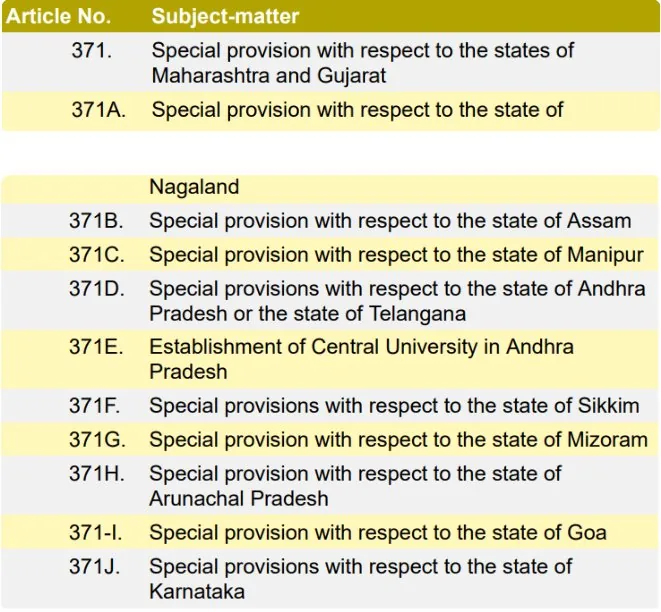
- Article 371 and its related provisions (Articles 371A to 371J) deals with “Temporary, Transitional and Special Provisions.” It provides specific asymmetric federal safeguards to 12 States (including Nagaland, Mizoram, Assam, Maharashtra, and Gujarat) to protect local customs, land rights, and resources.
- Applying an Article 371 provision to a Union Territory would mark a significant constitutional departure.
- Article 371(K) vs. Sixth Schedule:
- The Sixth Schedule (Article 244) applies to tribal areas in Assam, Meghalaya, Mizoram, and Tripura, establishing Autonomous District Councils (ADCs) with legislative, judicial, and administrative autonomy.
- Although the National Commission for Scheduled Tribes (NCST) recommended the Sixth Schedule for Ladakh’s tribal-majority population in 2019, the Centre’s Article 371(K) proposal seeks a separate, overarching UT-level arrangement rather than extending ADCs.
- Current Administrative Structure: Ladakh currently relies on two Hill Councils (Leh and Kargil). However, their powers remain highly limited as they do not fall under the protective umbrella of the Sixth Schedule.
Polity & Governance
Concerns Regarding the Population Enumeration of Census 2027
Source Why in News?- The Office of the Registrar General & Census Commissioner, India (ORGI) has formally notified a 40-question schedule for the second phase, Population Enumeration, of Census 2027, compared with 29 questions in the 2011 Census.
- The questionnaire introduces several new fields, including Aadhaar, Voter ID, mobile number, nationality, parents’ details and bank accounts. While many questions are relevant to demographic and socio-economic planning, concerns have emerged over the necessity of collecting extensive personal information.
- Census as a Statistical Exercise:
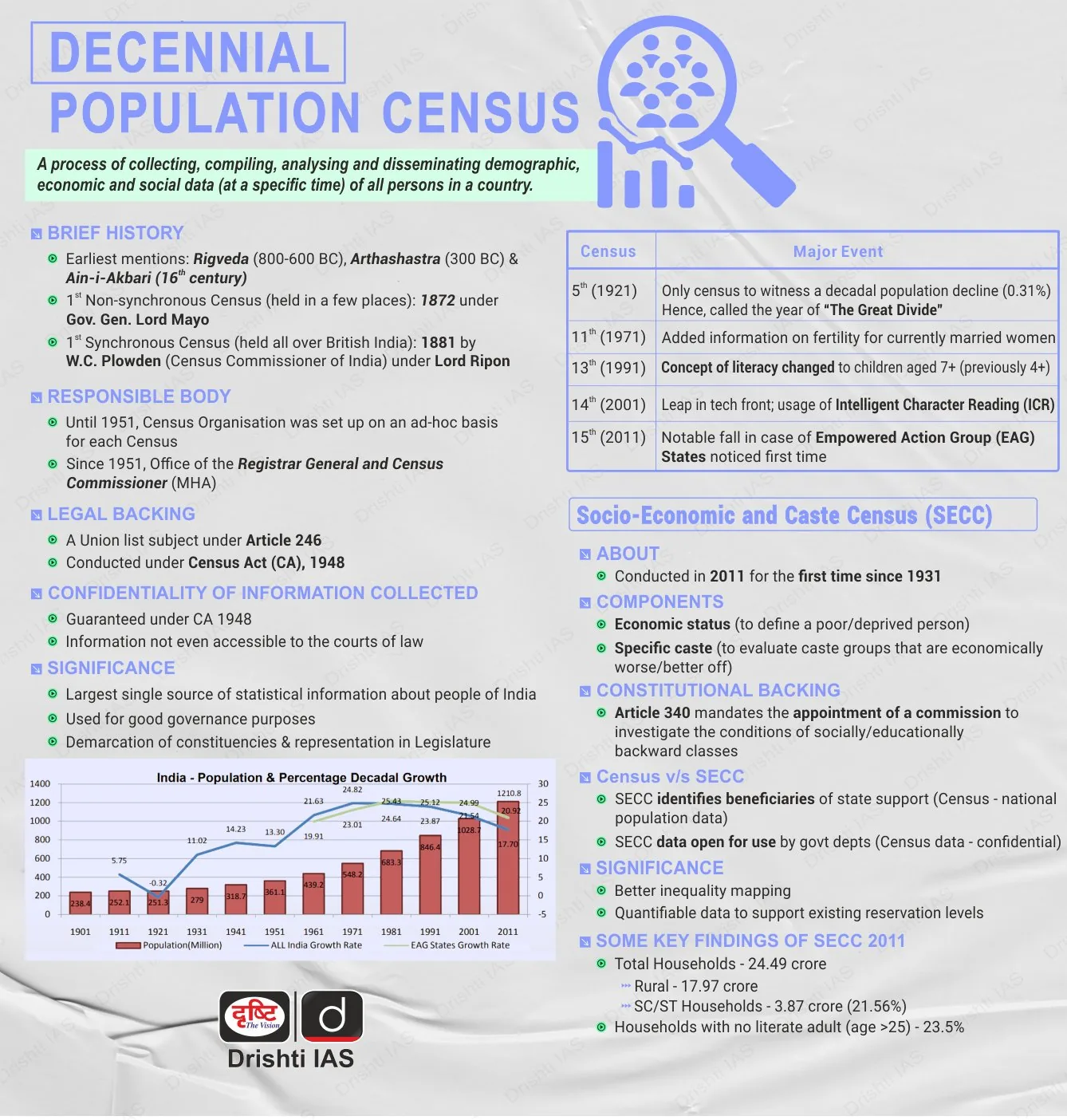
- The United Nations defines a census as a process of collecting, processing and analysing demographic, economic and social data at the smallest geographical level.
- Concerns have been raised regarding the several new Census questions, including parents’ birth details, declared nationality, Aadhaar, Voter ID, passport, driving licence and mobile number, closely resembling information sought for the National Population Register (NPR).
- Critics fear that collecting parental details and nationality could shift the Census from a statistical exercise towards population and citizenship profiling, potentially facilitating a National Register of Citizens (NRC).
- UN Fundamental Principles of Official Statistics emphasise maintaining the confidentiality of individual information and using it strictly for statistical purposes.
- Although the Census Act, 1948 provides confidentiality safeguards, concerns remain over the possible sharing of Census data with the NPR or other administrative systems, which could undermine this principle.
- Methodological Flaws in Caste Enumeration:
- While SC and ST categories will be selected from a predefined list, other castes, including OBCs, will be recorded through an open-text field based on the respondent’s declaration.
- Different spellings, regional names and sub-caste identities could produce a large number of duplicate or unclassified entries.
- A similar approach in the 2011 Socio-Economic and Caste Census (SECC) reportedly produced around 46 lakh caste names, making standardisation and meaningful analysis difficult.
- Without a robust standardisation and validation mechanism, the exercise may generate extensive data but limit its usability for policymaking.
- Privacy Risks:
- Details such as Aadhaar, Voter ID, passport numbers and the location of Covid-19 vaccination have little relevance for generating aggregate statistics needed for socio-economic planning.
- Census 2027 will be the country’s first fully digital and self-enumerated demographic exercise. While digitisation promises efficiency, centralising multiple personal identifiers into linkable profiles significantly elevates the risks of data breaches, unauthorised access, and de-anonymization.
- Critics warn that this shift from statistical data gathering to individual-level tracking compromises privacy, violates purpose limitation, and could ultimately facilitate state surveillance.
- Respondent Fatigue and Practical Challenges:
- The 40-question questionnaire may increase respondent burden, as the primary respondent may not have immediate details of every household member, resulting in incomplete or inaccurate responses.
- The challenge is greater in institutional households such as hostels and old-age homes, where administrators may not possess detailed parental or identity information of all residents.
- Methodological Challenge: The de facto enumeration approach may lead to the undercounting of migrant workers, as they may be away from their usual place of residence during the Census.
 What Measures are Needed to Ensure the Integrity of the Census?
- Standardise Caste Data: Replace the open-ended caste field with a standardised and consultative caste list (a drop-down menu) to avoid fragmented and unusable data.
- Limit Non-Statistical Data:
- The questionnaire should be streamlined by removing requirements for granular administrative identifiers like Aadhaar, Passport, and bank account numbers.
- If financial inclusion data is needed, a simple “Yes/No” regarding bank account ownership is sufficient.
- Strengthen Data Verification: Conduct a robust Post Enumeration Survey (PES) to identify undercounting and inaccurate responses.
- Separate Census from NPR/NRC: Establish clear legal and administrative firewalls to prevent Census data from being repurposed for citizenship profiling or administrative tracking.
- Robust Data Protection Architecture: As this census will be fully digital, stringent cybersecurity protocols aligned with the Digital Personal Data Protection (DPDP) Act, 2023 must be implemented to prevent unauthorized access or the cross-linking of census databases with other government servers.
- Strengthen Cybersecurity: Ensure end-to-end encryption, independent security audits and strong access controls for the digital Census ecosystem to prevent data breaches and unauthorised linking of personal information.
- The integrity of the census is fundamentally anchored in public trust. Ensuring that the exercise remains a purely demographic tool—shielded from political polarization, stripped of extraneous administrative variables, and fortified by rigorous statistical protocols—is non-negotiable for evidence-based policymaking in India.
Schemes & Initiatives
Emergency Credit Line Guarantee Scheme (ECLGS) 5.0
Source Why in News?- The Emergency Credit Line Guarantee Scheme (ECLGS) 5.0, approved by the Government in May 2026, has gained attention due to its role in strengthening liquidity support for businesses facing external economic challenges.
- The scheme has witnessed significant progress in implementation, enabling eligible MSMEs, non-MSME businesses and scheduled passenger airlines to access government-backed credit support for sustaining operations and enhancing resilience.
- About: The ECLGS 5.0 is a targeted credit support initiative designed to provide government-backed credit guarantees to businesses impacted by external disruptions. It will remain operational until 31st March 2027 or until guarantees amounting to ₹2.55 lakh crore are issued, whichever is earlier.
- Objective and Implementation: Implemented by the National Credit Guarantee Trustee Company (NCGTC), the scheme provides government-backed credit guarantees to Member Lending Institutions (MLIs), enabling them to extend additional working capital support to eligible business borrowers.
- Financial Support: The scheme aims to facilitate an additional credit flow of up to ₹2.55 lakh crore, helping enterprises meet operational requirements and maintain business continuity.
- Evolution:
- The ECLGS was launched in 2020 under the Aatmanirbhar Bharat Package to help businesses overcome pandemic-induced financial stress. It enabled Member Lending Institutions (MLIs) to provide additional credit with 100% Government-backed guarantee support.
- The scheme has evolved through successive phases to address changing sectoral requirements, with wider outreach, digital access through the Jan Samarth Portal, and participation of banks and financial institutions expanding its coverage.
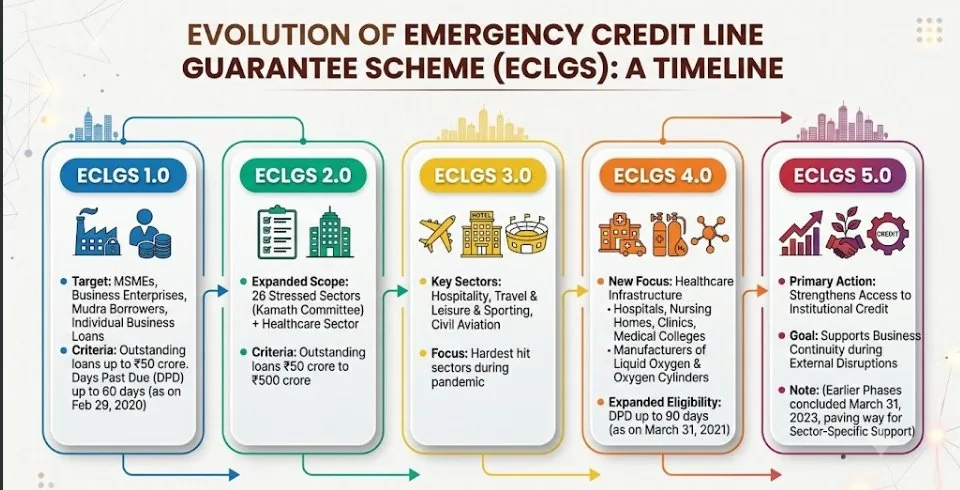
- Economic Impact and Progress: ECLGS has strengthened business resilience by improving liquidity access, supporting domestic production, maintaining supply chains and preserving employment. Under ECLGS 1.0 to 4.0, 1.19 crore guarantees amounting to ₹3.68 lakh crore were issued, while ECLGS 5.0 has issued 6,73,979 guarantees worth ₹2,50,024 crore as on 20 August 2026, reflecting strong adoption.
- Sectors: The scheme covers MSMEs, eligible non-MSME business borrowers and scheduled passenger airline companies. MSMEs from all sectors are eligible, while specified non-MSME sectors such as NBFCs, power, telecom, IT, sugar, tobacco and educational institutions are excluded.
- Credit Guarantee Support: ECLGS 5.0 provides 100% guarantee coverage for eligible MSMEs and 90% guarantee coverage for eligible non-MSME borrowers, reducing credit risks for lending institutions.
- MSME Focus and Digital Access: MSMEs constitute the major beneficiaries of ECLGS 5.0, accounting for 97.3% of guarantees by number and 80.79% of the guaranteed amount. The scheme is also accessible through the Jan Samarth Portal, enabling easier and transparent digital access to credit support.
- Support for Scheduled Passenger Airlines: Airlines with outstanding fund-based and non-fund-based credit facilities as on 31 March 2026 and classified as Standard accounts (excluding SMA-2) are eligible for support.
- Airline Credit Assistance: Eligible scheduled passenger airlines receive 90% credit guarantee coverage and can avail additional credit support of up to 100% of eligible credit facilities, subject to a maximum ceiling of ₹1,500 crore per borrower.
- The ECLGS 5.0 represents a shift from crisis-driven financial support to a broader framework of business resilience and economic stability. By providing government-backed credit guarantees, the scheme enhances liquidity access for eligible enterprises, supports uninterrupted business operations, strengthens supply chains and contributes to sustained economic growth amid external uncertainties.
Space
CosmoCube and PRATUSH Missions
Source Why in News?- A study published in Nature Astronomy highlighted a proposed lunar satellite mission named CosmoCube. Led by scientists from the Royal Astronomical Society (RAS) and the University of Cambridge, the mission aims to orbit the moon’s far side before the end of this decade.
- Its goal is to detect the elusive 21-cm radio signal from the universe’s infancy- a formidable scientific challenge that India is also pursuing through its proposed PRATUSH mission.
- About: CosmoCube is a compact satellite designed for a two-year mission in lunar orbit.
- Strategic Orbit: The satellite will orbit the moon every two hours. During each orbit, it will spend approximately 40 minutes on the lunar far side (the side that permanently faces away from Earth).
- Target Objective: To detect ultra-faint radio signals emitted by neutral hydrogen during the Cosmic Dark Ages (a period before the formation of the first stars and galaxies).
- Scientific Instruments:
- It will carry a highly sensitive radiometer operating at low frequencies (10-100 MHz).
- This instrument will separate incoming radio waves into multiple frequency channels to search for the characteristic “fingerprint” of early hydrogen.
- Operational Mechanism: To prevent its own communications from contaminating the data, CosmoCube will remain radio-silent while collecting data behind the moon. It will transmit the gathered data back to Earth during the Earth-facing portion of its orbit.
- Importance of Lunar Far Side for Radio Astronomy: The far side of the Moon permanently faces away from Earth, providing a pristine, radio-quiet environment. This natural shield protects sensitive radiometers from terrestrial radio frequency interference (such as FM radio and telecommunications) and Earth’s ionosphere, allowing the detection of ultra-faint cosmic signals.
- Significance of the Mission:
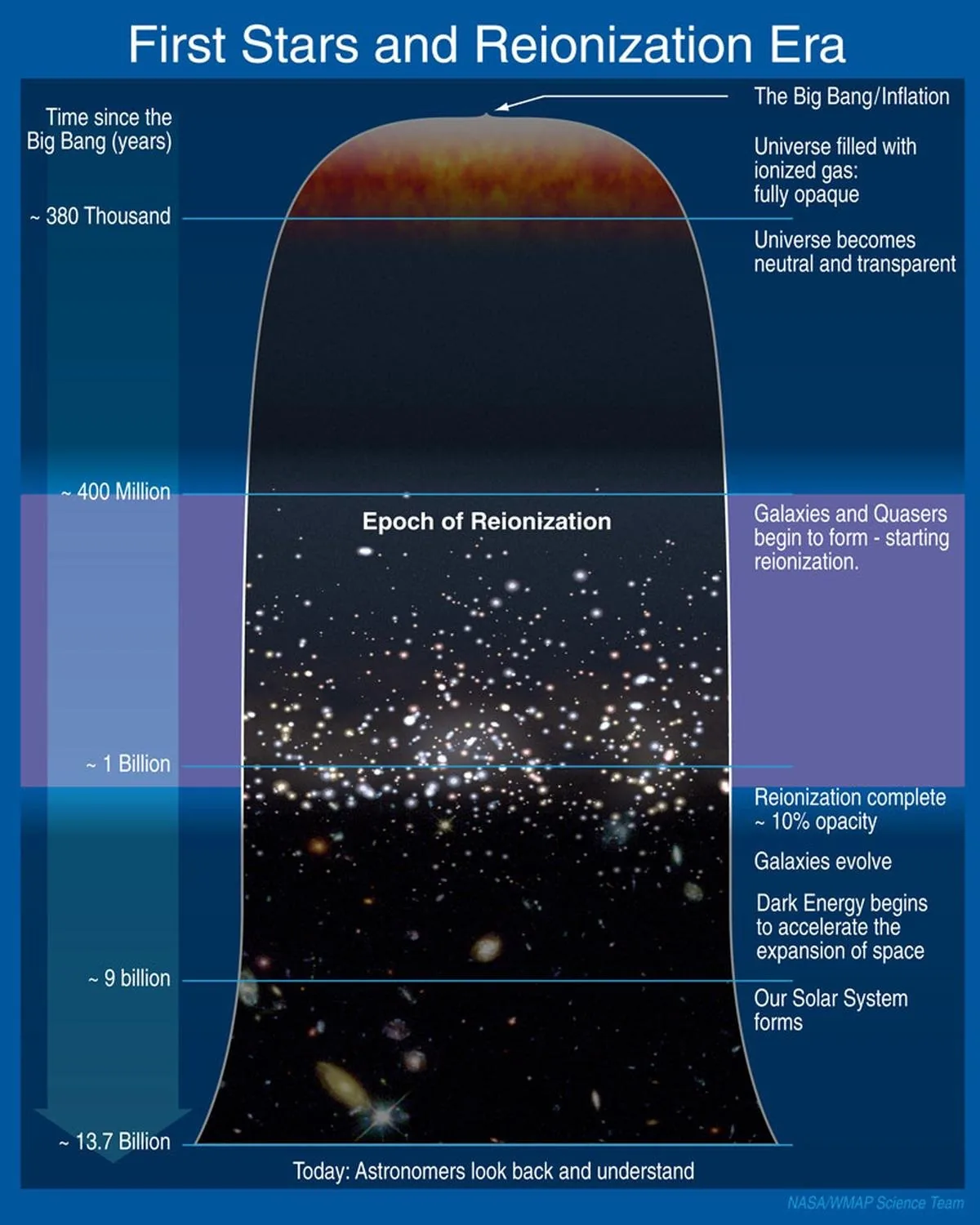
- Understanding the Cosmic Dawn: The 21-cm signal acts as a “cosmic thermometer,” allowing scientists to trace the exact period when the first stars and galaxies formed and reionised the universe.
- Investigating Dark Matter: The amplitude and shape of the ancient hydrogen signal are heavily influenced by the distribution and properties of dark matter, offering a new avenue to study this mysterious component.
- Addressing the Hubble Tension: CosmoCube may help resolve the “Hubble Tension” (a noted discrepancy between the universe’s expansion rate measured via the early universe (CMB) and nearby celestial bodies).
- Cosmic Dark Ages (380,000 to ~200 million years post-Big Bang):
- Following the Big Bang and the emission of the Cosmic Microwave Background (CMB), the universe entered a completely lightless phase.
- Dominated by dense, neutral hydrogen gas, it was entirely devoid of luminous objects.
- This era preceded the Cosmic Dawn (the ignition of the first stars and galaxies) which subsequently triggered the Epoch of Reionisation.
- The 21-cm Emission: Neutral hydrogen atoms occasionally undergo a rare quantum event known as a “spin-flip transition,” which emits electromagnetic radiation at a specific wavelength of 21 centimetres.
- Redshifting: Because the universe has expanded significantly over billions of years, this original 21-cm signal has stretched, shifting it into the lower-frequency radio spectrum (MHz range) observed today.
- Observational Challenge: This signal is incredibly faint. It is easily drowned out by foreground radiation from the Milky Way (which can be thousands of times stronger) and human-made radio frequency interference.
 India’s PRATUSH Mission
- About: PRATUSH (Probing ReionizATion of the Universe using Signal from Hydrogen) is an indigenous radio astronomy project initiated by the Raman Research Institute (RRI), Bengaluru (an autonomous body under the Department of Science and Technology (DST)) in collaboration with the Indian Space Research Organisation (ISRO).
- Objective: Like CosmoCube, PRATUSH is designed to operate in a lunar orbit to detect the redshifted 21-cm signal from the Cosmic Dawn and the Epoch of Reionisation.
- Technological Innovation:
- To meet the strict Size, Weight, and Power (SWaP) constraints of space payloads, the PRATUSH team developed a digital receiver system powered by a Single-Board Computer (SBC), roughly the size of a credit card.
- The SBC acts as the master controller, coordinating the antenna, the analog receiver, and a powerful Field Programmable Gate Array (FPGA) chip. This compact computer efficiently records, stores, and calibrates high-speed streams of cosmic radio data, demonstrating how low-power technology can execute precision astrophysics.
- Significance: It positions India at the frontier of observational cosmology, leveraging the pristine, radio-quiet conditions of the Moon’s far side.
Wildlife
Ophiopogon Japonicus
Source Researchers from the Wildlife Institute of India (WII) and the Uluberia Botanical Institute Herbarium, West Bengal, recorded Ophiopogon japonicus (Thunb.) Ker Gawl. for the first time in India from a moist, shaded forest floor near a temperate broadleaf forest at an elevation of 2,185 metres in West Kameng district, Arunachal Pradesh.- About: Commonly known as dwarf lilyturf or mondo grass, Ophiopogon japonicus is an evergreen perennial herb that grows in dense clumps. It has Narrow grass-like leaves, Small white to pale-purple flowers and blue berry-like fruits.
- Taxonomic Classification: Ophiopogon japonicus belongs to the Asparagaceae family. The genus Ophiopogon comprises around 85 species worldwide, of which seven species were previously recorded from India.
- Distribution: The species is native to East Asia and occurs in China, Japan, Korea, and Nepal, generally at elevations ranging from 200–2,800 metres.
- Uses: Its tuberous roots, known as Ophiopogonis Radix or Maidong, are traditionally used in Chinese medicine. The plant is reported to have anti-inflammatory, antioxidant, and immunomodulatory properties.
- Concerns: The newly recorded population may face local threats due to its roadside habitat, particularly from Road construction, Landslides and Habitat disturbance.
- Significance: The discovery adds a new species to India’s floral diversity and extends the known distribution of the species to the Eastern Himalaya, a region considered botanically under-explored.

Orangutans
Source Recently, five baby orangutans were rescued from Balasore, Odisha, prompting a joint investigation by the Odisha Police Special Task Force (STF) and the Wildlife Crime Control Bureau (WCCB) over suspected international wildlife trafficking.- The rescued orangutans have been shifted to Nandankanan Zoological Park, Bhubaneswar, and Odisha has sought approval from the Central Zoo Authority (CZA) for their care.
- Meaning and Habitat: The name orangutan means “man of the forest” in the Malay language. They are not found in India and are found only in the tropical rainforests of Borneo and Sumatra, where they are mostly solitary, tree-dwelling animals.
- Species Diversity: Three recognised species of orangutans are Bornean orangutan (Pongo pygmaeus), Sumatran orangutan (Pongo abelii), and Tapanuli orangutan (Pongo tapanuliensis).
- Diet and Lifestyle: Orangutans primarily feed on wild fruits such as lychees, mangosteens and figs, along with leaves and other vegetation. They build nests on trees and play an important role as seed dispersers.
- Physical Characteristics:
- Orangutans are among the largest arboreal mammals.
- They have long arms, reddish-brown hair and grasping hands and feet adapted for climbing.
- Adult males may weigh up to 200 pounds.
- Flanged males have cheek pads (flanges) and throat sacs used for producing loud long calls.
- Differences Between Species: Sumatran orangutans have longer facial hair and relatively stronger social bonds, whereas Bornean orangutans are more likely to descend from trees and move on the ground.
- Conservation Status: Bornean orangutan (Pongo pygmaeus) is classified as Endangered, while Sumatran orangutan (Pongo abelii) and Tapanuli orangutan (Pongo tapanuliensis) are classified as Critically Endangered, with the Tapanuli orangutan being considered the most threatened great ape species.
- Legal Protection: International commercial trade in orangutans is prohibited under CITES (Convention on International Trade in Endangered Species of Wild Fauna and Flora).
- Threats: Orangutans face threats from habitat loss due to deforestation, palm oil plantations and mining activities, illegal wildlife trade, hunting and their slow reproductive rate, which makes population recovery difficult.