Comrades Dispatch · 11 Sep 2026 (PDF)
In this edition
- Jute Sector in India Agriculture & Rural
- International Literacy Day 2026 Important Days
- Ocean Research Vessel Sagar Manthan Infrastructure & Energy
- DRC’s Sovereign Control Over Geological Data Places in News
- Curbing Misuse of Political Funding Through RUPPs Polity & Governance
- India–Sri Lanka Defence Cooperation Security
Agriculture & Rural
Jute Sector in India
Source Why in News?- Recently, India’s Jute sector has gained attention as the country continues to lead global raw jute production, producing 76 lakh bales of raw jute and 12.80 lakh MT of jute goods in FY 2025-26, while supporting millions of livelihoods.
- Government interventions, technological innovations and product diversification are strengthening the jute value chain, positioning jute (the Golden Fibre) as a biodegradable and sustainable alternative to synthetic materials with growing global potential.
- About: Jute is one of India’s most important natural fibres, known for its strength, durability, biodegradability and wide range of applications in packaging, textiles, construction and technical products. Due to its golden colour and silky lustre, jute is popularly known as the “Golden Fibre”.
- Raw Jute Classification:
- In trade and industrial usage, jute and mesta are collectively classified as raw jute due to their similar end uses.
- Mesta is a bast fibre crop cultivated as a cost-effective alternative to jute, particularly in relatively drier agro-climatic regions.
- Global Position of India:
- India is the world’s largest producer of raw jute. According to the Third Advance Estimate (2025-26), jute and mesta production increased from 88.02 lakh bales in 2024-25 to 94.03 lakh bales in 2025-26.
- India is also a global leader in jute goods production, accounting for around 75% of world production (July 2026), with domestic output largely meeting national demand and ensuring self-reliance in jute goods production.
- Major Producing States: Jute cultivation is concentrated mainly in eastern and northeastern India due to suitable agro-climatic conditions. West Bengal accounts for the largest share of raw jute cultivation in India, followed by Bihar, Assam, Odisha and Jharkhand.
- Cultivation Conditions: Jute is generally sown during March-April and harvested within 100–110 days. It requires a hot and humid climate with around 700–1,500 mm rainfall during the growing period.
- Regional and Farming Pattern: Jute cultivation is predominantly rainfed and is largely undertaken by small and marginal farmers.
- Economic Importance: The jute industry supports around 3.70 lakh workers through organised mills and diversified jute units and provides livelihoods to nearly 40 lakh farm families engaged in jute cultivation.
- Industrial Base: The sector has a strong presence in eastern India, particularly West Bengal, which houses 89 out of 120 composite jute mills (December 2025) in the country.
- Historical Origins: Jute cultivation in India can be traced back to the third century BC, but it emerged as a major commercial commodity during the British colonial period, when Bengal developed as an important centre of jute cultivation and processing.
- Impact of Partition: The Partition of 1947 disrupted the integrated jute economy, as nearly 80% of jute-growing areas became part of East Pakistan (present-day Bangladesh), while most jute mills remained in India, creating an acute raw-material shortage.
- Post-Independence Revival: To address the shortage, the Government launched the “Grow More Jute” campaign in September 1949, encouraging farmers to shift from paddy to jute cultivation. Consequently, raw jute production increased from 6.7 lakh tonnes in 1951-52 to 14.56 lakh tonnes in 1961-62.
- Policy Support: The Jute Packaging Materials (Compulsory Use in Packing Commodities) Act, 1987 strengthened the sector by mandating the use of jute sacks for packaging essential commodities, thereby providing a stable market for jute producers.
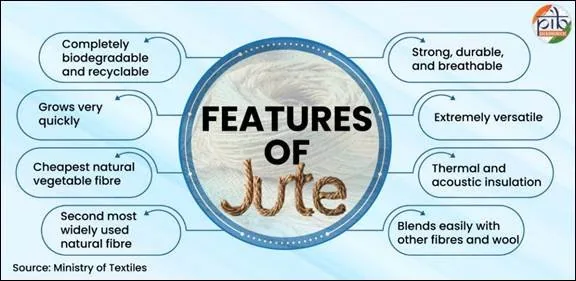
- Sustainable Natural Fibre: Jute is a biodegradable and recyclable natural fibre known for its rapid growth, cost-effectiveness and wide availability, making it an environmentally sustainable alternative to synthetic fibres.
- Strength and Versatility: It is strong, durable, breathable and versatile, with applications across packaging, construction, agriculture and industrial textiles.
- Functional Properties: Jute possesses valuable properties such as thermal and acoustic insulation, high moisture absorption capacity and low static generation, enhancing its suitability for diverse applications.
- Value-Added Applications: Jute can be blended with both natural and synthetic fibres, enabling the development of a wide range of value-added textile products.
- Traditional Consumption: Jute leaves have been traditionally consumed as vegetables in regions such as Africa, the Middle East and Southeast Asia. In Japan, they are recognised as a health food.
- Nutritional Benefits: Jute leaves are rich in vitamins, carotenoids, calcium, potassium and dietary fibre, making them a potential source of functional nutrition.
- Health Applications: Technologies have been developed for producing antioxidant herbal drinks and healthcare products from jute leaves, expanding the fibre crop’s potential beyond industrial applications.
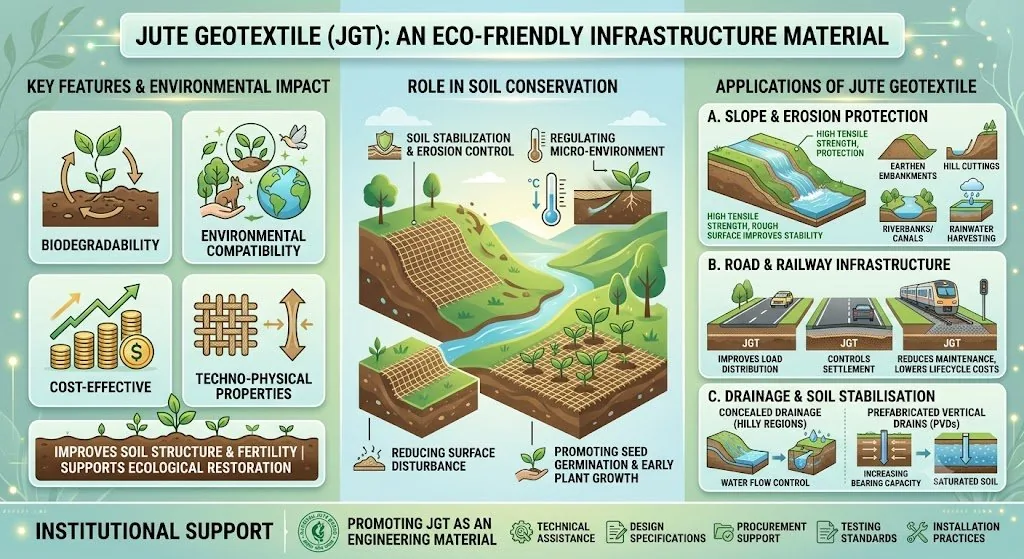
 Jute Geotextile
- Jute Geotextile is a diversified jute product under technical textiles, manufactured through special treatment and weaving of jute fibres. It is used in civil engineering, soil conservation, erosion control, road construction and riverbank protection.
 What are the Government Interventions for the Jute Industry?
- Ensuring Remunerative Prices through MSP: The Government has strengthened price support mechanisms for jute farmers through periodic revisions in the Minimum Support Price (MSP) for raw jute. The MSP has increased by around 147% compared to FY 2014-15.
- Jute Corporation of India: The Jute Corporation of India (JCI) is the sole nodal agency for implementing the MSP policy for raw jute. It protects farmers from price fluctuations by procuring raw jute directly when market prices fall below MSP. JCI operates around 110 Departmental Purchase Centres (DPCs).
- Assured Market through Jute Packaging Mandate:
- The Government has implemented the Jute Packaging Materials (Compulsory Use in Packing Commodities) Act to create stable demand for jute products and support farmers and the jute industry.
- Under the Act, 100% of food grains and 20% of sugar are mandated to be packed in jute bags, ensuring a guaranteed market for jute packaging materials.
- National Jute Board (NJB): The National Jute Board (NJB) acts as the nodal agency for the development, promotion and diversification of the jute sector across the value chain. Its major functions include improving jute cultivation practices and fibre quality, enhancing productivity and standardisation, promoting domestic and export markets, supporting research and value-added product development.
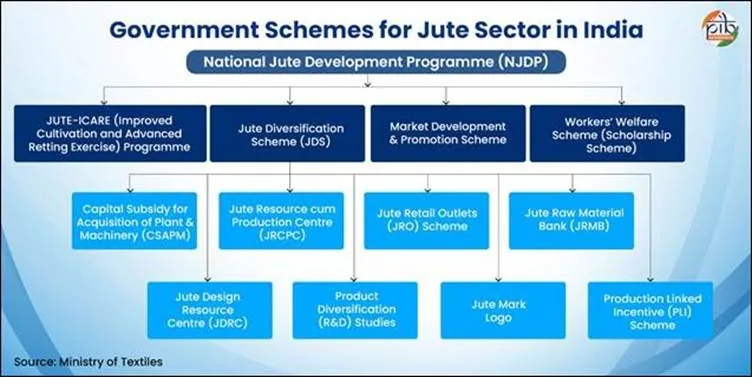 National Jute Development Programme (NJDP)
- About: The National Jute Development Programme (NJDP) is the flagship scheme for the development, promotion and diversification of the jute sector. It is implemented by the National Jute Board (NJB) with an outlay of ₹485.58 crore for FY 2021–22 to FY 2025–26.
- Key Objectives:
- The programme focuses on:
- Enhancing jute productivity and farmer incomes.
- Promoting value addition and diversification of jute products.
- Encouraging the use of jute as an eco-friendly alternative to plastics through awareness campaigns, exhibitions and promotional activities.
- The programme focuses on:
- Objective: Launched in FY 2015–16, the JUTE-ICARE scheme aims to enhance jute productivity and fibre quality through scientific cultivation practices, mechanisation and improved retting techniques.
- Farmer Support:
- The scheme supports small and marginal farmers by providing:
- Subsidised certified seeds.
- Field demonstrations on improved cultivation practices.
- Mechanised interventions to reduce labour dependency and improve efficiency.
- The scheme supports small and marginal farmers by providing:
- Implementation Partners: The scheme is implemented in collaboration with the Central Research Institute for Jute and Allied Fibers (CRIJAF) and the Jute Corporation of India (JCI).
- Infrastructure Support:
- It facilitates the construction of retting ponds through convergence with:
- Pradhan Mantri Krishi Sinchayee Yojana (PMKSY).
- Rashtriya Krishi Vikas Yojana (RKVY).
- It facilitates the construction of retting ponds through convergence with:
- Outcome Focus: By improving cultivation methods and retting practices, JUTE-ICARE helps enhance fibre quality, farmer income and competitiveness of India’s jute sector.
- Objective: The Jute Diversification Scheme promotes value addition, modernisation, processing, marketing and sales of Jute Diversified Products (JDPs) to enhance the competitiveness of the jute sector.
- Ensuring Raw Material Availability: The Jute Raw Material Bank (JRMB) facilitates regular supply of quality raw jute materials to the unorganised sector and small production units engaged in manufacturing jute diversified products.
- Support to Artisans and MSMEs: Raw jute is supplied at an economical rate of mill-gate price plus actual transportation costs, benefiting Artisans, Women Self-Help Groups (SHGs) and MSMEs involved in jute-based products.
- Rural Livelihood Promotion: By ensuring affordable access to raw materials, JRMB strengthens rural entrepreneurship and employment opportunities in the jute value chain.
- Capital Subsidy for Acquisition of Plant & Machinery: Provides 30% subsidy on machinery costs for jute mills and MSMEs engaged in manufacturing Jute Diversified Products (JDPs).
- Jute Resource-cum-Production Centres: Establishes cluster-based training and production centres for Artisans, Women SHGs, Entrepreneurs, NGOs and Cooperative societies.
- Jute Retail Outlets: Supports retail promotion and showroom sales of JDPs by providing 25% sales assistance up to ₹9 lakh per unit.
- Production Linked Incentive for JDP Exports: Encourages exports by providing incentives linked to Raw material utilisation in exported jute diversified products and Export value realisation.
- Jute Mark India Logo:
- The Jute Mark India Logo represents authenticity, quality assurance and sustainability of jute and jute-blended products.
- It certifies Compliance with prescribed quality standards and Authentic jute content in blended products.
- The logo enhances consumer confidence, brand recognition and market acceptance of Indian jute products.
- Domestic Marketing Initiatives:
- The Government promotes jute products through exhibitions, trade fairs and market-linkage programmes.
- More than 57 regional jute fairs were organised during FY 2025–26, including major platforms such as India International Trade Fair (IITF), Surajkund Mela and Bharat Tex.
- About: Under the National Jute Development Programme (NJDP), the Government implements the Market Development & Promotion Scheme to support Jute Diversified Product (JDP) entrepreneurs and exporters.
- Objective: The scheme promotes Domestic marketing of JDPs, Export promotion and Market access for jute-based enterprises.
- About: Under the National Jute Board Act, 2008, the National Jute Board is mandated to improve working conditions, amenities and incentives for workers engaged in the jute industry.
- Objective:
- In line with this objective, NJB provides scholarship and incentive support to girl children of workers employed in Jute mills and Jute Diversified Product (JDP) MSME units.
- The scheme supports workers’ welfare, education and social empowerment within the jute industry.
- Sustainable Textile Innovation: Jute-viscose blended apparel was worn by the Indian contingent at the Commonwealth Games 2026. The apparel was developed by the National Jute Board and designed by the National Institute of Fashion Technology (NIFT), New Delhi.
- Global Promotion of Jute: The initiative highlights the potential of 100% biodegradable jute-viscose blended fabrics as sustainable textile solutions while providing global visibility to India’s jute industry and manufacturing capabilities.
 Conclusion
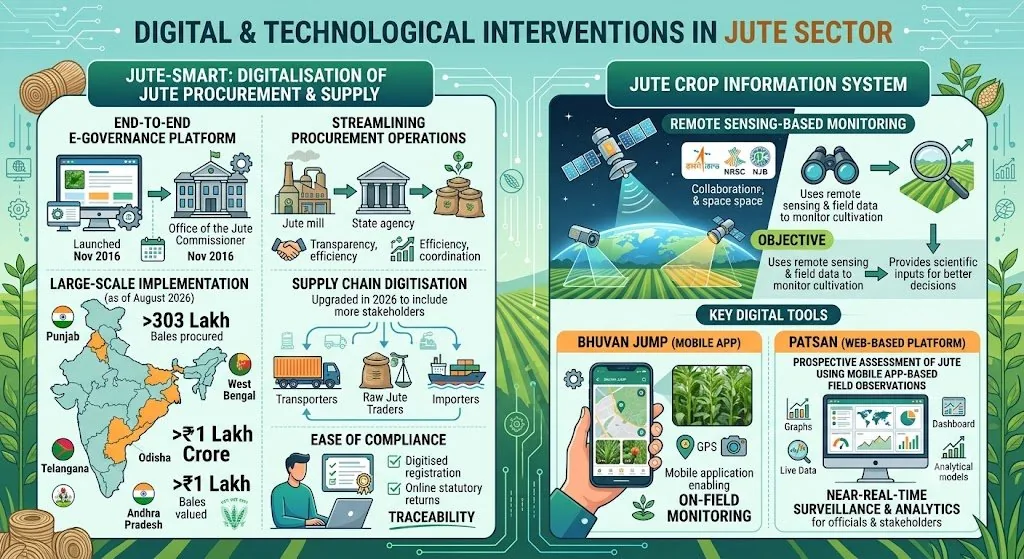
- India’s jute sector represents the convergence of agriculture, sustainable industry and rural livelihoods. Through MSP support, technological interventions, diversification and environmental applications, jute is emerging as a strategic green fibre. Strengthening innovation, value addition and global market linkages can transform India’s Golden Fibre into a globally competitive and sustainable industry.
Important Days
International Literacy Day 2026
Source The International Literacy Day 2026 celebrations concluded with the ULLAS Mela in New Delhi, providing a platform for learners, volunteer teachers and States/UTs to share experiences and best practices in strengthening India’s literacy movement.- ULLAS (Understanding of Lifelong Learning for All in Society) also known as the Nav Bharat Saaksharta Karyakram (New India Literacy Programme) is a Centrally Sponsored Scheme implemented by the Ministry of Education from 2022-23 to 2026-27 to provide foundational literacy and numeracy to non-literate adults aged 15 years and above and promote lifelong learning.
- Background: International Literacy Day has been observed annually on 8th September since 1967. It was proclaimed by UNESCO in 1966 during the 14th session of the UNESCO General Conference to highlight the importance of literacy in building inclusive, peaceful and sustainable societies.
- ILD 2026 Theme: The theme for International Literacy Day 2026 is “Literacy for people, the planet and prosperity.” It highlights the role of literacy in promoting inclusion, sustainable futures and opportunities for development .
- Global Literacy Challenges: Despite progress, around 739 million youth and adults worldwide lacked basic literacy skills in 2024, while 272 million children and adolescents were out of school in 2023.
Infrastructure & Energy
Ocean Research Vessel Sagar Manthan
Source Recently, India launched Ocean Research Vessel (ORV) Sagar Manthan at Rishi Bankim Shipyard, Kolkata, marking a major step towards self-reliance in oceanographic research and maritime technology. The advanced vessel will gradually replace the 43-year-old ORV Sagar Kanya, which was acquired from Germany in 1983.- About: The vessel (Yard 3041) has been designed, engineered and constructed by Garden Reach Shipbuilders and Engineers (GRSE) for the National Centre for Polar and Ocean Research (NCPOR) under the Ministry of Earth Sciences (MoES).
- Research Capabilities:
- The all-weather, multidisciplinary research vessel is designed to operate in challenging oceanic environments, including the Southern Ocean, with an expected service life of around 30 years.
- It is equipped with multibeam bathymetry, multichannel seismic systems, sub-bottom profiling, weather radar, dynamic positioning, and facilities for deploying Remotely Operated Vehicles (ROVs) and Autonomous Underwater Vehicles (AUVs).
- Deep Ocean Capability: ORV Sagar Manthan can undertake swath multibeam and geophysical seismic surveys up to depths of 6 km, enabling advanced deep-sea mapping and marine resource assessment.
- Scientific Applications: The vessel will support oceanographic and geophysical research, including surveys for multi-metal hydrothermal sulphide mineralisation, exploration of marine mineral resources such as manganese nodules and polymetallic sulphides, environmental baseline studies, Conductivity, Temperature and Depth(CTD) profiling, water-column sampling, seabed sampling and atmospheric observations.
- Strategic Significance: The vessel represents India’s transition from procuring ocean research platforms abroad to building advanced research infrastructure domestically. It will strengthen capabilities in climate studies, disaster prediction, maritime domain awareness and the Blue Economy, while carrying dual-class certification from Indian Register of Shipping (IRS) and American Bureau of Shipping (ABS).
Places in News
DRC’s Sovereign Control Over Geological Data
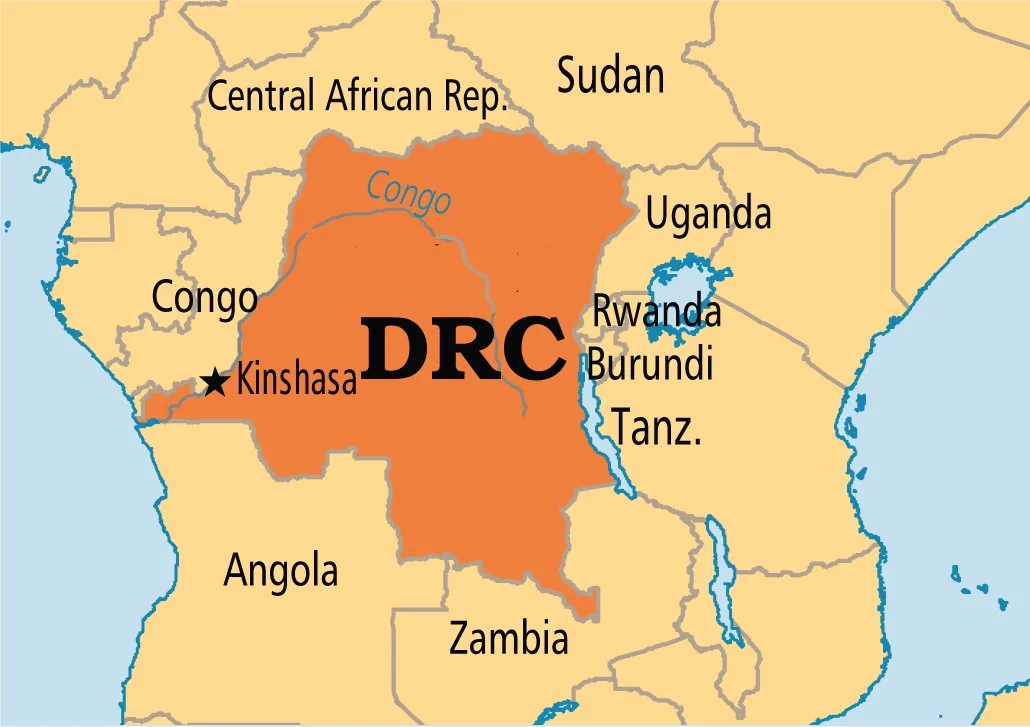
Source The Democratic Republic of Congo (DRC) announced plans to tighten state control over its geological data by creating a comprehensive national databank for critical minerals. This move aims to extend state influence over future mineral discoveries, direct billions of dollars in mining exploration, and safeguard the nation’s “strategic interests”. Democratic Republic of Congo (DRC)- Location: Located in Central Africa, it is the 2nd-largest country in Africa (after Algeria) and the 11th largest in the world.
- Capital: Kinshasa, situated on the banks of the Congo River.
- Bordering Countries: The DRC shares land borders with nine countries: Republic of the Congo (northwest), Central African Republic (north), South Sudan (northeast), Uganda, Rwanda, Burundi, and Tanzania (east), Zambia (southeast), and Angola (southwest).
- Geographical Features:
- Equator: The Equator passes directly through the northern part of the country.
- Congo River: It is the 2nd-longest river in Africa (after the Nile) and uniquely crosses the equator twice. It boasts massive hydroelectric potential, most notably harnessed through the Inga Dam complex and the proposed Grand Inga Dam project envisioned to become one of the world’s largest hydropower projects) situated on the Inga Falls in the DRC.
- Congo Rainforest: It is the second-largest tropical rainforest in the world (after the Amazon), acting as a crucial global carbon sink.
- Great Lakes: Its eastern border is flanked by the African Great Lakes, including Lake Albert, Lake Edward, Lake Kivu, Lake Tanganyika (world’s second-deepest lake after Lake Baikal in Siberia), and Lake Mweru.
- Mountains and Volcanoes: The eastern highlands feature the snow-capped Ruwenzori Mountains (highest peak: Margherita Peak) and active volcanoes like Mount Nyiragongo and Nyamuragira in the Virunga volcanic chain.
- Mineral Belts:
- The southern region, particularly the Katanga Copperbelt, is world-renowned for its exceptionally high-grade copper and cobalt deposits.
- The DRC is the world’s largest producer of cobalt (holding reserves estimated at 6 million tons) and it is Africa’s largest producer of copper. It also hosts rich deposits of lithium, tantalum, germanium, and gold.
Polity & Governance
Curbing Misuse of Political Funding Through RUPPs
Source Why in News?- The discourse around political funding has intensified following allegations of large-scale tax evasion and money laundering involving Registered Unrecognised Political Parties (RUPPs).
- About: Political funding refers to the methods and sources through which political parties and candidates raise financial resources to cover their operational costs, election campaigns, and party activities.
- Constitutional Provisions:
- Article 324: Vests the superintendence, direction, and control of elections in the Election Commission of India (ECI) to ensure free, fair, and untainted democratic processes.
- Article 19(1)(a):
- The Supreme Court has repeatedly affirmed that voters have a fundamental “Right to Know” regarding the sources of political funding, as informed choices are foundational to participatory democracy.
- In Association for Democratic Reforms v. Union of India (2024), the Supreme Court struck down the Electoral Bond Scheme, holding that anonymous political funding violates voters’ Right to Information under Article 19(1)(a). It also warned that unlimited corporate funding could promote institutionalised corruption.
- Statutory Provisions
- Representation of the People Act (RPA), 1951:
- Section 29A: Governs the formal registration of associations as political parties with the ECI to be eligible for donations and tax exemptions.
- Section 29B: Grants parties the legal entitlement to accept voluntary contributions from individuals and non-government corporations.
- Section 29C: Mandates every registered party to submit an annual Contribution Report to the ECI declaring donations received in excess of Rs 20,000.
- Companies Act, 2013:
- Companies can donate to political parties, subject to disclosure requirements under Section 182 of the Companies Act, 2013.
- Following the Supreme Court’s 2024 verdict on Electoral Bonds, earlier unlimited, undisclosed corporate political contributions stand unconstitutional, reviving debate on corporate transparency.
- Foreign Contribution (Regulation) Act (FCRA), 2010:
- Prohibits political parties and election candidates from receiving foreign funding to safeguard national sovereignty.
- However, amendments through the Finance Acts of 2016 and 2018 excluded Indian companies with over 50% foreign ownership from the definition of a foreign source, subject to FEMA and FDI limits, thereby permitting such companies to make political contributions.
- Taxation Provisions
- Section 13A of the Income Tax (IT) Act, 1961:
- Political parties registered under the Representation of the People Act, 1951 can claim tax exemption on specified incomes and voluntary contributions, provided they maintain proper accounts, record donations above Rs 20,000, and get their accounts audited.
- The exemption is denied if the party fails to submit the required contribution report under Section 29C of the RPA, 1951.
- Sections 80GGB and 80GGC of the IT Act, 1961: Permit Indian companies (80GGB) and individual taxpayers (80GGC) to claim a 100% deduction on gross taxable income for donations made to registered political parties or recognized electoral trusts.
- Section 13A of the Income Tax (IT) Act, 1961:
- Representation of the People Act (RPA), 1951:
- Legal Basis: Any association of citizens can form a political party and apply for registration with the ECI under Section 29A of the RPA, 1951.
- Benefits of Registration:
- Once registered, even without gaining state or national recognition, RUPPs enjoy significant privileges:
- Tax Exemptions: They receive 100% tax exemption on donations under the Income Tax Act, provided they comply with specific rules.
- Common Symbols: They are allotted common symbols for their candidates in general or state assembly elections.
- Campaigning: They are allowed to deploy up to 20 ‘star campaigners’ during an election campaign.
- Once registered, even without gaining state or national recognition, RUPPs enjoy significant privileges:
- Compliance Mandates:
- Under Section 29C of the RP Act, RUPPs must maintain records of all individual donors contributing more than Rs 20,000 in a financial year and submit an annual report to the ECI.
- Donations above Rs 2,000 must be received exclusively via cheque or bank transfers. Failure to furnish these details legally strips them of their income tax exemptions.
- Proliferation of Bogus Parties:
- Out of more than 2,800 RUPPs registered as of July 2026, only about 750 actively contested the 2024 general elections. The vast majority exist only on paper, earning them the moniker ‘letter pad parties’.
- According to a July 2025 report by the Association for Democratic Reforms (ADR), the annual reports for the 2022-23 period were publicly available for only 26% of RUPPs.
- In 2025, the ECI found 334 RUPPs non-compliant with registration requirements, raising concerns over inactive or bogus political parties. Some may function as shell entities for laundering unaccounted money, exploiting political donations and tax deductions under Section 80GGC.
- Regulatory Limits of the ECI:
- Under Section 29A of the RPA, 1951, the ECI possesses the power to register political parties but lacks the statutory power to deregister them for dormancy, financial crimes, or non-contestation (Indian National Congress v. Institute of Social Welfare, 2002).
- The ECI can only “delist” them, which does not automatically strip them of tax benefits under the IT Act.
- The ECI can de-register a political party only under specific and exceptional circumstances, such as when its registration was obtained through fraud, when it ceases to uphold allegiance to the Indian Constitution, or when it is declared unlawful by the Central Government.
- Asymmetry in Campaign Expenditure Limits:
- While the Conduct of Elections Rules, 1961 (Rule 90) imposes statutory expenditure ceilings on individual candidates ( Rs 75–95 lakh for Lok Sabha; Rs 28–40 lakh for State Assemblies), there is no statutory limit on the expenditure incurred by political parties.
- This allows parties to flood constituencies with centralized funds, circumventing candidate-level caps.
- Outdated Spending Limits:
- Rising inflation, large constituencies and costly digital campaigns have made candidate spending limits increasingly unrealistic.
- This encourages under-reporting of expenses, pushing campaign finance underground and fuelling unaccounted black money.
- Corporate-Political Nexus:
- Despite the abolition of Electoral Bonds, corporate donations can still flow through Electoral Trusts and direct party donations.
- This opacity often obscures potential quid pro quo arrangements, crony capitalism, and policy capture.
- Institutional Auditing Deficits: The ECI lacks an in-house investigative and forensic accounting apparatus. It remains dependent on the Central Board of Direct Taxes (CBDT) to verify whether parties comply with Section 13A rules, resulting in delayed enforcement.
- Empower the ECI: Amend Section 29A of the RPA, 1951, as recommended by the Law Commission (255th Report, 2015) and the ECI itself (in a 2016 memorandum), to give the ECI explicit powers to deregister inactive parties or those failing to submit audited accounts.
- Cap Party Expenditure: Introduce statutory limits on political party expenditure, as recommended by the Law Commission (255th Report, 2015), to ensure a level playing field.
- Strengthen Audits: Mandate CAG-empanelled audits and impose strict penalties for non-compliance, as recommended by the 2nd ARC (2007).
- Inter-Agency Financial Monitoring: Since parties can easily bypass deregistration by fielding a token number of candidates, statutory changes alone are insufficient. Enforcement agencies, particularly the Income Tax Department, must leverage digital infrastructure to aggressively monitor the financial transactions of RUPPs and initiate strict penal action against money laundering.
- Threshold for Tax Benefits: Instead of granting tax exemptions to all RUPPs merely upon registration, require them to secure a minimum vote share, such as 1%, before becoming eligible for tax benefits. This would promote financial accountability while allowing genuine emerging parties to qualify.
- Regulate Corporate Funding: Strengthen restrictions on corporate donations, in line with the Dinesh Goswami Committee (1990) recommendation to curb corporate influence.
- Promote State Funding: Introduce partial public funding, particularly in-kind support such as free airtime and campaign facilities, as recommended by the Indrajit Gupta Committee (1998).
- Plug Tax Loopholes: Rationalise deductions under Sections 80GGB and 80GGC by imposing reasonable limits to prevent misuse and round-tripping of funds.
- A clean, equitable, and transparent political funding architecture is indispensable to upholding the basic structure of the Constitution and ensuring genuine democratic representation. Statutory reforms empowering the ECI, coupled with strict transparency mandates and expenditure caps, are essential to insulate India’s electoral democracy from the distorting influence of black money.
Security
India–Sri Lanka Defence Cooperation
Source Why in News?- India’s Defence Minister concluded a historic three-day visit to Sri Lanka, marking the first visit by an Indian Defence Minister to the island nation in 38 years. During the visit, India and Sri Lanka signed three key Memoranda of Understanding (MoUs) to bolster bilateral defence cooperation and regional security.
- Three Strategic Defence MoUs:
- Upgradation of L70 Guns: India will fund the upgradation of six 40mm L70 anti-aircraft guns operated by the Sri Lankan Air Force under a Government of India grant, significantly enhancing Sri Lanka’s air-defence architecture.
- National Defence Colleges (NDC): Academic cooperation and knowledge sharing between the NDCs of both nations to foster long-term strategic learning and institutional linkages.
- National Cadet Corps (NCC): Formalization of a youth exchange programme, strengthening people-to-people ties and military youth engagement.
- Infrastructure & Disaster Relief:
- Both leaders virtually inaugurated three Bailey bridges constructed by the Indian Armed Forces in Sri Lanka’s Kurunegala and Batticaloa districts, restoring connectivity in areas severely affected by Cyclone Ditwah. The initiative forms part of India’s humanitarian assistance under Operation Sagar Bandhu.
- Under Operation Sagar Bandhu, India has provided emergency relief and initiated a USD 450-million reconstruction package to support Sri Lanka.
- Security Assurances: Sri Lankan reiterated that Sri Lankan territory would never be used for activities inimical to India’s security interests.
- Maritime Engagement: The Indian Navy’s indigenously built multi-role stealth frigate, INS Udaygiri, arrived at Colombo port for an Operational Turnaround (OTR), symbolizing strong maritime ties.
- Fisheries Issue: The long-standing fisheries dispute in the Palk Strait was discussed, with Sri Lanka seeking support to safeguard local fishermen’s livelihoods against destructive bottom trawling by Indian counterparts.
- Countering Regional Influence: With China’s growing footprint in the Indian Ocean Region (IOR) and its investments in ports like Hambantota, reinforcing security ties ensures a stable maritime environment and protects crucial shipping lanes.
- Neighbourhood First Policy: The visit reinforces India’s commitment as a “first responder” in times of crisis, cementing its status as a reliable neighbor in South Asia.
- MAHASAGAR Initiative: The agreements align with India’s broader vision for maritime security, intelligence sharing, and cooperative growth for all in the IOR.
- Joint Military Exercises: The two countries conduct annual bilateral exercises, including SLINEX (Navy) and MITRA SHAKTI (Army), alternately in India and Sri Lanka.
- Maritime Security & Capacity Building: India has supported Sri Lanka’s maritime security through the Maritime Rescue Coordination Centre (MRCC), established with USD 6 million Indian grant assistance.
- Defence Cooperation Agreement & Training:
- A MoU on Defence Cooperation was signed during the Indian Prime Minister’s visit to Sri Lanka in 2025.
- India also provides around 1,200 training vacancies annually to the Sri Lankan Armed Forces.
- Counter-Terrorism & Regional Security:
- Security cooperation covers counter-terrorism and emerging regional security challenges.
- The Colombo Security Conclave (CSC) has emerged as an important platform for regional security cooperation, with its founding documents signed in 2024.