Comrades Dispatch · 14 Sep 2026 (PDF)
In this edition
- Swami Vivekananda’s Historic Chicago Address History
- Birth Anniversary of Acharya Vinoba Bhave Important Days
- International Criminal Court (ICC) International Organisations
- IAEA Refers Iran to UNSC Over Nuclear Non-Compliance International Relations
- 18th BRICS Summit 2026: Adoption of the New Delhi Declaration International Relations
- Amendments to Consumer Protection (E-Commerce) Rules, 2026 Polity & Governance
- Pradhan Mantri Matsya Sampada Yojana (PMMSY) Schemes & Initiatives
- NCPCR Probes Meta Over CSEAM Ads on Social Media Social Issues
History
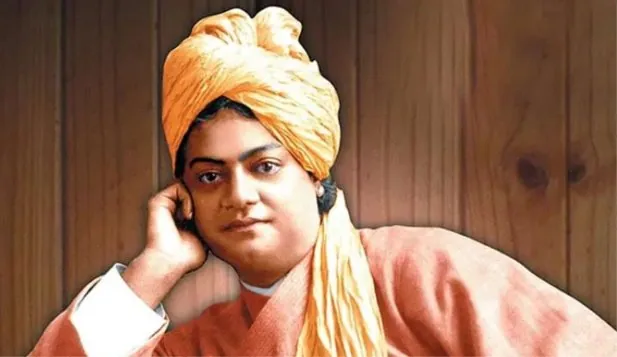
Swami Vivekananda’s Historic Chicago Address
Source Recently, the Prime Minister remembered Swami Vivekananda’s 1893 Chicago Address highlighting its enduring contribution to presenting India’s civilisational ethos, spiritual traditions and message of universal harmony to the world.- Historic Address: Swami Vivekananda addressed the World’s Parliament of Religions in Chicago on 11 September 1893, beginning with “Sisters and Brothers of America.”
- Universal Tolerance & Religious Pluralism: He stressed that Hinduism teaches acceptance of all religions as true, with different spiritual paths ultimately leading to the same divine goal.
- Critique of Fanaticism: He strongly condemned sectarianism, bigotry and religious fanaticism, calling for religious harmony, coexistence and universal brotherhood.
- About: Swami Vivekananda, born as Narendra Nath Datta on 12th January 1863, in Kolkata was a monk and chief disciple of Ramakrishna Paramhansa. In 1893, at the request of Maharaja Ajit Singh of Khetri, he adopted the name ‘Vivekananda’, replacing ‘Sachidananda’.
- Enlightenment: In December 1892, Vivekananda meditated on a rock off Kanyakumari, reflecting deeply on India’s past, present and future and on his mission for national and social regeneration. The site is today associated with the Vivekananda Rock Memorial.
- Philosophical Contribution: He popularised Indian philosophies of Vedanta and Yoga, and developed Neo-Vedanta, combining spirituality with material progress.
- Spiritual Contribution: Drawing from the Upanishads, Gita, Buddha and Jesus, he emphasised self-realisation, compassion and selfless service, including the idea that serving Jiva is worship of Shiva.
- Pathways to Moksha: He identified four paths to liberation—Raja Yoga, Karma Yoga, Jnana Yoga and Bhakti Yoga.
- Education and Revivalism: He advocated man-making and character-building education as a means of social regeneration and national reconstruction.
- Nationalism: His nationalism was rooted in humanism and universalism, with emphasis on freedom, equality, upliftment of the masses and selfless service through Karma Yoga.
- Ramakrishna Mission: He founded the Ramakrishna Mission in 1897 to promote service, education and spiritual upliftment, and established Belur Math in 1899.
- Birth and Death Anniversaries: Swami Vivekananda died on 4th July 1902 at Belur Math, and his death anniversary is observed as Nirvana Day, while his birth anniversary on 12th January is celebrated in India as National Youth Day.
Important Days
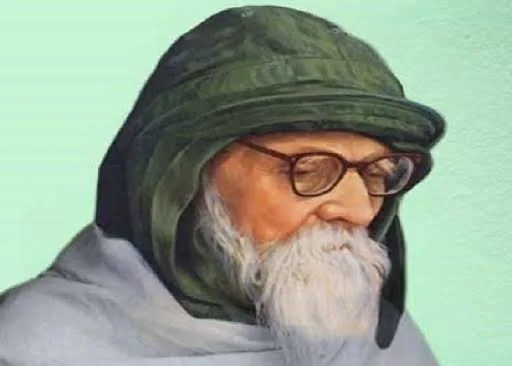
Birth Anniversary of Acharya Vinoba Bhave
Source Recently, the Prime Minister paid tribute to Acharya Vinoba Bhave on his birth anniversary, recalling his message of ‘Jai Jagat’, which placed humanity above social, political and geographical boundaries.- About: Vinayak Narahari Bhave, popularly known as Acharya Vinoba Bhave, was born on 11th September 1895 at Gagode, Bombay Presidency (Maharashtra). From an early age, he developed a deep interest in spirituality, Sanskrit, the Bhagavad Gita and the Upanishads.
- Association with Gandhi:
- Vinoba met Mahatma Gandhi on 7th June 1916 and joined his Ashram, adopting the ideals of non-violence, equality, austerity and village development.
- On 8th April 1921, Gandhi sent him to Wardha to take charge of an Ashram, where he published the Marathi monthly Maharashtra Dharma, containing essays on the Upanishads. The name “Vinoba” was given to him by Mama Phadke, an Ashram member.
- Role in Freedom Struggle:
- He participated in the Non-Cooperation Movement, promoted Swadeshi and Khadi. He played a prominent role in the Nagpur Flag Satyagraha of 1923 and was imprisoned for his participation.
- During his imprisonment in Dhulia Jail in 1932, he delivered discourses on the Bhagavad Gita, which were later published as Gita Pravachane.
- Gandhi selected him as the first Individual Satyagrahi in 1940, and he spent several years in prison for leading non-violent resistance against British rule.
- Sarvodaya Movement: Inspired by Gandhi, Vinoba promoted Sarvodaya, or the welfare and uplift of all, with emphasis on social equality, decentralisation, non-violence and self-reliant village communities.
- Bhoodan Movement:
- In 1951, Vinoba began a peace trek through violence-affected Telangana.
- At Pochampalli, a request for land for landless people led him to appeal to landlords for voluntary land donations, with a landlord donating the required land, marking the beginning of the Bhoodan (Land Gift) Movement.
- The movement continued for 13 years, during which he travelled about 58,741 km, collected around 4.4 million acres of land, and distributed approximately 1.3 million acres among landless farmers.
- Spiritual and Social Work: Vinoba established several Ashrams promoting simple and self-sufficient living and founded Brahma Vidya Mandir in 1959, a community for women based on Gandhian principles of self-sufficiency and simple living. He also campaigned strongly against cow slaughter.
- Literary Contributions: His important works include Swarajya Sastra, Geeta Pravachane and Teesri Shakti (The Third Power).
- Awards and Recognition: He became the first recipient of the Ramon Magsaysay Award for Community Leadership in 1958. He was awarded the Bharat Ratna posthumously in 1983.
- Death: Acharya Vinoba Bhave died on 15 November 1982 at Paunar in Wardha district, Maharashtra.
International Organisations
International Criminal Court (ICC)
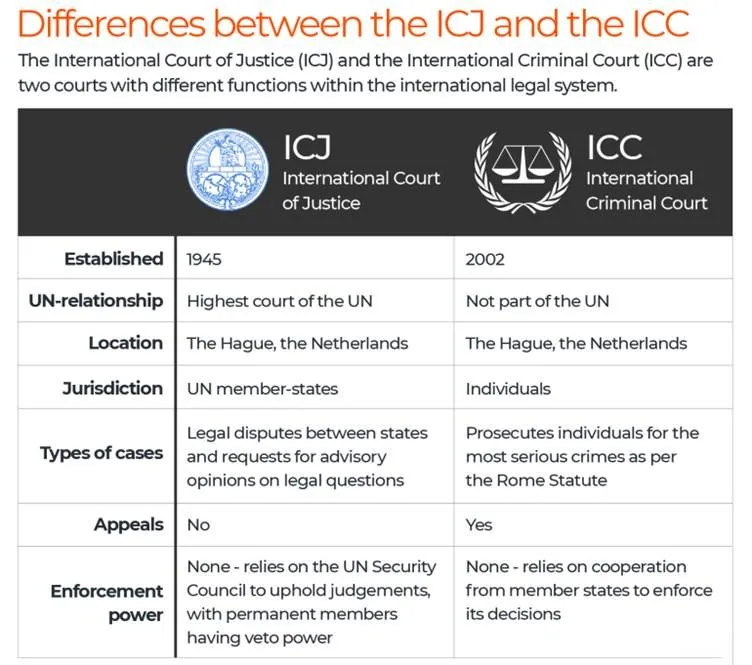
Source Why in News?- The International Criminal Court (ICC) is facing renewed pressure after the United States launched measures against the Court, including sanctions on ICC officials and efforts to encourage member states to withdraw, while Venezuela and Chad announced plans to leave the Rome Statute.
- The developments have renewed concerns over the legitimacy, universality and effectiveness of the international criminal justice system.
- U.S. Opposition: The U.S. has intensified pressure against the ICC, citing concerns over national sovereignty and the Court’s investigations involving U.S. personnel in Afghanistan and Israeli officials over the Gaza conflict.
- African Concerns:
- Mali, Burkina Faso and Niger have accused the ICC of selective justice and neo-colonialism, alleging that the Court disproportionately focuses on African situations.
- Burundi became the first country to withdraw from the ICC in 2017, criticising what it viewed as unequal attention towards African conflicts.
- Accountability vs Sovereignty: The withdrawals highlight the tension between international criminal accountability and principles of state sovereignty and non-interference.
- Withdrawal Is Not Retrospective: A country’s withdrawal does not terminate the ICC’s jurisdiction over crimes committed while it was a member, as illustrated by the Philippines, where an ICC investigation continued after its withdrawal.
- About:
- The ICC is the world’s first permanent international criminal court, established under the Rome Statute, adopted on 17th July 1998 and which entered into force on 1st July 2002. It is headquartered in The Hague, Netherlands.
- The ICC was created to end impunity for the most serious international crimes and ensure accountability when national justice systems fail.
- The ICC is independent of the United Nations, although the UN Security Council can refer situations to it.
- Core Crimes: The ICC has jurisdiction over four crimes—genocide, crimes against humanity, war crimes and the crime of aggression.
- Jurisdiction: The ICC prosecutes individuals, not states, for crimes committed after 1st July 2002. It follows the principle of complementarity, meaning it acts as a court of last resort and intervenes only when national authorities are unwilling or unable to genuinely carry out investigations or prosecutions.
- Territorial Jurisdiction: It generally exercises jurisdiction over crimes committed in States Parties, or over nationals of States Parties; it can also exercise jurisdiction in non-member states through a UNSC referral.
- Membership: The Rome Statute has 125 States Parties. India, the US, China and Israel are not parties to the ICC. India has raised concerns relating to sovereignty and the UNSC’s referral powers.
- Structure: The ICC has four principal organs—the Presidency, Judicial Divisions, Office of the Prosecutor and Registry. The Assembly of States Parties (ASP) provides legislative oversight and governance.
- Enforcement: The ICC has no independent police or enforcement force and therefore depends on State cooperation for arrest and surrender of accused persons, asset freezing and enforcement of sentences.
- Key Limitation: The effectiveness of the ICC depends heavily on international cooperation, making arrest and enforcement difficult when states refuse to cooperate or when major powers remain outside the Rome Statute.
International Relations
IAEA Refers Iran to UNSC Over Nuclear Non-Compliance
Source The International Atomic Energy Agency (IAEA) has formally referred Iran to the United Nations Security Council (UNSC) for the first time in 20 years due to Tehran’s persistent failure to comply with its nuclear non-proliferation obligations and its severe lack of cooperation with international nuclear inspectors.- The Vote:
- The resolution, sponsored by the US, UK, France, and Germany, was adopted with 23 votes in favour, 3 against (Russia, China, and Niger), 8 abstentions, and one Board member not voting.
- Although a UNSC referral opens the door for sweeping global sanctions and asset freezes, punitive measures are unlikely. Iran’s allies, Russia and China, hold veto power as permanent members of the UNSC and are expected to block any punitive resolutions.
- Core Concerns:
- The referral highlights Iran’s failure to explain anthropogenic (man-made) uranium traces found at several undeclared sites.
- The IAEA estimates Iran holds around 440.9 kilograms of uranium enriched to 60% purity - a short technical step away from the 90% weapons-grade threshold.
- Iran’s Nuclear Program and IAEA Concerns:
- The Joint Comprehensive Plan of Action (JCPOA):
- Signed in 2015 between Iran and the P5+1 (China, France, Russia, UK, US, plus Germany), the JCPOA strictly limited Iran’s nuclear program in exchange for the lifting of economic sanctions.
- In 2018, the US unilaterally withdrew from the JCPOA and reinstated harsh “maximum pressure” sanctions. In response, Iran gradually breached the deal’s limits on uranium enrichment.
- NPT Safeguards Agreement:
- Independent of the JCPOA, Iran is a party to the Nuclear Non-Proliferation Treaty (NPT) and is obligated to comply with its Comprehensive Safeguards Agreement (CSA) with the IAEA.
- The safeguards framework requires Iran to declare its nuclear material and facilities and enables the IAEA to verify that nuclear material is not diverted for weapons purposes.
- Following the June 2025 US-Israeli strikes, Iran restricted IAEA access to several nuclear sites, significantly impairing the Agency’s ability to verify Iran’s nuclear activities and stockpiles.
- These restrictions have prevented the IAEA from fully carrying out its verification responsibilities under Iran’s safeguards obligations.
- The Joint Comprehensive Plan of Action (JCPOA):
- The IAEA is an intergovernmental organisation established in 1957 as the world’s “Atoms for Peace” organisation to promote the peaceful use of nuclear energy and prevent its military use.
- Headquartered in Vienna, it reports to the UNGA and UNSC, and has 181 members (as of December 2025), with India as a founding member.
- The IAEA was awarded the Nobel Peace Prize in 2005 for its contribution to a safer and more peaceful world
18th BRICS Summit 2026: Adoption of the New Delhi Declaration
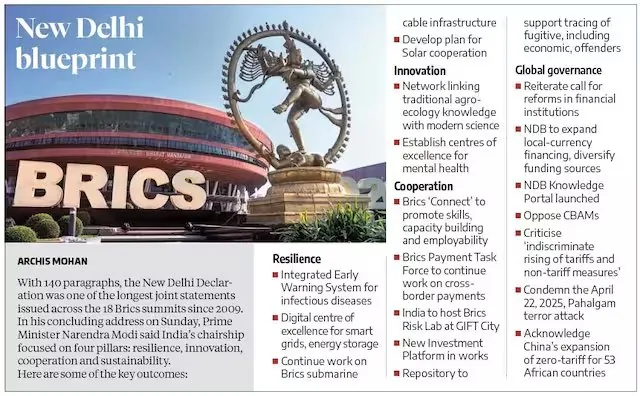
Source Why in News?- India hosted the 18th BRICS Summit (2026) in New Delhi, marking its fourth BRICS Chairship, under the theme “Building for Resilience, Innovation, Cooperation and Sustainability.” The summit concluded with the unanimous adoption of the New Delhi Declaration, focusing on multilateralism, conflict prevention and equitable global governance.
-
Financial, Economic & Trade Initiatives
- Cross-Border Payments & Local Currency: Mandated the BRICS Payment Task Force to advance the interoperability of payment and messaging channels for trade settlements using local currencies, aiming to insulate BRICS economies from Western financial sanctions and exchange rate volatility.
- BRICS Risk Lab & Insurance Resilience: Endorsed India’s proposal to host a BRICS Risk Lab at GIFT City, Gujarat, to build a self-reliant reinsurance ecosystem that mitigates geopolitical risks for large-scale Global South infrastructure projects.
- MSME Invoice Discounting (Jaipur Consensus): BRICS countries welcomed the Jaipur Consensus to study the establishment of an Invoice Discounting Mechanism to help MSMEs unlock working capital from unpaid invoices and strengthen their participation in international trade.
- Contingent Reserve Arrangement (CRA): Approved amendments to the CRA Treaty and initiated the 9th Test Run to strengthen the bloc’s internal financial safety net, ensuring swift liquidity support during balance-of-payment crises without relying on the International Monetary Fund (IMF).
- Taxation & Customs Cooperation:
- Launched the BRICS Tax Cross-Learning Lab and the Authorised Economic Operator (AEO) Action Plan 2026, mandating annual joint customs enforcement operations to dismantle smuggling networks, prevent illicit financial flows, and streamline legitimate trade.
- BRICS gave in-principle approval to an agreement on customs cooperation to facilitate legitimate trade, strengthen border security, and combat illicit trade.
- New Development Bank (NDB) & Multilateral Guarantees: Launched the BRICS-NDB Knowledge Portal and advanced pilot transactions for Multilateral Guarantees to de-risk infrastructure projects and effectively mobilize private institutional capital for developing nations.
- Innovation & Financing: Proposed the BRICS Startup Innovation Fund to finance early-stage ventures.
-
Science, Technology, and Digital Infrastructure
- Space & Satellite Cooperation: Expanded the BRICS Remote Sensing Satellite Constellation and drafted terms for the BRICS Space Council to democratize access to outer space technology and utilize collective satellite data for disaster risk reduction and climate monitoring.
- Digital Public Infrastructure (DPI): Approved the creation of a BRICS DPI Repository and initiated pilot projects to share scalable, open-source digital public goods (like digital identity and payment systems), preventing monopolistic control by private tech giants.
- Global Research Advanced Infrastructure Network (GRAIN): Adopted an Action Plan to pool financial and intellectual resources for high-cost megascience projects, ensuring long-term technological sovereignty for member states.
- Submarine Cable Network: Tasked a feasibility study for a direct high-speed submarine communication network to ensure secure, resilient data connectivity that bypasses traditional routing choke points controlled by Western entities.
- Energy Grids & Startup Ecosystem: Established the Digital Centre of Excellence for Smart Grids to integrate renewable energy seamlessly using AI, and launched the BRICS Incubator Network to catalyze innovation-led economic growth and foster entrepreneurship.
-
Agriculture and Food Security
- BRICS Grain Exchange: BRICS aims to launch the Grain Exchange by 2027. Proposed in 2023 and championed by Russia, it seeks to strengthen food security, reduce grain price volatility, and facilitate intra-BRICS trade.
- BRICS AGRIN (Agro-Inputs, Genetic Resources, and Information Network):
- It is a collaborative, voluntary, and farmer-centric cooperation framework established by BRICS nations to strengthen joint efforts in seeds, germplasm, and agricultural inputs.
- India showcased its culinary diplomacy by serving Gucchi Marmik, featuring rare Himalayan Gucchi mushrooms. Delegates were also given Koraput coffee from Odisha, promoting Vocal for Local and grassroots economic empowerment.
- Global Forum on Farmers’ Rights in Seed Systems: A platform dedicated to protecting farmers’ rights, preserving traditional agricultural knowledge, and addressing shared seed system challenges.
- Centres of Excellence on Agroecology & Regenerative Agriculture: A network established to promote natural and sustainable farming practices for climate resilience and productivity.
- BRICS Network on Digital Agriculture: A tech-focused initiative to scale modern digital solutions across agriculture, agroforestry, fisheries, and aquaculture.
-
Health and Medicine
- BRICS Mission for Healthy Lifestyle: The declaration endorses a BRICS Mission for Healthy Lifestyle along with a Joint Roadmap for Healthy Lifestyle Promotion (2026–2029).
- Mental Health & Traditional Medicine: Created a Training Hub Network led by India’s NIMHANS for mental well-being and established an Expert Working Group to integrate safe traditional medicine into modern health systems, advancing affordable Universal Health Coverage.
- BRICS BioDesign Initiative:
- Spearheaded by the Andhra Pradesh MedTech Zone (AMTZ), the newly launched BRICS BioDesign Centre will advance cross-border healthcare innovation.
- It aims to combine scientific expertise to translate medical ideas into accessible and deployable healthcare solutions for the Global South.
-
Transport, Logistics, and Climate
- BRICS Logistics Supply-Chain Cooperation Framework: BRICS agreed on a voluntary framework to strengthen the resilience and sustainability of transport logistics and supply chains through technical cooperation, knowledge sharing, and capacity building.
- BRICS Cooperation on Global Value Chains: BRICS adopted the GVC Action Plan 2026–2030, including a Technical Council and Joint Study, to make global value chains more resilient and efficient while promoting market opening and economic diversification.
- Sustainable Aviation & Urban Mobility: BRICS launched a Sustainable Aviation Fuels Forum, created the BRICS Urban Mobility Hub, and adopted Voluntary Principles for Climate-Resilient Urban Infrastructure to promote sustainable and resilient transport systems.
- Climate Adaptation & Forestry: Adopted principles for Integrated Landscape-Based Greening and Wildfire Preparedness to combat desertification, protect vital carbon sinks like tropical forests, and enhance community-level resilience against extreme weather.
-
Security, Law, and Society
- Counter-Terrorism: Condemned cross-border terrorism and the 2025 Pahalgam terror attack, urging the adoption of the UN Comprehensive Convention on International Terrorism to hold perpetrators accountable and dismantle terror financing networks.
- Asset Recovery & Corruption: Established an Expert Network and a Repository for Tracing Fugitive Offenders to deny safe havens to economic offenders, trace illicit financial flows, and facilitate the legal recovery of stolen national assets.
- Labour, Social Security & Culture: BRICS welcomed the adoption of BRICS CONNECT (BRICS Cooperation Network for Capacity Building, Employability, and New Skills and Technologies) to strengthen the rights of gig workers and promote cross-border portability of social security, along with an Artist Registry to protect cultural heritage and curb illicit trafficking of antiquities.
- BRICS Youth Cooperation: The declaration adopted the BRICS Youth Cooperation Framework 2026 and the Joint Statement of the 2026 BRICS Youth Ministers’ Meeting, while establishing a Working Group on Sport Technology.
-
Geopolitical Mandates and Endorsements
- UNSC Reform: BRICS officially backed the Ezulwini Consensus and Sirte Declaration to secure African representation in a reformed UN Security Council, alongside explicit support from China and Russia for the aspirations of India and Brazil, aiming to rectify the Global South’s historical underrepresentation in global security decisions.
- WTO & ICAO Expansion: Formally endorsed the World Trade Organisation (WTO) accession bids of Ethiopia and Iran, and backed Ethiopia and Indonesia for newly expanded seats on the International Civil Aviation Organization Council to amplify developing nations’ voices in global standard-setting.
- Future Chairship: Confirmed China as the host for the 19th BRICS Summit in 2027 to ensure the seamless continuation and implementation of the New Delhi Declaration’s vast institutional mandates.
- Roadmap for Global Governance Reform: India proposed a 10-point roadmap to reform global governance based on the “3Rs” (Representation, Responsiveness, and Rule-making). This aims to transform the current international system from a “pyramid of privilege” to a “platform of partnership”.
- India’s BRICS Chairships: Evolution from Continuity to Consensus
-
2012: Laying the Institutional Foundation
- Theme: “BRICS Partnership for Global Stability, Security and Prosperity.”
- New Development Bank (NDB): Proposed the creation of a multilateral institution to mobilize resources for infrastructure and sustainable development projects in emerging economies.
- Contingent Reserve Arrangement (CRA): Laid the conceptual foundation for a financial safety mechanism designed to provide short-term liquidity support against global financial instability.
- Intra-Bloc Trade: Championed the Master Agreement on Extending Credit Facility in Local Currency to mitigate currency risks and boost internal trade.
-
2016: Expanding Regional Outreach (Goa Summit)
- Theme: “Building Responsive, Inclusive and Collective Solutions.”
- NDB Rollout: Formally operationalized the NDB, disbursing its first tranches of loans primarily for renewable energy projects.
- Regional Integration: Hosted the joint BRICS–BIMSTEC Outreach Summit to bridge commercial, technological, and security ties across the Bay of Bengal.
- Security & FATF: Mandated alignment with Financial Action Task Force (FATF) standards to curb cross-border terror financing.
- Research Platforms: Agreed to establish the BRICS Agriculture Research Platform, Railway Research Network, and Sports Council.
-
2021 (Virtual) — Consolidation & Technological Resilience
- Theme: BRICS@15: Intra-BRICS Cooperation for Continuity, Consolidation and Consensus
- Counter-Terrorism: Adopted the unified BRICS Counter-Terrorism Action Plan to operationalize intelligence and enforcement coordination.
- Health & Pandemic Preparedness: Launched the BRICS Vaccine R&D Center and convened the inaugural BRICS Digital Health Summit.
- Space Data Sharing: Signed the BRICS Remote Sensing Satellite Constellation Agreement to exchange satellite data for climate and disaster management.
- Resource Governance: Instituted the BRICS Alliance for Green Tourism and organized the first ministerial meeting on sustainable water management.
-
BRICS Evolution and Expansion of the Global South
- Origin to Formal Bloc: The acronym ‘BRIC’ was originally coined by Goldman Sachs in 2001. It formalized as a political grouping in 2006, held its first summit in Yekaterinburg (2009), and became BRICS when South Africa joined in 2010.
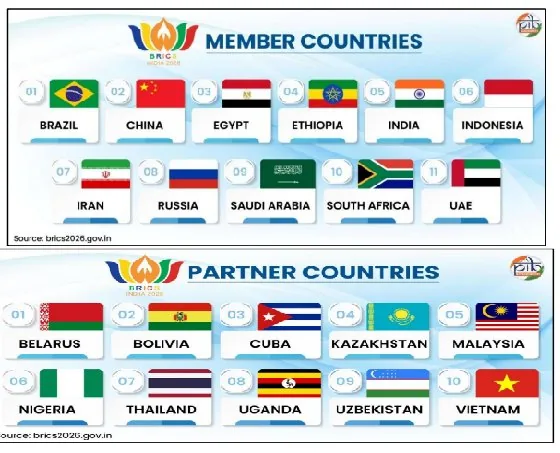
- Expanded Membership & Economic Weight: The bloc now comprises 11 full members (Brazil, China, Egypt, Ethiopia, India, Indonesia, Iran, Russia, Saudi Arabia, South Africa, and the UAE). Together, they represent a massive 49.5% of the global population, 40% of global GDP, and 26% of global trade.
- New “Partner Country” Framework: To accommodate growing global interest without altering the core structure, 10 countries (including Belarus, Malaysia, Nigeria, Thailand, and Vietnam) were inducted as Partner Countries in 2025, broadening opportunities for South-South cooperation.
- Reforming Global Governance: Beyond economic coordination, BRICS acts as a collective voice demanding greater equity and representation in the International Monetary Fund (IMF), World Bank, and the WTO, pushing back against protectionism.
- Presidency Rotation: Historically, the Presidency rotates annually on January 1st based on the acronym. Due to the recent rapid expansion, a new rotation formula is currently being deliberated among member states.
- India’s 2026 BRICS Chairship seeks to translate the grouping’s growing representation into meaningful cooperation and tangible outcomes. By strengthening consensus and advancing cooperation on development, technology, climate, energy and finance, BRICS can emerge as a constructive force for a more inclusive and resilient global order.
Polity & Governance
Amendments to Consumer Protection (E-Commerce) Rules, 2026
Source The Department of Consumer Affairs has notified the Consumer Protection (E-Commerce) (Amendment) Rules, 2026 to bolster consumer rights, mandate fair trade practices, and curb deceptive digital tactics, aiming to balance consumer protection with the ease of doing business.- Statutory Framework & Timeline: Notified under the broader framework of the Consumer Protection Act, 2019, these amendment rules will officially come into force on 1st January 2027.
- Integration with NCH: E-commerce entities must mandatorily partner with the National Consumer Helpline (NCH) convergence process to strengthen the national grievance redressal mechanism.
- Search & Pricing Transparency: The rules prohibit search result manipulation, mandate clear identification of sponsored listings, and require displaying the lowest prior price (from the preceding 30 days) during promotional sales.
- Regulating Dark Patterns: The rules mandate strict compliance with the Guidelines for Prevention and Regulation of Dark Patterns, 2023, requiring platforms to conduct a yearly self-audit and display a compliance certificate.
- Consumer Data & Consent: Platforms are prohibited from using consumer information for specified purposes without the user’s express and affirmative consent.
- Product Disclosures: Marketplaces must disclose vital information, including ‘best-before’ dates, return/refund policies, importer details, and the country of origin for imported goods.
- Anti-Bundling Rules: Imposing bundled fees for services unrelated to the platform is banned, with exceptions for loyalty or membership programs.
- The Consumer Protection Act, 2019 replaced the Consumer Protection Act, 1986 to strengthen consumer rights in the digital age, covering e-commerce, direct selling and misleading advertisements.
- It established the Central Consumer Protection Authority (CCPA), equipping it with suo-motu powers to investigate unfair trade practices, order product recalls, penalize misleading ads, and enforce statutory accountability on e-commerce platforms.
- It also significantly strengthened the three-tier consumer dispute redressal mechanism (District, State, and National Commissions) through rationalized pecuniary jurisdictions and procedural innovations.
- These include the e-Daakhil portal for nationwide online grievance filing, zero filing fees for cases up to Rs 5 lakh, and the deemed admissibility of complaints within 21 days.
Schemes & Initiatives
Pradhan Mantri Matsya Sampada Yojana (PMMSY)
Source Why in News?- Recently, the Pradhan Mantri Matsya Sampada Yojana (PMMSY) completed six years, marking an important milestone in India’s fisheries sector.
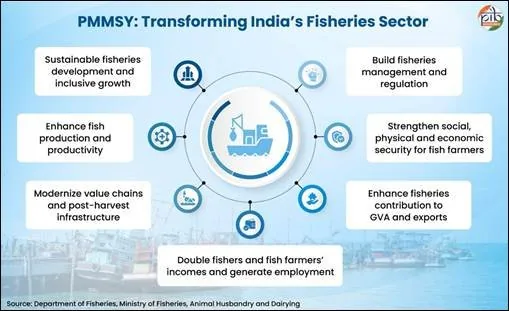
- About: Launched in 2020, the Pradhan Mantri Matsya Sampada Yojana (PMMSY) builds on the Blue Revolution scheme to address critical gaps across the fisheries value chain and promote inclusive, sustainable and modern fisheries development.
- Scheme Structure:
- PMMSY is an umbrella scheme comprising a Central Sector Scheme and a Centrally Sponsored Scheme (CSS).
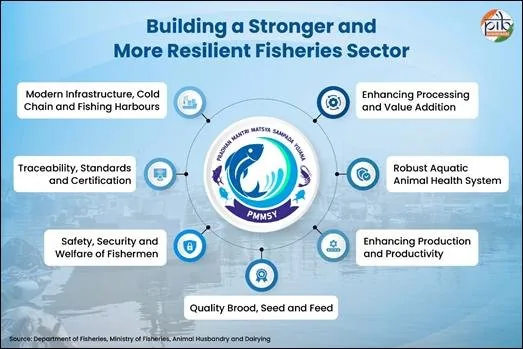
- Its major components include production and productivity enhancement, infrastructure and post-harvest management, and fisheries management and regulation.
- Financial Outlay: PMMSY has a total outlay of ₹20,750 crore, with a record ₹2,500 crore allocated in BE 2026–27 to strengthen fisheries infrastructure and livelihoods.
- Infrastructure Investment: Between 2020–21 and 2025–26, fisheries and aquaculture projects worth ₹21,394.88 crore were approved, including a Central share of ₹9,510.89 crore, based on proposals from States, UTs and implementing agencies.
 Key Components and Sub-Scheme under PMMSY
- PM-MKSSY: The Pradhan Mantri Matsya Kisan Samridhi Sah-Yojana (PM-MKSSY) is a Central Sector sub-scheme under PMMSY, operational across all States/UTs during 2023–24 to 2026–27, with an estimated outlay of ₹6,000 crore. It focuses on formalisation, insurance, institutional finance, quality assurance and traceability.
- Production & Productivity: The CSS component promotes technology-driven improvements across inland and marine fisheries, mariculture, seaweed cultivation, Himalayan and North-Eastern fisheries, and ornamental fisheries.
- Infrastructure & Post-Harvest: The CSS component strengthens fishing harbours, fish landing centres, cold chains, post-harvest facilities, deep-sea fishing, coastal fishing villages, markets and marketing infrastructure.
- Fisheries Management & Safety: The CSS component promotes monitoring, control and surveillance, fisher and vessel insurance, fisheries extension services, and safety and security of fishers at sea, while supporting their livelihood and nutritional needs.
- Growth in Fish Production: PMMSY has contributed to a significant rise in fish production, increasing it from 141.64 lakh tonnes in 2019–20 to a record 197.75 lakh tonnes in 2024–25, reflecting improved productivity and sectoral growth.
- Employment Generation: The scheme has created direct and indirect employment opportunities for around 58 lakh persons engaged in fisheries and aquaculture-related activities.
- Growth in Fisheries Exports: Fisheries exports increased from ₹46,663 crore in 2019–20 to ₹73,890 crore in 2025–26, strengthening India’s position in the global seafood market.
- Integrated Aquaparks: PMMSY has approved 12 Integrated Aquaparks with a total investment of ₹713.80 crore to promote modern fisheries infrastructure and value-chain development.
- Seaweed Cultivation: Projects worth ₹198.17 crore were approved during 2020–25 to promote seaweed cultivation and allied activities, supporting coastal livelihoods and diversification.
- Technology-Driven Aquaculture: PMMSY promotes high-density, resource-efficient aquaculture through technologies such as Recirculatory Aquaculture Systems (RAS) and Bio-floc systems. The scheme has supported 12,081 RAS and 4,205 Biofloc units, improving productivity, water-use efficiency and environmental sustainability.
- Ornamental Fisheries: The scheme has supported 2,672 ornamental fish rearing and integrated ornamental fish units, encouraging diversification and entrepreneurship in the fisheries sector.
- Fish Farmers Producer Organisations (FFPOs): PMMSY strengthens the collective bargaining power and economic empowerment of fishers and fish farmers by supporting the establishment of FFPOs; between 2021–22 and 2025–26, projects worth ₹544.86 crore were approved for 2,195 FFPOs.
- Climate-Resilient Coastal Villages: Under the Central Sector component of PMMSY, 100 coastal fishermen villages have been identified as Climate Resilient Coastal Fishermen Villages (CRCFV), with ₹200 lakh per village fully funded by the Government for resilient infrastructure, livelihoods and post-harvest facilities.
- Digital Transformation: The National Fisheries Digital Platform (NFDP), launched under PM-MKSSY in September 2024, provides a single-window digital system for formalisation, institutional credit, aquaculture insurance, traceability, incentives, cooperatives and capacity building; as of 8 September 2026, over 37.01 lakh individual registrations had been recorded, with total registrations exceeding 37.23 lakh.
- The Pradhan Mantri Matsya Sampada Yojana has emerged as a transformative initiative for India’s fisheries sector by combining production growth, infrastructure development, technology adoption and livelihood empowerment. As India advances its Blue Economy vision, PMMSY will remain crucial in ensuring a competitive, sustainable and inclusive fisheries ecosystem while promoting responsible utilisation of aquatic resources.
Social Issues
NCPCR Probes Meta Over CSEAM Ads on Social Media
Source Why in News?- The National Commission for Protection of Child Rights (NCPCR) summoned senior executives of Meta (parent company of Facebook, Instagram, and WhatsApp) regarding the promotion of advertisements linked to Child Sexual Exploitative and Abuse Material (CSEAM) on its platforms.
- Concurrently, the Ministry of Electronics and Information Technology (MeitY) issued a stern notice, demanding Meta to disable all such content and explain the severe gaps in its algorithmic safeguards.
- Limitations of AI Filters:
- Automated safety systems mostly look for direct keywords or previously banned images.
- They struggle to catch manipulated text, secret codewords, or disguised visuals used by criminals to bypass security checks.
- Systemic Misclassification: Moderation tools often mistakenly label child abuse material as general “adult content.” This bypasses strict child-safety rules and hides the true scale of the problem.
- Lack of Oversight in Ad Networks: Platforms rely heavily on third-party global ad agencies. These agencies often operate with relaxed checks, allowing illegal ads to slip through in the pursuit of ad revenue.
- External Links (Bait Strategy): The advertisements usually do not show illegal images directly. Instead, they act as “bait,” providing links or QR codes that direct users to secret, encrypted chat groups (like Telegram) where the actual material is sold.
- Human Moderation Errors: Overburdened or inadequately trained human reviewers often make mistakes, frequently dismissing user complaints and wrongly declaring illegal ads as safe.
- Legal & Regulatory Framework Against CSEAM in India
- POCSO Act, 2012:
- Strict criminal liability for the creation, storage, distribution, or facilitation of Child Sexual Abuse Material (CSAM).
- Section 19 makes it legally binding for any person or commercial entity possessing knowledge of sexual offenses against children to immediately report it to the Special Juvenile Police Unit or the local police.
- Information Technology Act, 2000:
- Section 67B: Specifically prescribes punishment (up to 5 years imprisonment on first conviction) for publishing, transmitting, or facilitating material depicting children in sexually explicit acts in electronic form.
- Section 79 (Safe Harbour): Provides intermediaries legal immunity for third-party content hosted on their platforms, contingent upon observing strict “due diligence”.
- IT (Intermediary Guidelines and Digital Media Ethics Code) Rules, 2021:
- Social media intermediaries must deploy automated tools to proactively identify and disable content related to child sexual exploitation.
- Platforms must appoint a resident Chief Compliance Officer, a Nodal Contact Person, and a Grievance Officer based in India.
- Failure to remove CSEAM upon receipt of court order or government notice results in the forfeiture of safe-harbor protections under Section 79.
- Government Mechanisms to Combat Online CSAM:
- The National Cyber Crime Reporting Portal enables citizens to report cybercrimes involving children, while the Indian Cyber Crime Coordination Centre (I4C) coordinates investigation and enforcement efforts.
- Internationally, the NCRB shares cyber-tipline reports received through its cooperation with the NCMEC, US, with States and Union Territories for further action..
- UN Convention on the Rights of the Child (UNCRC), 1989: A legally binding international agreement setting out civil, political, economic, and cultural rights of children. India ratified the UNCRC in 1992.
- POCSO Act, 2012:
- Statutory Status: Established in March 2007 under the Commissions for Protection of Child Rights (CPCR) Act, 2005.
- Nodal Ministry: Functions under the administrative control of the Ministry of Women and Child Development (MoWCD).
- Composition: Consists of a Chairperson and six members (at least two must be women) appointed by the Central Government.
- Key Mandates:
- Ensures that all laws, policies, and administrative mechanisms align with child rights as enshrined in the Constitution of India and the UN Convention on the Rights of the Child (UNCRC).
- Monitors the implementation of the Protection of Children from Sexual Offences (POCSO) Act, 2012 and the Right to Education (RTE) Act, 2009.
- Quasi-Judicial Powers:
- While conducting inquiries, NCPCR exercises specified powers of a civil court under the Code of Civil Procedure, 1908 (now Bharatiya Nagarik Suraksha Sanhita, 2023):
- Can summon and enforce the attendance of witnesses under oath.
- Can require the discovery and production of documents or digital evidence.
- Can requisition public records or reports from any court or office.
- While conducting inquiries, NCPCR exercises specified powers of a civil court under the Code of Civil Procedure, 1908 (now Bharatiya Nagarik Suraksha Sanhita, 2023):
- Limitation: It has recommendatory powers; it cannot directly punish an offender or pass executable decrees, but can recommend prosecution or relief to governments/courts.