Comrades Dispatch · 18 Sep 2026 (PDF)
In this edition
- Anant Nag Selected for Dadasaheb Phalke Award 2024 Art & Culture
- Montreal Protocol and World Ozone Day Environment & Ecology
- India’s Energy Security Amid Sanctions International Relations
- India Rejects Pakistan-China Boundary Joint Commission Polity & Governance
- 3 Years of PM Vishwakarma Scheme Schemes & Initiatives
- Pradhan Mantri Bhartiya Janaushadhi Pariyojana (PMBJP) Schemes & Initiatives
- Pradhan Mantri Awas Yojana–Urban (PMAY-U) Schemes & Initiatives
- Pygmy Hog Wildlife
Art & Culture
Anant Nag Selected for Dadasaheb Phalke Award 2024
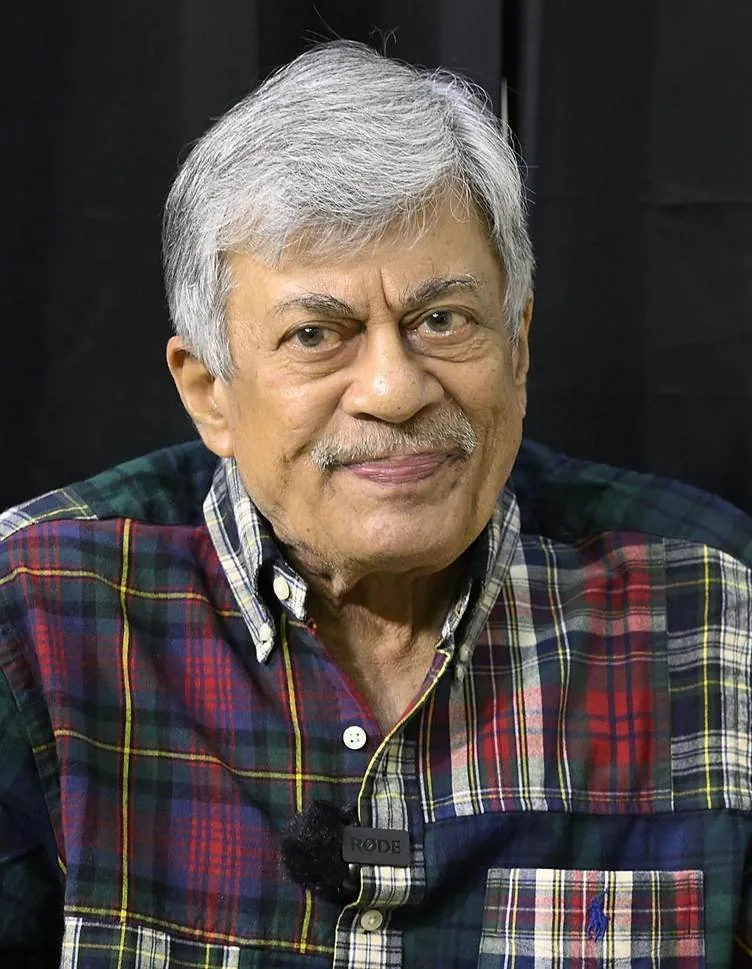
Source Veteran Kannada actor Anant Nag has been selected for the prestigious Dadasaheb Phalke Award, India’s highest honour in cinema, making him the second Kannada actor to receive the award after Dr. Rajkumar (1995).- He will be presented with the award at the 72nd National Film Awards Ceremony on 22nd September 2026 at Kevadia, Gujarat.
- Birth: Born as Anant Nagarkatte in 1948 in Karnataka, he has acted in 300+ films, including over 250 Kannada films, across mainstream and parallel cinema.
- Major Works: He made his Kannada film debut with Sankalpa and Hindi debut with Ankur. His notable works include Malgudi Days and several acclaimed Kannada films.
- Recognition: He has received five Filmfare Awards, five Karnataka State Film Awards, Karnataka Rajyotsava Award and Karnataka Sahitya Academy Award. He was honoured with the Padma Bhushan in 2025.
- Contributions: He also served as a Member of Karnataka Legislative Council (1988–1994) and Member of Legislative Assembly (1994–1999). He also served as Minister of State for Bangalore City Development.
 Dadasaheb Phalke Award
- Instituted in 1969, the award is India’s highest honour in the field of cinema.
- It was introduced to commemorate Dadasaheb Phalke, the director of India’s first full-length feature film Raja Harishchandra (1913).
- The award recognises outstanding contribution to the growth and development of Indian cinema and includes a Swarna Kamal (Golden Lotus) medallion, shawl and ₹10 lakh cash prize.
Environment & Ecology
Montreal Protocol and World Ozone Day
Source Why in News?- On the occasion of the International Day for the Preservation of the Ozone Layer (World Ozone Day, observed on 16th September), global attention was drawn to the historic journey of the Montreal Protocol.
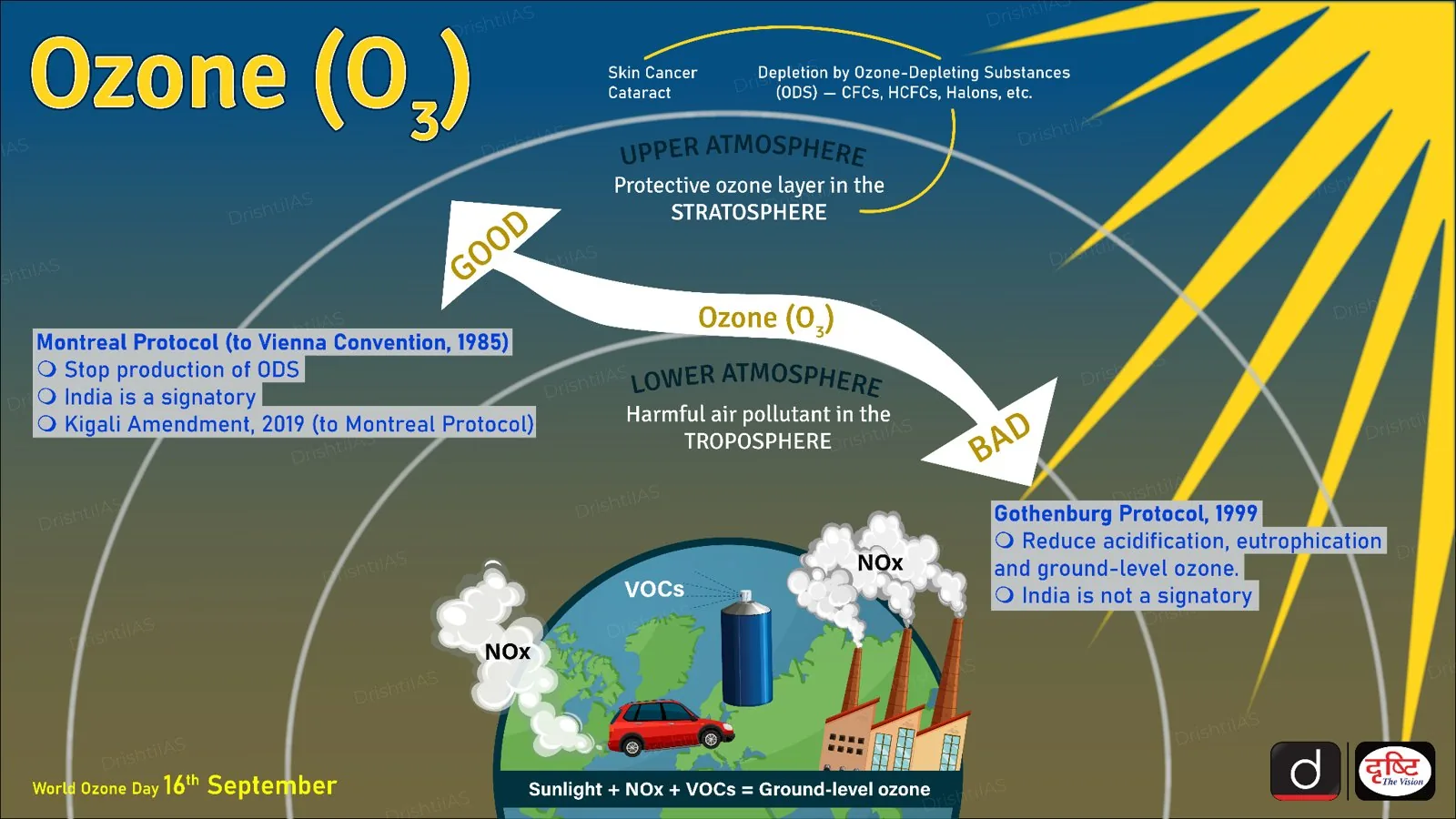
- Background: In the 1970s and 1980s, scientists confirmed that certain synthetic chemicals, primarily chlorofluorocarbons (CFCs) used in refrigeration and aerosols, were migrating to the stratosphere (altitude range of 12 to 50 kilometers above Earth’s surface) and destroying ozone molecules, creating a massive “ozone hole” over Antarctica.
- Vienna Convention (1985):
- Prompted by this scientific discovery, the international community adopted the Vienna Convention for the Protection of the Ozone Layer.
- Established a framework for international cooperation, environmental monitoring and scientific research, paving the way for the Montreal Protocol.
- India became a Party to the Vienna Convention for the Protection of the Ozone Layer in 1991.
- Montreal Protocol:
- Adopted in 1987, it is a legally binding multilateral environmental agreement aimed at protecting the ozone layer by regulating the production and consumption of nearly 100 man-made chemicals known as Ozone Depleting Substances (ODS), such as chlorofluorocarbons (CFCs) and hydrochlorofluorocarbons (HCFCs).
- India became a Party to the Montreal Protocol in June 1992.
- Regulatory Metric: Under the Protocol, “Consumption” is formally defined as Production + Imports – Exports – Verified Destruction.
- Targeted Phase-Out: The treaty categorizes chemicals by family and sets strict, differentiated timetables for developed and developing countries to eventually eliminate their use.
- Success:
- Often celebrated as the world’s most successful environmental treaty, it has facilitated the phase-out of 99% of ODS globally.
- India has met its Montreal Protocol commitments, including the complete phase-out of HCFC-141b from production, import and use from 1 January 2020. It also phased out Chlorofluorocarbons (CFCs), Carbon tetrachloride (CTC) and Halons, achieving a 67.5% reduction in HCFC production and consumption by 2025.
- Universal Ratification: On 16th September 2009, the Vienna Convention and the Montreal Protocol achieved a monumental milestone by becoming the first treaties in UN history to attain universal ratification (all 198 UN member states).
- The Kigali Amendment (2016):
- As industries moved away from ozone-damaging CFCs and HCFCs, they adopted Hydrofluorocarbons (HFCs) as alternatives.
- While HFCs do not harm the ozone layer, they are exceptionally potent Greenhouse Gases (GHGs) that heavily exacerbate climate change.
- To address this, the Parties to the Montreal Protocol adopted the Kigali Amendment at their 28th Meeting of the Parties (MOP 28) in Kigali, Rwanda, in 2016.
- It legally expanded the Protocol’s mandate to phase down non-ozone-depleting HFCs (potent greenhouse gases with high global warming potential) turning the ozone agreement into an indispensable climate change mitigation framework by formally mandating a global phase-down of HFCs.
- India’s Commitment: India ratified the Kigali Amendment in 2021, committing to freeze HFC consumption in 2028 and phase it down by 85% by 2047, in four stages: 10% by 2032, 20% by 2037, 30% by 2042 and 85% by 2047 against the baseline.
- Climate Impact: By curbing HFC emissions and pushing industries toward sustainable cooling alternatives, the successful implementation of the Kigali Amendment is projected to avoid up to 0.3–0.5°C of future global warming by the end of this century.
- Background:
- In 1994, the United Nations General Assembly (UNGA) officially proclaimed 16th September as the International Day for the Preservation of the Ozone Layer.
- The date was specifically chosen to commemorate the signing of the landmark Montreal Protocol on Substances that Deplete the Ozone Layer in 1987.
- Objective: The day serves as a powerful reminder of the ozone layer’s vital role in shielding life on Earth from the Sun’s harmful ultraviolet (UV) radiation and highlights the ongoing need to prevent environmental degradation.
- 2026 Theme & Focus:
- Theme: “Global action for a cooler planet – Celebrating 10 years of sustainable cooling under the Kigali Amendment to the Montreal Protocol”.
- Focus: The theme highlights rising global demand for cooling amid increasing temperatures and calls for energy-efficient, climate-friendly cooling solutions, while marking a decade of efforts to phase down potent greenhouse gases.
- India’s Net Zero Portal and NAPCC Dashboard:
- Launched as digital platforms to track and showcase India’s climate commitments.
- Net Zero Portal: Enables industries, organisations and government bodies to voluntarily register and report progress towards net-zero emissions.
- NAPCC Dashboard: Provides a centralised gateway to track progress and insights across India’s National Missions on Climate Change.
International Relations
India’s Energy Security Amid Sanctions
Source Why in News?- India has reiterated that it remains firmly committed to ensuring energy security for its 1.4 billion people and will continue sourcing crude oil based on diversified supplies and evolving market dynamics.
- India’s stance comes after the US Congress passed the Sanctioning Russia and Iran Act of 2026, which authorises up to 100% trade tariffs on major purchasers of Russian oil.
- The development is significant as Russian crude accounted for over 51% of India’s crude oil imports in July 2026, prompting calls for a centralised strategic “war room” to protect India’s economic and energy interests from unilateral sanctions.
- Dollar Clearing and “Over-Compliance” Trap:
- Global energy and commodities remain indexed to the US dollar, routed via Western clearinghouses and the SWIFT messaging network.
- Domestic and international banks operating in India often practice defensive over-compliance (preemptively rejecting lawful non-dollar transactions, Special Rupee Vostro Accounts (SRVA), or alternative currency settlements (e.g., UAE Dirhams) out of fear of losing access to US correspondent banking licenses.
- Maritime Logistics and P&I Insurance Chokepoint:
- Over 90% of global maritime protection and indemnity coverage is underwritten by the London-headquartered International Group of Protection and Indemnity (P&I) Clubs.
- Sanctions targeting insurers immediately invalidate vessel cover. Without sovereign or accepted mutual guarantees, tankers bearing Indian-bound crude risk being denied entry at maritime chokepoints (e.g., the Danish Straits, the Bosphorus) and domestic discharge ports.
- Collateral Damage to Strategic Projects: The constant looming threat of secondary sanctions such as under the US CAATSA (Countering America’s Adversaries Through Sanctions Act) repeatedly stalls critical defense acquisitions (like the S-400) and connectivity investments (like the Chabahar Port in Iran and the INSTC)
- Human Capital Exposure:
- India is the world’s 2nd-largest supplier of seafarers (ranks behind the Philippines), with 311,936 maritime professionals, accounting for 12.16% of the global seafaring workforce, according to the BIMCO-ICS Seafarer Workforce Report 2026.
- Regulatory blacklisting and interdiction of shadow fleet tankers lead to sudden vessel seizures, unpaid wages, and legal abandonment of Indian crew members in foreign jurisdictions.
- Siloed Governance:
- When sanctions hit, the impact ripples through commodity markets, shipping routes, insurers, and banks.
- However, India’s governance structure remains siloed: the Ministry of External Affairs handles diplomacy, the RBI manages banking, and the Ministry of Shipping manages vessels.
- This fragmentation prevents the generation of early warnings for domestic companies regarding vulnerable payment channels or targeted ports.
- Targeting the Shadow Fleet: The legislation is designed to choke Russia’s energy revenue by targeting the “shadow fleet” of tankers transporting Russian crude outside the G7 price cap mechanism.
- Secondary Sanctions and Tariffs: It empowers the US administration to levy tariffs of up to 100% on exports from countries that are major buyers of Russian energy, directly threatening nations like India and China.
- Extraterritorial Reach: The sanctions do not just target the buyer and seller; they target the entire transaction ecosystem, restricting foreign banks, maritime insurers, and ship managers from accessing the US financial system if they facilitate these trades.
- Extension of Iran Sanctions: Alongside the Russia-focused measures, it also broadens existing enforcement mechanisms against Iran’s military and energy trade and extends the duration of the Iran Sanctions Act of 1996 for an additional five years, through to 2031.
- Presidential Waiver: The legislation does include a provision allowing the US President to waive these tariffs if deemed necessary for US “national security interests,” providing some diplomatic maneuvering room.
- Record Supply Dependency: Driven by heavy discounts, Russia has become India’s single largest crude supplier, with imports reaching 2.6 million barrels per day (mbpd) in July 2026.
- Anchoring Energy Affordability & Inflation:
- For a rapidly growing economy that imports over 85% of its crude oil requirements, energy security rests on four pillars: availability, affordability, accessibility, and sustainability.
- Over the past few years, Russian oil has fundamentally anchored the “affordability” and “availability” metrics.
- Discounted Russian oil has been instrumental in keeping domestic retail fuel prices stable and checking inflation in India.
- Macroeconomic Stability:
- India has saved around USD 13 billion by importing discounted crude from Russia across FY23 and FY24.
- This compressed India’s Current Account Deficit (CAD) by 15–22 basis points in FY24, shielding the Rupee from severe depreciation and curbing capital flight.
- Refining Arbitrage: Indian refiners captured an estimated USD 16 billion in windfall profits by processing discounted Urals crude. Consequently, refined petroleum exports reached ~ USD 60 billion in FY25, paradoxically supplying Western markets (EU and US) that had sanctioned Russian energy.
- Assertion of Strategic Autonomy: Procurement underscored India’s independent foreign policy stance: adhering strictly to UNSC-mandated sanctions while exercising strategic autonomy outside unilateral regimes to safeguard the energy security of 1.4 billion people.
- Establish a ‘Sanctions War Room’:
- To transition from ad-hoc diplomatic firefighting to structured resilience, India requires an Economic Security and Sanctions Office under the Cabinet Secretariat or the National Security Council Secretariat (NSCS).
- It must be formally integrated into the Government of India (Allocation of Business) Rules, 1961, empowering it to issue binding inter-agency directives.
- It should map supply-chain vulnerabilities, monitor foreign sanctions, provide clear guidance to banks and firms, and coordinate maritime risk management across ministries, reducing fragmented responses and defensive over-compliance.
- Achieving Maritime ‘Atmanirbharta’: Fast-track the operationalization of an Indian-owned Protection and Indemnity (P&I) Club and expand the capacity of the Bharat Maritime Insurance Pool to guarantee coverage for vital imports during geopolitical stress. Simultaneously, incentivize the acquisition of Indian-flagged Very Large Crude Carriers (VLCCs) and LNG carriers.
- De-Dollarization and Financial Interoperability:
- Deepen local currency settlement systems and link the Reserve Bank of India’s (RBI) central bank digital currency (CBDC) architecture with key trade partners.
- This includes leveraging platforms like Project Nexus (a multilateral initiative the RBI has joined to enable instant cross-border retail payments by interlinking domestic fast payment systems).
- Furthermore, India must establish bilateral non-dollar clearing corridors and leverage the BRICS alliance to co-develop decentralized trade architectures.
- Augmenting Strategic Buffers: Accelerate Phase II of the Strategic Petroleum Reserve (SPR) program at Chandikhol and Padur to insulate the domestic economy from sudden supply chain blockades.
- Structural Demand Substitution: Mitigate long-term external vulnerability by accelerating the green energy transition through the National Green Hydrogen Mission, biofuel blending mandates (E20), and expanding industrial-scale battery storage.
- Strengthening Strategic Diplomacy and Diversification: India should pursue multi-vector diplomacy while reducing dependence on any single supplier by diversifying crude imports across the US, Brazil, Canada and Africa, securing long-term contracts with OPEC+ partners, and expanding LNG, gas pipelines and biofuel alternatives to strengthen energy security.
- In an era of weaponised global finance, strategic autonomy cannot be sustained by diplomacy alone. As India advances toward its vision of Viksit Bharat 2047, economic sovereignty must stand alongside defense readiness as a core pillar of national strength. By building indigenous financial networks, sovereign maritime insurance capacities, and a dedicated economic security apparatus, India can successfully insulate its growth trajectory from external coercion.
Polity & Governance
India Rejects Pakistan-China Boundary Joint Commission
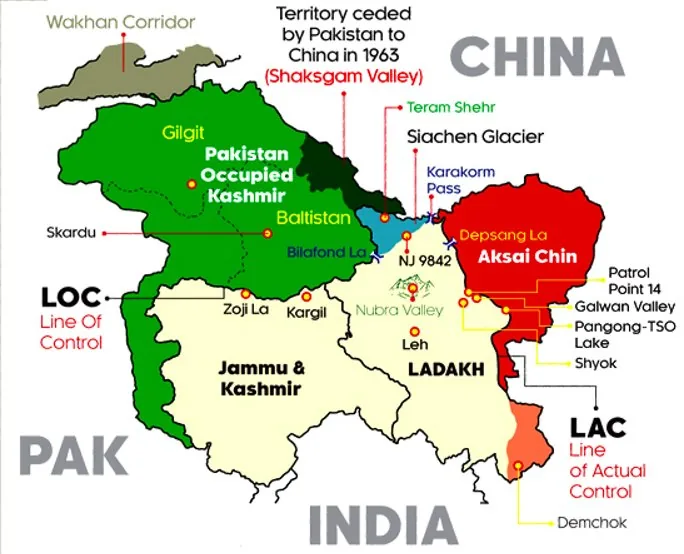
Source India has rejected the newly operationalised Pakistan–China Boundary Joint Commission, stating that it has no legal basis and reiterating its position that there is no legally recognised Pakistan–China boundary in the territory concerned.- About: Pakistan and China operationalised the Commission in September 2026, with its inaugural meeting held in Islamabad. It is envisaged as a coordination mechanism for border management, joint surveys, trade flows and people-to-people connectivity.
- Origin: The Commission stems from the 2013 Pakistan–China Agreement on the Boundary Management System. Article 45 provides for a joint commission to oversee implementation of border-management arrangements.
- India’s Position: The Ministry of External Affairs reiterated that the Union Territories of Jammu & Kashmir and Ladakh are integral and inalienable parts of India and that Pakistan has no locus standi to enter into arrangements concerning territory that India considers under Pakistan’s illegal occupation.
- 1963 China–Pakistan Boundary Agreement: India has never recognised the 1963 agreement, under which Pakistan transferred approximately 5,180 sq km of the Shaksgam Valley (Trans-Karakoram Tract) to China. India maintains that the agreement is illegal and invalid because the territory is Indian territory under Pakistani occupation.
- Aksai Chin: India considers Aksai Chin as part of Ladakh, while China claims it as part of Hotan County in Xinjiang. China constructed a highway in the 1950s connecting Xinjiang and Tibet through Aksai Chin, becoming a major factor in India–China tensions.
- Opposition to CPEC: The boundary is important for connectivity through the Khunjerab crossing and the China–Pakistan Economic Corridor (CPEC). India opposes CPEC because parts of the corridor pass through Pakistan-occupied Kashmir, territory claimed by India.
Schemes & Initiatives
3 Years of PM Vishwakarma Scheme
Source Why in News?- The PM Vishwakarma Scheme completed three years of its implementation in September 2026. To mark this milestone, the Ministry of Micro, Small and Medium Enterprises (MSME) celebrated its third anniversary, highlighting the successful registration of its targeted 30 lakh traditional artisans and craftspeople across the country.
- About:
- Launched in 2023, the scheme is built around the three pillars of Samman (Respect), Samarthya (Capability), and Samriddhi (Prosperity).
- It aims to strengthen the Guru-Shishya parampara (family-based practice of traditional skills) by providing end-to-end support to artisans working in the unorganized sector.
- Nature of Scheme: It is a Central Sector Scheme with a financial outlay of Rs 13,000 crore, fully funded by the Union Government for a five-year period from FY 2023-24 to FY 2027-28.
- Nodal Ministries: It is jointly implemented by the Ministry of Micro, Small and Medium Enterprises (MSME), the Ministry of Skill Development and Entrepreneurship, and the Department of Financial Services (Ministry of Finance).
- Eligible Applicants:
- PM Vishwakarma covers artisans and craftspeople aged 18 years or above engaged in any of the 18 notified traditional trades, working with their hands and tools in the unorganised sector on a self-employment basis.
- Applicants must not have availed similar government self-employment loans in the previous 5 years, and benefits are limited to one family member. Government employees and their family members are excluded.
- However, beneficiaries of MUDRA and PM SVANidhi who have fully repaid their loans are eligible.
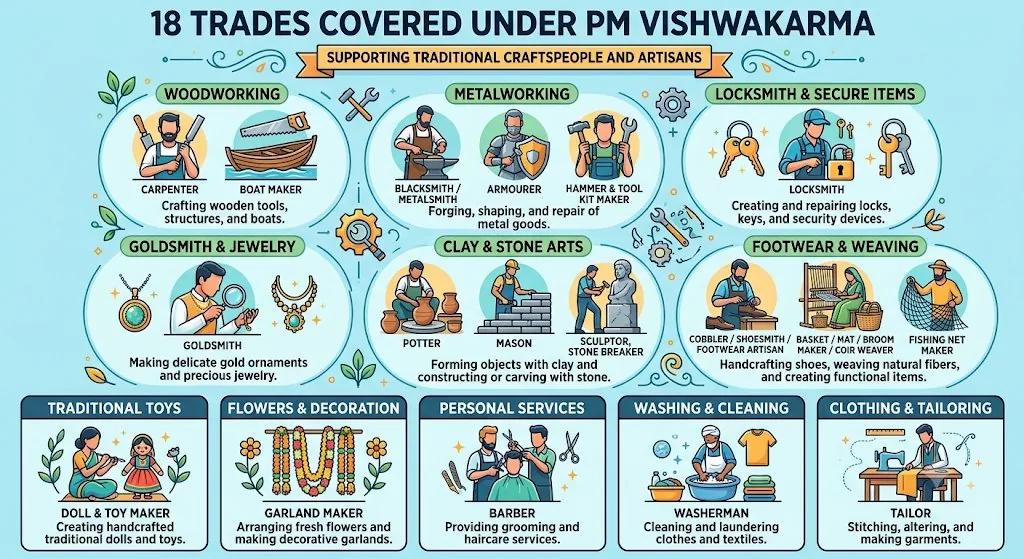 Key Features and Components
- Recognition: Beneficiaries are formally recognized through a PM Vishwakarma Certificate and ID Card.
- Skill Upgradation: Artisans undergo Basic Training (5-7 days) and Advanced Training (15 days or more), during which they receive a stipend of Rs 500 per day.
- Toolkit Incentive: An e-voucher or incentive of up to Rs 15,000 is provided for the purchase of modern tools.
- Credit Support:
- Collateral-free Enterprise Development Loans are offered up to Rs 3 lakh in two tranches (Rs 1 lakh for 18 months, and Rs 2 lakh for 30 months).
- These loans carry a concessional interest rate of 5%, with the government bearing an interest subvention of up to 8%.
- Incentives for Digital Transactions: To promote the digital economy, artisans receive an incentive of Rs 1 per eligible digital payout or receipt, capped at 100 transactions per month.
- Marketing Support: The scheme facilitates integration with domestic and global value chains through e-commerce onboarding (Government e-Marketplace (GeM), Open Network for Digital Commerce, Amazon), trade fairs, branding, and packaging support.
- Registration Target Achieved: Reached the target of 30 lakh verified beneficiaries.
- Skill & Tool Upgradation: Over 24.37 lakh artisans have completed basic skill training, and 18.15 lakh modern toolkits have been delivered directly to beneficiaries via India Post.
- Financial Inclusion: Over 6.18 lakh collateral-free loans amounting to nearly Rs 5,300 crore have been sanctioned.
- Market Linkages:
- More than 30,000 beneficiaries have been successfully onboarded onto e-commerce platforms.
- Specialized initiatives have also been undertaken, such as integrating Divyangjan (differently-abled) artisans via the ‘One Station One Product’ (OSOP) scheme across railway stations and airports.
- Hospitality and Tribal Platforms: PM Vishwakarma craft stalls have been integrated into star-category hotels and luxury resorts (e.g., Taj, Radisson) across states like Goa, Gujarat, and Bihar, while partnerships with TRIFED have linked tribal artisans to Tribes India networks.
- Formalization of the Informal Economy: By mandating digital transactions, basic bank accounts, and formal enterprise loans, it integrates unorganized sector workers into the formal national economic framework.
- Socio-Economic Upliftment: Traditional trades are predominantly practiced by marginalized communities (SC, ST, OBCs) and rural families. The scheme directly tackles rural poverty and builds sustainable grassroots livelihoods.
- Preservation of Heritage: It prevents the extinction of indigenous crafts and heritage skills by making them economically viable for the younger generations through modern tech and marketing interventions.
- Productivity Enhancement: The shift from rudimentary tools to modern toolkits enhances efficiency, product quality, and earning potential, bridging the gap between ancient craftsmanship and contemporary market demands.
- PM Vishwakarma integrates traditional occupations into a national support framework while preserving their local, family-based character. By strengthening the Guru-Shishya tradition, supporting artisans across the value chain, and improving livelihood opportunities, the scheme seeks to preserve traditional skills and sustain their relevance in a changing economy.
Pradhan Mantri Bhartiya Janaushadhi Pariyojana (PMBJP)
Source Why in News?- The Government is expanding the scope of the Pradhan Mantri Bhartiya Janaushadhi Pariyojana (PMBJP) beyond affordable medicines by introducing a wider healthcare basket of surgical products, medical consumables, healthcare devices and supportive-care products.
- With a network of over 20,000 Jan Aushadhi Kendras (JAKs), PMBJP aims to provide affordable healthcare solutions for different stages of life, from infant and maternal care to disease monitoring, recovery and elderly care.
- About: The Pradhan Mantri Bhartiya Janaushadhi Pariyojana (PMBJP) is a government initiative aimed at providing quality-assured generic medicines at significantly lower prices through a nationwide network of Jan Aushadhi Kendras (JAKs).
- Coverage:
- Over 18,000 Jan Aushadhi Kendras are operational, offering 2,110 medicines and 315 surgical items, medical consumables and devices across major therapeutic categories.
- During 2021–22 to 2025–26, Pradhan Mantri Bhartiya Janaushadhi Pariyojana (PMBJP) recorded ₹7,873.85 crore in sales through Jan Aushadhi Kendras, generating estimated savings of around ₹37,200 crore for citizens.
- Quality Assurance: Medicines are procured from manufacturers compliant with the World Health Organization–Good Manufacturing Practices (WHO-GMP) and tested at laboratories accredited by the National Accreditation Board for Testing and Calibration Laboratories (NABL).
- Affordability: Medicines available under the scheme are generally 50–80% cheaper than comparable branded medicines, helping reduce household healthcare expenditure.
- Expansion Target: The Government aims to establish 25,000 Jan Aushadhi Kendras by March 2027, including in rural and remote areas, through a franchise-based model.
- Citizen-Centric Initiatives: Janaushadhi Suvidha Oxo-biodegradable Sanitary Napkins, available at ₹1 per pad, promote affordable menstrual hygiene, while the Jan Aushadhi Sugam mobile application helps users locate nearby Kendras, check medicine availability and compare prices.
- Inclusive Entrepreneurship: Special incentives are provided to women, persons with disabilities (Divyangjan), Scheduled Castes (SCs), Scheduled Tribes (STs) and entrepreneurs establishing Kendras in specified disadvantaged regions.
- Significance: The scheme promotes affordable and equitable healthcare, reduces out-of-pocket expenditure and improves access to quality generic medicines across India.
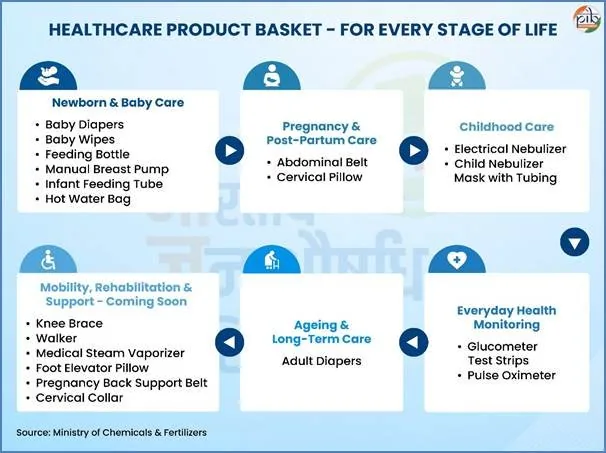 Conclusion
- The Pradhan Mantri Bhartiya Janaushadhi Pariyojana (PMBJP) is expanding its affordable healthcare framework beyond medicines to include surgical products, medical devices, consumables and supportive-care products. By widening its product basket and expanding access through Jan Aushadhi Kendras, the scheme seeks to make essential healthcare products more accessible and affordable across different stages of life.
Pradhan Mantri Awas Yojana–Urban (PMAY-U)
Source Why in News?- The Pradhan Mantri Awas Yojana–Urban (PMAY-U) continues to strengthen India’s urban housing mission by providing affordable pucca houses with basic amenities to eligible urban households.
- About: Pradhan Mantri Awas Yojana–Urban (PMAY-U) was launched in June 2015 to promote affordable housing and achieve “Housing for All” in urban areas by providing all-weather pucca houses with basic civic amenities to eligible households.
- Target Beneficiaries: The Mission primarily addresses the housing needs of slum dwellers, Economically Weaker Sections (EWS), Low Income Groups (LIG) and Middle-Income Groups (MIG).
- Implementation: The Central Government provides assistance to States and Union Territories for the construction and delivery of affordable housing.
- Mission Period: Originally implemented up to March 2022, PMAY-U was extended until 30th September 2026 to facilitate completion of already sanctioned projects.
- Beneficiary Family: A beneficiary family comprises husband, wife and unmarried sons/daughters and should not own a pucca house anywhere in India in the name of any family member. An adult earning member, irrespective of marital status, may be treated as a separate household if they do not own a pucca house.
- Benefit Conditions: For a married couple, either spouse or both jointly can avail a single house, subject to household income eligibility. An eligible beneficiary can receive assistance under only one of the Mission’s four verticals.
- House Upgradation: Individuals having a pucca house below 21 sq. m. may be considered for expansion up to 30 sq. m.; if expansion is infeasible due to land or other constraints, they may receive a house elsewhere under PMAY-U.
-
PMAY-U 2.0
- PMAY-U 2.0: Launched in September 2024 as the next phase of the Pradhan Mantri Awas Yojana–Urban (PMAY-U), it builds on the earlier mission experience and aims to provide housing support to 1 crore additional urban poor and middle-class families during 2024–2029.
- Financial Assistance: Eligible beneficiaries receive assistance of up to ₹2.50 lakh per unit for construction or purchase of affordable houses. The scheme also promotes affordable rental housing to address diverse urban housing needs.
- Eligibility Criteria:
- PMAY-U 2.0 covers Economically Weaker Sections (EWS), Low Income Groups (LIG) and Middle-Income Groups (MIG) with annual household income limits:
- EWS: Annual income up to ₹3 lakh.
- LIG: Annual income between ₹3–6 lakh.
- MIG: Annual income between ₹6–9 lakh.
- PMAY-U 2.0 covers Economically Weaker Sections (EWS), Low Income Groups (LIG) and Middle-Income Groups (MIG) with annual household income limits:
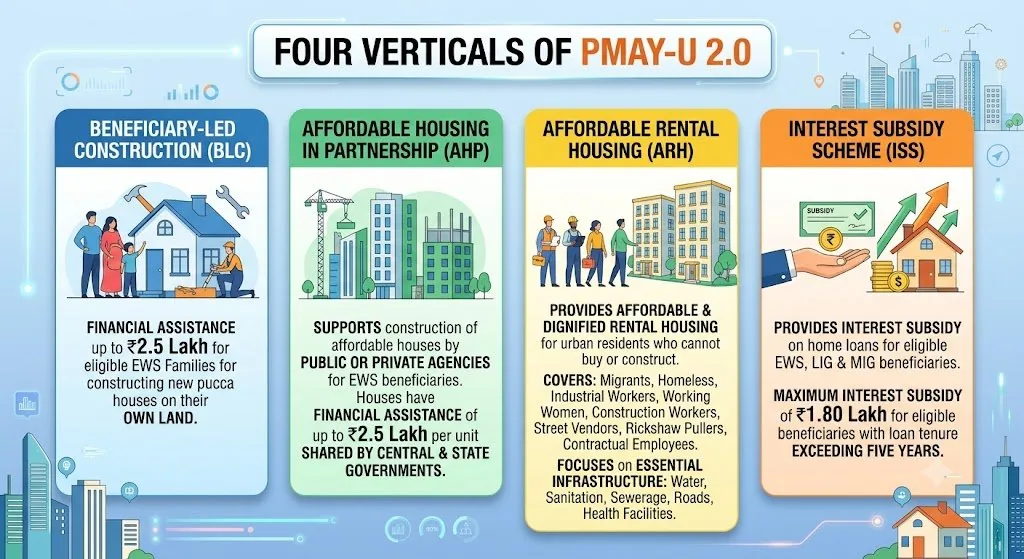
- Key Achievements: PMAY-U has significantly expanded affordable urban housing access. While earlier schemes (2005–2014) completed around 8 lakh urban houses, PMAY-U and PMAY-U 2.0 have sanctioned 1.25 crore houses as of 9th August 2026, of which more than 1 crore houses have been completed and delivered to beneficiaries.
- Women-Centric Housing: PMAY-U promotes women’s empowerment through ownership or co-ownership of houses in the name of women beneficiaries. Out of the 1.25 crore sanctioned houses, around 1 crore houses have been allotted to women either in the name of the female head of the household or through joint ownership.
- Inclusive Urban Housing: The Mission prioritises vulnerable groups including SCs, STs, OBCs, minorities, senior citizens, persons with disabilities and transgender persons, ensuring more equitable access to urban housing.
- Digital Monitoring: PMAY-U uses digital dashboards, geo-tagging and integrated monitoring systems to strengthen transparency, accountability and project monitoring.
- Unified Web Portal: The PMAY-U 2.0 Unified Web Portal provides a single platform for beneficiary applications, processing, tracking, geo-tagging and fund disbursement, connecting beneficiaries, Urban Local Bodies (ULBs), States/Union Territories and implementing agencies.
- PMAY-U Dashboard: Provides real-time information on key performance indicators, enabling stakeholders to monitor implementation and support data-driven decision-making.
- Geo-tagging: Housing projects are monitored through five stages—grounding, foundation, superstructure, finishing and external development, and completion—to track progress and quality.
- Technology Sub-Mission (TSM): Promotes modern, green, innovative and disaster-resilient construction technologies. Under the Global Housing Technology Challenge–India (GHTC-India), 54 proven technologies were shortlisted and six Light House Projects (LHPs) were constructed using six distinct technologies.
- Technology and Innovation Sub-Mission (TISM): Under PMAY-U 2.0, it promotes innovative designs, quality assurance, green building standards and climate-responsive housing suited to different geo-climatic zones.
- Technology Innovation Grant (TIG): Provides additional support to Affordable Housing in Partnership (AHP) projects adopting innovative and alternative construction technologies recognised under GHTC-India.
- PMAY-U represents a shift from viewing housing merely as shelter towards recognising it as a foundation of dignity, inclusion and empowerment. Through PMAY-U 2.0, technology-enabled monitoring, women-centric ownership and innovative construction practices, the mission continues to advance the goal of Housing for All and promote inclusive urban development in India.
Wildlife
Pygmy Hog
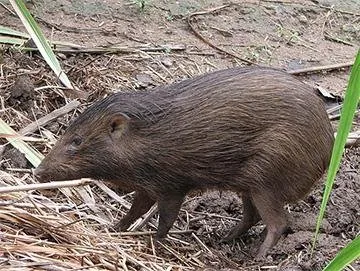
Source The Assam government recently highlighted the success of the Pygmy Hog Conservation Programme, which has increased the pygmy hog population in the State significantly over the last three decades. Pygmy Hog- About: The pygmy hog (Porcula salvinia) is the world’s smallest wild suid and the only surviving species of the genus Porcula. It is an endemic species of the Indian subcontinent and is closely associated with tall, wet alluvial grasslands of the Himalayan foothills.
- Distribution: Historically, it was found from Uttar Pradesh to Assam, including Nepal’s Terai and Bengal’s Duars. After remaining unreported for decades and being feared extinct, the pygmy hog was rediscovered in 1971 in Assam, with its surviving wild populations now mainly restricted to Assam, especially the Manas landscape.
- Physical Features: It is the smallest member of the pig family (Suidae), characterised by an extremely small body, ears and tail, short medial false hooves, a streamlined body shape, and absence of facial warts found in many other pigs.
- Habitat:
- The pygmy hog inhabits undisturbed tall grasslands of riverine ecosystems, comprising dense grasses, herbs, shrubs and young trees.
- Its fertile alluvial grassland habitat is highly vulnerable to agricultural expansion and human settlement, leading to habitat loss. It serves as an indicator species of healthy tall grassland ecosystems.
- Diet: It is an omnivorous species feeding on roots, tubers, shoots, ground vegetation, worms, invertebrates and occasionally small vertebrates such as reptiles and eggs/nestlings of ground-nesting birds.
- Social Organisation: Adult males are generally solitary, while females and juveniles live in small family groups of about 4–6 individuals; males associate with females mainly during the breeding season.
- Reproduction: Breeding is highly seasonal, with births peaking during late April–May with the onset of monsoon in Assam. Litter size ranges from 2–6 piglets (usually 3–4), and both sexes construct nests throughout the year.
- Conservation Status:
- IUCN Red List : Endangered
- CITES : Appendix I
- Wildlife (Protection) Act, 1972: Schedule I
- Conservation Efforts: The Pygmy Hog Conservation Programme (PHCP) was initiated in 1995, with major captive breeding efforts beginning in 1996. The programme focuses on captive breeding, disease prevention and reintroduction.
- Significance: Conservation of pygmy hog habitat supports other threatened grassland species such as Bengal florican, hispid hare, hog deer and greater one-horned rhinoceros.