> ## Documentation Index
> Fetch the complete documentation index at: https://signals.joincomrades.com/llms.txt
> Use this file to discover all available pages before exploring further.
# 19 Sep 2026 · Dispatch
> Comrades Dispatch of 19 Sep 2026, by news group.
> **[Comrades Dispatch · 19 Sep 2026 (PDF)](https://dl.joincomrades.com/d/19-09-26)**
***
## In this edition
1. [India’s 1st Soil Carbon Payments Initiative](#h-1) Agriculture & Rural
2. [Real-World Asset Tokenisation](#h-2) Banking & Finance
3. [Advisory on Regulation of Stem Cell Therapy](#h-3) Health & Medicine
4. [Hyderabad Liberation Day](#h-4) Important Days
5. [Deep-Sea Mining: Balancing Mineral Security with Conservation](#h-5) Infrastructure & Energy
6. [Definition of Census Town](#h-6) Polity & Governance
7. [Pradhan Mantri Khanij Kshetra Kalyan Yojana (PMKKKY)](#h-7) Schemes & Initiatives
8. [Sumatran Elephants](#h-8) Wildlife
## Agriculture & Rural
### India’s 1st Soil Carbon Payments Initiative
[Source](https://www.drishtiias.com/current-affairs-news-analysis-editorials/news-analysis/19-09-2026#37523)
Recently, India’s agricultural carbon market reached the farm level as more than 2,500 smallholder farmers in Punjab and Haryana received digital payments for adopting regenerative agricultural practices under the ‘Aadi’ farmer carbon programme.
* **About the Initiative:** The ‘Aadi’ programme was launched in 2019 by Grow Indigo with technical guidance from Indian Council of Agricultural Research (ICAR) to link sustainable farming practices with additional farmer income.
* **Farming Practices:**
* Farmers adopted regenerative practices such as Direct Seeded Rice (DSR), reduced tillage, and crop residue management between 2019 and 2022 to improve soil health and reduce greenhouse-gas emissions.
* Farmers received payments based on their share of carbon credits generated from their fields, with the first payments ranging between ₹3,000 and ₹15,000.
* **Carbon Credit Generation:** The greenhouse-gas reductions and increases in soil carbon were scientifically measured and independently verified before carbon credits were issued under the Verra VM0042 methodology.
* **Scale of Programme:** The initiative covers over two million acres and more than 100,000 farmers across seven states, making it one of India’s major agricultural carbon programmes.
* **Environmental Benefits:** The programme estimates that regenerative practices helped save 45 billion litres of water, prevented more than two lakh tonnes of crop residue burning, and avoided around 1,000 tonnes of PM2.5 emissions.
* **Significance:** The initiative connects scientific research, carbon markets, and farmer incentives, showing how regenerative agriculture can support higher farmer incomes, soil improvement, resource conservation, and climate-resilient farming.
## Banking & Finance
### Real-World Asset Tokenisation
[Source](https://www.drishtiias.com/current-affairs-news-analysis-editorials/news-analysis/19-09-2026#37526)
**Why in News?**
* The Government of Maharashtra has proposed the Digitisation and Exchange of Land Token Assets (DELTA) Act to establish a state-backed legal framework for Real-World Asset (RWA) tokenisation. The Act aims to make Maharashtra India’s first “tokenised State” by converting physical assets such as land into secure and tradable digital tokens.
* With land serving as one of India's largest yet most illiquid repositories of wealth, the initiative marks a major milestone in linking physical property to formal financial markets.
**What is Real World Asset (RWA) Tokenisation?**
* **About:** RWA Tokenisation uses blockchain and distributed ledger technology (DLT) to convert the ownership, rights, or economic value of physical assets (like real estate) into secure, verifiable digital tokens.
* **Fractional Ownership:** Tokens can represent fractions of an asset. This reduces capital barriers, allowing retail and institutional investors to own pieces of high-value real estate that would normally be out of reach.
* **Reserve Bank of India (RBI) and RWA:**
* The RBI views RWA tokenisation as a technological layer to enhance market efficiency, rather than a substitute for regulated finance.
* RBI and SEBI recently launched "Demat 2.0" to issue tokenised corporate bonds via DLT. It enables instant "atomic" settlement using the RBI's wholesale digital rupee (e₹) through the Unified Market Interface (UMI).
* **Contrast with SEBI’s SM REITs:** While SEBI has introduced Small and Medium Real Estate Investment Trusts (SM REITs) to fractionalise real estate through a highly regulated trust structure, blockchain tokenisation decentralises the ledger entirely, theoretically lowering intermediary costs even further.
* **Significance:**
* **Frictionless Transactions:** By moving asset transfers to a digital ledger, tokenisation provides transparent ownership histories, speeds up verification, automates compliance, and reduces fraud - similar to what Unified Payments Interface (UPI) achieved for digital payments.
* **Unlocking Capital:**
* Land is one of India's largest wealth repositories, yet a substantial portion remains economically locked due to slow transactions and complex documentation.
* With Indian household real estate wealth standing at roughly Rs 500 lakh crore, tokenising even a modest 5%–10% of this asset base can unlock between Rs 25 lakh crore and Rs 50 lakh crore in liquid, digitally tradable capital, bridging dormant physical wealth directly with institutional and retail financial markets.
* Tokenisation acts as a financial bridge connecting these physical assets directly with capital markets.
**How has India's Land Administration Evolved Digitally?**
* **Computerisation of Legacy Records:** Through the Digital India Land Records Modernization Programme (DILRMP), India has systematically digitized textual land records, cadastral maps, and the property registration process across the country.
* **Unique Land Parcel Identification Number (ULPIN):** Often referred to as "Bhu-Aadhaar," ULPIN assigns a 14-digit alphanumeric geo-referenced ID to every land parcel, ensuring robust traceability and preventing fraudulent transactions.
* **Drone-Assisted Mapping:** The SVAMITVA Scheme utilizes drone technology to map inhabited rural areas, granting formal, legal property cards to village households and integrating rural assets into the formal financial system.
* **Cloud-based Integrated Registries:** States are adopting artificial intelligence (AI) and cloud-based platforms like the National Generic Document Registration System (NGDRS) to create tamper-proof, real-time land information systems, creating the necessary digital infrastructure for tokenisation.
What are the Key Challenges of Real World Asset (RWA) Tokenisation in India?
* **Conflict with Existing Property Laws:**
* Laws such as the Registration Act, 1908 require formal registration of property transfers.
* A blockchain token by itself is not currently a legally recognised substitute for a registered property deed.
* Blockchain smart contracts can automatically execute transactions, but courts may order a property transfer to be stopped or frozen during litigation. This creates a conflict between automatic blockchain execution and judicial intervention.
* The Indian Contract Act, 1872 recognises contracts based on consent and enforceability, but it does not specifically address self-executing blockchain-based smart contracts, creating legal uncertainty.
* **Stamp Duty Issues:**
* Property transfers attract stamp duty, but tokenisation allows fractional and repeated digital transfers of an asset.
* It is therefore unclear how stamp duty should be calculated and collected for every token transaction.
* **Centre-State Regulatory Overlap:**
* Land is a State subject, while financial instruments and securities are regulated mainly by central authorities such as SEBI and RBI.
* Tokenised land could therefore fall between different regulatory jurisdictions.
* **Presumptive vs. Conclusive Title:**
* Indian land records generally provide presumptive rather than conclusive title.
* Tokenising a defective or disputed title under the current system merely digitises and multiplies litigation, exposing multiple retail investors to fraud.
* **Taxation Uncertainty:** Existing Virtual Digital Asset (VDA) taxation rules do not clearly distinguish between speculative crypto assets and asset-backed RWA tokens, creating uncertainty over their tax treatment.
* **Irreversibility of Blockchain Transactions:**
* Blockchain transactions are often difficult to reverse.
* Lost private keys, fraud, court-ordered seizure or erroneous transfers can therefore create recovery problems.
* **Consumer Protection:** Investors may be exposed to fraudulent or inadequately backed tokens if there are no strong requirements to verify that every token is actually backed by the claimed physical asset.
* **Privacy Concerns:**
* Public blockchains can permanently record transaction-related information, creating potential tension with data minimisation and other privacy principles under the DPDP Act, 2023.
* A blockchain-based ownership model is vulnerable to cyber threats. It requires institutional-grade security architecture to prevent hacking, data manipulation, and fraud.
What Measures can Enable Safe and Effective RWA Tokenisation in India?
* **Create a Unified Regulatory Framework:**
* The Centre and States should jointly establish clear rules for tokenised assets. These rules should clarify how land ownership under State laws will connect with digital tokens regulated by SEBI/RBI, preventing conflicting regulations.
* Only assets with verified and dispute-free ownership records should be tokenised.
* Every RWA token should have clearly verified underlying assets, transparent ownership records, disclosure requirements and mechanisms for resolving disputes, fraud and loss of digital keys.
* **Use Maharashtra as a Pilot Model:** The success and legal rigors of the DELTA Act could provide a vital blueprint. States with large real estate markets such as Karnataka, Tamil Nadu, and Delhi could adopt similar frameworks to unlock India’s massive household wealth.
* **Leveraging Digital Public Infrastructure (DPI):** India should deeply integrate its RWA tokenisation ecosystem with its existing, world-class DPIs (like UPI and Account Aggregators) to ensure seamless interoperability, identity verification, and secure financial settlements.
* **Expanding Asset Classes:** Once a framework for real estate is proven, India can scale RWA tokenisation into digitized debt markets, privately held gold, agricultural commodities, and carbon credits, fundamentally deepening the country's capital markets.
* **Centralised Stamp Duty Collection Mechanism:** States can replicate the framework of the amended Indian Stamp Act, 1899 (where stamp duty on dematerialised securities is collected centrally via stock exchanges and depositories, and then disbursed back to the states).
**International Best Practices**
* **Switzerland:** Created legal certainty by recognising digital records and DLT -based financial market infrastructure, supporting regulated tokenisation.
* **Singapore:** Adopted a cautious, innovation-friendly approach through Project Guardian, testing tokenised bonds, funds and foreign exchange, mainly for institutional investors.
* **Hong Kong:** Through Project Ensemble, is exploring tokenised deposits and asset settlement, alongside pilots for tokenised bonds.
* **UAE:** Follows a more aggressive innovation-led approach, using regulatory sandboxes and dedicated virtual-asset frameworks.
* **European Union:** Established a structured regulatory framework through Markets in Crypto Assets (MiCA) and the DLT Pilot Regime for crypto-assets and blockchain-based financial infrastructure.
* **United Kingdom:** Uses the Digital Securities Sandbox to allow firms to test blockchain-based issuance and settlement of securities under controlled conditions.
## Health & Medicine
### Advisory on Regulation of Stem Cell Therapy
[Source](https://www.drishtiias.com/current-affairs-news-analysis-editorials/news-analysis/19-09-2026#37524)
**Why in News?**
* The Union Ministry of Health and Family Welfare issued a comprehensive advisory to all States and Union Territories to strictly regulate stem cell therapy, mandating that it can be offered as a standard clinical care only for specific disease conditions approved by the Ministry.
* The advisory was issued in compliance with the Supreme Court’s January 2026 judgment in the Yash Charitable Trust & Ors. v. Union of India case, which underscored the need to penalize the unauthorized and unscientific use of stem cell therapies.
What are the Key Highlights of the Advisory on Regulation of Stem Cell Therapy?
* **Standard Care vs. Experimental Therapy:** Stem cell therapy can be offered as standard care in routine clinical practice only for disease conditions and indications included in the Ministry-approved list (e.g., specific blood cancers and haematologic disorders).
* **Restrictions on Autism Spectrum Disorder (ASD):**
* The therapeutic use of any type of stem cell for ASD is explicitly restricted to approved clinical trials.
* Unproven stem cell interventions for ASD must not be marketed as standard commercial treatments.
* **Compliance with Guidelines:** Any clinical trial involving stem cells must strictly adhere to the National Guidelines for Stem Cell Research, 2017, jointly issued by the Indian Council of Medical Research (ICMR) and the Department of Biotechnology (DBT).
* **Penalties for Non-Compliance:**
* The National Medical Commission (NMC) reiterated that unauthorized administration, promotion, or advertisement of stem cell therapy beyond approved indications constitutes professional misconduct under the Indian Medical Council (IMC) Regulations, 2002.
* Violators will face disciplinary action from State Medical Councils.
* Establishments may face penalties and cancellation of registration under Sections 32 and 40 of the Clinical Establishments (Registration and Regulation) Act, 2010.
**What is Stem Cell Therapy?**
* **About:**
* Stem cell therapy, often referred to as regenerative medicine, is a clinical treatment that utilizes stem cells or their derivatives to promote the repair, regeneration, or replacement of diseased, dysfunctional, or injured tissues.
* Instead of just treating symptoms with conventional drugs, it harnesses the body's natural cellular healing capabilities.
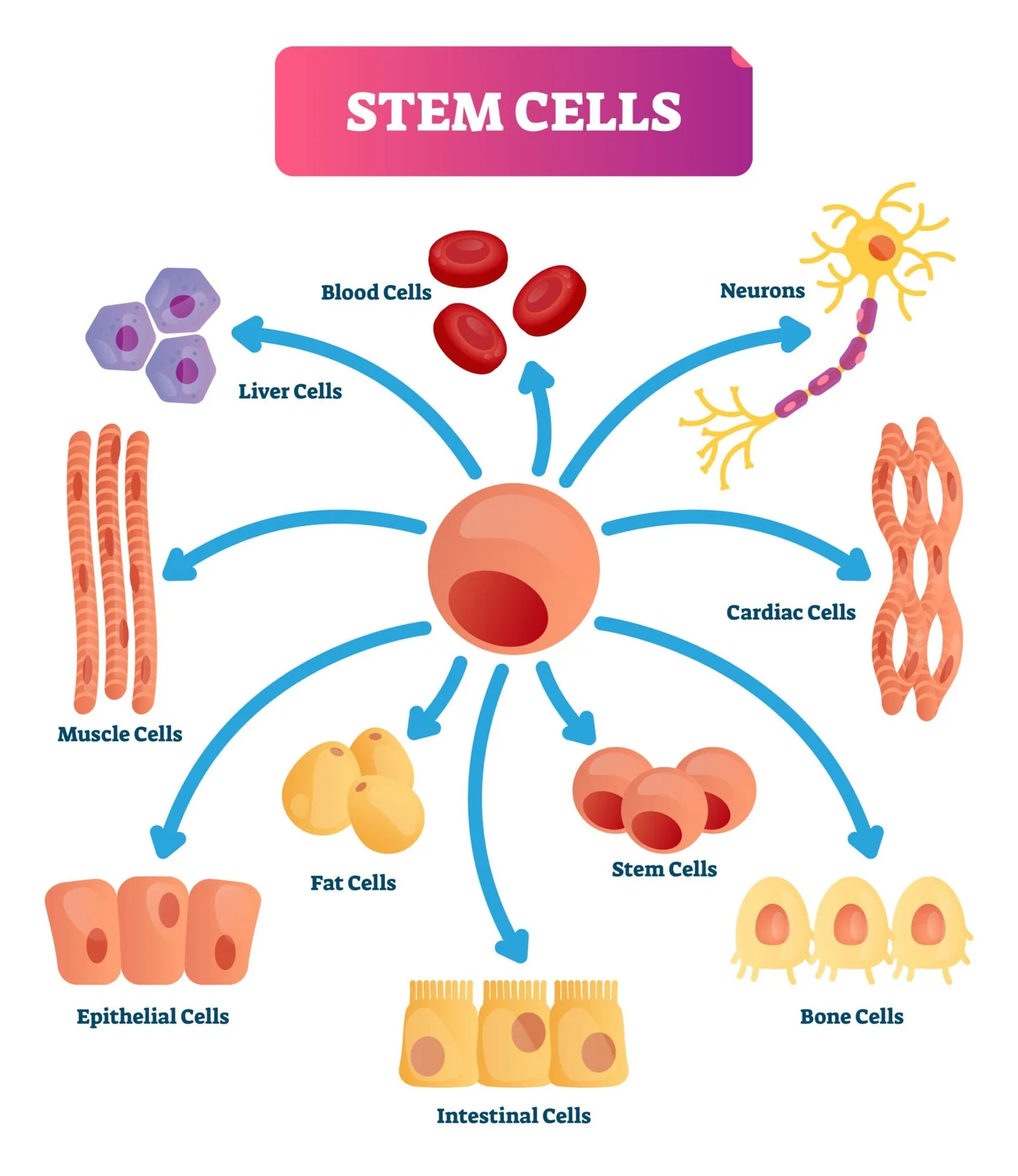
* **Stem Cells:** Stem cells are the body's foundational "raw materials." Unlike specialized cells (such as skin, muscle, or nerve cells) that have a single fixed purpose, stem cells are undifferentiated master cells from which all other functional cells are generated.
* **Core Characteristics:**
* Stem cells are defined by two unique biological properties:
* **Self-Renewal:** The ability to continuously divide and create exact copies of themselves, maintaining a lifelong reserve pool of healthy cells.
* **Differentiation:** The capacity to mature and transform into various specialized cell types in response to physiological signals and tissue demands.
* **Types of Stem Cells:**
* **Embryonic Stem Cells:** Pluripotent cells derived from embryos that can divide into more stem cells or become any type of cell in the body.
* **Adult Stem Cells:**
* Found in small numbers in most adult tissues (like bone marrow or fat).
* They are typically multipotent, meaning they can only differentiate into a limited number of cell types.
* **Induced Pluripotent Stem Cells (iPSCs):** Adult cells that have been genetically reprogrammed to behave like embryonic stem cells.
* **Perinatal Stem Cells:** Multipotent cells harvested from childbirth-associated tissues, including the placenta, umbilical cord blood, and amniotic fluid.
* **Working Mechanism:**
* The Stem Cell Therapy process involves harvesting stem cells from the patient (autologous) or a donor (allogeneic), processing them, and administering them through infusion, injection, or implantation.
* Once introduced, the cells home to injured tissues, differentiate into needed cell types, and release growth factors and cytokines that reduce inflammation and stimulate the body’s natural repair mechanisms.
* **Current Clinical Landscape:**
* **Established Medicine:** Haematopoietic stem-cell transplantation (bone marrow transplant) is a globally accepted and established treatment for certain blood cancers (like Leukemia) and serious blood disorders (like Thalassemia).
* **Experimental Medicine:** Using stem cells for neurological conditions (like Autism, Alzheimer’s, or Parkinson’s) is still highly experimental.
* **Key Concerns & Risks:**
* Stem cell therapy carries risks including tumour formation, unintended cell differentiation and immune complications.
* Embryonic stem-cell research raises ethical concerns, while unregulated clinics may expose patients to serious complications such as infections, embolisms and neurological damage.
**Regulatory Framework for Stem Cells in India**
* **National Guidelines for Stem Cell Research (NGSCR) 2017:** Provides the ethical and scientific framework for stem cell research, categorizing it into permitted, restricted, and prohibited areas.
* **Drugs and Cosmetics Act, 1940 & New Drugs and Clinical Trials Rules, 2019:** Stem cell-derived products (SCDPs) are classified as "New Drugs" and require mandatory approval from the Central Drugs Standard Control Organisation (CDSCO) before commercialization.
* **Clinical Establishments Act, 2010:**
* Regulates hospitals and clinics, ensuring they adhere to minimum standards of facilities and services.
* The Health Ministry’s advisory relies on this Act to mandate registration cancellations for rogue clinics.
## Important Days
### Hyderabad Liberation Day
[Source](https://www.drishtiias.com/current-affairs-news-analysis-editorials/news-analysis/19-09-2026#37527)
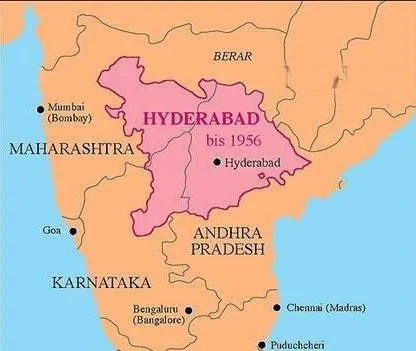
Recetly, the Hyderabad Liberation Day was commemorated on 17th September, marking the integration of the erstwhile Hyderabad State with India in 1948.
* **Background:** Before independence, Hyderabad was one of the largest princely states in India, comprising present-day Telangana and parts of Karnataka and Maharashtra. It was ruled by Nizam Mir Osman Ali Khan (Asaf Jah VII), who sought to maintain an independent status after British withdrawal.
* **Nizam’s Independence Demand (1947):**
* Unlike most princely states that joined India or Pakistan, the Nizam of Hyderabad did not accede to India in August 1947 and explored the possibility of remaining independent.
* India and Hyderabad later signed a Standstill Agreement in November 1947 to continue existing relations.
* **Moves Towards Independence:** The Nizam strengthened Hyderabad’s military, restricted Indian currency, imported arms from Pakistan and expanded the Razakars militia with support from Ittehad-ul-Muslimeen.
* **Role of Razakars:** Led by Qasim Razvi, the Razakars opposed Hyderabad’s integration with India and were involved in violent suppression of political opponents and pro-integration groups.
* **Internal Agitations:** Hyderabad faced the Communist uprising in Telangana and the Hyderabad State Congress movement, both challenging the Nizam’s rule and demanding reforms/integration.
* **International Appeals:** The Nizam sought support from Britain, the USA and the United Nations, including appeals to the UN Security Council and International Court of Justice in 1948, but diplomatic efforts failed.
* **India’s Diplomatic Efforts:** Sardar Vallabhbhai Patel initially pursued negotiations for Hyderabad’s accession, seeking a peaceful settlement while maintaining India’s territorial and national interests.
* **Operation Polo (1948):** On 13th September 1948, the Indian Army launched Operation Polo, a military action to integrate Hyderabad into India. Within three days, Hyderabad’s forces surrendered, and the Nizam announced the disbanding of the Razakars.
## Infrastructure & Energy
### Deep-Sea Mining: Balancing Mineral Security with Conservation
[Source](https://www.drishtiias.com/current-affairs-news-analysis-editorials/news-analysis/19-09-2026#37529)
**Why in News?**
* India’s growing focus on deep-sea exploration and seabed minerals has opened new opportunities for strategic mineral security, renewable energy, electric mobility and advanced manufacturing.
* However, the deep ocean remains scientifically less explored and ecologically sensitive, raising concerns over the environmental consequences of large-scale seabed disturbance.
**What is Deep-Sea Mining?**
* **Definition:** Deep-sea mining is the process of retrieving mineral deposits from the deep seabed (the ocean floor at depths greater than 200 meters).
* **Targeted Resources:**
* **Polymetallic Nodules:** Potato-sized concretions lying on abyssal plains containing valuable metals like manganese, nickel, cobalt, and copper.
* **Polymetallic Sulphides:** Found predominantly at hydrothermal vents.
* **Cobalt-rich Ferromanganese Crusts:** Located on the flanks of underwater mountains (seamounts).
* **Governing Legal Framework:**
* **UNCLOS:**
* The United Nations Convention on the Law of the Sea (1982) governs global maritime zones.
* The seabed lying beyond national jurisdiction (beyond a country's Exclusive Economic Zone) is termed 'The Area'.
* Under UNCLOS, 'The Area' is declared the "common heritage of mankind".
* **International Seabed Authority (ISA):** Headquartered in Kingston, Jamaica, this UN body administers 'The Area' and issues exploration and exploitation contracts.
**What are India's Deep-Sea Initiatives?**
* **National Mission for Deep Ocean Exploration (DOE):**
* The DOE is a national scientific mandate established in 2019 by the Prime Minister’s Science, Technology, and Innovation Advisory Council (PM-STIAC).
* It serves as one of 9 overarching advisory missions designed to set strategic scientific priorities for the country.
* **Deep Ocean Mission (DOM):**
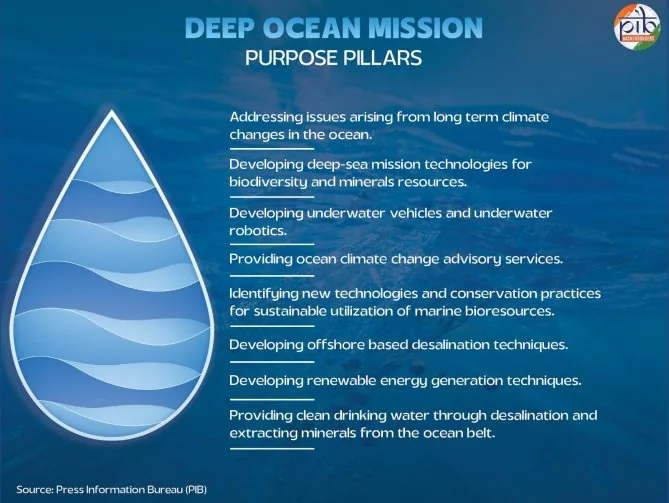
* Spearheaded by the Ministry of Earth Sciences (MoES) and approved by the Union Cabinet in 2021, the DOM is India's flagship initiative executed to fulfill the DOE mandate.
* It aims to explore the depths of the ocean for resources and develop sustainable deep-sea technologies. The mission is a central pillar of the Government of India's "New India 2030" vision, which identifies the Blue Economy as a core dimension of national growth.
* **Samudrayaan Project:**
* It is a component of DOM, under Samudrayaan Project India is developing MATSYA-6000 - an indigenous manned submersible capable of carrying three humans (aquanuts) to a depth of 6,000 meters.
* This depth was strategically chosen because polymetallic nodules are generally found at around 5,000 meters in the Central Indian Ocean.
* **Seabed Mining Technology:** India’s National Institute of Ocean Technology (NIOT) has successfully conducted locomotion trials for its underwater mining system, 'Varaha', at depths of 5,270 meters.
* **Exploration Contracts:** India has 3 International Seabed Authority (ISA) exploration contracts: one for polymetallic nodules (PMN) in the Central Indian Ocean Basin (CIOB) and two for polymetallic sulphides (PMS) in the Central Indian Ridge (CIR) and Carlsberg Ridge regions.
* **Offshore Areas Mineral (Development and Regulation) Act (OAMDR) (amended in August, 2023):** Provides for development and regulation of mineral resources in the territorial waters, continental shelf, EEZ and other maritime zones of India.
**What are the Major Concerns Regarding Deep-Sea Mining?**
* **Seafloor Habitat Destruction:**
* Mining machines scrape the seabed, destroying benthic ecosystems.
* Slow-growing species such as deep-sea sponges and corals may take centuries or millennia to recover.
* **Sediment Plumes:** Mining creates large sediment clouds that can travel long distances, clog filter feeders and disrupt pelagic food webs.
* **Heavy-Metal Pollution:** Wastewater may release heavy metals and toxic substances, which can accumulate through the marine food chain and potentially affect seafood.
* **Noise and Light Pollution:** Mining machinery and vessels generate noise and vibrations, while artificial light can disrupt organisms dependent on bioluminescence.
* **Carbon-Sequestration Loss:** Disturbing deep-sea sediments may release stored carbon and reduce the ocean’s capacity to function as a carbon sink.
* **Regulatory and Governance Gaps:**
* The International Seabed Authority (ISA) has issued over 30 exploration contracts, it has not yet finalized the "Mining Code" , the comprehensive environmental and financial regulations required for commercial exploitation.
* In 2021, the Pacific island state of Nauru triggered a clause requiring the ISA to finalize its exploitation regulations within two years.
* The ISA is still developing regulations for commercial exploitation of seabed minerals, with debates continuing over environmental safeguards and financial rules.
* **Global Moratorium Demands:** Countries are sharply divided over deep-sea mining, with dozens urging a precautionary pause while major industrial economies and select nations push ahead to secure critical green technology minerals.
What Measures Can India Adopt for Responsible Deep-Sea Exploration?
* **Mandate Environmental Bonds:** India can propose that the ISA require all sponsored contractors to post an environmental bond before receiving a sponsorship certificate, ensuring funds are available for ecological remediation if accidents occur.
* **Adopt Low-Impact Technologies:**
* **Low-Impact Mining:** Develop technologies such as Varaha with a smaller seabed footprint and closed-loop slurry systems to reduce sediment plumes.
* **Plume Modelling:** Conduct scientific modelling before trials to predict sediment and toxic plume movement and establish buffer zones.
* **No-Touch Zones:** Use biodiversity data from the Deep Ocean Mission (DOM) to identify and protect ecologically sensitive areas.
* **Reduce Dependence on Deep-Sea Mining:**
* India can reduce dependence on deep-sea mining by aligning efforts with Mission LiFE, promoting recycling, urban mining and resource efficiency, and investing in alternative battery technologies such as sodium-ion and LFP batteries to reduce demand for cobalt and nickel.
* Deep-sea minerals can therefore be treated as a long-term strategic reserve rather than an immediate resource for extraction.
## Polity & Governance
### Definition of Census Town
[Source](https://www.drishtiias.com/current-affairs-news-analysis-editorials/news-analysis/19-09-2026#37522)
The Ministry of Housing and Urban Affairs (MoHUA) has informed a parliamentary panel that the four-decade-old definition of a Census Town fails to capture India's actual scale of urbanisation, highlighting the need to replace outdated classification metrics with modern, data-driven approaches.
* **Definition of Census Town:** As per the 1981 Census, a Census Town is defined as a settlement with a minimum population of 5,000, at least 75% of the male working population engaged in non-agricultural pursuits, and a population density of at least 400 persons per sq. km.l̥
* **Discrepancy in Urbanisation Data:** While the Census 2011 recorded India's urbanisation at 31.2%, the Economic Advisory Council to the Prime Minister (EAC-PM) estimates that satellite data could put the actual urbanisation level as high as 63% in 2015.
* **Key Objections Raised by MoHUA:**
* **Rigid Uniform Thresholds:** The current national parameters disadvantage hilly and North-Eastern States.
* **Male Bias:** The criteria only considers the male working population, ignoring female workforce participation.
* **Flawed Density Calculation:** Population density is calculated using administrative boundaries rather than built-up areas, leading to misclassifications.
* **Outdated Binary:** The rigid rural-urban binary overlooks peri-urban growth corridors and regional economic diversity.
* **Registrar General of India (RGI) Stance:** The RGI maintained that altering the framework for Census 2027 is unfeasible as field deployment and enumeration blocks are finalized in advance, though future digital censuses could explore updated parameters.
* **Parliamentary Panel Recommendation:** The Parliamentary Standing Committee on Housing and Urban Affairs deferred the adoption of the draft report and recommended wider consultations to evolve updated criteria for future census exercises.
## Schemes & Initiatives
### Pradhan Mantri Khanij Kshetra Kalyan Yojana (PMKKKY)
[Source](https://www.drishtiias.com/current-affairs-news-analysis-editorials/news-analysis/19-09-2026#37525)
**Why in News?**
* The Pradhan Mantri Khanij Kshetra Kalyan Yojana (PMKKKY) completed significant progress in improving the welfare of mining-affected communities by utilising funds collected through District Mineral Foundations (DMFs).
What are the Key Facts About Pradhan Mantri Khanij Kshetra Kalyan Yojana (PMKKKY)?
* **About:**
* It was launched on 17th September 2015 to ensure that mining-affected communities receive benefits from mineral extraction through welfare and development projects.
* The scheme is implemented through District Mineral Foundations (DMFs), which utilise funds collected from mining lease holders.
* **Objectives:** PMKKKY aims to improve the quality of life in mining-affected areas by developing social infrastructure, reducing the adverse impacts of mining on the environment, health and livelihoods, and promoting sustainable income opportunities for affected communitie.
* **District Mineral Foundation (DMF):**
* DMFs are non-profit trusts established under the 2015 amendment to the Mines and Minerals (Development and Regulation) Act, 1957 to work for the welfare of people and areas affected by mining operations.
* They function under State Governments and have been established in 656 districts across 23 States.
* **Legal Framework:** The Mines and Minerals (Development and Regulation) Act, 1957 requires States to incorporate PMKKKY provisions into their DMF rules. Revised PMKKKY guidelines issued in January 2024 provide an updated framework for planning and implementing projects funded through DMFs.
* **Protection of Vulnerable Communities:** Since mining activities often affect remote and tribal regions, DMF rules must consider constitutional safeguards for Scheduled Areas and Scheduled Tribes, along with provisions of the Panchayats (Extension to Scheduled Areas) Act, 1996 (PESA) and Forest Rights Act, 2006.
* **Funding Mechanism of DMFs:**
* DMFs are funded through contributions from mining lease holders:
* 10% of royalty for mining leases or prospecting licence-cum-mining leases granted on or after 12 January 2015.
* 30% of royalty for mining leases granted before 12 January 2015.
* **Fund Utilisation:**
* At least 70% of PMKKKY funds are allocated to high-priority sectors such as drinking water, healthcare, education, environmental protection, sanitation, housing, skill development, livelihood generation, agriculture and animal husbandry.
* Up to 30% can be used for other priority sectors like infrastructure, irrigation, energy and watershed development.
* **Progress:** DMF-funded projects have expanded significantly, with over 4.70 lakh projects worth more than ₹1 lakh crore sanctioned. Of these, more than 2.92 lakh projects have been completed, while 78,809 projects are under implementation as of July 2026.
**Conclusion**
* The Pradhan Mantri Khanij Kshetra Kalyan Yojana (PMKKKY) represents an important step towards ensuring that communities bearing the social and environmental costs of mining also share its economic benefits. By channelising mineral revenues into healthcare, education, infrastructure and livelihoods, PMKKKY promotes the idea of inclusive and sustainable mining-led development.
## Wildlife
### Sumatran Elephants
[Source](https://www.drishtiias.com/current-affairs-news-analysis-editorials/news-analysis/19-09-2026#37530)
Recently, large-scale wildfires in Sumatra have increased threats to Sumatran elephants, with hundreds of thousands of hectares of their habitat affected by fires. The fires are worsening habitat fragmentation and increasing extinction risks for the species.
* **About:** The Sumatran elephant (Elephas maximus sumatranus) is a subspecies of Asian elephant classified as Critically Endangered. Only around 1,320–1,635 individuals are estimated to survive in the wild, with populations declining significantly over recent decades.
* **Geographical Range:** It is endemic to the Indonesian island of Sumatra, making its conservation highly dependent on protecting fragmented forest habitats and wildlife corridors.
* **Ecological Role:** It acts as an important seed disperser, supporting forest regeneration and ecosystem stability.
* **Shared Habitat:** Its conservation also benefits other threatened species such as the Sumatran rhinoceros, Sumatran tiger and Sumatran orangutan.
* **Major Threats:** The species faces severe threats from deforestation, conversion of forests for palm oil and pulpwood plantations, habitat fragmentation, human-elephant conflict, wildfires and illegal ivory trade.
* **Conservation Approach:** Conservation efforts focus on protecting elephant corridors, reducing human-elephant conflict, strengthening anti-poaching measures, and preserving forest landscapes that support multiple endangered species.

This documentation is built and hosted on [Mintlify](https://mintlify.com), a developer documentation platform.