Comrades Dispatch · 21 Sep 2026 (PDF)
In this edition
- India’s FinTech Ecosystem Banking & Finance
- SLINEX-26 Military Exercises
- Uniform Civil Code Polity & Governance
- Role of ECI in Resolving Political Party Disputes & Symbol Allocation Polity & Governance
- Scheme to Promote Manufacturing of Sintered Rare Earth Permanent Magnets Schemes & Initiatives
- Swachhata Hi Seva 2026 Schemes & Initiatives
- Research and Analysis Wing (R&AW) Security
- New Cat Species ‘Tilcayo’ Identified in Bolivia Wildlife
Banking & Finance
India’s FinTech Ecosystem
Source Why in News?- Recently, the 7th edition of Global FinTech Fest (GFF) 2026 was organised in Mumbai, highlighting India’s growing global influence in financial technology and digital finance.
- India’s fintech ecosystem has been transformed through Digital Public Infrastructure (DPI) such as Aadhaar and UPI, enabling digital identity, instant payments and inclusive financial services at a large scale.
- About: Global FinTech Fest (GFF) is a global platform for fintech innovation, collaboration and dialogue, showcasing India’s digital finance ecosystem and experience with Digital Public Infrastructure (DPI).
- Evolution: Since its inception in 2020, GFF has emerged as one of the world’s leading fintech gatherings, connecting global innovators, policymakers and industry leaders.
- Organisers: The event is organised by the Payments Council of India (PCI), National Payments Corporation of India (NPCI), and Fintech Convergence Council (FCC), with support from institutions such as RBI, MeitY, SEBI, NITI Aayog, etc.
- Theme of GFF 2026:
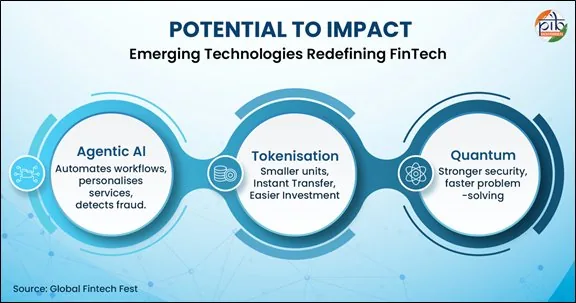
- “Potential to Impact: Agentic AI | Tokenisation | Quantum: Trusted, Connected, Global Systems for Inclusive Finance.” The theme focuses on three transformative technologies that are reshaping financial systems by making them more autonomous, programmable, secure and inclusive.
- Agentic AI: Enables real-time decision-making, automation, fraud prevention and personalised financial services.
- Tokenisation: Facilitates programmable digital assets, fractional ownership and faster settlements.
- Quantum Technology: Strengthens financial security through quantum-safe systems and advanced computing.
 What are the Key Facts About FinTech?
- About: Financial Technology (FinTech) refers to the use of technology-driven innovations to improve the efficiency, accessibility and delivery of financial services. It includes new business models, applications, processes and products that significantly influence financial markets, financial institutions and financial service delivery.
- Application Programming Interface (API): APIs are a set of rules and protocols that enable different software applications to communicate with each other. They allow developers to build new financial applications and services by integrating existing platforms.
- Cloud Computing: Cloud computing uses online networks of computing resources to provide scalable and flexible digital infrastructure. It reduces operational costs and enables financial institutions to handle large volumes of data efficiently.
- Biometric Technology: Biometrics uses unique and measurable human characteristics, such as fingerprints and facial recognition, for identification and authentication. It improves security and enables easier access to financial services.
- Distributed Ledger Technology (DLT): DLT is a digital record-keeping system where transaction data is stored across multiple locations simultaneously. It enhances transparency, security and efficiency in financial transactions.
- Big Data Analytics: Big Data refers to large volumes of structured and unstructured data that can be collected, analysed and utilised through digital tools. It helps financial institutions improve decision-making, risk assessment and customer services.
- Artificial Intelligence (AI) and Machine Learning (ML): AI and ML systems enable computers to perform tasks requiring human-like intelligence. Machine learning allows systems to learn from data and improve performance without direct human programming.
- Enhancing Financial Efficiency: FinTech has improved the speed, affordability and efficiency of financial services. For example, Unified Payments Interface (UPI), recognised by the International Monetary Fund (IMF) as the world’s largest real-time payment system, processed 2,365.8 crore transactions worth ₹29.88 lakh crore in July 2026, with 741 banks connected to the platform. Transaction volumes have increased nearly 12,000 times since FY 2016–17.
- Promoting Financial Inclusion: FinTech helps overcome barriers such as information asymmetry and high transaction costs, thereby expanding access to formal financial services. India’s Financial Inclusion Index increased from 43.4 in March 2017 to 70.0 in March 2026, reflecting greater penetration of digital financial services.
- Diversifying Credit Sources: FinTech platforms have expanded credit access beyond traditional banking channels by enabling alternative lending models. This diversification reduces excessive dependence on a limited number of financial institutions and strengthens competition, resilience and stability in the financial ecosystem.
- JAM Trinity:
- Enabling Digital Financial Inclusion: The Jan Dhan–Aadhaar–Mobile (JAM) Trinity provides the foundational layer for India’s digital finance ecosystem. Jan Dhan accounts enable access to formal banking services, Aadhaar provides secure digital identity, and expanding mobile and internet connectivity connects citizens with digital financial services.
- As of 26th August 2026, 59.15 crore Jan Dhan accounts had been opened, while Aadhaar enrolments crossed 144 crore by March 2026, creating a vast user base for fintech services.
- Unified Payments Interface (UPI): Building Interoperable Digital Payments: UPI has emerged as the backbone of India’s digital payment ecosystem by enabling instant, low-cost and interoperable transactions.
- Digital Identity and Documents:
- Secure digital identity and document systems have reduced barriers in financial onboarding and verification.
- Aadhaar e-KYC enables paperless customer authentication and has processed over 2,458 crore transactions as of 29th June 2026. Similarly, DigiLocker, with over 73.53 crore registered users and 936.03 crore issued documents, strengthens trust and efficiency in digital financial services.
- Direct Benefit Transfer (DBT):
- DBT leverages digital financial infrastructure to transfer government benefits directly into beneficiaries’ bank accounts. By reducing intermediaries and leakages, it improves transparency and efficiency in welfare delivery.
- The cumulative value of DBT transfers reached ₹53.26 lakh crore as of September 2026, demonstrating the capability of India’s digital ecosystem to support large-scale financial transactions.
- Open Digital Commerce:
- The Open Network for Digital Commerce (ONDC) extends India’s interoperable digital model beyond payments by creating an open marketplace ecosystem.
- By June 2026, ONDC had expanded to over 20 crore buyers and 5 lakh sellers across 1,000+ cities. Its Financial Services category provides new opportunities for fintech firms to deliver digital financial products and expand market access.
- Self-Regulation and Industry Standards: The RBI Framework for Self-Regulatory Organisation(s) in the FinTech Sector (SRO-FT), 2024 promotes responsible practices, ethical conduct, market integrity and effective grievance resolution within the fintech industry.
- Strengthening Digital Payment Security:
- The RBI Master Directions on Digital Payment Security Controls (2021) establish minimum security standards for digital payment channels, including internet and mobile banking.
- Additionally, the National Payments Corporation of India (NPCI) uses Artificial Intelligence (AI) and Machine Learning (ML)-based fraud monitoring systems to enhance security in UPI transactions.
- Ensuring Data Protection and Privacy: The Digital Personal Data Protection Act, 2023 and the Digital Personal Data Protection Rules, 2025, notified by the Ministry of Electronics and Information Technology, provide a framework for protecting personal data and strengthening user trust in digital financial services.
- Regulatory Sandbox for Innovation: The RBI Regulatory Sandbox framework, introduced in August 2019, enables fintech companies to test innovative financial products and services in a controlled environment before wider deployment. It encourages experimentation while ensuring regulatory oversight.
- Consumer Protection in Digital Lending: To address risks associated with fraudulent digital lending platforms, RBI has strengthened regulations through measures such as the Digital Lending Apps (DLA) directory and cybercrime reporting mechanisms through the National Cybercrime Reporting Portal and helpline 1930. The SACHET portal further enables citizens to report complaints related to illegal deposit-taking activities.
- India’s fintech transformation demonstrates how Digital Public Infrastructure, innovation and regulatory trust can democratise financial services at population scale. The next phase of fintech growth will depend on balancing technological advancement with security, inclusion and responsible innovation, enabling India to emerge as a global leader in digital finance.
Military Exercises
SLINEX-26
Source The 13th edition of Sri Lanka–India Naval Exercise (SLINEX-26) is being conducted at Visakhapatnam, Andhra Pradesh from 17th –21st September 2026 under the aegis of the Eastern Naval Command.- About: SLINEX is a bilateral maritime exercise between the Indian Navy and the Sri Lanka Navy. Conceptualised in 2005, it has evolved as an important platform for enhancing maritime cooperation, interoperability and mutual understanding between India and Sri Lanka.
- Phases: The exercise comprises two phases — Harbour Phase involving professional interactions and cultural activities, followed by Sea Phase focusing on maritime coordination and interoperability.
- Participating Platforms: The Indian Navy is participating with INS Kavaratti, an indigenous Anti-Submarine Warfare Corvette, and INS Jyoti, the Fleet Tanker, while the Sri Lanka Navy is represented by SLNS Sindurala.
- Significance: The exercise is aligned with India’s MAHASAGAR (Mutual and Holistic Advancement for Security and Growth Across Regions) vision, which focuses on promoting a secure, stable and inclusive maritime environment in the Indian Ocean Region.
Polity & Governance
Uniform Civil Code
Source Why in News?- The debate surrounding the Uniform Civil Code (UCC) has regained momentum as UCC Bills passed by Assam, Gujarat and Madhya Pradesh are currently awaiting Presidential assent, while Uttarakhand has had a UCC in force since January 2025. The developments reflect growing efforts to establish a common civil law framework covering marriage, divorce, inheritance and adoption.
- Definition: A Uniform Civil Code envisions a singular, common set of civil laws governing all citizens of India equally in matters of marriage, divorce, custody, adoption, maintenance, inheritance, and succession of property, irrespective of their religious faith or community affiliations.
- Dichotomy in Indian Law:
- India possesses uniform codes across the criminal and commercial spectra (e.g., Bharatiya Nyaya Sanhita, 2023, Indian Contract Act, 1872, Transfer of Property Act of 1882).
- However, civil personal matters continue to be governed primarily by community-specific personal laws derived from religious texts, traditions, or customary practices.
- Constitutional Provisions Governing UCC:
- Article 44 of the Constitution, placed under Part IV (Directive Principles of State Policy (DPSP)), states: “The State shall endeavour to secure for the citizens a Uniform Civil Code throughout the territory of India.”
- Under Article 37, DPSPs are fundamental in the governance of the country, but they are non-justiciable (unenforceable by courts).
- Hindus, Buddhists, Jains, and Sikhs:
- Broadly codified under the Hindu Code Bills of 1955–56 (Hindu Marriage Act, Hindu Succession Act, Hindu Minority and Guardianship Act, and Hindu Adoptions and Maintenance Act).
- Sikh marriages can additionally be registered under the Anand Marriage Act, 1909 (amended 2012).
- Muslims: Governed by uncodified or partially codified personal laws based on Shariat, primarily anchored in the Muslim Personal Law (Shariat) Application Act, 1937, and the Dissolution of Muslim Marriages Act, 1939.
- Christians and Parsis: Governed by enactments such as the Indian Christian Marriage Act (1872), the Indian Divorce Act (1869), and the Parsi Marriage and Divorce Act (1936).
- Tribal Customary Laws: Protected through constitutional exceptions and safeguards, including provisions under the Fifth and Sixth Schedules and Articles 371, which protect customary family traditions from standard legislative overriding.
- Secular Legislation: Parallel secular options exist for citizens choosing to step outside personal laws, such as the Special Marriage Act, 1954.
 Landmark Supreme Court Pronouncements on UCC
- Mohd. Ahmed Khan v. Shah Bano Begum (1985): The Supreme Court upheld the right of a divorced Muslim woman to maintenance under Section 125 of the CrPC and lamented that Article 44 had remained a “dead letter” and stressed the need for a Uniform Civil Code.
- Sarla Mudgal v. Union of India (1995): The Court held that a Hindu husband cannot convert to Islam solely to contract a second marriage without dissolving an existing Hindu marriage and highlighted the need for a UCC to prevent misuse of personal laws.
- Daniel Latifi v. Union of India (2001): The Court upheld the Muslim Women (Protection of Rights on Divorce) Act, 1986, while ensuring that a divorced Muslim woman receives reasonable and fair provision beyond the Iddat period.
- John Vallamattom v. Union of India (2003): The Court struck down Section 118 of the Indian Succession Act, 1925, as discriminatory under Article 14 and linked a common civil code with national integration.
- Shayara Bano v. Union of India (2017): The Court declared Talaq-e-Biddat (instant triple talaq) unconstitutional, reinforcing that personal-law practices can be tested against constitutional principles.
- Jose Paulo Coutinho v. Maria Luiza Valentina Pereira Case, 2019: The Court praised Goa as a “shining example” where “the uniform civil code is applicable to all, regardless of religion, except while protecting certain limited rights” and called for its implementation across India.
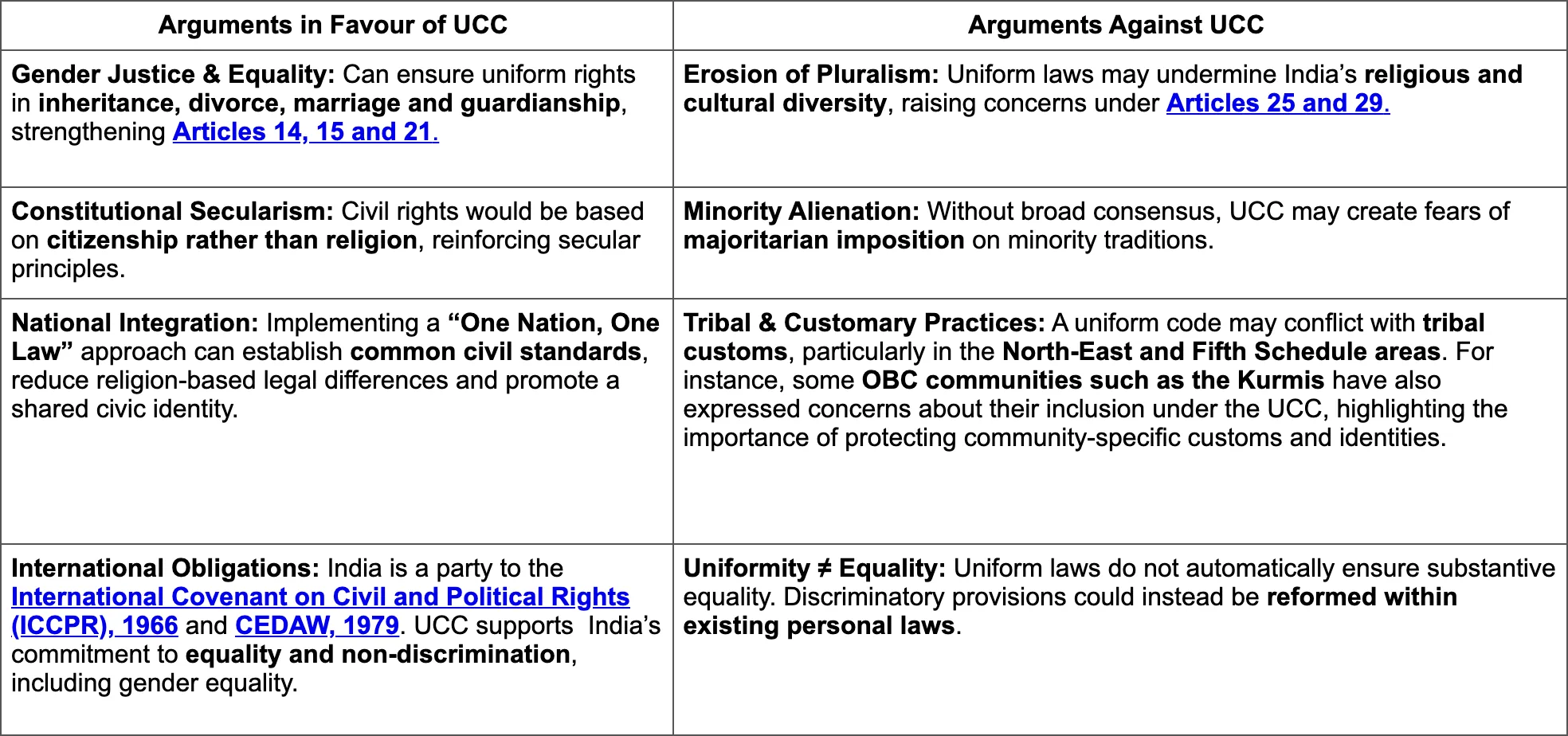
- Prioritising Gender Justice: The fundamental objective of reforming civil laws must be to secure equal rights for women across all religions in matters of marriage, divorce, maintenance, and inheritance.
- Upholding Constitutional Morality:
- As observed by the Supreme Court in the Section 6A of the Citizenship Act, 1955 (2024) case, fundamental rights (like Articles 25 and 29) are subject to constitutional morality and equality. Practices running against the spirit of the Constitution (like gender discrimination) do not receive protection under Article 29.
- Therefore, reforming personal laws to eliminate discrimination should be viewed as upholding the Constitution’s spirit.
- A Voluntary Approach (Dr. B.R. Ambedkar’s Vision):
- To address resistance and build trust among minority communities, lawmakers could consider Dr. B.R. Ambedkar’s suggestion in the Constituent Assembly.
- He proposed that the application of a UCC could initially be made voluntary, applying only to citizens who explicitly declare their willingness to be bound by it.
- Focus on ‘Equality Within Communities’:
- The 21st Law Commission of India, in its 2018 Consultation Paper on Reform of Family Law, concluded that a blanket UCC is “neither necessary nor desirable at this stage”.
- Instead of forcing ‘equality between communities’ (uniformity), the immediate legislative focus should be on achieving ‘equality within communities’.
- This can be achieved by systematically amending discriminatory provisions in various existing personal laws (regarding custody, adoption, succession, etc.) to ensure comprehensive gender justice.
- UCC should balance gender justice, individual dignity and constitutional equality with India’s religious and cultural diversity. Its success depends on broad consultation (including women’s groups, communities and stakeholders), consensus-building and sensitivity to customary practices. The goal should be inclusive legal reform, not cultural uniformity.
Role of ECI in Resolving Political Party Disputes & Symbol Allocation
Source The Election Commission of India (ECI) froze the ‘All India Trinamool Congress’ name and its reserved symbol due to competing claims from rival factions ahead of the West Bengal Assembly bypolls.- Freezing of Symbols:
- If the ECI cannot conclude proceedings before an imminent election, it may issue an interim order to freeze the reserved symbol.
- Both factions are then directed to contest under temporary names and choose separate symbols from the ECI’s list of ‘free symbols’.
- Legal Framework and ECI’s Authority The ECI derives its authority to resolve party name and symbol disputes from Article 324 of the Constitution, the Representation of the People Act (1951), and the Election Symbols (Reservation and Allotment) Order, 1968.
- Paragraph 15: Under the 1968 Order, the ECI is the sole authority empowered to decide which rival faction of a recognised national or state party is the “real” party. Its decision is binding.
- Unrecognised Parties: For registered but unrecognised parties, the ECI does not adjudicate symbol disputes, instead advising internal resolution or directing them to civil courts.
- The ‘Test of Majority’:
- The Supreme Court in Sadiq Ali v. Election Commission of India (1971) upheld the ECI’s power under Paragraph 15 to resolve disputes between rival factions of political parties, establishing a three-test formula for determining the legitimate party group.
- Test of Aims and Objects: Examining the party’s constitution and primary objectives.
- Test of Party Constitution: Evaluating which faction adhered to internal rules and democratically held organisational elections.
- Test of Majority (Legislative and Organisational): The most crucial metric. The ECI assesses the numerical strength of each faction’s organisational wing (office bearers, delegates) and legislative wing (elected MPs and MLAs).
- Fallback Mechanism: If organisational support is disputed or unclear, the ECI relies heavily on the majority support among the elected legislative representatives.
- Fate of the Losing Faction Once the ECI makes a final determination, the faction that loses the claim to the original name and symbol. It may continue under another name/symbol if allotted by ECI.
- It must earn its own State or National recognition based strictly on its future electoral performance, regardless of its past association.
Schemes & Initiatives
Scheme to Promote Manufacturing of Sintered Rare Earth Permanent Magnets
Source Why in News?- The Scheme to Promote Manufacturing of Sintered Rare Earth Permanent Magnets has brought renewed focus on India’s efforts to build a domestic permanent magnet manufacturing ecosystem and reduce dependence on China.
- However, experts highlight a “visibility problem” in accurately mapping India’s technological capabilities and strategic dependencies across the complex, multi-stage REPM value chain, from rare-earth processing to finished magnet production.
- About:
- Approved by the Union Cabinet in November 2025, it is a Rs 7,280 crore scheme aimed at establishing an integrated domestic manufacturing ecosystem for sintered rare earth permanent magnets.
- It is a first-of-its-kind national initiative that seeks to build the complete supply chain within the country - from refining rare-earth oxides to producing metals, alloys, and finished sintered magnets.
- Target Capacity:
- The scheme targets setting up a 6,000 Metric Tonnes Per Annum (MTPA) capacity.
- This capacity will be allocated among five beneficiaries (1,200 MTPA each) selected through a global competitive bidding process.
- The financial outlay includes a Rs 750 crore capital subsidy for setting up units and Rs 6,450 crore in sales-linked incentives.
- Implementation & Duration: The scheme will run for 7 years, comprising a 2-year gestation period for facility setup and 5 years of incentive disbursement. This phased approach ensures adequate time for infrastructure creation and sustained production.
- Need for the Scheme:
- Surging Demand & Import Dependence: India’s demand for REPMs is projected to double by 2030. Currently, the country is heavily reliant on imports, bringing in over 53,000 metric tonnes in 2024–25 alone.
- Supply Chain Vulnerability:
- Between 2022 and 2025, China supplied 60–90% of India’s permanent magnets.
- With China controlling the global supply chain and tightening export rules, Indian EV and automakers have faced severe delays, supply uncertainty, higher costs, and production risks.
- Strategic Alignment: Domestic REPM manufacturing is crucial for industry resilience. It directly supports clean mobility, enhances energy security, and aligns with India’s long-term targets under Net Zero 2070 and Viksit Bharat 2047.
- About: REPMs are high-performance magnets made from rare earth elements such as Samarium (Sm), Neodymium (Nd), Praseodymium (Pr), Dysprosium (Dy), and Cerium (Ce).
- Superior Properties:
- Compared to traditional ferrite or AlNiCo magnets, REPMs offer a much higher maximum energy product, greater coercivity, and stronger magnetic output in highly compact sizes.
- This makes them indispensable for high-efficiency motors and miniaturized devices.
- Sintered REPMs:
- These are produced through “sintering” - a process where fine rare-earth alloy powders are compacted under intense pressure and heated at high temperatures to form dense, strong magnetic structures.
- Sintered NdFeB (neodymium-iron-boron) and SmCo (samarium-cobalt) magnets are the strongest commercially available permanent magnets.
- Importance for India’s EV Ecosystem:
- Rare earth magnets, particularly NdFeB types, are vital for EV traction motors, steering, braking, and other critical components.
- They drastically improve a vehicle’s mechanical efficiency, power output, and overall battery range.
- Mines and Minerals (Development and Regulation) Amendment Act, 2023: De-listed several critical minerals, including rare earths, from the atomic minerals list, enabling commercial mining and greater private-sector participation.
- National Critical Minerals Mission (NCMM): Approved in January 2025, it focuses on securing critical-mineral value chains through exploration, processing, recycling and overseas asset acquisition.
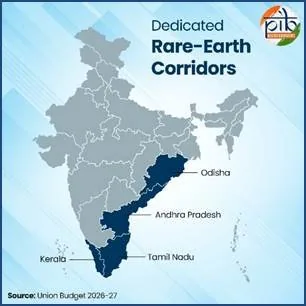
- Dedicated Rare Earth Corridors: Announced in Union Budget 2026–27 for Odisha, Kerala, Andhra Pradesh and Tamil Nadu, aimed at integrating mining, processing, research and manufacturing.
- International Partnerships:
- India is securing critical-mineral supplies through partnerships with countries such as Australia, Argentina, Zambia and Mozambique.
- Khanij Bidesh India Limited (KABIL) works to acquire and develop overseas critical-mineral assets; it has partnered with Argentina for lithium exploration.
 What are the Key Challenges to India’s REPM Mission?
- Visibility Gap and Import Surge:
- India faces a “visibility gap” in tracking its magnet economy. While the domestic market is estimated at Rs 750 crore, imports are much higher as magnets often enter embedded in EV motors and wind turbines.
- Consequently, imports nearly doubled from 28,700 tonnes in FY2023–24 to 53,700 tonnes in FY2024–25, highlighting the need for stage-wise value-chain mapping.
- Shallow Exploration and Failed Auctions:
- India’s critical-mineral auctions face weak participation due to inadequate geological data. Only about 48% of blocks auctioned during 2020–23 were successfully sold.
- Limited G1/G2 exploration data makes it difficult for investors to assess reserves and price blocks accurately, leading to failed auctions.
- Heavy Rare-Earth Deficit:
- India has a substantial rare-earth resource base, holding an estimated 13.15 million tonnes of monazite that contains approximately 7.23 million tonnes of Rare Earth Oxides (REOs) spread across eight states ( Odisha, Kerala, Andhra Pradesh, Tamil Nadu, West Bengal, Gujarat, Maharashtra, and Jharkhand).
- However, this resource availability has not yet translated into a self-reliant REPM manufacturing ecosystem.
- A critical reason for this is geological: India’s monazite deposits are heavily skewed toward Light Rare Earth Elements (LREEs) such as Cerium, Lanthanum, and Neodymium, but severely lack Heavy Rare Earth Elements (HREEs) like Dysprosium and Terbium.
- These heavy elements are essential for sintered NdFeB magnets to retain their magnetic properties at the high operating temperatures found in electric vehicle motors and wind turbines.
- The Monazite-Thorium Regulatory Knot:
- Indian monazite is found alongside radioactive Thorium, which is strictly reserved for the nuclear program.
- This subjects the entire extraction process to restrictive atomic energy regulations, severely complicating fast-paced private commercial processing.
- Absence of a Circular Economy: India lacks specific material recovery targets for rare earth magnets, treating them instead as general bulk electronic waste.
- Map the Value Chain: The government must update the National Critical Mineral Mission’s monitoring framework to record domestic capabilities at every single stage (from ore to final assembly) to target subsidies effectively.
- Mineral Diplomacy for Heavy Rare Earths: To fix the Dysprosium shortage, India must secure heavy rare earth offtake through overseas asset acquisitions, making these contracts conditional on processing the materials inside India.
- De-Risk Monazite Processing: The government should create a licensed, transparent private participation route for the non-thorium fraction of monazite, implementing a strict custody protocol to safely return the radioactive thorium residue to the state.
- Urban Mining & Circular Economy: Establish robust e-waste protocols specifically designed to separate and recover NdFeB magnets from old EVs and electronics, creating a secondary domestic feedstock that requires no new mining.
Swachhata Hi Seva 2026
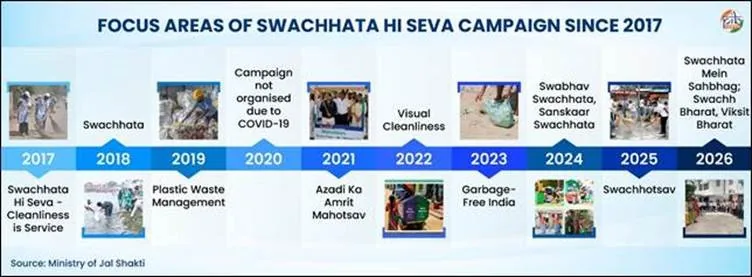
Source Why in News?- The Swachhata Hi Seva (SHS) 2026 campaign is being organised from 17th September to 2nd October 2026 with the theme: “Swachhata Mein Sahbhag; Swachh Bharat, Viksit Bharat”.
- About: Swachhata Hi Seva (SHS) has been observed annually since 2017 as a cleanliness campaign conducted before Swachh Bharat Diwas on 2nd October.
- Objective: The campaign aims to promote voluntary citizen participation and collective ownership of cleanliness under the broader Jan Bhagidari approach of the Swachh Bharat Mission (SBM).
- Evolution: The campaign has expanded towards sustainable sanitation, waste management, sanitation workers’ welfare, youth participation and collective responsibility through a whole-of-government and whole-of-society approach.
 Swachhata Hi Seva 2026
- Approach:
- The campaign follows a Whole of Government and Whole of Society approach, with emphasis on youth participation, stakeholder responsibility and community ownership.
- It also focuses on creating awareness about the Solid Waste Management Rules, 2026 and strengthening the understanding of waste management responsibilities among different stakeholders.
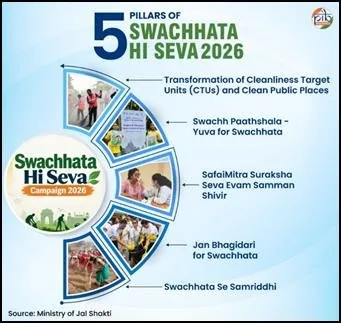 Five Core Activity Pillars of SHS 2026
- Transformation of Cleanliness Target Units (CTUs) and Clean Public Places:
- The campaign focuses on transforming neglected garbage points and difficult-to-clean locations through waste removal, beautification and sustained maintenance.
- Citizens can report sanitation-related grievances through the Swachhata App, and identified locations can be mapped on the SHS 2026 portal.
- Public and community toilets are assessed through FACES parameters, which include Functional, Accessible, Clean, Eco-friendly and Safe facilities.
- Swachh Paathshala – Yuva for Swachhata:
- This initiative gives a dedicated role to students and youth in promoting long-term behavioural change towards cleanliness.
- Students from Classes 6 to 12 participate in Swachhata Gyan Yatras to understand waste management and sanitation practices.
- SafaiMitra Suraksha Seva Evam Samman Shivirs: This initiative focuses on sanitation workers and their families by providing health services, safety equipment and welfare support. It aims to recognise the contribution of sanitation workers and improve their working conditions.
- Jan Bhagidari for Swachhata:
- Jan Bhagidari remains a central pillar of SHS 2026 by encouraging citizens and institutions to take responsibility for everyday cleanliness.
- The campaign promotes awareness about the Solid Waste Management Rules, 2026, four-way source segregation, home composting and reduction of littering.
- It also encourages campaigns against single-use plastics, Swachhata rallies, human chains, public cleanliness pledges and collection drives for reusable household items.
- The campaign promotes “Swachh Parv, Harit Parv” by encouraging eco-friendly and plastic-free celebrations during festivals.
- Swachhata Se Samriddhi:
- This pillar connects cleanliness with resource recovery and circular economy principles by promoting the Reduce, Reuse and Recycle (3R) approach.
- Kabaad Se Jugaad encourages the creation of useful products from discarded materials, while Kabaad Se Kala promotes artistic creations using waste materials.
- These initiatives aim to transform waste into resources while encouraging creativity and sustainability.
- About:
- Swachh Bharat Mission (SBM) was launched on 2nd October 2014 as one of the world’s largest government-led sanitation movements. The SBM logo features Mahatma Gandhi’s spectacles, symbolising his emphasis on cleanliness and social responsibility.
- The logo helped create a strong identity for the cleanliness movement and encouraged public participation.
- Components of SBM:
- Swachh Bharat Mission–Grameen (SBM-G): Focuses on rural sanitation, toilet access, usage and solid-liquid waste management.
- Swachh Bharat Mission–Urban (SBM-U): Focuses on urban sanitation, waste management, public spaces and cleanliness infrastructure.
- Rural Sanitation Achievements: Rural India was declared Open Defecation Free (ODF) in 2019.
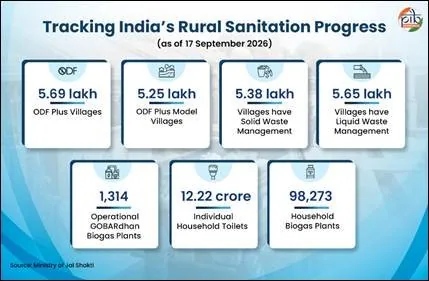
- ODF Plus Village: A village that sustains its Open Defecation Free (ODF) status and ensures effective management of solid waste, liquid waste and visual cleanliness.
-
Classification of ODF Plus Villages:
- Aspiring: Manages either solid waste or liquid waste.
- Rising: Manages both solid waste and liquid waste.
- Model: Manages both waste streams along with visual cleanliness and ODF Plus awareness messaging.
-
Urban Sanitation Achievements:
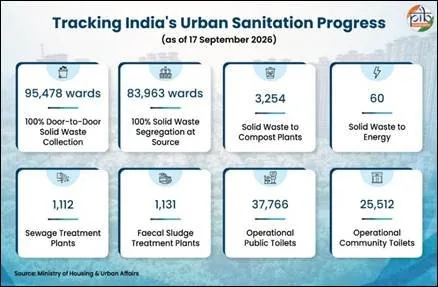
- Swachhata Hi Seva has transformed cleanliness from a government programme into a people-driven movement. Its journey from toilet construction to waste management, public-space transformation and behavioural change reflects the evolution of India’s sanitation approach. Sustained citizen participation, scientific waste management and dignity for sanitation workers will be essential for achieving a truly clean, sustainable and inclusive India.
Security
Research and Analysis Wing (R&AW)
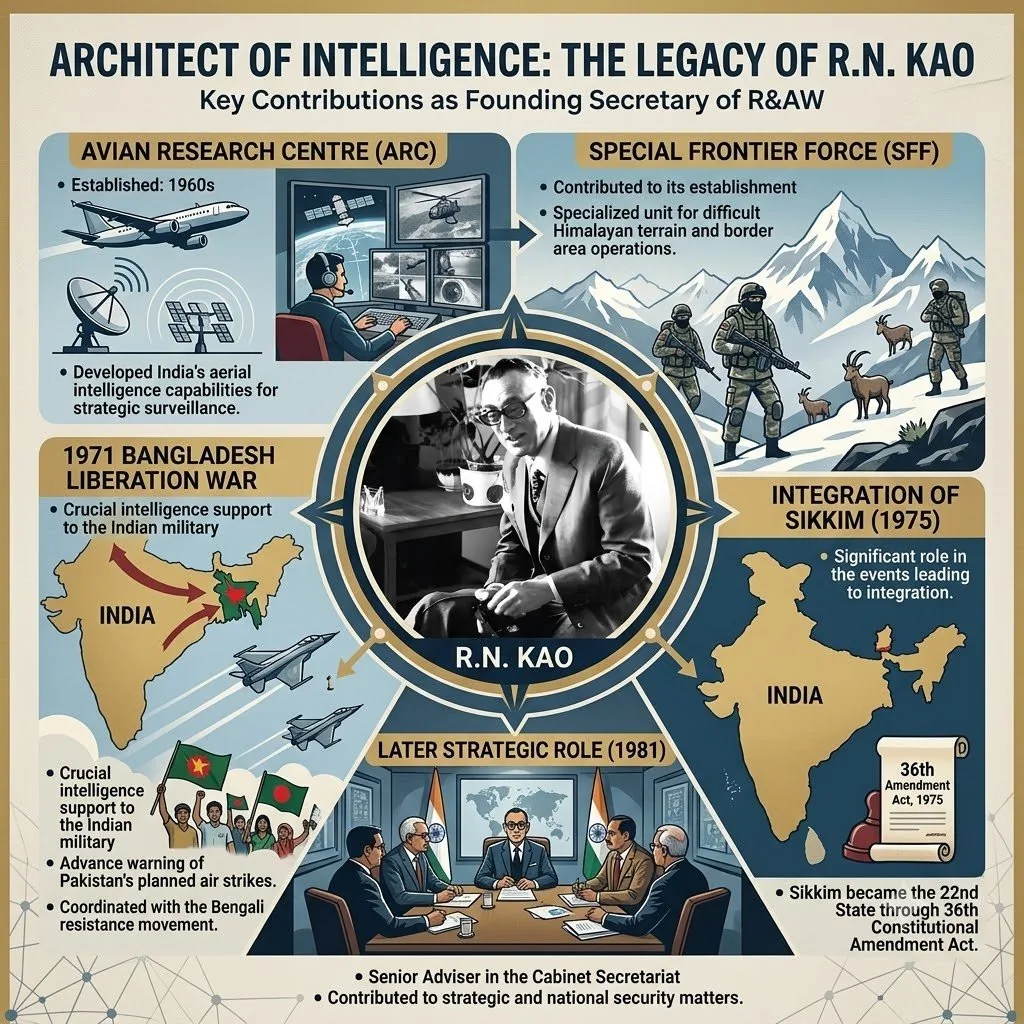
Source Recently, the Research and Analysis Wing (R&AW) completed 58 years since its establishment on 21st September 1968.- About R&AW: It is India’s primary external intelligence agency, functioning under the Cabinet Secretariat and reporting directly to the Prime Minister’s Office (PMO).
- Background: India’s external security environment after the 1962 India–China War highlighted the need for a dedicated foreign intelligence agency. Until 1968, the Intelligence Bureau (IB) handled both internal and external intelligence, but intelligence shortcomings during the war led to the creation of a separate organisation.
- Establishment: Created in 1968 under Prime Minister Indira Gandhi, with R.N. Kao as its first chief, who built its institutional structure and operational capabilities.
- Key Objectives: Monitoring developments in neighbouring countries, gathering foreign intelligence, and supporting national security and foreign policy objectives.
- Major Milestones: R&AW is credited with significant intelligence contributions during the 1971 Bangladesh Liberation War, including intelligence support and coordination with resistance groups.
- Evolution: Over time, its focus expanded from China and Pakistan to broader areas such as counterterrorism, strategic intelligence and regional security.
Wildlife
New Cat Species ‘Tilcayo’ Identified in Bolivia
Source A new wild cat species named Tilcayo (Leopardus tilcayo) has been identified in Bolivia’s Yungas cloud forests, marking the first formal description of a new living cat species in over a century.- About: Leopardus tilcayo is a small spotted wildcat belonging to the tiger cat group (Leopardus genus). It is named after Tilcayo, the name used by local communities for the animal.
- Discovery & Identification: The species was identified after a rescued kitten was found in 2016 and later transferred to the Senda Verde Wildlife Sanctuary. Genomic analysis confirmed it as a distinct species.
- Features: The cat is around 46 cm long, weighs about 1.4 kg, and has light brown fur with irregular rosette patterns, making it smaller than an average domestic cat.
- Habitat: It is found in the Yungas cloud forests of Bolivia, a biodiversity-rich ecosystem located on the eastern slopes of the Andes.
- Ecology: Limited information is available about its population, diet and behaviour. Initial evidence suggests feeding on small rodents and possible nocturnal activity.
- Conservation Status: The discovery may lead to a separate IUCN assessment as tiger cat species are reassessed individually, potentially revealing higher conservation risks.
- Threats: The Yungas ecosystem faces pressures from deforestation, agriculture, forest fires and mining, highlighting the need for habitat protection and biodiversity conservation.