Comrades Editorial · 22 Sep 2026 (PDF)
In this edition
- Ethanol for Sustainable Future Infrastructure & Energy
Infrastructure & Energy
Ethanol for Sustainable Future
Source This editorial is based on “India’s ethanol vision needs a feedstock reality check” published in the Indian Express on 21/09/2026. The article highlights that mandatory E20 blending targets create fixed energy demands that clash with agricultural realities. Heavy reliance on maize, rice, and sugarcane strains water resources and risks inflating prices for food, poultry, and dairy feed. India’s Ethanol Blending Programme has rapidly evolved into a cornerstone of national energy security and transport decarbonisation, achieving the E20 milestone ahead of schedule. While this shift cuts crude oil imports and boosts rural incomes, it concurrently triggers complex challenges across food security, water sustainability, and vehicle compatibility, necessitating a strategic pivot toward advanced biofuels. What are the Key Developments Shaping India’s Ethanol Blending Programme?- Early Achievement of the E20 Blending Milestone:
- India’s Ethanol Blended Petrol Programme (EBP) has moved from a supplementary fuel initiative to a central pillar of energy security and transport decarbonisation.
- Average ethanol blending increased from only 1.53% in ESY 2013–14 to approximately 20% in 2025, achieving the original 2030 target nearly five years early.
- The programme has consequently entered a post-E20 phase, involving assessment of blends beyond 20%, feedstock sustainability and vehicle compatibility rather than merely expanding ethanol availability.
- Structural Transition from Sugar-Based to Multi-Feedstock Ethanol:
- Ethanol production is no longer dependent exclusively on C-heavy molasses; the supply basket now includes sugarcane juice, B-heavy molasses, damaged foodgrains, surplus FCI rice and maize.
- By August 2026, grain-based sources reportedly supplied around 624 crore litres—nearly 70% of total ethanol supplies in ESY 2025–26—signalling a decisive shift towards grain-based distilleries.
- Maize emerged as the largest individual feedstock during the first half of ESY 2025–26, reducing dependence on the geographically concentrated sugar industry.
- Rapid Creation of Distillation and Storage Capacity:
- Assured procurement, interest-subvention schemes and long-term supply contracts have stimulated investment in standalone and integrated distilleries.
- India’s ethanol-production capacity increased from approximately 518 crore litres in 2017 to over 1,800 crore litres by mid 2025, encompassing both molasses- and grain-based facilities.
- OMCs have also invested in dedicated tanks, blending terminals, quality-testing facilities and ethanol-compatible pipelines, converting blending from a seasonal exercise into a nationwide fuel-supply operation.
- Calibrated Food–Fuel Management through Flexible Feedstock Allocation:
- The government increasingly adjusts ethanol feedstocks according to the availability of sugar, rice and maize, making the programme a form of adaptive commodity management.
- Restrictions imposed on sugarcane juice and B-heavy molasses during the poor 2023–24 sugar season were subsequently relaxed when supplies improved.
- In ESY 2025–26, approximately 44 lakh tonnes of FCI rice had been allocated for ethanol production by June 2026, while maize use expanded substantially.
- E20-Compatible Automobile Ecosystem:
- The programme is now influencing vehicle design, fuel standards and consumer markets through a transition towards E20 material-compatible and E20-tuned engines.
- BIS fuel specifications, corrosion-resistant components, revised engine calibration and ethanol-compatible fuel systems are reducing operational risks.
- The next policy challenge is managing the legacy vehicle fleet, because E20 may reduce fuel economy and affect seals, hoses or components in older vehicles designed principally for E10 petrol.
- Expansion towards Advanced and Second-Generation Biofuels:
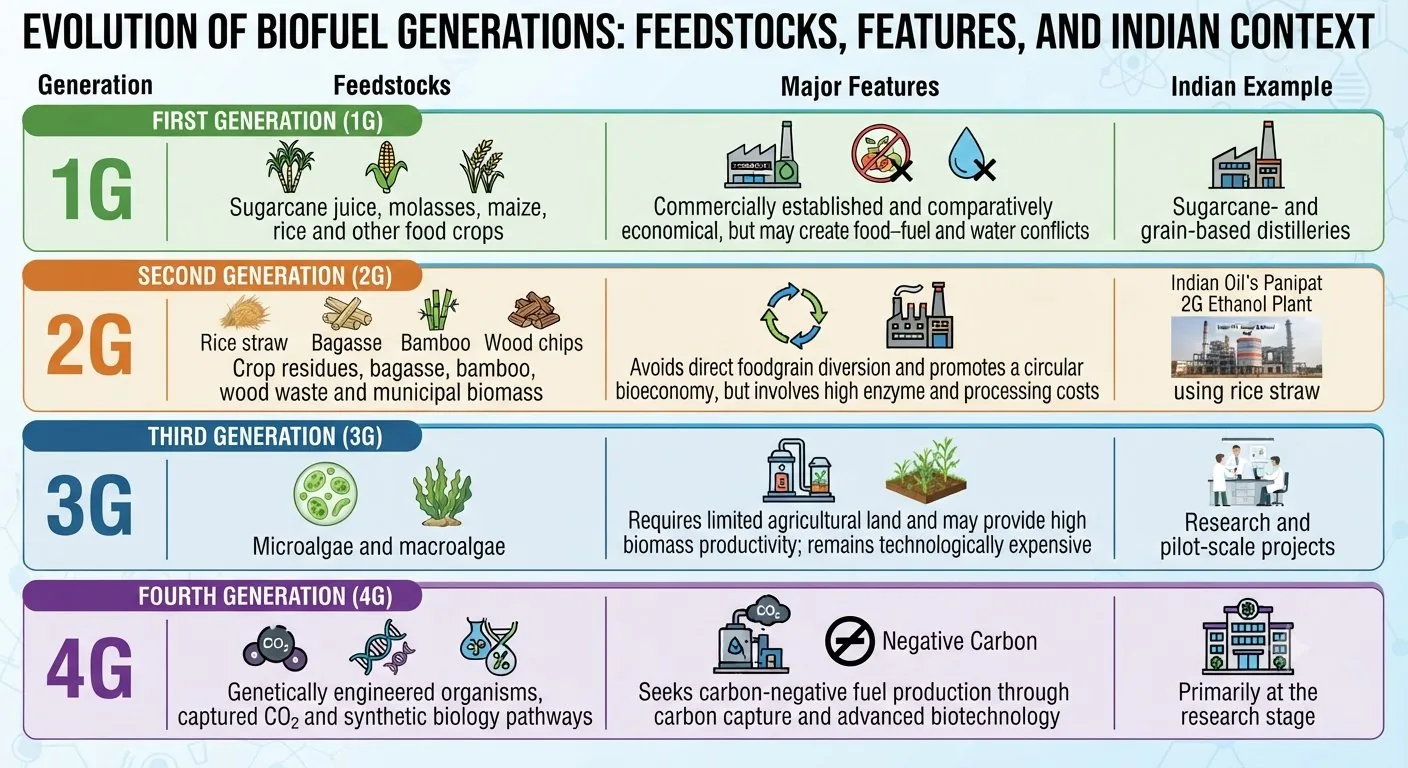
- India is attempting to reduce dependence on food crops by commercialising 2G ethanol derived from agricultural residues and lignocellulosic biomass.
- Indian Oil’s Panipat 2G Ethanol Plant, with a designed capacity of about 100 kilolitres per day, uses rice straw that might otherwise be burnt, linking ethanol production with mitigation of stubble burning and particulate pollution.
- The bamboo-based biorefinery at Numaligarh, Assam, illustrates the use of non-food biomass for ethanol and green chemicals.
- Ethanol as an Energy-Security, Rural-Income and Decarbonisation Instrument:
- Government estimates indicate that accelerated blending has substituted substantial quantities of imported crude oil, saved over ₹1.97 lakh crore in foreign exchange since 2014–15, reduced carbon emissions and transferred large payments to farmers and sugar mills.
- Faster ethanol offtake has improved the liquidity of sugar mills and supported timely cane-dues settlement, while maize procurement has created an additional market for farmers.
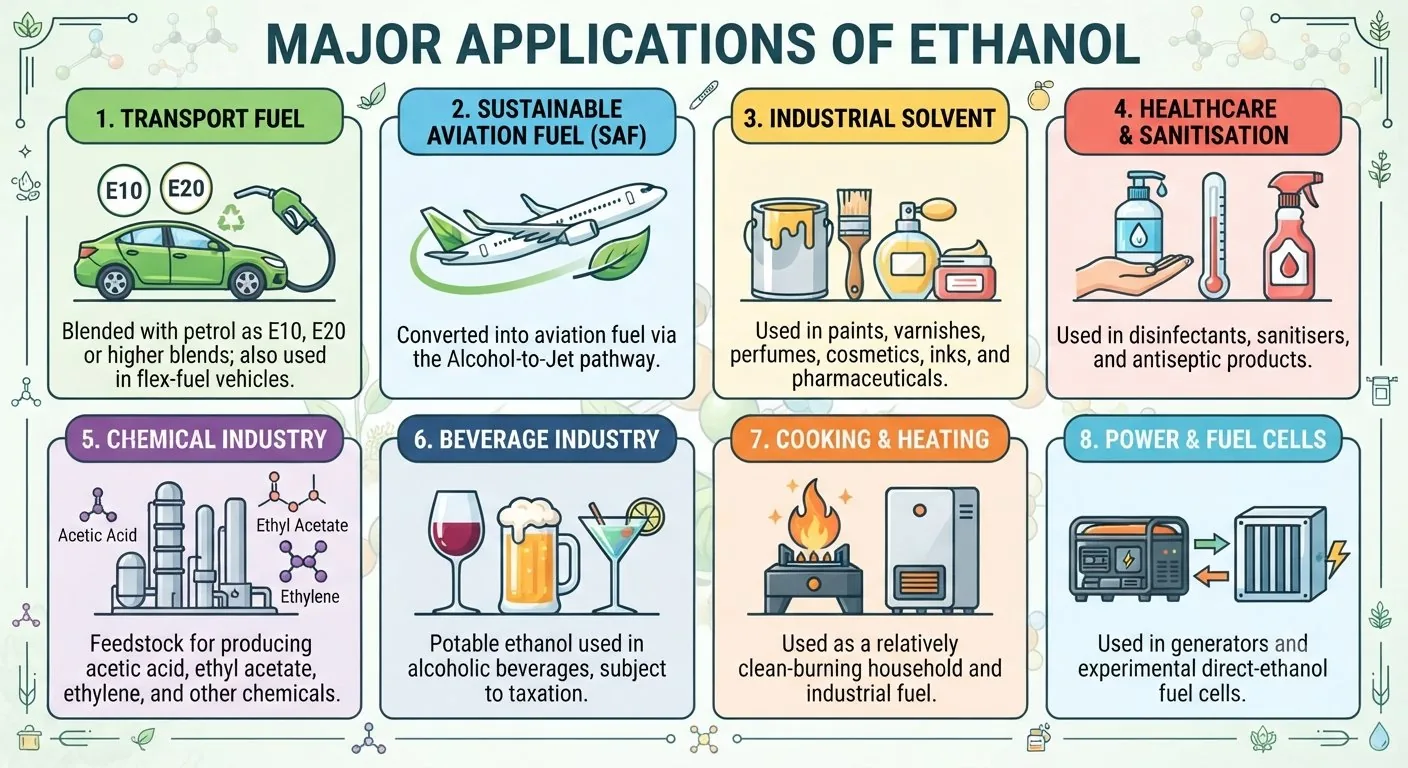
- India is also extending the biofuel architecture towards Sustainable Aviation Fuel, with proposed blending targets for international flights, connecting the EBP ecosystem with future CORSIA compliance and aviation decarbonisation.
-
About:
- Ethanol, also called ethyl alcohol, is a colourless, volatile, flammable and oxygen-containing organic compound belonging to the alcohol family.
- It may be produced either through the fermentation of sugar and starch-rich biomass or through synthetic industrial processes.
- Ethanol used for fuel is anhydrous ethanol, generally containing over 99% ethanol, because excess water can cause separation when mixed with petrol.
-
Major Sources:
- Sugar-based feedstocks: Sugarcane juice, sugar syrup, B-heavy molasses and C-heavy molasses.
- Starch-based feedstocks: Maize, broken rice, damaged foodgrains, cassava, sorghum and surplus foodgrains.
- Lignocellulosic feedstocks: Rice straw, wheat straw, bagasse, bamboo, cotton stalks, forest residues and other agricultural waste.
- Waste-based feedstocks: Municipal solid waste, industrial gases, food waste and other biodegradable waste.
- Emerging sources: Algae, captured carbon dioxide and engineered microorganisms may support future third- and fourth-generation ethanol.
-
Generations of Ethanol:
-
Major Applications:
- Ethanol Blending Programme (EBP):
- EBP involves mixing domestically produced ethanol with petrol to reduce fossil-fuel consumption. It was launched as a pilot in 2001 and expanded to selected States in 2003 with the introduction of 5% ethanol-blended petrol.
- It is administered by the Ministry of Petroleum and Natural Gas, with public-sector Oil Marketing Companies—Indian Oil, Bharat Petroleum and Hindustan Petroleum—procuring and blending ethanol.
- Policy Framework Governing EBP:
- National Policy on Biofuels, 2018: Expanded the range of permissible feedstocks and classified biofuels into basic and advanced categories.
- National Policy on Biofuels Amendment, 2022: Advanced the target of achieving 20% ethanol blending from 2030 to ESY 2025–26.
- Roadmap for Ethanol Blending in India 2020–25: Provided a phased plan covering ethanol supply, E20-compatible vehicles, fuel standards and infrastructure.
- PM JI-VAN Yojana: Provides financial assistance for 2G and advanced biofuel projects.
- Ethanol Blending Programme (EBP):
-
Major Applications:
- Food-versus-Fuel Competition:
- Large-scale use of maize, rice and sugarcane for fuel can divert agricultural output from human consumption, livestock feed and industrial uses, making energy policy compete with food and nutritional security.
- Rapid distillery demand created a maize shortfall of nearly 5 million tonnes in 2024, while estimated imports reached a record 1 million tonnes, reversing India’s traditional position as a maize exporter.
- Poultry, dairy and starch industries face higher input costs because they compete with distilleries for maize; these costs may eventually appear as food inflation in eggs, milk and meat.
- Distortion of Cropping Patterns and Edible-Oil Security:
- Assured ethanol procurement and attractive maize prices can alter the relative profitability of crops, encouraging farmers to substitute maize and rice for pulses, oilseeds or coarse cereals.
- Between 2024-25 and 2025-26 sowing periods, maize acreage reportedly increased by 10.5%. The total acreage under oilseeds dropped by 2.22% compared to last year.
- This may undermine the National Mission on Edible Oils, despite India spending over USD 17 billion annually on edible-oil imports.
- Ethanol production also generates Distillers’ Dried Grains with Solubles (DDGS); its output expanded 13-fold to about 5.5 million tonnes by 2025, depressing demand for conventional soybean and groundnut oilmeal.
- High Water Footprint and Spatial Unsustainability:
- Sugarcane cultivation in Maharashtra, Karnataka and Uttar Pradesh and irrigated rice in Punjab, Haryana and Telangana create a large embedded-water footprint before water used inside distilleries is counted. Treating maize as universally sustainable is also misleading because its water footprint varies according to local rainfall, irrigation and cropping practices.
- E.g., in the case of maize, it takes 500-900 litres to produce one kg, which goes up to 1,500-2,500 litres for sugarcane and 2,000-3,500 litres for rice.
- Therefore, petrol-import savings may conceal the transfer of environmental costs to depleting aquifers, irrigation subsidies and inter-sectoral water conflicts.
- Uncertain Net Climate and Air-Quality Benefits:
- Ethanol’s lower tailpipe carbon monoxide and hydrocarbon emissions do not automatically make it carbon-neutral.
- Fertiliser manufacture, groundwater pumping, crop-residue burning, grain drying, ethanol distillation and road transportation consume fossil energy.
- Expansion of cropland may cause indirect land-use change, while higher ethanol blends may increase acetaldehyde and certain nitrogen-oxide emissions under particular engine conditions.
- Mileage Loss, Legacy Vehicles and Consumer Costs:
- The government acknowledged in Parliament in 2026 that E10-designed vehicles may experience a 3–5% reduction in fuel efficiency when operated on E20. Earlier NITI Aayog estimates indicated losses could vary by vehicle category and engine calibration.
- Older vehicles may face deterioration of rubber seals, gaskets, fuel hoses and metallic components, while ethanol’s hygroscopic nature increases the risks of water absorption and phase separation.
- Uniform fuel pricing despite reduced mileage imposes an implicit per-kilometre cost on consumers.
- Weak Consumer Choice and Disclosure:
- By 2026, E20 had effectively become the standard petrol available across roughly 90,000 retail outlets, while ethanol-free petrol or E10 remained unavailable to most consumers.
- Fuel pumps generally disclose the blend category but not the actual ethanol percentage, compatibility implications or expected mileage effect.
- Ambiguity over warranty coverage may leave owners uncertain whether engine or fuel-system damage is attributable to the fuel, vehicle age or poor maintenance.
- Questionable Fiscal and Economic Efficiency:
- Ethanol receives support through administered procurement prices, concessional finance, tax treatment, subsidised grain and assured OMC purchases, making headline foreign-exchange savings different from net economic savings.
- The true calculation must deduct interest subsidies, grain and electricity subsidies, irrigation costs, storage expenditure, tax revenue foregone and higher consumer fuel consumption.
- The average delivered cost of ethanol can exceed its ex-mill price after adding GST and transportation, weakening the assumption that domestic ethanol is invariably cheaper than the petrol component it replaces.
- Industrial Pollution, Logistics and Environmental-Justice Risks:
- Ethanol distilleries produce spent wash, wastewater, odour and air emissions, while concentrated plants can compete with nearby communities for land and water. E.g., residents around a grain-based distillery at Chittanur in Telangana alleged water pollution, health effects and inadequate public consultation.
- Ethanol’s water affinity and corrosiveness restrict its movement through ordinary petroleum pipelines, increasing dependence on road tankers, specialised storage and decentralised blending terminals.
- Weak monitoring of zero-liquid-discharge requirements, feedstock origin and groundwater extraction can convert a decarbonisation programme into a source of local ecological injustice.
- Adopt a Dynamic “Food-First” Feedstock Allocation Framework:
- Ethanol procurement should be linked to annually assessed food stocks, fodder demand, crop prices and inflation, rather than fixed volumetric targets.
- A statutory Food–Feed–Fuel Cascade should prioritise human consumption, livestock feed and strategic reserves before permitting foodgrain diversion.
- Separate limits for rice, maize, sugarcane and damaged grains would prevent excessive dependence on any single commodity.
- Accelerate 2G and Advanced Ethanol through Viability-Gap Support:
- Policy incentives should progressively shift from conventional first-generation ethanol towards lignocellulosic, residue-based and waste-derived fuels.
- The Pradhan Mantri JI-VAN Yojana should finance modular plants using rice straw, bagasse, bamboo, cotton stalks, municipal waste and industrial off-gases.
- Developing domestic enzymes, pre-treatment technologies and high-yield microbial strains through CSIR–industry consortia can reduce 2G production costs.
- Introduce Water-Budgeted Ethanol Production:
- Environmental clearance should incorporate the concept of water carrying capacity, particularly in over-exploited groundwater blocks.
- Plants should be required to disclose litres of freshwater consumed per litre of ethanol and progressively adopt treated municipal wastewater, condensate recycling, multi-effect evaporation and zero-liquid discharge.
- Procurement incentives can be indexed to a Water-Efficiency Rating, while sugarcane ethanol should increasingly be sourced from drip-irrigated and high-recovery varieties.
- Protect Consumers through Fuel Choice and Vehicle-Compatibility Safeguards:
- Retail outlets should display the verified ethanol percentage, calorific implications, and compatibility requirements through labels and QR codes.
- E10 or a protected low-ethanol grade should remain available during a defined transition for legacy vehicles, farm machinery, generators and two-wheelers not calibrated for E20.
- Automakers must clearly specify material compatibility, warranty conditions and expected mileage, while an independent E20 grievance and failure-reporting portal should detect systemic problems.
- Optimise Logistics through Regional Biofuel Hubs:
- India should develop decentralised blending depots, rail-linked ethanol terminals and dedicated flexi-tank infrastructure near refinery and consumption centres to align production with regional demand and feedstock availability.
- GIS-based optimisation can match surplus-producing districts with the nearest OMC terminal, reducing empty tanker movement and logistics emissions.
- OMC procurement contracts should favour plants with lower delivered carbon intensity and provide transparent, long-term offtake commitments to efficient facilities.
- India’s Ethanol Blending Programme has successfully advanced energy security and reduced foreign dependence by achieving the E20 target early. However, this progress introduces critical challenges regarding food inflation, heavy water footprints, and vehicle compatibility for legacy fleets. Sustaining the programme’s long-term viability requires pivoting toward a dynamic feedstock framework, accelerating 2G biofuels from agricultural waste, and enforcing strict water-budgeting measures to ensure true ecological and economic resilience.