> ## Documentation Index
> Fetch the complete documentation index at: https://signals.joincomrades.com/llms.txt
> Use this file to discover all available pages before exploring further.
# 24 Sep 2026 · Dispatch
> Comrades Dispatch of 24 Sep 2026, by news group.
> **[Comrades Dispatch · 24 Sep 2026 (PDF)](https://dl.joincomrades.com/d/24-09-26)**
***
## In this edition
1. [RBI's Forex Swap Facility and VRRR Operations](#h-1) Banking & Finance
2. [Canal-Top Photovoltaics](#h-2) Infrastructure & Energy
3. [Northeast India’s Largest Thermal Power Project](#h-3) Infrastructure & Energy
4. [Deen Dayal Upadhyaya Grameen Kaushalya Yojana 2.0](#h-4) Schemes & Initiatives
5. [US, Denmark and Greenland Sign Agreement on Arctic Security](#h-5) Security
6. [Recognising Women Farmers in India](#h-6) Social Issues
7. [G20 Nations Adopt 4 Consensus Outcomes on Energy, Water and Critical Minerals](#h-7) Visits & Conferences
## Banking & Finance
### RBI's Forex Swap Facility and VRRR Operations
[Source](https://www.drishtiias.com/current-affairs-news-analysis-editorials/news-analysis/24-09-2026#37625)
In a strategic move to stabilize the weakening domestic currency and manage money markets, the Reserve Bank of India (RBI) successfully mobilized over USD 143.5 billion through its special forex swap facility while simultaneously deploying absorption tools to handle the resulting Rs 4.92 lakh crore systemic cash surplus.
* **Special Forex Swap Facility:**
* Launched by the RBI in June 2026, the facility allows commercial banks to swap foreign-currency inflows, such as Foreign Currency Non-Resident (Bank) (FCNR(B)) deposits and External Commercial Borrowings (ECBs), with the RBI for rupees, while protecting them from exchange-rate risk.
* It aims to encourage US-dollar inflows, improve dollar liquidity in the forex market, and help curb depreciation of the rupee.
* **Composition of Forex Inflows:** Out of the USD 143.5 billion received by September 2026, the overwhelming majority came through FCNR(B) deposits ( USD 132 billion), with the rest contributed by Overseas Foreign Currency Borrowings (OFCBs) and External Commercial Borrowings (ECBs).
* **Variable Rate Reverse Repo (VRRR) Auction:**
* To manage the massive cash flush, the RBI conducted an overnight VRRR auction, successfully absorbing Rs 71,971 crore from the banking system.
* The VRRR auction is a monetary policy tool utilized by the RBI under its Liquidity Adjustment Facility (LAF). Its primary objective is to absorb excess funds from the banking system for a specific duration to ensure short-term, overnight money market rates align with the benchmark policy repo rate.
* Unlike fixed-rate reverse repos, the interest rate in a VRRR auction is determined through competitive bidding by commercial banks.
* **Open Market Operations (OMO):** Alongside VRRR, the RBI is utilizing OMOs to permanently drain rupee liquidity from the banking system by conducting sales of Government securities.
## Infrastructure & Energy
### Canal-Top Photovoltaics
[Source](https://www.drishtiias.com/current-affairs-news-analysis-editorials/news-analysis/24-09-2026#37646)
**Why in News?**
* Growing difficulty and rising costs of land acquisition for large-scale ground-mounted solar projects have renewed interest in Canal-Top Photovoltaics (CTPV) as a land-neutral renewable energy solution.
* This aligns with the government’s push for land-neutral solar power, complementing initiatives such as PM Surya Sarovar Yojana (PM-SSY) for floating solar projects, PM-KUSUM for decentralised solar energy in agriculture, and the National Solar Mission for expanding India’s solar power capacity.
**What is Canal-Top Photovoltaics (CTPV)?**
* **About:** CTPV is a renewable energy system where solar panels are mounted on specialized elevated structures built directly over irrigation or water-supply canals.
* **Difference from Floating Solar:** Unlike floating solar power plants (where panels rest on floating pontoons directly on the surface of reservoirs or lakes) CTPV uses static, elevated structures that span the canal.
* **Design Imperative:** The structural geometry is engineered according to the canal’s width and orientation, ensuring that the flowing water beneath remains completely unobstructed for agricultural and municipal use.
* **Key Benefits of CTPV:**
* **Limiting Additional Land Required:**
* By utilizing existing canals, CTPV entirely bypasses the costly and legally complex process of land acquisition.
* For example, a 20 MW CTPV installation in Punjab saved an estimated 100 acres of land.
* **Water Conservation:**
* Shading the canal with solar panels significantly reduces the amount of water lost to evaporation, providing a critical lifeline for India's water-stressed agricultural regions.
* A 1 MW system over the Narmada Canal in Gujarat reportedly saves close to 9 million liters of water annually.
* **Enhanced Panel Efficiency:**
* The cooling effect of flowing water helps regulate panel temperatures, improving solar power generation during extreme heat.
* CTPV can also support localised power generation, transforming existing irrigation infrastructure into multi-functional infrastructure that serves both water-management and renewable-energy objectives.
* **Reduced Canal Maintenance:** Reduced sunlight penetration can limit algae growth and weed formation in canals, potentially lowering maintenance requirements.
* **Current Status and Potential of CTPV in India:**
* **Early adoption:**
* India has been a pioneer in this space, commissioning its first 1 MW CTPV installation in Mehsana, Gujarat, in 2012.
* This was followed by 20 MW in Vadodara and 20 MW in Punjab between 2014 and 2018.
* **Massive untapped potential:** A 2024 assessment co-authored by CSTEP estimated India’s total potential for CTPV and canal-bank solar at an impressive 131 GW.
* **Top prospective states:** Based on solar irradiation, canal characteristics, and grid proximity, the five states with the highest potential are Uttar Pradesh, Bihar, Karnataka, Andhra Pradesh, and Punjab.
* **Renewed state interest:**
* In September 2025, Punjab invited expressions of interest for 40 MW of CTPV projects across its 10,000 km canal network.
* Haryana is also evaluating CTPV systems over six of its major irrigation canals.
* **Major Challenges:**
* **High Capital Expenditure:** Elevated structures capable of spanning canals and withstanding wind loads make CTPV more expensive than conventional ground-mounted solar projects.
* **Complex Maintenance:** Panel cleaning, repairs and canal desilting become difficult when the canal is covered by solar installations.
* **Grid Connectivity:** The linear nature of canals can increase the cost of power evacuation, particularly where projects are far from substations.
**Pradhan Mantri Surya Sarovar Yojana (PM-SSY)**
* **About:** The Pradhan Mantri Surya Sarovar Yojana (PM-SSY) is a pioneering Central Sector Scheme aimed at utilizing India's vast inland reservoirs to rapidly expand Floating Solar Photovoltaic (FSPV) capacity, effectively mitigating land acquisition challenges while bolstering grid reliability through integrated Energy Storage Systems (ESS).
* **Target & Financial Outlay:** The scheme aims to achieve 5,000 MW of floating solar capacity by FY 2030-31 with a dedicated budget allocation of Rs. 5,070 crore.
* **Energy Storage Mandate:** To manage solar intermittency and stabilize the grid, projects must include co-located Battery Energy Storage Systems (BESS) with a minimum two-hour storage capacity (totaling 10,000 MWh across the scheme).
* **Financial Assistance Support:** Developers benefit from a Central Financial Assistance (CFA) of Rs. 1 crore per MW upon successful commissioning, plus up to Rs. 50 lakh per project to de-risk critical feasibility, bathymetry, and environmental studies.
* **Socio-Ecological Advantages:** It inherently saves scarce agricultural land, reduces reservoir water evaporation, cuts CO2 emissions by an estimated 10 million tonnes annually, and promises around 16,000-17,000 new green jobs.
### Northeast India’s Largest Thermal Power Project
[Source](https://www.drishtiias.com/current-affairs-news-analysis-editorials/news-analysis/24-09-2026#37626)
Recently, the Assam Chief Minister laid the foundation stone for the Northeast’s largest power project at Chapar, Dhubri district.
* Once completed, it will become the largest power project in Northeast India by installed capacity, surpassing the 2,000 MW Subansiri Lower Hydroelectric Project.
* **About:** The project is a 3,200 MW Ultra-Supercritical Thermal Power Plant being developed by Adani Power Ltd. with an investment of ₹48,000 crore. Commissioning of the thermal power plant is planned in phases from December 2030.
* **Technology:** The project will use ultra-supercritical technology, which improves efficiency through higher operating temperatures and pressures while incorporating modern environmental safeguards.
* **Energy Significance:** The plant aims to provide reliable and affordable electricity for households, industries and businesses. It is expected to strengthen Assam’s position as an energy hub in Northeast India.
* **Economic Impact:** The project is expected to generate employment opportunities and promote local industries, contractors and suppliers. Assam is expected to benefit through increased economic activity and State GST (SGST) revenues.
## Schemes & Initiatives
### Deen Dayal Upadhyaya Grameen Kaushalya Yojana 2.0
[Source](https://www.drishtiias.com/current-affairs-news-analysis-editorials/news-analysis/24-09-2026#37647)
**Why in News?**
* The Deen Dayal Upadhyaya Grameen Kaushalya Yojana (DDU-GKY), marking its 12th anniversary in 2026, continues to strengthen pathways from skills to employment by providing rural youth with industry-aligned training, employment opportunities, and sustainable livelihood options.
* This milestone assumes significance as India’s youth population is projected to reach nearly 345 million by 2036, underscoring the need to expand access to quality skilling and livelihood opportunities for rural youth.
What are the Key Facts About Deen Dayal Upadhyaya Grameen Kaushalya Yojana (DDU-GKY)?
* **About:** The Deen Dayal Upadhyaya Grameen Kaushalya Yojana (DDU-GKY) was launched on 25th September 2014 by the Ministry of Rural Development (MoRD) under the National Rural Livelihoods Mission to provide placement-linked skill training and employment opportunities to rural youth.
* **Target Beneficiaries:** The scheme focuses on rural youth aged 15–35 years from poor households, enabling them to acquire industry-relevant skills and access sustainable livelihood opportunities.
* **Focus on Social Inclusion:** The programme promotes social inclusion through mandatory coverage of SC/ST communities (50%), women (33%), and persons with disabilities (5%), ensuring equitable access to skilling opportunities
* **DDU-GKY 2.0 Framework:** The upgraded DDU-GKY 2.0 Guidelines (notified in May 2025) strengthen the scheme’s focus on Industry-aligned training, Employment outcomes, post-placement support and Employment sustainability.
* **Sectoral Expansion:** DDU-GKY 2.0 provides training across diverse sectors based on industry requirements, including Aerospace and aviation, Agriculture, Beauty and wellness, Green jobs, Healthcare and Textiles.
* **Budgetary Support:** The Union Budget 2026–27 allocated ₹750 crore for DDU-GKY, reflecting continued emphasis on rural youth skilling and employment generation.
**Special Initiatives under DDU-GKY 2.0**
* **Roshni Initiative:** The Roshni programme addresses skill development needs in Left-Wing Extremism (LWE)-affected districts identified by the Ministry of Home Affairs. It provides residential skill training and ensures 40% participation of women candidates. The initiative has also been extended to Aspirational Districts, focusing on local resources, traditional skills and regional development needs.
* **Himayat Initiative:** Himayat is a special DDU-GKY programme for Jammu & Kashmir and Ladakh that supports rural and urban youth, including both BPL and APL categories, through opportunities in wage employment, self-employment and gig employment. It is 100% centrally funded and implemented with State support through dedicated Mission Management Units.
* **North Eastern Region Support:** To address geographical and socio-cultural challenges in the North Eastern States, 10% of DDU-GKY allocation is earmarked for the region, ensuring greater focus on skill development in these areas.
* **Support for Difficult Areas:** For hard-to-reach areas, Project Implementing Agencies receive a Special Area Allowance of an additional 10% of the base training cost per candidate, encouraging skill development interventions in challenging locations.
**What are the Key Facts About DDU-GKY 2.0?**
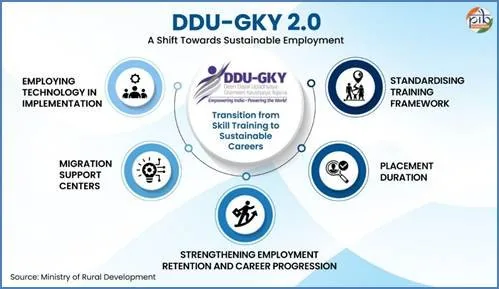
* **End-to-End Skilling Approach:** DDU-GKY 2.0 adopts a comprehensive approach covering the entire employment cycle, including skill training, placement, employment retention and career progression. The revised framework strengthens training quality, placement outcomes, post-placement support and technology-based monitoring.
* **Standardised Training Framework:**
* The scheme retains the 576-hour minimum training duration while restructuring courses into:
* 396 hours of domain-specific training for job-related technical skills.
* 180 hours of mandatory non-domain training.
* **Extended Placement Duration:** Under DDU-GKY 2.0, the minimum placement duration has been increased from three months to six months. The revised framework recognises different employment formats, including wage employment, self-employment and gig employment.
* **Job Melas for Employer Linkages:** Job Melas organised by State Rural Livelihood Missions (SRLMs) at block and Gram Panchayat levels connect trained youth with employers. Financial support of up to ₹50,000 for Gram Panchayat-level fairs and ₹1 lakh for block-level fairs is provided.
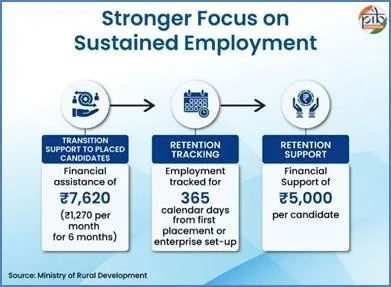
* **Migration Support Centres (MSC):** To address challenges faced by migrating workers, SRLMs establish Migration Support Centres in high-migration areas and destination locations. The annual funding support for MSCs has increased from ₹10 lakh to ₹30 lakh per centre.
* **Technology-Driven Implementation:** DDU-GKY 2.0 strengthens technology-enabled implementation through an end-to-end digital platform covering the entire programme lifecycle, including PIA onboarding, project management, training-centre and candidate management, assessment, certification, financial management, and placement tracking.
* **Digital Monitoring and Transparency Measures:**
* The revised framework introduces:
* Real-time dashboards for programme monitoring.
* Public candidate portal for searching training opportunities and viewing PIA performance ratings.
* Automated processes for project registration, grievance redressal and certificate verification.
* Face-authenticated attendance and digital assessments.
* Integration with the Skill India Digital Hub for course validation.
* **State-Level Rollout of DDU-GKY 2.0 (2025–26):**
* Goa became the first State to create batches under DDU-GKY 2.0.
* Andhra Pradesh initiated training for over 12,000 candidates within three months.
* Jammu & Kashmir allocated 100% of its targets and commenced training for 91% of the allocated candidates.
**Key Milestones Achieved Under DDU-GKY**
* **Extensive Implementation Network:** DDU-GKY is being implemented across 31 States and Union Territories through a wide skilling ecosystem comprising 749 approved projects, 760 active training centres and more than 455 Project Implementing Agencies (PIAs).
* **Large-Scale Skill Training:** Since its inception in 2014–15, the scheme has trained over 18.47 lakh rural youth across 36 sectors and more than 800 job roles, reflecting its broad sectoral coverage and focus on industry-oriented skill development.
* **Employment Generation:** More than 12.43 lakh candidates trained under DDU-GKY have secured placements, demonstrating the scheme’s emphasis on linking skills with employment opportunities.
* **Women Empowerment through Skilling:** The scheme has trained over 9.71 lakh women, with more than 6.34 lakh women securing placements, strengthening women’s participation in the rural workforce.
**Other Initiatives Supporting Rural Youth Entrepreneurship**
* **Promoting Self-Employment:** Alongside placement-based skilling through DDU-GKY, the Government promotes rural entrepreneurship through Rural Self-Employment Training Institutes (RSETIs), which provide free residential training and handholding support to rural unemployed youth.
* **Target Beneficiaries:** RSETIs focus on rural youth aged 18–50 years, particularly those from Below Poverty Line (BPL) households and DAY-NRLM-linked families, helping them establish sustainable livelihoods.
* **District-Level Skill Infrastructure:** RSETIs aim to create dedicated entrepreneurship development infrastructure in every district of the country to support self-employment opportunities.
* **Operational Network:** As of now, 647 RSETIs are operational across 634 districts in 33 States and Union Territories.
* **Training and Settlement Outcomes:** Since inception in 2009, RSETIs have trained 63.47 lakh candidates, of whom 45.60 lakh candidates have been settled through livelihood opportunities.
**Conclusion**
* DDU-GKY 2.0 represents a shift from skill training to sustainable livelihood creation. By integrating industry-aligned training, employment support, digital monitoring and entrepreneurship promotion, the scheme contributes to building a skilled, empowered and self-reliant rural workforce. It supports India’s broader vision of inclusive growth and the goal of Viksit Bharat @2047.
## Security
### US, Denmark and Greenland Sign Agreement on Arctic Security
[Source](https://www.drishtiias.com/current-affairs-news-analysis-editorials/news-analysis/24-09-2026#37628)
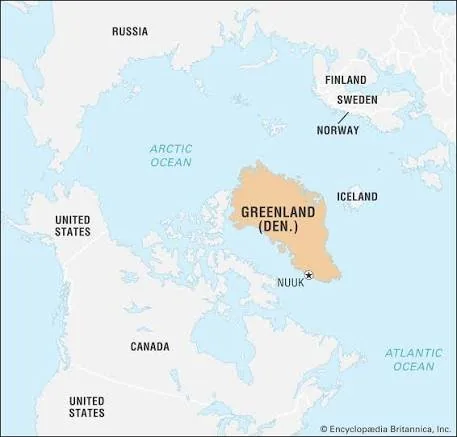
Recently, the US, Denmark and Greenland signed a trilateral agreement on the sidelines of the UN General Assembly in New York to enhance Arctic and North Atlantic security cooperation.
* **About:** The agreement amends the 1951 US–Denmark Defense Agreement on Greenland and aims to strengthen defence cooperation while respecting Greenland’s sovereignty and self-determination.
* **Military Infrastructure:** The agreement allows the US to modernise and expand activities at Pituffik Space Base and establish additional defence areas at Narsarsuaq and Mestersvig in Greenland.
* **Defence Capabilities:** The agreement provides the US military wider access to Greenland, including movement of aircraft, vessels and undersea access, and allows defence cooperation including the possible establishment of the “Golden Dome” missile defence system.
* **NATO and Arctic Security:** The agreement supports stronger NATO engagement in the Arctic through enhanced planning, military presence, exercises and intelligence cooperation.
* **Security Safeguards:** The agreement restricts non-NATO military presence in Greenland and prevents foreign control or influence in sensitive sectors, including critical infrastructure and resource extraction.
* **Strategic Significance:** Greenland’s Arctic location, proximity to North America and Europe, resource potential, emerging shipping routes and strategic importance amid growing competition involving major powers such as Russia and China make it a key region for Arctic security and geopolitics.
## Social Issues
### Recognising Women Farmers in India
[Source](https://www.drishtiias.com/current-affairs-news-analysis-editorials/news-analysis/24-09-2026#37627)
**Why in News?**
* Maharashtra recently became the first Indian state to pass the Women Farmers Empowerment Bill, 2026, which grants women independent legal recognition as farmers through a 'Woman Farmer Certificate,' irrespective of land ownership.
* This historic legislation aligns with the United Nations designating 2026 as the International Year of the Woman Farmer, bringing global and national focus to the systemic exclusion of the female agricultural workforce from formal welfare schemes.
What is the Status of Women in Indian Agriculture?
* **Workforce Participation:**
* The Indian agricultural sector is undergoing a massive demographic shift, widely termed the "feminisation of agriculture (growing role and reliance on women in farming and rural economies)."
* According to the Periodic Labour Force Survey (PLFS) 2023-24, over 76.95% of rural working women are engaged in agriculture and allied activities, making it the largest employer for women.
* **The Ownership Paradox:**
* Women remain underrepresented in land ownership. According to the Agricultural Census 2015–16, only 14% of operational agricultural land holdings were held by women.
* Moreover, only 12.8% of women had ownership or legal rights over agricultural land.
* **Scheme Exclusion:** Because welfare schemes use land records as the sole metric to identify farmers, women are systemically excluded. For instance, women constitute only 23% of beneficiaries under the PM-KISAN scheme nationally.
* **High Incidence of Unpaid Labor:**
* In 2025, despite nearing gender parity in raw workforce numbers (roughly 110 million women to 127 million men), over 41% of female agricultural workers are classified as unpaid helpers in family enterprises, compared to just 20% of men.
* Conversely, nearly 63% of men were own-account workers, compared with only 39% of women.
* Thus, despite women’s growing participation in agriculture, their limited economic recognition and ownership continue to create a significant recognition gap.
**Factors Driving the Feminisation of Agriculture in India**
* Economic Forces
* **Male Distress Out-Migration:**
* Agrarian distress and stagnant farm incomes push rural men toward non-farm urban sectors (e.g., construction, manufacturing) for higher wages, leaving family farm management to women.
* Covid-19 triggered massive urban job losses and reverse migration of men to rural areas. The return of men often shifted land control and key farming decisions back to them, pushing women into marginalised and unpaid agricultural labour.
* **Cost-Cutting via Wage Disparity:**
* High input costs induce landowners to employ women as casual agricultural labourers, as patriarchal wage structures allow them to be paid 20–30% less than male counterparts.
* Economic distress compels small and marginal farmer households to substitute paid hired labour with unpaid female household labour to preserve profit margins.
* **Lack of Rural Non-Farm Alternatives:** Poor rural industrialisation and lower formal educational/vocational training for women restrict them from accessing non-farm rural employment, confining them to primary sector work.
* Socio-Cultural Forces
* **Spatial Immobility and Care Burden:** Social norms designate women as primary caregivers for children, the elderly, and livestock, anchoring them to the village while men migrate.
* **Cultural Perceptions of Farm Work:** Labour-intensive farm operations (transplanting, weeding, harvesting) are culturally treated as extensions of domestic chores, making agricultural tasks socially acceptable for women.
* **Patriarchal Barriers to Migration:** Safety concerns, social surveillance, and caste/community taboos discourage women from independently migrating to cities for livelihood opportunities.
* **Lack of Property Rights:** Customary inheritance norms favor male lineage, leaving women landless and trapped in informal subsistence agriculture without the assets or collateral needed to transition into entrepreneurship.
Why is it Crucial to Recognise Women as Farmers?
* **Ensuring Food Security:** The Food and Agriculture Organization (FAO) estimates that if women farmers had the same access to productive resources as men, agricultural yields could increase by 20% to 30%, potentially reducing global hunger for 100–150 million people.
* **Household Wellbeing and Nutrition:**
* Recognizing women as independent economic actors gives them greater control over agricultural income.
* Women are statistically more likely to reinvest earnings into household nutrition, healthcare, and education.
* **Climate-Smart Agriculture:**
* Women hold significant indigenous knowledge regarding traditional seed preservation, biodiversity, and soil management.
* Empowering them is critical for building resilience against climate change and adopting sustainable practices.
What are the Major Challenges Faced by Women Farmers?
* **The Worker-Owner Dichotomy:** Patriarchal inheritance norms dictate that land is usually registered in a man's name. Because state mechanisms define a "farmer" based on land titles, women are rendered statistically invisible.
* **Lack of Institutional Credit:** Without land to serve as collateral, women cannot easily access formal banking services, Kisan Credit Cards (KCC), or affordable agricultural loans, forcing them to rely on informal money lenders.
* **Exclusion from State Welfare:** Essential support mechanisms such as subsidized fertilizers, seeds, crop insurance (PMFBY), and extension services are channeled through land records, bypassing female cultivators entirely.
* **Gender Bias in Mechanization:**
* Most modern agricultural machinery is designed for male ergonomics.
* The lack of lightweight, gender-sensitive farming technology increases the physical drudgery for women.
* **Poor Market Access:** Social constraints, lack of transportation, and male-dominated APMC mandis restrict women from negotiating fair prices for their produce, leaving them vulnerable to middlemen.
**India’s Initiatives Related to Women Farmers**
* **Mahila Kisan Sashaktikaran Pariyojana (MKSP):** A sub-component of the DAY-NRLM scheme that seeks to improve the skills and capacities of women in agriculture to enhance their participation and productivity.
* **Krishi Sakhi Convergence Program (KSCP):** Linked with the 'Lakhpati Didi' initiative, this program trains rural women as Community Agriculture Care Service Providers to deliver last-mile agricultural advisory services.
* **Earmarked Allocations:** The Ministry of Agriculture and Farmers Welfare mandates that at least 30% of the budget allocation for various central schemes and programs is reserved for women farmers.
* **Promotion of Women FPOs:** The government is actively promoting the creation of Farmer Producer Organizations (FPOs) exclusively for women to improve their bargaining power and market integration.
* **Uttar Pradesh:** The UP Government provides a 1% stamp duty concession on property or agricultural land registered in a woman’s name to promote female land ownership.
**What Measures Can Empower Women Farmers in India?**
* **De-linking Farmer Status from Land Ownership:** States should replicate Maharashtra's model by introducing activity-based definitions of farming. Issuing legal "Woman Farmer Certificates" through local Gram Sabhas can help landless cultivators, sharecroppers, and laborers access state benefits.
* **Creating Interoperable Databases:** Standardizing the definition of a woman farmer across states and integrating this data with Agri Stack will create a unified digital registry, enabling direct benefit transfers and unique FarmerIDs.
* **Expanding Collateral-Free Credit:** Financial institutions and NABARD should formally recognize activity-based farming certificates as valid documents to disburse zero-collateral agricultural credit and Kisan Credit Cards to women.
* **Strengthening Local Governance:** Empowering Gram Panchayats and local institutions is crucial for generating awareness, facilitating the certification process, and embedding women's agricultural priorities into Gram Panchayat Development Plans (GPDPs).
* **Gender-Responsive Budgeting and Audits:** State governments must conduct strict annual audits to ensure that the mandated 30% allocation in agricultural subsidies directly reaches certified women farmers on the ground.
**Conclusion**
* Bridging the women farmer recognition gap by delinking farmer identity from land ownership can improve access to agricultural schemes, credit, technology and welfare benefits. It can also advance SDG 5 (Gender Equality), SDG 1 (No Poverty) and SDG 2 (Zero Hunger).
* As 2026 marks the International Year of the Woman Farmer, scaling Maharashtra’s activity-based farmer recognition model across States can ensure that women engaged in farming are formally recognised, included in agricultural databases and empowered as equal participants in India’s agricultural economy.
## Visits & Conferences
### G20 Nations Adopt 4 Consensus Outcomes on Energy, Water and Critical Minerals
[Source](https://www.drishtiias.com/current-affairs-news-analysis-editorials/news-analysis/24-09-2026#37624)
India joined other G20 members in adopting four consensus outcomes at the G20 Energy Abundance Ministerial held in Houston, Texas, focusing on household energy access, infrastructure approvals, water reuse and critical mineral supply chains.
* **Household Energy Access:** G20 members supported affordable and scalable clean cooking solutions, including liquefied petroleum gas (LPG) as an option to replace traditional biomass in developing countries where LPG can be reliably expanded.
* **Infrastructure Permitting Reforms:** Countries agreed to promote efficient, predictable and effective domestic permitting and regulatory processes to accelerate energy infrastructure projects.
* **Water Reuse Initiative:** G20 launched a voluntary water-reuse initiative to encourage recycling and reuse of water across sectors such as communities, agriculture, manufacturing and energy production, based on water quality and intended use.
* **Critical Mineral Supply Chains:** Members agreed to voluntary cooperation for creating secure, affordable and diversified critical mineral value chains through information sharing, innovation, investment, capacity building and local value addition.
* **Nature of Commitments:** The G20 outcomes are consensus-based political commitments and not legally binding treaties; their implementation depends on the domestic policies, regulations and investments of participating countries.
* **Significance:** The outcomes align with India’s priorities in clean cooking fuel expansion, infrastructure development, water conservation and securing critical minerals required for sectors such as electronics, renewable energy and advanced manufacturing.
This documentation is built and hosted on [Mintlify](https://mintlify.com), a developer documentation platform.