Comrades Dispatch · 25 Sep 2026 (PDF)
In this edition
- Alternatives to SWIFT Banking & Finance
- India’s 1st Blue Bond Banking & Finance
- Autonomy of the Election Commission of India (ECI) Polity & Governance
- Bridging the Civic Infrastructure and Governance Deficit Polity & Governance
- Retention of Scheduled Tribe (ST) Status Post-Conversion Polity & Governance
- MoD Signs Contract for SAT-SAAW Glide Bombs for IAF Security
- Jay Meena Wins India’s 1st-Ever Asian Games Medal in Soft Tennis Sports
Banking & Finance
Alternatives to SWIFT
Source Why in News?- Geopolitical events and economic sanctions have accelerated global efforts to develop alternatives to the Society for Worldwide Interbank Financial Telecommunication (SWIFT) network.
- Forums like BRICS are actively exploring cross-border payment systems utilizing local currencies, Central Bank Digital Currencies (CBDCs), and platforms such as mBridge and Project Nexus.
- About: SWIFT is a secure, global messaging system integral to international trade that provides financial institutions with reliable instruction messages for cross-border fund transfers without directly settling the money itself.
- Nature and Function:
- It is a trusted cooperative messaging network, rather than a clearing or settlement system.
- It securely transmits standardized payment instructions between banks to facilitate quick international transactions.
- Establishment and Governance: Based in Brussels, Belgium, SWIFT was founded in 1973. It is overseen by the central banks of the G10 countries, the European Central Bank, and the National Bank of Belgium.
- Global Reach:
- More than 11,000 financial institutions around the world use SWIFT, making it the backbone of the international financial transfer system.
- While most payments are made in the US dollar, the system also includes payments in the British pound, Indian rupees, euros, and yen, among others.
- Operational Mechanism: It uses unique 8-character or 11-character alphanumeric codes (SWIFT or BIC codes) to identify participating institutions, their country, location, and specific branch.
- Impact of Sanctions (e.g., Russia):
- Excluding a country’s banks from the network paralyses its ability to execute international financial transactions, receive export payments, and access short-term credit.
- It can also disrupt domestic credit card networks operating through the system and create broader global economic ripples, such as energy supply disruptions and elevated commodity prices.
- National Interbank Systems
- India’s Unified Payments Interface (UPI):
- India’s Unified Payments Interface (UPI) is a real-time domestic instant payment system that is expanding internationally through bilateral linkages with foreign payment networks, enabling cross-border digital payments.
- Recognized by the International Monetary Fund (IMF) in a June 2025 report, UPI accounted for an impressive 49% of the global real-time payment transaction volume in 2024.
- As of 2026, UPI is live in 11 foreign countries for merchant acceptance and cross-border remittances. Adding to its established presence in popular destinations like Singapore, the UAE, France, Bhutan, Nepal, Sri Lanka, Mauritius, and Qatar, recent 2026 expansions have successfully enabled seamless UPI connectivity in Cambodia, Greece, and the Maldives.
- With ongoing initiatives to empower Non-Resident Indians (NRIs) and build payment interoperability with nations like Japan, India’s UPI continues to redefine secure and instant international financial connectivity.
- China’s CIPS (Cross-Border Interbank Payment System):
- Backed by the People’s Bank of China and launched in 2015, CIPS facilitates the clearing and settlement of cross-border Yuan transactions directly onshore.
- It allows global banks to bypass offshore clearing hubs and currently has participants in over 120 countries, including all BRICS members except India.
- Russia’s SPFS (System for Transfer of Financial Messages):
- Developed by the Bank of Russia in 2014 to bypass Western sanctions, this system serves as an alternative electronic financial messaging channel.
- It proved crucial when Russian banks were cut off from SWIFT in 2022.
- Iran’s SEPAMA: Iran’s local interbank telecommunication system. In 2023, the Central Bank of Iran linked SEPAMA with Russia’s SPFS, allowing Iranian and foreign banks to connect.
- India’s Unified Payments Interface (UPI):
- Project mBridge:
- Launched in 2021, mBridge is a cross-border, decentralised multi-CBDC (mCBDC) platform developed using distributed ledger technology (DLT).
- Its blockchain-based mBridge Ledger enables real-time peer-to-peer cross-border payments and foreign exchange transactions.
- Initially led by the Bank for International Settlements (BIS) Innovation Hub with the central banks of China, Thailand, UAE and Hong Kong, it was joined by the Saudi Central Bank in 2024.
- The platform also has 31+ observing members, including the Reserve Bank of India (RBI).
- Achieved “minimum viability” in 2024, enabling direct multi-currency cross-border wholesale transactions.
- BIS exited the initiative in 2024 amid concerns over its potential use to bypass unilateral sanctions. By late 2025, the platform primarily functioned as a renminbi-based settlement channel for energy and commodity trade between China and the Gulf region.
- Project Nexus:
- Developed by the BIS Innovation Hub, it aims to connect domestic Fast Payment Systems (FPSs) for instant cross-border retail payments.
- India and four ASEAN countries (Malaysia, Philippines, Singapore and Thailand) are the founding members.
- Nexus builds on India’s UPI and existing bilateral Fast Payment System (FPS) linkages to enable instant, multilateral cross-border retail payments.
- BRICS Pay:
- Proposed by the BRICS Business Council in 2018, BRICS Pay is a decentralised digital payment ecosystem aimed at simplifying payments among BRICS countries.
- It can also be used by “friendly states” and is envisioned as a compatible alternative to Western payment systems such as SWIFT, Visa and Mastercard, rather than a replacement.
- BRICS is working to integrate domestic payment networks, local currencies and CBDCs into a unified cross-border payment architecture. The more plausible model is a network of interoperable national systems, linking platforms such as India’s UPI and Brazil’s Pix, while enabling greater settlement in national currencies.
- Stablecoin Settlements:
- Digital tokens pegged to fiat currencies (like USDC or USDT) settle cross-border transactions in seconds on public blockchains (such as Solana or Base).
- Because they operate 24/7 without geographic constraints, stablecoin rails cost mere cents per transaction, making them a rapidly growing choice for global B2B payments and payroll.
India’s 1st Blue Bond
Source India is set to enter the blue finance market with its first-ever blue bond issuance by Sagarmala Finance Corporation Limited (SMFCL) (India’s first maritime sector-specific Non-Banking Financial Company (NBFC)), aimed at mobilizing long-term capital for sustainable maritime infrastructure and ocean economy projects.- Issuance Size and Structure: The maiden issue aims to raise a total of Rs 600 crore through 10-year debt securities, which includes a base issue and an over-subscription greenshoe option of Rs 500 crore.
- Definition and Scope of Blue Bonds:
- These are specialised debt instruments, a sub-category of green bonds, that raise capital for protecting and sustainably using ocean and water ecosystems.
- They can finance projects related to sustainable shipping, ocean renewable energy, marine biodiversity conservation, sustainable fisheries, water recycling and coastal mapping.
- Capital Allocation: The proceeds are slated for deployment within the current financial year to support maritime sector lending, development of greenfield port projects, and expansion of the coastal road network.
- Market Placement: SBI Capital Markets is appointed as the arranger to secure commitments from long-term institutional investors such as insurance companies and provident funds.
- Municipal Sector Traction: Following the national maritime lender’s move, Gujarat’s Vadodara Municipal Corporation plans to raise roughly Rs 200 crore via blue bonds, marking the arrival of ocean and water-centric thematic borrowing into Urban Local Body (ULB) municipal debt markets.
- Global Examples: Seychelles issued the world’s first sovereign blue bond in 2018 through World Bank’s SWIOFish3 project, while Belize used a debt-for-ocean swap in 2021 to support marine conservation.
Polity & Governance
Autonomy of the Election Commission of India (ECI)
Source Why in News?- The Election Commission of India (ECI) is facing renewed scrutiny over its institutional independence and functioning. Opposition parties have sought action against the Chief Election Commissioner(CEC) following reports that two Election Commissioners (ECs) had recorded objections on several decisions, while the ECI has maintained that its final decisions were unanimous.
- At the same time, the Supreme Court has referred challenges to the Chief Election Commissioner and Other Election Commissioners (Appointment, Conditions of Service and Term of Office) Act, 2023 to the Chief Justice of India (CJI) for consideration of an appropriate Constitution Bench after a 1:1 split verdict.
- Concerns Regarding the 2023 Appointments Act
- Article 324:
- Vests the superintendence, direction, and control of elections in an ECI. It states that the appointment of the CEC and other Election Commissioners shall, subject to the provisions of any law made by Parliament, be made by the President.
- For over seven decades, Parliament did not enact a specific law for these appointments, leaving the process under the exclusive domain of the Union Executive (the Central Government).
- The CEC can only be removed from office in a manner and on grounds similar to a judge of the Supreme Court. The other Election Commissioners can only be removed on the recommendation of the CEC.
- The 2023 Election Commissioner Appointment Act:
- In March 2023, a five-judge Constitution Bench in the Anoop Baranwal v. Union of India case ruled that until Parliament enacts a law, the CEC and ECs shall be appointed on the advice of a committee comprising the Prime Minister, the Leader of Opposition (LoP) in the Lok Sabha, and the Chief Justice of India (CJI).
- To replace this interim arrangement, Parliament enacted the 2023 Act, which introduced a new Selection Committee comprising:
- The Prime Minister (Chairperson), The Leader of the Opposition in the Lok Sabha (Member), and a Union Cabinet Minister nominated by the Prime Minister (Member).
- Key Concerns with the Act:
- Exclusion of the CJI: The most contentious aspect is the removal of the CJI from the selection panel, replacing them with a Cabinet Minister.
- Executive Dominance: The 2:1 majority in the Selection Committee (PM and Cabinet Minister) essentially gives the Executive the final say, rendering the LoP’s presence largely ornamental.
- Perception of Bias: Critics contend that the provision may affect perceptions of institutional independence and raise concerns regarding safeguards for free and fair elections.
- Referring the Matter to a Larger Bench:
- The core judicial concern, highlighted during the recent split verdict, is that “it is not enough for the ECI to be independent, it must also appear to be independent.”
- Critics argue that the 2023 Act fails this “perception test” (whether the ECI is seen as independent and impartial), potentially undermining public confidence in its neutrality.
- Article 324:
- Concerns Regarding Internal Governance of the ECI
- Collegial Decision-Making:
- The ECI functions as a multi-member collegial body comprising the CEC and two ECs. Under Article 324 of the Constitution, decisions are taken through unanimity or majority.
- Reports of repeated dissent over decisions allegedly taken without the knowledge of all Commissioners raise concerns about transparency and institutional collegiality.
- Procedural Irregularities in Form 6:
- During the Special Intensive Revision (SIR), it is alleged that changes were introduced to Form 6 (for new voter registration) through administrative directives rather than statutory procedure.
- Form 6 is a statutory form framed under the Registration of Electors Rules, 1960. Under Section 28 of the Representation of the People Act, 1950, the power to amend these rules and forms rests exclusively with the Central Government through an Official Gazette notification (in consultation with the ECI), making changes via administrative orders or portal updates legally untenable.
- Centralisation of Electoral-Roll Management:
- The dissenting Election Commissioners also raised concerns over the centralisation of electoral-roll IT systems, including ERONet, in Delhi.
- They argued that limited access for State-level officials could weaken the decentralised structure of electoral-roll management.
- Risk of Mass Disenfranchisement:
- Despite the ECI’s inclusive guiding principle that “no voter to be left behind,” reports indicating the deletion of approximately 13 crore voters nationwide during the SIR have raised critical alarms.
- Such large-scale deletions raise serious questions about the procedural transparency and accuracy of the verification process, highlighting the potential risk of disenfranchising legitimate voters.
- Institutional Credibility: Repeated internal dissent and concerns over decision-making procedures may affect transparency, accountability, institutional coherence and public confidence in the ECI.
- Collegial Decision-Making:
- Broad-Based Selection Committee: Reform the appointment process to reduce executive dominance and strengthen the perception of ECI independence. The Dinesh Goswami Committee (1990), the Law Commission of India (255th Report, 2015) and Anoop Baranwal judgment (2023) support a more balanced or consensus-based selection mechanism.
- Equal Protection for Election Commissioners: Extend removal protection to Election Commissioners on par with the CEC to enable independent decision-making and fearless dissent.
- Post-Retirement Safeguards: Introduce a cooling-off period or restrictions on post-retirement executive appointments to reduce perceptions of conflicts of interest or quid pro quo.
- Clear Transaction of Business Rules: Codify internal procedures requiring circulation and approval of major decisions by all Commissioners, strengthening collegial decision-making, transparency and accountability.
- Follow Statutory Procedure: Changes to electoral forms and procedures under the Representation of the People Act, 1950 and Registration of Electors Rules, 1960 should follow proper legal vetting and formal notification, rather than administrative directions alone.
- Protect Decentralised Electoral Administration: Systems such as ERONet should support, rather than centralise, electoral administration. State and district authorities should retain adequate access, oversight and operational autonomy.
- Expenditure Charged on the Consolidated Fund of India:
- Unlike the Supreme Court, the Comptroller and Auditor General (CAG), and the Union Public Service Commission (UPSC), the administrative expenses of the ECI are currently “voted” by Parliament rather than “charged” upon the Consolidated Fund of India.
- Granting “charged” status under the Union Budget would insulate the Commission from financial control or budgetary pressures exerted by the Union Executive.
- An Independent and Permanent Secretariat:
- Analogous to Article 98 (Secretariat of Parliament) and Article 146 (Supreme Court officers and servants), the ECI should have an independent cadre and service conditions for its officers and staff.
- Reducing dependence on deputations from Union civil services helps foster institutional memory and insulates operational staff from executive reporting chains.
- The ECI is central to ensuring free and fair elections. Strengthening its structural autonomy, financial independence, collegial transparency and institutional integrity is essential to preserve the “perception of independence” and sustain public confidence in India’s electoral process.
Bridging the Civic Infrastructure and Governance Deficit
Source Why in News?- Urban tragedies across Indian metropolises, including deaths from open manholes, flooded construction pits, fires and severe waterlogging, have exposed systemic gaps in civic infrastructure, urban planning and governance, driven by bureaucratic apathy, flawed master plans and impunity for illegal constructions.
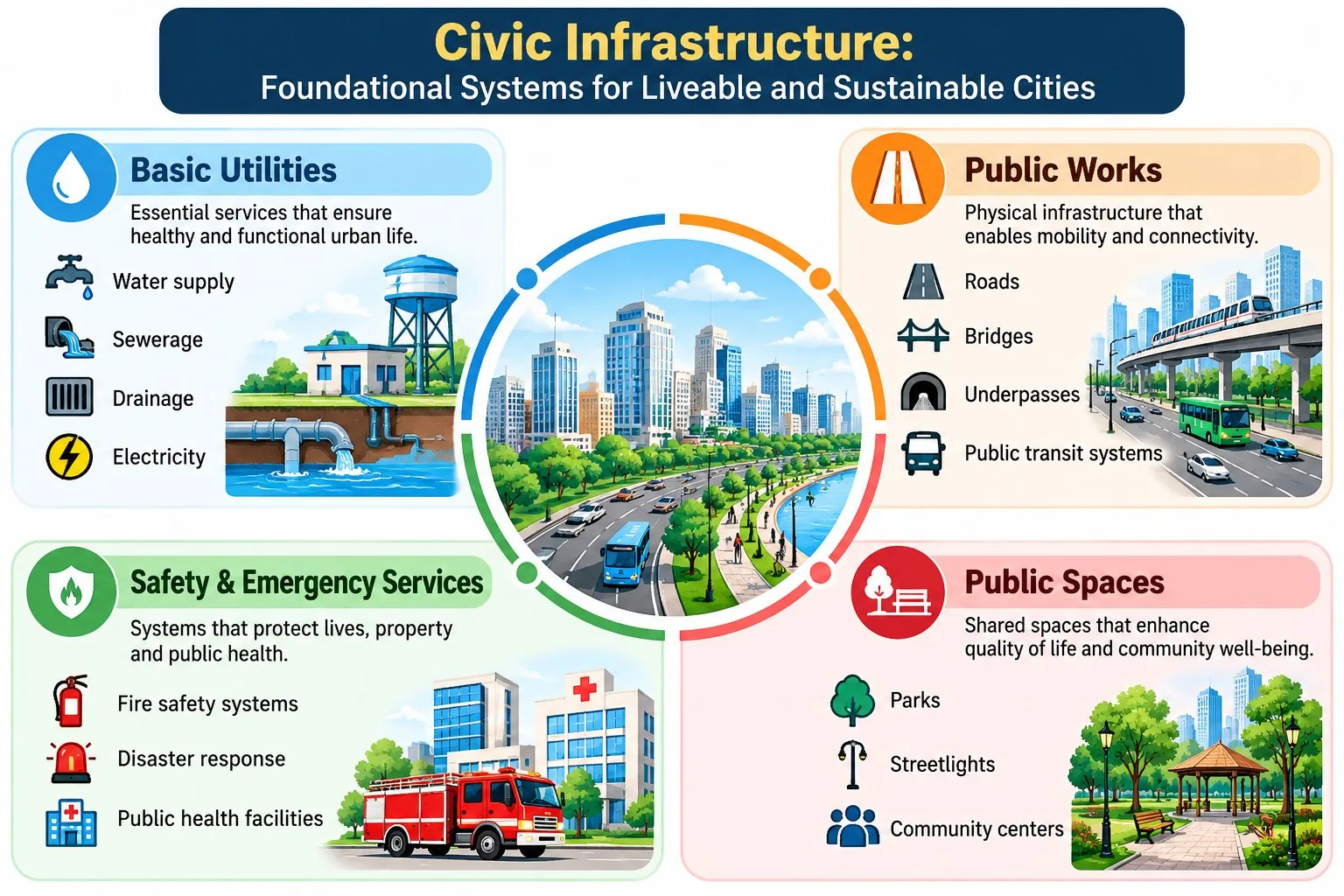
- About: Civic infrastructure refers to the foundational physical and institutional structures required for the smooth functioning of a city.
- Significance of Robust Civic Infrastructure:
- Fundamental Rights: Safe water, public spaces and infrastructure are integral to Article 21 – Right to Life with Dignity. Municipal Council, Ratlam v. Vardichand (1980) affirmed the municipal duty to ensure public health and sanitation.
- Stemming Human Capital Flight (Brain Drain):
- Poor civic amenities can drive high-net-worth individuals (HNIs) and skilled professionals abroad (over 1.5 million Indians relinquished citizenship over the past decade), reflecting migration for better quality of life and social security.
- Better urban services improve quality of life, helping retain skilled professionals and reduce migration.
- Economic Growth & Investment: Robust infrastructure attracts FDI, private investment and formal jobs, while poor infrastructure can lead to low investment, unemployment, distress migration and stagnant development.
- Public Health: Poor drainage, waste management and contaminated water increase vector-borne and waterborne diseases, healthcare costs and productivity losses.
- Social Equity: Affordable housing, public transport and social infrastructure improve access to opportunities and prevent vulnerable groups from being trapped in intergenerational poverty.
- Mass Rapid Transit Expansion:
- Over 900 km of operational metro networks have expanded public transport capacity and supported low-carbon urban mobility.
- Namo Bharat (Delhi–Meerut RRTS), India’s first RRTS, enables faster NCR connectivity and supports decentralised urban growth.
- Atal Setu - 21.8-km India’s longest sea bridge, connecting Mumbai and Navi Mumbai and improving regional connectivity.
- Sanitation & Solid Waste Management (SBM-U): Swachh Bharat Mission-Urban has promoted ODF status, sanitation access and scientific waste segregation, with Indore emerging as a leading model.
- Digital Governance (Smart Cities Mission): Integrated Command and Control Centres (ICCCs) across 100 cities use IoT, GIS and data analytics for traffic management, utility monitoring and disaster response.
- Transit-Oriented Development (TOD): Promotes high-density, mixed-use development around transit corridors to improve land-use efficiency, public transport use and curb urban sprawl.
- MICE Infrastructure:
- Bharat Mandapam: Major international convention and exhibition centre supporting global summits and business tourism.
- Yashobhoomi: Large-scale MICE hub in Dwarka with dedicated metro connectivity.
- Surat Diamond Bourse: World’s largest office building, consolidating the diamond trading ecosystem.
- Institutional Fragmentation:
- Mega-cities suffer from a multiplicity of parastatal agencies (Municipal Corporations, Development Authorities, Water Boards) operating in silos.
- The Mumbai Ghatkopar hoarding collapse (May 2024) highlighted the fatal jurisdictional ambiguity between the local municipal corporation and railway authorities, resulting in a severe regulatory vacuum.
- Constitutional Bypass of ULBs:
- Despite the 74th Constitutional Amendment Act 1992, state governments routinely bypass elected Urban Local Bodies (ULBs) via technocratic parastatals accountable to the state legislature rather than city electorates.
- This renders Metropolitan Planning Committees (Article 243ZE) largely defunct or unnotified.
- Deficits in Master Planning & Spatial Regulation:
- The NITI Aayog (2021 report on Urban Planning Capacity) highlights that over 65% of urban settlements lack statutory Master Plans.
- The Delhi UPSC Coaching Tragedy (July 2024) exemplifies this, where illegal land-use conversion (basement libraries) and the encroachment of stormwater drains exposed the gross enforcement failure of the Master Plan for Delhi.
- Ecological Blindness in Infrastructure Design:
- Unregulated concretization over natural hydrological networks has severely compromised the natural drainage coefficient of cities.
- The Bengaluru water crisis and recurring urban floods illustrate the catastrophic impact of disrupting natural cascades (e.g., Bellandur and Varthur valleys), trapping the city in a cycle of monsoon flooding and summer water scarcity.
- Compromised Safety Auditing & Structural Integrity: The Delhi Airport canopy collapse (June 2024) following extreme precipitation underscores the inadequacies in lifecycle maintenance, structural auditing, and climate-proofing of even highly capitalized public infrastructure.
- Fiscal Starvation & Incomplete Devolution:
- The Second Administrative Reforms Commission (ARC), 2005, and the High-Powered Expert Committee (HPEC) on Urban Infrastructure (2011) have noted the failure to devolve the 3Fs (Funds, Functions, Functionaries).
- As per the RBI Report on Municipal Finances, municipal revenue in India remains stagnant at approximately 1% of GDP (compared to ~6% in South Africa and ~5% in Brazil). ULBs rely heavily on intergovernmental fiscal transfers and state-tied grants.
- The abolition of local taxes (like Octroi) post-GST without dynamic buoyancy mechanisms, combined with abysmal property tax collection efficiency (often under 30–40% of potential) and an underdeveloped Municipal Bond market, prevents cities from financing capital-intensive infrastructure upkeep.
- Ecological Blindness:
- Conventional urban engineering prioritizes grey infrastructure (concrete culverts and asphalt roads) over blue-green infrastructure (wetlands, retention ponds, and urban forests).
- This drastically increases the impervious surface area, lowering the runoff retention capacity.
- Natural floodplains, catchments, and hydrological cascades that historically moderated monsoon floods have been reclaimed for real estate and transport corridors.
- Weak Non-Motorised Transport (NMT):
- Indian cities often lack safe pedestrian and cycling infrastructure, with existing footpaths and cycle tracks frequently encroached upon, poorly designed or poorly maintained.
- Poor integration of land-use and transport planning also weakens Transit-Oriented Development (TOD) and sustainable urban mobility.
- Climate Vulnerability:
- Increasing impermeable surfaces intensify the Urban Heat Island (UHI) effect, raising urban temperatures and thermal stress.
- At the same time, extreme rainfall and cloudbursts frequently overwhelm outdated drainage systems, causing urban flooding and waterlogging and exposing gaps in climate-resilient urban infrastructure.
- Ethical Deficit, Moral Hazard & “Sanctioned Impunity”:
- Post-disaster inquiry ritualism often replaces meaningful accountability.
- Saket Building Collapse (May 2026), killed six people despite prior MCD notices, highlighting enforcement failure and “sanctioned impunity.”
- After building collapses, structural failures or flood-related deaths, authorities typically announce magisterial inquiries, ex-gratia compensation and suspension of junior officials, while senior officers, planners, structural consultants and builders rarely face criminal or professional liability. This weakens urban governance and civic accountability.
- Despite the Supreme Court’s ruling in Municipal Council, Ratlam v. Vardichan (1980), which affirmed municipal bodies’ statutory duty to ensure public health, sanitation and safety, weak personal accountability has allowed civic non-compliance and “sanctioned impunity” to persist.
- AMRUT 2.0: Aims to make all statutory towns water-secure through the circular economy of water, rejuvenation of water bodies, and universal coverage of sewerage.
- PM Awas Yojana - Urban (PMAY-U): Focused on addressing the urban housing shortage by providing affordable, pucca houses to the urban poor.
- PM-eBus Sewa: Augmenting city bus operations with 10,000 electric buses on a Public-Private Partnership (PPP) model to promote green mobility.
- Best Practices:
- Surat & Ahmedabad Model: Effective use of Town Planning (TP) schemes for land pooling and infrastructure layout before development occurs, alongside successful Bus Rapid Transit Systems (BRTS).
- Odisha’s Jaga Mission: A globally recognized initiative that granted land rights to slum dwellers while upgrading slums into livable, basic-infrastructure-equipped habitats, shifting away from aggressive eviction models.
- Singapore Model (Global): Integrated water management (NEWater), strictly enforced zoning laws, and a single, unified nodal authority for city planning.
- Implementing NITI Aayog Recommendations (2021):
- Launch a ‘500 Healthy Cities Programme’ to integrate spatial planning with public health.
- The critical shortage of town planners (currently at a 42% vacancy rate in state departments) must be addressed via lateral entry.
- Investment in NMT:
- Nearly 50% of urban trips are under 5 km, making them well-suited for walking and cycling.
- Punjab became the first Indian state to enforce the “Right to Walk”, mandating road-owning agencies, including NHAI, to provide safe pedestrian infrastructure.
- Expanding dedicated footpaths, cycle tracks and NMT infrastructure can promote affordable, inclusive and sustainable urban mobility while reducing congestion and emissions.
- Empowering Urban Local Bodies (Mayor-in-Council):
- As recommended by the High-Powered Expert Committee (2011), ULBs must be financially empowered.
- Establishing a Mayor-in-Council system will create a single, accountable executive authority for the entire city, eliminating parastatal fragmentation.
- Climate-Resilient Infrastructure (Sponge Cities): Adopt the “Sponge City” concept by restoring urban wetlands, mandating permeable pavements, and strictly enforcing Rainwater Harvesting (RWH) to manage peak monsoon loads and recharge groundwater.
- Urban Heat Island (UHI) Mitigation: Mandate “Cool Roof” policies, urban green corridors, and the deployment of permeable, high-albedo pavements to arrest micro-climatic thermal spikes in high-density urban cores.
- Deepening the Municipal Bond (Muni Bond) Market:
- Create credit-enhancement vehicles and leverage the Pooled Finance Development Fund (PFDF) scheme for Tier-2 and Tier-3 ULBs lacking standalone credit ratings (drawing lessons from the Ahmedabad and Vadodara Municipal Green Bonds).
- State governments should implement State Finance Commission recommendations under Article 243Y and ensure predictable, formula-based local-body funding, linked to own-revenue mobilisation and the performance-based grant framework of the 16th Finance Commission.
- Independent Third-Party Quinquennial Audits:
- Mandate comprehensive structural, hydrological, and fire-safety audits by accredited, independent agencies (e.g., IITs/CBRI) prior to issuing building permits and subsequently at mandatory 5-year intervals for all commercial and institutional structures.
- Audit ratings and structural compliance logs must be published on a public Right to Information (RTI) Act, 2005 Section 4-compliant Open Data Dashboard to eliminate opacity.
- Indian cities drive economic growth, but this momentum cannot be sustained without resilient civic infrastructure and urban governance. The shift from “absorbing tragedy and moving on” requires treating urban governance as a core constitutional responsibility.
Retention of Scheduled Tribe (ST) Status Post-Conversion
Source The Allahabad High Court affirmed that religious conversion does not automatically extinguish Scheduled Tribe (ST) status; however, the continuation of such status is a question of fact that requires substantiating an ongoing connection to tribal customs, traits, and community life.- Legal Ratio on Religious Conversion: Relying on the Supreme Court ruling in Chintad Anand vs State of Andhra Pradesh and Others (2026), the Court ruled that there is no absolute legal bar terminating ST status upon conversion, contrasting with Scheduled Caste (SC) status under the Constitution (Scheduled Castes) Order, 1950, which restricts SC status primarily to Hinduism, Sikhism, and Buddhism.
- Test of Tribal Identity (Question of Fact): To claim constitutional protection under Article 342, an individual must prove that they have not severed their ethnic roots, demonstrated through active observance of tribal customs, traditions, rituals, and acceptance by the community.
- Evidentiary Value of Caste Certificates: The Court held that a caste certificate issued by an executive authority (such as a Tehsildar) is not conclusive proof; it remains rebuttable if subsequent conduct, such as complete social and religious assimilation into a non-tribal community over decades, indicates a severance of tribal identity.
- Statutory Bar on Tribal Land Alienation: The ruling reinforced land transfer prohibitions under Section 157-B of the UP Zamindari Abolition and Land Reforms (UPZA&LR) Act, 1950 and Section 99 of the UP Revenue Code, 2006, which mandate that agricultural land belonging to an ST member cannot be transferred to a non-ST person to prevent land dispossession.
- Article 366(25) of the Constitution of India states: “Scheduled Tribes” means such tribes or tribal communities or parts of or groups within such tribes or tribal communities as are deemed under Article 342 to be Scheduled Tribes for the purposes of this Constitution.
- Under Article 342, the President of India holds the initial authority to formally notify these communities, while only Parliament has the power to amend the official list.
- Constituting 8.6% of India’s total population (Census 2011), Scheduled Tribes are identified based on the rigorous Lokur Committee (1965) criteria, which include primitive traits, distinctive culture, geographical isolation, shyness of contact with the larger community, and socio-economic backwardness.
- The constitutional framework safeguards their land rights, political representation, and traditional governance through the targeted administrative structures of the Fifth and Sixth Schedules.
- Further institutional protection is anchored by the National Commission for Scheduled Tribes (NCST, Article 338A) and statutory frameworks like the Forest Rights Act (FRA), 2006, which recognize historical land tenure and biodiversity conservation efforts.
- Within this demographic, India officially categorizes 75 Particularly Vulnerable Tribal Groups (PVTGs). These specific groups are characterized by pre-agricultural levels of technology, physical isolation, and extreme socio-economic vulnerability, necessitating specialized policy interventions and welfare support.
Security
MoD Signs Contract for SAT-SAAW Glide Bombs for IAF
Source Recently, the Ministry of Defence signed a contract with Bharat Dynamics Limited (BDL) for the procurement of 160 Satellite Smart Anti-Airfield Weapons (SAT-SAAW) along with associated equipment for the Indian Air Force (IAF). The ₹810.79 crore contract was signed in New Delhi under the Buy (Indian-Indigenously Designed, Developed and Manufactured) category, with deliveries scheduled between 2027-28 and 2028-29.- About SAT-SAAW: SAT-SAAW is an air-to-ground precision-guided glide bomb designed to neutralise enemy airfields from long stand-off ranges, thereby enhancing the IAF’s precision strike capability.
- Platform Compatibility: The weapon can be launched from Jaguar fighter aircraft, Hawk advanced jet trainers and Su-30MKI fighter aircraft.
- Indigenous Development:
- The system has been designed and developed by the Defence Research and Development Organisation (DRDO) and will have 60% indigenous content.
- The programme aims to increase self-reliance by indigenising critical sub-systems, including the Inertial Measurement Unit (IMU), Long Impact Delay Fuse and Twin Store Carrier.
- Significance: The induction of SAT-SAAW will enhance the IAF’s stand-off precision strike capability, strengthen defence preparedness and support Atmanirbharta in defence production.
Sports
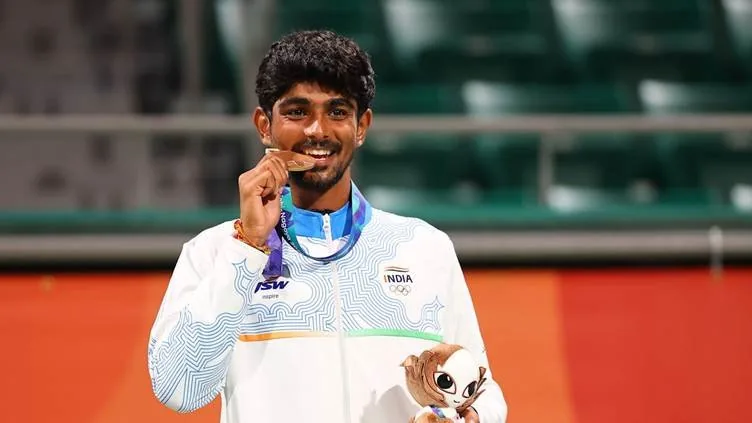
Jay Meena Wins India’s 1st-Ever Asian Games Medal in Soft Tennis
Source Jay Meena won the bronze medal in the Men’s Individual event in Soft Tennis at the 2026 Asian Games, becoming India’s first-ever Asian Games medallist in Soft Tennis.- About: Jay secured his historic medal after reaching the semi-finals of the Men’s Individual event. He defeated Sherwin Nuguit of the Philippines in the quarter-final before losing to Japan’s Takuya Kurosaka in the semi-final.
- Major Achievements:
- Won a gold medal in Men’s Singles at the 36th National Games (2022), Gujarat.
- Became India’s Men’s Singles National Champion in 2025.
- Won India’s first-ever mixed doubles bronze medal at the World Soft Tennis Championships (2024) with Aadhya Tiwari.
- Became the first Indian male player to win a bronze medal in Men’s Singles at the Asian Soft Tennis Championships (2025).
- Asian Games Participation: The 2026 Asian Games marked Jay Meena’s third Asian Games appearance, following his participation in Jakarta 2018 and Hangzhou 2023.
- About Soft Tennis: Soft Tennis is a racquet sport that originated in Japan and is a variation of lawn tennis. It uses lightweight rubber balls and specialised equipment and is mainly popular in East and Southeast Asian countries.
- Significance: Jay Meena’s achievement marks a milestone for Indian Soft Tennis, bringing recognition to an emerging sport and encouraging greater participation among young athletes.