Comrades Editorial · 25 Sep 2026 (PDF)
In this edition
- Formalisation of India’s Informal Economy Economic Scenario
Economic Scenario
Formalisation of India’s Informal Economy
Source This editorial is based on “State of informal economy” published in the Business Standard on 22/09/2026. The article highlights that the ASUSE 2025 provides insights into the scale, distribution and performance of India’s unincorporated sector, emphasising the need for data-driven reforms to improve productivity and enable inclusive formalisation. The Annual Survey of Unincorporated Sector Enterprises (ASUSE) 2025, released by the National Statistical Office (NSO), provides the first district-level estimates of India’s unincorporated sector. India’s informal economy remains the largest employment ecosystem, supporting livelihoods and production while facing challenges of low productivity, financial exclusion and limited social security. The focus is therefore on inclusive formalisation with dignity and protection. What is the Informal Economy?-
About:
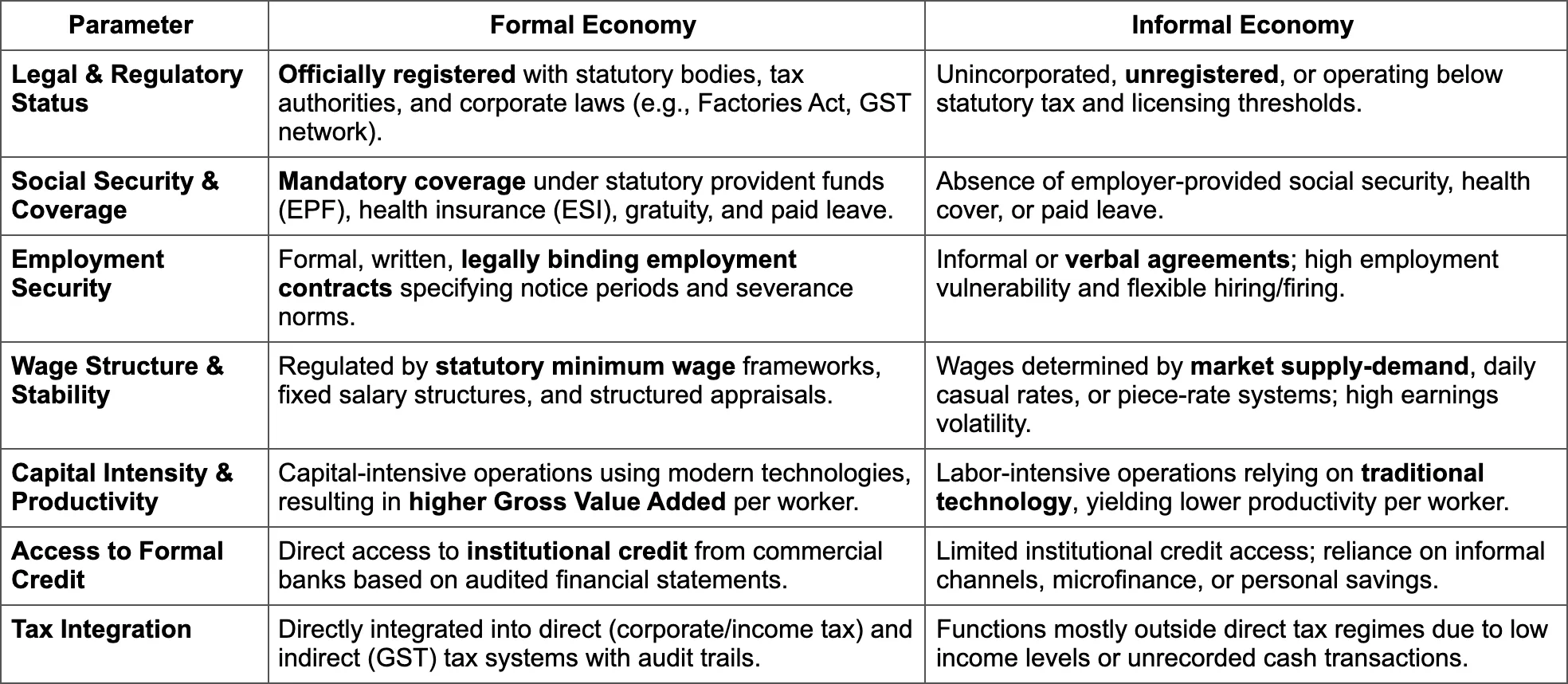
- The informal economy encompasses all economic activities by workers and economic units that are, in law or in practice, not covered or insufficiently covered by formal legal and institutional frameworks.
- It operates outside official tax systems, municipal registration, and statutory labor regulations.
- The International Labour Organization (ILO) conceptualizes the informal economy through two distinct parameters established at the International Conference of Labour Statisticians (ICLS):
- Informal Sector (Enterprise Concept, 15th ICLS 1993): Refers to unincorporated enterprises owned by households that produce goods or services for sale or barter, operating below defined registration thresholds or employer size (typically fewer than 5–10 employees) without separate legal personality from their owners.
- Informal Employment (Job Concept, 17th ICLS 2003): Refers to jobs that lack statutory social security coverage, written employment contracts, paid annual leave, or protection under standard national labor legislation, regardless of whether they exist inside formal enterprises, informal enterprises, or households.
-
Key Characteristics:
- Enterprise & Operational Characteristics:
- Unincorporated Status: The owner and the enterprise share a single legal identity, placing personal assets at full business risk.
- Low Capital Intensity & Scale: Heavy reliance on labor-intensive methods, traditional skills, and micro-capital outlay rather than advanced machinery.
- Informal Accounting: Operations function without audited double-entry bookkeeping, relying on cash transactions or unrecorded digital ledgers.
- Labor & Employment Characteristics:
- Absence of Social Security: Workers lack mandatory coverage under provident funds, health insurance, gratuity, or paid maternity/sick leave.
- Informal Work Agreements: Reliance on oral contracts creates job insecurity, arbitrary dismissals, and an absence of notice periods.
- Income Volatility: Earnings are frequently tied to daily wages, piece-rate output, or seasonal demand, resulting in unstable household cash flows.
- Regulatory & Financial Characteristics:
- Regulatory Exemption/Avoidance: Businesses often operate beneath tax registration thresholds or within regulatory grey zones regarding labor standards and licensing.
- Financial Exclusion: Restricted access to formal banking channels and commercial loans due to a lack of collateral, driving reliance on microfinance or informal moneylenders.
- Enterprise & Operational Characteristics:
-
Current Status of Informal Economy in India:
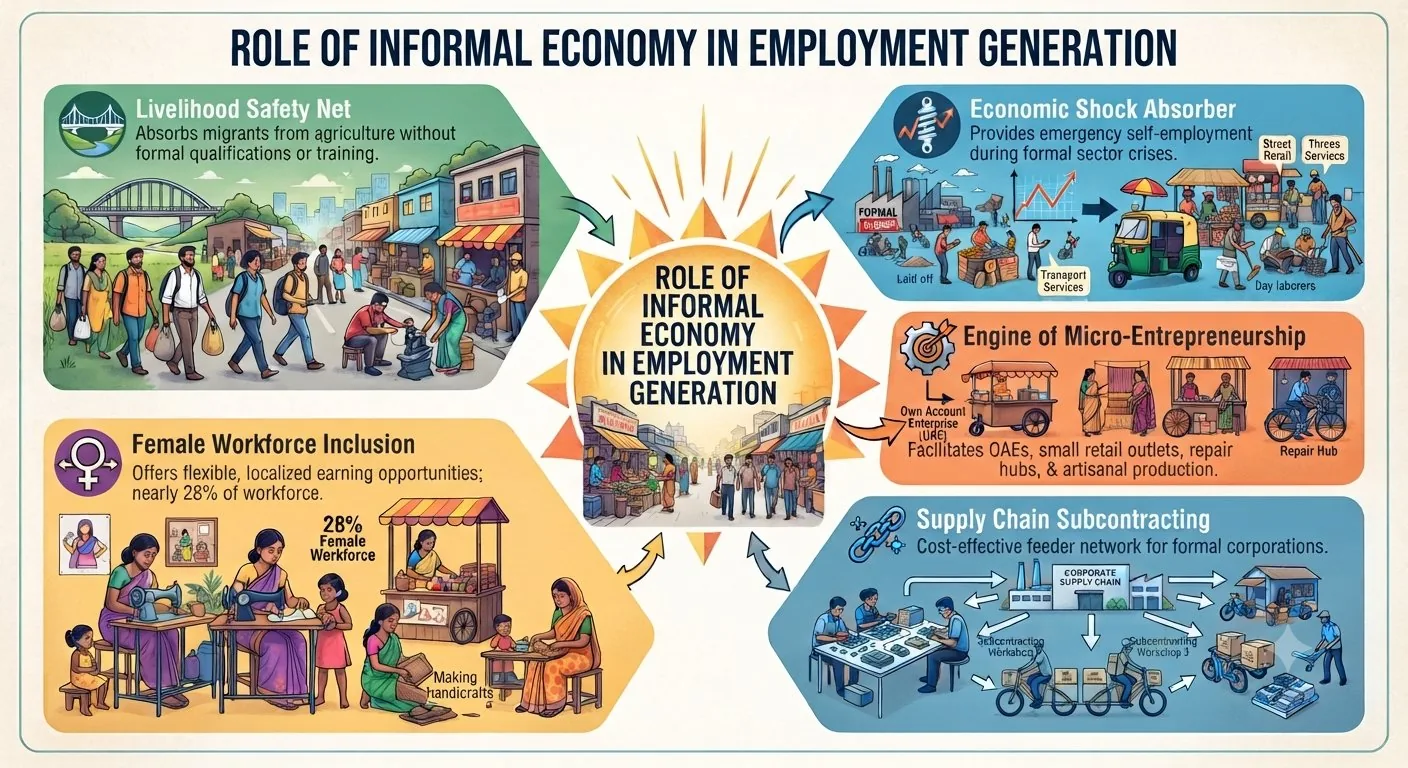
- The informal sector remains the central structural pillar of India’s labor market, absorbing the vast majority of non-farm and agrarian labor force entrants.
- Workforce Share: Approximately 90% of India’s overall workforce operates under informal employment conditions (combining the unorganized sector and informal jobs within formal establishments).
- Employment Categories (PLFS 2025):
- Self-Employed: ~56.2% of total employment, dominated by Own Account Enterprises (OAEs) and unpaid helper household members.
- Casual Labor: ~20.2% of the workforce, primarily concentrated in construction, agriculture, and daily-wage urban labor.
- Regular Wage/Salaried Workers: ~23.6%, though a significant share of these salaried positions lack formal written contracts or social security benefits.
- Unincorporated Sector Scale (ASUSE 2025):
- India hosts approximately 7.92 crore unincorporated non-agricultural enterprises.
- The non-agricultural unincorporated sector employs over 12.8 crore workers.
- Own Account Enterprises (run without hired workers) comprise the vast majority of these establishments, indicating a high concentration of self-subsistence livelihoods.
- Macroeconomic Output: The informal sector contributes roughly 45% of India’s total GDP.
- Digitalization & Formalization Milestones:
- e-Shram Portal Registration: Over 31.78 crore unorganized workers have registered on the e-Shram portal, creating a national database with Universal Account Numbers (UAN) for social security delivery.
- Digital Footprint: The share of establishments using the internet increased from 26.7% in ASUSE 2023–24 to 39.4% in ASUSE 2025.
-
Role in Employment Generation:
- Emerging Trends in Informal Economy:
- Platformization & The Gig Economy:
- Rapid expansion of app-based aggregators (delivery, ride-hailing, home services) has created a distinct class of gig and platform workers.
- While offering flexible hours, this model introduces algorithmic informalization, where workers operate as independent contractors without traditional employment rights, minimum wage guarantees, or health protection.
- FinTech Adoption & Digital Credit Footprints:
- Widespread adoption of UPI and micro-merchant QR codes has created verifiable digital transaction histories for micro-enterprises.
- This digital footprint enables cash-flow-based credit scoring, driving schemes like PM SVANidhi to extend collateral-free micro-credit to street vendors.
- Informalization of the Formal Sector: Formal enterprises increasingly utilize fixed-term contracts, third-party staffing agencies, and outsourced gig work to minimize wage bills, pension liabilities, and regulatory overheads.
- Data-Driven Worker Identification: The transition from invisible informal labor to digital identity platforms (e-Shram’s Universal Account Numbers) allows governments to link unorganized workers directly to social security schemes (e.g., PM-SYM pension, insurance coverage) via direct benefit transfers.
- Platformization & The Gig Economy:
- Emerging Trends in Informal Economy:
 What are the Major Issues Associated with India’s Informal Economy?
- Capital-Labor Disparity & Labor Productivity Deficit:
- The informal sector is trapped in a low-productivity equilibrium driven by an acute capital-labor ratio disparity.
- While absorbing the vast majority of job seekers, informal units operate with minimal technology, outdated machinery, and near-zero R&D spending, creating a massive divergence in worker output compared to the formal sector.
- E.g., in informal textile clusters such as those in Surat or Bhiwandi, powerloom operators use second-hand shuttle looms that operate at 20–30% of the efficiency of air-jet looms utilized by formal, vertically integrated textile mills, forcing workers into long shifts for marginal economic yields.
- Algorithmic Precarity in the Emerging Gig & Platform Economy:
- Platform aggregators leverage algorithmic management systems to classify workers as “independent partners” or “contractors” rather than statutory employees, deliberately circumventing traditional employer-employee obligations under Indian labor law.
- Dynamic algorithmic fare-decouplings, arbitrary penalty deductions, and unilateral payout reductions keep gig workers in a state of high income volatility with zero institutional safety nets.
- The gig workforce is expanding rapidly, projected to reach 1.2 crore workers. Yet, the Fairwork India Ratings revealed that major ride-hailing and logistics platforms (including Ola, Uber, and Porter) scored 0 out of 10 on foundational parameters such as fair pay, fair conditions, and fair contracts.
- Asymmetric Institutional Credit Access:
- Informal micro-enterprises face an institutional credit supply bottleneck. Formal banking institutions rely heavily on collateral, audited balance sheets, and formal credit scores, metrics that informal enterprise owners, micro-traders, and artisans naturally lack.
- Reserve Bank of India (RBI) and MSME estimation frameworks indicate an unmet MSME credit gap of around ₹80 lakh crore.
- While targeted schemes like PM SVANidhi provide initial micro-credit lines to street vendors, graduation to higher-tier formal commercial bank loans remains throttled by rigid underwriting algorithms.
- Thermal Stress, and Climate Vulnerability:
- Informal workers, especially those in outdoor physical occupations like construction, agriculture, and doorstep delivery, absorb the frontline impact of climate change.
- Operating without climate-controlled environments or compensated sick leave, extreme weather leads directly to income compression and medical debt traps.
- Data from the Lancet Countdown and global economic climate studies highlight that India suffered an estimated $194 billion in potential income losses in 2024 due to heat-linked productivity declines.
- Outdoor informal workers are projected to lose an average of 22.5 working days annually to heat stress by 2030.
- Regulatory Drag & Distortionary “Dwarfism” Thresholds:
- Attempts at top-down formalization (such as strict e-invoicing and digital tax compliance) often act as a regressive tax on informal firms.
- Rather than incentivizing enterprise expansion, complex compliance regimes create an economic incentive for informal units to remain deliberately small, a phenomenon known as enterprise dwarfism.
- Periodic Economic Censuses indicate that over 99% of informal manufacturing and service units operate as micro-enterprises employing fewer than 10 workers.
- Structural Contract Deficits & Absence of Collective Bargaining:
- The informal labor market operates under severe contractual legal asymmetry.
- The vast majority of workers lack written contracts, statutory severance protections, or formal grievance mechanisms, severely undermining worker agency and trade union representation.
- According to PLFS Annual Reports, over 70% of non-agricultural informal wage earners have no written employment contract.
- Informal workers outsourced through unregistered third-party staffing agencies regularly face late wage disbursements, and immediate dismissal if they attempt to organize or raise safety concerns regarding hazardous working conditions.
- Legislative Consolidation & Statutory Coverage:
- The Code on Social Security (2020) establishes an overarching statutory umbrella. It consolidates nine central labor statutes into a single code to extend statutory protection to unorganized, gig, and platform workers.
- Aggregator Social Security Fund requires digital aggregators (ride-hailing, e-commerce, logistics) to contribute 1% to 2% of their annual turnover (capped at 5% of the amount paid/payable to gig/platform workers) toward a dedicated Social Security Fund.
- The Union Cabinet has approved to enhance the wage ceiling for mandatory coverage under the EPFO from Rs.15,000 to Rs.25,000 per month.
- It is expected to bring more than 51 lakh additional employees within the ambit of mandatory EPFO coverage.
- Enterprise Formalization & Credit Parity:
- The Udyam Assist Platform (UAP), launched by the Ministry of MSME and implemented by SIDBI, brings unregistered micro-units into the formal banking system without requiring initial GST compliance.
- Udyam Assist Certificates grant informal units formal MSME recognition, making them eligible for bank credit under Priority Sector Lending (PSL) norms.
- Cash-Flow Underwriting & Open Financial DPI:
- India’s Digital Public Infrastructure (DPI) transitions micro-credit evaluation from traditional asset-collateral requirements to verifiable digital transaction cash flows.
- The Account Aggregator (AA) ecosystem enables micro-merchants and informal workers to share bank statement data digitally with financial institutions.
- This facilitates cash-flow-based loan underwriting rather than relying on land or property collateral.
- PM SVANidhi leverages digital transaction trails to offer street vendors micro-credit starting at ₹10,000 and stepping up to ₹50,000 upon timely repayment.
- Cluster-Level Artisanal & Heritage Sector Support:
- The PM Vishwakarma Scheme provides end-to-end formalization support for traditional artisans and craftspeople who rely on informal, family-based skills (Guru-Shishya Parampara).
- Over 30,000 Vishwakarma beneficiaries have been onboarded onto digital storefronts like the Government e-Marketplace (GeM), Open Network for Digital Commerce (ONDC), and commercial e-commerce channels.
- Demand-Side Mandates & Public Procurement Access:
- Public Procurement Policy for MSEs (PPP-MSE) mandates that Central Ministries, Departments, and Central Public Sector Enterprises (CPSEs) procure a minimum of 25% of their annual purchases from micro and small enterprises.
- This includes sub-targets of 4% from SC/ST-owned MSEs and 3% from Women-owned MSEs.
- GeM directly onboards Self-Help Groups (SHGs), weavers, and micro-entrepreneurs through dedicated initiatives such as Womaniya.
- The Womaniya initiative on GeM has enabled over 2.1 lakh Udyam-verified women-led MSEs and SHGs to secure government contracts exceeding ₹28,000 crore.
- In addition, GeM Sahay provides purchase-order-backed micro-financing options.
- Skill Standardization & Wage Benchmarking:
- Under Pradhan Mantri Kaushal Vikas Yojana 4.0 (PMKVY 4.0), Recognition of Prior Learning (RPL) assesses and certifies the informal skills of workers (such as masons, plumbers, and electricians) against the standardized National Skills Qualifications Framework (NSQF).
- Digital skill credentials verified through Skill India Digital Hub (SIDH) allow workers to present validated credentials to formal employers, command standard wage benchmarks, and qualify for overseas opportunities managed by NSDC International.
- Tapered Tax Regimes to Eliminate “Enterprise Dwarfism”:
- Implement a Glide-Path Tax Scheme where newly registered micro-enterprises benefit from a phased compliance model, offering 100% tax credits on compliance expenditures during their first three years.
- It should be paired with a simplified, single-page Presumptive Tax & GST Filing System for businesses with annual turnovers below ₹1 crore.
- Enforcing Statutory Protections for the Platform & Gig Economy:
- Full operationalization of the Code on Social Security (2020) by establishing mandatory Gig Worker Social Security Boards.
- Furthermore, introduce Algorithmic Transparency Guidelines requiring platforms to audit dynamic pricing, arbitrary penalty deductions, and automated dispatch systems, establishing a baseline living wage floor for platform workers.
- Cluster-Based Shared Infrastructure & Plug-and-Play Hubs:
- Build Plug-and-Play Micro-Industrial Parks in established industrial clusters (e.g., Moradabad brassware, Surat textiles, Rajkot auto-components).
- These parks offer shared access to advanced machinery, quality-testing laboratories, export certification helpdesks, and effluent treatment facilities under a pay-per-use model, allowing informal manufacturers to improve product quality and meet formal supply chain requirements.
- Establishing shared industrial ecosystems lowers entry barriers in formalization.
- Institutionalizing the Care Economy & Micro-Equity Models for Women:
- Expand the National Creche Scheme by establishing public-private Community Childcare Hubs near major urban informal employment centers and rural craft clusters.
- In parallel, transition home-based female workers from piece-rate contractors into formal Women-Led Producer Collectives (FPOs/SHG Federations) supported by Micro-Equity and Revenue-Sharing Funds, providing direct ownership stakes and market bargaining power.
- Formalization-Linked Public Procurement Quotas:
- Implement a statutory Tiered Procurement Reservation Architecture mandating that at least 15% of all sub-contracted public infrastructure materials, municipal supplies, and government catering orders be sourced exclusively from newly formalizing micro-units and artisan federations.
- Providing guaranteed government-backed demand gives informal producers a direct financial reason to complete formal registration.
- Real-Time Dynamic Wage Floor Indexing & Decentralized Bargaining Protocols:
- Implement Algorithmic Living Wage Floor Indexing that uses real-time local consumer price metrics and regional housing costs to update baseline wage rates for casual and piece-rate labor every quarter.
- Pair this with Decentralized Digital Bargaining Protocols that allow unorganized workers within specific industrial clusters or digital sectors to collectively negotiate rates and working conditions directly with regional contractor associations.
- India’s informal economy is both a livelihood foundation and a development challenge. While it absorbs millions of workers and supports economic resilience, persistent gaps in productivity, credit access and social protection limit its potential. A balanced approach combining digital inclusion, enterprise formalisation, universal social security and worker empowerment can transform informality into inclusive growth.