Comrades Dispatch · 26 Sep 2026 (PDF)
In this edition
- WAVES OTT and MyWAVES Apps & Portals
- Exercise VARUNA Military Exercises
- Issues with River-Linking Projects Nation & States
- 12 Years of Make in India Schemes & Initiatives
- 8th Anniversary of Ayushman Bharat – Pradhan Mantri Jan Arogya Yojana (AB PM-JAY) Schemes & Initiatives
- 4 Cheetah Cubs Born at Kuno National Park Wildlife
Apps & Portals
WAVES OTT and MyWAVES
Source Why in News?- WAVES ecosystem marks Prasar Bharati’s transition from traditional broadcasting through Doordarshan and Akashvani to an integrated digital public-service platform, combining television, radio, archives, education and publications.
- WAVES OTT provides multilingual access to live channels, on-demand content and Prasar Bharati’s archival resources.
- MyWAVES expands this ecosystem by enabling citizens and creators to produce and share content, while initiatives like the Gems of India Challenge promote local culture, heritage and regional storytelling.
- Launch and Objective: WAVES OTT was launched on 20th November 2024 during the 55th International Film Festival of India (IFFI), Goa, as Prasar Bharati’s public-service OTT platform. It aims to modernise public broadcasting by shifting from traditional television schedules to on-demand digital access.
- Public Service-Oriented Platform: Unlike commercial OTT platforms, WAVES OTT integrates entertainment, education, news, culture and public information, extending the role of public broadcasting beyond conventional television.
- Preserving Broadcasting Heritage: The platform provides digital access to Prasar Bharati’s extensive archives, helping younger generations and global audiences connect with India’s broadcasting history, cultural heritage and regional content.
- Promoting Digital Inclusion: WAVES OTT supports wider digital access, cultural preservation and linguistic diversity by making content available across regions, languages and devices, including mobile applications, websites and connected televisions.
- Integrated Content Ecosystem:
- The platform combines multiple services, including:
- On-demand content: Films, television programmes, documentaries, web series and archival content.
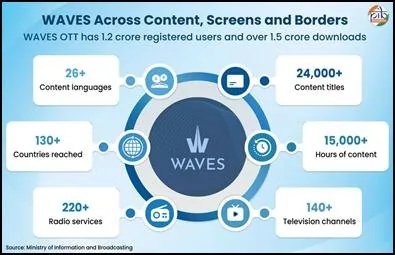
- Live broadcasting: Over 140 television channels and 220 radio services.
- Educational resources: PM eVidya channels and learning programmes.
- Digital publications: E-books, magazines such as Yojana and Kurukshetra, and photo collections.
- The platform combines multiple services, including:
- Additional services: Games and ONDC-integrated shopping facilities.
- Scale and Reach: WAVES OTT hosts over 20,000 titles and 15,000 hours of content, with 1.2 crore registered users, over 1.5 crore downloads, and availability across more than 130 countries.
- Language and Regional Outreach: The platform supports over 10 languages through its interface and provides content in more than 26 languages, strengthening access to India’s diverse linguistic and cultural traditions.
- Global Cultural Outreach: By reaching audiences including the Indian diaspora, WAVES OTT acts as a digital platform for showcasing India’s culture, knowledge traditions, regional diversity and creative expression.
- Content Partnership Model: The Pay-Per-View Content Sourcing Policy enables producers and rights holders to contribute quality content through a transparent mechanism, expanding opportunities for creators and regional content producers.
 What are the Key Facts About MyWAVES?
- Launch and Purpose: MyWAVES was launched on 23rd March 2026 as a feature within WAVES OTT to transform the platform from a content-consumption service into a citizen-driven digital creation ecosystem.
- Participatory Digital Platform: MyWAVES enables citizens to create, upload and share original content through a structured national platform, encouraging wider public participation in digital storytelling.
- Support for Emerging Creators: The platform provides opportunities for creators beyond established media networks by promoting regional stories, local talent and community experiences at a wider national and global level.
- Content Formats and Language Diversity: MyWAVES supports short videos, vertical videos and episodic content, with a multilingual interface that enables creators to produce content in Indian languages.
- Linkage with Creator Economy: By enabling grassroots participation, MyWAVES contributes to India’s expanding creator economy and strengthens citizen participation in digital media.
-
Showcasing Local Heritage through MyWAVES
- Initiative Overview: The Gems of India Challenge demonstrates the application of MyWAVES by encouraging citizens to create short videos highlighting the cultural and social identity of their districts.
- Pilot Phase: The pilot phase was launched on 21st July 2026 across six States and Union Territories, with video submissions accepted from 1st–31st August 2026 through the MyWAVES section of WAVES OTT.
- Content Themes:
- The challenge focuses on documenting:
- Culture, heritage and historical sites
- Tourism, nature and unexplored destinations
- Folk traditions, festivals and performing arts
- Handicrafts, handlooms and regional cuisine
- Local personalities, innovations and achievements
- The challenge focuses on documenting:
- Institutional Collaboration: The initiative involves Prasar Bharati, My Bharat, State and district administrations, along with support from cultural and educational institutions to encourage participation and content creation.
- Role of Digital Platforms: YouTube and Meta support outreach through their creator communities, helping expand awareness and participation.
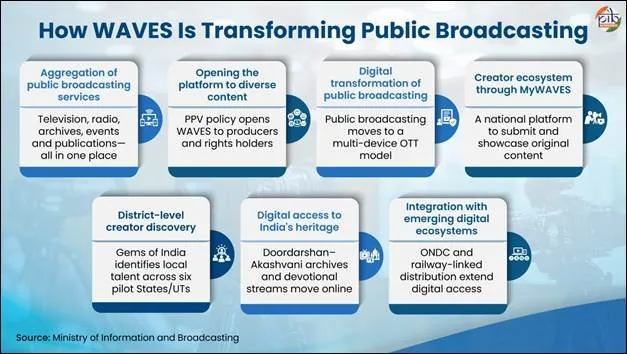
- The WAVES ecosystem represents a shift from public broadcasting to public participation. While WAVES OTT preserves India’s broadcasting legacy and expands digital access, MyWAVES empowers citizens to become creators and storytellers. Together, these initiatives connect India’s cultural heritage with the emerging creative economy, creating a digital ecosystem that is inclusive, multilingual and globally connected.
Military Exercises
Exercise VARUNA
Source The 24th edition of Exercise VARUNA, the bilateral maritime exercise between the Indian Navy and French Navy, commenced with the arrival of Indian Navy frigate INS Trishul (F43) at Toulon, France.- About: VARUNA is a bilateral naval exercise between the Indian Navy (IN) and the French Navy (FN) that began in 2001. It has evolved into a key platform for enhancing maritime cooperation and interoperability between the two navies.
- Objective: The exercise aims to improve operational coordination, exchange of best practices, and mutual understanding between the two forces.
- Key Activities: The 24th edition includes Cross-deck visits, Operational interactions, Exchange of best practices, Joint training activities and Sporting engagements.
- INS Trishul: INS Trishul is a Talwar-class guided missile frigate of the Indian Navy, commissioned in 2003. It is equipped with modernised systems, including BrahMos-capable launch systems, enhancing its precision strike capability.
- Significance: The exercise highlights the Indian Navy’s ability to undertake sustained deployments beyond the Indian Ocean Region (IOR) and engage with partner navies worldwide.
Nation & States
Issues with River-Linking Projects
Source Why in News?- At the Southern Zonal Council meeting in Mamallapuram, the Union Home Minister emphasised the need to resolve water disputes in southern India and proposed river interlinking from the Brahmaputra to the Godavari and Cauvery as a long-term water security measure.
- The issue gains importance amid disputes like Pennaiyar and Mekedatu, highlighting challenges in inter-State water management and the debate between large-scale water projects and demand-side conservation measures.
- About: The Interlinking of Rivers (ILR) programme is a large-scale water management initiative aimed at transferring water from water-surplus basins to water-deficit regions through a network of reservoirs, canals and diversion structures.
- Objectives: To improve water security, expand irrigation, reduce flood and drought risks, generate hydropower and support balanced regional development.
- Historical Background: The idea of linking rivers dates back to the 19th century, with Sir Arthur Cotton proposing river-based irrigation and navigation schemes. The concept gained momentum after independence due to concerns over uneven rainfall distribution and recurring floods and droughts.
- National Perspective Plan (NPP): Formulated in 1980 by the Ministry of Water Resources, it identified 30 major links (14 in the Himalayan component and 16 in the Peninsular component).
- Executing Agency: The National Water Development Agency (NWDA) was established in 1982 to study the feasibility of river-linking projects.
-
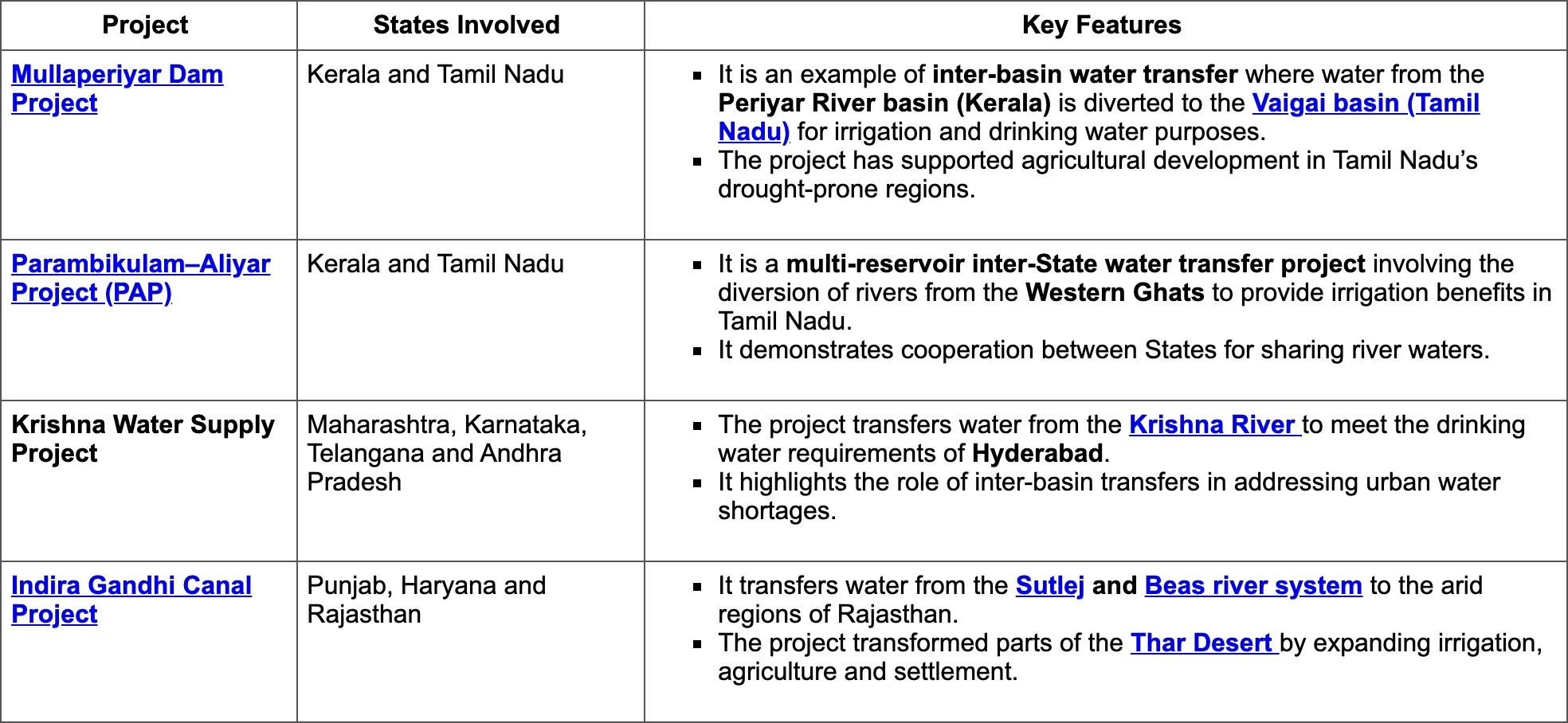
Examples of Successful Inter-Basin Water Transfer Projects in India
- Arguments in Favour
- Enhancing Water Security: River interlinking can help transfer water from surplus basins to water-deficit regions, reducing regional disparities in water availability. For example, the Ken–Betwa Link Project aims to provide irrigation and drinking water benefits to drought-prone areas of Bundelkhand (Madhya Pradesh and Uttar Pradesh).
- Improving Agricultural Productivity: Additional irrigation potential created through inter-basin water transfer can increase agricultural output, support crop diversification and improve farmers’ incomes. For example, the Indira Gandhi Canal Project transformed parts of the arid Rajasthan region by providing irrigation facilities.
- Mitigating Flood and Drought Risks: River linking can help manage excess water during floods by diverting water to water-scarce regions, thereby reducing the severity of both floods and droughts. Proponents argue that linking major rivers could improve India’s long-term water resilience.
- Supporting Drinking Water and Industrial Needs: Interlinking projects can enhance the availability of water for urban centres, industries and rural communities facing water shortages. The Krishna Water Supply Project is an example of transferring river water to meet the drinking water requirements of Hyderabad.
- Generating Economic Benefits: Large water infrastructure projects can create employment opportunities, improve rural infrastructure and support regional economic development through better irrigation, navigation and allied activities.
- Promoting Integrated River Basin Management: River interlinking can encourage coordinated planning of water resources across political boundaries and support a more integrated approach towards managing India’s rivers.
- Arguments Against
- Ecological Concerns:
- River ecosystems are highly interconnected, and altering natural river flows can affect aquatic biodiversity, wetlands, sediment transport and downstream ecosystems.
- Changes in water flow may disturb fish migration patterns, groundwater recharge processes and ecological balance in river basins.
- For example, Kerala has opposed the Pamba–Achankovil–Vaippar Link Project, arguing that it could adversely affect the Vembanad wetland ecosystem.
- Inter-State Water Conflicts:
- River waters are shared resources among multiple States, making allocation and usage a sensitive issue.
- The Pennaiyar River dispute highlights these challenges, where Tamil Nadu demanded a tribunal over alleged violation of the 1892 inter-State agreement by Karnataka.
- Similarly, the Mekedatu dam project proposed by Karnataka has faced strong opposition from Tamil Nadu due to concerns over downstream water availability.
- Federal and Governance Challenges:
- Water management requires strong cooperation between the Centre and States, as disputes often involve competing regional interests.
- Although the Inter-State River Water Disputes Act, 1956 provides a mechanism for resolving disputes through tribunals, delays in tribunal formation and implementation of decisions remain major concerns.
- Lack of consensus among States can delay projects and affect their timely completion.
- Social and Rehabilitation Issues:
- Large-scale river-linking projects require significant land acquisition, which may lead to displacement of local communities, particularly tribal populations. Ensuring fair rehabilitation and protecting the livelihood rights of affected communities remain major challenges.
- The Ken–Betwa Link Project has faced resistance from tribal communities due to concerns regarding displacement and environmental impacts.
- Economic and Technical Challenges:
- River interlinking projects involve high financial costs, complex engineering requirements and long gestation periods. Construction of large dams, canals and reservoirs requires extensive investment and continuous maintenance.
- Uncertainty regarding future rainfall patterns due to climate change also raises questions about the availability of “surplus” water for transfer.
- Climate Change and Sustainability Concerns:
- Climate change is altering rainfall patterns, glacier behaviour and river flows, making assumptions about permanent water surplus or deficit increasingly uncertain.
- Overdependence on large-scale engineering solutions may divert attention from sustainable approaches such as water conservation, watershed management and demand-side management.
- Ecological Concerns:
- Strengthen institutional mechanisms for water governance: The National River Linking Project (NRLP) and Interlinking of Rivers (ILR) Programme should be implemented through a scientific, transparent and participatory approach. The National Water Development Agency (NWDA) should undertake detailed basin-level studies to ensure that water transfers are ecologically and socially sustainable.
- Ensure effective dispute resolution and cooperative federalism: The Centre and States should strengthen mechanisms under the Inter-State River Water Disputes Act, 1956 and ensure timely resolution of disputes. The constitutional framework under Article 262 should be effectively utilised to promote equitable and cooperative management of inter-State rivers.
- Adopt a balanced approach towards river-linking projects: Projects such as the Ken–Betwa Link Project should integrate environmental impact assessments, climate risk analysis and rehabilitation measures to balance developmental objectives with ecological sustainability.
- Prioritise demand-side water management: India should shift from excessive dependence on large supply-side projects towards efficient water utilisation through micro-irrigation, groundwater conservation, rainwater harvesting, watershed management and restoration of traditional water bodies.
- Promote community participation and integrated river basin management: Local communities, farmers and civil society should be actively involved in water conservation efforts. A basin-based approach involving States, experts and stakeholders can ensure sustainable management of rivers while reducing conflicts over water sharing.
- River interlinking can contribute to water security in selected cases, but it cannot be viewed as a universal solution to India’s water challenges. A sustainable water strategy must move beyond large supply-side interventions towards conservation, efficient utilisation, groundwater management and cooperative federalism. Ensuring water security requires protecting both rivers and the communities that depend on them.
Schemes & Initiatives
12 Years of Make in India
Source Why in News?- The Government of India’s flagship ‘Make in India’ initiative completed exactly 12 years since its launch. While official government data highlights massive production gains in sectors like electronics and defence, economic analysts and recent reports point to a “patchy performance” regarding the broader manufacturing share of the economy, private investment, and job creation.
- Launch: It was launched on 25th September 2014, with the ambition of transforming India into a global hub for manufacturing, design, and innovation.
- Core Philosophy: The initiative is guided by the principle of ‘Minimum Government, Maximum Governance’ to facilitate investment, foster innovation, and build world-class infrastructure.
- Evolution (Make in India 2.0):
- Launched in February 2021, the initiative was subsequently expanded under Make in India 2.0.
- It now focuses on a broader and deeper sectoral coverage of 27 priority sectors, which include 15 in manufacturing and 12 in services.
- Electronics and Mobile Manufacturing:
- Electronics production increased nearly sevenfold, from Rs 1.9 lakh crore in 2014-15 to Rs 13.11 lakh crore in 2025-26
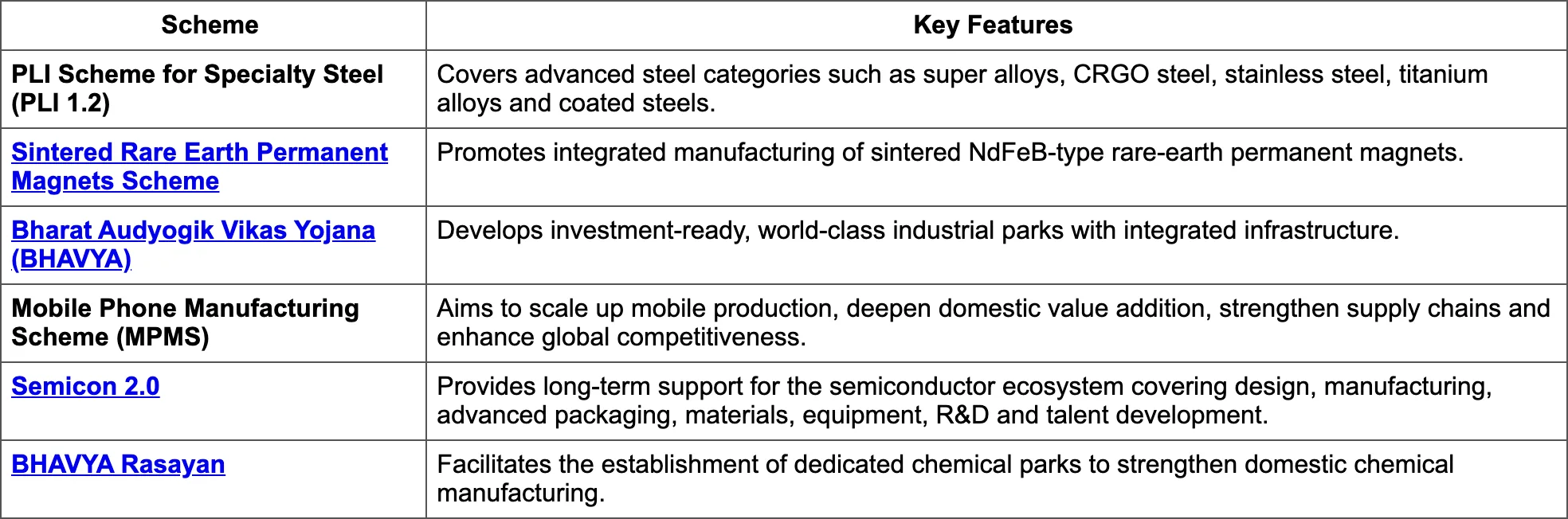
- Mobile phone manufacturing under the Mobile Phone Manufacturing Scheme (MPMS), has driven India’s electronics growth, making India the world’s 2nd-largest mobile phone manufacturer, with 99.2% of phones used domestically manufactured in India.
- In 2025, smartphones became India’s largest exported product category, strengthening the country’s electronics manufacturing ecosystem and global value-chain integration.
- Automotive Industry:
- Total vehicle production reached 31.03 million units in 2024-25, marking a 33% increase over 2014-15.
- Between 2020-21 and 2024-25, passenger vehicle and commercial vehicle output grew by 65% each, three-wheelers by 71%, and two-wheelers by 30%.
- Defence Indigenisation: The value of indigenous defence production grew by ~283%, from 2014-26.
- Heavy Industries (Steel): Crude steel production increased from 81.7 million tonnes in 2014-15 to 170.0 million tonnes in 2025-26.
- Pharmaceuticals & Medical Devices:
- India ranks 3rd globally in pharmaceutical volume and 11th in value, with annual turnover touching Rs 5,08,630 crore in 2025-26 (9.2% average annual growth rate over 5 years).
- Domestic manufacturing of medical devices expanded by 48.2% ( 2019-25).
- Domestic breakthroughs include:
- Trastuzumab Emtansine: The world’s first biosimilar antibody-drug conjugate for breast cancer.
- Docaravimab-Miromavimab: The world’s first monoclonal antibody cocktail against rabies.
- Miqnaf: India’s first domestically developed macrolide antibiotic in 30 years for pneumonia.
- Desidustat: A novel oral chemical entity for anaemia management in chronic kidney disease.
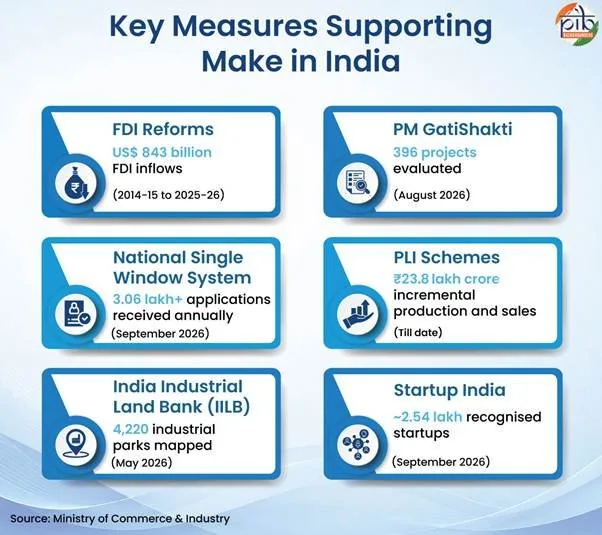
- Production Linked Incentive (PLI) Scheme: As a key pillar, the PLI schemes (across 14 sectors) had attracted Rs 2.6 lakh crore in investment and generated Rs 23.8 lakh crore in production and sales as of June 2026. They also created 14.6 lakh jobs.
- Crude Steel: National steel production more than doubled, increasing from 81.7 million tonnes in 2014-15 to 170.0 million tonnes in 2025-26.
- Space-Grade Semiconductors: ISRO and the Semi-Conductor Laboratory (SCL) developed the VIKRAM3201 (India’s first space-qualified launch-vehicle microprocessor fabricated at SCL) and the KALPANA3201 open-source flight-tested microprocessor.
- Permanent Magnets & Critical Materials: A pilot plant for sintered Neodymium-Iron-Boron (Nd-Fe-B) rare-earth permanent magnets was commissioned at ARCI Hyderabad in March 2026 to support domestic EV, wind turbine, and robotics supply chains.
- Aerospace & Defence Platforms: Hindustan Aeronautics Limited (HAL) operationalised its third LCA Tejas Mk1A assembly line in October 2025 (raising annual capacity to 24 jets) alongside a second production line for the indigenous HTT-40 basic trainer aircraft.
- Nuclear & Rail Components: Nuclear Fuel Complex (NFC) delivered its eighth domestic batch of steam-generator tubes for 700 MW nuclear power reactors, while the Rail Wheel Factory produced over 2.10 lakh wheels and 1.20 lakh wheelsets in 2025-26.
 What are the Concerns Regarding the ‘Make in India’ Initiative?
- Stagnant Share in GDP/GVA:
- The original aim of the initiative was to increase the manufacturing sector’s share to 25% of the GDP.
- However, under the revised national accounts series, manufacturing’s share in Gross Value Added (GVA) increased only marginally from 14.6% in 2022-23 to 15.6% in 2025-26.
- Stagnant Global Export Share: While non-petroleum goods exports rose from USD 253.5 billion in 2014-15 to USD 388.3 billion in 2025-26, India’s overall share of global merchandise exports has remained stuck at around 1.7% - the exact same level it was in 2013.
- Sluggish Private Investment: Analysts highlight that the anticipated private investment boom has not materialized. Private-sector Gross Fixed Capital Formation (GFCF) as a share of GDP has actually declined in recent years.
- FDI Disparities: Manufacturing Foreign Direct Investment (FDI) has grown at a slower pace than overall FDI in 7 out of the last 12 years.
- Employment Generation: Critics point out that broad-based job growth in the manufacturing sector remains severely missing, failing to absorb the vast demographic dividend transitioning away from agriculture.
- Shift from Final Assembly to Component Localisation: India must move beyond importing parts just to assemble them locally. Expanding Design-Linked Incentives (DLI) to critical upstream components like semiconductor wafers, active pharmaceutical ingredients (APIs), and rare-earth magnets will build domestic intellectual property and deepen true value addition.
- Establish “Plug-and-Play” Frontier Tech Parks:
- Under the new National Manufacturing Mission (NMM), India needs to rapidly execute the planned 20 Plug-and-Play Frontier Tech Industrial Parks.
- These clusters eliminate land acquisition delays and provide shared Industry 4.0 infrastructure (IoT, AI testbeds, digital twins) so that MSMEs can modernize without prohibitive capital costs.
- Aggressively Subsidize Private R&D: India’s R&D expenditure is stagnant at just 0.64% of GDP, severely limiting indigenous innovation. Policymakers need to introduce deep tax credits and Viability Gap Funding (VGF) specifically targeting private companies that research and develop advanced materials, robotics, and clean-tech.
- Hardwire Logistics to Manufacturing Clusters: High logistics costs make Indian exports less competitive. By utilizing the PM GatiShakti National Master Plan, the government must physically integrate manufacturing zones directly with major ports and dedicated freight corridors to drastically cut transit times and freight expenses.
- Make in India has built a strong foundation for manufacturing, but achieving global manufacturing leadership requires deeper domestic value chains, lower logistics costs, stronger R&D and greater indigenous innovation.
8th Anniversary of Ayushman Bharat – Pradhan Mantri Jan Arogya Yojana (AB PM-JAY)
Source Why in News?- The Government of India marked the 8th anniversary of Ayushman Bharat Pradhan Mantri Jan Arogya Yojana (AB PM-JAY), highlighting its role in expanding healthcare access and reducing financial burden on vulnerable sections. Together, these initiatives aim to achieve the goal of Universal Health Coverage (UHC).
- About: The Ayushman Bharat Pradhan Mantri Jan Arogya Yojana (AB PM-JAY) was launched on 23rd September 2018 to advance the goal of universal health coverage by providing affordable and quality healthcare access, particularly to vulnerable sections of society.
- Health Coverage: AB PM-JAY is a public health assurance scheme providing coverage for secondary and tertiary healthcare services. As of 21st September 2026, over 48.51 crore people had received Ayushman cards, covering nearly 33% of India’s population.
- Integrated Health System Approach:
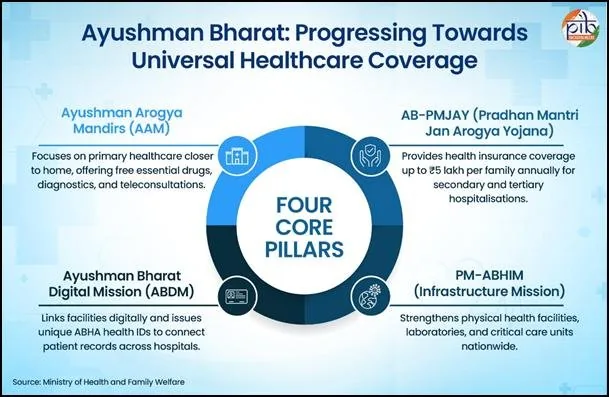
- AB PM-JAY is part of the broader Ayushman Bharat framework, which includes:
- Ayushman Aarogya Mandirs (AAM): Strengthening primary healthcare delivery.
- Ayushman Bharat Digital Mission (ABDM): Creating digital health infrastructure and improving healthcare accessibility.
- PM-Ayushman Bharat Health Infrastructure Mission (PM-ABHIM): Enhancing public health infrastructure and preparedness.
- AB PM-JAY is part of the broader Ayushman Bharat framework, which includes:
- Funding Pattern: AB PM-JAY is implemented as a Centrally Sponsored Scheme with a 60:40 Centre-State funding ratio for most States. A higher 90:10 sharing ratio is applicable for North-Eastern States, Himachal Pradesh, Uttarakhand and Jammu & Kashmir. Union Territories without legislatures receive 100% central funding, while UTs with legislatures follow a 60:40 sharing pattern.
- Budgetary Support: The Union Budget allocation for AB PM-JAY has increased over the years, with ₹9,500 crore estimated for 2026–27, reflecting continued government support for expanding health protection coverage.
- Financial Protection: AB PM-JAY and other Ayushman Bharat initiatives have contributed to reducing out-of-pocket health expenditure by expanding access to free and affordable healthcare services and increasing government health financing.
- Impact: Since its launch, the scheme has supported treatment worth up to ₹2.03 lakh crore through around 13.25 crore hospital admissions across a network of over 38,000 empanelled public and private hospitals (as of 31st August 2026).
- Expanding Financial Protection and Healthcare Access
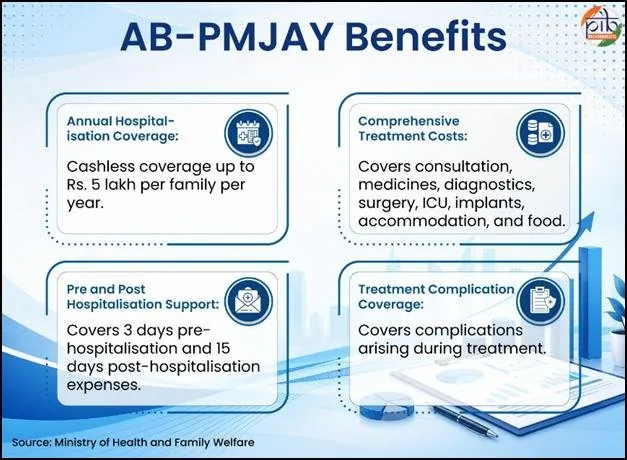
- Reducing Medical Expenditure Burden: AB PM-JAY aims to protect families from catastrophic healthcare expenses by providing cashless treatment for 1,961 procedures across 27 medical specialities through empanelled hospitals.
- Coverage of Frontline Health and Anganwadi Workers: In March 2024, the scheme was expanded to include around 37 lakh families of Accredited Social Health Activists (ASHAs), Anganwadi Workers (AWWs) and Anganwadi Helpers (AWHs). As of 21st September 2026, more than 44.81 lakh Ayushman cards have been issued to these beneficiaries.
- Healthcare Support for Senior Citizens: In 2024, AB PM-JAY was expanded to cover all citizens aged 70 years and above, benefiting around 6 crore senior citizens. As of 21st September 2026, more than 1.36 crore Ayushman Vay Vandana cards have been issued.
- Identification of Eligible Beneficiaries
- Rural Beneficiaries: Beneficiaries in rural areas are identified based on Socio-Economic Caste Census (SECC) 2011 deprivation criteria, covering vulnerable households such as those with poor housing conditions, no earning adult members, female-headed households without adult males, disabled members without able-bodied adults, SC/ST households and landless labour households.
- Urban Beneficiaries: In urban areas, eligibility is based on 11 occupational categories, including ragpickers, domestic workers, street vendors, construction workers, sanitation workers, artisans, transport workers, small establishment workers, mechanics and other vulnerable occupational groups.
- Additional Vulnerable Groups Covered
- Construction Workers: Building and Other Construction Workers (BOCW) and their dependants are covered under the scheme.
- Road Accident Victims: Eligible road accident victims receive healthcare support through PM-RAHAT.
- Transgender Persons: Transgender persons are covered through the SMILE initiative for social and livelihood support.
- Children Affected by COVID-19: Eligible children covered under the PM CARES for Children Scheme are included under AB PM-JAY.
- Sanitation Workers and Waste Pickers: Identified sanitation workers and waste pickers are covered under the NAMASTE Scheme.
- Tribal Communities: Particularly Vulnerable Tribal Groups (PVTGs) are covered under the PM-JANMAN initiative.
- Role in Healthcare Delivery: Ayushman Arogya Mandirs (AAMs) form the second pillar of Ayushman Bharat and aim to make primary healthcare services more accessible at the community level.
- Upgradation of Health Centres: AAMs are upgraded from existing health facilities by improving Infrastructure and equipment, Human resources, Availability of essential medicines and diagnostics and Information technology systems.
- Comprehensive Healthcare Services:
- Unlike earlier primary health centres focused mainly on maternal and child healthcare, AAMs provide a wider range of services, including:
- Screening and management of non-communicable diseases.
- Oral, eye and ear-nose-throat (ENT) care.
- Mental healthcare services.
- First-level emergency and trauma care.
- Free essential medicines and diagnostic services.
- Unlike earlier primary health centres focused mainly on maternal and child healthcare, AAMs provide a wider range of services, including:
- Integration of AYUSH Services: Along with conventional healthcare, the government is expanding AYUSH Arogya Mandirs to provide services related to Ayurveda, Yoga and Naturopathy, Unani, Siddha and Homoeopathy.
- Community Health Outreach: AAMs serve as centres for health awareness, patient follow-up and community-level monitoring through healthcare workers and Accredited Social Health Activists (ASHAs).
- Digital Healthcare Connectivity: Through e-Sanjeevani telemedicine services, AAMs connect citizens with healthcare professionals at district, state and national hospitals.
- Expanding Healthcare Access: AAMs have recorded a cumulative footfall of over 540 crore people, demonstrating their role in strengthening accessible, preventive and comprehensive primary healthcare delivery.
 What are the Key Facts About Ayushman Bharat Digital Mission (ABDM)?
- Launch and Objective: The Ayushman Bharat Digital Mission (ABDM) was launched in September 2021 to create an integrated, citizen-centric national digital health ecosystem and make healthcare delivery more accessible, efficient and seamless.
- Ayushman Bharat Health Account (ABHA): ABDM is built around ABHA IDs, which act as digital health identities for individuals. These accounts enable citizens to securely link their health records, insurance claims and medical history and access healthcare services through an interoperable digital network.
- Key Components of ABDM
- Healthcare Professionals Registry (HPR): It is a national registry of verified healthcare professionals, including doctors and Ayush practitioners, enabling their digital integration into the healthcare ecosystem.
- Health Facility Registry (HFR): It provides a unified database of healthcare facilities, including hospitals, clinics, laboratories and pharmacies from both public and private sectors.
- Unified Health Interface (UHI): It is an open digital network that enables citizens to discover healthcare services, book appointments and consult doctors across different digital platforms.
- Aarogya Setu 2.0: It functions as a unified platform for accessing digital health services and maintaining Personal Health Records (PHRs), supporting wider adoption of digital healthcare.
- Launch and Objective: The PM-Ayushman Bharat Health Infrastructure Mission (PM-ABHIM) was launched in October 2021 under Budget 2021-22 to strengthen India’s healthcare infrastructure, improve disease surveillance and enhance health research capabilities.
- Budgetary Support: The mission has an outlay of ₹64,180 crore (2021–2026) and aims to build a resilient healthcare system capable of addressing future public health challenges through a whole-of-government approach.
- Strengthening Rural Healthcare: PM-ABHIM supports the establishment of 23,224 rural health and wellness centres in 10 high-focus States to improve primary healthcare access.
- Expanding Urban Healthcare: The mission aims to establish 13,736 urban health and wellness centres across all States to strengthen healthcare delivery in urban areas.
- Improving Disease Surveillance:
- It focuses on creating a stronger surveillance network through:
- 3,389 Block Public Health Units in 11 high-focus States.
- 744 Integrated Public Health Laboratories across all districts.
- It focuses on creating a stronger surveillance network through:
- Enhancing Critical Care Capacity: The mission provides for the establishment of 631 Critical Care Hospital Blocks in districts with a population of more than 5 lakh, improving preparedness for emergencies and major health crises.
- Ayushman Bharat has moved healthcare delivery beyond hospital-based treatment by combining insurance protection, grassroots healthcare, digital innovation and resilient infrastructure. It represents an important step towards achieving Universal Health Coverage by ensuring accessible, affordable and quality healthcare for all citizens.
Wildlife
4 Cheetah Cubs Born at Kuno National Park
Source An India-born female cheetah, KGP12, gave birth to four cubs in Kuno National Park (KNP), Madhya Pradesh, taking India’s total cheetah population to 56. The births mark a milestone for Project Cheetah, India’s cheetah reintroduction programme, which completed four years since its launch.- About Project Cheetah: Launched in September 2022, it aims to reintroduce cheetahs in India after their extinction in 1952 through translocation and breeding programmes.
- Objective: Project Cheetah aims to establish breeding populations, restore open forest and savanna ecosystems, promote ecotourism and reduce human–wildlife conflict.
- Translocation History: India’s cheetah reintroduction programme began with the arrival of cheetahs from Namibia in 2022, followed by further translocations from South Africa in 2023 and Botswana in 2026.
- Implementation: The project is implemented by the National Tiger Conservation Authority (NTCA) under the Ministry of Environment, Forest and Climate Change (MoEFCC) in collaboration with the Madhya Pradesh Forest Department and the Wildlife Institute of India (WII).
- Future Expansion: Preparations are underway to develop Veerangana Durgavati Tiger Reserve, Madhya Pradesh, as another cheetah habitat; Banni Grasslands (Gujarat) and Nauradehi Wildlife Sanctuary (MP) are also being considered.
- Ecological Significance: Project Cheetah is moving towards landscape-level management, focusing on suitable habitat, prey availability and ecological connectivity for long-term cheetah recovery.