> ## Documentation Index
> Fetch the complete documentation index at: https://signals.joincomrades.com/llms.txt
> Use this file to discover all available pages before exploring further.
# 28 Sep 2026 · Dispatch
> Comrades Dispatch of 28 Sep 2026, by news group.
> **[Comrades Dispatch · 28 Sep 2026 (PDF)](https://dl.joincomrades.com/d/28-09-26)**
***
## In this edition
1. [UN Declaration on Sea-Level Rise](#h-1) Environment & Ecology
2. [119th Birth Anniversary of Shaheed Bhagat Singh](#h-2) Important Days
3. [India’s First LNG-Powered Train Flagged Off from Sabarmati](#h-3) Infrastructure & Energy
4. [India’s 1st Port-Based e-Methanol Facility at Kandla](#h-4) Infrastructure & Energy
5. [Debate on UNSC Veto Power](#h-5) International Relations
6. [Exercise Tarang Shakti 2026](#h-6) Military Exercises
7. [Lottery Regulation in India](#h-7) Polity & Governance
8. [Armed Forces (Special Powers) Act, 1958](#h-8) Security
## Environment & Ecology
### UN Declaration on Sea-Level Rise
[Source](https://www.drishtiias.com/current-affairs-news-analysis-editorials/news-analysis/28-09-2026#37687)
At the 81st session of the United Nations General Assembly (UNGA), India welcomed the adoption of the landmark UN Declaration on Sea-Level Rise, reiterating its commitment to climate equity, maritime stability, and developmental assistance for vulnerable nations.
* **UN Declaration on Sea-Level Rise:**
* It addresses the growing climate crisis driven by greenhouse gas emissions, melting land ice and thermal expansion of seawater, with global sea levels recording a 5.9 mm rise in 2024.
* It supports the legal continuity of States, ensuring that vulnerable Small Island Developing States (SIDS) can retain their sovereignty, statehood, UN membership, and maritime zones established under UNCLOS, even if they completely lose physical territory.
* It also seeks to protect maritime zones established under UNCLOS, safeguarding their territorial waters and Exclusive Economic Zones (EEZs).
* The declaration highlights sea-level rise as a human-rights and displacement challenge, threatening housing, freshwater, food security and cultural identity, while calling for stronger climate adaptation, resilient infrastructure, early-warning systems and increased adaptation finance for developing countries.
* **Reaffirming Climate Justice:** India stressed the non-negotiable application of equity and the principle of Common But Differentiated Responsibilities and Respective Capabilities (CBDR-RC) in global climate adaptation efforts.
* **India’s Vulnerability to Sea-Level Rise:**
* India faces significant risks from sea-level rise due to its extensive coastline and dependence on coastal ecosystems, with over 350 million people linked to the marine economy and coastal resources.
* According to INCOIS, the Relative Mean Sea Level (RMSL) along India’s coast could rise by 0.5–1 metre by 2100, increasing the frequency and intensity of storm surges, high tides and coastal flooding.
* Low-lying areas such as Mumbai, Chennai, Kolkata, the Sundarbans, Lakshadweep and the Andaman & Nicobar Islands are particularly vulnerable to permanent inundation, coastal erosion and saltwater intrusion.
## Important Days
### 119th Birth Anniversary of Shaheed Bhagat Singh
[Source](https://www.drishtiias.com/current-affairs-news-analysis-editorials/news-analysis/28-09-2026#37688)
**Why in News?**
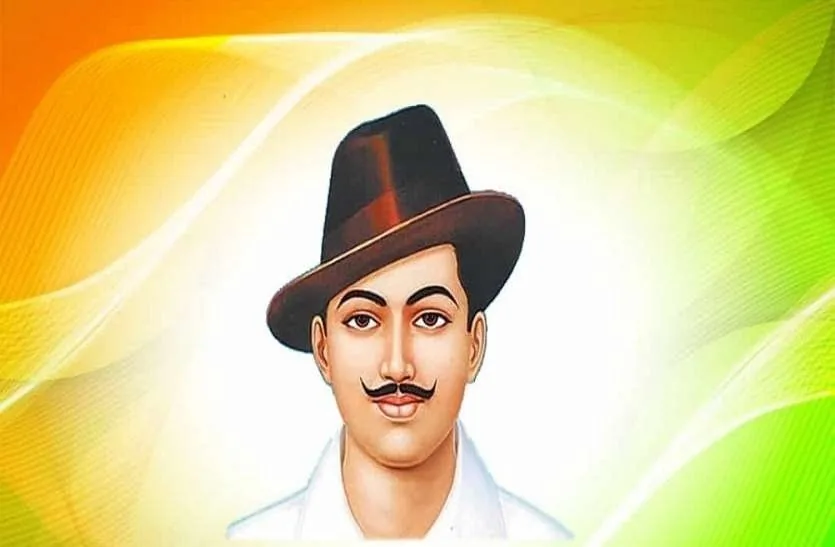
* The Prime Minister paid tribute to the revolutionary freedom fighter Shaheed Bhagat Singh on his 119th Birth Anniversary, describing him as a lasting inspiration, especially for India's youth.
**What are Key Facts About Bhagat Singh?**
* **Early Life:**
* Bhagat Singh, born on 28th September 1907 in Banga, Punjab (now Pakistan), came from a Sikh family active in the freedom struggle.
* His father, Kishan Singh and uncle Ajit Singh were notable revolutionaries, with his uncle deported to Mandalay and later associated with the San Francisco-based Ghadar Party.
* **Formative Experiences:** Bhagat Singh was deeply affected by the Jallianwala Bagh massacre and is said to have visited the site soon afterwards. He later joined National College, Lahore, founded by Lala Lajpat Rai, where he was exposed to Swadeshi and revolutionary ideas.
* **Revolutionary Politics:**
* In 1925, Bhagat Singh joined the Hindustan Republican Association (HRA), which was reorganised as the Hindustan Socialist Republican Association (HSRA) in 1928.
* In 1926, he founded the Naujawan Bharat Sabha to mobilize youth for the freedom movement.
* In 1929, Bhagat Singh and Batukeshwar Dutt threw low-intensity bombs in the Central Legislative Assembly to protest the Public Safety Bill (suppressing political activities and deporting individuals) and the Trade Dispute Bill (curbing workers’ right to strike).
* **Trial and Execution:** Bhagat Singh, Rajguru and Sukhdev were convicted in the Lahore Conspiracy Case for their role in the 1928 killing of British police officer J.P. Saunders in Lahore, carried out to avenge the death of Lala Lajpat Rai. All three were hanged on 23rd March 1931 in Lahore Central Jail.
* **Ideology and Writings:**
* Bhagat Singh was a firm atheist and socialist, influenced by thinkers such as Marx, Lenin, Trotsky, and Bakunin.
* His writings, including “Why I Am an Atheist”, reflect his belief in rationalism, equality, and social justice.
* In the 1920s, Bhagat Singh wrote for Urdu and Punjabi newspapers in Amritsar, as well as the journal of the Kirti Kisan Party, ‘Kirti’, and briefly for the Veer Arjun newspaper in Delhi.
* He often used pseudonyms such as Balwant, Ranjit, and Vidhrohi.
* **Legacy:**
* Bhagat Singh, honoured as Shahid-e-Azam, popularised the slogan ‘Inquilab Zindabad’ (Long Live the Revolution), which became a powerful rallying cry of the freedom struggle.
* Every year on 23rd March, India observes Shaheed Diwas (Martyrs’ Day) to honor the sacrifice of freedom fighters Bhagat Singh, Rajguru, and Sukhdev.
## Infrastructure & Energy
### India’s First LNG-Powered Train Flagged Off from Sabarmati
[Source](https://www.drishtiias.com/current-affairs-news-analysis-editorials/news-analysis/28-09-2026#37704)
**Why in News?**
* Union Home and Cooperation Minister Amit Shah flagged off India’s first LNG-powered train from Sabarmati Railway Station in Ahmedabad, Gujarat, on 27 September 2026. He also inaugurated and launched railway development projects worth ₹1,472 crore, focusing on cleaner fuel, railway safety, passenger amenities and connectivity.
**Key Points:**
* **First LNG-Powered Train:**
* Indian Railways has introduced an LNG-based fuel system in the train’s Driving Power Cars (DPCs) for the first time.
* The system uses a dual-fuel combination of diesel and Liquefied Natural Gas (LNG).
* Two 1,400 HP DPCs at the Sabarmati Integrated Coaching Depot have been converted to operate on both fuels.
* **LNG-Diesel Substitution:** The dual-fuel system allows LNG to replace around 40% of diesel consumption, helping reduce dependence on conventional diesel fuel.
* **Environmental Benefits:** The use of LNG is expected to reduce emissions such as CO₂, nitrogen oxides (NOx) and particulate matter, while also lowering fuel consumption and operating costs.
* **Kavach Safety System:**
* The Kavach train protection system has been introduced on the Sabarmati–Kalol–Sabarmati section at a cost of ₹48 crore.
* Work has also commenced for Kavach on the Ahmedabad–Palanpur and Ahmedabad–Samakhiali sections.
* **Railway Line Doubling:** Work has begun on the doubling of the Sabarmati–Sarkhej railway line to improve rail capacity and connectivity.
* **Freight Capacity:** The programme also highlighted the successful trial of India's first long-haul double-stack container train between Jawaharlal Nehru Port near Mumbai and Vadodara, aimed at increasing freight-carrying capacity.
* **Green Rail Transport:** The LNG-powered train represents an effort to introduce alternative fuels into railway operations and reduce the environmental impact of diesel-based traction.
### India’s 1st Port-Based e-Methanol Facility at Kandla
[Source](https://www.drishtiias.com/current-affairs-news-analysis-editorials/news-analysis/28-09-2026#37686)
India has laid the foundation stone for its 1st port-based e-methanol production facility at Deendayal Port Authority (DPA), Kandla, Gujarat, marking a major step towards supplying green maritime fuel to global shipping.
* **About:**
* The ₹2,300 crore project is a joint initiative of Deendayal Port Authority and Assam Petro-Chemicals Ltd. (APCL), with a capital contribution ratio of 76:24.
* The facility will have a total production capacity of 150 tonnes of e-methanol per day and will use renewable power, water and biogenic CO₂ to produce green fuel for ships.
* **Global Shipping Linkage:**
* The e-methanol will be supplied to vessels operating on the Asia-Europe International Trade Corridor, with Kandla envisioned as a green-fuel hub on the Singapore-Rotterdam route.
* E-Methanol is a synthetic fuel produced by combining green hydrogen with captured CO₂ using renewable energy, making it a cleaner alternative to conventional fossil-based methanol.
* **Phased Development:** Phase I will add 50 tonnes per day of capacity at an investment of ₹1,200 crore by January 2027, while Phase II will add another 100 tonnes per day at ₹1,100 crore by March 2027.
* **Cost and Employment:** The plant is expected to produce green methanol at around US$750 per tonne compared with a global rate of about US$1,300 per tonne and generate more than 3,500 direct and indirect jobs.
* **Wider Maritime Push:** The project forms part of India’s broader maritime expansion, which includes plans to add 100 ships to the merchant fleet over five years, become a top-five ship-owning nation by 2047, and develop major shipbuilding and repair infrastructure.
* **Significance:** The facility supports India’s Net Zero 2070 goal, energy self-reliance and the Make in India, Make for the World initiative, while strengthening India’s position as an exporter of green maritime fuel and promoting a green-energy ecosystem around Kandla.
## International Relations
### Debate on UNSC Veto Power
[Source](https://www.drishtiias.com/current-affairs-news-analysis-editorials/news-analysis/28-09-2026#37683)
**Why in News?**
* At the 81st Session of the United Nations General Assembly (UNGA) in September 2026, member states convened to debate structural reforms regulating the United Nations Security Council (UNSC) veto power, particularly during severe humanitarian crises.
* Concurrently, Russia reaffirmed its support for India’s permanent membership of the UNSC during the UNGA session. India reiterated its commitment to the “Pact for the Future”, adopted at the 2024 UN Summit, and called for urgent, time-bound UNSC reforms to reflect contemporary geopolitical realities.
**What is the Veto Power of the UNSC?**
* **Origin of the Veto:**
* While the word "veto" is not explicitly mentioned in the UN Charter, the concept was established through Article 27(3).
* This article dictates that decisions on non-procedural matters require an affirmative vote of nine members, including the concurring votes of all permanent members.
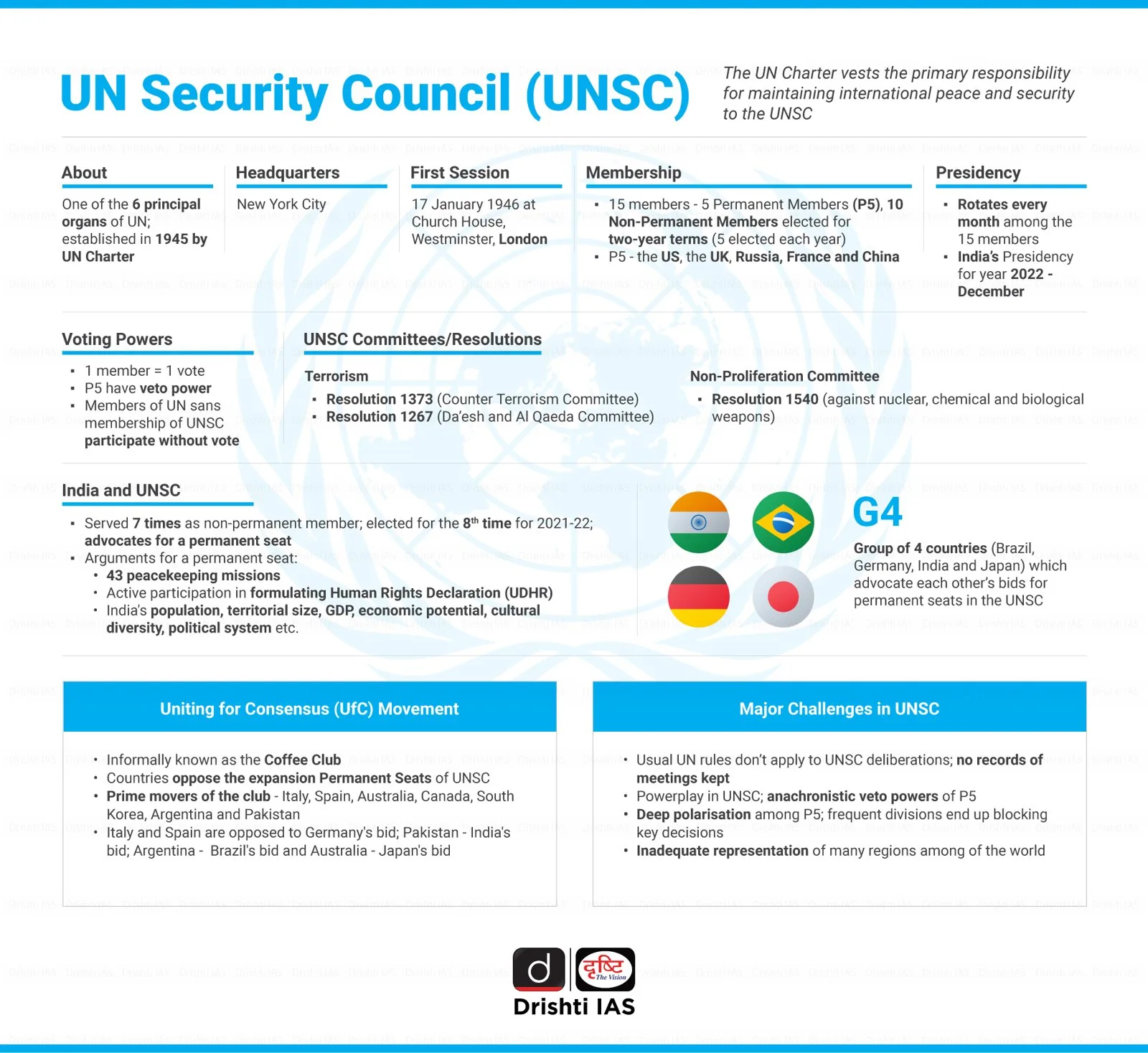
* **The Permanent Five (P5):** The UNSC, the UN's premier decision-making body, comprises 15 members: 5 permanent (China, France, Russia, the UK, and the US) and 10 non-permanent members elected by the UNGA for two-year terms.
* **Mechanism of Action:**
* A negative vote (a veto) cast by any of the P5 members prevents the adoption of a substantive draft resolution, regardless of the level of international support the resolution has garnered.
* However, an abstention or absence by a P5 member does not count as a veto.
What are the Arguments For and Against Abolishing the Veto?
* Arguments For Abolishing the Veto
* **Undemocratic Nature:** The absolute negative vote of five states legally enshrines an oligopoly, fundamentally violating the UN Charter's own foundational principle of the "sovereign equality of all its Members". It replaces democratic multilateralism with a legally codified hierarchy.
* **Institutional Paralysis:**
* The veto frequently causes gridlock during major geopolitical crises. For example, between 2011 and 2023, Russia (often joined by China) vetoed over 15 draft resolutions related to the Syrian Civil War, blocking humanitarian aid and chemical weapons investigations.
* Furthermore, the mere threat of a veto (the "pocket veto") often prevents draft resolutions from even being formally tabled, preemptively paralyzing the Council.
* **Protection Against Accountability:**
* The veto is often criticized for shielding the P5 or their strategic allies from accountability for violations of international law, including the UN’s Responsibility to Protect (R2P) doctrine.
* For instance, the US has frequently used its veto to block resolutions critical of Israel regarding the situation in Gaza, while Russia has used the veto to block resolutions condemning its actions in Ukraine (such as the vetoes in 2014, 2022, and 2024).
* From 1945–2025, the UNSC veto was used 320 times on 264 draft resolutions/amendments, led by the Soviet Union/Russia (155) and the US (94).
* **Anachronistic Architecture:**
* The P5 configuration reflects the world in 1945. Maintaining the permanent veto excludes entire continents like Africa (a point frequently raised via the Ezulwini Consensus) and Latin America, as well as modern economic powers like the G4 (India, Brazil, Germany, Japan), undermining the UNSC’s contemporary legitimacy.
* France argues that veto power should carry a special responsibility to enable UNSC action during mass atrocities, rather than function as an unrestricted privilege.
* Arguments Against Abolishing the Veto
* **Preventing the "League of Nations Trap":**
* The UN's predecessor, the League of Nations, operated on a principle of universal unanimity and collapsed because major powers simply withdrew when the organization made decisions contrary to their vital interests.
* The veto was designed as a "safety valve." Proponents argue that without it, major powers might abandon the UN framework entirely, risking the collapse of the institution and a return to unmediated great-power conflict.
* **The Structural Paradox (Article 108):**
* Complete abolition is practically impossible under the current UN Charter. Article 108 dictates that any amendment to the Charter requires ratification by two-thirds of the General Assembly, including all five permanent members.
* Therefore, the P5 holds a structural, legal veto over the abolition of their own veto power.
* **The Risk of Multiplier Paralysis:** Factions opposing the expansion of permanent membership (such as the Uniting for Consensus group, or the "Coffee Club") argue that extending the veto to new permanent members would mathematically multiply the number of actors capable of blocking Council action, exponentially increasing the likelihood of institutional gridlock.
**Initiatives for Veto Reform**
* **The French-Mexican Initiative (2015):**
* Launched by France and Mexico in 2015, is a political declaration calling on the permanent members of the UNSC to voluntarily refrain from using their veto power in situations involving mass atrocities like genocide, crimes against humanity, and large-scale war crimes.
* The French-Mexican Initiative currently has the backing of 128 member states, including two P5 members (France and the UK).
* **The Liechtenstein Initiative (UNGA Resolution 76/262, 2022):**
* Also known as the Veto Initiative, it requires the UN General Assembly to convene a formal meeting within 10 working days whenever a veto is cast in the UNSC, enhancing transparency and political accountability.
* This ensures a veto does not terminate the conversation; the vetoing permanent member must publicly explain and defend its action, introducing a degree of political accountability.
* **The ACT Code of Conduct:** Formulated by the Accountability, Coherence, and Transparency (ACT) group, this initiative urges all UNSC members (both permanent and non-permanent) to pledge not to vote against credible draft resolutions aimed at preventing or halting mass atrocity crimes.
**What is India's Position on UNSC Veto Reform?**
* **India’s Core Position on UNSC Veto Reform:**
* During the Inter-Governmental Negotiations (IGN) on UNSC reform, India opposes a two-tier system that creates permanent members without veto powers, arguing for parity among permanent members. India maintains that as long as the veto exists, it should be extended to new permanent members.
* It also highlights that even non-permanent members can exercise an informal “effective veto” by blocking press statements and sanctions committee decisions, underscoring the need for comprehensive UNSC reform.
* **The G4 Compromise:**
* India, along with the G4 nations, has proposed a 15-year moratorium on the exercise of the veto by new permanent members.
* Under this model, new members would have the same responsibilities and obligations as existing permanent members but would voluntarily refrain from using the veto for 15 years.
* After this period, the UN General Assembly would review the arrangement. The proposal reflects India's diplomatic flexibility to overcome the long-standing deadlock over UNSC reform.
* **Championing the Global South and African Representation:**
* India positions itself as a voice of the Global South and seeks broad developing-country support for UNSC reform.
* **Ezulwini Consensus:** India supports the African Union’s demand for permanent African representation with veto rights, as long as the veto continues to exist.
* **L.69 Group:**
* India works with the L.69 Group of developing countries to build support for comprehensive UNSC reform.
* India has coordinated with the G4 and L.69 to strengthen developing-country consensus on UNSC reform.
* **Reformed Multilateralism:**
* India links UNSC reform with a broader goal of making global institutions more representative, inclusive and reflective of contemporary geopolitical realities.
* India is also seeking a non-permanent UNSC seat for 2028–29, using its participation to strengthen its case for eventual permanent membership.
What Measures can be Taken to Reform the Veto System?
* **Advancing Normative Self-Restraint:** Diplomatic pressure should be sustained to solidify the French-Mexican initiative into a globally recognized norm, increasing the reputational cost of using the veto during verified humanitarian disasters.
* **Strengthening Post-Veto Instruments:** General Assembly debates triggered under the Liechtenstein Initiative should be linked to actionable multilateral follow-ups, such as independent commissions of inquiry or humanitarian aid corridors authorized under the "Uniting for Peace" resolution.
* **Compromise Models for Expansion:** The UN must move beyond open-ended debates toward Intergovernmental Negotiations (IGN) based on a single text. Compromise models such as inducting G4 nations with permanent membership while placing a long-term moratorium on veto privileges can balance the need for representation with Council operability.
* **Objective Atrocity Triggers:** Empowering independent statutory bodies, such as the International Court of Justice (ICJ) or the UN High Commissioner for Human Rights, to issue factual alerts could serve to automatically trigger voluntary veto-restraint protocols.
**Conclusion**
* The debate over the UNSC veto is ultimately not just about retaining or abolishing veto power. It is about balancing three objectives:
* **Effectiveness:** Preventing UNSC paralysis.
* **Representation:** Making the Council reflect contemporary global realities.
* **Accountability:** Ensuring that exceptional powers are exercised responsibly.
* For India, however, meaningful reform must go beyond veto regulation and address the composition, representativeness and decision-making structure of the UNSC itself.
## Military Exercises
### Exercise Tarang Shakti 2026
[Source](https://www.drishtiias.com/current-affairs-news-analysis-editorials/news-analysis/28-09-2026#37684)
Exercise Tarang Shakti 2026 has begun in Jodhpur, Rajasthan, bringing together participating air forces and observers from nearly 40 countries to enhance multinational air combat cooperation and interoperability.
**Tarang Shakti 2026**
* **About:** It is the 2nd edition of the Indian Air Force’s multinational air exercise, building on the inaugural edition held in 2024 and being conducted under the theme “Power in Partnership”.
* **Objective:** It aims to train participating air forces in the planning and execution of multinational joint combat operations in a realistic contemporary battlespace and to derive tactically viable solutions.
* **Wider Engagement:** It will also include professional seminars, industrial tours, the Sekhon Marathon, heritage tours and yoga sessions, providing foreign contingents exposure to India’s aerospace and defence ecosystem and encouraging professional and cultural interaction.
* **Participation:** Australia, Bangladesh, France, Germany, Greece, Sri Lanka, the UAE and the USA are participating with air assets, while around 32 countries are attending as observers.
* **Aircraft and Operations:** Foreign platforms include F-35 Lightning II, Rafale, F-16, A400M, Multi-Role Tanker Transport (MRTT), C-130, C-130J and KC-30A aircraft, with missions covering counter-air operations, air defence, reconnaissance, airlift, air-to-air refuelling and other complex combat scenarios.
* **French Participation:** As part of Mission Pégase 26, the French Air and Space Force has deployed four Rafale F4 fighters, three A330 MRTT Phénix aircraft and two A400M Atlas aircraft, highlighting growing India-France aerospace and defence cooperation.
* **Significance:** The exercise enables the IAF to demonstrate its operational capabilities, professional standards and growing indigenous aerospace and defence capabilities, while strengthening defence partnerships, interoperability, mutual trust and strategic cooperation in support of regional peace and security.
## Polity & Governance
### Lottery Regulation in India
[Source](https://www.drishtiias.com/current-affairs-news-analysis-editorials/news-analysis/28-09-2026#37685)
**Why in News?**
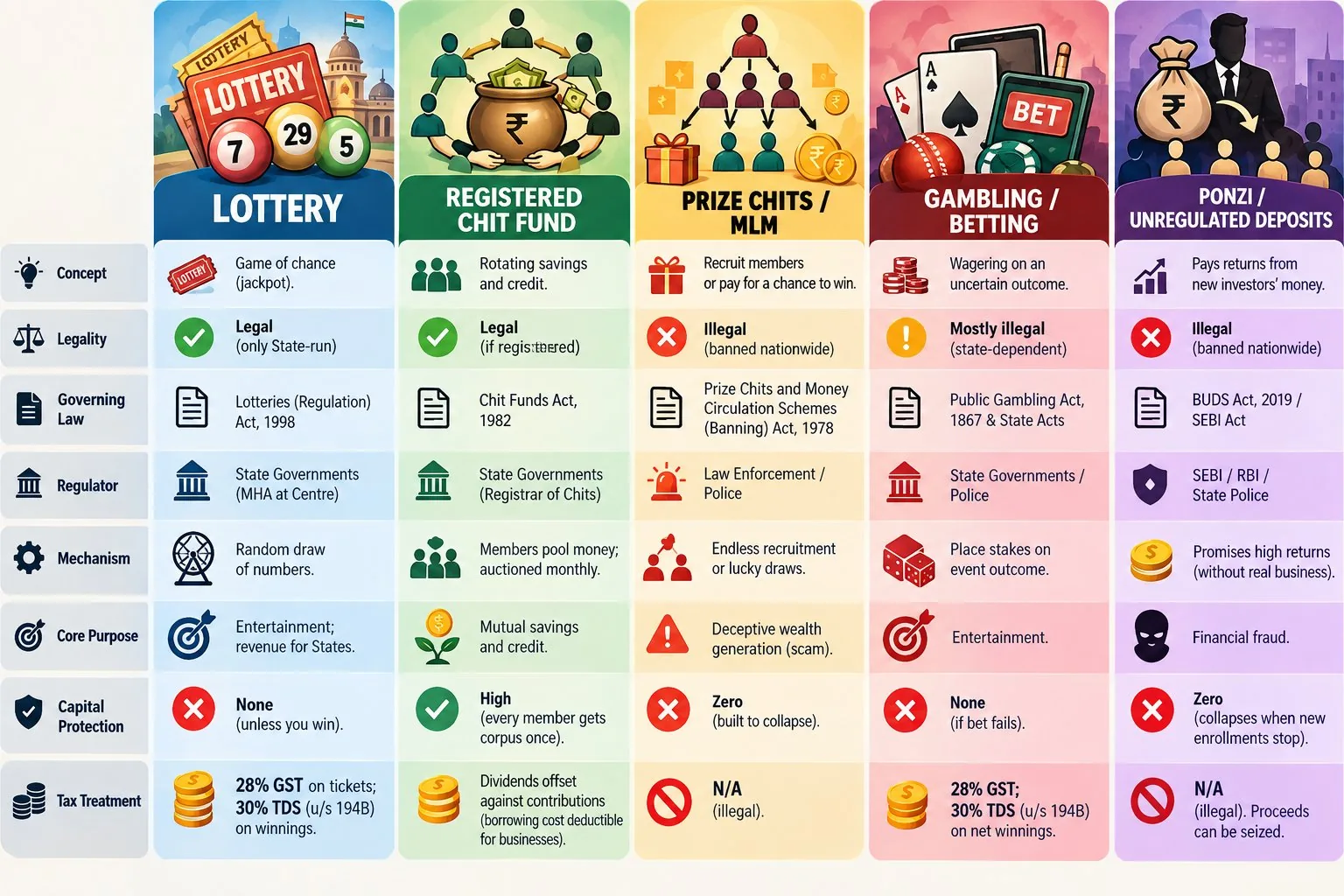
* The debate over lottery regulation in India has gained renewed attention amid concerns that blanket prohibition may push gambling activity towards illegal lotteries, matka, satta and offshore betting platforms, while depriving States of revenue and legitimate vendors of livelihoods.
* The discussion highlights whether strict regulation rather than complete prohibition can better balance consumer protection, accountability and fiscal interests.
What is the Constitutional and Statutory Architecture Governing Lotteries?
* **Seventh Schedule:**
* **Union List (Entry 40):** Grants Parliament exclusive competence over "Lotteries organised by the Government of India or the Government of a State."
* **State List (Entry 34):** Vests competence over "Betting and gambling" within State legislatures.
* **State List (Entry 62):** Authorizes States to levy taxes on betting, gambling, and lotteries.
* **Lotteries (Regulation) Act, 1998:**
* The law defines a lottery as any scheme in which prizes are drawn by chance or lot among people who buy tickets.
* It lays down conditions for State-organised lotteries, including government-printed tickets and restrictions on certain lottery formats.
* It also allows States to prohibit the sale of lotteries from other States, while empowering the Union Government to prohibit lotteries violating the prescribed legal conditions.
* The Lotteries (Regulation) Rules, 2010 regulate online lotteries by requiring secure lottery software, banning hybrid paper-online formats and unauthorised online sales. States such as Punjab and Nagaland have also restricted online/WhatsApp-based lottery sales.
* **Taxation:**
* Lottery winnings are taxed at a flat 30% under the Income Tax Act, 1961, plus 4% cess, making the base effective rate 31.2%.
* Tax Deducted at Source (TDS) is deducted before payout, and winnings are reported under “Income from Other Sources” without standard deductions.
* Judicial Jurisprudence
* **Taxation Framework under GST:** The Supreme Court of India in Skill Lotto Solutions Pvt. Ltd. v. Union of India (2020) ruled that lotteries, betting, and gambling are actionable claims that legally qualify as "goods" under the Goods and Services Tax (GST) law.
* **The Res Extra Commercium Doctrine:**
* In State of Bombay v. R.M.D. Chamarbaugwala (1957), the Supreme Court ruled that gambling activities are res extra commercium (activities outside commerce and trade).
* Consequently, lottery operators cannot claim fundamental rights protection under Article 19(1)(g) (freedom to practice any trade or business) or Article 301 (freedom of trade and commerce across territories).
* **The "All-or-Nothing" Dilemma (B.R. Enterprises v. State of U.P., 1999):**
* The Supreme Court interpreted Section 5 of the 1998 Act to hold that a State cannot selectively prohibit lotteries originating from other States while running its own.
* A State can ban outside lotteries only if it becomes completely lottery-free by abandoning its own state-run lotteries.
* **The Regulatory Fallout:**
* Because destination States possess zero administrative machinery to audit or regulate how outside States’ private marketing agents conduct draws, major States like Tamil Nadu (2003) and Karnataka (2007) opted for complete prohibition to block predatory external cartels, thereby sacrificing their own potential state revenues and welfare surpluses.
* As of 2023, only nine States (e.g., Kerala, Maharashtra, Goa, Punjab, West Bengal) operate lotteries.
What are the Key Concerns Regarding Lottery Regulation in India?
* **Regressive Socio-Economic Burden:** Lotteries disproportionately attract low-income households. Rapid-draw formats, instant-win games, and misleading jackpot marketing foster compulsive gambling, loss-chasing, and chronic household debt.
* **Expansion of the Underground Shadow Economy:**
* Blanket prohibitions fail to eliminate inelastic demand.
* Banning state lotteries drives players to illegal markets such as matka, satta, single-digit rackets, and offshore digital betting, which operate without age checks, financial audits, or fraud safeguards.
* **Loss of Public Revenue and Welfare Funding:**
* Blanket prohibition can eliminate significant lottery revenue and GST collections.
* From September 2025, lottery, betting, gambling and related actionable claims attract 40% GST.
* **Destruction of Marginalized Livelihoods:** Legal paper lottery distribution provides decentralized employment to lakhs of vulnerable individuals, including persons with disabilities, widows, and low-income vendors, whose livelihoods vanish under sudden bans.
* **Class Asymmetry in State Paternalism:**
* Critics highlight a socio-economic asymmetry in the regulation of financial risk. Affluent citizens can legally participate in high-risk activities such as intraday trading, Futures & Options (F\&O), and crypto-asset trading, primarily through disclosure and regulatory safeguards rather than competence tests.
* Yet, lotteries, often more accessible to lower-income groups, face stricter restrictions and, in some States, outright prohibition.
* SEBI data showing that around 9 out of 10 individual F\&O traders incur net losses further fuels the debate over whether policy should prioritise risk regulation and consumer protection over blanket prohibition.
* **Advertising Standards:**
* The Advertising Standards Council of India (ASCI) is a non-statutory, self-regulatory body, so its advertising code does not have the same legal force as statutory regulations.
* This can create enforcement gaps and limited accountability in regulating lottery advertisements.
**International and Domestic Models on Lottery Regulation**
* **Global Standard of "Controlled Legality":** Nearly 80% of nations permit lotteries under regulated oversight rather than prohibition. Prohibitions exist primarily in closed ideological regimes or strict Sharia jurisdictions.
* **The Public-Operator Model:**
* Globally, over 70% of jurisdictions utilize a state-owned or statutory corporation to directly run operations, hiring private contractors strictly for logistics and IT.
* This prevents "concessionaire capture", where private marketing agents divert profits.
* **Multi-Jurisdictional Pooling:** Federal democracies (e.g., the US, Canada, Germany) allow states to voluntarily pool prizes, technical platforms, and regulatory compliance through inter-state pacts while retaining destination-state sovereignty.
* **The Kerala Template:**
* **Direct Public Oversight:** Kerala conducts lottery draws departmentally, eliminating intermediary concessionaires and predatory private syndicates.
* **Revenue Hypothecation:** In FY 2023–24, Kerala generated over Rs 2,880 crore in gross proceeds, which is used to fund the Karunya Benevolent Fund for healthcare subsidies.
* **Social Welfare Distribution:** Distribution rights are reserved for registered street vendors and persons with disabilities, turning the system into a decentralized social security mechanism.
What Measures are Needed for an Accountable Regulatory Regime?
* **Ending the All-or-Nothing Rule:**
* Parliament must amend Section 5 of the Lotteries (Regulation) Act, 1998, to clarify that a State may exclude outside lotteries regardless of whether it runs its own lottery, provided the exclusion is non-discriminatory (excluding all external operators uniformly).
* This removes the perverse incentive for States to shut down safe, transparent domestic lotteries simply to protect themselves from opaque external operators.
* **Structural Separation of Operations and Oversight:**
* Establish an Independent Statutory Lottery Authority in organizing States.
* The administrative department organizing the draw must not act as its own auditor; draw software, Random Number Generators (RNG), and ball-draw machines must undergo mandatory third-party cryptographic audits.
* **Mandatory Consumer Safeguards:**
* Implement daily/monthly purchase caps per individual to curb loss-chasing behaviour.
* Strictly prohibit credit-based sales and predatory marketing that misleads consumers on mathematical odds.
* Ban rapid-draw and instant scratch games that trigger addictive dopaminergic feedback loops.
* **Unified Digital Enforcement:** Create a specialized task force under the Ministry of Electronics and Information Technology (MeitY) and the Financial Intelligence Unit (FIU-IND) to systematically block illegal offshore betting apps and freeze domestic payment gateways facilitating untaxed gambling.
**Conclusion**
* India needs to move beyond the binary choice of prohibition versus unrestricted gambling. A strictly regulated lottery framework, with transparent operations, consumer safeguards, responsible advertising and dedicated revenue for healthcare and social welfare, can address gambling-related harms while preventing the growth of illegal markets.
## Security
### Armed Forces (Special Powers) Act, 1958
[Source](https://www.drishtiias.com/current-affairs-news-analysis-editorials/news-analysis/28-09-2026#37702)
The Ministry of Home Affairs (MHA) has announced the extension of the Armed Forces (Special Powers) Act, 1958 in designated "disturbed areas" across specific regions of Arunachal Pradesh, Manipur, and Nagaland for another six months to maintain internal security and counter insurgent activities.
* **AFSPA, 1958:**
* It was originally enacted as the Armed Forces (Assam and Manipur) Special Powers Act to empower the military to address the Naga uprising.
* Succeeding the earlier Assam Disturbed Areas Act of 1955, the legislation was later renamed and geographically expanded to manage armed insurgencies across the broader northeastern region.
* The Act traces its colonial roots to the Armed Forces Special Powers Ordinance promulgated on 15th August 1942 during the Quit India Movement.
* AFSPA empowers the armed forces deployed in areas declared “disturbed” to use force, including lethal force in specified circumstances, arrest without warrant, and search premises without warrant, while providing certain legal protections to personnel, including requiring Central Government sanction for prosecution in specified cases.
* J\&K is governed by a separate Armed Forces (Jammu and Kashmir) Special Powers Act, 1990.
* **Declaration of a "Disturbed Area":** Under Section 3 of AFSPA, 1958, the Central Government, the Governor of the State, or the Administrator of the Union Territory holds the power to declare the whole or part of a State or Union Territory as a "disturbed area" if it is deemed that the use of armed forces in aid of the civil power is necessary.
* **Security Context:**
* While the Union Government has pursued a policy of a gradual rollback of AFSPA from the Northeast since 2022 (having completely revoked it in Tripura and Meghalaya), the localized extensions are necessitated by the volatile ethnic violence in Manipur and persistent cross-border threats from insurgent factions in the Naga hills.
* The Justice B.P. Jeevan Reddy Committee (2005) critically recommended the repeal of AFSPA, suggesting its essential provisions be subsumed into the Unlawful Activities (Prevention) Act (UAPA).
* The Justice Santosh Hegde Commission (2013), appointed by the Supreme Court to examine alleged extrajudicial killings in Manipur, highlighted serious concerns regarding fake encounters and reinforced demands for accountability in AFSPA areas.
* The Supreme Court in Naga People’s Movement of Human Rights v. Union of India (1997/1998) upheld AFSPA’s constitutional validity but stressed that disturbed-area declarations require periodic review, ordinarily before six months expire.
This documentation is built and hosted on [Mintlify](https://mintlify.com), a developer documentation platform.