> ## Documentation Index
> Fetch the complete documentation index at: https://signals.joincomrades.com/llms.txt
> Use this file to discover all available pages before exploring further.
# 29 Sep 2026 · Dispatch
> Comrades Dispatch of 29 Sep 2026, by news group.
> **[Comrades Dispatch · 29 Sep 2026 (PDF)](https://dl.joincomrades.com/d/29-09-26)**
***
## In this edition
1. [Steel Industry Safety Council](#h-1) Economic Scenario
2. [Delhi’s Proactive Air Quality Management Framework 2026-27](#h-2) Environment & Ecology
3. [Drought Management in India](#h-3) Geography
4. [The 'Enemy State' Clauses in the UN Charter](#h-4) International Organisations
5. [Pradhan Mantri Anusuchit Jaati Abhyuday Yojana (PM-AJAY)](#h-5) Schemes & Initiatives
6. [Need to Revisit India's Nuclear Doctrine](#h-6) Security
7. [India Reaffirms Commitment to Cetacean Conservation at IWC-70](#h-7) Wildlife
## Economic Scenario
### Steel Industry Safety Council
[Source](https://www.drishtiias.com/current-affairs-news-analysis-editorials/news-analysis/29-09-2026#37706)
The Ministry of Steel has decided to establish the Steel Industry Safety Council (SISC) as an apex-level industry safety body to strengthen safety standards, accident prevention and safety culture across India’s steel industry.
* **About SISC:** The Steel Industry Safety Council (SISC) will function under the administrative control of the Ministry of Steel and will focus on improving safety practices, developing standards and reducing industrial accidents.
* **Composition:** The Council will be headed by the Secretary, Ministry of Steel, as Chairman and will include senior officials, CEOs of integrated steel producers, and representatives from key technical and statutory organisations such as the Directorate General of Mines Safety (DGMS), Petroleum and Explosives Safety Organisation (PESO), National Disaster Management Authority (NDMA) and recognised steel technology institutions.
* **Functions of SISC:** It will assess safety conditions in the steel industry, conduct studies, approve safety standards and recommended practices, and review serious accidents and near-miss incidents.
* **Steel Industry Safety Directorate (SISD):** A technical support body, SISD, will be established to provide expertise in process safety, blast furnaces, steel melting, rolling mills, coke ovens, electrical and mechanical safety, occupational health, fire engineering and disaster management.
* **Role of SISD:** It will implement Council decisions, conduct safety audits, investigate serious incidents, maintain accident and near-miss databases, review emergency preparedness and strengthen safety training programmes.
* **Safety Standards Development:** SISD will prepare and issue Steel Industry Safety Standards, Recommended Practices and Guidelines suited to Indian conditions to ensure uniform safety practices across the sector.
* **Significance:** The establishment of SISC and SISD aims to create a stronger safety culture, improve industrial accident prevention and promote consistent safety management practices in India's steel industry.
## Environment & Ecology
### Delhi’s Proactive Air Quality Management Framework 2026-27
[Source](https://www.drishtiias.com/current-affairs-news-analysis-editorials/news-analysis/29-09-2026#37710)
**Why in News?**
* Ahead of the annual winter smog crisis, the Delhi Government, in coordination with the Union Environment Ministry and Commission for Air Quality Management (CAQM), has introduced a permanent Proactive Winter Air Quality Management Framework (Winter Action Plan 2026-27).
* The new framework shifts pollution control from the reactive approach of the Graded Response Action Plan (GRAP) to a more proactive and preventive model, with year-round institutional measures, advanced seasonal action, and airshed-based management that treats Delhi-NCR as a single air-pollution region.
* These measures will operate alongside GRAP, which will continue to impose graded restrictions based on prevailing AQI levels, particularly during periods of severe pollution.
What are the Key Highlights of Delhi's Winter Action Plan 2026-27?
* **Vehicular Emission Control:**
* **Entry Restrictions:** Non-Delhi-registered commercial and private vehicles failing to meet BS-VI emission standards are barred from entering the capital during the winter months (exempting CNG, EVs, and emergency services).
* **'No PUCC, No Fuel' Mandate:** Petrol pumps integrated with Automatic Number Plate Recognition (ANPR) camera systems deny fuel to end-of-life vehicles or those operating without a valid Pollution Under Control Certificate (PUCC).
* **Demand Management:** Doubled municipal parking fees across authorized public sites (except metros) to discourage private motorized trips and promote mass transit.
* **Workplace & Mobility Arrangements:**
* **50% Work-From-Home (WFH):** Government and private offices will ensure not more than 50% physical attendance during the winter pollution period, with remaining employees working remotely.
* **Staggered Working Hours:** Decentralized reporting times between municipal corporations and government offices to flatten peak-hour traffic volumes and reduce idling emissions.
* **Fugitive Dust & Construction Regulations:**
* **Phased Construction Bans:** The framework provides phased restrictions on dust-generating construction activities, including a stricter construction and demolition ban during the peak winter pollution period.
* **Mechanical Road Sweeping:** Scaling deployment of mechanized sweeping machines and water sprinklers with chemical dust suppressants along high-density traffic corridors.
* **Industrial Monitoring & Technology:**
* An AI-enabled Command and Control Centre will be operational from 1st October 2026, supported by 334 enforcement teams working in shifts to monitor industrial emissions and open-burning violations.
* The city's continuous air quality monitoring stations are being expanded from 47 to 60 to map pollution sources more finely.
* **Public Reporting:** Citizens can report local pollution violations using the Green Delhi App and submit feedback through a new citizen suggestions portal.
**Graded Response Action Plan (GRAP)**
* The GRAP is a dynamic, pre-emptive emergency framework implemented to control and mitigate deteriorating air pollution levels in the Delhi-National Capital Region (NCR).
* **Origin & Legal Backing:** Formulated under the directives of the Supreme Court of India in the M.C. Mehta v. Union of India (2016) case, GRAP was officially notified in 2017.
* **Implementing Authority:** It is strictly enforced by the Commission for Air Quality Management (CAQM) in direct coordination with the Ministry of Environment, Forest and Climate Change (MoEFCC) and respective state authorities.
* **Objective:** GRAP ensures a graded, time-bound response based on the Air Quality Index (AQI), preventing the atmosphere from reaching hazardous toxicity levels through stage-wise interventions.
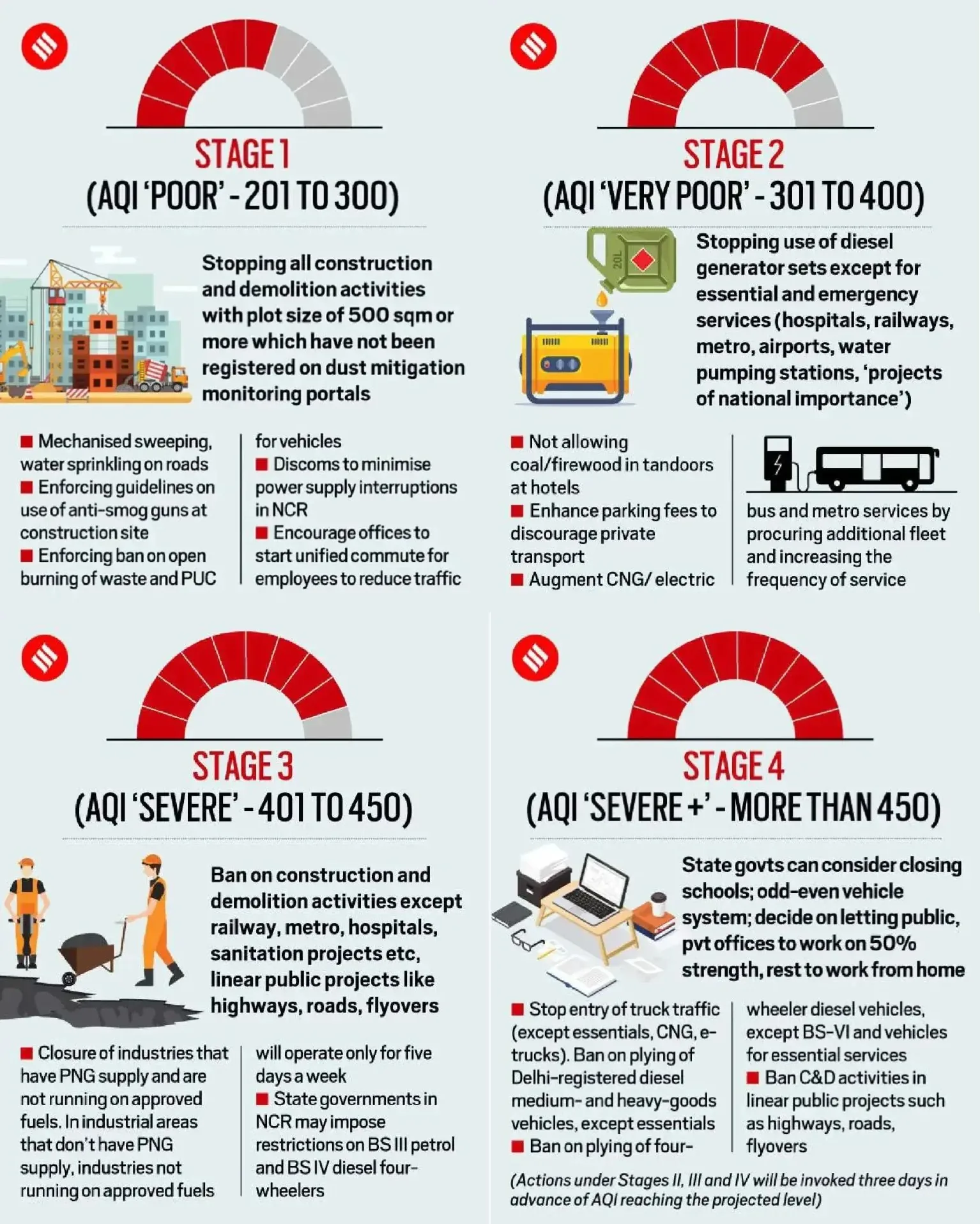
* **Stages of GRAP:**
* **Stage I (Poor:** AQI 201–300): Focuses on basic pollution control, including intense road dust management and strict enforcement of vehicle PUC (Pollution Under Control) norms.
* **Stage II (Very Poor:** AQI 301–400): Introduces stricter curbs, prominently limiting diesel generator (DG) set usage and targeting localized pollution hotspots for targeted remedial action.
* **Stage III (Severe:** AQI 401–450): Imposes heavy restrictions on vehicular movement (such as banning BS-III petrol and BS-IV diesel vehicles), halts construction and demolition activities, and allows state governments to initiate remote schooling.
* **Stage IV (Severe+:** AQI > 450): The most stringent phase, triggering bans on the entry of heavy vehicles/trucks, mandatory closure of physical schools, and the complete shutdown of non-essential industries.
## Geography
### Drought Management in India
[Source](https://www.drishtiias.com/current-affairs-news-analysis-editorials/news-analysis/29-09-2026#37705)
**Why in News?**
* The Maharashtra Government has declared drought conditions in 265 out of 358 talukas, covering nearly 74% of the state’s landmass, due to deficient monsoon rainfall. Similar drought-like conditions and water stress are being reported in Karnataka, Telangana, Andhra Pradesh and parts of Rajasthan, highlighting India’s growing vulnerability to water scarcity and drought.
* With India supporting nearly 18% of the global population with only 4% of the world’s freshwater resources, drought poses significant risks to agriculture, food security, rural livelihoods and economic growth.
**What is a Drought?**
* **About:** Drought is generally considered a deficiency in rainfall/precipitation over an extended period, resulting in a water shortage that causes adverse impacts on vegetation, animals, and people.
* **Drought Scenario in India:**
* According to the Drought Atlas of India (1901–2020), nearly two-thirds of India is drought-prone. During this period, about 56% of India’s area experienced moderate to exceptional drought, affecting around 300 million people and 150 million cattle.
* Crop losses caused an estimated USD 8.7 billion economic loss and reduced agricultural GDP by 3.1%.
* **Changing Face of Drought in India:**
* Traditionally, drought was seen as a phenomenon of arid and semi-arid areas.
* However, regions with high rainfall now face severe scarcities. For example, Cherrapunji (Meghalaya), one of the world’s highest rainfall areas, now faces drought for almost nine months of the year, while the western part of Jaisalmer (Rajasthan) records around 9 cm of rainfall in a year.
* **Classification of Drought:**
* The 2009 Manual of Drought Management issued by the Union Ministry of Agriculture (prepared for Ministry by National Institute of Disaster Management) classifies droughts into three categories:
* **Meteorological Drought:**
* It refers to a deficiency in precipitation compared with the long-term average over an extended period.
* It is generally the first stage of drought and can trigger other forms of drought. A rainfall deficit of 26–50% is considered a moderate drought, while a deficit of more than 50% is considered a severe drought.
* **Hydrological Drought:**
* It occurs when there is a shortage of surface and groundwater resources needed for normal and specific uses.
* It may develop even when rainfall is normal or above normal if water withdrawal and consumption exceed the available water reserves, leading to declining river flows, reservoir levels and groundwater availability.
* **Agricultural Drought:**
* Occurs when soil moisture and rainfall are inadequate for crop growth, causing crop stress and reduced yields.
* In India, it is defined as 4 consecutive weeks of severe meteorological drought with >50% rainfall deficiency or weekly rainfall ≤5 cm from mid-May to mid-October (Kharif season), when \~80% of India’s crops are planted, or 6 consecutive weeks during the rest of the year.
* **Drought Declaration:**
* Traditionally, District Collectors recommended drought declaration using the annewari / paisewari / girdawari system (estimating agricultural losses post-harvest).
* However, to facilitate early determination, the Manual for Drought Management, 2009 recommends four standard monitoring tools.
* **Rainfall Deficiency:** Drought can be declared if the total rainfall from June-September is less than 75% of the average, or June-July rainfall is less than 50%.
* **Area under Sowing:** Sowing area of crops is less than 50% of the total cultivable area by the end of July/August.
* **Normalized Difference Vegetation Index (NDVI):** An index indicating the density of vegetation based on satellite remote sensing (via NADAMS). States could declare a drought when the deviation of the NDVI value from the normal is 0.4 or less.
* **Moisture Adequacy Index (MAI):** Based on a calculation of weekly water balance (ratio of actual to potential evapotranspiration). An MAI below 25 indicates a severe agricultural drought.
* **Regulation:**
* The State Government is the final authority for declaring an area drought-affected. The Union Government has issued two key reference documents: Manual for Drought Management, 2009 by the Ministry of Agriculture and Guidelines for Management of Drought, 2010 by NDMA.
* Both are non-binding, allowing states to adopt criteria suited to local irrigation and crop conditions.
* **Financial Relief:**
* Financial assistance is initially provided through the State Disaster Response Fund (SDRF).
* If SDRF funds are depleted. The Government of India sends an Inter-Ministerial Central Team to assess losses, after which assistance is released from the National Disaster Response Fund (NDRF).
* While the Ministry of Home Affairs oversees relief for most natural calamities, the Ministry of Agriculture and Farmers’ Welfare is the nodal ministry for managing droughts, hailstorms, and pest attacks.
* **Supreme Court's Directives:**
* In Swaraj Abhiyan vs Union of India (2016), the Supreme Court held that drought qualifies as a “disaster” under the Disaster Management Act, 2005.
* The Court also linked drought declaration with Article 21, observing that failure to declare drought can deprive vulnerable people of essential assistance required to live with dignity.
**What are the Causes of Drought in India?**
* Meteorological and Climatic Causes:
* **Erratic South-West Monsoon:** India receives roughly 70-80% of its annual rainfall during the four-month monsoon season. Any delay in onset, prolonged "monsoon breaks," or early withdrawal triggers severe Meteorological Drought.
* **El Niño Southern Oscillation (ENSO):** The warming of the equatorial Pacific Ocean (El Niño) disrupts the Walker Circulation, historically correlating with severe rainfall deficits and widespread droughts in India.
* **Climate Change:** Global warming has altered local micro-climates, leading to extreme weather events where short, intense bursts of rain are followed by prolonged dry spells, severely impacting the Moisture Adequacy Index (MAI).
* Anthropogenic (Human-Induced) Causes:
* **Skewed Cropping Patterns:**
* Driven by Minimum Support Price (MSP) policies and free electricity, farmers cultivate water-guzzling crops like sugarcane in Marathwada and paddy in Punjab/Haryana (semi-arid zones).
* This leads to a massive "virtual water export" from water-stressed regions, causing Agricultural Drought.
* **Over-exploitation of Groundwater:**
* India is the world's largest extractor of groundwater.
* Unregulated extraction via deep borewells has decoupled agriculture from annual rainfall recharge, permanently depleting aquifers and triggering Hydrological Drought.
* **Ecological Degradation:** Deforestation, destruction of wetlands, and encroachment on traditional water bodies (like Johads, Baolis, and Eris) have drastically reduced the natural water-retention capacity of the soil.
What are the Key Challenges in Drought Management in India?
* **Non-Binding Nature of Guidelines:**
* The Manual for Drought Management, 2009 and the NDMA’s Guidelines for Management of Drought, 2010 are merely advisory.
* The flexibility available to states can sometimes lead to variations in the timing and methodology of drought declaration.
* **Delayed Declaration & Relief:**
* Many states still rely on post-harvest crop-cutting experiments (annewari / paisewari) rather than modern early-warning indicators like the NDVI.
* This delays the declaration of early or mid-season droughts, denying farmers timely relief from the SDRF.
* **Fragmented Water Governance:** Water management is siloed between the Central Water Commission (surface water) and the Central Ground Water Board (groundwater), preventing a holistic, basin-level approach to water security.
* **Focus on Relief over Mitigation:** Despite the Disaster Management Act, 2005 mandating proactive risk reduction, state machinery largely activates only for reactive crisis management (distributing tankers and fodder) rather than long-term drought-proofing.
* **Low Penetration of Micro-Irrigation:** Despite schemes like PMKSY, the adoption of drip and sprinkler irrigation remains highly concentrated in a few states due to high initial capital costs for marginal farmers.
What Measures are Needed to Strengthen Drought Management in India?
* **Agronomic Reforms:**
* **Agro-Climatic Zoning:** Strictly aligning cropping patterns with regional water availability.
* **Crop Diversification:** Incentivizing a shift from paddy and sugarcane to drought-resistant crops like Millets (Shree Anna), pulses, and oilseeds through robust MSP and procurement support.
* **Technological and Scientific Interventions:**
* State governments must be mandated to use satellite data from the National Agricultural Drought Assessment and Monitoring System (NADAMS), enforcing drought declarations based on objective deviations in NDVI and MAI.
* Aggressively scaling up the Per Drop More Crop component of the Pradhan Mantri Krishi Sinchayee Yojana (PMKSY).
* **Institutional Restructuring:** Implement the Mihir Shah Committee's (2016) recommendation to create a unified National Water Commission for integrated surface and groundwater management.
* **Decentralized Groundwater Budgeting:** Empowering Gram Panchayats to audit and regulate village-level groundwater extraction, scaling up models like the Atal Bhujal Yojana.
* **Rejuvenating Traditional Water Bodies:** Leveraging VB-GRAM G Act, 2025 funds and the Jal Shakti Abhiyan to de-silt tanks, build check dams, and construct rainwater harvesting structures.
**Conclusion**
* Drought in India is a governance, agricultural and water-security challenge, not merely a rainfall deficit. India must shift from reactive drought relief to proactive drought-proofing through early-warning systems, climate-resilient crops, efficient irrigation and community-led water conservation. This is essential for livelihood security, food security and sustainable economic growth.
## International Organisations
### The 'Enemy State' Clauses in the UN Charter
[Source](https://www.drishtiias.com/current-affairs-news-analysis-editorials/news-analysis/29-09-2026#37707)
Japan’s Prime Minister at the United Nations General Assembly (UNGA) urged the UN to eliminate the "enemy state" clauses from the UN Charter.
* **Background:**
* The UN Charter was drafted towards the end of World War II (WWII) and came into force in October 1945.
* The victorious Allied Powers (including the US, UK, Soviet Union, and China) inserted mechanisms to prevent the resurgence of militarism or fascism in the defeated Axis Powers (mainly Japan, Germany, Italy, and their allies).
* The enemy state clauses are an exception to the post-1945 principle under Article 2(4) of the UN Charter, which generally prohibits the threat or use of force against states.
* **Key Articles Pertaining to the Clauses:**
* The term “enemy state” is explicitly mentioned in three articles of the UN Charter: Articles 53, 77, and 107.
* **Article 53:**
* Allows regional arrangements or agencies to take enforcement action against an “enemy state” without the prior authorization of the UN Security Council (UNSC).
* Article 53(2) defines an enemy state as any nation that was an enemy of a signatory of the UN Charter during WWII.
* **Article 77:** Pertains to the UN "trusteeship system" and mentions territories detached from "enemy states" as a result of WWII.
* **Article 107:** Validates and protects actions taken by Allied governments against the Axis powers during and immediately after the war.
* **Japan's Stance on Obsolescence:**
* Japan joined the United Nations in 1956, after post-war reconstruction and reconciliation with the international community.
* Japan argues these clauses no longer reflect modern geopolitical realities. The UNGA previously recognized these clauses as "obsolete" in 1995 and adopted a resolution supporting their deletion in 2005.
* **Geopolitical Weaponization:** The outdated clauses are currently being invoked by China and Russia as diplomatic leverage to criticize Japan's increased defense spending and to invalidate Japan's territorial claims over the southern Kuril Islands.
* **Hurdles to Amendment:**
* Amendment requires adoption by a two-thirds majority of the UN General Assembly, and ratification by two-thirds of UN member states, including all permanent members of the Security Council who hold veto power.
* They hesitate to open the Charter for revision, fearing it could trigger broader demands for UNSC structural reforms and membership expansion, which Japan strongly advocates.
* **Significance for India:**
* Japan’s concerns over outdated UN Charter provisions reinforce India’s long-standing call for UN reform that reflects 21st-century geopolitical realities.
* As a G4 member with Japan, Germany and Brazil, India supports a more representative, legitimate and effective multilateral system.
## Schemes & Initiatives
### Pradhan Mantri Anusuchit Jaati Abhyuday Yojana (PM-AJAY)
[Source](https://www.drishtiias.com/current-affairs-news-analysis-editorials/news-analysis/29-09-2026#37711)
**Why in News?**
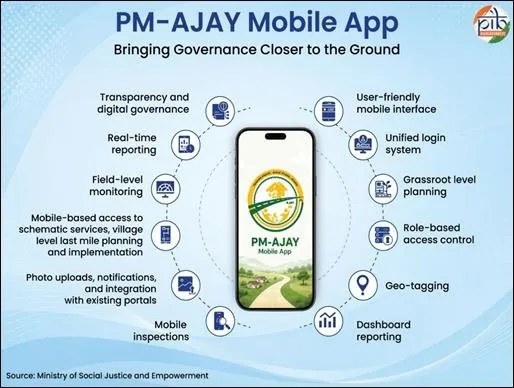
* The Ministry of Social Justice & Empowerment highlighted the progress of the Pradhan Mantri Anusuchit Jaati Abhyuday Yojana (PM-AJAY), including the recent launch of the PM-AJAY Mobile App and Portal to facilitate faster, transparent and quality implementation of the scheme.
What is Pradhan Mantri Anusuchit Jaati Abhyuday Yojana (PM-AJAY)?
* **About:**
* The Pradhan Mantri Anusuchit Jaati Abhyuday Yojana (PM-AJAY) is a 100% centrally sponsored scheme launched in FY 2021-22 with the objective of achieving the socio-economic and educational empowerment of Scheduled Caste(SC) communities through an integrated development approach.
* PM-AJAY was created by merging three erstwhile centrally sponsored schemes, namely Pradhan Mantri Adarsh Gram Yojana (PMAGY), Special Central Assistance to Scheduled Castes Sub Plan (SCA to SCSP) and Babu Jagjivan Ram Chhatrawas Yojana (BJRCY).
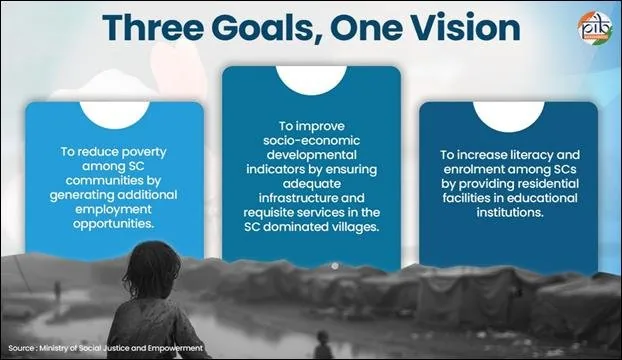
* **Implementation Framework:** The scheme is implemented by the Ministry of Social Justice & Empowerment and focuses on reducing poverty, improving infrastructure in SC-dominated areas and increasing access to education.
* **Beneficiaries:**
* Under the Grants-in-Aid (GIA) component, priority is given to families or persons belonging to the Scheduled Castes whose annual income is not more than ₹2.50 lakh, while SC members of SC-majority groups are also eligible.
* Under the Infrastructure Development component, villages having 40% or more SC population and a total population of 500 or more are eligible for grants under the scheme.
* **Funding Pattern of PM-AJAY:**
* Up to 50% of funds for gap-filling activities in selected Adarsh Gram villages, 5% for the Technical Support Group (TSG) and Project Implementation Units (PIUs), and 2% for hostel construction and repair.
* Remaining funds are allocated as Grants-in-Aid for State/District-level projects based on Scheduled Caste (SC) population and State Scheduled Caste Sub Plan (SCSP)-related parameters.
* Completed infrastructure projects are maintained by State Governments or implementing agencies.
**What are the Major Components of PM-AJAY?**
* **Development of SC-Dominated Villages into “Adarsh Gram”:**
* The Adarsh Gram component seeks to transform SC-majority villages into model villages by filling critical gaps in infrastructure and essential services.
* An Adarsh Gram is envisaged as a village where people have access to basic services, the minimum needs of all sections of society are met, socio-economic disparities are reduced, and essential infrastructure is available to ensure a dignified quality of life.
* **Grants-in-Aid for Socio-Economic Projects:** Provides financial assistance to States/Districts for SC development projects focusing on livelihood generation, skill development, infrastructure creation in SC-dominated villages, and promotion of education through residential facilities. Over ₹1,730 crore was released to States from FY 2021-22 to FY 2025-26, benefiting more than 2.5 lakh individual and group beneficiaries.
* **Construction and Repair of Hostels:**
* The construction and repair of hostels under PM-AJAY seeks to facilitate access to quality education for SC students, particularly those belonging to rural and remote areas. As of September 2026, a total of 785 student hostels had been completed.
* For FY 2026-27, the Government allocated ₹61.46 crore in central assistance for the construction of two hostel projects, comprising one hostel for girls and one for boys, which together will provide accommodation for 264 students.
* **Digital Governance under PM-AJAY:**
* The Government has launched the PM-AJAY Mobile App and PM-AJAY Portal to shift the implementation process from paper-based workflows to an end-to-end digital and real-time workflow.
* The digital system is expected to strengthen transparency, accountability, monitoring and efficiency by improving access to information, facilitating data-driven decision-making and enhancing coordination among different stakeholders involved in the implementation of the scheme.
**Conclusion**
* PM-AJAY represents a comprehensive approach towards the empowerment of Scheduled Castes by integrating livelihood support, infrastructure development and educational opportunities. Effective monitoring, digital governance and strong last-mile implementation can further enhance its impact and contribute towards inclusive development under Viksit Bharat @2047.
## Security
### Need to Revisit India's Nuclear Doctrine
[Source](https://www.drishtiias.com/current-affairs-news-analysis-editorials/news-analysis/29-09-2026#37709)
**Why in News?**
* India’s nuclear doctrine, largely unchanged since its operationalisation in 2003, is facing renewed scrutiny amid evolving strategic, technological and geopolitical challenges.
* The Bangladesh-US Memorandum of Understanding (MoU) on strategic civil nuclear cooperation signed in September 2026 is part of the changing regional security environment, prompting debate on whether India’s nuclear doctrine should be revisited without being completely overhauled.
**What is India's Current Nuclear Doctrine?**
* **India's Nuclear Doctrine:**
* India's nuclear doctrine emerged in the late 1990s. The 1998 Pokhran-II tests established India as a nuclear weapons state, while the 1999 Kargil War demonstrated that nuclear deterrence did not rule out conventional conflicts.
* The Cabinet Committee on Security (CCS) operationalised the doctrine in 2003, based on the 1999 Draft Nuclear Doctrine. The doctrine rests on the pillars of "credible minimum deterrence" and a declared "No First Use" (NFU) posture.
* **Core Principles of India's Nuclear Doctrine:**
* **Credible Minimum Deterrence:** Maintaining a sufficient, non-country-specific arsenal to deter adversaries by guaranteeing unacceptable damage.
* **No First Use (NFU):** Employing nuclear weapons only in retaliation to a nuclear attack on Indian territory or forces.
* **Massive Retaliation:** Ensuring any retaliatory strike is "massive" enough to inflict incalculable damage, reinforcing Mutually Assured Destruction (MAD).
* **Strict Civilian Political Control:**
* Authorization rests solely with the Nuclear Command Authority (NCA) (comprises a Political Council and an Executive Council):
* Political Council (Chaired by the Prime Minister): Sole authority to release nuclear weapons.
* Executive Council (Chaired by the National Security Advisor): Provides strategic inputs and executes directives.
* **Negative Security Assurance & Exceptions:** Pledging not to use nuclear weapons against non-nuclear weapon states, except retaining the option to retaliate against major Chemical or Biological weapon attacks.
* **Commitment to Disarmament:** Maintaining a moratorium on nuclear testing and advocating for verifiable, non-discriminatory global nuclear disarmament.
* **India's Nuclear Arsenal:**
* According to the SIPRI Yearbook 2026, India's nuclear arsenal expanded to an estimated 190 warheads (12 deployed, 178 in reserve), positioning it slightly ahead of Pakistan (170) but well behind China (620).
* Furthermore, the report highlighted a significant shift in regional deterrence during the May 2025 "Operation Sindoor" confrontation, marking the first time India and Pakistan actively integrated cyber warfare into a military conflict.
What is the Need to "Revisit" India's Nuclear Doctrine?
* **China-Pakistan Strategic Convergence:**
* When the doctrine was drafted, China and Pakistan presented distinct, isolated threats.
* Today, their military and nuclear postures are deeply interconnected. China is rapidly expanding its nuclear arsenal and modernizing infrastructure along the Line of Actual Control (LAC), while Pakistan relies heavily on nuclear posturing to offset India’s conventional military superiority.
* **The "Massive Retaliation" Dilemma:**
* Pakistan has developed low-yield Tactical Nuclear Weapons (TNWs), such as the Nasr missile, that could be used in a limited conflict with India to offset India’s conventional military advantage.
* This creates a challenge for India’s Massive Retaliation doctrine, which promises a large-scale nuclear response to a nuclear attack.
* Experts therefore debate whether India should retain Credible Minimum Deterrence (CMD) and No First Use (NFU) while developing more flexible and proportionate nuclear response options.
* **Disruptive Technologies & NC3 Vulnerability:**
* The advent of Artificial Intelligence (AI), cyber warfare, anti-satellite (ASAT) weapons, and Hypersonic Glide Vehicles (HGVs) severely compresses early-warning and decision-making timelines.
* A review is essential to harden India’s Nuclear Command, Control, and Communications (NC3) infrastructure against cyber-sabotage, ensuring the survivability of second-strike capabilities.
* **Great Power Competition in the Neighbourhood:**
* Nuclear dynamics in South Asia are increasingly multipolar. The September 2026 Bangladesh-U.S. Strategic Civil Nuclear MoU perfectly illustrates this shift.
* While focused on peaceful energy diversification, the US's entry into Dhaka’s nuclear sector, which is historically dominated by Russia (via the Rooppur Nuclear Power Plant, where India participates by supplying non-critical equipment, materials, and training through a trilateral framework) and courted by China, highlights the intense geopolitical scramble in the Indo-Pacific.
* For India, this implies its nuclear diplomacy and strategic autonomy must navigate a congested neighbourhood where external superpowers are actively leveraging civil nuclear technology to build influence right on its borders.
What Measures are Needed to Strengthen India’s Nuclear Doctrine?
* **Enhancing Nuclear Triad:**
* For the NFU pledge to remain credible, India must achieve Continuous At-Sea Deterrence (CASD).
* This requires accelerating the commissioning of nuclear-powered ballistic missile submarines (SSBNs like INS Arighat and subsequent S4 class) and fielding Multiple Independently Targetable Reentry Vehicles (MIRV) demonstrated in the Agni-V Divyastra test to overwhelm adversary Ballistic Missile Defence (BMD) systems.
* **Hardening C4ISR and Space Resilience:**
* Modernizing the Nuclear Command, Control, and Communications (NC3) network is critical.
* India must secure its early-warning architectures against gray-zone threats, including cyber-sabotage, AI-driven data spoofing, and anti-satellite (ASAT) blinding.
* Robust space-based surveillance guarantees the Nuclear Command Authority (NCA) receives uninterrupted intelligence during crisis timelines.
* **Implementing Strategic Committee Reforms:**
* Building on the recommendations of the Naresh Chandra Task Force on National Security (2012) and the Kargil Review Committee (1999), the integration of the Chief of Defence Staff (CDS) into the nuclear decision-making matrix must be optimized.
* The CDS acts as the vital bridge between the civilian Political Council and the tri-services Strategic Forces Command (SFC), ensuring joint operational readiness.
* **Cultivating Strategic Ambiguity:** To address the tactical nuclear weapon dilemma without altering the NFU text, India should cultivate calculated strategic ambiguity. Developing flexible, proportional response options ensures adversaries cannot exploit predictable gaps on the nuclear escalation ladder.
**Conclusion**
* India’s nuclear doctrine has ensured strategic stability, credible minimum deterrence and policy continuity for over two decades. Rather than a complete overhaul, periodic review, survivable nuclear forces and secure command systems can help India maintain effective deterrence amid evolving geopolitical and technological challenges.
## Wildlife
### India Reaffirms Commitment to Cetacean Conservation at IWC-70
[Source](https://www.drishtiias.com/current-affairs-news-analysis-editorials/news-analysis/29-09-2026#37708)
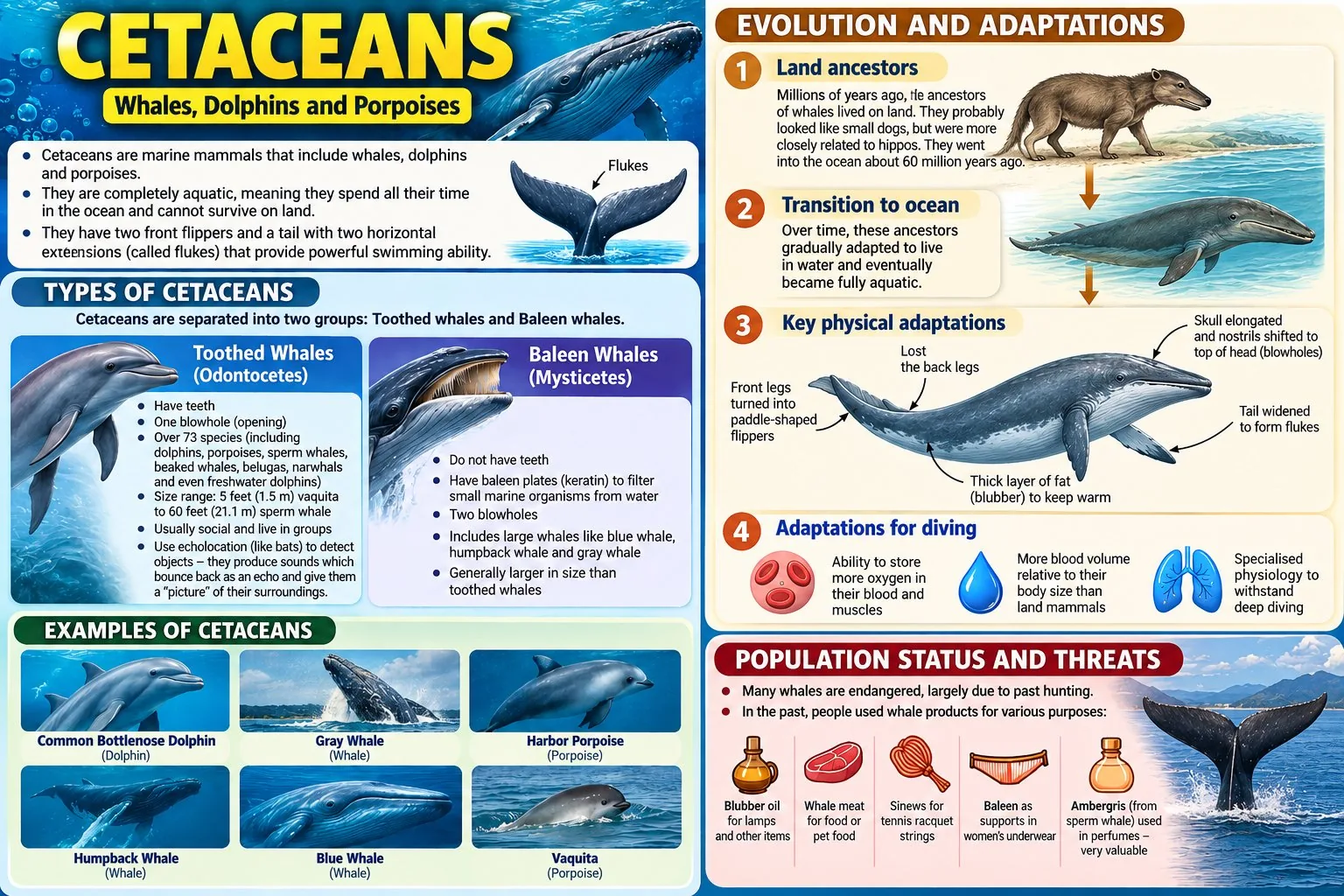
India has reaffirmed its commitment to the conservation of whales and other cetaceans at the 70th meeting of the International Whaling Commission (IWC-70) held in Hobart, Australia.
* **India’s Stand:** India emphasized that cetacean conservation requires science-based approaches, international cooperation and practical measures to address threats faced by whales, dolphins and other related species.
* **Importance of Scientific Research:** India highlighted the need for improved scientific information on cetacean population status, distribution, movements, breeding ecology and threats to support informed conservation decisions.
* **International Cooperation:** India stressed collaboration among range countries, scientific institutions, governments, researchers and local communities to develop effective and locally suitable conservation strategies.
* **International Whaling Commission (IWC):** The IWC was established under the International Convention for the Regulation of Whaling, signed in Washington, D.C., on 2nd December 1946, and serves as the global body for the management of whaling and the conservation of whales.
* **IWC-70 Significance:** The 70th meeting coincides with the 80th anniversary of the signing of the International Convention for the Regulation of Whaling. The IWC currently has 89 member governments, and India has been a member since 1981.
* **India’s Conservation Measures:** Cetaceans in Indian waters receive the highest legal protection under the Wild Life (Protection) Act, 1972. India has also established Marine Protected Areas and launched Project Dolphin for conservation of dolphins, whales, porpoises and aquatic ecosystems.
* **Focus Species and Future Approach:** India has given special importance to the conservation of the Arabian Sea humpback whale, identified among 25 species for focused conservation efforts, while supporting future IWC work based on science, cooperation and practical conservation action.
This documentation is built and hosted on [Mintlify](https://mintlify.com), a developer documentation platform.